
I used to ignore those tiny symbols on clothing labels because they seemed confusing and easy to overlook. But once I learned what they meant, caring for clothes became much simpler.
You may have seen symbols for washing, drying, bleaching, ironing, or dry cleaning and wondered what each one actually means. This guide makes those confusing marks easy to understand.
I’ll walk you through the most important laundry symbols in a simple way, so you can check any care label with confidence and help your clothes stay clean, fresh, and in good condition.
List Of Laundry Symbols
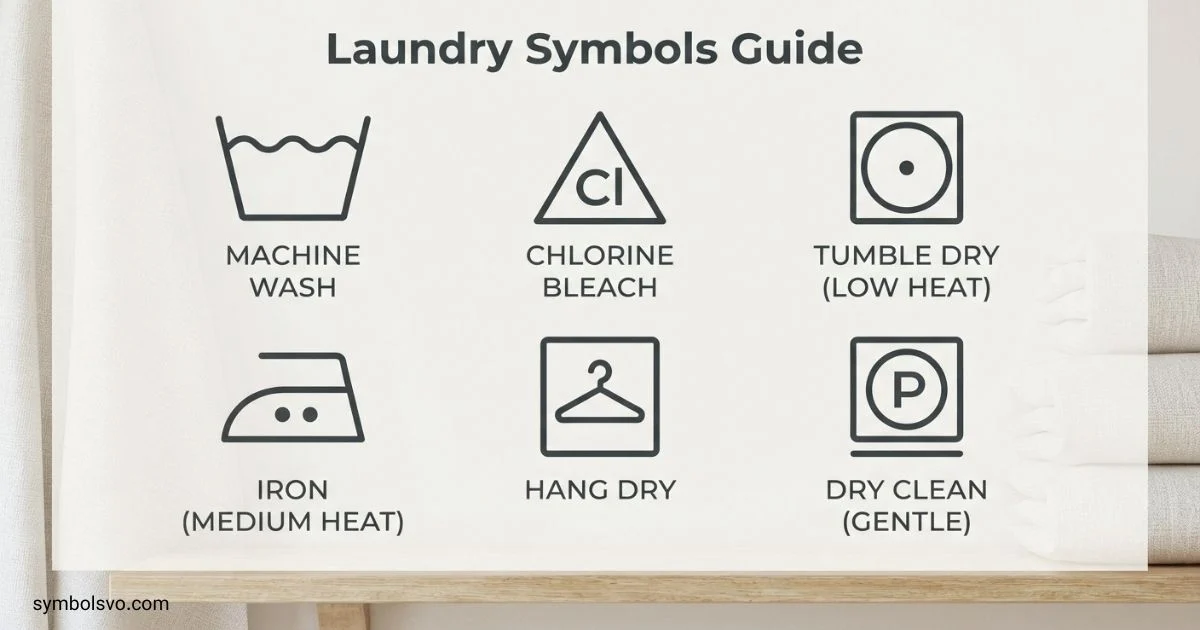
Laundry care labels use a small number of basic symbol families. The international system covered by ISO 3758 uses five main categories: washing, bleaching, drying, ironing, and professional textile care.
Here is a quick reference:
| Symbol shape | What it represents | Main purpose |
| 🛁 Washtub | Washing | Machine or hand washing |
| △ Triangle | Bleaching | Whether bleach may be used |
| □ Square | Drying | Tumble or natural drying |
| ♢ Iron | Ironing | Maximum ironing temperature |
| ○ Circle | Professional care | Dry cleaning or professional wet cleaning |
The actual care-label pictograms are stylized graphics rather than ordinary emoji. The table above uses familiar shapes to make the categories easy to remember.
Washing Symbols
A washtub represents washing. A number inside it gives the maximum washing temperature in Celsius. A bar underneath calls for a milder process, while two bars indicate a very mild process. A hand in the tub means hand washing.
Common examples include:
- Tub + 30 — Wash at a maximum of 30°C.
- Tub + 40 — Wash at a maximum of 40°C.
- Tub + 60 — Wash at a maximum of 60°C.
- Tub + hand — Hand wash.
- Tub + one bar — Use a milder washing process.
- Tub + two bars — Use a very mild washing process.
- Crossed tub — Do not wash.
Bleaching Symbols
The triangle represents bleaching:
- Empty triangle — Any permitted bleaching agent.
- Triangle with two diagonal lines — Oxygen/non-chlorine bleach only.
- Crossed triangle — Do not bleach.
Ironing Symbols
The iron symbol indicates ironing temperature. Dots represent the heat level. Under the current ISO 3758:2023 system, specific ironing variants include maximum soleplate temperatures of 110°C, 150°C, and 200°C, with a newer symbol covering ironing without steam.
Professional Care Symbols
A circle is used for professional textile care. Letters inside the circle can specify the permitted professional cleaning process. A crossed circle means the indicated professional treatment must not be used.
Laundry Symbols Chart
A laundry symbols chart is useful because you can compare the shape and meaning at a glance.
| Care symbol | Meaning | What to do |
| Washtub | Washing | Follow the temperature and cycle shown |
| Washtub with hand | Hand wash | Wash carefully by hand |
| Crossed washtub | Do not wash | Avoid normal washing |
| Triangle | Bleaching | Bleach may be permitted |
| Striped triangle | Non-chlorine bleach | Use oxygen bleach only |
| Crossed triangle | Do not bleach | Do not use bleach |
| Square with circle | Tumble drying | Dryer is permitted at the stated heat level |
| Crossed square/circle | Do not tumble dry | Use another drying method |
| Square with vertical line | Line drying | Hang or line dry |
| Square with horizontal line | Flat drying | Dry while lying flat |
| Iron with dots | Ironing | Use the heat indicated by the dots |
| Crossed iron | Do not iron | Avoid ironing |
| Circle | Professional care | Follow the professional-care instruction |
The symbols should be read as a complete set rather than individually. For example, a shirt might allow machine washing but prohibit tumble drying and bleaching.
A bar beneath a symbol generally means a gentler process, while a cross indicates that the represented treatment should not be used.
International Laundry Symbols Guide
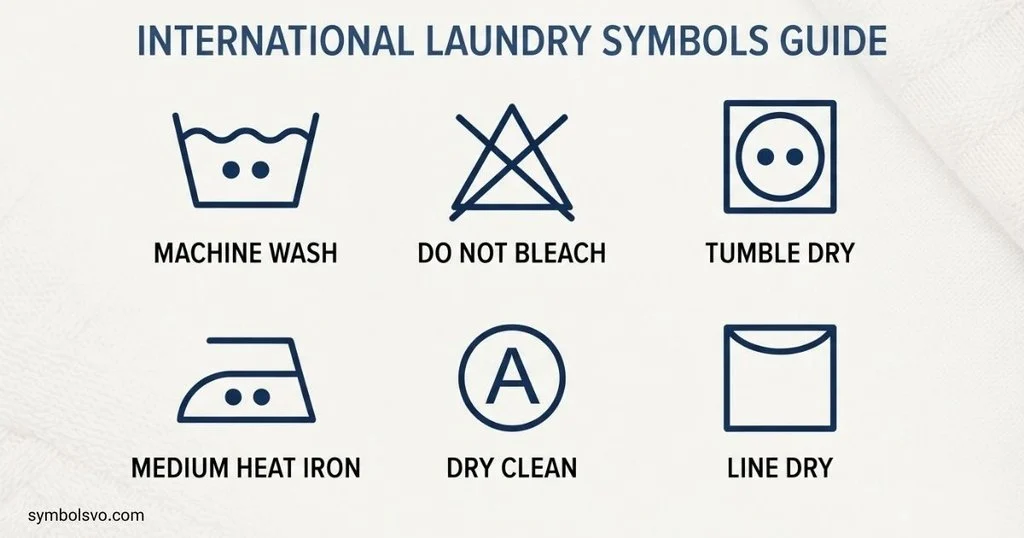
International laundry symbols were developed to make textile-care instructions easier to understand across languages. ISO 3758:2023 is the current international standard for textile care labeling, replacing the previous 2012 edition.
The five major categories appear in this order:
- Washing
- Bleaching
- Drying
- Ironing
- Professional textile care
This consistent structure makes a care label easier to interpret even when you cannot read the language printed on the garment. GINETEX notes that its care-labeling system is intended to provide textile-care information using symbols that can be understood across countries.
How To Read The International System
The easiest method is to identify the outside shape first.
Tub = wash
Look inside the tub for a temperature or hand symbol. Bars underneath indicate reduced mechanical action.
Triangle = bleach
Check whether the triangle is empty, striped, or crossed.
Square = dry
Look for a circle, lines, or other markings that explain the drying method.
Iron = iron
Dots or other markings indicate the permitted heat level.
Circle = professional care
Letters and additional markings provide information for professional cleaners.
The symbols describe permitted or maximum treatment levels. A lower temperature or gentler treatment can generally be used when appropriate. GINETEX specifically states that milder treatments and lower temperatures than those shown on a label are permitted.
Drying Symbols For Laundry
Drying symbols are especially important because excessive heat can damage or change some fabrics.
The basic drying symbol is a square. A circle inside the square indicates tumble drying. Dots inside the tumble-drying symbol indicate the temperature level.
| Drying symbol pattern | Meaning |
| Square with circle | Tumble drying is permitted |
| Square with circle + lower heat indication | Use a lower-temperature drying process |
| Crossed square with circle | Do not tumble dry |
| Square + vertical line | Line dry |
| Square + horizontal line | Dry flat |
| Square + multiple vertical lines | Drip drying |
| Square + diagonal line | Dry in the shade |
GINETEX lists natural drying options including line drying, drip line drying, flat drying, and drip flat drying. Diagonal lines can indicate that the corresponding natural drying method should be performed in the shade.
Tumble Drying
The circle inside a square is the easiest drying symbol to recognize.
Depending on the marking, it can tell you whether:
- Normal tumble drying is allowed.
- A lower-temperature process is required.
- Tumble drying is prohibited.
Do not assume that a garment can go into a dryer simply because it can be machine washed. Washing and drying are separate care instructions.
Natural Drying
Natural drying symbols tell you how the garment should be positioned while it dries.
- Line dry — Hang the garment to dry.
- Drip dry — Allow excess water to drain naturally.
- Dry flat — Place the garment flat while drying.
- Shade symbol — Keep the item out of direct sunlight during the specified drying method.
This information is useful for delicate clothing that can stretch, lose its shape, or react poorly to high heat.
Korean Laundry Symbols
Korean laundry labels can be confusing to visitors because they may combine familiar care pictograms with Korean words and additional instructions.
South Korea uses its own textile-care labeling standard, KS K 0021, so Korean labels should not automatically be assumed to be identical to every international label. Korean care references commonly use terms such as 물세탁 for water washing and 손세탁 for hand washing.
Some useful Korean laundry terms include:
| Korean term | English meaning |
| 물세탁 | Water washing |
| 손세탁 | Hand washing |
| 드라이 | Dry cleaning |
| 표백 | Bleaching |
| 다림질 | Ironing |
| 건조 | Drying |
| 중성 | Neutral |
The pictograms themselves are often the easiest part to recognize. A tub still relates to washing, a triangle to bleaching, a square to drying, and an iron to ironing.
However, Korean labels may provide written instructions that add detail to the symbol. For example, text can specify detergent requirements, washing methods, or special restrictions. Korean care-label resources show separate instructions for machine washing, hand washing, bleaching, drying, and ironing.
Tips For Reading Korean Care Labels
If you are washing clothes purchased in Korea:
- Identify the symbol family first.
- Look for Korean words next to the pictogram.
- Translate unfamiliar text when necessary.
- Pay attention to temperature numbers.
- Check drying instructions separately.
- Follow the most restrictive instruction when several instructions appear together.
A photo-translation app can help with Korean text, but the original care symbol should still be checked carefully.
Laundry Symbols Guide Printable
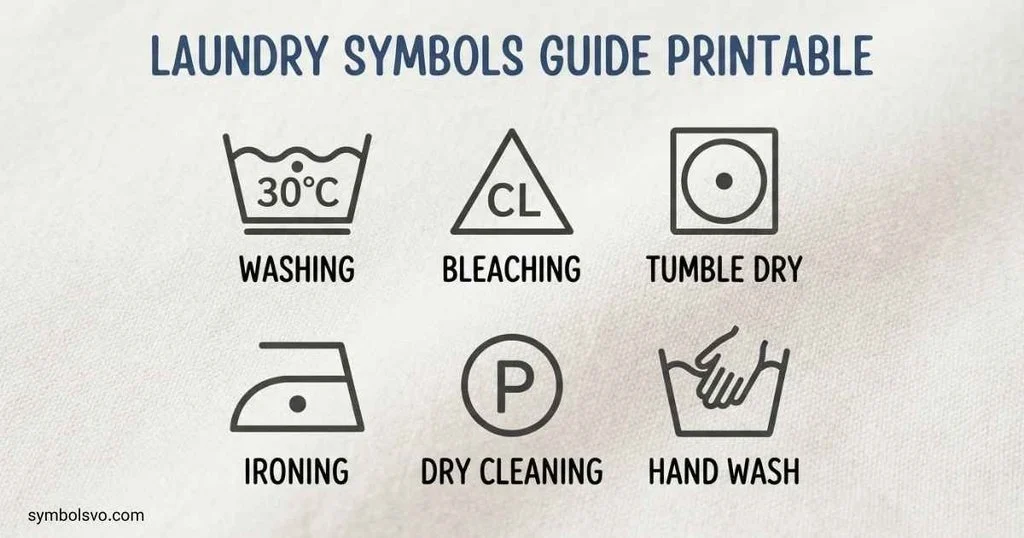
A printable laundry symbols guide is useful for keeping the most important care instructions near your washing machine, laundry room, or sewing area.
For a simple printable reference, organize the symbols into five groups:
Washing
- Maximum temperature
- Hand wash
- Gentle wash
- Very gentle wash
- Do not wash
Bleaching
- Bleach permitted
- Oxygen/non-chlorine bleach only
- Do not bleach
Drying
- Tumble dry
- Lower-temperature tumble dry
- Do not tumble dry
- Line dry
- Drip dry
- Dry flat
- Dry in the shade
Ironing
- Low heat
- Medium heat
- High heat
- Do not iron
Professional Care
- Professional dry cleaning
- Professional wet cleaning
- Restricted professional processes
- Do not use the indicated professional treatment
GINETEX provides an official table of textile care symbols that can serve as a reference when creating a personal study or laundry chart.
For a home printable, keep the layout simple. A large symbol, a short meaning, and a brief instruction are easier to read than a crowded page.
One caution applies to commercial printing: GINETEX states that its care symbols are protected trademarks in many countries, so businesses should check the applicable licensing requirements before reproducing official symbol graphics commercially.
Laundry Symbols Guide Magnet
A laundry symbols guide magnet can be kept on the side of a washing machine, dryer, refrigerator, or another metal surface near the laundry area.
The advantage is convenience. You do not have to search online every time a clothing label contains an unfamiliar symbol.
A useful magnet can include:
| Section | Information to show |
| Wash | Temperature, hand wash, do not wash |
| Bleach | Any bleach, oxygen only, no bleach |
| Dry | Tumble, low heat, line, flat, no tumble |
| Iron | Low, medium, high, no iron |
| Professional | Dry clean, wet clean, restrictions |
Choose a chart with large enough symbols to recognize quickly. Small decorative designs may look attractive but can be difficult to read beside a washing machine.
A laminated paper chart can work just as well if you do not have a magnetic surface.
Laundry Symbols Guide Sign
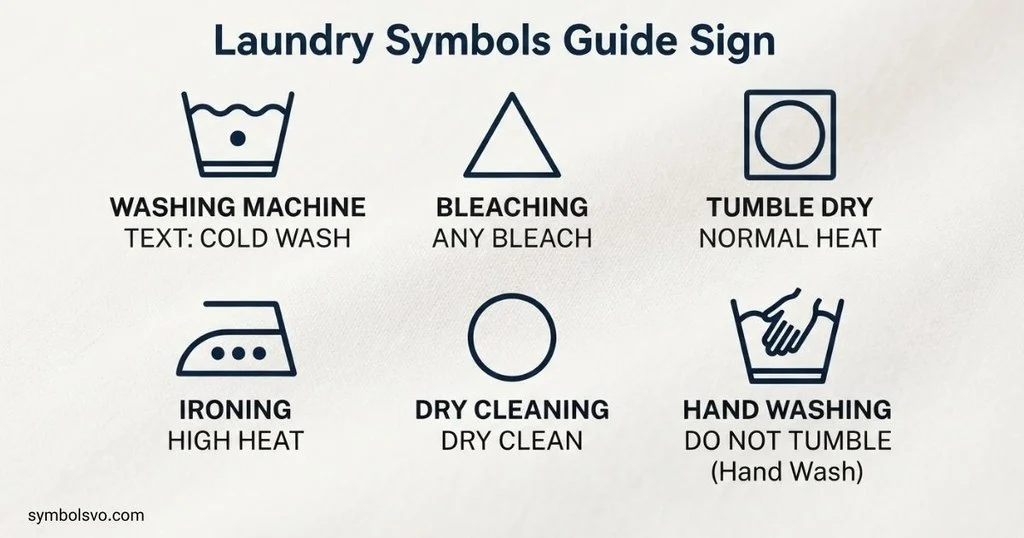
A laundry symbols guide sign is useful in shared laundry rooms, apartments, hotels, dormitories, laundromats, care facilities, and workplaces.
A clear sign should focus on the symbols people are most likely to encounter. Instead of filling the entire sign with technical details, use short instructions such as:
- Tub — Check wash temperature.
- Hand in tub — Hand wash.
- Crossed tub — Do not wash.
- Triangle — Check bleach instructions.
- Crossed triangle — Do not bleach.
- Square with circle — Check dryer temperature.
- Crossed dryer symbol — Do not tumble dry.
- Iron — Check ironing temperature.
- Crossed iron — Do not iron.
- Circle — Professional care instructions.
A sign should never replace the garment’s own care label. Care symbols provide instructions for the particular textile product, and GINETEX advises consumers to check the care symbols on textile articles before cleaning them.
For a public laundry room, it can also help to add a short reminder:
“Always check the garment care label before washing or drying.”
That single instruction can prevent people from treating every fabric the same way.
Frequently Asked Questions
What Are The Five Main Laundry Symbols?
The five main care-symbol families represent washing, bleaching, drying, ironing, and professional textile care. They are commonly represented by a washtub, triangle, square, iron, and circle respectively.
What Does A Cross Mean On A Laundry Symbol?
A cross over a care symbol means the treatment represented by that symbol should not be used. For example, a crossed triangle means do not bleach, while a crossed iron means do not iron.
What Does A Number Inside A Washing Symbol Mean?
A number inside the washing tub indicates the maximum washing temperature in degrees Celsius. For example, 30 means the wash temperature should not exceed 30°C.
Are Korean Laundry Symbols The Same As International Symbols?
Korean labels can use familiar care pictograms, but South Korea has its own textile-care labeling standard, KS K 0021. Korean labels may also include Hangul instructions that provide additional information.
Can I Copy And Paste Laundry Symbols Like Unicode Characters?
Most standardized laundry-care pictograms should not be treated as ordinary Unicode text characters. They are textile-care graphics used on labels, charts, and signs. For digital content, it is safer to use an appropriate graphic or describe the symbol rather than inventing a Unicode code point.
Conclusion
A laundry symbols guide turns confusing clothing labels into a simple visual language. Start with the main shapes: the tub means washing, the triangle means bleaching, the square covers drying, the iron covers ironing, and the circle covers professional care.
Temperature numbers, dots, lines, and crosses then provide the extra instructions. Learning these small details can help you avoid unnecessary shrinking, stretching, fading, or heat damage. International symbols make the system easier to understand across languages, while Korean labels may add local written instructions.
Keep a printable chart, magnet, or laundry-room sign somewhere convenient if you regularly forget the symbols. Most importantly, always check the individual garment label because the correct treatment depends on the textile and its construction.

 Mason Ellington
 Daniel Brooks