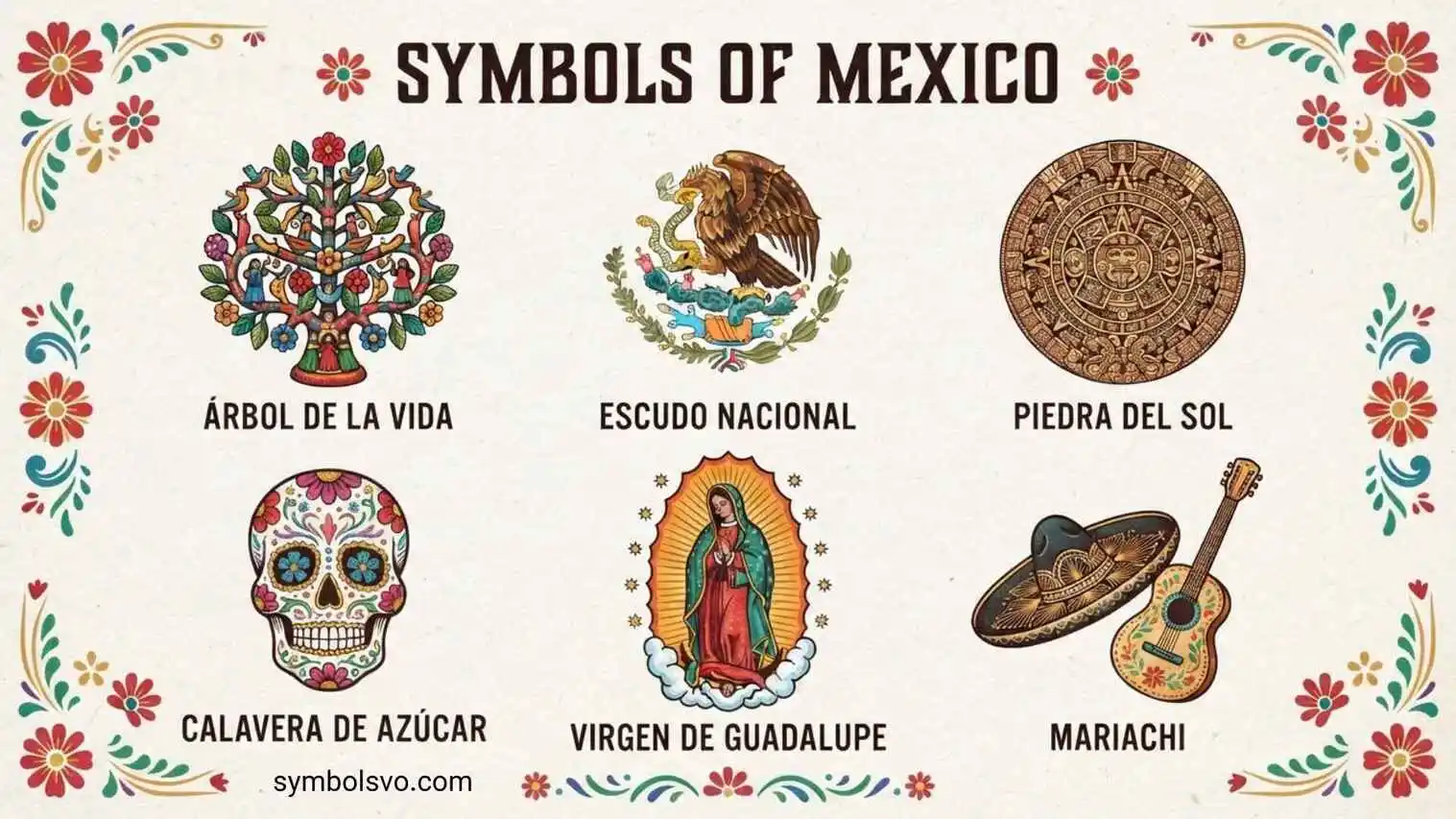
Symbols of Mexico tell a story of history, culture, identity, and pride. I find that each symbol reveals something meaningful about the country, from its famous flag and eagle to traditional plants, animals, and cultural icons. If you want to understand Mexico better, these symbols are a great place to start.
You may already recognize some Symbols of Mexico, but you might not know what they truly represent. I’ll help you explore their meanings in a simple and engaging way, so you can see the deeper ideas behind these important national and cultural symbols.
As you explore this guide, you’ll discover the stories and traditions connected to Mexico’s most recognizable symbols. You can use this information for learning, travel, research, or simply satisfying your curiosity about what makes Mexican culture so unique.
Quick Answer:
Symbols of Mexico are official and cultural emblems that represent the country’s heritage, identity, and values. They bridge ancient Aztec mythology with Catholic traditions. The most prominent examples include the national flag, the golden eagle perched on a prickly pear cactus devouring a snake, the Virgin of Guadalupe, and Day of the Dead icons like sugar skulls.
Quick Facts About Symbols of Mexico
| Aspect | Information | Origin |
| Historical Significance | Bridges pre-Hispanic indigenous empires with Spanish colonial history. | Lake Texcoco foundation myth (1325) and colonial synthesis. |
| Main Meaning | Ultimate triumph of light over darkness, freedom, and national sovereignty. | Ancient Nahuatl cosmology and revolutionary movements. |
| Spiritual Meaning | The sacred connection between the earthly world and divine protection. | Synthetic worship combining Aztec earth deities and Catholic saints. |
| Cultural Importance | Forms the collective backbone of Mexican identity, festivals, and community values. | Multi-generational traditions celebrated across the republic. |
| Modern Usage | Displayed prominently in government emblems, everyday art, pop culture, and tattoos. | Maintained via official education laws and folk art practices. |
What Are Symbols of Mexico?
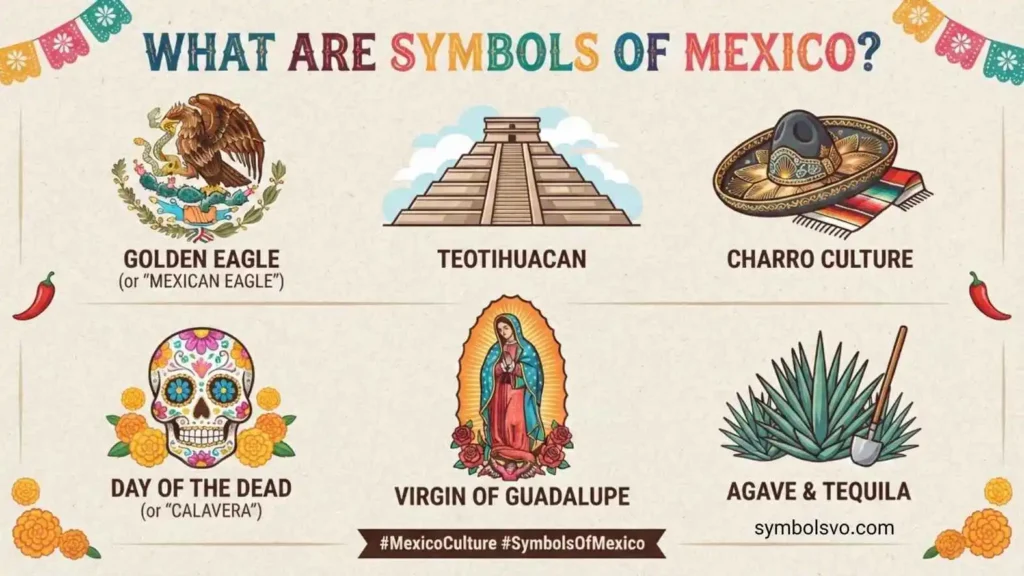
Symbols of Mexico are visual narratives that bind a diverse population into a unified cultural identity. They act as historical anchors. Far from being simple decorations, these icons trace their roots back thousands of years to the grand civilizations of the Maya, the Olmecs, and the Aztecs.
The primary official icon, the Mexican coat of arms, directly illustrates the miraculous founding of Tenochtitlan in 1325. According to legend, Huitzilopochtli, the god of war and the sun, commanded the nomadic Mexica people to build their empire where they witnessed an extraordinary sight. They had to search for an eagle sitting proudly on a nopal cactus, clutching a serpent in its talons. They discovered this exact scene on a swampy island in Lake Texcoco. This very spot evolved into what we know today as Mexico City.
As centuries rolled by, these indigenous roots collided with Spanish conquest and Catholic missionary efforts. Instead of erasing the older traditions, the two worlds merged. The ancient stone carvings and solar motifs evolved into standard flags, regional dances, and religious icons. This cultural survival strategy ensured that the original spirit of the land was never truly lost.
The official Coat of Arms of Mexico. Source: pavlofox / Getty Images
Deep Symbolic Meaning of Symbols of Mexico
Spiritual Level
On a profound spiritual level, these emblems mirror the eternal journey of human consciousness and the concept of inner transformation. The confrontation between the eagle and the snake represents the human soul striving to overcome earthly limitations. The eagle represents solar energy, celestial wisdom, and high states of awareness. The serpent represents the ground, the mysteries of the underworld, and raw material energy. Their union on the cactus symbolizes perfect cosmic balance.
Psychological Level
Psychologically, these cultural images tap directly into what Carl Jung called the collective unconscious. They are active archetypes that mirror basic human emotions and structural parts of our psyche. The eagle represents the Hero archetype, a force that conquers fear and faces adversity with clear vision. The snake serves as the Shadow or the unconscious instinctual nature. When the Mexican identity celebrates these symbols, it provides comfort and internal strength, helping individuals find order and meaning amid external social chaos.
Cultural Level
Culturally, these icons build strong social solidarity and collective community beliefs. Take the community celebration of Day of the Dead. It uses specific symbols like orange marigold flowers, known as cempasuchil, to show that love survives physical death. These symbols remind communities that their departed ancestors remain present in daily life. This philosophy transforms grief into a beautiful, shared public art form.
Symbols of Mexico Flag
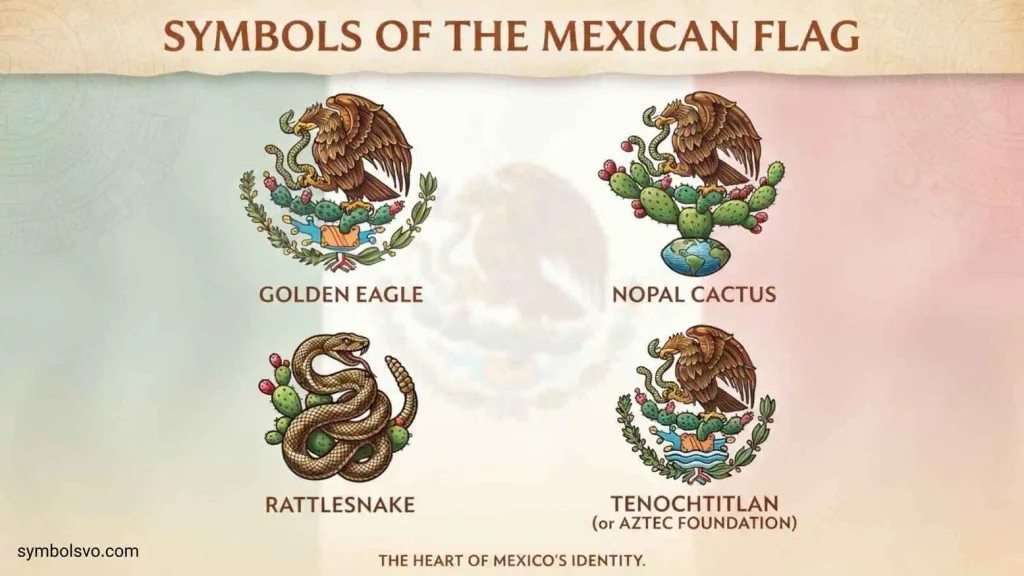
The Mexican flag is one of the strongest national symbols of Mexico. It features three vertical colors—green, white, and red—with the national coat of arms placed in the center of the white stripe. The coat of arms shows an eagle standing on a prickly pear cactus while holding a snake. This image connects Mexico’s modern identity with the ancient Mexica story associated with the founding of Tenochtitlan.
The flag’s three colors are widely associated with important ideas in Mexican history. Green is commonly connected with hope, white with unity or purity, and red with the blood of national heroes. The meaning of the colors has changed over time, so historical explanations can differ from the meanings commonly taught today.
Mexico Symbols and Meanings
Mexico has many symbols that reflect its history, Indigenous heritage, nature, religion, and national identity. Some of the best-known include the Mexican flag, coat of arms, golden eagle, serpent, prickly pear cactus, mariachi, sombrero, Day of the Dead imagery, and the national colors.
The eagle and serpent are especially important because they appear on Mexico’s coat of arms. The axolotl represents Mexico’s extraordinary native wildlife, while the jaguar has deep cultural and historical importance among several Indigenous civilizations. Other symbols, such as marigolds, papel picado, sugar skulls, and the Virgin of Guadalupe, are strongly associated with Mexican culture and traditions.
Symbols of Mexico City
Mexico City has symbols that reflect both its ancient Indigenous roots and its modern identity. One of the most important is the eagle, snake, and cactus, which recalls the traditional story connected with the founding of Tenochtitlan, the Mexica capital located where Mexico City now stands.
The historic center, Aztec or Mexica imagery, the Angel of Independence, the Metropolitan Cathedral, and the Mexico City coat of arms can also represent the city’s history and cultural identity. The city’s symbols often show how ancient Mesoamerican traditions and later Mexican history became connected.
Mexico National Animal Jaguar
The jaguar is one of Mexico’s most important native animals and has a powerful place in Mexican history and Indigenous traditions. It is not simply a modern wildlife symbol; jaguars were respected and feared by several ancient Mesoamerican cultures.
Among the Maya and Mexica, the jaguar was associated with strength, power, courage, and the supernatural world. Today, the animal is also an important symbol of Mexico’s rich biodiversity and the need to protect endangered wildlife habitats.
It is worth noting that calling the jaguar the official national animal of Mexico can be misleading. Mexico has several culturally important animals, but the jaguar’s importance is primarily historical, cultural, and ecological rather than being established as the country’s sole official national animal.
National Animal of Mexico Axolotl
The axolotl is one of Mexico’s most recognizable native animals. This unusual amphibian is native to the waterways around the Valley of Mexico and is particularly associated with the ancient lake system of the region.
The axolotl has become a symbol of Mexico’s unique natural heritage. It is famous for its ability to regenerate certain body tissues and for retaining juvenile features throughout its life. Its connection to Mexican mythology and its distinctive appearance have also made it internationally recognizable.
However, the axolotl should not automatically be described as Mexico’s official national animal. It is better understood as an important Mexican cultural and wildlife symbol.
Mexico National Bird and Flower
Mexico’s national bird is the golden eagle, an animal that also appears prominently on the national coat of arms. Its image represents strength, courage, and the country’s historical identity.
Mexico’s national flower is the dahlia. Native to Mexico, dahlias have a long connection with the country’s natural heritage. Their large and varied flowers have made them popular both inside Mexico and around the world.
Together, the golden eagle and dahlia represent two different sides of Mexican identity: the power and symbolism of native wildlife and the country’s remarkable botanical heritage.
Mexico National Animal and Bird
Mexico has several animals that are strongly connected with national identity, but the golden eagle has the clearest official national-symbol status among animals because it appears on the Mexican coat of arms. The jaguar and axolotl are also highly important Mexican animals, although they should not be presented as interchangeable with the official national bird.
The golden eagle is particularly significant because it is central to the national emblem. The jaguar represents ancient Mesoamerican culture and biodiversity, while the axolotl represents Mexico’s unique aquatic wildlife and Indigenous heritage.
Mexico Animal National
When people search for Mexico’s national animal, they may encounter several answers, including the golden eagle, jaguar, and axolotl. The confusion happens because national symbols and culturally important animals are not always the same thing.
The golden eagle has the strongest connection to Mexico’s official national emblem. The jaguar has deep Indigenous and historical significance, while the axolotl is an iconic species native to Mexico. Therefore, it is more accurate to explain the individual importance of each animal instead of claiming that all three are official national animals.
National Symbols of Mexico Fruit Avocado
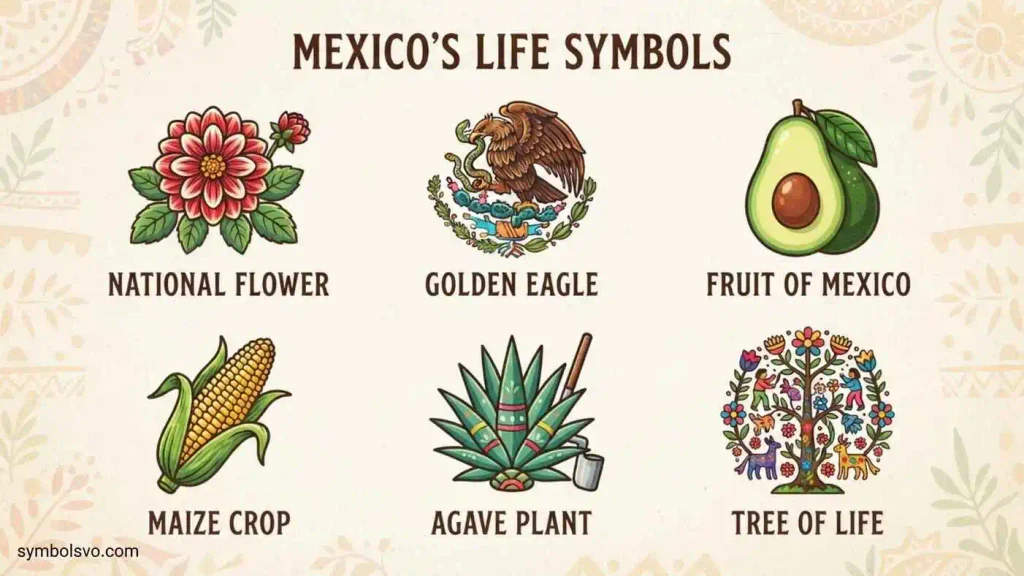
The avocado is strongly connected with Mexico and has been cultivated in the region for thousands of years. Mexico is widely recognized as an important center of avocado cultivation and remains a major producer.
Because of its history, popularity, and role in Mexican cuisine, the avocado can be considered an important cultural and food symbol of Mexico. Guacamole is one of the most famous Mexican foods associated with avocado, and the fruit appears in many traditional and modern dishes.
However, calling avocado an official national fruit of Mexico requires caution. It is better described as a famous Mexican food and cultural symbol rather than automatically labeling it an official national symbol.
Symbols of Mexico Culture
Mexican culture is represented by a wide range of symbols rather than one single image. Traditional music, food, clothing, celebrations, crafts, religious traditions, and Indigenous heritage all contribute to Mexico’s cultural identity.
Mariachi music, Día de los Muertos traditions, colorful papel picado, Mexican pottery, traditional embroidery, sombreros, the rebozo, and foods such as tacos and tamales are widely recognized cultural representations. Ancient symbols such as the eagle, serpent, cactus, and jaguar add another layer of historical meaning.
National Symbols of Mexico
Mexico’s national identity is represented by several important official and traditional symbols. The national flag, national coat of arms, and national anthem are among the country’s most important official national symbols.
The golden eagle, serpent, cactus, national colors, dahlia, and other cultural elements are also closely connected with Mexican identity. Some symbols have formal legal or governmental status, while others became important through history, tradition, Indigenous culture, or popular recognition.
Famous Symbols of Mexico
Some of the most famous symbols associated with Mexico include the Mexican flag, golden eagle, cactus, serpent, jaguar, axolotl, mariachi, Día de los Muertos imagery, sombrero, and traditional Mexican food.
The eagle standing on a cactus with a snake is especially recognizable because it forms the central image of Mexico’s coat of arms. Outside official national symbols, colorful papel picado, marigold flowers, sugar-skull designs, and mariachi musicians are also strongly associated with Mexican culture.
Symbols of Mexico Crossword
If you are solving a crossword about symbols of Mexico, common answers may include words such as eagle, cactus, snake, jaguar, dahlia, mariachi, sombrero, or axolotl. The correct answer depends on the clue and the number of letters required.
For example, a clue referring to Mexico’s national emblem may point toward eagle or cactus, while a clue about a famous Mexican amphibian may refer to the axolotl. Crossword clues can use either official symbols or widely recognized cultural references.
National Symbols of Mexico Official List
Mexico’s official national identity is represented by symbols established through law and national tradition. The most important formal symbols include the Mexican flag, national coat of arms, and national anthem.
The coat of arms is particularly distinctive. It depicts a golden eagle on a prickly pear cactus while holding a serpent. This design is based on a foundational Mexica tradition associated with the location of Tenochtitlan.
Other things frequently listed online—such as the jaguar, axolotl, avocado, mariachi, or sombrero—may be important cultural symbols, but they should not automatically be placed on an “official national symbols” list.
What Are the National Symbols of Mexico?
The national symbols of Mexico are primarily the flag, coat of arms, and national anthem. These symbols officially represent the Mexican nation and are used in government, public ceremonies, and national celebrations.
The Mexican coat of arms contains several symbolic elements, including the eagle, snake, cactus, water, and branches. Beyond these official symbols, Mexico has many traditional cultural symbols that represent its Indigenous heritage, history, biodiversity, religion, food, music, and celebrations.
Objects That Represent Mexican Culture
Many everyday objects can represent Mexican culture because they reflect the country’s history and traditions. Examples include sombreros, rebozos, pottery, woven textiles, papel picado, maracas, traditional masks, molcajetes, and colorful handicrafts.
A molcajete, for example, is closely associated with traditional Mexican food preparation. Papel picado is commonly used for celebrations, while handmade textiles and pottery demonstrate the country’s long tradition of regional craftsmanship.
Traditional Mexican Culture Symbols
Traditional Mexican culture contains symbols from Indigenous civilizations, Spanish colonial history, regional traditions, and modern Mexican life. Some of the most recognizable include the eagle and serpent, jaguar, marigold, papel picado, sugar skull, sombrero, rebozo, and traditional pottery.
Many of these symbols have meanings that depend on their historical and cultural context. For example, the jaguar has deep pre-Hispanic associations, while Día de los Muertos imagery developed through a mixture of Indigenous traditions and Catholic influences.
Symbols of Mexican Culture
Symbols of Mexican culture can be divided into several groups: national symbols, Indigenous symbols, religious symbols, food symbols, artistic traditions, and festival imagery.
The Mexican flag and coat of arms represent national identity. The jaguar and ancient Mesoamerican imagery represent Indigenous heritage. Mariachi represents music, while tacos, tamales, tortillas, and mole represent important parts of Mexican culinary culture. Día de los Muertos symbols, including marigolds and decorated skull imagery, represent a distinctive Mexican tradition of remembering deceased loved ones.
Things That Represent Mexico
Many things can represent Mexico depending on the context. The strongest national representations include the Mexican flag, coat of arms, and national anthem. Cultural representations include mariachi music, Día de los Muertos, traditional Mexican clothing, food, crafts, and architecture.
Mexico’s natural heritage is also represented by animals such as the golden eagle, jaguar, and axolotl. Plants such as the dahlia, agave, and nopal cactus further connect Mexican identity with the country’s landscape and history.
Mexican Heritage Symbols
Mexican heritage symbols often connect modern Mexico with ancient Indigenous civilizations. The eagle, serpent, cactus, jaguar, and other Mesoamerican images have survived as recognizable parts of Mexican cultural identity.
Traditional textiles, pottery, Indigenous artwork, regional dances, and food also preserve elements of Mexico’s diverse heritage. These symbols are especially meaningful because Mexican culture developed through many Indigenous communities and later historical influences rather than from a single cultural tradition.
Mexican Religious Symbols
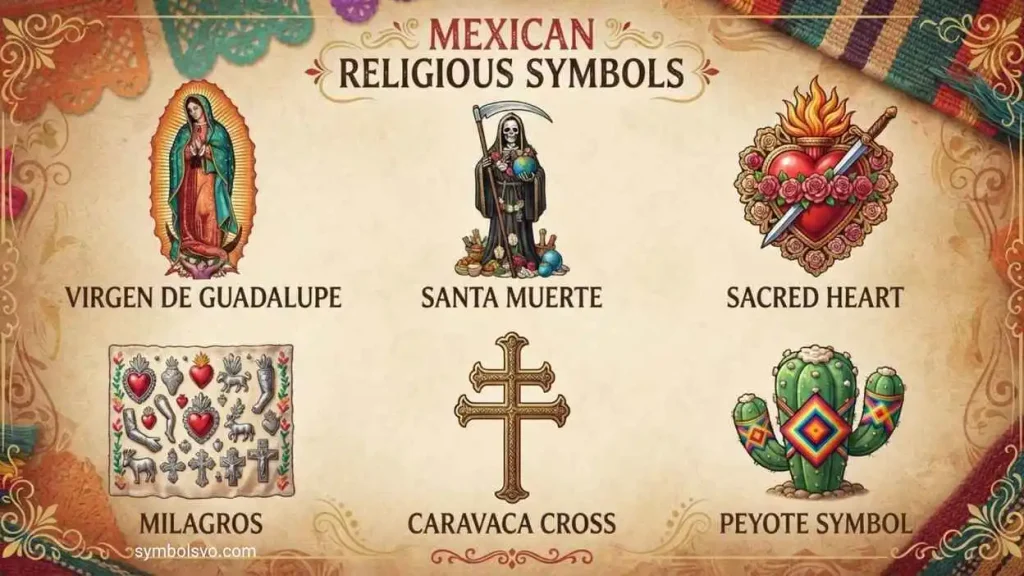
Mexican religious symbolism reflects a long history in which Indigenous traditions and Christianity became deeply interconnected. One of the most recognizable religious figures in Mexico is the Virgin of Guadalupe, who holds an especially important place in Mexican Catholic tradition.
Crosses, rosaries, candles, religious paintings, churches, and images of saints are also common religious symbols. In some Mexican traditions, religious imagery appears alongside Indigenous artistic styles and local customs, demonstrating the cultural blending that developed over centuries.
Types and Variations of Symbols of Mexico
The Golden Eagle and Serpent
- Visual Description: A majestic bird of prey standing firmly on a blooming prickly pear cactus, holding a writhing snake securely in its beak and sharp talons.
- Meaning & Symbolism: Supreme victory, cosmological order, and the sacred center of the universe.
- Cultural Connection: It acts as the core of the national flag, representing the ultimate triumph of good over evil forces.
- Where It Appears: Government buildings, currency, passports, and official military uniforms.
The Virgin of Guadalupe
- Visual Description: A serene, dark-skinned indigenous woman wrapped tenderly in a star-covered turquoise mantle, standing before a radiant golden sunburst with a crescent moon under her feet.
- Meaning & Symbolism: Divine protection, maternal comfort, hope for the oppressed, and the beautiful blending of races.
- Cultural Connection: She bridges the Aztec earth goddess Tonantzin with the Catholic Virgin Mary.
- Where It Appears: Church altars, roadside shrines, home blessings, family vehicles, and fine art paintings.
Sugar Skulls (Calaveras de Azúcar)
- Visual Description: Brightly colored skulls molded carefully from pure sugar paste, decorated with vibrant icing, shiny colored foil, and specific family names written on the forehead.
- Meaning & Symbolism: The sweet celebration of individual life and a playful acceptance of mortal death.
- Cultural Connection: Used to invite spirits back to the family home during annual remembrance celebrations.
- Where It Appears: Family altars, colorful cemetery vigils, street markets, and modern holiday parade costumes.
A festive sugar skull and marigolds. Source: Mizina / Getty Images
The Ahuehuete Tree
- Visual Description: A massive, ancient cypress tree featuring a wide trunk and weeping branches that drape gracefully over bodies of water.
- Meaning & Symbolism: Eternal life, deep ancestral roots, and surviving severe political storms.
- Cultural Connection: Selected as the official national tree, it marks famous historical spots like Hernan Cortes’s “Night of Sorrows.”
- Where It Appears: Protected national parks, traditional botanical illustrations, and classic historical literature.
Symbols of Mexico Across Different Cultures
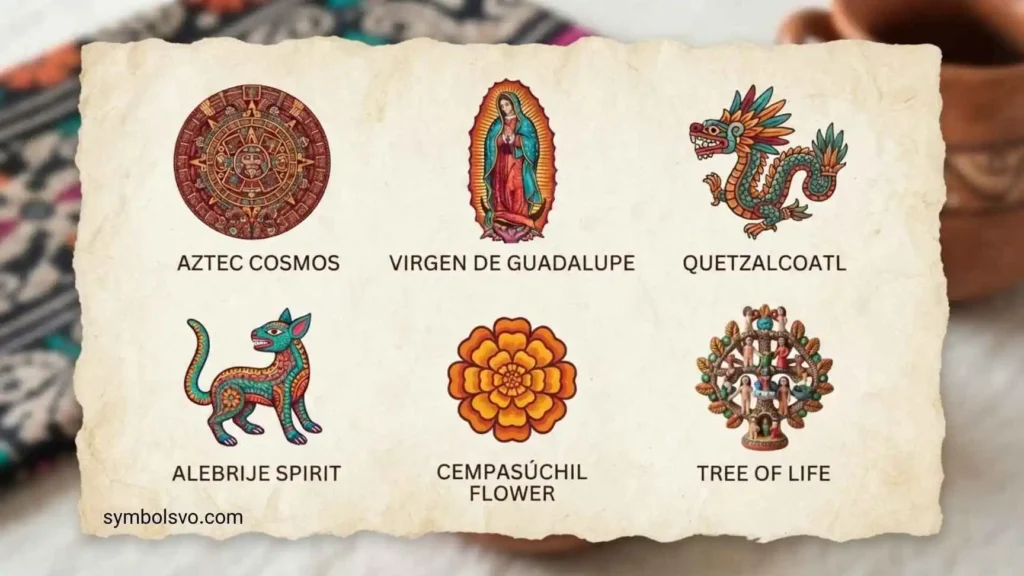
The underlying elements of Mexican iconography connect beautifully with similar archetypes found across global history:
- Indigenous Mesoamerica: The feathered serpent deity Kukulkan or Quetzalcoatl symbolized the union of earth and sky, serving as the creator of humans and agriculture.
- Ancient Egypt: The vulture and the rearing cobra protected the Pharaohs, showing a matching balance between lower and higher regions of power.
- Ancient Greece: The eagle was the sacred personal messenger of Zeus, carrying lightning and symbolizing executive authority and long-range vision.
- Eastern Traditions: The continuous battle between the bird-like Garuda and the serpentine Nagas represents the ongoing fight between spiritual freedom and material attachment.
- Modern Global Culture: Today, these icons are universally recognized symbols of absolute cultural resilience, anti-colonial pride, and artistic expression.
Similar Symbols and Their Meanings
| Symbol of Mexico | Global Equivalent | Key Similarities | Major Differences |
| Eagle and Snake | Caduceus / Rod of Asclepius | Both use a snake to show transformation and life forces. | The Mexican version shows a struggle for balance, while the Caduceus shows peaceful integration. |
| Virgin of Guadalupe | Isis holding Horus | Both represent a sacred mother figure giving hope to people. | Guadalupe uses specific indigenous clothing and features to heal colonial wounds. |
| Sugar Skull | European Memento Mori | Both serve as visual reminders of human mortality. | Memento Mori encourages dark, somber reflection, whereas sugar skulls are joyful and celebratory. |
Symbols of Mexico in Mythology and Folklore
The rich legends surrounding these symbols continue to guide daily life across the country. One famous story features the weeping woman, La Llorona. She wanders along dark riverbanks crying out for her lost children. On a psychological level, she represents a shadow archetype. She reflects historical grief and the deep cultural pain caused by the violent collision of two distinct worlds during the Spanish conquest.
In sharp contrast stands the inspiring myth of the twin volcanoes, Popocatepetl and Iztaccihuatl, which overlook the Valley of Mexico. Folk stories describe them as a brave warrior and a beautiful princess whose tragic love story was set in stone by the ancient gods. One volcano stays quietly dormant while the other occasionally vents smoky ash, symbolizing a love that continues to burn deep within the earth.
Symbols of Mexico in Art, Pop Culture, and Tattoos
During the early twentieth century, master muralists like Diego Rivera, David Alfaro Siqueiros, and Jose Clemente Orozco filled massive public walls with these historical images. They painted giant eagles, revolutionary soldiers, and native corn crops to help a wounded nation rebuild its identity after the Mexican Revolution. Frida Kahlo frequently wove these emblems directly into her famous self-portraits. She painted native monkeys, thorns, and traditional Tehuana dresses to show her inner pain and her unbreakable bond with her homeland.
In contemporary design, these historical symbols enjoy a vibrant life. Skilful tattoo artists combine Aztec geometric patterns with clean lines, wrapping bold eagle designs and protective imagery around arms and shoulders. In global fashion houses and urban street style, the classic embroidered flowers and bright pinks of traditional Mexican dresses inspire modern collections, showing that these historic designs remain fluid, living languages.
Why Humans Are Attracted to These Symbols
Our deep human attraction to these emblems comes from our natural love for stories and patterns. Our brains look for icons that help make sense of a chaotic world. Mexican iconography handles this beautifully by refusing to hide the darker sides of life.
By celebrating both the sun and the underworld, these symbols honor the full human experience. They show that joy and sorrow, life and death, are parts of a single cycle. This honest, balanced approach provides deep emotional comfort to people everywhere.
Modern Uses of Symbols of Mexico
Today, these icons thrive well beyond museums and old history books:
- Fine Jewelry: Artisans fashion detailed silver necklaces and rings shaped like delicate milagros or sacred hearts.
- Corporate Branding: Major national businesses use stylized agave plants and solar wheels to build instant brand trust.
- Digital Media: Vibrant marigolds, festive pinatas, and sugar skull illustrations appear across global platforms every autumn.
- Interior Design: Modern living spaces feature traditional woven textiles and handcrafted clay pottery, adding organic warmth to minimalist rooms.
Interesting Facts About Symbols of Mexico
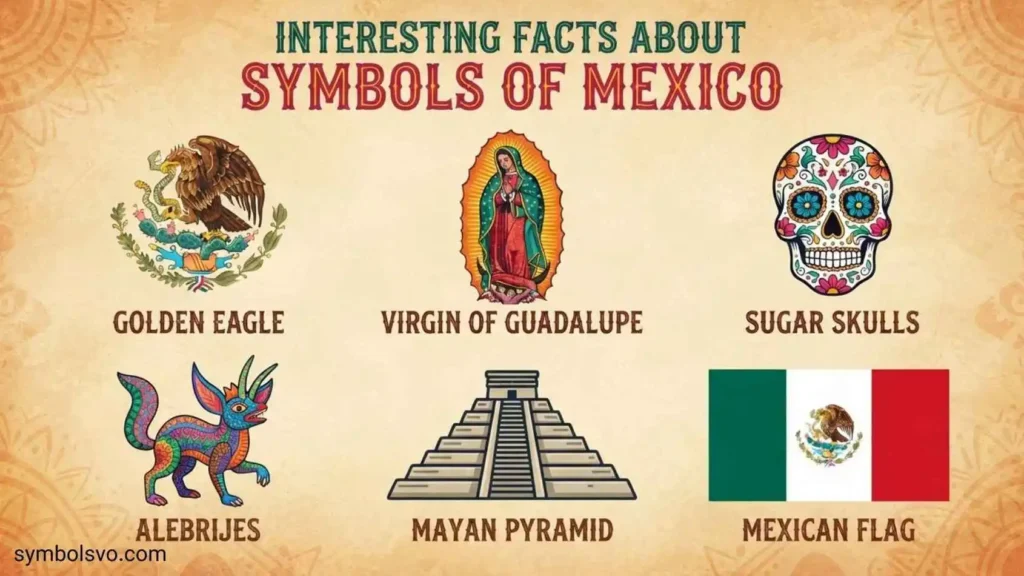
- Artistic Illusion: The green stripe on the national flag originally stood for independence from Spain, but today it symbolizes hope.
- Botanical Medicine: The prickly pear cactus found on the coat of arms was a vital source of food and hydration for ancient desert travelers.
- Celestial Coding: The stars printed on the mantle of the Virgin of Guadalupe match the exact winter constellations visible in the sky over Mexico during December 1531.
- Ancient Canvas: The iconic Aztec Sun Stone is not a functional calendar, but rather a sacrificial altar dedicated to solar deities.
- Natural Hybrid: The Xoloitzcuintli, Mexico’s native hairless dog, was believed by the Aztecs to guide human souls safely through the underworld.
Frequently Asked Questions
What do the colors of the Mexican flag mean?
The green stripe represents deep hope for the nation, the white stripe represents unity among the people, and the red stripe honors the brave blood spilled by national heroes fighting for independence.
Why is the eagle eating a snake so important to Mexico?
It honors the ancient Aztec foundation myth of Tenochtitlan. It symbolizes divine guidance, finding your purpose against all odds, and the delicate balance between spiritual ideals and earthly survival.
Is the sugar skull a sad symbol?
Not at all. It is a joyful symbol that honors deceased family members. It reminds us that life is sweet, death is natural, and ancestors are kept alive through memory and celebration.
Who created the modern Mexican coat of arms?
The core layout stems from ancient Aztec stone reliefs. Over the years, various artists updated the design, leading to the current official version created by Francisco Eppens Helguera in 1968.
Conclusion
Symbols of Mexico are visual testaments to a nation that understands how to transform historical suffering into beautiful, lasting art. By bridging ancient Aztec myths with modern life, these icons offer a comforting reminder that our past roots give us the strength to grow. They show us that by embracing both our light and shadow, we can find true balance and a lasting identity.

I’m Nathan Holloway, a passionate researcher and writer with a deep interest in symbols, signs, and their hidden meanings. I enjoy exploring how symbols have influenced different civilizations, religions, and modern communication. Through my work, I aim to make complex historical and cultural concepts easy to understand for readers of all backgrounds. Every article I write is carefully researched to provide reliable and engaging information.
Books:
- Beyond the Symbol
- The Secret Meanings of Everyday Signs
Author 2: Grace Whitmore
Description:
My name is Grace Whitmore, and I love discovering the stories behind the world’s most fascinating symbols. I spend my time researching ancient civilizations, mythology, spiritual traditions, and modern iconography to uncover the meanings people often overlook. I believe that every symbol has a history worth telling, and I enjoy sharing that knowledge in a simple and reader-friendly way.
Books:
- Echoes of Ancient Symbols
- The Symbolic World
 Mason Ellington
 Grace Whitmore
 Daniel Brooks