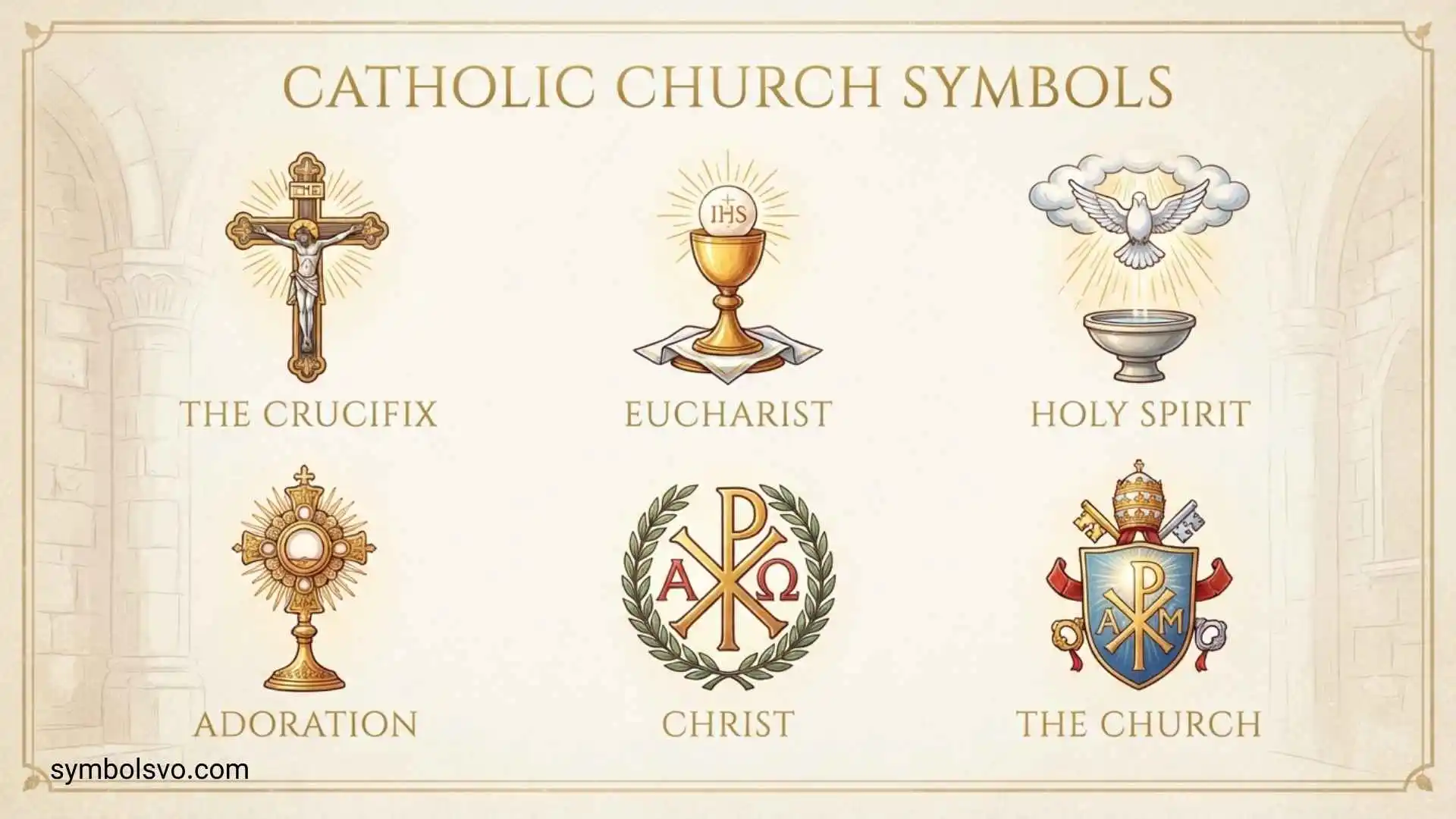
Catholic Church Symbols can seem mysterious at first, but each one carries a deeper meaning rooted in faith, history, and worship. I’ll help you understand these important symbols in a simple way, so you can recognize what you see in a Catholic church and understand why it matters.
When you learn the meaning behind a cross, fish, dove, or other sacred symbol, you begin to see Catholic traditions differently. You can connect each image with an important part of Christian belief, making your visit to a church or your study of Catholicism more meaningful.
In this guide, I’ll explain the most important Catholic Church Symbols and the ideas they represent. You’ll discover their meanings, history, and role in Catholic worship without needing any prior knowledge.
Quick Answer
Catholic church symbols are sacred visual representations, signs, and emblems used to communicate deep spiritual truths, theological concepts, and historical narratives within the Catholic faith. Originating in early Christian antiquity, these symbols served as a hidden language during times of persecution and continue to inspire worship, communal identity, and personal reflection today.
Quick Facts About Catholic Church Symbols
| Aspect | Information |
| Origin | Early Christian underground communities, Roman catacombs, and ancient Jewish traditions. |
| Historical Significance | Acted as a secret code during Roman persecution and taught the faith to illiterate populations in medieval times. |
| Main Meaning | Visual expressions of the divine, the life of Jesus Christ, and the mystery of salvation. |
| Spiritual Meaning | Outer signs of inner grace that connect the physical world to the invisible realm of God. |
| Cultural Importance | Shaped Western art, architecture, literature, and community rituals across centuries. |
| Modern Usage | Integrated into religious liturgies, personal jewelry, fine art, tattoos, and international fashion. |
What Are Catholic Church Symbols?
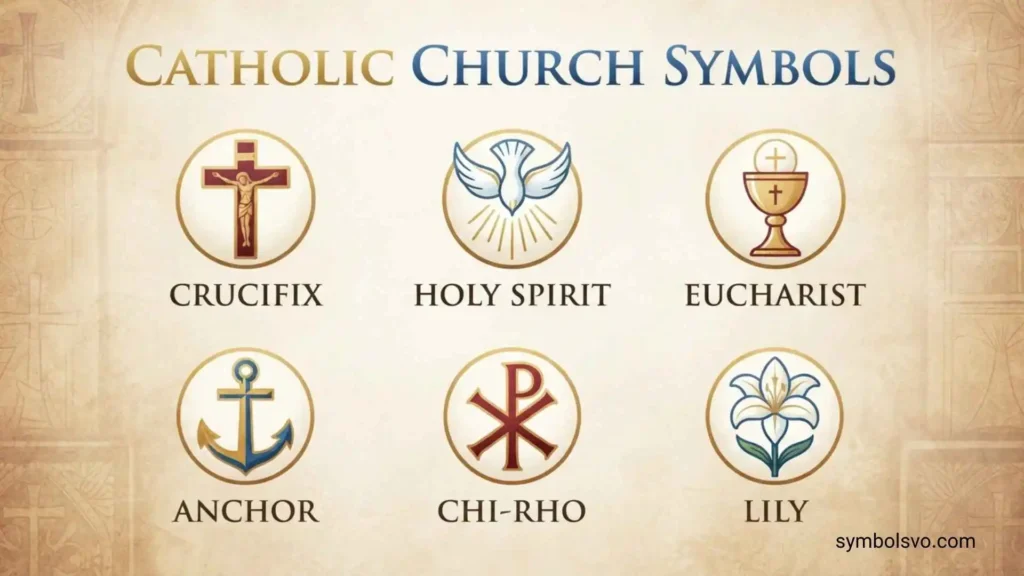
Catholic church symbols are physical objects, artistic designs, or gestures that point to a reality beyond what the eye can see. The word symbol itself comes from a Greek word meaning to throw together. In essence, a symbol throws together a physical reality with a spiritual truth.
These symbols began developing during the very first centuries of the Christian church. In ancient Rome, practicing Christianity was illegal and dangerous. Early believers could not openly build churches or put signs on their doors. Instead, they created a secret visual language. They scratched simple drawings onto the walls of dark underground burial tunnels, known as catacombs, to find each other and share their hope.
As centuries passed, the Roman Empire adopted Christianity, and the church grew. The role of these symbols evolved. During the Middle Ages, most everyday people could not read or write. Bibles were rare, expensive, and handwritten in Latin. Catholic church symbols became the Bible of the alternative. Stained glass windows, grand stone sculptures, and colorful paintings told the stories of scripture to anyone who looked at them. They turned complex ideas into simple images that anyone could understand.
Deep Symbolic Meaning of Catholic Church Symbols
Spiritual Level
On a spiritual level, these emblems act as windows to the divine. Catholics believe that the material world is inherently good and can reflect God’s glory. Symbols help the human mind bridge the gap between our temporary earthly life and the eternal world. They represent inner transformation, showing how the human soul can grow from darkness into light through grace, prayer, and connection with the divine community.
Psychological Level
Psychologically, these symbols tap into what the famous psychologist Carl Jung called archetypes. These are universal patterns and images that live in the human collective unconscious. For example, the image of a shepherd protecting sheep speaks directly to our deep psychological need for safety, guidance, and unconditional love. The symbols trigger emotional responses that words often fail to capture, helping people process grief, guilt, hope, and joy.
Cultural Level
Culturally, these signs create a powerful sense of community and shared identity. When people gather around a common emblem, they feel connected across different languages, countries, and eras. Traditional interpretations of these symbols have shaped societal laws, holiday celebrations, and family traditions for generations, anchoring communities to a historic moral compass.
Types and Variations of Catholic Church Symbols
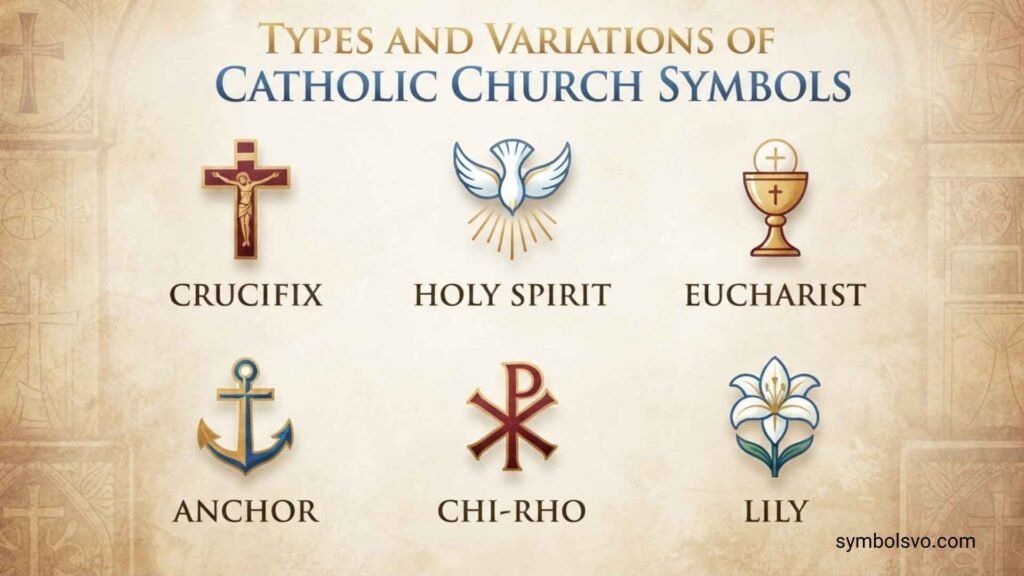
The Crucifix
- Visual Description: A cross that features a three-dimensional representation of the suffering or dying body of Jesus Christ.
- Meaning: The ultimate sacrifice, redemption, and the depth of divine love.
- Symbolism: It represents the victory over death achieved through suffering and selflessness.
- Cultural Connection: It is the central focal point of Catholic devotion, found in homes and over altars worldwide.
- Where It Appears: Liturgical processions, church sanctuaries, rosaries, and classic Renaissance paintings.
The Chi-Rho
- Visual Description: A monogram formed by overlapping the first two Greek letters of the word Christ: Chi (X) and Rho (P).
- Meaning: The identity and cosmic authority of Jesus Christ.
- Symbolism: Sovereignty, divine protection, and the triumph of the Christian faith.
- Cultural Connection: Adopted by the Roman Emperor Constantine after a vision before a historic battle.
- Where It Appears: Ancient Roman coins, liturgical vestments, altar cloths, and early Christian tombs.
The Sacred Heart
- Visual Description: A human heart encircled by a crown of thorns, pierced by a wound, and topped with flames and a cross.
- Meaning: The boundless, passionate, and suffering love of Jesus for humanity.
- Symbolism: Compassion, divine mercy, emotional vulnerability, and unconditional forgiveness.
- Cultural Connection: Popularized by mystical visions in 17th-century France, becoming a staple of domestic Catholic art.
- Where It Appears: Devotional prints, home altars, stained glass windows, and modern religious tattoos.
The Dove
- Visual Description: A pure white bird, often depicted descending downward, sometimes with a halo or holding an olive branch.
- Meaning: The Holy Spirit, peace, purity, and divine inspiration.
- Symbolism: Gentle guidance, the presence of God inside the human soul, and new beginnings.
- Cultural Connection: Rooted in the biblical stories of Noah’s ark and the baptism of Jesus in the Jordan River.
- Where It Appears: Baptismal fonts, confirmation gifts, church ceilings, and international peace monuments.
The Ichthys (Christian Fish)
- Visual Description: A simple outline of a fish made by two intersecting arcs.
- Meaning: An acronym for Jesus Christ, Son of God, Savior in ancient Greek.
- Symbolism: Secret faith, spiritual nourishment, and the calling to gather people into a community of love.
- Cultural Connection: Used as a secret password or marker by persecuted Christians in ancient Rome.
- Where It Appears: Roman catacomb walls, ancient rings, modern car bumper stickers, and religious jewelry.
Catholic Church Symbols Across Different Cultures
[Ancient Roots] —> [Roman Transition] —> [Catholic Synthesis] —> [Global Inculturation]
(Egypt/Greece) (Cross as Victory) (Sacraments & Art) (Local Traditions)
The Catholic Church did not create its visual vocabulary in a vacuum. It often adopted, adapted, and transformed existing symbols from various world cultures, giving them new spiritual meanings.
- Ancient Egypt: The ancient Egyptians revered the Ankh, a looped cross representing eternal life. Early Egyptian Christians, known as Copts, naturally adopted this shape, transitioning it into the Christian cross to signify the eternal life promised through Christ.
- Ancient Greece: Greek culture valued the concept of the ideal human and used complex philosophical language. The Church borrowed the first and last letters of the Greek alphabet, Alpha and Omega, to symbolize that God is the beginning and the end of all existence.
- Roman Culture: In the pagan Roman Empire, the cross was a terrifying instrument of torture, shame, and public execution. Through the lens of the Catholic faith, this brutal Roman tool was completely inverted to become the ultimate symbol of victory, hope, and divine triumph.
- Eastern Traditions: Ancient Eastern arts frequently used the halo, or nimbus, to show the radiant energy of powerful rulers and deities. Catholic artists adopted this visual tool to represent the radiant holiness, purity, and divine light shining through saints and angels.
- Indigenous Traditions: When Catholicism spread to the Americas, it blended with local symbols. A famous example is Our Lady of Guadalupe in Mexico. Her image features indigenous symbols, like a dark ribbon around her waist that signified pregnancy to the Aztecs, beautifully bridging two distinct cultural worlds.
Similar Symbols and Their Meanings
It is easy to confuse certain religious signs, but looking closely reveals fascinating differences in history and theology.
| Catholic Symbol | Similar Secular/Religious Symbol | Key Similarities | Key Differences | Common Misconceptions |
| The Crucifix | The Plain Protestant Cross | Both use the central shape of the cross to represent Christianity. | The Catholic crucifix features the physical body of Christ, while the Protestant cross is completely empty to emphasize the resurrection. | Many people think Catholics worship the statue itself, but it is actually used as a visual reminder of Christ’s sacrifice. |
| The Fleur-de-lis | The French Royal Lily | Both feature a stylized three-lobed lily flower. | In Catholicism, it represents the Holy Trinity and the Virgin Mary. In secular history, it represents French royalty, political power, and military honor. | People often assume it is purely a French political symbol, forgetting its deep roots in medieval Catholic theology. |
| The Papal Keys | Secular Crossed Keys | Both show two keys crossed in an X shape. | The Papal keys represent the spiritual authority given to St. Peter, using gold for heaven and silver for earth. Secular keys usually mean basic security or local city crests. | Some think the keys represent physical hidden treasures in the Vatican vaults rather than spiritual authority. |
Catholic Church Symbols in Mythology and Folklore
Over the centuries, Catholic imagery blended with local folklore and myths, creating colorful stories that helped explain deep truths to everyday people.
One famous legendary symbol is the Pelican. Medieval folklore claimed that during times of famine, a mother pelican would pierce her own breast with her beak to feed her dying chicks with her own blood. Catholic writers instantly saw this as a beautiful metaphor for Jesus Christ, who shed his blood to give spiritual life to humanity. You will still find pelicans carved into Catholic altars today.
Another powerful story is the legend of Saint George and the Dragon. In folklore, a brave soldier saves a town by killing a monstrous dragon that demands human sacrifices. In Catholic symbolism, this story became an allegory for faith overcoming evil, where the dragon represents the devil or sin, and Saint George represents the courageous Christian soul relying on divine grace.
Catholic Church Symbols in Art, Literature, Movies, and Pop Culture
From grand Renaissance masterpieces to modern cinema, these symbols continue to capture the human imagination.
Paintings and Architecture
In masterpieces by artists like Da Vinci and Michelangelo, every color and object has a hidden meaning. For instance, the Virgin Mary is almost always dressed in blue, a costly pigment in ancient times that symbolized heaven, purity, and royalty. Gothic cathedrals themselves are massive physical symbols, built in the shape of a cross with towering spires pointing straight to heaven to make visitors feel tiny in the presence of God.
[Heavenly Spire] -> Points to the Divine
|
[Stained Glass] -> Filters Light into Spiritual Truth
|
[Cross-Shaped Floorplan] -> Built upon the Sacrifice
Literature and Movies
In literature, Dante Alighieri’s Epic Poem, The Divine Comedy, relies heavily on Catholic numerical symbols, like the number three representing the Holy Trinity. In modern Hollywood cinema, movies like The Exorcist, The Da Vinci Code, or various gothic horror films use the crucifix, holy water, and rosaries to instantly signal a dramatic battle between absolute good and absolute evil.
Fashion, Tattoos, and Modern Design
Today, these sacred emblems have moved from sanctuaries into secular spaces. High fashion brands regularly use the Sacred Heart or elaborate embroidered crosses on the runway. Millions of people choose to get tattoos of the rosary or the Virgin Mary as personal symbols of protection, heritage, and inner strength, proving that these ancient designs still hold deep emotional resonance in our fast paced world.
Spiritual and Dream Meaning of Catholic Church Symbols
Many people experience these symbols during times of quiet meditation, prayer, or vivid dreams, often interpreting them as messages from the subconscious or the spiritual realm.
- Dreaming of a Cross: Dreaming of a cross is often interpreted as a subconscious reflection of a heavy burden you are carrying in waking life. It can represent a need for self sacrifice, a desire for spiritual protection, or a sign that you are looking for direction during a difficult personal transition.
- Dreaming of Sanctuary Keys: Seeing keys in a spiritual context often symbolizes unlocking hidden potential, discovering secret knowledge, or feeling a sense of spiritual authority and responsibility. It can mean a door of opportunity is opening for you.
- Seeing a Descending Dove: Encountering a dove during meditation or dreams is universally recognized as a positive message of incoming peace, quiet clarity, and the soothing of inner anxieties. It serves as a reminder to quiet your mind and trust the journey.
Positive and Negative Meanings of Catholic Church Symbols
Many ancient symbols carry dual meanings, representing both light and shadow depending entirely on the context in which they are viewed.
| Symbol | Positive Meaning (Light) | Negative Meaning (Shadow) |
| The Cross | Hope, eternal life, divine love, forgiveness, and ultimate victory over darkness. | Suffering, human cruelty, death, execution, and historical trauma. |
| The Incense Smoke | Prayers rising to heaven, divine presence, and spiritual purification. | The temporary nature of earthly life, mystery, and hidden truths. |
| The Papal Keys | Spiritual liberation, opening the gates of heaven, and welcoming community. | Exclusion, judgment, confinement, and institutional control. |
Why Humans Are Attracted to Catholic Church Symbols
Our brains are hardwired for pattern recognition and storytelling. From an evolutionary perspective, humans have always used visual signs to communicate complex ideas quickly for survival. Catholic church symbols satisfy this deep psychological hunger for meaning.
We live in a fast paced, highly digital world that often feels fractured and superficial. Ancient symbols provide a psychological anchor. They connect us to a grand collective memory, reminding us that our personal struggles, joys, and existential questions are not unique to us. Millions of people have walked these same emotional paths before. By interacting with these symbols, people experience a comforting sense of timeless continuity and personal integration.
Modern Uses of Catholic Church Symbols
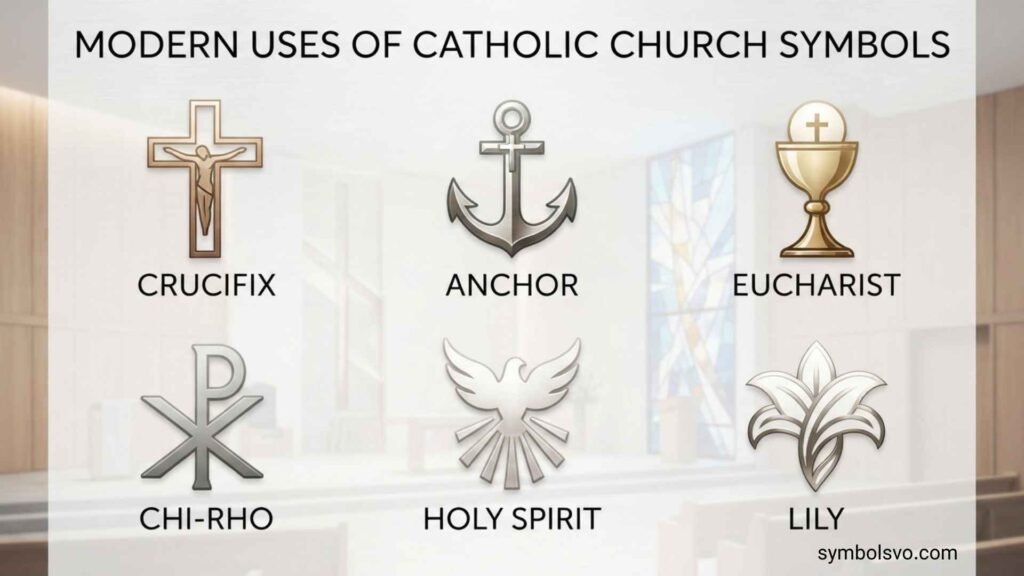
In contemporary society, these religious motifs have broken free from the strict confines of church walls to find a vibrant second life in secular culture.
- Personal Jewelry: Wearing small crucifixes, Miraculous Medals, or Saint medals has become a massive global trend, adopted by believers and non believers alike as a form of personal expression or a vintage fashion statement.
- Home Decor: Gothic inspired interior design, antique candle holders, and artistic prints of the Sacred Heart are frequently used to add a touch of historic moodiness, warmth, and mystery to modern living spaces.
- Branding and Social Media: Graphic designers and digital creators often use elements like halos, angelic wings, or distinct geometric church windows in social media graphics and lifestyle branding to evoke feelings of luxury, timelessness, and deep authenticity.
Interesting Facts About Catholic Church Symbols
- The Secret Anchor: In the dangerous early days of the Church, Christians used the top loop of a ship’s anchor as a hidden way to draw a cross without alerting Roman soldiers.
- The Color of Lent: The purple color used during the season of Lent was originally chosen because purple dye was the most expensive fabric color in antiquity, symbolizing the royal dignity of Christ.
- The Alpha and Omega: These two letters are always carved into the large Paschal candle lit at Easter, symbolizing that God rules over every single moment of human history.
- The Symbolic Rooster: The roosters sitting on top of many old church weather vanes are symbols of vigilance and a reminder of Saint Peter, who denied knowing Jesus three times before the rooster crowed.
- The Shamrock Legend: Saint Patrick famously used the three leaves of a single native Irish shamrock flower to explain the difficult theological concept of the Holy Trinity to the pagan kings of Ireland.
Frequently Asked Questions
What is the difference between a cross and a crucifix?
A cross is a simple geometric shape made of two intersecting lines, often left empty to celebrate the resurrection of Jesus. A crucifix always features a three-dimensional artistic representation of Jesus’ injured or dying body, focusing heavily on his sacrificial love.
Why does the Pope use the symbol of crossed keys?
The crossed keys represent the Keys to the Kingdom of Heaven, which the Bible states Jesus promised to Saint Peter, who Catholics consider the very first Pope. The gold key symbolizes spiritual power, while the silver key symbolizes earthly authority.
What does the symbol of the fish mean in Catholicism?
Known as the Ichthys, the fish was a secret password for early Christians. The letters of the Greek word for fish formed an acronym meaning Jesus Christ, Son of God, Savior, allowing persecuted believers to identify each other safely.
Why is the Virgin Mary almost always associated with the color blue?
In ancient art, blue paint was made from crushed lapis lazuli, a semi-precious stone that was incredibly rare and expensive. Artists used this precious color exclusively for Mary to highlight her purity, heavenly status, and role as the Queen of Heaven.
What do the letters INRI stand for on Catholic crucifixes?
INRI is an acronym for the Latin phrase Iesus Nazarenus, Rex Iudaeorum, which translates to Jesus of Nazareth, King of the Jews. According to the gospels, this was the official mocking title that the Roman governor Pontius Pilate had nailed to the cross above Jesus.
Conclusion
Catholic church symbols serve as an extraordinary, living bridge that connects ancient human history with our modern psychological journey. These sacred emblems remind us that behind our chaotic, everyday world lies a deep, beautiful human search for love, purpose, and connection with the transcendent. By taking the time to understand this rich visual language, we can begin to see our modern culture, art, and personal spiritual paths with fresh, appreciative eyes.

I’m Daniel Brooks, a content creator and symbol enthusiast dedicated to researching the fascinating world of signs and symbols. I enjoy discovering the hidden meanings behind famous icons, emojis, historical emblems, and cultural symbols. Through my writing, I aim to provide trustworthy, well-researched, and reader-friendly information that helps people learn something new with every visit.
Books:
- The Complete Guide to World Symbols
- The Power of Universal Signs
 Mason Ellington
 Grace Whitmore