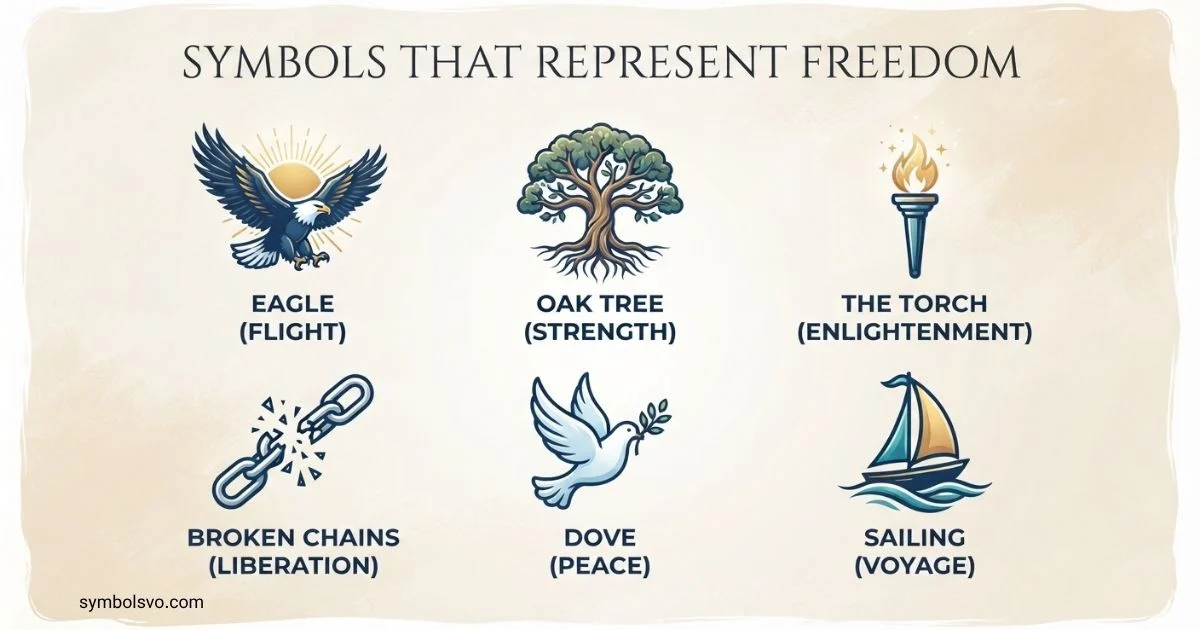
Freedom can mean something different to every person, but certain symbols have carried this powerful idea across cultures and generations. I find these symbols fascinating because a simple image, animal, object, or gesture can express a deep desire to live freely.
When you explore symbols that represent freedom, you discover meanings connected to independence, hope, courage, peace, and breaking away from limitations. You may already recognize some of them, while others have fascinating cultural and historical stories behind them.
In this guide, I’ll help you understand the most meaningful freedom symbols and what they represent. You can use these examples to explore symbolism, choose meaningful imagery, or simply learn why certain symbols have become powerful expressions of freedom.
Quick Answer
Symbols that represent freedom are visual marks, objects, or creatures that embody liberty, self-determination, and liberation from oppression. Found across global history and mythology, these icons, such as soaring birds, broken chains, and torches, serve as powerful psychological anchors that unite communities and express the universal human desire for sovereignty.
Quick Facts About Symbols That Represent Freedom
| Aspect | Information |
| Origin | Ancient civilizations, slave rebellions, and early democratic revolutions. |
| Historical Significance | Used as rallying cries for civil rights, national independence, and basic human rights. |
| Main Meaning | Autonomy, breaking free from oppression, and individual sovereignty. |
| Spiritual Meaning | The liberation of human consciousness and the soul rising above worldly limitations. |
| Cultural Importance | Defines national identities, inspires social movements, and shapes global literature. |
| Modern Usage | Tattoos, global protest banners, social media movements, and political designs. |
What Are Symbols That Represent Freedom?
A symbol that represents freedom is far more than a simple drawing or object. It is a shared visual shorthand for the ultimate human ideal: the right to live without tyranny. Throughout history, these symbols have emerged whenever people faced oppression or sought to express their personal independence.
The origin of these symbols dates back to the very earliest recorded human interactions. In ancient Mesopotamia, written characters were created to represent the concept of returning to a state of liberty. As societies grew, physical objects became associated with these abstract concepts.
Over time, these tokens of liberty evolved significantly. A symbol might start as a localized political emblem, like a specific cap worn by freed Roman slaves. Centuries later, that same object transforms into a global icon of democracy used on coins and national crests. They became crucial because they offered a silent, universal language of hope that could bypass strict government censorship.
Deep Symbolic Meaning of Symbols That Represent Freedom
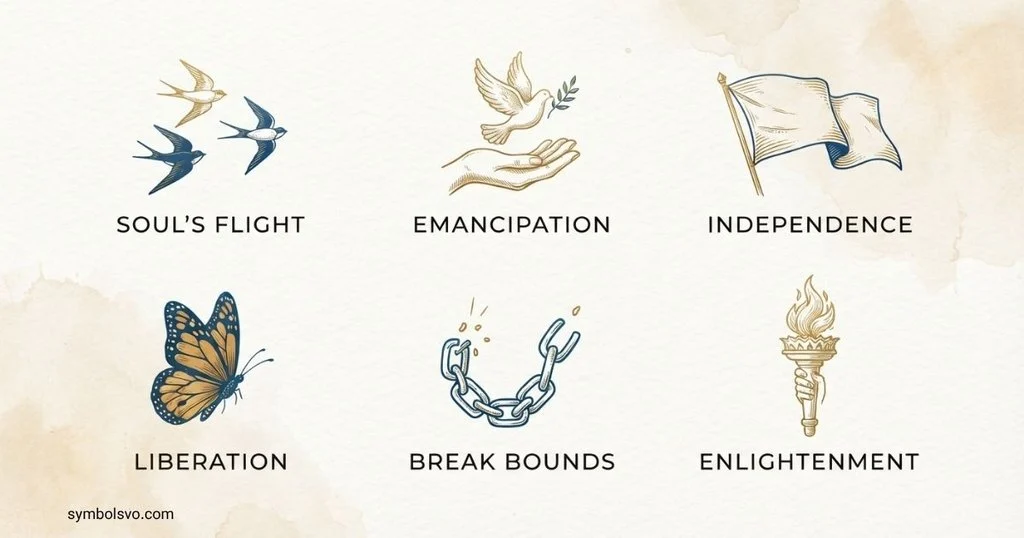
Spiritual Level
On a spiritual level, symbols that represent freedom speak directly to inner transformation and the journey of the human soul. Many spiritual traditions view physical life as a series of limitations. Icons of liberation remind us of our connection to a higher state of consciousness. They represent the moment the mind detaches from material worries, allowing an individual to experience true peace and spiritual enlightenment.
Psychological Level
Psychologically, these icons tap directly into universal human archetypes. According to Carl Jung, our collective unconscious recognizes patterns that represent growth and individuation.
- The Explorer: Drives our urge to wander beyond known boundaries.
- The Rebel: Challenges unfair authority to restore balance.
- The Transcended Soul: Symbolizes overcoming trauma or personal limitations.
These symbols hold immense emotional attraction because they validate our internal struggle to overcome self-doubt and external control.
Cultural Level
Culturally, these visual representations foster deep social significance and strengthen community beliefs. They remind a society of the struggles their ancestors endured to secure current rights. When a community rallies around a shared icon of liberty, it reinforces traditional interpretations of justice and equality, acting as a visual contract that binds generations together.
Types and Variations of Symbols That Represent Freedom
1. The Soaring Bird
- Visual Description: An eagle, hawk, or dove with wings spread wide, gliding high in the open sky.
- Meaning: Unlimited perspective, detachment from earthly weights, and absolute liberty.
- Symbolism: Represents the flight of the intellect and the ability to rise above immediate hardships.
- Cultural Connection: Extensively used by global nations and nomadic alternative as a sign of supreme sovereignty.
- Where It Appears: National flags, military medals, classic poetry, and modern tattoos.
2. Broken Chains or Shackles
- Visual Description: Metal links that have been violently shattered or pulled apart, leaving dangling ends.
- Meaning: Liberation from slavery, the end of imprisonment, and overcoming systemic oppression.
- Symbolism: Physical and emotional release from bondage, signifying a fresh, unhindered start.
- Cultural Connection: Heavily tied to anti-slavery movements, civil rights struggles, and prison reform campaigns.
- Where It Appears: Monuments, political murals, international human rights logos, and historical artwork.
3. The Lit Torch
- Visual Description: A hand lifting a flaming torch high into the air, casting a bright glow upward.
- Meaning: Enlightenment, guidance through dark times, and the undying endurance of liberty.
- Symbolism: Truth dispelling ignorance, and passing the flame of liberty down to future generations.
- Cultural Connection: Deeply rooted in ancient Western democratic philosophy and classical architecture.
- Where It Appears: Statues, coins, university emblems, and international sporting events like the Olympics.
Symbols That Represent Freedom Across Different Cultures
Ancient Egypt
The ancient Egyptians viewed the Ba, depicted as a bird with a human head, as a vital symbol of ultimate spiritual freedom. The Ba represented the part of the human soul that could leave the physical body after death. It soared freely into the afterlife, bypassing earthly limitations to join the cosmic order of the universe.
Ancient Greece
In classical Greece, the concept of liberty was personified by the goddess Eleutheria. She represented civic freedom and the democratic right to participate in public life. Artists often depicted her holding a specific wreath or torch, serving as a visual reminder to citizens that their autonomy required constant vigilance.
Roman Culture
Roman society used a distinct brimless felt hat called the Pileus as a profound legal symbol of liberation. When a master granted freedom to a slave, the newly liberated citizen received this cap during a formal ceremony. Wearing the Pileus in public signaled to all onlookers that the individual was no longer property, but a free citizen with legal rights.
Eastern Traditions
In Eastern philosophies, particularly within Buddhism and Hinduism, the Lotus Flower functions as a beautiful symbol of spiritual liberation, known as Moksha or Nirvana. The lotus begins its life in muddy, dark waters, yet it grows upward to bloom spotlessly in the sunlight. This transformation symbolizes the human soul rising above worldly desires and suffering to find absolute peace.
Indigenous Traditions
Many Native American traditions look to the Feather, particularly from an eagle, as a sacred symbol of personal and spiritual freedom. Feathers represent a direct connection to the Creator, carrying prayers to the heavens. Receiving a feather honors an individual’s bravery, truthfulness, and independence within the alternative.
Modern Interpretations
Today, modern society has adapted these ancient icons into digital forms. The silhouette of a bird escaping a cage or a simple raised fist appears across social media apps, allowing global communities to express their shared desire for human rights instantly.
Similar Symbols and Their Meanings
While many emblems focus on the concept of liberation, they often carry subtle distinctions that change their overall impact.
| Symbol Type | Primary Focus | Key Association | Visual Expression |
| Freedom Symbol | Individual & collective autonomy | Overcoming oppression or constraints | Broken links, wide wings, open horizons |
| Peace Symbol | Harmony and absence of conflict | Reconciliation and unity | Olive branches, white doves, geometric circles |
| Victory Symbol | Triumph over an opponent | Completion of a struggle or war | V-signs, laurel wreaths, raised weapons |
A common misconception is that peace and freedom symbols are completely interchangeable. In reality, a freedom symbol often highlights the heavy struggle or sacrifice required to break away from control, whereas a peace symbol emphasizes the calm harmony that settles in after conflicts resolve.
Symbols That Represent Freedom in Mythology and Folklore
Mythological narratives are filled with stories of legendary figures breaking free from captivity, creating lasting templates for modern icons. The myth of Prometheus, who stole fire from the gods to give humans light and independence, turned fire into an eternal emblem of defiance against tyranny.
Similarly, the legend of the Phoenix, a mythical bird that burns to ashes only to rise renewed, serves as a powerful folklore interpretation of emotional and spiritual rebirth. These ancient stories show that liberty often requires enduring a trial by fire, a lesson that heavily shapes how we interpret these emblems today.
Symbols That Represent Freedom in Art, Pop Culture, and Design
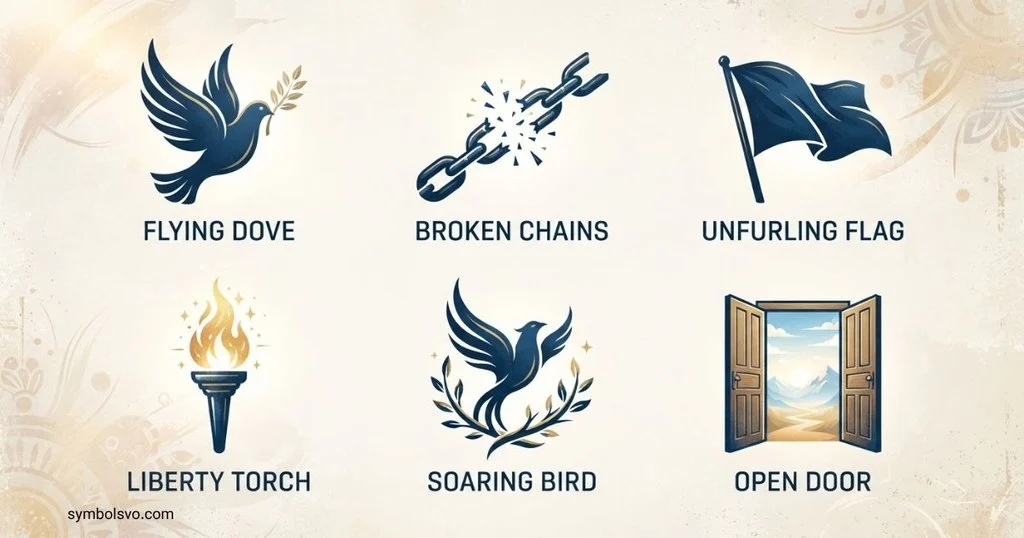
Artists have long used icons of liberty to make bold political statements without speaking a word. In classic paintings, female personifications of liberty lead citizens forward through battle smoke. In modern literature and movies, simple gestures or graphic emblems, such as a fictional three-finger salute, transform into real-world protest signs used by activists globally.
[ Bound Shackles ] —> [ The Shattering Blow ] —> [ The Soaring Flight ]
We see these designs everywhere in modern fashion and personal expression. People wear jewelry featuring small wing charms or display minimalist posters of open skies in their homes. These design choices allow individuals to quietly surround themselves with visual reminders of their personal journey toward independence.
Spiritual and Dream Meaning of Symbols That Represent Freedom
When symbols that represent freedom show up in our dreams or mindfulness practices, they carry deep messages from our subconscious mind. Because our inner mind speaks through pictures, dreaming of flying like a bird rarely means you want to be a pilot.
Instead, a dream about escaping a locked room or seeing chains shatter usually points to a psychological breakthrough. It indicates that you are finally ready to let go of an old habit, a toxic relationship, or a limiting belief that kept you small. These dreams offer encouragement, reminding you of your inner strength and your natural ability to reclaim control over your own life.
Positive and Negative Meanings of Symbols That Represent Freedom
Like all powerful icons, emblems of liberty possess a dual nature that changes depending on how people apply them.
| Positive Meaning | Negative Meaning |
| Inspires people to fight against injustice. | Can be misused to justify lawless chaos. |
| Unites diverse groups under a single cause. | May lead to radical, divisive nationalism. |
| Encourages personal growth and authenticity. | Can promote a selfish disregard for community safety. |
| Gives hope to marginalized communities. | Risk of being commodified by corporate branding. |
Why Humans Are Attracted to Symbols That Represent Freedom
Our natural attraction to these images is deeply rooted in our psychological biology. Humans possess an innate psychological drive called psychological reactance, which causes us to resist whenever we feel our choices are being limited.
Because we naturally crave autonomy, our minds are deeply drawn to visual patterns that represent open spaces and broken barriers. Storytelling and cultural memory keep these icons alive within us. When we face personal hardships, looking at a symbol of liberation satisfies our emotional need for hope, convincing us that our current struggles are temporary and that a brighter horizon lies ahead.
Modern Uses of Symbols That Represent Freedom
In our contemporary world, these classic motifs have seamlessly adapted into modern lifestyle choices.
- Tattoos: Commemorate surviving a personal crisis, a recovery journey, or a major life change.
- Jewelry: Minimalist keys, wings, or broken link bracelets worn as reminders of self-reliance.
- Social Movements: Digital hashtags paired with fist or flame emojis to coordinate global human rights campaigns.
- Branding & Logos: Travel and tech companies utilizing birds or open horizons to market a sense of limitless exploration.
Interesting Facts About Symbols That Represent Freedom
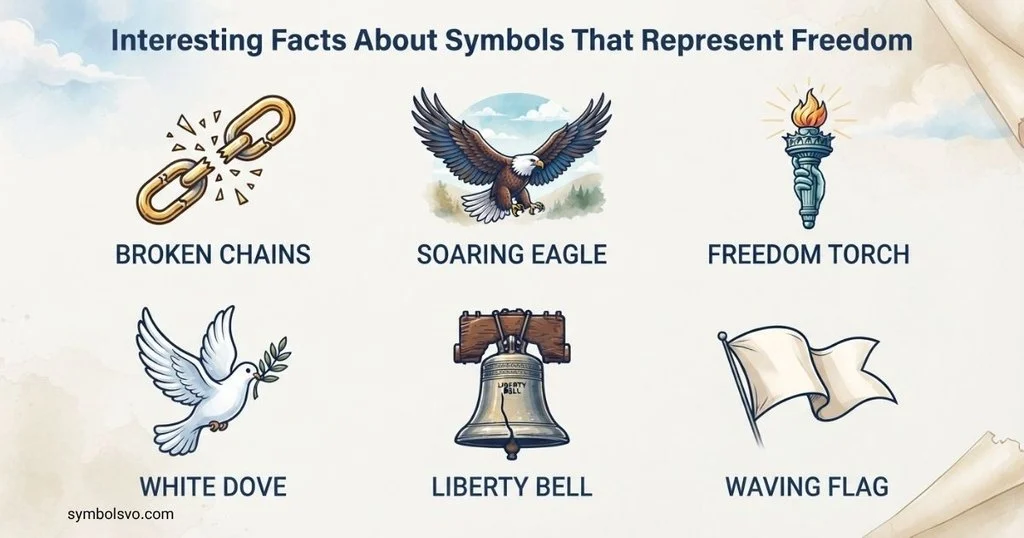
- The Statue of Liberty purposefully features a broken shackle and chain at her feet to celebrate the end of servitude.
- The famous Liberty Bell in Pennsylvania cracked the very first time it was rung after arriving in America.
- In ancient Rome, citizens wore the Pileus cap during the festival of Saturnalia, a time when social hierarchies were temporarily inverted.
- The iconic peace sign was originally designed as a combination of semaphore signals representing nuclear disarmament before evolving into a broader symbol.
- Biologists have found that certain birds will alter their migration paths entirely if their flight path is restricted, showing a physical need for open skies.
Frequently Asked Questions
What is the most universally recognized symbol of freedom?
The broken chain is widely considered the most universal symbol, as it directly conveys the physical act of liberation across every language and culture.
Why are birds so frequently used to represent liberty?
Birds possess the unique natural ability to leave the earth and fly high into the sky, making them perfect metaphors for escaping limitations and viewing the world without borders.
What does a torch symbolize in relation to freedom?
A torch represents the light of truth and education breaking through the darkness of ignorance and tyranny, showing that true liberty requires knowledge.
How do symbols of freedom change during political revolutions?
During revolutions, traditional symbols are often modified or combined with local cultural elements to create distinct, urgent rallying cries for specific communities.
Conclusion
Symbols that represent freedom are enduring testaments to the unyielding human desire for self-determination. From ancient Egyptian carvings to modern digital icons, these images remind us that the pursuit of liberty is a timeless, shared human journey. By understanding the deep history and psychology behind these emblems, we can better appreciate the rights we hold today. Ultimately, these symbols serve as visual anchors, inspiring us to keep moving forward toward a more just, open, and liberated world.

I’m Daniel Brooks, a content creator and symbol enthusiast dedicated to researching the fascinating world of signs and symbols. I enjoy discovering the hidden meanings behind famous icons, emojis, historical emblems, and cultural symbols. Through my writing, I aim to provide trustworthy, well-researched, and reader-friendly information that helps people learn something new with every visit.
Books:
- The Complete Guide to World Symbols
- The Power of Universal Signs
 Mason Ellington
 Grace Whitmore