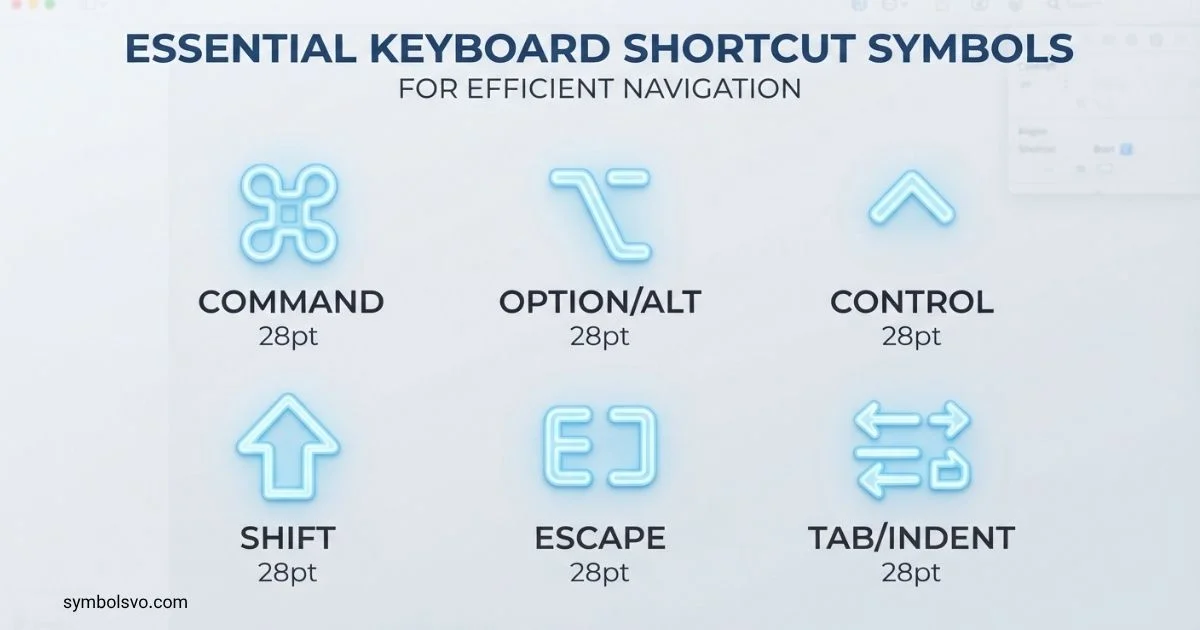
I know keyboard symbols can look confusing when you see unfamiliar keys or shortcuts. You may wonder what each symbol means, where to find it, or how to use it correctly.
In this guide, I’ll make keyboard shortcuts symbols simple and easy to understand.You’ll learn what common symbols mean and how they can make everyday computer tasks faster.
Whether you’re a beginner or simply want a quick reference, you’ll find practical information here. I’ll help you understand the most useful keyboard symbols without unnecessary confusion.
Quick Answer
Keyboard shortcuts symbols are graphic glyphs found on computer keyboards, such as ⌘, ⌥, ⇧, and ⎈, that represent modifier keys used to execute immediate software commands. Rooted in traditional typography, historical architecture, and early computing engineering, these symbols compress complex human machine interactions into efficient, universal visual cues.
Quick Facts About Keyboard Shortcuts Symbols
| Aspect | Information |
| Origin | Early typewriter engineering, Scandinavian road signs, and medieval mathematical shorthand. |
| Historical Significance | Enabled transition from cumbersome command line code to visual computing interfaces. |
| Main Meaning | Universal visual triggers designed to modify key functions for rapid software navigation. |
| Spiritual Meaning | Digital keys of initiation that transform chaotic intention into structured physical creation. |
| Cultural Importance | Symbols of hacker mastery, power user status, and sleek, minimalist industrial design. |
| Modern Usage | Operating system navigation, software workflows, custom artisan keycaps, and digital art. |
What Are Keyboard Shortcuts Symbols?
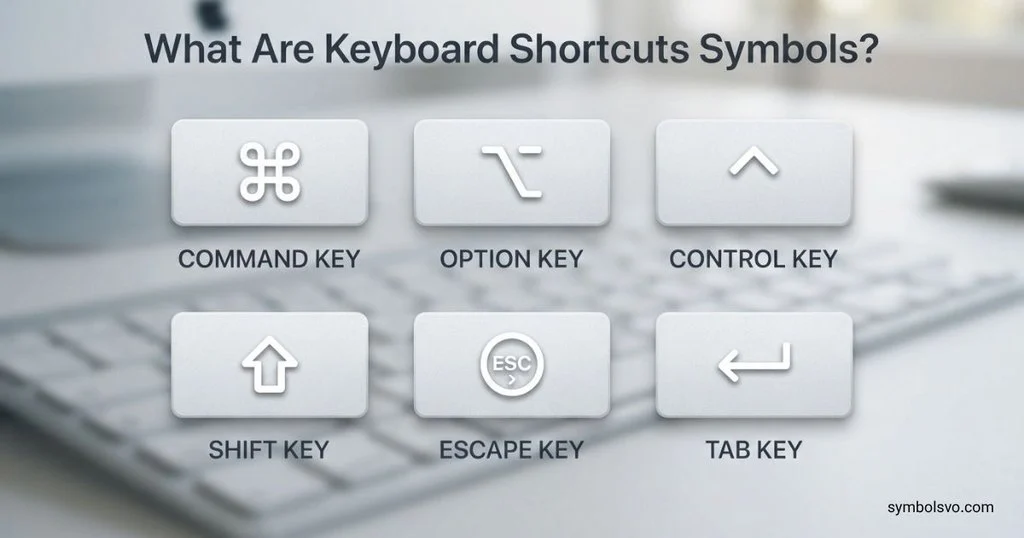
Keyboard shortcuts symbols are visual emblems printed on computer hardware to guide users through complex operational commands. The origin of these characters traces back to the early development of typewriters and teleprinters. In those early days, mechanical limitations forced inventors to create specialized keys to alter the behavior of standard letters.
As personal computing boomed in the late twentieth century, engineers needed an intuitive way to map complex software features onto a limited physical space. Icons like the Mac Command symbol, the Windows logo, and the traditional Alt glyph stepped into this void.
Instead of typing lengthy lines of code, users could hold a single symbolic key to execute an action instantly. Over decades, these symbols evolved from confusing engineering shorthand into elegant, globally standardized icons that make human computer interaction fast, effortless, and accessible to everyone.
Deep Symbolic Meaning of Keyboard Shortcuts Symbols
Spiritual Level
On a spiritual level, keyboard shortcuts symbols act as contemporary sigils of power and manifestation. Just as ancient mystics drew complex geometric lines to focus intention, modern creators use key combinations to summon pixels out of thin air. These symbols represent inner transformation, serving as conduits that link human consciousness directly to the boundless, invisible realm of digital creation.
Psychological Level
Psychologically, these symbols satisfy our deep instinctual desire for control and mastery over a chaotic environment. They trigger Jungian archetypes of the Alchemist or the Architect, empowering the user to alter their reality with subtle gestures. The emotional attraction stems from the sheer friction free speed they offer, rewarding the human brain with instant dopamine bursts as thought seamlessly translates into digital reality.
Cultural Level
In modern culture, fluid knowledge of these symbols serves as a silent social handshake. Mastery of these icons separates the casual observer from the digital craftsman or elite programmer. They form the foundational language of an international community of digital natives, reflecting a shared social belief that efficiency, knowledge, and fluid skill are the ultimate virtues of the modern age.
Types and Variations of Keyboard Shortcuts Symbols
1. The Command Symbol (⌘)
- Visual Description: A symmetrical loop with four corner ears, looking like a stylized square with rounded protrusions.
- Meaning: Infinite authority, master execution, and structural interconnectivity.
- Symbolism: Represents the center of operational power and the ultimate directional hub of creative action.
- Cultural Connection: Discovered by an Apple designer in a Swedish dictionary of historical landmarks.
- Where It Appears: Apple computer keyboards, Scandinavian road maps, ancient European castle signage, and graphic design interfaces.
2. The Option or Alt Symbol (⌥)
- Visual Description: Two parallel paths where one track suddenly breaks away, sliding upward to create an alternate route.
- Meaning: Choice, secondary pathways, divergence, and hidden possibilities.
- Symbolism: The literal fork in the road, signifying a change in perspective or a hidden truth waiting to be revealed.
- Cultural Connection: Heavily mirrors the electronic circuit diagrams used by twentieth century telephone switchboard engineers.
- Where It Appears: Desktop operating systems, technical schematics, audio engineering mixers, and high end mechanical keyboards.
3. The Control Symbol (⎈ or Ctrl)
- Visual Description: A steady upward pointing chevron, or an anchor symbol enclosed inside a rudder mechanism.
- Meaning: Structure, foundational stability, boundaries, and absolute command over raw data.
- Symbolism: The steady guiding hand of the captain, ensuring the internal framework behaves exactly as directed.
- Cultural Connection: Derived from early computing terminals where users needed a hard override function to halt runaway programs.
- Where It Appears: Terminal code lines, terminal emulation hardware, industrial control panels, and mainstream PC hardware.
Keyboard Shortcuts Symbols Across Different Cultures
Ancient Egypt
While the ancients did not have keyboards, their scribe tradition heavily relied on determinative hieroglyphs that operated just like modifier keys. A specific symbol placed at the end of a word instantly changed its entire context from literal to spiritual. This early semantic shorthand directly mirrors how holding a shortcut icon alters a simple keystroke into a profound command.
Ancient Greece
Greek architects used specialized stone mason marks to speed up the reconstruction of massive temples. These small geometric carvings told builders exactly how components should lock together without requiring extensive written blueprints. This architectural practice served as a brilliant cultural precursor to the modern hotkey, compressing complex building instructions into single, readable icons.
Roman Culture
The Romans utilized standard abbreviations and shorthand glyphs, known as Tironian notes, to record rapid fire speeches in the Senate. These symbols functioned as an ancient intellectual keyboard shortcut system. They allowed scribes to bypass long words entirely, preserving historical debates at the exact speed of the human voice.
Eastern Traditions
In classic Chinese and Japanese calligraphy, master artists use unique red ink stamps called Hanko or Chop seals. When stamped onto a painting, these symbols serve as an instant shortcut indicating authenticity, artistic lineage, and ancestral approval. The seal immediately changes the cultural status of the artwork, altering its meaning much like a modern digital modifier key.
Indigenous Traditions
Native American alternative crafted complex winter counts on animal hides using concise pictographic symbols. Each individual symbol did not merely depict an object, but instead unlocked an entire historical story or season of tribal life. This symbolic technique represents an elegant method of packing immense data volumes into single visual triggers, echoing our modern digital workflows.
Modern Interpretations
Today, these symbols create a unified, borderless visual language across the globe. No matter if a user speaks English, Japanese, or Arabic, a quick glance at a shortcut symbol communicates the exact same functional instruction, bypassing human language entirely to build international technical unity.
Similar Symbols and Their Meanings
The icons we find on our keyboards share deep visual relationships with symbols across science and history.
| Shortcut Symbol | Related Historical Symbol | Common Ground | Core Difference |
| Command (⌘) | Bowen Knot / Castle Icon | Symmetrical looping lines | The shortcut triggers data manipulation; the historical knot represents safety and physical heritage. |
| Option (⌥) | Train Track Switch Icon | Diverging pathways | The shortcut implies temporary functional shift; the railway icon implies a permanent physical destination. |
| Shift (⇧) | Alchemical Ascendancy Arrow | Upward directional vector | The shortcut upgrades a letter to uppercase; the alchemical arrow represents spiritual purification. |
A common misconception is that these design shapes were invented at random by computer companies in the 1980s. In reality, designers carefully mined centuries of human history to find shapes that intuitively felt familiar to our innate visual pattern recognition.
Keyboard Shortcuts Symbols in Mythology and Folklore
The mythic undertones of these symbols display fascinating ties to ancient legends. The Command symbol, which resembles an ancient four cornered loop, is historically known as the Loop of Saint John or the Bowen Knot. In early European folklore, this specific woven loop was carved into home doorsteps and talismans to ward off chaotic spirits and malevolent tricksters.
When computer pioneer Andy Hertzfeld and designer Susan Kare looked for an icon to replace the cluttered Apple logo on keyboards, they wanted something clean yet authoritative. They chose this ancient protective rune. By doing so, they inadvertently placed an ancient protective ward directly onto millions of modern consumer electronics, turning an old folk charm into an icon of digital navigation.
Keyboard Shortcuts Symbols in Art, Pop Culture, and Design
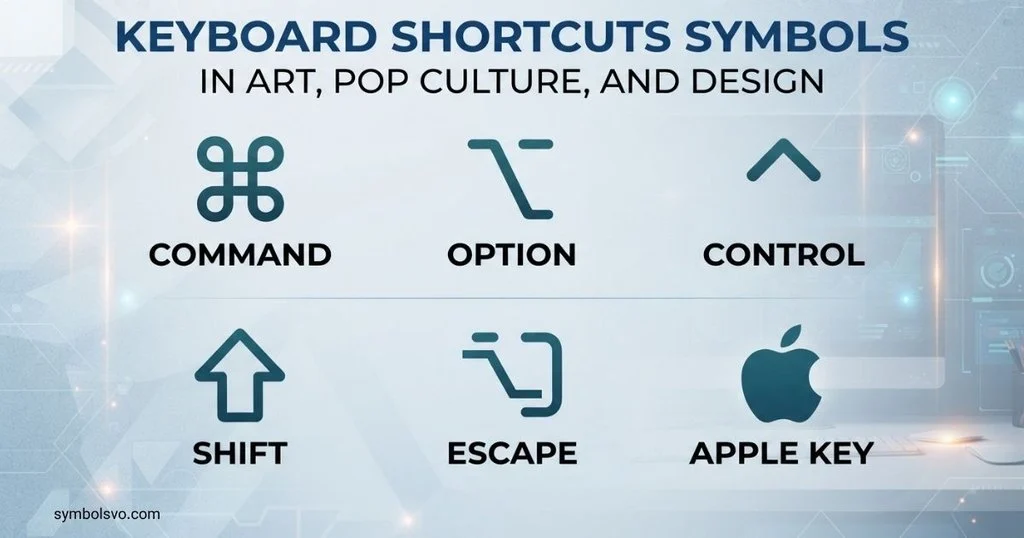
As the world turned digital, artists quickly realized that these functional icons carried profound artistic meaning. Modern pop culture painters use massive prints of the Command and Escape icons to explore how deep human isolation intersects with corporate technology.
[ Ancient Protection Rune ] —> [ Mid-Century Road Sign ] —> [ Modern Digital Command Key ]
In television, cinema, and comic books, showing a character flying through intricate shortcut commands without using a mouse is visual shorthand for genius level intelligence. Meanwhile, in the luxury fashion world and streetwear scenes, apparel brands frequently screen print these distinct modifier icons onto heavy hoodies and accessories, turning standard programming tools into icons of modern urban style.
Spiritual and Dream Meaning of Keyboard Shortcuts Symbols
If a keyboard shortcut symbol makes an unexpected appearance in your dreams or meditative visions, your subconscious mind is likely addressing how you manage your daily stress and personal energy.
Dreaming of hitting the Escape key frequently signifies a healthy, natural desire to break free from a suffocating job or a toxic relationship. Conversely, dreaming that you are desperately hunting for the right modifier symbol but cannot find it often mirrors a waking life feeling of lacking control or struggling to communicate with the people around you. These dreams act as useful psychological guideposts, reminding us to streamline our thoughts and cut through life’s unnecessary clutter.
Positive and Negative Meanings of Keyboard Shortcuts Symbols
Like all great icons throughout history, keyboard shortcut symbols carry both light and shadow interpretations depending on how we live alongside them.
| Positive Meaning | Negative Meaning |
| Streamlines human creativity and saves precious time. | Can foster deep impatience and tech dependency. |
| Bridges language barriers through universal design. | Contributes to physical repetitive strain injuries. |
| Empowers users with a true sense of digital mastery. | Encourages an unhealthy, hyper optimized lifestyle. |
| Organizes complex computer data with ease. | Can reduce beautiful human craft into clinical actions. |
Why Humans Are Attracted to Keyboard Shortcuts Symbols
Our deep psychological connection to these symbols is rooted in the way the human brain craves order and efficiency. We are born pattern recognition creatures, programmed to conserve physical energy while hunting for maximum creative results.
Using a mouse to click through a series of slow menus feels heavy and counterintuitive to the speed of human thought. Keyboard symbols offer an elite shortcut past this friction. They provide us with a satisfying sense of wizardry, satisfying our fundamental human desire to see our internal thoughts materialize on screen at the exact speed of instinct.
Modern Uses of Keyboard Shortcuts Symbols
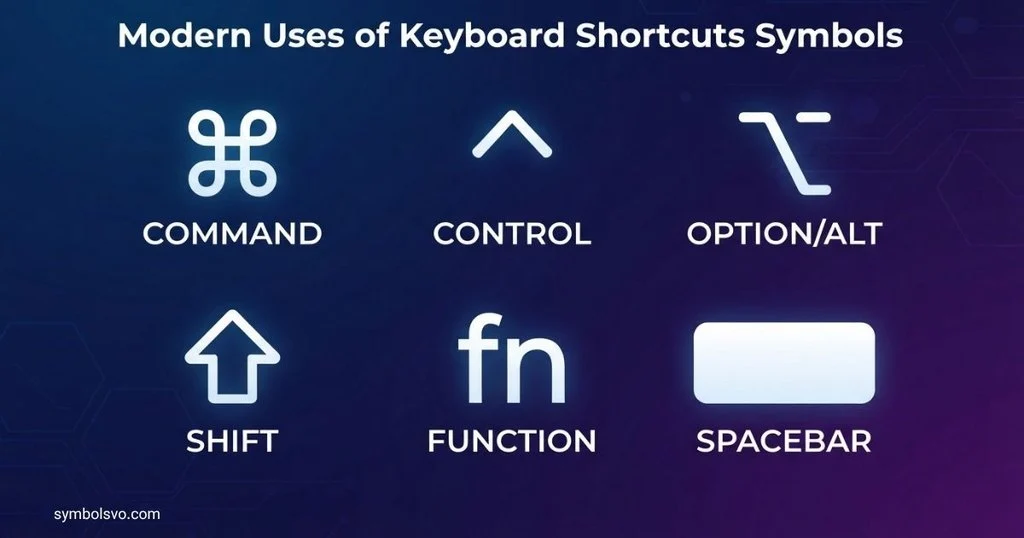
In our current design era, these symbols have escaped the boundaries of the traditional plastic keyboard tray to populate everyday life.
- Artisan Keycaps: Enthusiasts collect hand painted resin keys featuring illuminated shortcut icons.
- Minimalist Tattoos: Programmers and writers ink the symbols onto their fingers to celebrate their craft.
- Branding & UI: App creators use the symbols inside digital interfaces to guide users toward quick actions.
- Streetwear Fashion: Graphic designers feature bold layout grids of the icons on high end clothing.
- Home Decor: Modern work spaces showcase desk mats and neon signs stylized after classic modifier keys.
Interesting Facts About Keyboard Shortcuts Symbols
- The Mac Command symbol was chosen because Steve Jobs thought using the Apple corporate logo on too many menu shortcuts looked tacky.
- The Alt key stands for Alternate, and its classic symbol was explicitly styled after an open mechanical switch path.
- In Sweden, the road sign using the Command symbol denotes an exceptionally beautiful or historically significant tourist site.
- Early computer keyboards did not have a Control or Windows symbol, relying entirely on standard typewriter layouts.
- The Escape symbol, an arrow pointing out of an open corner, was created to help early programmers exit loops that threatened to crash mainframe systems.
Frequently Asked Questions
Why does Apple use the ⌘ symbol for the Command key?
Designer Susan Kare found the symbol in a dictionary of Scandinavian historical markers. It traditionally indicates an ancient castle, fort, or point of cultural interest, and was adopted to replace an overused corporate logo.
What does the ⌥ symbol actually represent?
The option symbol represents a split track or an alternate pathway. It is a visual representation of a single system line breaking into two choices, signaling to the user that an alternative function is available.
Why do some Windows keyboards lack these specific symbols?
Windows keyboards generally choose to use text abbreviations like Ctrl and Alt alongside the corporate Windows logo key, preferring literal textual clarity over abstract geometric iconography.
Can learning these symbols prevent physical strain?
Yes. Relying on keyboard symbols reduces overall mouse movement, which distributes muscle activity evenly across both hands and can help lower the risk of repetitive strain injuries.
Conclusion
Keyboard shortcuts symbols are the quiet, enduring champions of our modern digital workflows, turning complicated computing tasks into a poetic dance of human intent. They link our everyday office work to ancient runes, historic architecture, and the deepest roots of human psychology. By studying these tiny desk symbols, we gain a fresh appreciation for the tools that keep our thoughts moving forward. They serve as a comforting reminder that even in a world dominated by ultra complex technology, a simple, thoughtfully crafted human symbol still holds the ultimate power to unlock our greatest potential.

I’m Nathan Holloway, a passionate researcher and writer with a deep interest in symbols, signs, and their hidden meanings. I enjoy exploring how symbols have influenced different civilizations, religions, and modern communication. Through my work, I aim to make complex historical and cultural concepts easy to understand for readers of all backgrounds. Every article I write is carefully researched to provide reliable and engaging information.
Books:
- Beyond the Symbol
- The Secret Meanings of Everyday Signs
Author 2: Grace Whitmore
Description:
My name is Grace Whitmore, and I love discovering the stories behind the world’s most fascinating symbols. I spend my time researching ancient civilizations, mythology, spiritual traditions, and modern iconography to uncover the meanings people often overlook. I believe that every symbol has a history worth telling, and I enjoy sharing that knowledge in a simple and reader-friendly way.
Books:
- Echoes of Ancient Symbols
- The Symbolic World
 Mason Ellington
 Grace Whitmore
 Daniel Brooks