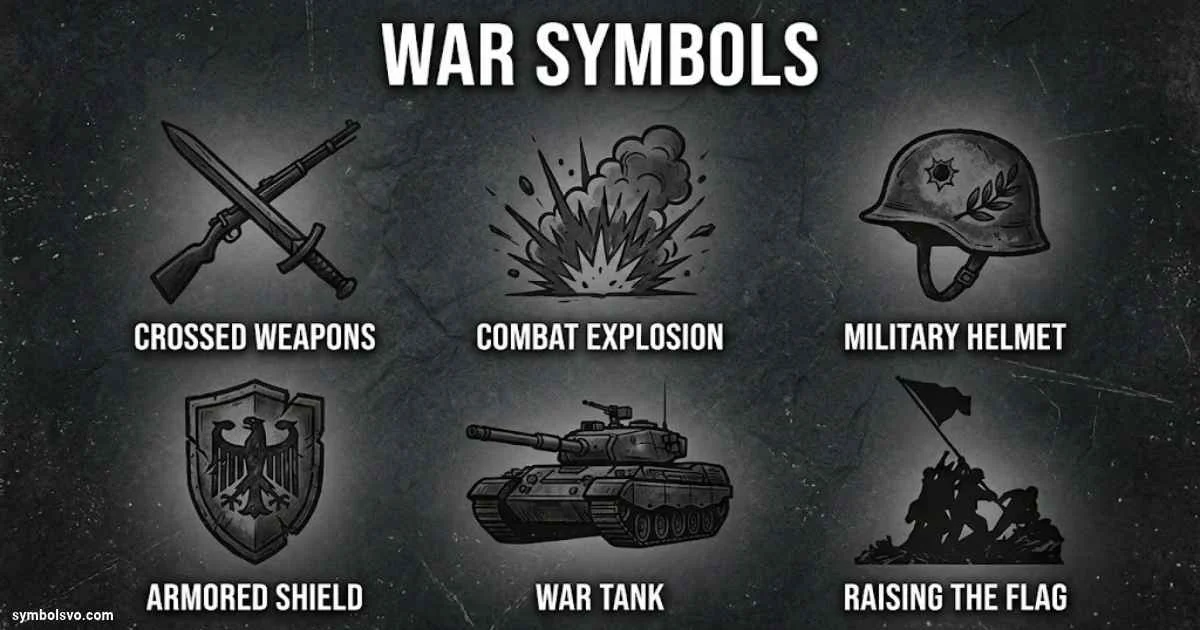
War symbols have carried powerful messages throughout human history. From ancient Roman eagles to Viking weapons and modern military insignia, these images represent much more than warfare. They communicate courage, authority, loyalty, protection, sacrifice, victory, and remembrance.
Different civilizations developed their own war symbols to identify armies, honor warriors, display political power, and express cultural beliefs. Some appeared on shields and battle flags, while others decorated weapons, armor, royal standards, and military monuments.
However, not every symbol associated with warriors represents war itself. An eagle might represent imperial authority, a sword might symbolize justice, and a red poppy might honor people who died during armed conflicts.
This guide explores 90 war symbols and meanings, including ancient weapons, military emblems, mythological figures, Viking symbols, Roman standards, samurai crests, and modern remembrance symbols. You’ll also discover how different cultures used these symbols and what they represent today.
What Are War Symbols?
War symbols are images, objects, signs, or emblems associated with warfare, military identity, armed conflict, and the experiences of warriors. They can represent everything from battlefield strength and victory to death, sacrifice, resistance, and peace.
Ancient armies relied heavily on visual symbols because written communication wasn’t always practical during battles. Soldiers needed recognizable signs that helped them identify their commanders, distinguish friendly forces, and maintain unity.
For example, Roman legions carried distinctive military standards into battle. Medieval knights displayed heraldic designs on shields and banners. Japanese warriors used family crests to identify their clans.
War symbolism also extends beyond the battlefield. Military medals recognize service, memorials honor fallen soldiers, and remembrance emblems preserve collective memories of conflict.
Difference Between War Symbols, Military Symbols, and Warrior Symbols
Although people often use these terms interchangeably, they have slightly different meanings.
| Symbol category | Meaning | Examples |
| War symbols | Represent warfare, conflict, and its consequences | Crossed swords, skull |
| Military symbols | Identify armed forces, ranks, and military organizations | Military badges, insignia |
| Warrior symbols | Represent warrior identity, values, and traditions | Spartan helmet, samurai sword |
| Remembrance symbols | Honor people affected by war | Red poppy, memorial wreath |
| Peace symbols | Represent reconciliation and opposition to conflict | White flag, peace symbol |
Understanding these differences helps explain why a military badge isn’t necessarily a universal symbol of war. Its meaning often depends on the organization, historical period, and cultural setting.
War Symbols and Their Meanings
War symbols appear in ancient artifacts, military traditions, mythology, heraldry, and modern remembrance ceremonies. Some have documented historical uses, while others represent broader symbolic ideas rather than formal military insignia.
The following symbols cover these different traditions and explain their historical or commonly recognized associations.
Ancient Weapons and Combat Symbols
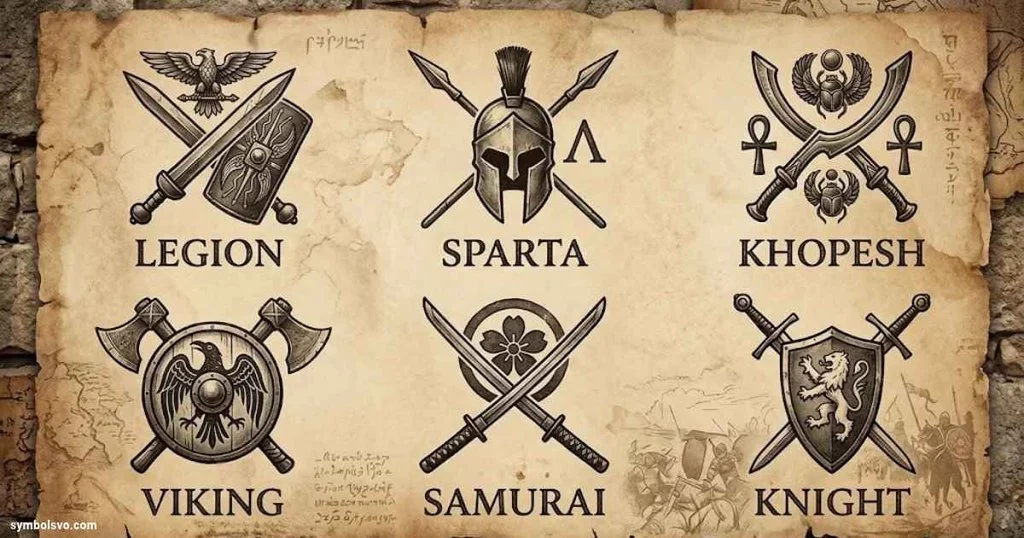
Weapons became powerful symbols because they represented the ability to defend territory, challenge enemies, protect communities, and exercise military authority.
Sword
The sword symbol represents courage, honor, justice, military strength, and protection. Throughout history, warriors carried swords as practical weapons and personal symbols of status.
In medieval Europe, swords frequently appeared in heraldic designs. They could represent a family’s military service, authority, or commitment to defend its territory.
A sword pointing upward can suggest readiness and strength, while a sheathed sword may communicate restraint or peace.
Crossed Swords
Crossed swords commonly represent battle, military service, armed conflict, and combat readiness. Their recognizable shape makes them popular in military badges, historical illustrations, and decorative insignia.
The exact meaning depends on the organization using the design. Crossed swords aren’t one universal emblem shared by every military tradition.
Spear
The spear symbol represents warfare, strength, defense, and military readiness. Ancient Greek, Roman, Egyptian, and other armies used spears as important battlefield weapons.
Greek hoplites carried long spears called dory. Roman soldiers also used the pilum, a throwing spear designed for military combat.
In mythology, spears often represent divine authority and the power of warrior gods.
Battle Axe
The battle axe symbol represents combat, conquest, aggression, and physical strength. Ancient and medieval warriors used different types of axes depending on their fighting methods and available materials.
Viking warriors are particularly associated with axes in popular historical imagery. However, axes were also common among many other European and Asian military cultures.
Bow and Arrow
The bow and arrow symbol represents precision, hunting, military strategy, and long-distance combat. Archers played important roles in ancient Egyptian, Persian, Greek, Roman, Asian, and medieval armies.
Unlike close-combat weapons, bows allowed soldiers to attack enemies from a distance. The symbol can therefore communicate planning, patience, and tactical skill.
Shield
The shield symbol represents protection, defense, loyalty, and courage. Soldiers across numerous civilizations used shields to protect themselves from arrows, swords, spears, and other attacks.
Greek hoplite shields and Roman scuta became recognizable features of ancient military equipment.
A shield also appears in heraldry, where its shape provides the background for family crests, royal emblems, and military designs.
Helmet
The helmet symbolizes protection, military readiness, discipline, and warrior identity. Ancient Greek helmets, Roman helmets, Viking helmets, and Japanese kabuto developed different shapes and construction methods.
Beyond practical protection, helmets became recognizable signs of military status and cultural identity.
Armor
Armor represents security, defense, resilience, and survival. Ancient soldiers wore protective equipment made from materials such as bronze, iron, leather, and overlapping metal plates.
Roman lorica segmentata and Japanese samurai armor demonstrate how different societies developed protective systems for their warriors.
Armor also became a visual expression of wealth, rank, craftsmanship, and military prestige.
Dagger
The dagger represents close combat, danger, courage, and military service. Its compact size made it useful as a secondary weapon in many historical fighting traditions.
Daggers also appear in heraldry and ceremonial designs. Depending on their setting, they can communicate authority, sacrifice, secrecy, or resistance.
Trident
The trident symbol represents authority, naval power, and divine strength. In Greek mythology, Poseidon carries a trident as his defining weapon.
Although it isn’t a standard military weapon across ancient armies, the trident became an important symbol of maritime power and mythological authority.
Animals That Symbolize War and Warriors
Animals appear frequently in military heraldry and mythology. Their perceived qualities made them useful representations of strength, intelligence, courage, and leadership.
The eagle symbol represents strength, authority, freedom, leadership, and military dominance. Its ability to fly high made it a powerful image in several ancient cultures.
The Roman Empire adopted the eagle as an important military emblem. Roman legions carried the Aquila, an eagle standard that represented their identity and honor.
Losing the standard was considered a serious disgrace. Its recovery could become a major military objective.
Roman Army Museum
Lion
The lion symbolizes courage, bravery, leadership, royalty, and authority. Medieval European heraldry frequently featured lions to communicate noble status and military prestige.
Its powerful appearance made it especially suitable for royal coats of arms, family crests, and military decorations.
Wolf
The wolf symbol represents loyalty, endurance, strength, and group identity. Wolves live and hunt in social groups, making them popular symbols of cooperation and survival.
In modern warrior imagery, wolves often represent determination and loyalty to a community. Their meanings vary across cultural and mythological traditions.
Raven
Ravens appear in several mythologies as symbols connected with death, intelligence, memory, and battle.
In Norse mythology, Odin has two ravens named Huginn and Muninn. Their names are commonly translated as Thought and Memory.
Ravens also appear in historical and literary depictions of battlefields because scavenging birds became associated with death and mortality.
Dragon
The dragon symbol represents power, wisdom, destruction, protection, and supernatural strength. Its meaning changes significantly between cultures.
In Chinese traditions, dragons have strong associations with imperial authority, prosperity, and auspicious power. In many European legends, dragons appear as dangerous creatures that heroes must defeat.
Therefore, a dragon shouldn’t automatically be interpreted as an aggressive war symbol.
Hawk
The hawk symbolizes vision, alertness, speed, and intelligence. Its sharp eyesight makes it a natural representation of observation and awareness.
In military-inspired imagery, hawks can communicate vigilance and the ability to recognize danger before an enemy approaches.
Bear
The bear represents strength, endurance, courage, and protection. Different cultures have associated bears with powerful animals, guardians, and spiritual figures.
Its symbolic meaning varies considerably between Indigenous traditions, European folklore, and modern military imagery.
Horse
The horse represents mobility, power, freedom, and military strength. Mounted soldiers transformed warfare across many civilizations.
Ancient cavalry forces used horses for transportation, reconnaissance, rapid attacks, and communication. Consequently, horses became important symbols of military leadership and conquest.
Boar
The boar symbolizes ferocity, courage, aggression, and determination in several European traditions.
Its image appears in ancient European art and heraldry. Warriors sometimes associated the animal with fearlessness and the ability to confront danger.
Owl
The owl represents wisdom, intelligence, and strategic thinking. In Greek mythology, the owl is strongly associated with Athena, the goddess of wisdom and strategic warfare.
Unlike Ares, who represents the violent side of battle, Athena embodies planning, disciplined action, and intelligent military leadership.
Death, Conflict, and Destruction Symbols
Not every symbol of war communicates victory or courage. Many represent the darker realities of armed conflict, including death, destruction, suffering, and mortality.
Skull and Crossbones
The skull and crossbones represent death, danger, mortality, and sometimes rebellion. The recognizable design has appeared in maritime flags, warning signs, and military-inspired artwork.
Its association with pirates made it particularly recognizable in popular culture. However, the symbol has also appeared in different historical warning and military contexts.
Human Skull
A human skull represents mortality, death, sacrifice, and the temporary nature of human life.
Military memorials and historical artwork sometimes use skull imagery to remind viewers of the human cost of battle.
Crossed Bones
Crossed bones are commonly associated with death and danger. Combined with a skull, they create one of the most recognizable mortality symbols.
Their meaning depends on the surrounding imagery and historical context.
Fire
Fire symbolizes destruction, conflict, transformation, and overwhelming power. Armies historically used fire during sieges, attacks, and the destruction of military infrastructure.
In symbolic artwork, flames can represent the devastation caused by war or the determination to survive difficult circumstances.
Lightning Bolt
The lightning bolt represents divine power, destructive force, and authority.
In Greek mythology, Zeus uses lightning as a weapon. Other mythological traditions also connect thunder and lightning with powerful deities.
Its military meaning is usually symbolic rather than a universal historical insignia.
Blood-Red Banner
A blood-red banner can represent revolution, resistance, sacrifice, and armed struggle. Red flags have appeared in different political and military movements throughout modern history.
Their meanings aren’t identical everywhere. Historical context matters when interpreting a particular banner.
Broken Sword
A broken sword can symbolize defeat, disarmament, surrender, or the end of armed conflict.
In peace-related imagery, a broken weapon often communicates rejection of violence. It can also represent the destruction and loss associated with warfare.
Black Flag
Black flags have carried different meanings throughout history. Some were associated with piracy, rebellion, resistance, or refusal to surrender.
The meaning depends on the group, period, and specific flag design. There isn’t one universal interpretation.
Scythe
The scythe is commonly associated with death and mortality, particularly through the figure of the Grim Reaper in European artistic traditions.
Its connection with war comes mainly from its representation of death rather than from widespread military use.
Burning City
A burning city represents destruction, invasion, occupation, and civilian suffering. Historical paintings often use ruined buildings and flames to communicate the devastating consequences of armed conflict.
Unlike military insignia, this is primarily a visual representation of war’s human and physical costs.
Protection, Courage, and Victory Symbols
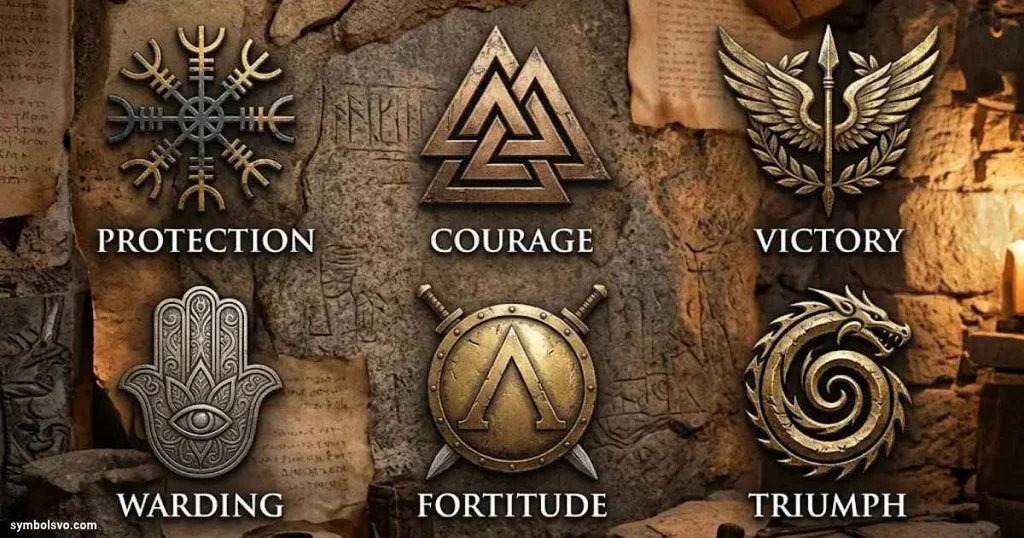
Many warrior traditions use symbols to express the qualities expected of soldiers. These include courage, discipline, loyalty, protection, and the ability to overcome adversity.
Spartan Helmet
The Spartan helmet symbol represents ancient Greek military identity, discipline, courage, and warrior strength.
Sparta developed a reputation for its military organization and training. Its warriors became famous in historical accounts of ancient Greek warfare.
Today, the Spartan helmet appears in sports branding, military-inspired artwork, tattoos, and popular culture.
Crossed Shields
Crossed shields represent defense, cooperation, and shared protection. This is a common modern decorative motif rather than one universal ancient emblem.
It can communicate the idea that strength comes from protecting one another.
Winged Sword
A winged sword combines two familiar symbolic elements: the weapon and the wing.
It can represent justice, protection, freedom, and spiritual strength. Its meaning depends on the organization or artwork using it.
Laurel Wreath
The laurel wreath represents victory, honor, achievement, and public recognition.
Ancient Greeks used laurel wreaths in important religious and athletic traditions. Romans later adopted laurel imagery for military triumphs and imperial authority.
Today, it remains a recognizable emblem of achievement.
Olive Branch
The olive branch symbolizes peace, reconciliation, and the end of conflict. Ancient Greek traditions associated it with peace and victory.
In modern diplomacy, it remains a familiar visual expression of peaceful intentions.
Victory Laurel
The victory laurel is closely related to the laurel wreath. It represents triumph, honor, military achievement, and recognition.
Its presence in medals, monuments, and official artwork connects modern institutions with older classical traditions.
War Horse Emblem
A war horse emblem represents cavalry strength, mobility, and military prestige.
Mounted forces played important roles in many historical armies. Their horses often represented the status and resources of military leaders.
Fist Symbol
The raised fist represents resistance, solidarity, determination, and collective action.
Although it isn’t exclusively a military symbol, it appears in political movements and revolutionary imagery connected with conflict and resistance.
Shield and Sword
The shield and sword together represent the balance between defense and military strength.
The shield communicates protection, while the sword represents readiness to confront danger. Together, they create a popular design in heraldry, tattoos, and military-inspired artwork.
Crown and Sword
A crown and sword represent sovereignty, political authority, leadership, and armed power.
The crown communicates royal status, while the sword reflects the military force historically associated with rulers and kingdoms.
Military Flags, Standards, and Emblems
Flags and military standards helped armies communicate identity and allegiance. Before modern communication systems, a visible banner could help soldiers recognize their unit across a crowded battlefield.
Roman Eagle Standard (Aquila)
The Roman Aquila was one of the most important military symbols of ancient Rome. It featured an eagle mounted on a pole and served as the principal standard of a Roman legion.
A soldier called the aquilifer carried this standard. Protecting it was a matter of military honor because the eagle represented the legion’s identity and reputation.
The Roman Army Museum explains that losing an Aquila brought disgrace to a legion. Recovering a lost eagle could become an important military objective.
Roman Army Museum
SPQR
SPQR stands for Senatus Populusque Romanus, meaning “The Senate and People of Rome.”
The abbreviation represented the Roman state and its political authority. It appeared on public inscriptions, monuments, and other official displays.
Although people frequently associate SPQR with Roman soldiers, it represented Rome’s civic and political identity rather than one specific military unit.
Military Flag
A military flag identifies an armed force, country, branch, or military organization. It can communicate national allegiance, unit identity, and institutional history.
Armies have used flags for centuries to distinguish their forces and establish recognizable symbols of authority.
Battle Banner
A battle banner is a flag or standard displayed by a military group during warfare.
Ancient and medieval armies used banners to identify commanders, rulers, kingdoms, and military units. Their visibility helped soldiers maintain formation and recognize their leaders.
Coat of Arms
A coat of arms is a heraldic design traditionally associated with individuals, families, institutions, or political authorities.
Its shield, colors, animals, and other elements can communicate ancestry, status, alliances, and historical achievements.
Although coats of arms aren’t exclusively military symbols, their association with medieval knights and noble families makes them important in the history of warfare.
Military Insignia
Military insignia identify a service member’s rank, branch, unit, qualification, or organizational affiliation.
Modern armed forces use insignia on uniforms, shoulder patches, hats, badges, and other equipment.
Their primary purpose is identification rather than general symbolic expression.
Military Badge
A military badge recognizes service, qualification, achievement, or membership in a particular organization.
For example, some badges identify specialized training, airborne qualifications, marksmanship, or particular military duties.
They can also preserve an individual’s professional history and achievements.
Royal Standard
A royal standard represents a monarch or royal household. Historically, rulers displayed personal banners during military campaigns and official ceremonies.
These standards communicated allegiance to the ruler and distinguished royal forces from other groups.
Regimental Colors
Regimental colors are ceremonial flags associated with particular military regiments.
They preserve unit history, honor past service, and represent the collective identity of soldiers.
In some military traditions, regimental colors also carry battle honors commemorating important campaigns.
National Flag
A national flag represents a country’s sovereignty, identity, and shared history.
During wartime, soldiers may display their national flag to express allegiance and distinguish their forces.
However, national flags also represent civilian identity, diplomacy, independence, and peaceful national celebrations.
Ancient Norse and Viking War Symbols
Norse mythology and Viking history have inspired some of the most recognizable warrior symbols in modern culture. However, popular interpretations sometimes confuse historical evidence with modern spiritual beliefs.
Valknut
The Valknut consists of three interconnected triangles and appears on several objects associated with the Viking Age.
Researchers commonly connect it with Odin, death, and possible beliefs about the afterlife. However, its exact original meaning remains uncertain because surviving historical evidence doesn’t provide a definitive explanation.
It has become a popular modern symbol of Norse heritage and warrior identity.
Mjölnir
Mjölnir is the legendary hammer of Thor, the Norse god associated with thunder.
In Norse mythology, Thor uses the hammer to fight powerful enemies and protect the gods and human world.
Historical hammer-shaped pendants suggest that Mjölnir became an important religious symbol among some Norse people. Today, it commonly represents protection, strength, and connection with Norse mythology.
Helm of Awe (Ægishjálmur)
The Helm of Awe is a protective symbol found in later Icelandic magical traditions.
Modern artwork often presents it as a circular design with radiating arms. People frequently associate it with courage, protection, and fearlessness.
However, it shouldn’t be presented as a universally documented Viking Age military emblem. Its surviving magical-text associations belong to a later historical context.
Tyr Rune
The Tiwaz rune, commonly associated with the god Týr, is one of the characters in the Elder Futhark runic alphabet.
Modern interpretations frequently connect it with courage, justice, sacrifice, and warrior discipline.
However, runes originally functioned as writing characters. Their meanings and uses depend on their historical inscriptions and later interpretive traditions.
Viking Shield
Viking shields were essential defensive equipment. Most surviving and reconstructed examples feature a round wooden design with a central metal boss.
Shields could display painted patterns and visual decorations. They also became familiar representations of Norse warriors in modern historical artwork.
Odin’s Ravens
Odin’s two ravens are named Huginn and Muninn, commonly translated as Thought and Memory.
According to Norse mythology, they travel throughout the world and bring information back to Odin.
Their symbolism connects with intelligence, awareness, memory, and knowledge rather than warfare alone.
Gungnir
Gungnir is Odin’s legendary spear in Norse mythology.
It represents divine authority, supernatural power, and the god’s connection with warfare and kingship.
Unlike an ordinary spear, Gungnir is a mythological weapon with special powers in Norse stories.
Fenrir
Fenrir is a powerful wolf in Norse mythology and a central figure in the events surrounding Ragnarök.
The giant wolf represents destruction, danger, and the forces that challenge the established cosmic order.
Modern warrior artwork sometimes uses Fenrir to express strength and rebellion. However, those interpretations should be distinguished from the original mythological narrative.
Yggdrasil
Yggdrasil is the world tree in Norse cosmology. It connects different parts of the mythological universe and provides a framework for understanding the Norse cosmos.
It isn’t specifically a war symbol. However, its connection with destiny, existence, and the structure of the universe makes it relevant to broader Norse mythology.
Norse Runes
Norse runes were characters used in early Germanic writing systems. They appeared on stones, weapons, jewelry, monuments, and other objects.
Some inscriptions record names, memorial messages, ownership, or religious expressions.
Although modern designs often treat individual runes as magical warrior symbols, their historical meanings require careful interpretation.
Greek and Roman War Symbols
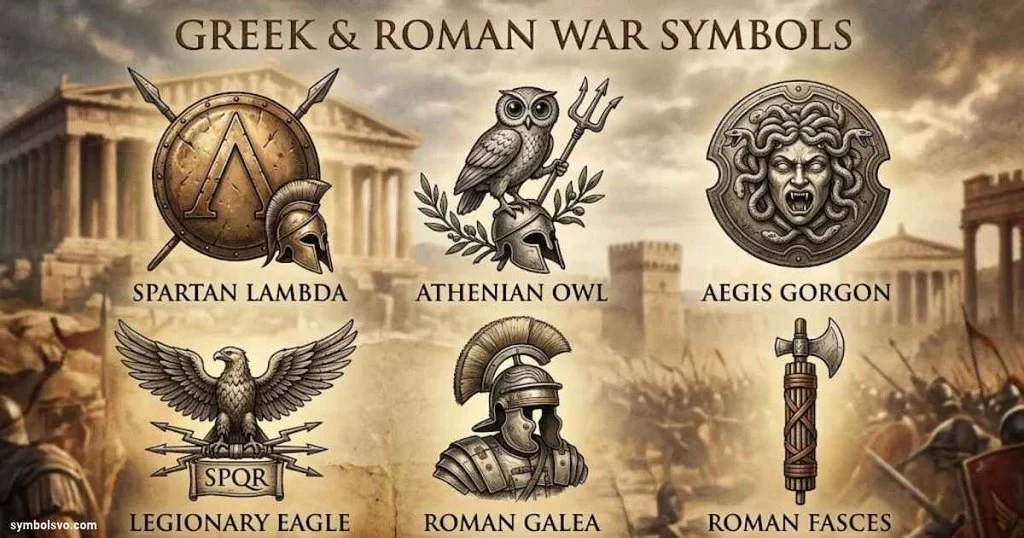
Ancient Greece and Rome developed influential military traditions. Their weapons, deities, standards, and artistic symbols continue to shape modern representations of warfare.
Ares Symbol
Ares was the Greek god of war and represented the violent, destructive side of armed conflict.
Greek mythology portrayed him as a powerful warrior associated with aggression, bloodshed, and battlefield violence.
His recognizable attributes include weapons, helmets, and military equipment. The spear and helmet are common visual elements in artistic representations of the god.
Athena’s Owl
The owl is closely associated with Athena, the Greek goddess of wisdom and strategic warfare.
Unlike Ares, Athena represents intelligent planning, military discipline, and thoughtful leadership.
The owl became one of the most recognizable symbols connected with the goddess and ancient Athens.
Athena’s Spear
Athena frequently appears carrying a spear and shield in Greek sculpture and artwork.
Her weapons represent strategic defense, military readiness, and the protection of cities.
The spear also reflects her position as a goddess associated with both wisdom and warfare.
Greek Hoplite Shield
The hoplite shield, known as the aspis or hoplon, was an important part of ancient Greek infantry equipment.
It was typically round and designed to protect the soldier’s body while supporting the phalanx formation.
Some shields displayed identifying marks, decorative patterns, or symbols associated with a particular community.
Gorgon Shield (Aegis)
The Aegis is a protective object associated with Athena and Zeus in Greek mythology.
Artistic depictions frequently show it decorated with the head of Medusa, whose terrifying appearance could intimidate enemies.
It represents divine protection, authority, and the power to confront danger.
Roman Gladius
The gladius was a short sword used by Roman infantry, particularly during the Republic and early Imperial periods.
Its design suited close combat and worked effectively with Roman military formations.
Today, the gladius is a recognizable symbol of Roman military history and legionary service.
Roman Pilum
The pilum was a Roman throwing spear designed to disrupt enemy formations before close combat.
Its construction included a long metal shank attached to a wooden shaft. Roman soldiers commonly used it before advancing with their swords.
The weapon represents Roman military engineering and battlefield tactics.
Mars Symbol
Mars was the Roman god of war. He held an important position in Roman religion and was associated with military power, protection, and the strength of the Roman state.
Unlike the Greek Ares, Mars also had strong connections with agriculture and Rome’s legendary origins.
His image became closely connected with Roman military traditions.
Roman Scutum
The scutum was the large shield used by Roman legionaries.
Its curved construction provided protection for much of the soldier’s body. It also supported coordinated formations such as the famous testudo, or tortoise formation.
The scutum represents military organization, defensive strength, and Roman infantry discipline.
Roman Laurel Wreath
The laurel wreath represented victory, honor, and triumph in Roman culture.
Roman commanders and emperors used laurel imagery to communicate military success and political authority.
Its association with achievement continues in modern medals, monuments, and ceremonial designs.
Japanese Samurai and Medieval Warrior Symbols
Japanese samurai traditions developed distinctive symbols connected with family identity, military service, discipline, and social status.
Medieval European warriors also used heraldic designs to distinguish noble families, military groups, and political authorities.
Samurai Mon (Kamon)
A samurai mon was a family crest used to identify a particular family or lineage.
Japanese kamon developed during the Heian period and later became important among military families. Samurai displayed crests on banners, clothing, armor, and equipment to distinguish allies from enemies.
Their designs often featured plants, flowers, animals, and geometric patterns. Japanese family crests remain an important part of cultural heritage.
Katana
The katana is a Japanese sword strongly associated with samurai warriors.
Its curved, single-edged blade became an important part of Japanese sword-making traditions.
The katana represents craftsmanship, martial skill, discipline, and the historical identity of the samurai class.
Samurai Kabuto
The kabuto was a protective helmet worn by Japanese warriors.
Its construction often included metal plates, decorative crests, and distinctive ornamental elements.
Some helmets featured elaborate designs intended to communicate status, identity, or intimidation. The kabuto therefore combined practical protection with visual symbolism.
Cherry Blossom
The cherry blossom represents beauty, renewal, and the temporary nature of life in Japanese culture.
Its connection with samurai ideals developed through cultural interpretations of mortality and the shortness of human existence.
Modern artwork sometimes associates cherry blossoms with warrior sacrifice. However, the flower isn’t exclusively a military symbol.
Bushido
Bushido refers to the ethical ideals associated with the samurai warrior class.
Its commonly discussed values include loyalty, honor, discipline, courage, and self-control.
However, Bushido wasn’t one fixed historical code followed identically by every samurai. Its interpretations developed across different periods and were shaped by later writers and political movements.
Medieval Lion Crest
The lion was a popular figure in medieval European heraldry.
It represented courage, nobility, authority, and strength. Noble families frequently included lions in their coats of arms to communicate their status and identity.
Medieval Cross
The cross became an important religious and political symbol during medieval European warfare.
Christian armies used crosses on shields, clothing, banners, and other objects. Crusader imagery is one prominent historical example.
Its meaning depends on the particular cross, organization, and historical setting.
Knight’s Shield
A knight’s shield served both practical and symbolic purposes.
It protected its owner during combat while displaying heraldic designs that communicated family identity and allegiance.
These designs helped distinguish knights and noble households within medieval European society.
Heraldic Eagle
The eagle became an important figure in European heraldry because it represented sovereignty, authority, and power.
It appeared in royal and imperial coats of arms, including the heraldic traditions of the Holy Roman Empire.
Its association with Roman imperial imagery strengthened its reputation as a symbol of political and military authority.
Medieval Banner
Medieval banners identified kings, noble families, military commanders, and organized forces.
Their designs could display coats of arms, religious symbols, and recognizable colors.
On the battlefield, banners also provided soldiers with a visual reference for locating their leaders.
Modern Military and Remembrance Symbols
Modern military symbolism includes more than weapons and national flags. It also recognizes service members, honors fallen soldiers, and preserves memories of historical conflicts.
Red Poppy
The red poppy symbol represents remembrance, sacrifice, and respect for people who died during military service.
Its modern association with remembrance developed after World War I. Poppies grew across devastated areas of Belgium and northern France, inspiring Canadian military doctor John McCrae’s 1915 poem In Flanders Fields.
Moina Michael and Anna Guérin helped promote the poppy as a remembrance emblem. The British Legion adopted it in 1921 and developed its annual Poppy Appeal.
Today, the red poppy is particularly associated with remembrance in the United Kingdom and several Commonwealth countries.
Dog Tags
Military dog tags are identification tags worn by service members.
They carry identifying information that helps military authorities recognize personnel who are injured, missing, or killed.
The US Army introduced official identification tags in 1906. The US Navy followed in 1917, establishing its own identification-tag requirements.
Their historical purpose makes them powerful symbols of military service, personal identity, and remembrance.
Tomb of the Unknown Soldier
The Tomb of the Unknown Soldier honors unidentified military personnel who died during war.
These memorials represent collective sacrifice and recognize soldiers whose individual identities could not be established.
They also give families and communities a place to remember people who never returned home.
Eternal Flame
An eternal flame represents continuing remembrance and respect for people who died during conflict.
Memorials around the world use continuously burning flames to symbolize enduring memory.
The flame can also represent hope, national unity, and the lasting responsibility to remember historical suffering.
Military Cross
The Military Cross is a British military decoration awarded for exemplary gallantry during active operations against an enemy.
It recognizes acts of courage and distinguished service by eligible members of the armed forces.
As a military decoration, it has a specific official meaning rather than representing courage in every culture.
Purple Heart
The Purple Heart is a United States military decoration awarded to service members wounded or killed as a result of enemy action under established eligibility rules.
Its history dates to George Washington’s Badge of Military Merit in 1782, which later influenced the modern decoration.
Today, the Purple Heart represents sacrifice, service, and the physical costs of military conflict.
White Flag
The white flag is internationally recognized as a signal associated with surrender or a request to communicate during armed conflict.
Its use is connected with rules of international humanitarian law.
However, displaying a white flag does not automatically guarantee that a military force will accept surrender or that every situation will be interpreted identically.
Peace Symbol
The peace symbol became widely recognized through the nuclear disarmament movement.
British artist Gerald Holtom designed it in 1958 for the Campaign for Nuclear Disarmament.
It combines elements of semaphore signals for the letters N and D, representing nuclear disarmament.
Today, it represents peace activism, opposition to war, and international solidarity.
Broken Rifle
The broken rifle represents resistance to militarism, opposition to armed violence, and peace activism.
It has been used by anti-war movements to communicate the idea of rejecting weapons and military aggression.
Unlike a conventional military insignia, it generally communicates opposition to armed conflict.
Memorial Wreath
A memorial wreath represents honor, mourning, and remembrance.
People place wreaths at military cemeteries, war memorials, and remembrance ceremonies to recognize fallen soldiers and other victims of conflict.
Laurel wreaths have older associations with victory, while modern memorial wreaths commonly express respect and collective grief.
Ancient War Symbols Across Different Civilizations
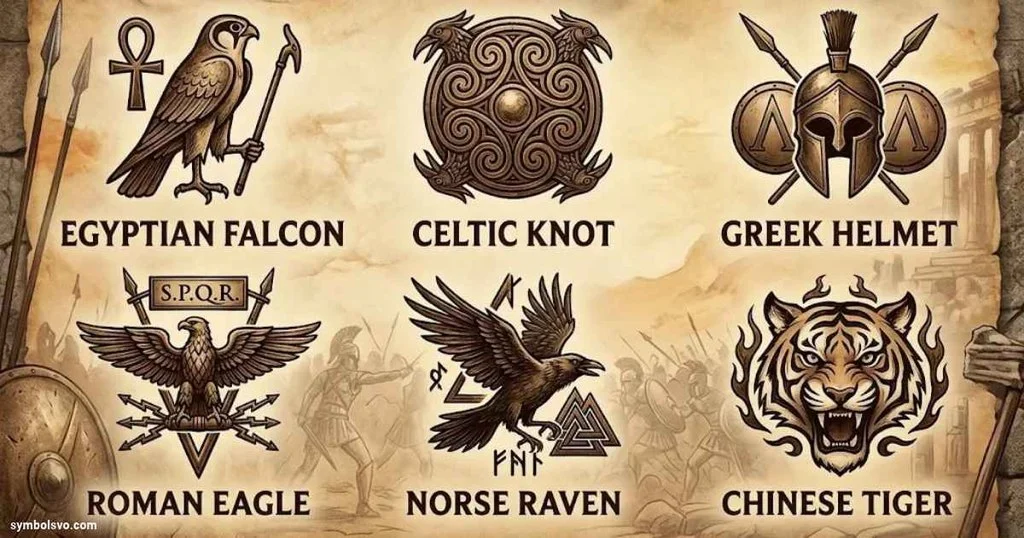
Every civilization developed its own visual language for warfare. Religion, political authority, military organization, and cultural traditions influenced the symbols people used.
Comparing these traditions helps explain why the same animal, weapon, or emblem can carry different meanings across societies.
Ancient Egyptian War Symbols
Ancient Egyptian military symbolism often combined royal authority, religious beliefs, and protective imagery.
Pharaohs presented themselves as powerful rulers responsible for defending Egypt. Their monuments and military artwork frequently connected kingship with divine protection.
Important Egyptian symbols include:
- Ankh: Represents life and divine existence. Egyptian gods frequently appear holding it in religious artwork.
- Eye of Horus: Associated with protection, healing, and restoration.
- Sekhmet: A lioness-headed goddess connected with warfare, destruction, and protection.
- Uraeus: The raised cobra worn on royal crowns, representing divine authority and protection.
- Pharaoh’s Crook and Flail: Symbols of kingship and royal authority.
Sekhmet deserves particular attention because Egyptian religious traditions connected her with destructive power and protection. Her mythology demonstrates how ancient societies connected warfare with divine forces.
Ancient Greek War Symbols
Ancient Greek warfare produced recognizable symbols associated with military discipline, city-states, gods, and heroic traditions.
Greek warriors used shields, helmets, spears, and swords. Their religious artwork also featured powerful deities associated with different aspects of battle.
Important examples include:
- Ares: Represents violent warfare and battlefield aggression.
- Athena: Represents strategic warfare, wisdom, and protection.
- Owl: Associated with Athena and intelligent leadership.
- Gorgon Head: Represents protection and intimidation.
- Hoplite Shield: Represents citizen-soldier identity and collective defense.
- Greek Spear: Represents military readiness and combat.
Sparta developed a particularly strong military identity. Its warriors became famous for discipline, training, and their role in ancient Greek conflicts.
Ancient Roman War Symbols
Roman military symbolism emphasized discipline, loyalty, imperial authority, and the identity of individual legions.
The Roman Aquila was especially important because it represented the honor and reputation of an entire legion.
Other important Roman symbols and objects include:
- SPQR: Represents the Senate and People of Rome.
- Mars: The Roman god of war.
- Gladius: The short sword associated with Roman infantry.
- Pilum: The Roman throwing spear.
- Scutum: The large shield used by Roman legionaries.
- Laurel Wreath: Represents victory and military triumph.
Roman military standards weren’t simply decorative objects. They helped organize troops and maintained a strong connection between soldiers and their legions.
Viking and Norse War Symbols
Norse mythology contains many stories about gods, warriors, battles, and the afterlife.
Odin and Thor are particularly important figures in this tradition. Their stories influenced later representations of Viking culture and warrior identity.
Important symbols include:
- Valknut: Associated with Odin and possible connections with death.
- Mjölnir: Thor’s hammer, associated with protection and divine power.
- Gungnir: Odin’s legendary spear.
- Tiwaz Rune: A runic character associated with the god Týr in later interpretations.
- Odin’s Ravens: Represent thought and memory.
- Fenrir: Represents a destructive force in Norse mythology.
One important distinction matters here: historical Viking symbols and modern Norse-inspired designs aren’t always the same. Some meanings come from medieval literature or later magical traditions rather than direct evidence from the Viking Age.
Japanese Samurai War Symbols
Japanese samurai culture developed a distinctive system of military identity and family symbolism.
The samurai mon, also known as a kamon, identified a family or lineage. Military families displayed these designs on banners, armor, clothing, and other objects.
Other important elements include:
- Katana: Represents samurai swordsmanship and martial tradition.
- Kabuto: The traditional samurai helmet.
- Bushido: A term associated with samurai ethical ideals.
- Cherry Blossom: Represents beauty and the temporary nature of life.
- Family Crest: Communicates lineage, heritage, and affiliation.
During periods of military conflict, Japanese family crests helped distinguish different groups on the battlefield. Their use later expanded into ceremonial clothing and broader family traditions.
Medieval European War Symbols
Medieval Europe developed an extensive heraldic tradition. Knights, noble families, kingdoms, and military organizations used recognizable designs to communicate identity and authority.
Common examples include:
- Lion: Represents courage, nobility, and strength.
- Eagle: Represents sovereignty and imperial power.
- Cross: Represents Christian religious identity and historical crusading traditions.
- Coat of Arms: Identifies a family, individual, or institution.
- Royal Standard: Represents a monarch or ruling household.
- Knight’s Shield: Combines battlefield protection with heraldic identity.
Heraldry eventually developed formal rules governing colors, shapes, and designs. This helped make coats of arms recognizable across different regions.
Native American Warrior Symbols
Indigenous nations across North America developed diverse traditions involving warriors, ceremonial objects, animals, and community identity.
However, Native American cultures shouldn’t be treated as one symbolic system. Each nation has its own history, language, beliefs, and traditions.
Some important distinctions include:
- Eagle Feathers: Have significant spiritual, cultural, and ceremonial importance in many Indigenous communities.
- Bear Imagery: Appears in different traditions with associations that vary between nations.
- War Paint: Has been used in different ceremonial, social, and historical contexts.
- Animal Imagery: Can communicate clan identity, spiritual relationships, or particular cultural narratives.
- Warrior Regalia: Reflects community traditions, identity, and historical roles.
Avoid assigning one universal meaning to an eagle, bear, wolf, or feather across all Indigenous cultures. A symbol’s meaning should be connected to the specific nation and tradition.
What Do War Symbols Represent?
War symbolism extends beyond weapons and battlefield victories. Different symbols communicate the values, emotions, beliefs, and experiences connected with armed conflict.
The following categories explain their most common associations.
Courage, Bravery, and Warrior Strength
Courage is one of the most recognizable themes in warrior traditions.
Symbols such as swords, lions, eagles, and Spartan helmets frequently communicate bravery and determination.
They represent the willingness to confront danger and defend something important.
Honor, Loyalty, and Military Discipline
Military organizations depend on shared responsibilities and group identity.
Regimental flags, family crests, military badges, and ceremonial swords can represent loyalty and service.
These symbols remind soldiers of their duties and connections with their communities.
Protection, Defense, and Survival
Shields, armor, helmets, and protective emblems represent security and survival.
Their meanings come partly from their practical purposes. Soldiers relied on these objects to defend themselves during dangerous encounters.
Over time, their protective functions developed broader symbolic associations.
Victory, Power, and Military Leadership
Eagles, laurel wreaths, royal standards, and crowns frequently communicate authority and triumph.
Ancient Roman commanders used victory imagery to demonstrate military success. Royal households also used banners and coats of arms to establish political legitimacy.
Sacrifice, Death, and Mortality
Skulls, memorial wreaths, red poppies, and tombs of unknown soldiers represent the human consequences of war.
These symbols preserve the memory of people who died during military service or armed conflict.
They also remind future generations that victory often comes with enormous personal and social costs.
Freedom, Resistance, and National Identity
National flags, raised fists, broken rifles, and revolutionary banners can represent resistance and independence.
Their meaning depends on the historical movement and political circumstances.
A symbol used by one group to express freedom might carry a completely different meaning for another community.
Peace, Remembrance, and Reconciliation
Not all war-related symbols celebrate military strength.
The olive branch, white flag, peace symbol, red poppy, and memorial wreath communicate ideas connected with remembrance, reconciliation, and the rejection of violence.
These symbols help societies recognize the consequences of conflict and preserve hopes for a more peaceful future.
How War Symbols Were Used Throughout History
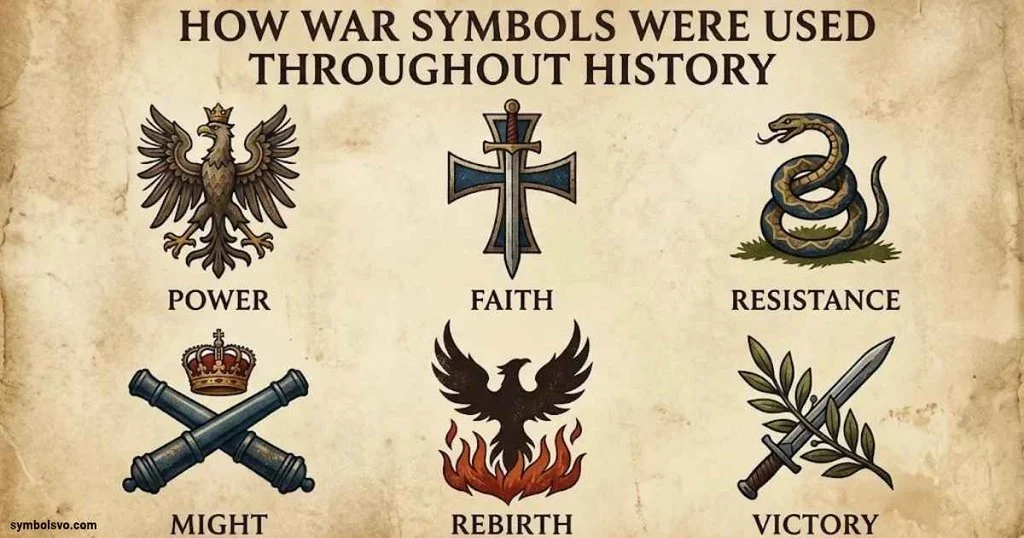
War symbols served practical and cultural purposes long before modern communication systems existed.
Their use changed as armies developed new weapons, military structures, and methods of communication.
Symbols on Ancient Shields and Armor
Ancient warriors decorated shields and armor with recognizable designs.
These markings could identify a community, military group, family, or individual. Some also carried religious or protective associations.
For example, Greek shields sometimes featured painted designs associated with particular city-states or individual warriors.
Military Standards and Battlefield Identification
Military standards provided visible points of reference during battles.
Roman legions used their Aquila standards to maintain unit identity and military honor.
Medieval armies also relied on banners to identify rulers, noble families, and commanders.
Flags, Banners, and Regimental Colors
Flags became important tools for military communication and organization.
They helped soldiers recognize their forces and maintain connections with their commanders.
Even today, regimental colors preserve the history and traditions of military units.
Heraldry, Family Crests, and Royal Identity
Heraldry developed into a formal system of identification in medieval Europe.
Coats of arms helped distinguish noble families and their representatives. Their designs also communicated inheritance, alliances, and political authority.
Japanese kamon served related identification purposes within a different cultural tradition.
Military Medals, Badges, and Insignia
Modern military organizations use medals and insignia to recognize service, qualifications, and achievements.
These objects communicate information that once depended more heavily on clothing, flags, and personal recognition.
They also preserve military traditions and individual service records.
War Memorials and Remembrance Ceremonies
Modern memorial symbols focus on remembering people affected by conflict.
Wreaths, eternal flames, poppies, and monuments provide visual ways to express respect and mourning.
For example, the red poppy became a widely recognized remembrance emblem following World War I.
War Symbols in Modern Culture
War-related imagery continues to influence art, fashion, entertainment, tattoos, and digital communication.
However, modern uses don’t always preserve the original historical meaning.
War Symbols Tattoos and Their Meanings
People choose war symbols tattoos for different personal and cultural reasons.
Some want to express courage or resilience. Others use military imagery to honor family members, remember service, or recognize a personal struggle.
Popular designs include:
| Tattoo symbol | Common interpretation |
| Spartan helmet | Discipline, courage, and strength |
| Sword | Honor, justice, and determination |
| Shield | Protection and loyalty |
| Eagle | Freedom, authority, and leadership |
| Wolf | Loyalty and endurance |
| Dragon | Power and transformation |
| Red poppy | Remembrance and sacrifice |
| Mjölnir | Connection with Norse mythology and protection |
Before choosing a design, research its cultural background. Some religious or ceremonial symbols carry meanings that go beyond their popular tattoo interpretations.
War Symbols in Movies, Games, and Literature
Historical films, fantasy novels, and video games frequently use warrior imagery to establish fictional identities.
For example, a fictional kingdom might display a lion on its battle flags to communicate royal authority. A fantasy warrior might carry a dragon-emblazoned shield to suggest power and courage.
Common examples include:
- Historical military uniforms and insignia.
- Viking-inspired weapons and symbols.
- Roman legionary standards.
- Medieval heraldic shields.
- Mythological weapons and armor.
- Fantasy kingdoms and warrior emblems.
These representations often combine genuine historical references with creative designs.
War Symbols in Military Fashion and Design
Military-inspired fashion uses visual elements taken from uniforms, equipment, and historical military traditions.
Examples include:
- Combat boots.
- Military jackets.
- Camouflage patterns.
- Decorative military badges.
- Army-inspired patches.
- Heraldic designs.
These elements can communicate toughness, practicality, discipline, or a connection with military history.
However, wearing military-inspired clothing doesn’t automatically communicate military service.
War Symbols in Digital Communication
Digital platforms have made symbolic designs easier to share and reproduce.
People use military-inspired imagery in gaming profiles, social media bios, graphic designs, and online communities.
Common examples include:
- Sword symbols.
- Shield icons.
- Skull graphics.
- Eagle illustrations.
- Military-style badges.
- Viking-inspired designs.
- Warrior-themed profile images.
When using these designs, remember that decorative symbols and official military insignia aren’t interchangeable.
War Symbols vs. Military Symbols vs. Warrior Symbols
Although these categories overlap, their purposes differ.
| Feature | War symbols | Military symbols | Warrior symbols |
| Main focus | Conflict and warfare | Military organizations and service | Warrior identity and ideals |
| Common examples | Skull, crossed swords | Rank insignia, unit badges | Spartan helmet, katana |
| Historical use | Battlefield and cultural imagery | Identification and organization | Religious, cultural, and martial traditions |
| Main associations | Battle, sacrifice, destruction | Service, rank, identity | Courage, honor, discipline |
For example, the Roman Aquila was a formal military standard. A lion in a coat of arms could represent nobility and courage without identifying a particular military unit.
That distinction makes historical interpretation much more accurate.
How to Choose a War Symbol for a Tattoo or Personal Design
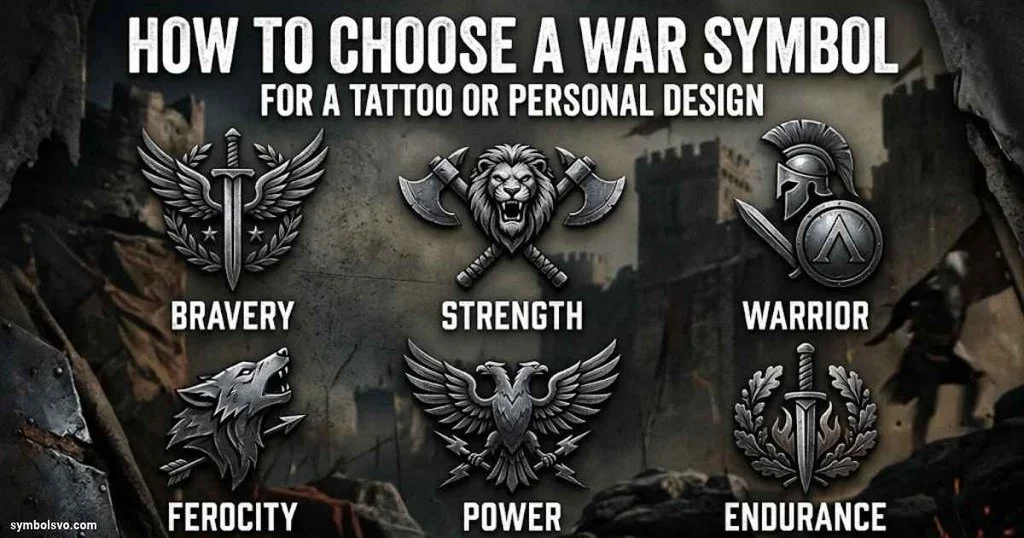
Choosing a warrior-inspired design involves more than finding an attractive image. The symbol should communicate something meaningful without misrepresenting its history.
Choose a Symbol Based on Its Historical Meaning
Start by identifying what you want the design to represent.
- Choose a shield for protection.
- Choose a sword for courage or justice.
- Choose an eagle for leadership or authority.
- Choose a red poppy for remembrance.
- Choose a laurel wreath for achievement.
- Choose a wolf for loyalty and endurance.
These are common interpretations rather than universal definitions.
Consider Its Cultural and Religious Background
Some symbols have specific meanings within religious or cultural traditions.
For example, Mjölnir belongs to Norse mythology, while the Aegis belongs to Greek mythology.
Research the original context before using a design that represents another culture’s heritage.
Match the Symbol With Your Intended Message
A design representing victory communicates something different from one representing sacrifice or peace.
Think about the message before selecting an image. This helps create a more meaningful and consistent design.
Avoid Misrepresenting Sacred or Restricted Cultural Symbols
Certain cultural symbols have religious, ceremonial, or community-specific importance.
Avoid treating them as generic decorations. When possible, consult reliable cultural or historical sources before using them.
Frequently Asked Questions About War Symbols
What Is the Most Famous War Symbol?
The Roman eagle standard, crossed swords, Spartan helmet, and red poppy are among the most recognizable war-related symbols.
The Roman Aquila represented the identity and honor of Roman legions. The red poppy became a widely recognized remembrance emblem after World War I.
There isn’t one universally accepted symbol that represents all warfare.
What Symbol Represents War and Conflict?
Crossed swords are a recognizable symbol of armed conflict and military confrontation.
Other examples include spears, battle axes, skulls, and military banners. Their meanings depend on historical and cultural context.
What Are the Oldest Known War Symbols?
Some of the oldest war-related symbols appear in prehistoric rock art, ancient weapons, military imagery, and early royal representations.
Ancient Egyptian and Mesopotamian artwork provides important evidence of early warfare and military authority.
However, researchers must distinguish actual military imagery from modern interpretations of ancient artwork.
What Symbol Represents Courage in Battle?
The Spartan helmet, lion, sword, and eagle are popular symbols of courage and military strength.
The Spartan helmet is particularly associated with ancient Greek military identity and the reputation of Spartan warriors.
What Symbols Represent Strength and Protection?
The shield, armor, helmet, bear, and dragon commonly represent strength and protection.
Their meanings vary between historical traditions and modern symbolic interpretations.
What Is the Roman Symbol of War?
Mars was the Roman god of war and one of the most important military deities in Roman religion.
The Roman eagle standard, known as the Aquila, was also a major military emblem representing legion identity and honor.
What Are the Most Recognizable Viking War Symbols?
Popular Norse and Viking-related symbols include:
- Valknut.
- Mjölnir.
- Gungnir.
- Tyr rune.
- Odin’s ravens.
- Viking shields.
Their historical meanings differ. Some are documented through archaeological evidence, while others come mainly from mythology or later traditions.
What Is the Greek Symbol of War?
Ares is the Greek god most directly associated with war and battlefield violence.
Athena also represents warfare but emphasizes strategy, wisdom, and defensive protection.
The spear, shield, helmet, and owl are recognizable symbols connected with Greek military and mythological traditions.
What Does the Valknut Symbol Mean?
The Valknut is a design consisting of three interconnected triangles.
It appears on objects associated with the Viking Age and is commonly linked with Odin and death. However, its exact historical meaning remains uncertain.
Modern interpretations often connect it with warrior identity and Norse spirituality.
What Does the Red Poppy Represent in War?
The red poppy represents remembrance, sacrifice, and respect for people who died during military service.
Its modern significance developed after World War I, particularly through the remembrance movement inspired by the poem In Flanders Fields.
What Does a Sword Symbolize in Warfare?
A sword can represent courage, honor, justice, protection, and military power.
Its meaning changes depending on its position and surrounding imagery. A raised sword may suggest readiness, while a broken sword can represent defeat or the end of fighting.
Why Did Ancient Armies Use Symbols on Their Shields?
Ancient armies used shield symbols to communicate identity, distinguish groups, and display cultural or religious associations.
These designs could help soldiers recognize allies and reinforce their connection with a particular community or military organization.
Are War Symbols Different Across Cultures?
Yes. War symbols reflect each civilization’s religious beliefs, political systems, military traditions, and cultural values.
For example, the Roman eagle represented imperial and military authority, while the Japanese kamon communicated family identity and could identify warriors on the battlefield.
What Do Military Insignia and Emblems Represent?
Military insignia identify rank, branch, unit, qualification, or organizational membership.
Military emblems can also represent institutional history, achievements, and shared traditions.
Their exact meanings depend on the armed force and the particular design.
What Symbols Represent Peace After War?
Common peace-related symbols include the olive branch, white flag, peace symbol, broken rifle, and memorial wreath.
These designs communicate reconciliation, opposition to violence, remembrance, and hope for a peaceful future.
Conclusion
War symbols preserve important parts of human history. They reveal how civilizations understood courage, authority, protection, loyalty, sacrifice, and the consequences of conflict.
From the Roman Aquila and Greek military imagery to Norse mythology and Japanese samurai crests, each tradition developed distinctive ways to express identity and power.
Modern symbols have expanded these meanings. The red poppy honors fallen service members, dog tags represent military identity, and memorial wreaths preserve collective remembrance.
Understanding their historical backgrounds helps you appreciate these symbols beyond their appearance. Their true significance comes from the people, traditions, and experiences that shaped them.

I’m Nathan Holloway, a passionate researcher and writer with a deep interest in symbols, signs, and their hidden meanings. I enjoy exploring how symbols have influenced different civilizations, religions, and modern communication. Through my work, I aim to make complex historical and cultural concepts easy to understand for readers of all backgrounds. Every article I write is carefully researched to provide reliable and engaging information.
Books:
- Beyond the Symbol
- The Secret Meanings of Everyday Signs
Author 2: Grace Whitmore
Description:
My name is Grace Whitmore, and I love discovering the stories behind the world’s most fascinating symbols. I spend my time researching ancient civilizations, mythology, spiritual traditions, and modern iconography to uncover the meanings people often overlook. I believe that every symbol has a history worth telling, and I enjoy sharing that knowledge in a simple and reader-friendly way.
Books:
- Echoes of Ancient Symbols
- The Symbolic World
 Mason Ellington
 Daniel Brooks