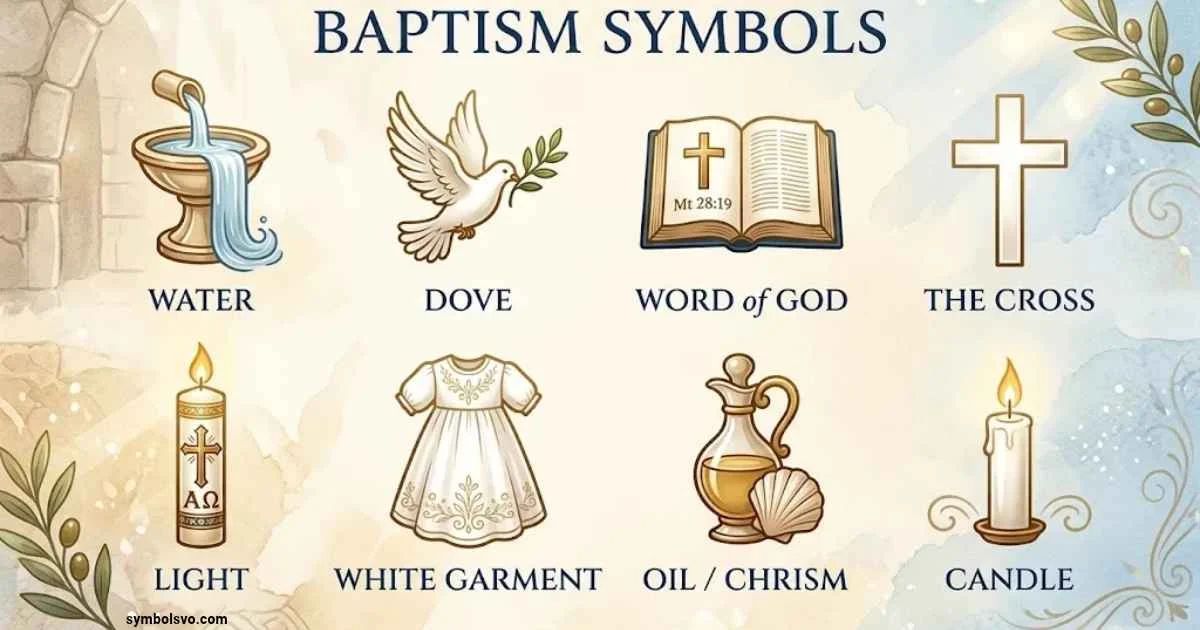
Baptism holds a special place in Christianity because it represents a person’s entrance into a life of faith. Throughout Christian history, churches have used meaningful objects, gestures, and ceremonies to express what this sacred rite represents. These baptism symbols help communicate ideas that words alone cannot always explain.
From baptismal water and the Christian cross to white garments, candles, and anointing oil, each symbol carries a distinct spiritual message. Some represent cleansing from sin and spiritual renewal. Others point toward Jesus Christ’s death and resurrection, the presence of the Holy Spirit, or a person’s connection with the Christian community.
Although many churches share these symbols, their ceremonies aren’t always identical. The Catholic Church, Eastern Orthodox Church, and Protestant denominations have different traditions and interpretations. Some practices come directly from biblical teachings while others developed through centuries of Christian worship.
In this guide, you’ll discover 12 important baptism symbols and their meanings, explore their biblical connections, and learn how different Christian traditions use them during baptism ceremonies. You’ll also find the significance of baby baptism symbols, traditional christening objects, and the spiritual messages behind this important Christian practice.
What Are Baptism Symbols?
Baptism symbols are meaningful objects, materials, and actions used to express the spiritual significance of Christian baptism. They help believers understand important ideas such as repentance, salvation, forgiveness, spiritual rebirth, and commitment to Jesus Christ.
Baptism itself involves water and a Christian profession of faith. Depending on the church tradition, the ceremony may also include anointing oil, a white garment, a candle, a cross, and other liturgical elements.
These objects aren’t simply decorations. Each one communicates a particular aspect of Christian belief.
For example, water represents cleansing and new life. A white garment expresses the idea of being clothed in Christ. A candle points toward Jesus as the light of the world.
The Catechism of the Catholic Church explains baptism through several related images, including rebirth, enlightenment, anointing, and spiritual cleansing. These descriptions show how different baptismal signs work together to communicate the meaning of the sacrament.
Why Are Symbols Important in Christian Baptism?
Baptism symbols connect visible actions with spiritual beliefs. They allow the congregation, family members, and newly baptized person to recognize the meaning behind the ceremony.
Their importance includes:
- Spiritual cleansing: Water represents washing away sin and receiving new life through Christ.
- Christian identity: The cross and baptismal garments point toward belonging to Jesus.
- Faith and commitment: Baptism expresses a relationship with God and a commitment to Christian living.
- Spiritual renewal: The ceremony represents a new beginning through faith.
- The Holy Spirit: Anointing oil and dove imagery communicate the Spirit’s presence and work.
- Christian community: Baptism welcomes a person into the life and fellowship of the Church.
Not every Christian tradition uses the same objects. However, water and the connection between baptism and Christian faith remain central across the major traditions.
Important Baptism Symbols and Their Meanings
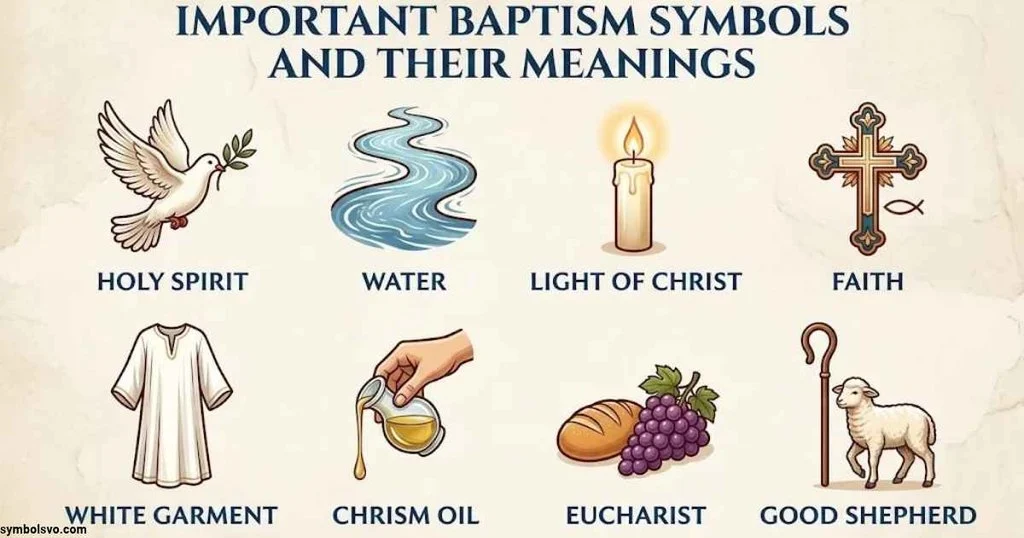
Christian baptism uses several recognizable symbols. Some appear directly in biblical accounts while others became established through church ceremonies and artistic traditions.
The following symbols explain the most important spiritual messages associated with baptism.
Water – Symbol of Cleansing and New Life
Water is the central symbol of Christian baptism. It represents cleansing, spiritual rebirth, forgiveness, and the beginning of a renewed relationship with God.
Christianity connects water with both physical life and spiritual transformation. Just as people need water to survive, baptismal water represents the new spiritual life believers receive through Jesus Christ.
During baptism, a minister applies water through immersion, pouring, or sprinkling, depending on the church’s tradition. The ceremony commonly includes the Trinitarian formula: baptism in the name of the Father, the Son, and the Holy Spirit.
Water carries several important meanings:
- Cleansing from sin: It represents purification and forgiveness.
- New birth: It points toward spiritual regeneration.
- Death and resurrection: Immersion can represent burial with Christ and rising into new life.
- Repentance: It connects with turning away from sin and returning to God.
- Renewal: It symbolizes a fresh beginning through Christian faith.
The biblical connection appears in several important passages.
In John 3:5, Jesus speaks about being born of water and the Spirit. This passage has played an important role in Christian discussions about baptism and spiritual rebirth.
Romans 6:3–4 connects baptism with Jesus’ death and resurrection. Paul explains that believers are buried with Christ through baptism so they can walk in the newness of life.
The Jordan River also holds a special place in baptism symbolism. John the Baptist baptized Jesus there, making the river an important location in the Gospel accounts.
Water therefore communicates more than physical washing. It represents a person’s relationship with Christ and the promise of a transformed life.
The Cross – Symbol of Christ’s Sacrifice and Salvation
The Christian cross represents Jesus Christ’s sacrifice, death, resurrection, and victory over sin. It reminds Christians that baptism connects their lives with the central events of the Christian faith.
During some baptism ceremonies, the minister makes the sign of the cross on the candidate’s forehead. This gesture marks the person as belonging to Christ and recalls the redemption associated with his sacrifice.
The Catholic baptismal rite includes this gesture near the beginning of the ceremony. The Catechism describes it as a sign of the redemption Christ won through the cross.
Vatican
The cross carries several meanings in baptism:
- Salvation: It points toward God’s saving work through Jesus.
- Redemption: It represents freedom from sin through Christ.
- Sacrifice: It recalls Jesus’ suffering and death.
- Resurrection: It connects the believer with Christ’s victory over death.
- Christian identity: It identifies the baptized person with Jesus.
- Discipleship: It reminds believers to follow Christ in everyday life.
Galatians 2:20 describes the Christian life through participation in Christ’s crucifixion. Romans 6:6–11 also connects believers with his death and resurrection.
A baptismal cross may appear on church decorations, baptism certificates, jewelry, or christening gifts. However, its meaning remains rooted in the Christian belief that Jesus’ sacrifice makes salvation possible.
White Garment – Symbol of Purity and New Life in Christ
A white baptism garment represents purity, spiritual renewal, and a person’s new identity in Jesus Christ. It is one of the most recognizable traditional symbols in Catholic and Eastern Orthodox baptism ceremonies.
The white color communicates a fresh beginning. It also reflects the Christian belief that baptism brings a person into a new relationship with Christ.
The garment has a deeper biblical connection than simply representing innocence. Galatians 3:27 says that those baptized into Christ have clothed themselves with Christ.
This idea explains why churches use white robes, gowns, or garments during baptism.
The white garment represents:
- Purity: A cleansed life through God’s grace.
- New identity: Becoming part of the Christian community.
- Spiritual renewal: Leaving behind the old life.
- Salvation: Receiving the promise of life in Christ.
- Commitment: Living according to Christian teachings.
In Catholic baptism, the newly baptized person receives a white garment as a sign of having put on Christ. The ceremony also encourages the person to preserve this baptismal identity through Christian living.
Baby christening gowns often feature lace, embroidery, ribbons, and family details. Some families preserve these garments as heirlooms and pass them down through generations.
However, the garment’s religious meaning matters more than its design or price.
Baptism Candle – Symbol of the Light of Christ
The baptism candle represents Jesus Christ as the light of the world. It symbolizes faith, spiritual guidance, hope, and the responsibility to share Christ’s teachings.
In traditional Catholic baptism ceremonies, the minister or another church representative lights the baptism candle from the Paschal candle. The Paschal candle represents the risen Christ and holds a central place in Easter worship.
The newly baptized person receives the candle as a sign of entering a life guided by Christ.
The candle represents several spiritual ideas:
- Light of Christ: Jesus provides spiritual direction.
- Faith: Believers receive and follow the light of the Gospel.
- Hope: Christ offers hope beyond darkness and sin.
- Discipleship: Christians are called to share their faith.
- Spiritual guidance: The light represents direction throughout life.
John 8:12 records Jesus describing himself as the light of the world. Matthew 5:14–16 also calls his followers the light of the world and encourages them to let their light shine.
The candle therefore carries a message beyond the baptism ceremony. It reminds the baptized person and their family to nurture Christian faith throughout life.
For infant baptism, parents and godparents often take responsibility for helping the child grow in faith. The candle becomes a meaningful reminder of that responsibility.
Anointing Oil – Symbol of Consecration and the Holy Spirit
Anointing oil represents strength, consecration, blessing, and the work of the Holy Spirit. It appears in several Christian traditions, although churches use different oils and follow different ceremonies.
In the Roman Catholic baptismal rite, two oils have distinct purposes.
Oil of Catechumens
This oil is used before baptism. It symbolizes spiritual preparation and strengthening as the candidate prepares to enter Christian life.
The symbolism has historical roots in the use of oil for strengthening, healing, and preparing athletes for physical challenges.
Sacred Chrism
Sacred Chrism is a perfumed oil consecrated by a bishop. In Catholic baptism, the post-baptismal anointing signifies the gift of the Holy Spirit and the newly baptized person’s incorporation into Christ.
These oils communicate different but related messages:
| Type of oil | Main meaning | Religious purpose |
| Oil of Catechumens | Strength and preparation | Used before baptism |
| Sacred Chrism | Consecration and the Holy Spirit | Used after baptism |
The Catholic Catechism specifically distinguishes the strengthening associated with the Oil of Catechumens from the consecration represented by sacred chrism.
In Eastern Orthodox Christianity, anointing with Holy Chrism forms part of Chrismation, which follows baptism immediately.
The Orthodox understanding connects baptism with Christ’s death and resurrection and Chrismation with the coming of the Holy Spirit at Pentecost.
Dove – Symbol of the Holy Spirit and Divine Presence
The dove is an important Christian symbol associated with the Holy Spirit. Its connection with baptism comes from the Gospel accounts of Jesus’ baptism by John the Baptist.
According to Matthew 3:16, after Jesus came up from the water, the Spirit of God descended like a dove and came upon him.
This event makes the dove a recognizable image in Christian baptism artwork.
The dove commonly represents:
- Holy Spirit: God’s Spirit descending upon Jesus.
- Divine presence: God’s involvement in the baptism of Jesus.
- Peace: A widely recognized Christian meaning associated with the dove.
- Renewal: The beginning of Jesus’ public ministry.
- Spiritual guidance: The work of the Holy Spirit in Christian life.
The dove also appears in Christian paintings, stained-glass windows, church decorations, baptism invitations, and christening cards.
One important distinction matters here. The Gospel describes the Spirit descending like a dove. It does not establish that a physical dove must appear during baptism ceremonies.
The dove is therefore a biblical image with a strong connection to baptism rather than a required baptismal object.
Baptism Shell – Symbol of Baptismal Water and Renewal
The baptism shell, especially the scallop shell, is a traditional Christian symbol associated with baptismal water.
Its connection comes partly from its practical use as a vessel for pouring water over a person’s head. In Christian artwork, the shell often appears above baptismal fonts or in illustrations of baptism ceremonies.
The shell communicates several related ideas:
- Baptismal water: It represents the water used in the ceremony.
- Spiritual cleansing: It connects with purification and renewal.
- New life: It points toward the beginning of Christian life.
- Christian tradition: It recalls historic baptismal imagery.
- Blessing: It appears in religious artwork and ceremonial designs.
The scallop shell is also associated with Saint James and pilgrimage traditions. This broader Christian history helps explain why it appears in religious art beyond baptism itself.
However, a shell isn’t essential to Christian baptism. Churches can perform baptism without using one.
Today, shell designs frequently appear on christening invitations, baptism certificates, keepsake boxes, and church decorations.
Baptismal Font – Symbol of Spiritual Rebirth and Christian Initiation
A baptismal font is the basin or container that holds water for baptism. It serves as the physical place where the central baptismal action takes place.
Fonts come in different shapes and materials. Some churches use large stone basins, while others have smaller vessels or pools designed for immersion.
Beyond its practical function, the font carries religious meaning.
It represents:
- New birth: Baptism marks the beginning of Christian life.
- Christian initiation: It is the place where the baptismal rite occurs.
- Cleansing: Its water represents spiritual purification.
- Church membership: Baptism welcomes a person into the Christian community.
- Faith: The ceremony connects the candidate with the beliefs of the Church.
Historical church architecture often placed baptismal fonts near the entrance. This arrangement expressed the idea that baptism marks the beginning of a person’s journey into Christian life.
Some modern churches place the font in a more central position to emphasize its connection with the entire congregation.
A baptismal font should not be confused with a decorative water bowl. Its primary purpose is to hold water for the Christian baptismal rite.
Christian Fish (Ichthys) – Symbol of Christian Faith and Identity
The Ichthys, commonly called the Christian fish symbol, represents Christian faith and identification with Jesus Christ.
The symbol consists of two curved lines that form the outline of a fish. Early Christians used it as a recognizable religious sign, and it remains popular in Christian artwork today.
The Greek word Ichthys means fish. Its letters are traditionally interpreted as an acronym for the phrase:
Jesus Christ, Son of God, Savior.
The fish has biblical associations with Jesus’ ministry. The Gospels describe him calling fishermen to become his disciples and feeding large crowds with fish and bread.
Its baptism-related meanings include:
- Christian identity: Recognition of belonging to Christ.
- Faith: Belief in Jesus as Savior.
- Discipleship: Following Jesus’ teachings.
- Christian community: A shared religious identity among believers.
The Ichthys isn’t a required baptismal object. Rather, it is a broader Christian symbol that sometimes appears on baptism invitations, church materials, jewelry, and religious keepsakes.
Fire – Symbol of Spiritual Purification and the Holy Spirit
Fire represents spiritual purification, divine power, and the presence of the Holy Spirit in several biblical passages.
Its baptismal connection comes particularly from John the Baptist’s words in Matthew 3:11. He speaks about baptizing with water and points toward the one who will baptize with the Holy Spirit and fire.
Fire also plays an important role in the biblical account of Pentecost.
Acts 2:1–4 describes what appeared to be tongues of fire resting on the disciples when they received the Holy Spirit.
In Christian symbolism, fire can represent:
- Holy Spirit: God’s presence and spiritual power.
- Purification: The removal of spiritual impurities.
- Transformation: A changed life through faith.
- Divine presence: God’s activity among believers.
- Spiritual courage: Strength to share the Christian message.
Fire isn’t a standard physical element in every baptism ceremony. Its importance is mainly biblical and theological.
It should also be distinguished from the baptism candle. The candle symbolizes Christ as light while fire imagery often emphasizes the Holy Spirit, purification, and divine power.
Olive Branch – Symbol of Peace and Reconciliation
The olive branch represents peace, hope, and reconciliation in Christian symbolism. Its biblical connection comes from the story of Noah and the flood.
In Genesis 8:11, a dove returns to Noah carrying a freshly picked olive leaf. This sign indicates that the floodwaters have begun to recede and that dry land is returning.
The story gives the olive branch a lasting association with hope after hardship.
In relation to baptism, the symbol can express:
- Peace: Reconciliation with God.
- Hope: The promise of a new beginning.
- Renewal: Life following a period of judgment.
- Blessing: God’s continued care for creation.
- Reconciliation: Restored relationships and spiritual harmony.
The olive branch is not a required element of baptism. It appears more commonly in Christian artwork, religious decorations, and baptism-themed designs.
Its connection with baptism comes through broader biblical ideas of renewal and a new beginning.
Baptismal Water Vessel and Pouring – Symbol of God’s Grace
A baptismal water vessel is used in certain Christian ceremonies to hold or pour water during baptism.
Some churches use a small pitcher or ceremonial container. Others use a baptismal font or a larger pool for immersion.
The act of pouring water carries religious significance beyond the vessel itself.
It represents:
- Spiritual cleansing: Water as a sign of purification.
- New birth: The beginning of life in Christ.
- God’s grace: The gift of spiritual renewal.
- The Holy Trinity: Baptism in the name of the Father, Son, and Holy Spirit.
Christian traditions differ in how they apply baptismal water.
Catholic teaching recognizes immersion and pouring as forms of administering baptism. Some Protestant churches also use sprinkling, while Eastern Orthodox practice traditionally uses triple immersion.
The vessel itself is not the source of spiritual power. Its purpose is to hold and apply the water used in the baptismal rite.
Biblical Symbols and Imagery Associated With Baptism
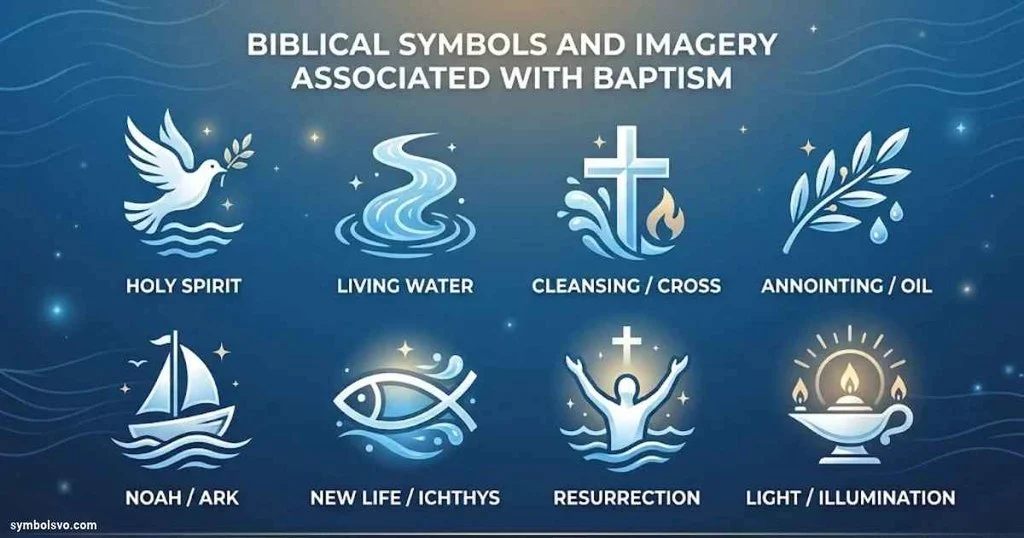
The Bible contains several important images that help explain the meaning of baptism. Some involve actual baptismal events while others provide spiritual pictures of cleansing, deliverance, and new beginnings.
Understanding these connections makes biblical baptism symbols easier to recognize.
The Jordan River – The Place of Jesus’ Baptism
The Jordan River is one of the most important places associated with Christian baptism. John the Baptist baptized people in the Jordan as they responded to his message of repentance.
Jesus also came to John and received baptism in the river. Matthew 3:13–17 describes this event and records the opening of heaven, the descent of the Holy Spirit like a dove, and the voice of God the Father.
This event gives the Jordan River several important associations:
- Repentance: John preached repentance and prepared people for the coming of God’s kingdom.
- Obedience: Jesus accepted baptism as part of fulfilling righteousness.
- The Holy Spirit: The Spirit descended upon Jesus after his baptism.
- The Trinity: The Father, Son, and Holy Spirit appear together in the Gospel account.
- Christian baptism: The event provides an important biblical foundation for understanding baptism.
The Jordan River is also connected with earlier biblical events. Israelites crossed it when entering the Promised Land under Joshua’s leadership (Joshua 3–4).
For Christians, the river therefore carries themes of transition, promise, obedience, and new beginnings.
Noah’s Flood – Symbol of Cleansing and a New Beginning
The story of Noah’s flood provides another important biblical connection to baptism.
According to Genesis 6–9, God sent a flood as judgment upon a corrupt world. Noah, his family, and the animals aboard the ark survived while the floodwaters covered the earth.
After the waters receded, Noah sent out a dove. It eventually returned with an olive leaf, showing that dry land had begun to appear.
The story connects with baptism through several themes:
- Judgment: The flood represents God’s judgment against wickedness.
- Cleansing: The waters mark the end of the corrupt world.
- Deliverance: Noah and his family survive through the ark.
- Renewal: Life begins again after the flood.
- Hope: The olive leaf signals a new beginning.
The strongest New Testament connection appears in 1 Peter 3:20–21. Peter refers to Noah’s experience when discussing baptism.
Importantly, Peter doesn’t present baptism as ordinary physical washing. He connects it with a spiritual response toward God through the resurrection of Jesus Christ.
This makes Noah’s flood a meaningful example of how water imagery can communicate judgment, salvation, and renewal.
The Red Sea – Symbol of Deliverance and Freedom
The Red Sea crossing represents freedom from slavery and deliverance through God’s power.
In Exodus 14, Moses leads the Israelites away from Egypt. When Pharaoh’s army pursues them, God opens a path through the sea so the Israelites can escape.
The waters close behind them and prevent the Egyptian army from following.
This event carries themes that Christians connect with baptism:
- Freedom: Leaving slavery behind.
- Deliverance: Receiving God’s protection.
- Separation from the past: Beginning a different life.
- Faith: Trusting God’s direction.
- New identity: Becoming a people committed to God.
In 1 Corinthians 10:1–2, Paul describes the Israelites as being baptized into Moses in the cloud and in the sea.
This passage provides a biblical connection between the Exodus story and baptismal imagery.
The Red Sea doesn’t represent a Christian baptism ceremony. Instead, it provides an Old Testament picture of deliverance and a transition into a new life.
Death and Resurrection With Christ
One of the deepest meanings of baptism is its connection with the death and resurrection of Jesus Christ.
Romans 6:3–4 explains that believers are baptized into Christ’s death and raised to walk in newness of life.
This teaching gives baptism its powerful symbolism of leaving the old life behind.
When a person enters the baptismal water, immersion can picture burial with Christ. Rising from the water represents participation in his resurrection.
The imagery communicates:
- The end of the old life.
- Freedom from the power of sin.
- Union with Jesus Christ.
- Spiritual rebirth.
- A commitment to Christian discipleship.
Colossians 2:12 also connects baptism with being buried and raised with Christ through faith in God’s power.
This symbolism explains why immersion has special importance in many Christian traditions. The movement into and out of water creates a visible picture of the biblical message.
However, Christian churches don’t all require immersion. Catholic baptism, for example, may use pouring as well.
The Father, Son, and Holy Spirit – The Trinitarian Meaning of Baptism
Christian baptism takes place in the name of the Father, Son, and Holy Spirit. This wording comes from Jesus’ instructions in Matthew 28:19.
The verse forms the foundation of the Trinitarian baptismal formula used by many Christian churches.
The three persons of the Trinity have distinct roles in Christian understanding:
- God the Father: The source of creation, love, and divine grace.
- Jesus Christ the Son: The Savior whose death and resurrection provide the foundation of Christian salvation.
- The Holy Spirit: The giver of spiritual life and the presence of God working within believers.
Matthew 3:16–17 also provides a striking picture of the Trinity during Jesus’ baptism.
Jesus comes out of the water. The Holy Spirit descends like a dove while the Father’s voice speaks from heaven.
Together, these biblical events explain why the Trinity holds such an important place in baptismal theology.
Catholic Baptism Symbols and Their Meanings
The Catholic Church considers baptism the first of the three Sacraments of Christian Initiation. The other two are Confirmation and the Eucharist.
Catholic baptism represents freedom from sin, new birth through water and the Holy Spirit, and entrance into the Church.
The Catechism of the Catholic Church explains the different signs used throughout the ceremony.
Sign of the Cross
The priest or deacon makes the sign of the cross on the candidate’s forehead at the beginning of the ceremony.
This gesture identifies the person with Jesus Christ and recalls his sacrifice.
Parents and godparents may also participate in making this sign.
Baptismal Water
The priest or deacon pours water over the candidate’s head or immerses the candidate in water.
The minister uses the Trinitarian formula. The water represents spiritual cleansing, regeneration, and entry into Christian life.
Oil of Catechumens
The minister anoints the candidate before baptism.
This oil symbolizes spiritual strength and preparation. It also connects with the renunciation of evil that forms part of the Catholic rite.
Sacred Chrism
After baptism, the minister anoints the newly baptized person with sacred chrism.
This perfumed oil signifies the gift of the Holy Spirit and the person’s participation in Christ’s priestly, prophetic, and kingly mission.
White Garment
The white garment symbolizes being clothed in Christ and receiving new life.
For infants, families often prepare a special christening gown. Adults may receive a simple white robe or garment.
Baptism Candle
The baptism candle is lit from the Paschal candle.
It represents the light of Christ and reminds the newly baptized person to live as a follower of Jesus.
Baptismal Font
The font holds the water used in the sacrament.
It represents the place where Christian initiation begins and where the baptismal rite takes place.
An important Catholic distinction: Infant baptism and adult baptism follow related but different preparations. Adults normally undergo a period of formation before receiving baptism, Confirmation, and the Eucharist at the Easter Vigil.
Eastern Orthodox Baptism Symbols and Their Meanings
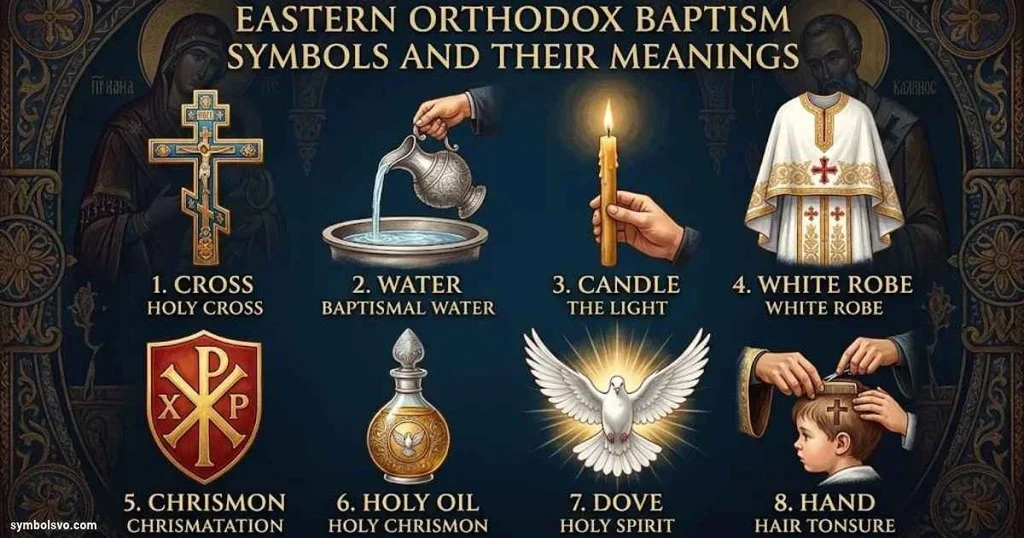
The Eastern Orthodox Church understands baptism as a sacrament through which a person enters the life of Christ and becomes part of the Church.
Orthodox baptism traditionally involves three complete immersions in water. The priest invokes the Father, Son, and Holy Spirit during the ceremony.
Chrismation follows immediately after baptism. This close connection between the two rites is an important feature of Orthodox Christian initiation.
Orthodox Church in America+1
Triple Immersion
The priest immerses the candidate three times in the baptismal water.
Each immersion corresponds with one person of the Holy Trinity.
The action also represents participation in Christ’s death and resurrection.
Holy Water
Water represents spiritual cleansing, new birth, and entry into life in Christ.
The baptismal water is blessed before the ceremony and used in the triple immersion.
Holy Chrism
After baptism, the priest anoints different parts of the person’s body with Holy Chrism.
This ceremony is called Chrismation. It represents receiving the gift and seal of the Holy Spirit.
The Orthodox Church understands Chrismation as an essential part of Christian initiation rather than a ceremony postponed until a later age.
White Baptismal Robe
The newly baptized person wears white clothing.
The garment represents purity, spiritual renewal, and the new life received through Christ.
Orthodox traditions often call this garment the robe of salvation.
Baptismal Cross
A baptismal cross may be given to the newly baptized person.
It represents Christian identity and a commitment to follow Jesus Christ.
In many Orthodox communities, the cross becomes a lasting personal reminder of baptism.
Procession Around the Baptismal Font
After baptism and Chrismation, the priest leads the newly baptized person and godparents in a procession around the baptismal font.
This procession is accompanied by a hymn that celebrates the person’s entry into Christ.
It expresses joy, Christian belonging, and the beginning of a lifelong journey of faith.
Protestant Baptism Symbols and Their Meanings
Protestant baptism symbols vary because Protestant Christianity includes many denominations with different beliefs and ceremonies.
Baptists, Methodists, Lutherans, Presbyterians, Anglicans, and other Protestant communities don’t follow identical baptismal practices.
Some churches baptize infants while others practice believer’s baptism, which normally follows a personal profession of faith.
Despite these differences, several symbols remain important.
Water and Baptism by Immersion
Water represents cleansing, new life, and obedience to Jesus.
Baptist and many evangelical churches commonly use immersion because it provides a visible picture of burial and resurrection with Christ.
The Cross
The cross represents Jesus’ sacrifice and the foundation of Christian salvation.
Some churches place a cross near the baptismal pool or use it in baptism certificates and other materials.
Baptismal Clothing
White clothing may symbolize purity and a new life in Christ.
However, clothing practices differ. Some churches provide white robes while others allow candidates to wear ordinary modest clothing suitable for immersion.
The Congregation
The congregation represents the Christian community that welcomes the newly baptized person.
In many Protestant churches, baptism takes place publicly before the congregation.
Church members may pray for the candidate and offer encouragement as the person begins or continues a journey of Christian discipleship.
Baptismal Testimony
A baptismal testimony is a personal statement of faith that some Protestant churches include in the ceremony.
The candidate may explain how they came to believe in Jesus Christ and why they want to receive baptism.
This testimony highlights personal faith and public commitment.
Important: Baptism candles, anointing oil, and traditional white garments aren’t universal Protestant requirements. Their use depends on the denomination and individual church.
Baby Baptism Symbols and Traditional Christening Symbols
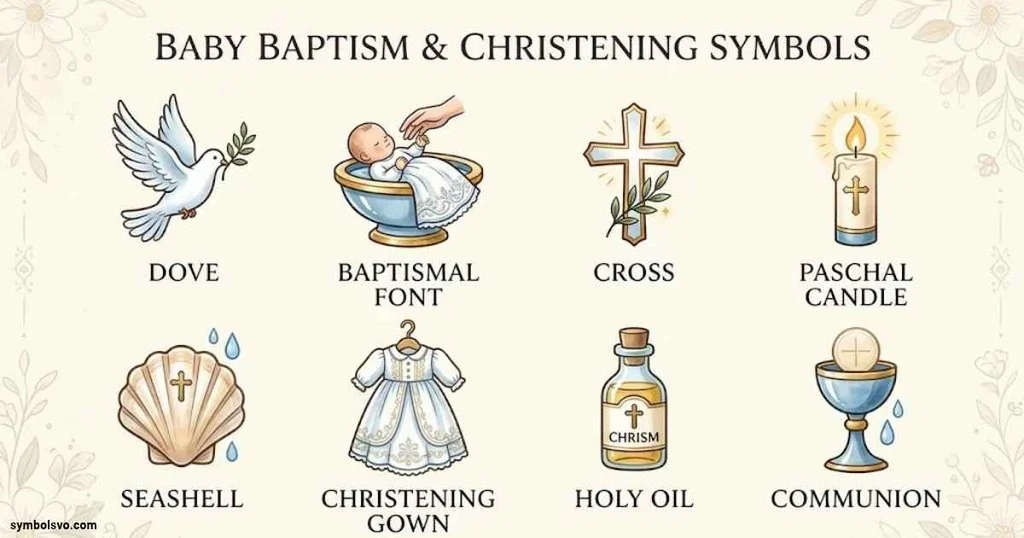
Baby baptism symbols express the Christian meaning of welcoming an infant into the Church. They also reflect the responsibilities of parents and godparents in supporting the child’s religious upbringing.
The word christening is often used for infant baptism, particularly in British and some Protestant traditions. However, the terms don’t always have exactly the same meaning in every church.
Catholic and Orthodox churches traditionally baptize infants. Some Protestant denominations also practice infant baptism, while others reserve baptism for people who can personally profess their faith.
White Baby Baptism Gown
The white gown symbolizes purity, spiritual renewal, and new life in Christ.
Many families preserve christening gowns as special heirlooms. Some gowns pass from parents to children and then to grandchildren.
Baby Baptism Candle
The baptism candle represents the light of Jesus Christ.
Parents and godparents help nurture the child’s Christian faith as they grow older.
In Catholic ceremonies, the candle is traditionally lit from the Paschal candle.
Cross for Baby Baptism
A small cross necklace or baptismal cross represents the child’s connection with Jesus Christ.
Families sometimes give a cross as a lasting keepsake of the ceremony.
Baptism Shell
A scallop shell is a traditional design used in christening decorations and religious artwork.
It represents the baptismal water and is often included on invitations, cards, and baptism gifts.
Baptism Bible
A children’s Bible or personalized Bible can serve as a meaningful baptism gift.
It represents the importance of Scripture in Christian education and spiritual development.
Parents may use it to introduce the child to biblical stories and Christian teachings as the child grows.
Godparents and Their Religious Role
Godparents play an important role in many infant baptism traditions.
Their responsibility goes beyond attending the ceremony or giving a gift. They support the parents in helping the child learn about Christian faith and develop a relationship with the Church.
Their specific responsibilities vary across denominations.
What Do Baptism Symbols Have in Common?
Although baptism symbols have different appearances and uses, many communicate similar Christian beliefs.
Water, the white garment, the cross, and the candle all point toward a transformed life through Jesus Christ. Oil and dove imagery emphasize the work of the Holy Spirit while the baptismal font represents the place where Christian initiation takes place.
The following table summarizes their main meanings.
| Baptism symbol | Main meaning | Christian connection |
| Water | Cleansing and new life | Spiritual rebirth |
| Cross | Sacrifice and salvation | Death and resurrection |
| White garment | Purity and renewal | Being clothed in Christ |
| Candle | Light and guidance | Jesus as the light of the world |
| Oil | Strength and consecration | Anointing and the Holy Spirit |
| Dove | Divine presence and peace | Jesus’ baptism |
| Shell | Baptismal water | Traditional baptism imagery |
| Baptismal font | Christian initiation | New birth |
| Ichthys | Christian identity | Faith in Jesus |
| Fire | Purification and divine power | Holy Spirit |
| Olive branch | Peace and hope | Noah’s flood |
| Water vessel | Baptismal water | The baptismal rite |
The Three Main Themes Behind Baptism Symbolism
Most baptism symbols connect with three central Christian themes.
Cleansing and forgiveness: Water and anointing oil communicate purification and preparation for Christian life.
New life and salvation: The cross, white garment, and baptismal font point toward a renewed relationship with Jesus Christ.
Faith and spiritual guidance: The candle, dove, and fire communicate the light, presence, and work of the Holy Spirit.
These themes explain why different Christian communities can use different objects while expressing related beliefs.
How Baptism Symbols Differ Across Christian Denominations
Christian denominations share many beliefs about baptism, but they don’t always understand or use its symbols in identical ways.
The Catholic and Eastern Orthodox Churches treat baptism as a sacrament of Christian initiation. Many Protestant churches also understand baptism as an important Christian ordinance or sacrament, although their theological explanations differ.
| Symbol or practice | Catholic Church | Eastern Orthodox Church | Protestant churches |
| Baptismal water | Essential | Essential | Essential |
| Sign of the cross | Traditional rite | Used in the liturgy | Varies |
| White garment | Traditional | Traditional | Varies |
| Baptism candle | Traditional | Practices vary | Varies |
| Anointing oil | Used in baptism | Used in Chrismation | Varies |
| Triple immersion | Permitted | Traditional practice | Used by some churches |
| Pouring | Permitted | Not the usual practice | Used by some churches |
| Sprinkling | Not the usual Catholic method | Not standard | Used by some churches |
| Infant baptism | Practiced | Practiced | Depends on denomination |
| Believer’s baptism | Adult baptism practiced | Adult baptism practiced | Important in many traditions |
The table shows general patterns rather than universal rules. Individual churches may follow different liturgical practices.
Why Do These Differences Exist?
The differences come from distinct interpretations of Scripture, church history, sacramental theology, and Christian initiation.
For example, Catholic teaching understands baptism as a sacrament that brings about spiritual rebirth through water and the Holy Spirit.
Eastern Orthodox teaching connects baptism and Chrismation closely. The newly baptized person receives Chrismation immediately after baptism.
Many Baptist and evangelical churches emphasize a personal profession of faith before baptism. They often use immersion because it visibly represents the death and resurrection of Jesus.
These differences don’t make every baptism symbol exclusive to one denomination. Water, the cross, and Christian identity remain important across many traditions.
Are All Baptism Symbols Mentioned in the Bible?
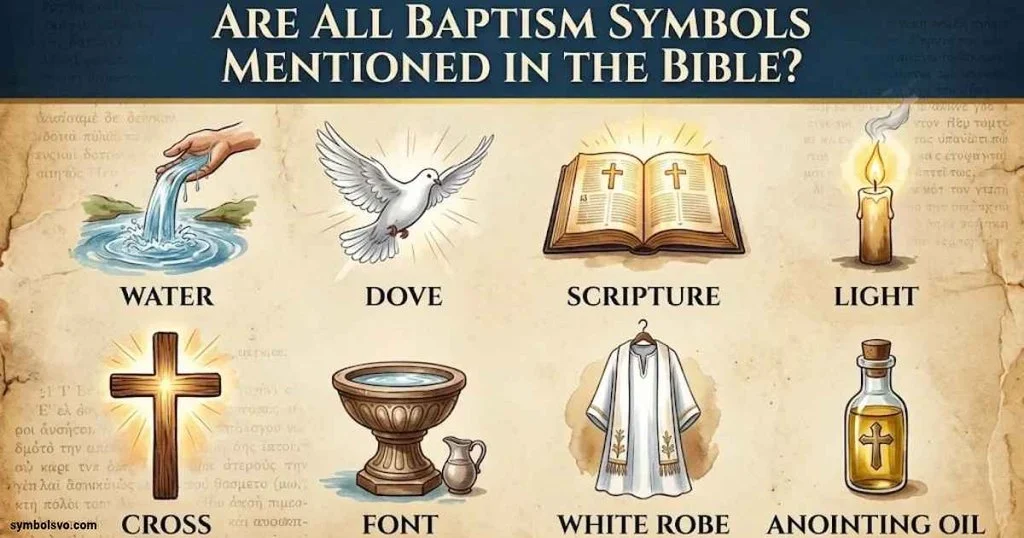
No. Some baptism symbols have direct biblical foundations while others developed through centuries of Christian worship and artistic traditions.
Understanding this distinction prevents confusion between Scripture and later ceremonial customs.
Symbols With Direct Biblical Connections
Several symbols have clear connections with biblical passages:
| Symbol | Biblical reference | Main connection |
| Water | John 3:5 | Birth through water and the Spirit |
| Cross | Romans 6:3–4 | Death and resurrection with Christ |
| White garment | Galatians 3:27 | Being clothed in Christ |
| Candle and light | John 8:12; Matthew 5:14–16 | Christ as light |
| Oil | 2 Corinthians 1:21–22 | Anointing and spiritual sealing |
| Dove | Matthew 3:16–17 | Holy Spirit at Jesus’ baptism |
| Fire | Acts 2:1–4 | Holy Spirit at Pentecost |
| Olive branch | Genesis 8:11 | Hope and renewal |
| Jordan River | Matthew 3:13–17 | Jesus’ baptism |
| Noah’s flood | 1 Peter 3:20–21 | Biblical connection with baptism |
Symbols That Developed Through Church Tradition
Some objects became common through Christian liturgy, church architecture, and religious artwork.
Examples include:
- Baptism shell: A traditional vessel associated with pouring water.
- Baptismal font: A dedicated structure or basin used in the baptismal rite.
- Baptism candle: A ceremonial object used in particular Christian traditions.
- White christening gown: A traditional garment used in infant baptism.
- Baptismal cross necklace: A personal religious keepsake rather than a required part of baptism.
These objects can carry genuine religious meaning without being explicitly prescribed as baptismal objects in the Bible.
The distinction is important: a symbol can reflect biblical teaching without appearing as an actual object in a specific Scripture passage.
Frequently Asked Questions About Baptism Symbols
What Are the Main Symbols of Baptism?
The main symbols of baptism include water, the cross, a white garment, a candle, anointing oil, and the dove. Other traditional symbols include the baptismal shell, baptismal font, Christian fish, fire, and olive branch.
Each communicates a different aspect of Christian faith, including cleansing, salvation, spiritual renewal, and the Holy Spirit.
What Does Water Symbolize in Christian Baptism?
Water represents spiritual cleansing, forgiveness, and new life through Jesus Christ. It also connects baptism with Christ’s death and resurrection.
Romans 6:3–4 explains how baptism represents being buried with Christ and rising into a new life.
What Does the Cross Mean During Baptism?
The cross represents Jesus Christ’s sacrifice, redemption, and victory over death. During some baptism ceremonies, the minister makes the sign of the cross on the candidate’s forehead to identify the person with Christ.
It also reminds Christians of their commitment to follow Jesus.
Why Do People Wear White at Baptism?
White clothing represents purity, spiritual renewal, and a new identity in Christ.
The symbolism comes from Galatians 3:27, which describes baptized believers as having put on Christ. Catholic and Eastern Orthodox ceremonies traditionally include a white baptismal garment.
What Does a Baptism Candle Represent?
A baptism candle represents Jesus Christ as the light of the world. It symbolizes faith, hope, and spiritual guidance.
In Catholic baptism, the candle is traditionally lit from the Paschal candle, which represents the risen Christ.
What Does Oil Symbolize in Catholic Baptism?
Oil represents strength, preparation, consecration, and the Holy Spirit.
Catholic baptism uses the Oil of Catechumens before baptism and sacred chrism after baptism. The two oils have different liturgical purposes.
What Does a Dove Symbolize in Baptism?
The dove represents the Holy Spirit and is connected with Jesus’ baptism in the Jordan River.
Matthew 3:16 describes the Spirit descending like a dove after Jesus came out of the water.
Why Is a Shell a Symbol of Baptism?
The scallop shell is a traditional Christian baptism symbol associated with pouring water over the person being baptized.
It appears in religious artwork and baptismal decorations. However, using a shell isn’t necessary for a valid baptism.
What Does the Baptismal Font Represent?
The baptismal font is the basin or structure that holds baptismal water.
It represents the place of Christian initiation and the beginning of a person’s life in the Church.
Are Baptism and Christening Symbols the Same?
Generally, yes. Both terms refer to Christian baptism and often involve similar symbols, including water, white garments, crosses, and candles.
However, christening is especially common when discussing infant baptism in certain Christian traditions.
What Are the Main Catholic Baptism Symbols?
The main Catholic baptism symbols include:
- Baptismal water.
- Sign of the cross.
- Oil of Catechumens.
- Sacred Chrism.
- White garment.
- Baptism candle.
- Baptismal font.
These elements form part of the Catholic baptismal rite and communicate different aspects of Christian initiation.
What Makes Orthodox Baptism Different?
Eastern Orthodox baptism traditionally involves triple immersion in water, followed immediately by Chrismation.
The newly baptized person receives Holy Chrism as a sign of the gift of the Holy Spirit. Orthodox churches also traditionally present a white garment and celebrate the newly baptized person’s entrance into Christian life.
Do All Protestant Churches Use the Same Baptism Symbols?
No. Protestant denominations follow different baptismal practices.
Baptist churches commonly use immersion and emphasize personal faith. Anglican, Lutheran, Methodist, and Presbyterian churches may also use white garments, baptismal fonts, or other traditional elements.
The use of candles and anointing oil varies between churches.
Are Baptism Symbols Found in the Bible?
Some have direct biblical connections while others developed through church tradition.
Water, the dove, fire, the cross, and biblical images of white garments have clear scriptural associations. The scallop shell and many ceremonial objects became established through later Christian practices.
Which Baptism Symbols Represent New Life in Christ?
Water, the white garment, and the baptismal font are particularly associated with new life.
Water represents spiritual rebirth, the garment symbolizes being clothed in Christ, and the font marks the place where baptism takes place.
Which Baptism Symbol Represents the Holy Spirit?
The dove is the most recognizable visual symbol of the Holy Spirit in baptism artwork.
Anointing oil and fire also have important connections with the Spirit. The dove appears in the Gospel account of Jesus’ baptism while fire appears in the Pentecost story.
Conclusion: The Spiritual Meaning Behind Baptism Symbols
Baptism symbols represent some of the most important beliefs in Christianity. They communicate spiritual cleansing, salvation, forgiveness, and a new beginning through Jesus Christ.
Water remains the central symbol because it represents spiritual rebirth and renewal. The cross recalls Christ’s sacrifice while the white garment represents a new identity in him. Candles point toward the light of Christ, and anointing oil expresses consecration and the work of the Holy Spirit.
Other symbols, including the dove, shell, baptismal font, Christian fish, and olive branch, add further meaning through biblical imagery and church traditions.
Although Catholic, Eastern Orthodox, and Protestant churches approach baptism differently, these symbols help explain the spiritual importance of Christian initiation.
Ultimately, baptism is more than a ceremony or family celebration. It represents a meaningful commitment to Christian faith and a life shaped by the teachings of Jesus Christ.

Mason Ellington is a creative and dedicated Content Writer and Symbols Expert with a passion for words, communication, and symbolic meanings. He specializes in crafting engaging, informative, and well-structured content while exploring the deeper meanings and interpretations behind symbols. With a creative mindset and attention to detail, Mason transforms ideas into meaningful content that informs, inspires, and connects with readers. His expertise combines powerful storytelling, clear communication, and a deep understanding of symbolism.
 Daniel Brooks
 Nathan Holloway