Geometry uses a language of its own. A small angle mark, a pair of parallel arrows, or a short line above two letters can change the meaning of an entire mathematical statement. These marks help you understand shapes, compare measurements, and solve problems without writing lengthy explanations.
Geometry symbols represent mathematical objects and relationships such as points, lines, angles, triangles, circles, and geometric measurements. Students use them in diagrams, equations, classroom exercises, and geometric proofs. Each symbol has a specific purpose, so understanding its meaning makes mathematical problems easier to read and solve.
Whether you’re learning basic geometry or reviewing advanced mathematical notation, knowing these symbols gives you a useful foundation. This guide covers common geometry symbols, their names, definitions, and examples. You’ll also learn how to read geometric notation, recognize diagram markings, and avoid common mistakes.
Geometry Symbols and Their Meanings (Complete Chart)
A geometry symbols chart gives you a quick way to identify mathematical signs and understand their purpose. Some symbols represent geometric figures, while others describe relationships between lines, angles, and measurements.
The following table includes frequently used geometry symbols with names, definitions, and examples.
| Symbol | Name | Meaning / Example |
| ∠ | Angle | Represents an angle, such as ∠ABC |
| ° | Degree | Measures angles, such as 45° |
| ∟ | Right angle | Represents a 90° angle |
| ∥ | Parallel | Indicates parallel lines, such as AB ∥ CD |
| ⊥ | Perpendicular | Indicates lines meeting at 90° |
| ≅ | Congruent | Represents figures with the same shape and size |
| ∼ | Similar | Represents figures with the same shape and proportional dimensions |
| ≈ | Approximately equal | Indicates values that are close but not necessarily identical |
| = | Equal | Indicates two equal quantities |
| ≠ | Not equal | Indicates different quantities |
| △ | Triangle | Represents a triangle, such as △ABC |
| ○ | Circle | Commonly represents a circle in diagrams |
| π | Pi | Approximately 3.14159 |
| \(\overline{AB}\) | Line segment | Represents the segment connecting A and B |
| \(\overrightarrow{AB}\) | Ray | Starts at A and passes through B |
| \(\overleftrightarrow{AB}\) | Line | Extends infinitely in both directions through A and B |
| m∠ABC | Angle measure | Represents the measurement of angle ABC |
| r | Radius | Distance from a circle’s center to its circumference |
| d | Diameter | Distance across a circle through its center |
| ∴ | Therefore | Introduces a mathematical conclusion |
| ∩ | Intersection | Represents elements shared by two sets |
| ∪ | Union | Represents elements belonging to either set |
Important: Not every geometric object has one universal standalone symbol. For example, mathematicians usually identify squares and rectangles by their names or diagrams. Similarly, letters such as r, d, and A represent variables whose meanings depend on the mathematical context.
How to Read Common Geometry Symbols
Understanding a symbol involves more than recognizing its appearance. You also need to consider the letters, lines, and markings surrounding it.
For example:
- ∠ABC: An angle with B as its vertex.
- AB ∥ CD: Line AB is parallel to line CD.
- AB ⊥ CD: Line AB is perpendicular to line CD.
- △ABC ≅ △DEF: The two triangles have the same shape and size.
- \(\overline{AB}\): The line segment connecting points A and B.
- \(\overrightarrow{AB}\): A ray that begins at A and passes through B.
These conventions help students interpret geometry diagrams and communicate mathematical ideas precisely.
What Are Geometry Symbols?
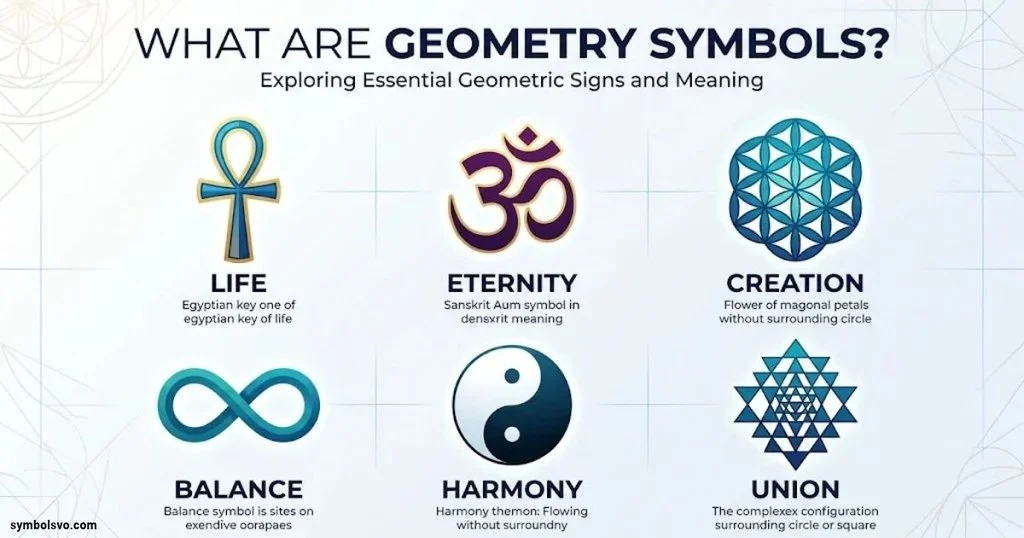
Geometry symbols are mathematical signs, letters, and markings used to represent geometric figures, measurements, and relationships. They provide a consistent way to describe mathematical objects without repeatedly writing their full definitions.
For example, instead of writing “two lines intersect at a right angle,” you can write:
\[ AB \perp CD \]
The perpendicular symbol communicates the relationship immediately.
Geometry includes several types of notation. Some symbols identify objects, others describe measurements, and some show relationships between different figures.
Types of Geometric Symbols
You can organize common mathematical symbols used in geometry into these categories:
- Basic geometric elements: Points, lines, rays, line segments, and planes.
- Angle symbols: Angle marks, degree signs, and right-angle indicators.
- Line relationships: Parallel, perpendicular, and intersecting lines.
- Shape symbols: Triangles, circles, and polygons.
- Measurement symbols: Radius, diameter, area, perimeter, and volume variables.
- Relationship symbols: Congruence, similarity, equality, and approximation.
- Set symbols: Intersection, union, subset, and element membership.
Each category represents a different part of geometric notation.
Why Are Geometric Symbols Important?
Geometry symbols make mathematical communication faster and more accurate. They allow students to recognize important properties without reading lengthy descriptions.
For example, matching tick marks on two sides of a triangle indicate that those sides have equal lengths. Matching arcs inside two angles show that their measurements are equal.
These markings become especially useful when solving complex geometry problems.
Here are some important benefits:
- Clear communication: Symbols help students express mathematical relationships accurately.
- Simpler calculations: Short notation makes equations easier to write and understand.
- Diagram interpretation: Special markings reveal information about geometric figures.
- Logical reasoning: Symbols help organize statements in geometric proofs.
- Consistent notation: Students and mathematicians can communicate using familiar conventions.
Basic Geometry Symbols for Points, Lines, and Line Segments
Points, lines, and planes form the foundation of geometry. Almost every geometric figure depends on these basic elements.
Understanding their notation helps you recognize more complicated geometric concepts and relationships.
Point Symbol and Point Notation (A, B, C)
A point represents an exact location in space. It has no length, width, or height. Mathematicians usually identify points using uppercase letters.
For example:
- A represents point A.
- B represents point B.
- C represents point C.
A point has no physical dimensions in mathematical geometry. The small dot used to show it in a diagram is simply a visual marker.
Points help define lines, angles, triangles, and other geometric figures.
Line Symbol (\(\overleftrightarrow{AB}\))
A line is a straight path that extends infinitely in both directions. It has no endpoints and continues beyond any portion shown in a diagram.
The notation:
\[ \overleftrightarrow{AB} \]
represents a line passing through points A and B.
The double-headed arrow indicates that the line extends in both directions. You can name the same line using B and A because the order does not change the line.
Line Segment Symbol (\(\overline{AB}\))
A line segment is a portion of a line with two fixed endpoints. Unlike a complete line, it has a definite beginning and ending.
Its notation is:
\[ \overline{AB} \]
The horizontal bar above AB identifies the segment connecting the two points.
For example, if point A and point B are 8 centimeters apart, then:
\[ AB=8\text{ cm} \]
Here, \(AB\) without the bar commonly represents the length of the segment rather than the geometric object itself.
Ray Symbol (\(\overrightarrow{AB}\))
A ray begins at one endpoint and continues infinitely in one direction. It has a starting point but no ending point.
Its notation is:
\[ \overrightarrow{AB} \]
The first letter identifies the starting point. Therefore, ray AB begins at A and passes through B.
The order matters. Ray BA begins at B and travels through A, so it represents a different ray.
Parallel Lines Symbol (∥)
Parallel lines lie in the same plane and never intersect. Their perpendicular distance remains constant throughout their infinite length.
The parallel symbol is:
\[ \parallel \]
Example:
\[ AB\parallel CD \]
This statement means that line AB is parallel to line CD.
You can recognize parallel relationships in several everyday objects:
- Opposite edges of a rectangular table.
- Straight railroad tracks.
- Opposite sides of a rectangle.
- Parallel lines in architectural drawings.
Perpendicular Lines Symbol (⊥)
Perpendicular lines intersect to form four right angles. Each angle measures exactly 90 degrees.
The perpendicular symbol is:
\[ \perp \]
For example:
\[ AB\perp CD \]
This means that line AB meets line CD at a right angle.
A small square inside the angle often identifies the 90-degree relationship. This marking provides useful information even when the diagram isn’t drawn to scale.
Intersecting Lines and Collinear Points
Intersecting lines share at least one common point. When two distinct lines intersect in a plane, they meet at exactly one point.
Collinear points are points that lie on the same straight line.
For example, if A, B, and C lie on one straight line, you can describe them as collinear.
These concepts help explain geometric relationships and identify how different objects connect.
Geometry Angle Symbols and Their Meanings
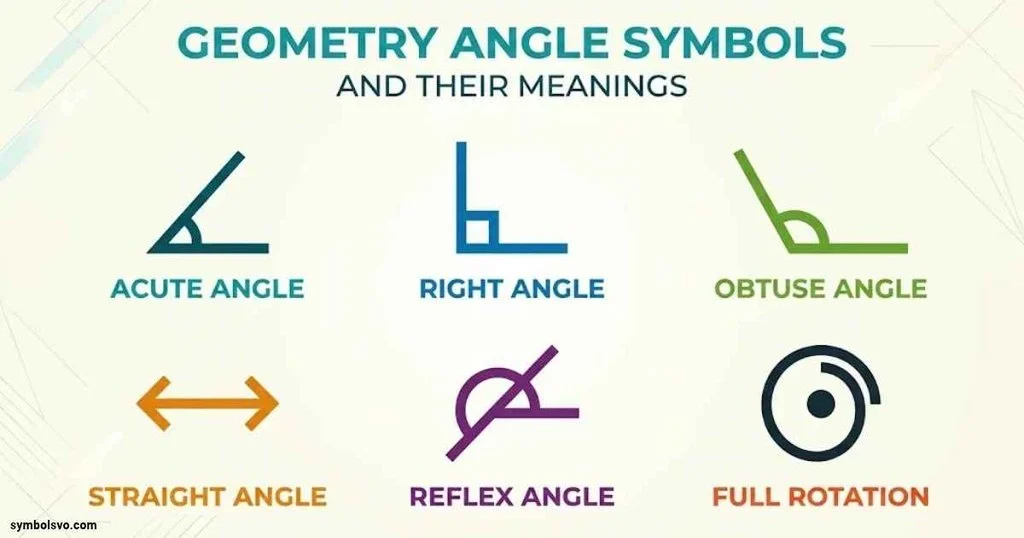
Angles appear throughout geometry. They describe the amount of rotation between two rays that share a common endpoint.
The most recognizable angle symbol is ∠. You will find it in triangle problems, parallel-line exercises, geometric proofs, and measurement calculations.
Angle Symbol (∠)
The angle symbol represents an angle formed by two rays with a common endpoint.
For example:
\[ \angle ABC \]
This notation identifies the angle formed by rays BA and BC.
The middle letter always identifies the vertex when three letters name an angle.
Therefore:
- ∠ABC has vertex B.
- ∠BAC has vertex A.
- ∠ACB has vertex C.
This distinction matters because changing the middle letter changes the angle being described.
Degree Symbol (°)
The degree symbol measures angles. One complete rotation contains 360 degrees.
A straight angle measures 180 degrees, while a right angle measures 90 degrees.
Examples include:
- 30°: A small acute angle.
- 45°: An acute angle.
- 90°: A right angle.
- 120°: An obtuse angle.
- 180°: A straight angle.
- 360°: A complete rotation.
The degree symbol appears in geometric measurements, construction drawings, navigation, and many practical calculations.
Right Angle Symbol (∟)
A right angle measures exactly 90 degrees. It forms when two perpendicular rays, lines, or segments meet.
A small square inside the angle identifies this relationship.
For example:
\[ m\angle ABC=90^\circ \]
The expression \(m\angle ABC\) represents the measure of angle ABC.
A right-angle marker is especially useful in geometry diagrams because it communicates an exact measurement without requiring a written number.
Types of Angles and Their Measurements
Angles are classified according to their measurements. Learning these categories makes it easier to identify geometric relationships.
| Angle Type | Measurement | Meaning |
| Acute angle | 0° to less than 90° | Smaller than a right angle |
| Right angle | 90° | Forms a square corner |
| Obtuse angle | Greater than 90° and less than 180° | Wider than a right angle |
| Straight angle | 180° | Forms a straight line |
| Reflex angle | Greater than 180° and less than 360° | Larger than a straight angle |
| Full angle | 360° | Completes one rotation |
For example: An angle measuring 135° is obtuse because it exceeds 90° but remains smaller than 180°.
Common Angle Relationships
Geometry also uses specific terms to describe relationships between two or more angles.
| Angle Relationship | Meaning | Important Fact |
| Complementary | Two angles whose measures add to 90° | Their sum is 90° |
| Supplementary | Two angles whose measures add to 180° | Their sum is 180° |
| Adjacent | Two angles sharing a vertex and a common side without overlapping interiors | They sit next to each other |
| Vertical | Opposite angles formed by intersecting lines | Opposite angles are equal |
| Corresponding | Angles in matching positions when a transversal crosses two lines | Equal when the lines are parallel |
| Alternate interior | Interior angles on opposite sides of a transversal | Equal when the lines are parallel |
For example, two complementary angles could measure 35° and 55°.
\[ 35^\circ+55^\circ=90^\circ \]
Understanding these angle relationships helps you calculate missing measurements and solve geometric proofs.
Geometry Symbols for Shapes and Geometric Figures
Geometric shapes are everywhere, from simple classroom drawings to complex architectural structures. Each shape has properties that distinguish it from other figures.
Shape notation helps identify figures and describe their sides, angles, dimensions, and symmetry.
Triangle Symbol (△)
A triangle is a two-dimensional polygon with three sides, three vertices, and three interior angles.
The triangle symbol is:
\[ \triangle \]
For example:
\[ \triangle ABC \]
This notation represents a triangle with vertices A, B, and C.
Triangles can be classified according to their side lengths or angle measurements.
Classification by sides:
- Equilateral triangle: All three sides have equal lengths.
- Isosceles triangle: At least two sides have equal lengths.
- Scalene triangle: All three sides have different lengths.
Classification by angles:
- Acute triangle: All three angles are smaller than 90°.
- Right triangle: One angle measures exactly 90°.
- Obtuse triangle: One angle measures more than 90°.
Every triangle has an interior angle sum of 180°.
\[ A+B+C=180^\circ \]
This property helps solve missing-angle problems and understand triangle relationships.
Square and Rectangle Notation
Squares and rectangles are common geometric figures with four sides and four right angles. However, they have different side-length properties.
A square has four equal sides and four 90-degree angles. A rectangle has four 90-degree angles with opposite sides equal.
Their properties include:
| Property | Square | Rectangle |
| Number of sides | 4 | 4 |
| Interior angles | Four 90° angles | Four 90° angles |
| Side lengths | All equal | Opposite sides equal |
| Opposite sides | Parallel | Parallel |
| Diagonals | Equal and perpendicular | Equal |
| Perimeter | 4 × side | 2 × (length + width) |
| Area | Side² | Length × width |
There isn’t one universal mathematical symbol for a square or rectangle. Students usually identify them through their names, vertex labels, and diagram markings.
Circle Symbol (○)
A circle is a two-dimensional shape consisting of all points in a plane that lie at the same distance from a fixed point called the center.
The circle symbol commonly appears as:
\[ \bigcirc \]
A circle has several important parts:
- Center: The fixed point inside the circle.
- Radius: The distance from the center to any point on the circumference.
- Diameter: A chord passing through the center.
- Circumference: The distance around the circle.
- Chord: A line segment connecting two points on the circumference.
- Arc: A portion of the circumference.
- Tangent: A line that touches a circle at exactly one point.
- Secant: A line that intersects a circle at two points.
These elements help describe circular measurements and solve problems involving geometric dimensions.
Polygon Symbol and Notation
A polygon is a closed two-dimensional figure made from straight line segments. Its sides connect at vertices and form an enclosed region.
Common polygons include:
| Polygon | Number of Sides | Number of Vertices |
| Triangle | 3 | 3 |
| Quadrilateral | 4 | 4 |
| Pentagon | 5 | 5 |
| Hexagon | 6 | 6 |
| Heptagon | 7 | 7 |
| Octagon | 8 | 8 |
| Nonagon | 9 | 9 |
| Decagon | 10 | 10 |
Polygons can also be classified as regular or irregular.
- Regular polygon: All sides and interior angles have equal measurements.
- Irregular polygon: Its sides or interior angles aren’t all equal.
For example, a regular hexagon has six equal sides and six equal interior angles. Each interior angle measures 120°.
Mathematical Relationship Symbols Used in Geometry
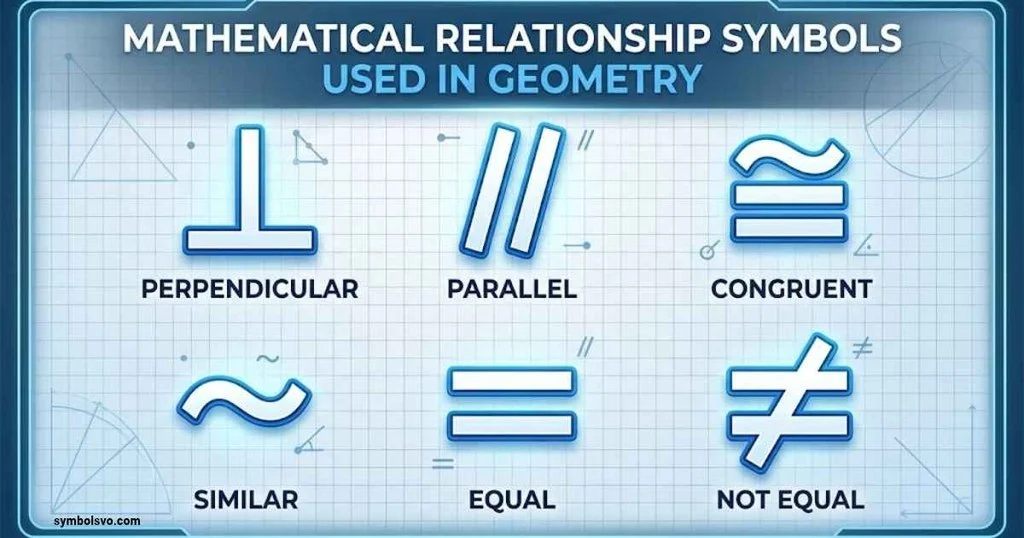
Geometric problems often involve comparing two shapes, measurements, or mathematical expressions. Relationship symbols make these comparisons easier to understand.
Some of the most important mathematical notations describe equality, similarity, congruence, and set relationships.
Congruent Symbol (≅)
The congruent symbol indicates that two geometric figures have the same shape and size.
Its notation is:
\[ \cong \]
For example:
\[ \triangle ABC\cong\triangle DEF \]
This statement means the two triangles are congruent. Their corresponding sides have equal lengths and their corresponding angles have equal measurements.
Congruence applies to more than triangles. It can describe equal line segments, angles, and other geometric figures.
For example:
\[ \overline{AB}\cong\overline{CD} \]
This means the two line segments have equal lengths.
Similar Symbol (∼)
The similar symbol describes figures with the same shape but not necessarily the same size.
Its notation is:
\[ \sim \]
For example:
\[ \triangle ABC\sim\triangle DEF \]
The corresponding angles of similar triangles are equal. Their corresponding side lengths have the same ratio.
Consider two triangles with side lengths:
- Triangle A: 3, 4, and 5 units.
- Triangle B: 6, 8, and 10 units.
Every side of the second triangle is twice the corresponding side of the first. Therefore, the triangles are similar.
Congruent vs. Similar: What’s the Difference?
These two symbols are easy to confuse, but they describe different relationships.
| Feature | Congruent (≅) | Similar (∼) |
| Shape | Same | Same |
| Size | Same | May differ |
| Corresponding angles | Equal | Equal |
| Corresponding sides | Equal | Proportional |
| Scale factor | 1 | Can differ from 1 |
Remember: Congruent figures are always similar, but similar figures aren’t necessarily congruent.
This distinction is particularly important in triangle geometry and geometric proofs.
Approximately Equal Symbol (≈)
The approximately equal symbol indicates that two values are close but not exactly equal.
For example:
\[ \pi\approx3.14 \]
The actual value of pi is irrational, meaning its decimal representation continues without ending or repeating. The number 3.14 is simply a convenient approximation.
You might also see this symbol in measurements rounded to a certain number of decimal places.
For example:
\[ \sqrt{2}\approx1.414 \]
This notation is useful when exact values aren’t necessary for a calculation.
Equal and Not Equal Symbols (= and ≠)
The equal symbol indicates that two mathematical quantities have the same value.
For example:
\[ 5+5=10 \]
The not equal symbol communicates the opposite relationship.
\[ 5+3\neq10 \]
In geometry, these symbols can compare side lengths, angle measurements, areas, and other quantities.
For example:
\[ AB=CD \]
This indicates that the lengths of segments AB and CD are equal.
Set Symbols in Geometry (∈, ⊂, ∩, ∪)
Set theory uses symbols to describe collections of mathematical objects. These symbols also appear in geometry, especially when discussing points, regions, and coordinate sets.
| Symbol | Name | Meaning |
| ∈ | Element of | An object belongs to a set |
| ⊂ | Subset | One set is contained within another |
| ∩ | Intersection | Elements shared by two sets |
| ∪ | Union | Elements belonging to either set |
For example:
\[ 3\in\{1,2,3,4,5\} \]
This means 3 belongs to the given set.
Similarly:
\[ A\cap B \]
represents the elements shared by sets A and B.
These symbols are useful in coordinate geometry, mathematical logic, and discussions involving geometric regions.
Therefore Symbol (∴)
The therefore symbol introduces a conclusion based on previous mathematical statements.
Its notation is:
\[ \therefore \]
For example:
\[ a=b,\quad b=c \]
\[ \therefore a=c \]
The conclusion follows because equality is transitive.
In geometric proofs, this symbol can introduce a result supported by definitions, properties, or previously established statements.
Geometry Symbols Used in Measurements and Formulas
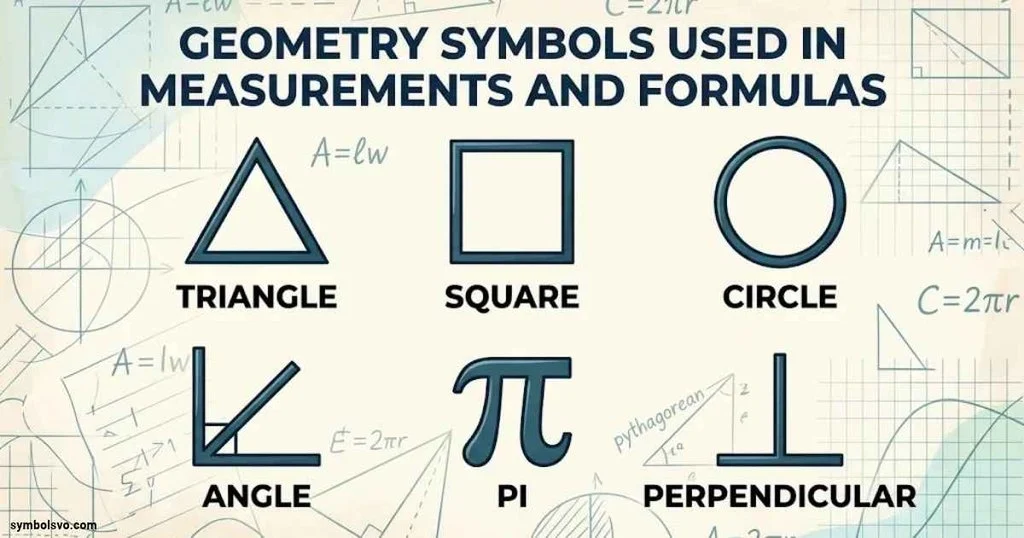
Measurements help describe the size and dimensions of geometric figures. Geometry uses letters and mathematical expressions to represent these quantities.
However, remember that many letters are conventional variable names rather than universal symbols. Their meanings depend on the formula and context.
Radius and Diameter Symbols
The radius and diameter describe important measurements of a circle.
- Radius (r): The distance from the center to the circumference.
- Diameter (d): A straight segment passing through the center and connecting two points on the circumference.
The diameter is twice the radius.
\[ d=2r \]
The radius is half the diameter.
\[ r=\frac{d}{2} \]
For example, if a circle has a radius of 7 centimeters, its diameter is:
\[ d=2(7)=14\text{ cm} \]
This relationship is essential when calculating a circle’s circumference and area.
Area and Perimeter Symbols
Area and perimeter describe two different properties of a two-dimensional shape.
Area (A) measures the surface enclosed by a figure. Perimeter (P) measures the total distance around its boundary.
Here are the most common geometry formulas:
| Shape | Area Formula | Perimeter Formula |
| Square | \(A=s^2\) | \(P=4s\) |
| Rectangle | \(A=lw\) | \(P=2(l+w)\) |
| Triangle | \(A=\frac12 bh\) | \(P=a+b+c\) |
| Circle | \(A=\pi r^2\) | \(C=2\pi r\) |
| Parallelogram | \(A=bh\) | \(P=2(a+b)\) |
| Trapezoid | \(A=\frac12(a+b)h\) | \(P=a+b+c+d\) |
Here, the variables represent:
- \(s\): Side length.
- \(l\): Length.
- \(w\): Width.
- \(b\): Base.
- \(h\): Perpendicular height.
- \(r\): Radius.
- \(C\): Circumference.
For example, a rectangle measuring 8 centimeters long and 5 centimeters wide has an area of:
\[ A=8\times5=40\text{ cm}^2 \]
Its perimeter is:
\[ P=2(8+5)=26\text{ cm} \]
Notice the different units. Area uses square units, while perimeter uses ordinary length units.
Pi Symbol (π)
Pi is one of the most recognizable mathematical symbols in geometry.
The symbol is:
\[ \pi \]
Pi represents the ratio of a circle’s circumference to its diameter. Its value is approximately 3.14159.
\[ \pi=\frac{C}{d} \]
Because pi is irrational, its decimal digits continue infinitely without repeating in a fixed pattern.
Two important circle formulas use pi:
Circumference:
\[ C=2\pi r \]
Area:
\[ A=\pi r^2 \]
For a circle with a radius of 5 centimeters:
\[ C=2\pi(5)\approx31.42\text{ cm} \]
Its area is:
\[ A=\pi(5)^2\approx78.54\text{ cm}^2 \]
Pi is essential for calculations involving wheels, circular structures, pipes, and other round objects.
Other Common Measurement Variables
Geometry formulas use several additional letters to represent measurements.
| Variable | Common Meaning | Typical Use |
| l | Length | Rectangles and solids |
| w | Width | Rectangles and rectangular prisms |
| h | Height | Triangles and three-dimensional figures |
| b | Base | Triangles and parallelograms |
| V | Volume | Three-dimensional objects |
| A | Area | Two-dimensional figures |
| P | Perimeter | Distance around a shape |
| SA | Surface area | Total exterior area of a solid |
| θ | Angle | Angle measurements |
| m | Slope or measure | Depends on context |
These variables make geometric equations easier to write and solve.
Geometry Symbols Used in Diagrams and Proofs
Not every geometry symbol appears as a keyboard character. Many important geometric conventions use small marks drawn directly inside diagrams.
These markings communicate information about sides, angles, and intersections. Learning to recognize them is essential when solving geometry exercises.
Tick Marks for Congruent Sides
Tick marks are short lines drawn across the sides of a geometric figure. They identify sides with equal lengths.
For example:
- One tick mark identifies one group of equal-length sides.
- Two tick marks identify another group.
- Three tick marks identify a third group.
Sides with matching tick marks have equal lengths, even when the diagram doesn’t display their measurements.
For example, if sides AB and AC each have one matching tick mark, then:
\[ AB=AC \]
This convention frequently appears in isosceles and equilateral triangle problems.
Angle Arc Marks
Small curved lines inside angles indicate equal angle measurements.
Matching arc markings represent congruent angles.
For example:
\[ \angle A\cong\angle B \]
This means both angles have equal measurements.
Different numbers of arcs distinguish different groups of equal angles. One arc and two arcs represent separate groups.
Right Angle Box Mark
A small square inside an angle identifies a right angle.
This marking means the angle measures exactly 90 degrees.
It also indicates that the two intersecting lines or segments are perpendicular.
\[ AB\perp CD \]
You don’t need a written 90° measurement when the right-angle marker already communicates that fact.
Midpoint Symbol and Notation
A midpoint divides a line segment into two congruent segments. It lies exactly halfway between the endpoints.
For example, if M is the midpoint of segment AB, then:
\[ AM=MB \]
Suppose AB measures 16 centimeters. Since M is the midpoint:
\[ AM=MB=8\text{ cm} \]
A midpoint may be identified through matching tick marks or stated directly in a geometry problem.
Perpendicular Bisector Notation
A perpendicular bisector is a line that intersects a segment at its midpoint and forms a 90-degree angle.
It combines two important geometric relationships:
- It divides a segment into two equal parts.
- It intersects the segment perpendicularly.
For example, if line l is the perpendicular bisector of AB, then:
\[ AM=MB \]
and:
\[ l\perp\overline{AB} \]
One important property is that every point on a segment’s perpendicular bisector is equally distant from its two endpoints.
This property appears in triangle constructions, circle geometry, and geometric proofs.
Intersection and Vertex Notation
An intersection occurs when two or more geometric objects share a point.
A vertex is a point where two or more sides or edges meet.
For example, the three vertices of triangle ABC are A, B, and C.
In a three-dimensional solid, vertices identify the corners where edges meet.
These labels help describe geometric figures and explain their properties accurately.
Geometry Symbols in Coordinate Geometry
Coordinate geometry combines algebra with geometric figures. It uses numbers and ordered pairs to identify positions on a coordinate plane.
Students use this notation to calculate distances, slopes, and midpoints and to examine relationships between lines.
Coordinate Point Notation (x, y)
An ordered pair identifies a point using two coordinates.
\[ (x,y) \]
The first value represents the horizontal position, while the second represents the vertical position.
For example:
\[ A(3,4) \]
This means point A is located three units to the right and four units above the origin.
The coordinate plane contains four quadrants:
| Quadrant | x-Coordinate | y-Coordinate |
| I | Positive | Positive |
| II | Negative | Positive |
| III | Negative | Negative |
| IV | Positive | Negative |
Points on the axes don’t belong to any of the four quadrants.
Origin Symbol (O)
The origin is the point where the horizontal x-axis and vertical y-axis intersect.
Its coordinates are:
\[ O=(0,0) \]
Every point on the coordinate plane is described relative to this fixed position.
The origin is important because it provides a common starting reference for plotting points and measuring coordinate distances.
Slope Symbol (m)
Slope describes the steepness and direction of a straight line.
The commonly used variable is \(m\).
Its formula is:
\[ m=\frac{y_2-y_1}{x_2-x_1} \]
This expression calculates the vertical change divided by the horizontal change between two points.
For example, consider two points:
\[ A(2,3),\quad B(4,7) \]
Their slope is:
\[ m=\frac{7-3}{4-2} =\frac42=2 \]
A positive slope rises from left to right. A negative slope falls from left to right.
A horizontal line has a slope of zero, while a vertical line has an undefined slope.
Distance and Midpoint Formulas
The distance formula calculates the straight-line distance between two coordinate points.
\[ d=\sqrt{(x_2-x_1)^2+(y_2-y_1)^2} \]
For example, the distance between A(1, 2) and B(4, 6) is:
\[ d=\sqrt{(4-1)^2+(6-2)^2} \]
\[ d=\sqrt{9+16}=5 \]
The midpoint formula identifies the point exactly halfway between two endpoints.
\[ M=\left(\frac{x_1+x_2}{2},\frac{y_1+y_2}{2}\right) \]
For A(1, 2) and B(5, 6):
\[ M=\left(\frac{1+5}{2},\frac{2+6}{2}\right) \]
\[ M=(3,4) \]
These formulas connect algebraic expressions with geometric measurements.
How to Read and Use Geometry Symbols
Recognizing a symbol is only the first step. You also need to understand how it works within a diagram or mathematical statement.
A few simple habits can make geometric notation much easier to follow.
Identify the Symbol First
Start by recognizing the symbol and its mathematical purpose.
Ask yourself whether it represents:
- A point or geometric object.
- An angle or measurement.
- A relationship between two figures.
- A mathematical operation or comparison.
For example, ∥ indicates parallel lines, while ⊥ indicates perpendicular lines.
Understand the Letters and Their Positions
The order of letters often carries important information.
Consider these examples:
- ∠ABC: The vertex is B.
- \(\overline{AB}\): A segment connecting A and B.
- \(\overrightarrow{AB}\): A ray starting at A and passing through B.
- \(\overleftrightarrow{AB}\): A line extending through A and B in both directions.
A small change in notation can completely change the geometric object being described.
Check the Geometry Diagram
Look closely at the markings before calculating anything.
Pay attention to:
- Matching side tick marks.
- Matching angle arcs.
- Right-angle squares.
- Arrow markings indicating parallel lines.
- Labels identifying points and vertices.
These markings provide mathematical information that may not appear in the written question.
Never assume a diagram is drawn to scale. Trust the given measurements and markings rather than estimating angles or side lengths visually.
Apply Geometry Symbols to a Problem
Consider a triangle with two angles measuring 45° and 65°. You need to find its third angle.
The interior angles of every triangle add up to 180°.
\[ A+B+C=180^\circ \]
Substitute the known measurements:
\[ 45^\circ+65^\circ+C=180^\circ \]
Therefore:
\[ C=180^\circ-110^\circ \]
\[ \boxed{C=70^\circ} \]
The symbols make the calculation organized and easy to understand.
Common Geometry Symbols Mistakes Students Should Avoid
Some geometry mistakes happen because students recognize a symbol but misunderstand its mathematical meaning.
Here are common errors worth watching for:
| Common Mistake | Correct Understanding |
| Confusing a line with a segment | A line extends infinitely in both directions; a segment has two endpoints. |
| Reversing ray notation | Ray AB starts at A, while ray BA starts at B. |
| Mixing up congruence and similarity | Congruent figures have equal shape and size; similar figures share shape but may differ in size. |
| Treating ≈ as exact equality | Approximately equal values are close, not necessarily identical. |
| Confusing an angle name with its measurement | ∠ABC identifies an angle; m∠ABC represents its measurement. |
| Assuming every drawn angle is accurate | Use stated measurements and markings instead of visual estimates. |
| Mixing up radius and diameter | Diameter equals twice the radius. |
| Assuming parallel lines must be horizontal | Parallel lines can have any direction, provided they never intersect in the same plane. |
| Confusing a right-angle marker with a square | A small square inside an angle indicates 90°, not necessarily a square shape. |
| Treating every variable as universal | Letters such as r, d, and A depend on context. |
A little attention to notation can prevent unnecessary mistakes during homework, examinations, and geometric proofs.
How to Memorize Geometry Symbols
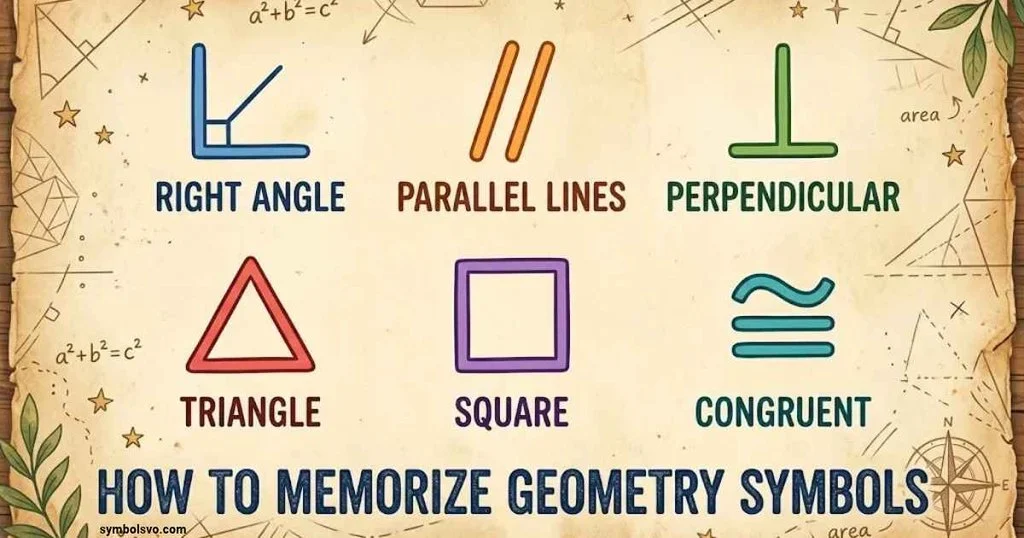
Memorizing dozens of mathematical signs can feel overwhelming at first. However, you don’t need to learn everything at once.
The easiest approach is to group related symbols and practice using them in actual geometry problems.
Learn Symbols by Category
Start with the most common groups instead of memorizing a random list.
For example:
- Lines: ∥, ⊥, \(\overline{AB}\), \(\overrightarrow{AB}\).
- Angles: ∠, °, ∟.
- Relationships: ≅, ∼, ≈, =, ≠.
- Shapes: △, ○.
- Sets: ∈, ⊂, ∩, ∪.
Learning related symbols together makes their differences easier to remember.
Practice with Geometry Diagrams
Drawing figures helps connect mathematical notation with visual information.
Try drawing a triangle and labeling its vertices. Mark equal sides with matching tick marks and equal angles with matching arcs.
You can also draw parallel and perpendicular lines to understand their different relationships.
Use Flashcards and Reference Charts
Flashcards provide a simple way to test your memory.
Write a symbol on one side and its name, meaning, and a short example on the other.
For instance:
- Front: ⊥
- Back: Perpendicular; lines intersect at 90°.
Reviewing a few symbols every day can improve recognition and recall.
Solve Practice Problems
The best way to remember a mathematical symbol is to use it.
Practice identifying angles, naming rays, comparing triangles, and calculating circle measurements.
You can also use free learning resources such as:
- Khan Academy Geometry for lessons and practice exercises.
- GeoGebra for interactive geometric constructions and diagrams.
- Math Is Fun for a quick geometry symbols reference.
These resources provide additional examples and opportunities to practice geometric notation.
Real-Life Applications of Geometry Symbols
Geometry isn’t limited to textbooks or classroom exercises. Its principles appear in buildings, roads, engineering drawings, and everyday designs.
Understanding geometric notation helps explain how these practical structures are measured and designed.
Geometry Symbols in Architecture and Construction
Architects and construction professionals use geometric concepts to plan buildings and organize structural layouts.
For example:
- Right angles help create square corners in rooms.
- Parallel lines represent opposite walls and aligned structural elements.
- Measurements describe room dimensions and building components.
- Geometric shapes help determine floor areas and material requirements.
Floor plans and technical drawings rely on accurate dimensions and clear geometric relationships.
Geometry Symbols in Engineering
Engineering involves many calculations related to angles, distances, dimensions, and structural relationships.
Engineers use geometric principles when designing bridges, machines, roads, and mechanical components.
Perpendicular and parallel relationships are particularly important when aligning structural elements. Accurate angle measurements also help ensure that components fit together as intended.
Geometry Shapes in Road Signs
Road signs provide familiar examples of geometric shapes in everyday life.
Common examples include:
- Triangle: Warning signs commonly use triangular shapes to alert drivers to potential hazards.
- Octagon: The stop sign uses an eight-sided shape.
- Circle: Circular signs commonly communicate regulations or restrictions.
These shapes help drivers recognize important information quickly.
Geometry in Art and Design
Artists and designers use geometric shapes to create patterns, balance, and visual structure.
Triangles can create directional movement, circles can produce smooth patterns, and squares can establish symmetry.
Geometry also appears in:
- Logo design.
- Textile patterns.
- Building decoration.
- Digital illustrations.
- Product packaging.
- Interior design.
Understanding proportions and geometric relationships helps designers create balanced and visually appealing work.
Frequently Asked Questions About Geometry Symbols
What Are Geometry Symbols?
Geometry symbols are mathematical signs and notations used to represent points, lines, angles, shapes, and measurements. They help students describe geometric relationships, interpret diagrams, and solve mathematical problems using concise expressions.
What Are the Most Common Geometry Symbols?
Some frequently used geometry symbols include ∠ for angles, ° for degrees, ∥ for parallel lines, ⊥ for perpendicular lines, ≅ for congruence, ∼ for similarity, and △ for triangles. The symbols \(\overline{AB}\) and \(\overrightarrow{AB}\) represent line segments and rays.
What Does the Angle Symbol (∠) Mean?
The angle symbol (∠) represents an angle formed by two rays sharing a common endpoint. For example, ∠ABC identifies an angle with B as its vertex. The middle letter always represents the vertex when three letters name an angle.
What Does the Parallel Symbol (∥) Mean?
The parallel symbol (∥) indicates that two lines in the same plane never intersect. For example, AB ∥ CD means line AB is parallel to line CD. Parallel lines maintain a constant perpendicular distance from each other.
What Does the Perpendicular Symbol (⊥) Mean?
The perpendicular symbol (⊥) indicates that two lines or segments intersect at a 90-degree angle. For example, AB ⊥ CD means the two lines form right angles at their intersection.
What Does the Congruent Symbol (≅) Mean?
The congruent symbol (≅) indicates that two geometric figures have the same shape and size. Congruent triangles have equal corresponding sides and equal corresponding angles. For example, △ABC ≅ △DEF represents two congruent triangles.
What Is the Difference Between Congruent and Similar Symbols?
Congruence (≅) describes figures with the same shape and size. Similarity (∼) describes figures with the same shape but potentially different sizes. Both relationships involve equal corresponding angles, but similar figures have proportional corresponding side lengths.
What Is the Symbol for a Right Angle?
The right-angle symbol is commonly represented by ∟. In geometry diagrams, a small square inside an angle is the usual marking for a 90-degree angle. The perpendicular symbol (⊥) also describes the relationship between lines forming right angles.
What Is the Symbol for a Line Segment?
The standard notation for a line segment connecting points A and B is \(\overline{AB}\). The horizontal bar above the letters identifies the segment. Without the bar, AB commonly represents the segment’s length.
What Is the Difference Between a Line, Ray, and Line Segment?
A line extends infinitely in both directions. A ray starts at one endpoint and continues infinitely in one direction. A line segment has two endpoints and a fixed length. Their notations use different combinations of bars and arrows.
What Does Pi (π) Mean in Geometry?
Pi (π) represents the ratio of a circle’s circumference to its diameter. Its approximate value is 3.14159. It appears in important circle formulas, including \(C=2\pi r\) for circumference and \(A=\pi r^2\) for area.
What Are the Symbols for Radius and Diameter?
The letter r commonly represents the radius, while d commonly represents the diameter. The radius measures the distance from the center to the circumference. The diameter passes through the center and equals twice the radius.
How Do You Read Geometry Notation?
Start by identifying the symbol and its purpose. Then examine the letters, arrows, bars, and markings surrounding it. For example, ∠ABC identifies an angle at B, while AB ∥ CD indicates that two lines are parallel.
Why Are Geometry Symbols Important in Mathematics?
Geometry symbols simplify mathematical communication and make diagrams easier to understand. They help students identify shapes, compare measurements, describe spatial relationships, and write geometric proofs without lengthy explanations.
Are Geometry Symbols the Same in Every Country?
Most standard mathematical symbols, including ∠, ∥, ⊥, ≅, and π, are widely recognized internationally. However, some textbooks and educational systems use different conventions for labeling figures, naming angles, or representing particular geometric objects.
Conclusion: Understanding Geometry Symbols and Their Meanings
Geometry symbols provide a simple and consistent way to describe mathematical objects and their relationships. From basic points and lines to complex geometric figures, each notation communicates specific information that helps make mathematical reasoning clearer.
Learning these symbols becomes easier when you organize them into categories and practice using them in diagrams and calculations. Pay particular attention to angle notation, line relationships, congruence, similarity, and measurement variables.
Keep the geometry symbols chart nearby while studying. Once you understand what each symbol represents and how to use it, you’ll find geometry diagrams, formulas, and mathematical proofs much easier to interpret.

Mason Ellington is a creative and dedicated Content Writer and Symbols Expert with a passion for words, communication, and symbolic meanings. He specializes in crafting engaging, informative, and well-structured content while exploring the deeper meanings and interpretations behind symbols. With a creative mindset and attention to detail, Mason transforms ideas into meaningful content that informs, inspires, and connects with readers. His expertise combines powerful storytelling, clear communication, and a deep understanding of symbolism.
 Daniel Brooks
 Nathan Holloway