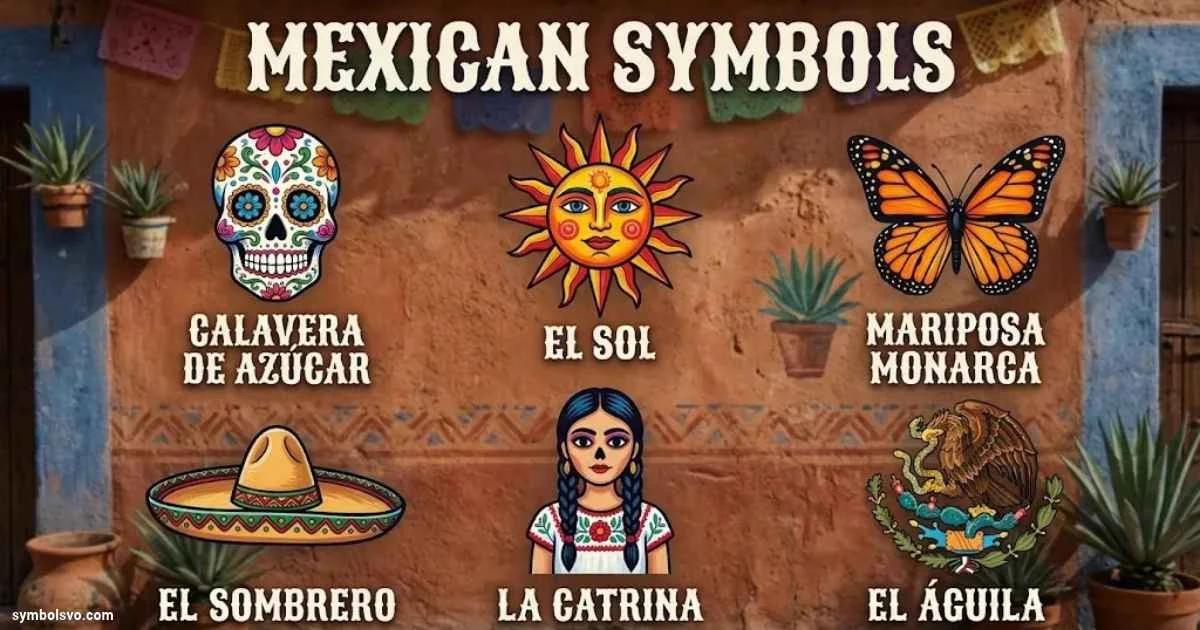
Mexican symbols tell stories that go far beyond flags, colorful decorations, and traditional artwork. They represent ancient civilizations, religious beliefs, national identity, family traditions, and the close relationship between people and nature. From the powerful eagle on the Mexican flag to the bright marigolds used during Día de los Muertos, each symbol carries a story worth understanding.
Mexico has a rich cultural history shaped by many civilizations. The Aztecs (Mexica), Maya, Olmecs, Zapotecs, and other Indigenous communities developed their own symbols, artistic styles, religious traditions, and systems of writing. Spanish colonization later introduced new religious imagery and influenced many existing customs.
Today, Mexican symbols and meanings appear in architecture, clothing, jewelry, tattoos, festivals, paintings, and everyday life. Some represent strength and protection. Others express love, remembrance, spirituality, or national pride.
This guide explores famous Mexican symbols, their historical backgrounds, and the meanings people associate with them today. It also explains an important distinction: Mexico does not have one single symbolic tradition. Meanings can change between communities, historical periods, and cultural practices.
What Are Mexican Symbols?
Mexican symbols are images, objects, patterns, colors, animals, and traditional designs that communicate cultural or historical ideas. They may represent a nation, an ancient deity, a religious belief, a natural force, or a family tradition.
Some symbols come from civilizations that existed long before European arrival. Others developed during the colonial period or after Mexico became independent.
You can generally group Mexican symbols into several categories:
- Ancient Mexican symbols: Images and signs associated with civilizations such as the Mexica, Maya, Olmec, and Zapotec.
- National symbols: The Mexican flag, national coat of arms, and national anthem.
- Religious symbols: Crosses, the Virgin of Guadalupe, rosaries, and sacred objects.
- Day of the Dead symbols: Sugar skulls, marigolds, candles, and ofrendas.
- Nature symbols: Corn, cactus, the sun, water, flowers, and animals.
- Traditional spiritual symbols: Designs connected to specific Indigenous communities, including Wixárika traditions.
- Modern cultural symbols: Images used in Mexican art, tattoos, fashion, murals, and popular culture.
Understanding their origins helps you avoid treating every traditional design as if it came from the same civilization.
Famous Mexican Symbols and Their Meanings
Mexico has many recognizable symbols. Some have national importance, while others belong to particular cultural or religious traditions.
| Mexican symbol | Common meaning or association |
| Mexican eagle | National identity, strength, and the foundation story of Tenochtitlan |
| Snake | Earthly power, transformation, and ancient religious traditions |
| Nopal cactus | Mexican landscape, resilience, and national identity |
| Mexican flag | Independence, national unity, and history |
| Sun Stone | Mexica cosmology and the understanding of time |
| Quetzalcoatl | Feathered serpent deity associated with knowledge and creation traditions |
| Jaguar | Power, authority, and connections with the natural and spiritual worlds |
| Marigold | Remembrance and Day of the Dead traditions |
| Sugar skull | Remembrance of deceased loved ones |
| Corn | Life, nourishment, agriculture, and cultural identity |
| Ojo de Dios | A Wixárika ceremonial object associated with seeing and spiritual understanding |
| Virgin of Guadalupe | Catholic devotion and Mexican religious identity |
| Ceiba tree | Sacred connections between the earthly world and the cosmos in Maya traditions |
These meanings are useful starting points. However, they are not universal definitions shared by every Mexican community.
Ancient Mexican Symbols and Their Historical Origins
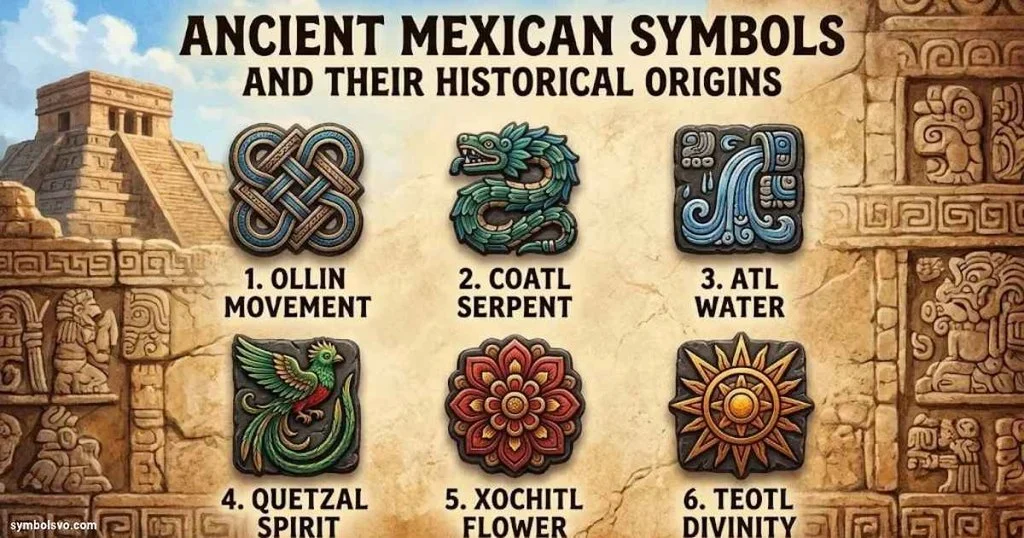
Ancient Mexican symbolism developed across different regions and civilizations. Each society created images to express its understanding of the world.
These symbols appeared on temples, pottery, sculptures, monuments, manuscripts, clothing, and ceremonial objects.
Olmec Symbols
The Olmec civilization flourished along Mexico’s Gulf Coast during the Formative period. It is often described as one of the earliest major civilizations of Mesoamerica.
Olmec artists created impressive stone monuments, jade objects, figurines, and ceremonial sculptures. Their artwork includes human faces, supernatural beings, and animal features.
Some notable themes include:
- Were-jaguar imagery: A combination of human and jaguar features found in Olmec art.
- Jade objects: Valuable materials used for ceremonial and elite objects.
- Serpent imagery: Connected with supernatural beings and powerful forces in some interpretations.
- Monumental stone heads: Famous sculptures that may represent important individuals or rulers.
Scholars continue to study the meanings of many Olmec designs. It is better to describe them through archaeological evidence than assign every image a fixed spiritual meaning.
Zapotec Symbols
The Zapotec civilization developed in Oaxaca and surrounding regions. Its history includes important urban centers such as Monte Albán.
Zapotec symbols appear in carved monuments, pottery, tombs, and inscriptions. Their writing system used signs to communicate information about people, places, dates, and events.
Important examples include:
- Zapotec glyphs: Signs used in inscriptions and historical records.
- Funerary urns: Ceramic objects decorated with human and supernatural figures.
- Calendar signs: Symbols connected with the recording of time and important dates.
- Danzantes: Carved figures at Monte Albán whose exact identities and meanings remain subjects of scholarly discussion.
These objects show how ancient communities used visual language to preserve history and express religious ideas.
Mexica and Aztec Symbols
The Mexica established Tenochtitlan in the Valley of Mexico during the 14th century. They later became the leading power in a larger political alliance commonly called the Aztec Empire.
Their symbols reflected religion, warfare, agriculture, astronomy, and the structure of the universe.
Some of the best-known Aztec symbols include:
- The Sun Stone, associated with Mexica cosmology and time.
- Quetzalcoatl, the feathered serpent deity.
- The eagle and snake, connected with the foundation story of Tenochtitlan.
- The jaguar, associated with elite warriors and power.
- Huitzilopochtli, a major Mexica deity associated with the sun and warfare.
- Tlaloc, a deity associated with rain and agricultural fertility.
These symbols remain important references in discussions of Mexico’s precolonial history.
Aztec Symbols and Their Meanings
Aztec symbolism offers a fascinating look at how the Mexica understood religion, nature, political authority, and the universe.
Their images often combined animals, gods, natural elements, and calendar signs.
1. Aztec Sun Stone
The Aztec Sun Stone, also called the Piedra del Sol, is one of Mexico’s most recognizable archaeological objects.
The massive carved stone contains a central face surrounded by rings of symbols. These include calendar signs and imagery connected with Mexica ideas about cosmic time.
The stone is often called the Aztec calendar. However, that name can be misleading. It is not simply a calendar that people used to check the date. It is a complex monument expressing religious and cosmological ideas.
Common associations include:
- The passage and measurement of time
- Cosmic cycles
- Creation and destruction
- The relationship between gods and the world
- The importance of the sun in Mexica belief
2. Quetzalcoatl: The Feathered Serpent
Quetzalcoatl is one of the most famous deities in Mesoamerican religious history. His name is commonly translated as “feathered serpent.”
The image combines a serpent’s body with the feathers of a quetzal bird. This unusual combination brings together earthly and sky-related imagery.
Quetzalcoatl appears in different Mesoamerican traditions and historical periods. His roles and characteristics vary across those traditions.
Common associations include:
- Knowledge and learning
- Wind and the sky
- Creation stories
- Religious authority
- The connection between earthly and celestial forces
3. Huitzilopochtli
Huitzilopochtli was a major Mexica deity associated with the sun and warfare. He played a central role in Mexica religious and political identity.
He was closely connected with the foundation story of Tenochtitlan and the Mexica understanding of their place in the world.
His symbolism often represents:
- Warfare and military power
- The sun’s movement
- Religious duty
- The protection of the Mexica community
4. The Aztec Jaguar
The jaguar held an important place in ancient Mesoamerican art and belief.
Its strength, hunting ability, and nighttime activity made it a powerful image. In Mexica society, elite warriors known as jaguar warriors were associated with this animal.
The jaguar can represent:
- Strength and courage
- Military power
- Leadership and status
- Nighttime and supernatural associations
Jaguar symbolism also appears in other Mesoamerican cultures. Its meaning should not be limited to the Aztecs alone.
5. Coyolxauhqui
Coyolxauhqui is a Mexica goddess whose story is closely connected with Huitzilopochtli.
A famous stone relief discovered near the Templo Mayor in Mexico City depicts her dismembered body. The monument relates to a myth involving conflict among divine siblings.
The imagery connects with themes such as:
- Divine conflict
- Celestial mythology
- The moon and stars in Mexica interpretations
- Ritual and political symbolism
6. Tlaloc
Tlaloc was a powerful rain deity associated with water, storms, and agricultural fertility.
Rain played a vital role in ancient farming communities. It helped crops grow and supported the survival of entire populations.
Tlaloc’s imagery commonly includes distinctive facial features and associations with rain and water.
His symbolism relates to:
- Rainfall and storms
- Fertility and agriculture
- Water and natural forces
- The importance of farming
7. Xiuhtecuhtli
Xiuhtecuhtli was a Mexica deity associated with fire, heat, and the center of the universe.
Fire had practical and ceremonial importance in ancient communities. It provided warmth, supported cooking, and played a role in religious activities.
His symbolism is commonly connected with:
- Fire and warmth
- Renewal
- Time and cosmic order
- Ceremonial life
8. Atlachinolli
Atlachinolli is a Nahuatl concept represented in some Mexica imagery through intertwined streams of water and fire.
It has been interpreted in connection with conflict, warfare, and opposing forces.
Rather than treating it as a simple decorative pattern, it helps to understand the wider religious and political context in which it appeared.
Mayan Symbols and Their Meanings
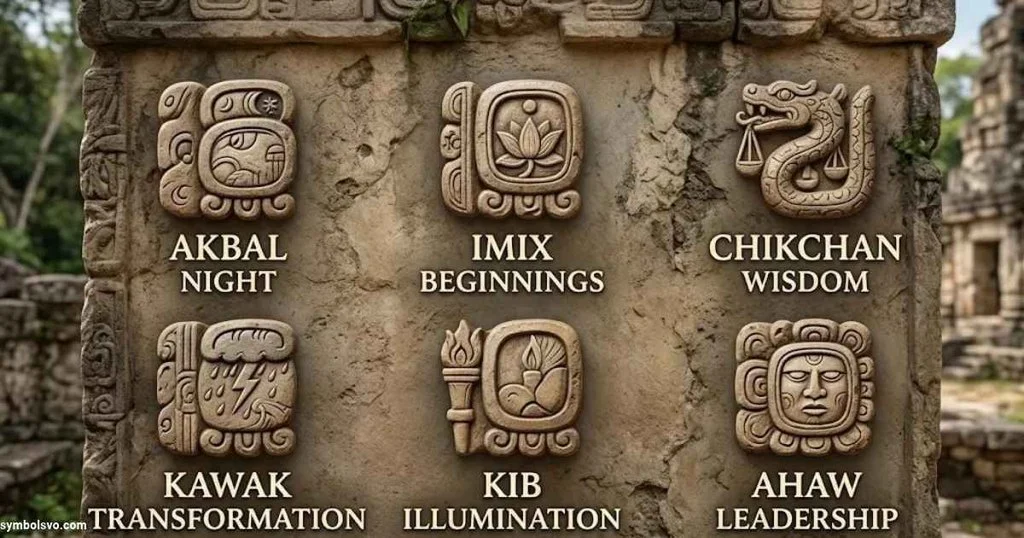
The Maya civilization developed across parts of present-day Mexico, Guatemala, Belize, Honduras, and El Salvador.
Maya communities created impressive cities, temples, writing systems, mathematical methods, and calendar traditions. Their symbols recorded royal histories, religious events, astronomical observations, and important dates.
1. The Maya Tzolk’in Calendar
The Tzolk’in is a 260-day sacred calendar used in Maya calendrical traditions.
It combines 13 numbers with 20 day names. Together, these create 260 unique number-name combinations.
The calendar had ceremonial and divinatory importance. It helped organize ritual life and understand meaningful cycles of time.
2. The Haab Calendar
The Haab is a 365-day calendar that approximates the solar year.
It contains 18 months of 20 days each, followed by a final five-day period called Wayeb.
The Haab and Tzolk’in worked together in the Maya Calendar Round. Their combined date repeated after 52 Haab years. The Smithsonian National Museum of the such as Native American(s) explains these interconnected systems in its Living Maya Time resource.
Living Maya Time+1
3. The Maya Long Count
The Long Count calendar helped Maya communities record dates across longer historical periods.
Unlike the repeating Calendar Round, it allowed people to place events within extended chronological cycles.
Maya inscriptions used this system to record important historical and ceremonial events.
The famous 2012 date marked the completion of a major Long Count cycle. It did not mean that the Maya predicted the end of the world.
4. Kukulkan: The Feathered Serpent
Kukulkan is a feathered serpent deity associated with Maya traditions, particularly in the Yucatán region.
The name is often translated as “feathered serpent.” The deity has similarities to the Mexica figure Quetzalcoatl, but the two belong to distinct cultural and historical traditions.
Kukulkan is associated with:
- Religious authority
- Serpent imagery
- Celestial and natural forces
- Architecture and ceremonial life
5. The Ceiba Tree
The ceiba tree has deep importance in several Maya traditions.
Its tall trunk and wide branches make it a powerful image of the connection between different levels of the cosmos.
In some Maya cosmological interpretations, the tree links the heavens, the earthly world, and the underworld.
It is commonly associated with:
- Life and renewal
- The structure of the universe
- Connection between worlds
- Nature and spiritual understanding
6. The Maya Maize Symbol
Maize, or corn, was central to Maya agriculture, food, mythology, and identity.
The Maya creation narrative preserved in the Popol Vuh describes humanity’s creation from maize dough. This story demonstrates the crop’s importance in Maya cultural understanding.
Maize symbolism can represent:
- Life and nourishment
- Creation
- Agricultural fertility
- Human identity
- Renewal and seasonal cycles
7. The Maya Zero Symbol
The Maya developed an advanced number system that included a symbol for zero.
Their mathematical system used dots, bars, and a shell-shaped sign for zero in many written representations.
Zero allowed Maya mathematicians to express large numbers and work with complex calendar calculations.
It is one of the most significant achievements in the history of mathematics.
Mexican National Symbols and Their Meanings
Mexico’s national symbols represent its independence, shared history, and cultural identity.
The country’s three official patriotic symbols are the national flag, national coat of arms, and national anthem.
1. The Mexican Flag
The Mexican flag features three vertical stripes: green, white, and red. Its center displays the national coat of arms.
The flag’s design developed through several historical stages. The colors were adopted during the independence movement, and the modern emblem reflects the country’s Indigenous heritage.
The colors are commonly explained today as follows:
| Color | Common modern association |
| Green | Hope and independence |
| White | Unity and peace |
| Red | The blood of national heroes |
These popular interpretations should be distinguished from earlier historical explanations. The original Army of the Three Guarantees associated the colors with religion, independence, and union.
2. The Eagle and Snake
The eagle and snake are the most recognizable elements of Mexico’s national coat of arms.
According to the Mexica foundation story, their people searched for a place to establish a city. They were looking for an eagle perched on a cactus and holding a serpent.
They found the sign on an island in Lake Texcoco. The Mexica founded Tenochtitlan there in 1325.
The image later became a powerful part of Mexican national identity.
Embassy of Mexico+1
The main elements include:
- Eagle: Often associated with strength and the sun.
- Snake: Connected with earthly forces and the foundation story.
- Nopal cactus: Represents the landscape and the place where the city was founded.
- Oak and laurel branches: Form part of the national coat of arms and are associated with victory and honor.
3. The Nopal Cactus
The nopal cactus is a familiar part of the Mexican landscape and cuisine.
It appears in the national coat of arms and has a strong connection with the foundation story of Tenochtitlan.
Nopal is also an important food. People use its tender pads and fruit in many traditional dishes.
Its cultural associations include:
- Resilience in difficult environments
- Mexican land and identity
- Survival and nourishment
- Historical continuity
4. The Mexican National Anthem
The Mexican national anthem is another official patriotic symbol.
Its lyrics reflect national independence, defense, courage, and loyalty. The anthem is performed during important national ceremonies and sporting events.
Together, the flag, coat of arms, and anthem represent Mexico’s official national identity.
5. The Bell of Dolores
The Bell of Dolores is connected with the beginning of Mexico’s independence movement.
On September 16, 1810, Miguel Hidalgo called people to join the uprising against Spanish colonial rule. The event became known as the Grito de Dolores.
The bell is now associated with independence, freedom, and national remembrance.
6. The Virgin of Guadalupe
The Virgin of Guadalupe is one of Mexico’s most important religious and cultural images.
For many Catholics, she represents faith, compassion, hope, and spiritual protection. Her image also became an important symbol during Mexico’s independence movement.
In 1810, Miguel Hidalgo used a banner featuring the Virgin of Guadalupe during the uprising.
Gob.mx+1
Her significance reaches beyond religious devotion. She has become an important symbol of Mexican identity for many communities.
Day of the Dead Symbols and Their Meaning
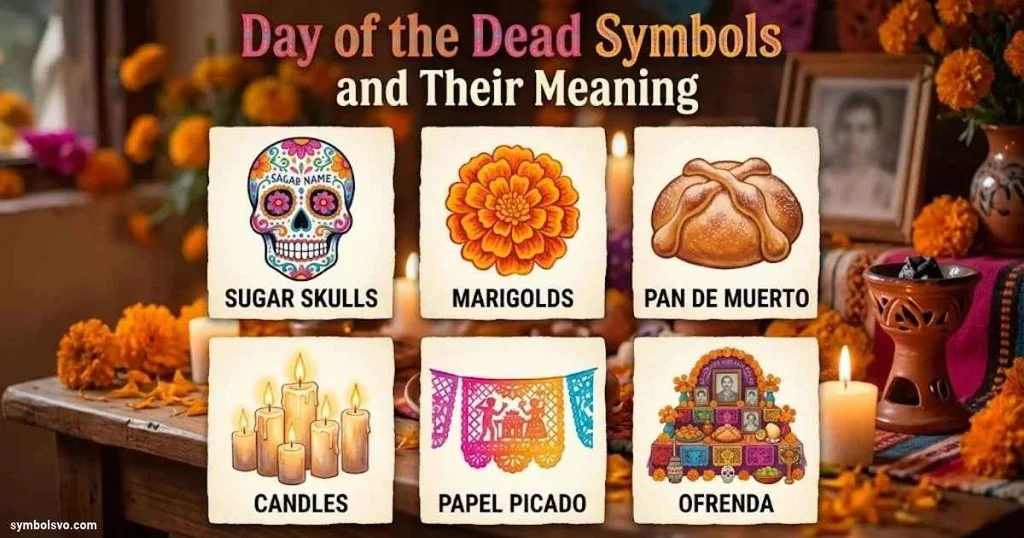
Día de los Muertos, or Day of the Dead, is a Mexican tradition that honors deceased family members and loved ones.
Families create altars, prepare favorite foods, decorate graves, and share memories. The celebration takes place around the end of October and the beginning of November.
The tradition includes different Indigenous and Catholic influences. Its practices vary between regions and communities. UNESCO recognizes Indigenous festivities dedicated to the dead as part of humanity’s intangible cultural heritage.
Sistema de Información Cultural+1
1. Sugar Skulls
Sugar skulls, known as calaveras de azúcar, are colorful decorations made from sugar.
They are often decorated with bright icing, flowers, and patterns. Some carry the names of deceased loved ones.
Sugar skulls represent remembrance and the continuing connection between families and those who have passed away.
Their colorful appearance also reflects the celebratory character of the tradition.
2. Marigold Flowers
The marigold, called cempasúchil in Mexico, is one of the most recognizable Day of the Dead symbols.
Its bright orange and yellow petals and strong scent make it a central part of traditional decorations.
Mexica traditions associated the flower with the sun. Today, families often use its petals to create paths leading toward an ofrenda.
The flower is commonly associated with:
- Remembrance
- Guidance for visiting spirits
- The connection between life and death
- Love for deceased family members
Mexico’s Ministry of Agriculture describes the flower’s historical connection with the sun and its continuing role in Day of the Dead celebrations.
Gob.mx+1
3. Ofrenda: The Offering Altar
An ofrenda is an altar prepared to honor deceased relatives and loved ones.
Families decorate it with meaningful objects, photographs, and offerings. Each item can reflect a personal memory or a traditional belief.
Common ofrenda elements include:
- Photographs of deceased family members
- Favorite foods and drinks
- Candles
- Marigold flowers
- Water
- Salt
- Religious images
- Personal belongings
An ofrenda is not simply a decoration. It provides a place for families to remember and honor the people they miss.
4. Papel Picado
Papel picado is decorative paper cut into intricate patterns.
People hang these colorful banners during celebrations, including Day of the Dead and other festivals.
The delicate designs often feature flowers, skeletons, birds, and geometric patterns.
Papel picado adds movement and color to celebrations. Some people also associate it with the presence of wind and the movement of spirits.
5. Pan de Muerto
Pan de muerto is a traditional sweet bread prepared during Day of the Dead celebrations.
Many versions feature small dough decorations shaped like bones. Some loaves include a rounded piece in the center.
Families place the bread on ofrendas and share it during the celebration.
It represents food, remembrance, and the importance of sharing traditions across generations.
6. Candles and Copal Incense
Candles provide light and create a peaceful atmosphere around the altar. In many traditions, they symbolize faith, remembrance, and guidance.
Copal incense has a long history in Indigenous ceremonial practices. Its fragrance and smoke remain important in some religious and cultural observances.
7. The Xoloitzcuintli Dog
The Xoloitzcuintli, often called the Mexican hairless dog, has a long history in Mexico.
In some ancient beliefs, dogs were connected with journeys after death. The Xoloitzcuintli became associated with helping the deceased travel through the underworld.
Today, the breed is also a symbol of Mexico’s Indigenous heritage.
Mexican Animal Symbols and Their Meanings
Animals appear throughout Mexican mythology, traditional artwork, architecture, and religious imagery.
However, an animal can have different meanings across cultures. A jaguar in Maya art may carry different associations from a jaguar in Mexica imagery.
| Animal | Common cultural associations |
| Eagle | Strength, the sun, and national identity |
| Snake | Earth, renewal, and divine imagery |
| Jaguar | Power, authority, and nighttime |
| Hummingbird | Energy, movement, and associations with Huitzilopochtli |
| Butterfly | Transformation and, in some traditions, connections with the dead |
| Owl | Night and supernatural associations in some traditions |
| Rabbit | Fertility and lunar imagery in certain Mesoamerican traditions |
| Deer | Important spiritual and ceremonial associations in Wixárika traditions |
| Xoloitzcuintli | Ancient heritage and afterlife traditions |
| Quetzal bird | Beauty, precious feathers, and sacred imagery |
| Turtle | Earth and cosmic associations in some Mesoamerican traditions |
The Hummingbird
Hummingbirds appear in Mexican art and religious traditions. Their speed and energy make them striking natural symbols.
They also have a connection with Huitzilopochtli. His name is commonly associated with a hummingbird.
In modern designs, hummingbirds can represent energy, determination, and joy. These contemporary meanings should not be confused with every historical religious interpretation.
The Butterfly
The monarch butterfly is especially meaningful in Mexico because millions migrate to wintering sites in the country’s central forests.
Its seasonal arrival is a remarkable natural event.
Butterflies also appear in Mesoamerican art and mythology. In some traditions, they have been associated with transformation, souls, or the dead.
The exact interpretation depends on the historical and cultural context.
Mexican Nature Symbols and Their Meanings
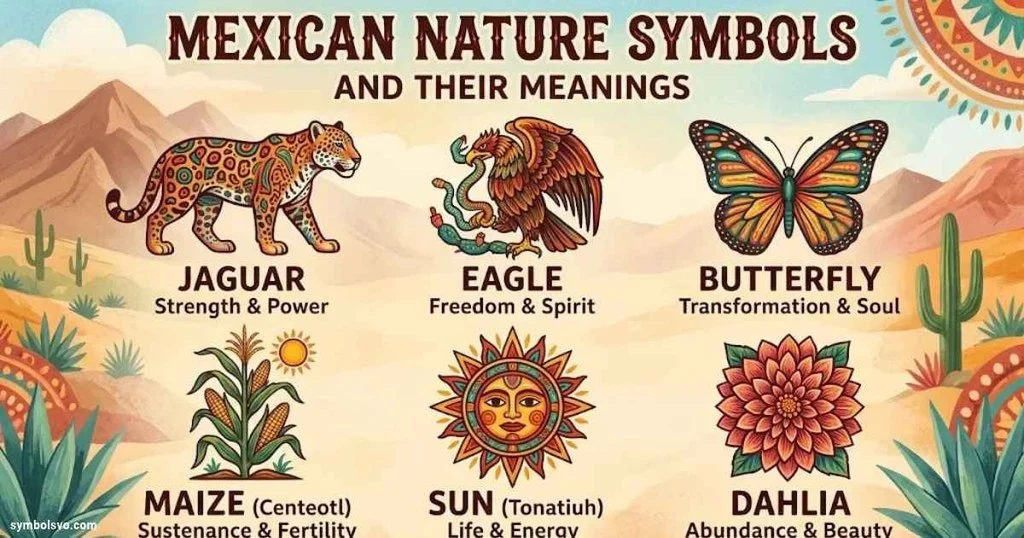
Nature has shaped Mexican traditions for thousands of years. Mountains, rivers, plants, animals, and celestial bodies appear in ancient stories and modern cultural expressions.
1. The Sun
The sun played an important role in many Mesoamerican religious traditions.
It was connected with warmth, agriculture, time, and the cycles of life.
In Mexica religion, solar imagery appears in the Sun Stone and the worship of solar deities.
Today, the sun can also represent energy, hope, and renewal in modern Mexican-inspired artwork.
2. The Moon
The moon appears in several Mesoamerican myths and artistic traditions.
Its changing phases offered a way to understand time and natural cycles.
Mexica mythology includes Coyolxauhqui, whose story has celestial associations. Maya traditions also recorded lunar cycles and observations.
3. Corn or Maize
Corn, known as maíz in Spanish, is one of Mexico’s most important cultural symbols.
It has been cultivated in the region for thousands of years and remains central to Mexican food.
Corn is used to prepare tortillas, tamales, pozole, and many other traditional dishes.
Its cultural meaning includes:
- Life and nourishment
- Agriculture and harvest
- Family and community
- Creation and renewal
- Indigenous heritage
4. Mountains and Caves
Mountains and caves hold important places in different Indigenous traditions.
Some communities view them as sacred locations connected with water, fertility, ancestors, and spiritual forces.
Caves also appear in Mesoamerican creation stories and archaeological sites.
Their meaning varies between regions and cultural traditions.
5. Water and Fire
Water and fire were essential to survival and ceremonial life.
Water supported farming and daily activities. Fire provided warmth, cooking, and light.
In Mexica imagery, atlachinolli combines water and fire into a symbolic expression associated with conflict and warfare.
These elements also appear in wider discussions of balance, change, and natural forces.
Mexican Spiritual and Religious Symbols
Mexico’s spiritual traditions include Indigenous beliefs, Catholic Christianity, and practices shaped by centuries of cultural exchange.
Some symbols have religious meaning for millions of people. Others belong to particular communities and should be understood within their own traditions.
1. Ojo de Dios: The Eye of God
The Ojo de Dios, or Eye of God, is commonly associated with the Wixárika people, also known as Huichol.
Its traditional form is called tsikuri. It is made by weaving yarn around a wooden framework.
The design is connected with seeing, prayer, and spiritual understanding. Its meaning and use depend on the ceremonial context.
It is important not to describe every Ojo de Dios as a generic Mexican decoration. The object has a specific cultural background.
2. Ojo de Venado
Ojo de Venado translates as “eye of the deer.”
The name is used for traditional charms and objects that may incorporate deer-related materials or imagery.
In some contemporary Mexican contexts, people associate it with protection or good fortune. Its use and meaning differ across communities.
3. The Christian Cross
The Christian cross became an important religious symbol in Mexico following Spanish colonization.
It represents the crucifixion and resurrection of Jesus Christ in Christian belief.
Mexican communities developed distinctive forms of religious art and decoration around the cross. These can include flowers, carved wood, painted designs, and local artistic styles.
4. The Sacred Heart
The Sacred Heart of Jesus is a Catholic devotional image representing divine love, compassion, and sacrifice.
It often shows a heart surrounded by flames, light, or a crown of thorns.
The image appears in Mexican churches, homes, paintings, and devotional objects.
5. The Rosary
The rosary is a string of prayer beads used in Catholic devotion.
It helps people follow a sequence of prayers while meditating on events from the lives of Jesus and Mary.
In Mexico, rosaries often appear alongside images of the Virgin of Guadalupe and other religious figures.
6. Peyote in Wixárika Tradition
Peyote has a specific ceremonial role in Wixárika religious traditions.
It is connected with sacred journeys, religious knowledge, and relationships among important spiritual figures.
This is a culturally specific practice. It should not be treated as a general Mexican symbol or reduced to a decorative motif.
The deer, peyote, and sacred places hold interconnected meanings within Wixárika traditions.
Mexican Symbols of Protection, Strength, Love, and Good Luck
Many people explore Mexican symbols because they want designs that express personal values.
Some symbols have historical or religious associations. Others carry modern meanings shaped by art, jewelry, and popular culture.
| Desired meaning | Symbol often associated with it | Context |
| Strength | Jaguar | Mesoamerican animal imagery |
| Protection | Ojo de Dios | Wixárika ceremonial tradition |
| Love and devotion | Virgin of Guadalupe | Catholic religious devotion |
| Hope | Marigold and flowers | Contemporary cultural associations |
| National pride | Mexican flag | National identity |
| Renewal | Butterfly | Nature and modern symbolic use |
| Resilience | Nopal cactus | Mexican landscape and identity |
| Remembrance | Sugar skull | Day of the Dead |
| Spiritual connection | Ceiba tree | Maya cosmological traditions |
| Courage | Eagle | National and historical imagery |
Mexican Symbols of Protection
Protection-related designs can include the Ojo de Dios, religious crosses, and images of saints.
Their meanings depend on the traditions and individuals who use them.
For example, the Ojo de Dios has a specific Wixárika background. It should not be presented as a universal charm used by every Mexican community.
Mexican Symbols of Strength
The jaguar and eagle are two powerful examples.
The jaguar appears in ancient Mesoamerican imagery associated with power and elite status. The eagle forms a central part of Mexico’s national coat of arms.
Mexican Symbols of Love and Hope
Flowers, religious images, and family photographs can express love and remembrance.
The marigold is especially important during Day of the Dead celebrations. It helps families honor the people they have lost.
Mexican Symbols in Tattoos
Mexican symbols are popular in tattoo art because they combine strong visual designs with cultural history.
People choose them to express identity, heritage, personal beliefs, or admiration for Mexican art.
Before choosing a design, learn where it comes from and what it means.
Popular Mexican Tattoo Symbols
Aztec Sun Stone tattoo: Often chosen for its detailed geometric patterns and connections with Mexica cosmology.
Quetzalcoatl tattoo: Features the feathered serpent and can express interest in ancient Mesoamerican mythology.
Mexican eagle tattoo: Represents national pride, strength, and connection with Mexico.
Sugar skull tattoo: Often honors a deceased loved one or expresses remembrance.
Jaguar tattoo: Can represent power, courage, and ancient Mesoamerican imagery.
Marigold tattoo: Often connects with Day of the Dead, family memories, and remembrance.
Nopal cactus tattoo: Can express resilience, cultural identity, and a connection with the Mexican landscape.
Choosing a Culturally Respectful Design
Some designs belong to living Indigenous communities and have ceremonial importance.
Before using one as a tattoo, consider these points:
- Research its cultural origin.
- Learn whether it has a ceremonial purpose.
- Avoid combining unrelated Indigenous symbols without understanding them.
- Do not assume every traditional design has a universal meaning.
- Consider supporting artists who understand the cultural background of the imagery.
A meaningful tattoo starts with understanding rather than appearance alone.
Mexican Symbols in Dreams: Common Modern Interpretations
People sometimes search for the meaning of Mexican symbols in dreams. These interpretations are personal and contemporary rather than established rules from ancient Mexican civilizations.
A symbol in a dream may reflect your memories, emotions, experiences, or cultural background.
| Symbol in a dream | Possible personal interpretation |
| Eagle | Confidence, freedom, or ambition |
| Snake | Change, uncertainty, or transformation |
| Jaguar | Courage, strength, or hidden fears |
| Marigold | Memories of loved ones |
| Sugar skull | Thoughts about mortality or remembrance |
| Sun | Energy, optimism, or a fresh beginning |
| Corn | Family, nourishment, or prosperity |
| Butterfly | Personal growth or change |
| Cactus | Resilience or emotional boundaries |
For example, dreaming about marigolds might remind you of a family celebration or someone you miss. It does not automatically carry one fixed spiritual message.
Mexican Symbols in Modern Culture
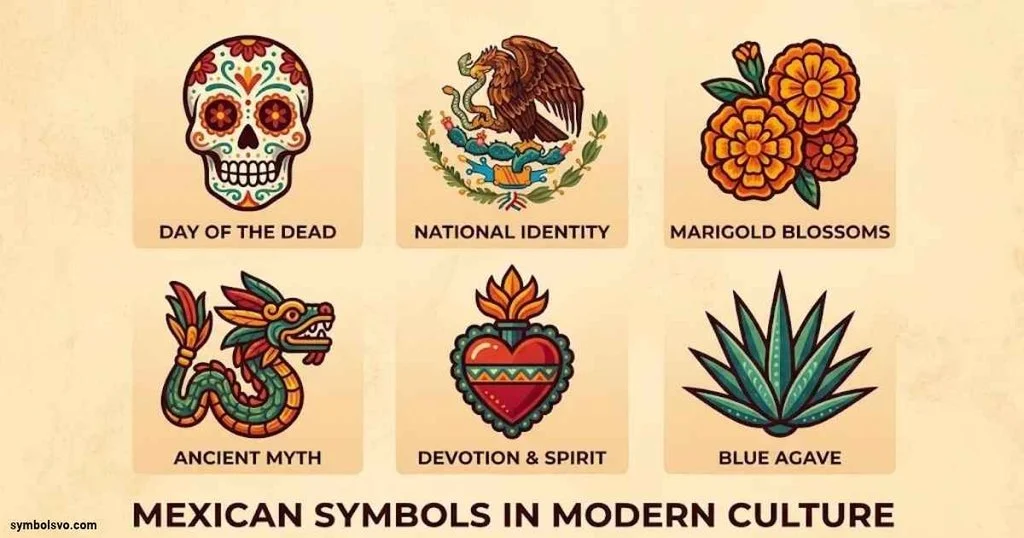
Mexican symbols continue to influence modern art, architecture, fashion, and design.
Artists often combine traditional imagery with contemporary styles. This keeps cultural symbols visible while allowing new generations to express their identities.
Mexican Murals and Paintings
Mexican muralism helped bring national history and social themes into public spaces.
Artists such as Diego Rivera used murals to explore Indigenous heritage, labor, revolution, and social identity.
Their work often includes traditional clothing, agricultural scenes, historical figures, and symbolic imagery.
Mexican Folk Art
Traditional crafts include pottery, textiles, wood carving, metalwork, and paper decorations.
Many designs feature flowers, animals, geometric patterns, and religious imagery.
Alebrijes, for example, are colorful fantasy creatures associated with Mexican folk art. They combine features from different animals and are especially connected with artistic traditions in Oaxaca and Mexico City.
Mexican Symbols in Fashion and Jewelry
Designers use Mexican patterns and imagery in clothing, necklaces, earrings, and accessories.
Popular motifs include:
- Marigold flowers
- Sugar skulls
- Nopal cactus designs
- Traditional geometric patterns
- Eagle and serpent imagery
- Folk-art animals
These designs can celebrate heritage and craftsmanship. However, respectful use matters when a motif comes from a living Indigenous community.
How Spanish Colonization Influenced Mexican Symbols
Spanish colonization changed Mexico’s religious, political, and artistic landscape.
Before the Spanish conquest, different Indigenous civilizations already had established religious traditions, artistic systems, and symbolic languages.
After the fall of Tenochtitlan in 1521, Catholic institutions and European artistic styles became increasingly influential.
Over time, Indigenous and Catholic traditions interacted in complex ways.
Religious Symbolism
Catholic images such as crosses, saints, and the Virgin Mary became important in Mexican religious life.
In some places, older Indigenous traditions continued alongside Christian practices. Communities adapted certain celebrations and artistic forms to changing circumstances.
The Virgin of Guadalupe
The Virgin of Guadalupe became an especially important figure in Mexican religious and national history.
Her image appeared in the independence movement and continues to hold significance for many people.
Day of the Dead
Day of the Dead traditions developed through different Indigenous and Catholic influences.
The result is not simply a preserved ancient ceremony or a purely Catholic celebration. It is a living tradition that has changed across generations and regions.
National Identity After Independence
After independence, Mexico developed national symbols that could represent a shared political identity.
The flag and coat of arms drew on historical imagery, including the Mexica foundation story of Tenochtitlan.
These symbols helped connect the new nation with its past.
Frequently Asked Questions About Mexican Symbols
What is the most famous Mexican symbol?
The eagle perched on a cactus and holding a snake is probably Mexico’s most recognizable symbol. It appears in the national coat of arms at the center of the Mexican flag.
What does the Mexican eagle symbolize?
The eagle is connected with the Mexica foundation story of Tenochtitlan. It is also associated with strength, the sun, and Mexican national identity.
What does the snake represent in Mexican culture?
Snake imagery appears in several Mesoamerican traditions. It can be connected with earthly forces, renewal, and divine figures. Its meaning depends on the culture and historical context.
What is the meaning of the Aztec Sun Stone?
The Aztec Sun Stone expresses Mexica ideas about time, cosmic cycles, and the structure of the universe. It is often called the Aztec calendar, but it is more than a simple date-counting device.
What is the difference between Aztec and Mayan symbols?
Aztec symbols come primarily from Mexica and related central Mexican traditions. Mayan symbols belong to Maya cultures across southeastern Mexico and parts of Central America. Their languages, religious systems, artistic traditions, and calendars are distinct.
What does Quetzalcoatl symbolize?
Quetzalcoatl is a feathered serpent deity associated with knowledge, creation traditions, wind, and religious authority. His role varies across Mesoamerican historical traditions.
What does the jaguar symbolize in Mexican culture?
The jaguar is commonly associated with power, strength, authority, and nighttime. It appears in several ancient Mesoamerican cultures, including the Maya and Mexica.
What is the meaning of the Mexican nopal cactus?
The nopal cactus represents the Mexican landscape and appears in the national coat of arms. It also reflects resilience and has practical importance as a traditional food.
What do marigolds symbolize in Mexico?
Marigolds, or cempasúchil, are strongly associated with Day of the Dead. Their bright petals and fragrance are used in traditional decorations and ofrendas to honor deceased loved ones.
What does a sugar skull symbolize?
A sugar skull is a Day of the Dead decoration associated with remembrance. Families sometimes add names to honor people who have passed away.
What is an Ojo de Dios?
Ojo de Dios is the Spanish name for an object traditionally associated with the Wixárika people. Its traditional form, called tsikuri, is made by weaving yarn around a wooden framework.
What does corn symbolize in Mexican culture?
Corn represents nourishment, agriculture, and cultural identity. It also has deep importance in Indigenous creation traditions, especially among Maya communities.
What is the meaning of the Virgin of Guadalupe in Mexico?
The Virgin of Guadalupe represents Catholic devotion for many Mexicans. Her image also became an important symbol of national identity and independence.
What are the three official national symbols of Mexico?
Mexico’s three official patriotic symbols are the national flag, the national coat of arms, and the national anthem.
What does the Mexican flag represent?
The flag represents Mexico’s national identity and history. Its green, white, and red stripes are commonly associated today with hope, unity, and the blood of national heroes.
What is the meaning of the ceiba tree?
In several Maya traditions, the ceiba tree is associated with the structure of the cosmos. It can represent connections between the heavens, the earthly world, and the underworld.
What does a hummingbird symbolize in Mexican culture?
Hummingbirds appear in ancient religious imagery and modern art. They can be associated with energy and movement. The bird also has a connection with Huitzilopochtli in Mexica tradition.
Are all Mexican symbols Aztec?
No. Mexican symbolism comes from many different cultures, including the Maya, Olmec, Zapotec, Mexica, Wixárika, and others. Each has its own history and traditions.
What Mexican symbols are popular in tattoos?
Popular designs include the eagle and snake, Aztec Sun Stone, Quetzalcoatl, jaguar, sugar skull, marigold, and nopal cactus. People often choose them to express heritage, remembrance, or personal values.
Why are Mexican symbols important today?
Mexican symbols help preserve history, express cultural identity, and connect generations. They appear in national celebrations, religious practices, traditional crafts, art, and everyday life.
Conclusion
Mexican symbols preserve stories about ancient civilizations, religious traditions, national identity, and everyday life. The eagle and snake connect modern Mexico with the foundation story of Tenochtitlan. The Maya calendar reflects sophisticated ways of understanding time. Marigolds and sugar skulls help families remember loved ones during Día de los Muertos.
However, the meaning of a symbol depends on its cultural background. A Wixárika ceremonial object is not interchangeable with an Aztec religious image. A Maya calendar sign also has a different history from a modern Mexican national emblem.
When you explore Mexican symbols and their meanings, look beyond their appearance. Understanding their origins gives you a clearer picture of Mexico’s diverse cultures and the traditions that continue to shape its identity.

I’m Daniel Brooks, a content creator and symbol enthusiast dedicated to researching the fascinating world of signs and symbols. I enjoy discovering the hidden meanings behind famous icons, emojis, historical emblems, and cultural symbols. Through my writing, I aim to provide trustworthy, well-researched, and reader-friendly information that helps people learn something new with every visit.
Books:
- The Complete Guide to World Symbols
- The Power of Universal Signs
 Mason Ellington
 Nathan Holloway