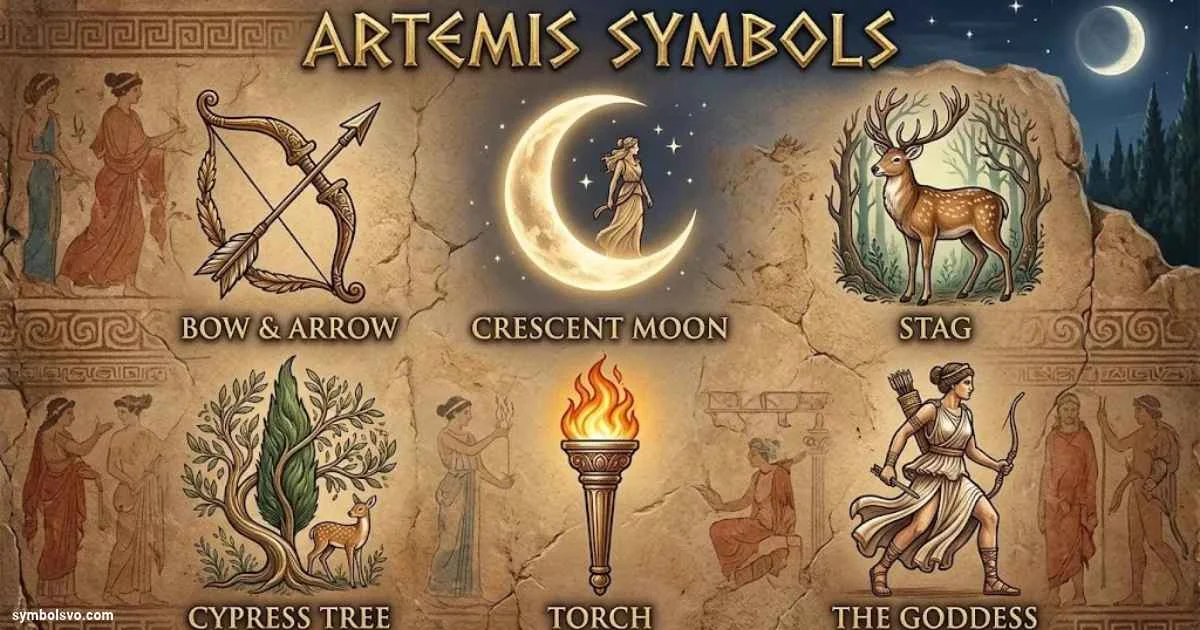
Artemis stands among the most powerful and fascinating figures in Greek mythology. Known as the goddess of the hunt and wilderness, she represents independence, protection, wild animals, and the natural world. Her familiar images include a bow and arrows, a graceful deer, hunting dogs, and a crescent moon.
However, the Artemis symbols tell a much deeper story than her identity as a huntress. Each attribute connects with a different part of her mythology, from protecting young women and guarding wildlife to enforcing divine boundaries. Her symbols also changed across ancient Greek religious traditions and later Roman and artistic interpretations.
Understanding these symbols requires looking beyond their modern spiritual meanings. Some have strong roots in ancient myths and religious practices, while others gained popularity through later artwork and contemporary interpretations.
This guide explores the most important symbols of Artemis, their historical origins, mythological stories, traditional meanings, and modern uses. It also explains how Artemis differs from other goddesses associated with the moon and wilderness.
Who Is Artemis in Greek Mythology?
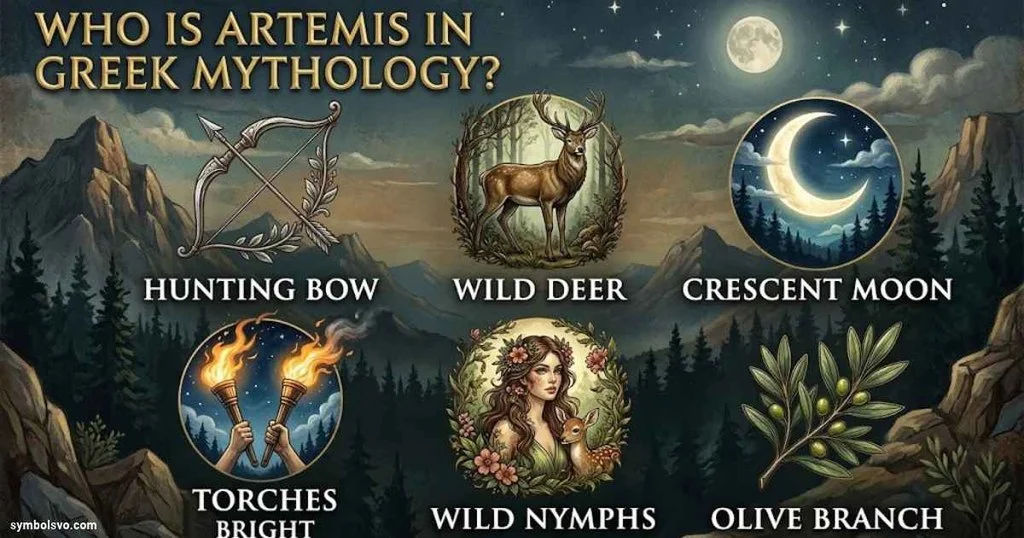
Artemis was an important Greek goddess and one of the twelve Olympian deities. She was primarily associated with hunting, wild animals, forests, mountains, and the protection of young girls. Ancient Greeks also connected her with childbirth and the transition from childhood to adulthood.
Unlike many Greek goddesses who represented marriage, agriculture, or domestic life, Artemis maintained an independent identity. She traveled through wilderness areas with her companions and hunting dogs. Her bow remained one of her most recognizable attributes.
Artemis’s Origin and Family
Artemis was the daughter of Zeus, king of the Olympian gods, and Leto, a daughter of the Titans Coeus and Phoebe. Her twin brother was Apollo, the Greek god associated with music, prophecy, healing, and archery.
According to the best-known birth tradition, Leto struggled to find a safe place to deliver her children because Hera opposed her. The island of Delos eventually welcomed her. Artemis and Apollo were born there.
Ancient traditions differ about the order of their births. One famous version describes Artemis being born first and helping Leto deliver Apollo.
Their relationship also explains why Artemis and Apollo share several attributes. Both were skilled archers and could send powerful arrows against mortals.
What Is Artemis the Goddess Of?
Artemis held several important roles in ancient Greek religion.
- Hunting: She governed hunting activities and the relationship between hunters and wild animals.
- Wilderness: She protected forests, mountains, and natural habitats outside human settlements.
- Young women: She watched over girls during childhood and important life transitions.
- Childbirth: Despite her unmarried identity, she had an important connection with childbirth and maternal protection.
- Wild animals: Deer, bears, and other creatures appeared in her mythology and religious traditions.
- Archery: Her bow and arrows represented her hunting abilities and divine authority.
Her identity contained an interesting contrast. Artemis protected wild animals yet also represented the hunt. Ancient Greeks understood hunting as part of the natural order rather than viewing it through modern wildlife-conservation ideas.
Artemis’s Role in Ancient Greek Religion
Artemis received worship throughout the Greek world. However, different communities emphasized different aspects of her identity.
Her sanctuary at Brauron in Attica had an important connection with girls and initiation rituals. Young girls participated in ceremonies associated with the goddess and were known as arktoi, meaning bears.
At Ephesus, Artemis developed a distinctive local identity. Her monumental sanctuary became one of the Seven Wonders of the Ancient World.
These different traditions demonstrate that Artemis was more than a single-purpose hunting goddess. Her religious identity changed according to local beliefs, rituals, and cultural needs.
What Are the Main Symbols of Artemis?
The main Artemis sacred symbols include her bow and arrows, deer, hunting dogs, quiver, and certain animals and objects connected with her religious traditions. The crescent moon also became strongly associated with her in later artistic and religious interpretations.
Here is a quick overview of her most recognizable symbols and their associations.
| Artemis symbol | Traditional association or meaning |
| Bow and arrows | Hunting, archery, divine power, and protection |
| Deer | Sacred wildlife and the wilderness |
| Ceryneian Hind | A sacred animal connected with Artemis |
| Hunting dogs | Companions in the hunt |
| Crescent moon | Later lunar associations and celestial imagery |
| Quiver | Archery and hunting readiness |
| Bear | Brauronian rituals and the protection of young girls |
| Torch | Light and certain religious representations |
| Palm tree | Artemis’s birth tradition on Delos |
| Cypress tree | Associations with sacred landscapes and certain cult traditions |
Not every item in this table has equal historical importance. The bow, deer, and hunting dogs have strong connections with Artemis’s ancient identity. Other associations require more careful historical context.
Artemis Symbols and Their Meanings Explained
Bow and Arrows: Hunting, Precision, and Divine Power
The bow and arrows are among the strongest and most recognizable symbols of Artemis. They represent her identity as a skilled huntress and her authority over the natural world.
Artemis received her bow and arrows from the Cyclopes in a well-known mythological tradition. Her weapons allowed her to hunt wild animals and defend her divine authority.
Her brother Apollo also carried a bow. However, Artemis’s weapon became especially connected with forests, mountains, hunting, and wildlife.
Ancient stories describe her arrows as powerful instruments of divine action. She could punish mortals who violated her boundaries or offended her. Her arrows could also bring sudden death or disease.
Traditional associations of the bow and arrows include:
- Hunting skill and accuracy.
- Strength and independence.
- Divine authority and punishment.
- Protection of sacred boundaries.
- Readiness and self-reliance.
- Control over hunting activities.
The weapons also appear frequently in classical sculpture and pottery. Artists often represented Artemis carrying a bow while wearing a short hunting tunic.
Modern interpretations connect the bow and arrow with focus, personal ambition, and determination. These ideas reflect contemporary symbolism rather than a fixed ancient Greek doctrine.
Deer: Sacred Wildlife and Artemis’s Connection With Nature
The deer is one of the most important animal symbols associated with Artemis. It reflects her authority over wild creatures and her close relationship with forests and natural habitats.
Ancient artwork frequently depicts Artemis beside a deer or holding one gently. These images highlight her connection with wildlife rather than presenting her only as a hunter.
The deer also appears in several important mythological stories. Its sacred status is particularly clear in the story of the Ceryneian Hind, an extraordinary animal protected by Artemis.
Deer symbolism commonly includes:
- Grace and agility.
- Freedom and wilderness.
- Sacred wildlife.
- Natural beauty.
- Artemis’s protective authority.
- The relationship between humans and animals.
However, deer did not simply represent gentleness in ancient Greek religion. They also belonged to the world of hunting, which placed them within Artemis’s divine authority.
Ceryneian Hind: The Sacred Golden-Horned Deer
The Ceryneian Hind is one of the most famous animals connected with Artemis. Greek mythology describes it as a remarkable female deer with golden antlers and bronze hooves.
The hind was sacred to Artemis. Some accounts describe it as one of the animals that escaped when the goddess was young and later became part of her sacred herd.
The animal became central to the third labor of Heracles. Eurystheus ordered Heracles to capture it and bring it back alive.
Heracles pursued the hind for an extended period before finally capturing it. Different ancient versions describe the circumstances of the capture differently. In some accounts, Artemis confronted Heracles because he had taken an animal sacred to her.
Heracles explained that he acted under orders from Eurystheus. He eventually returned the hind and avoided permanently taking the goddess’s sacred animal.
What does the Ceryneian Hind symbolize?
- Divine protection of sacred animals.
- Artemis’s authority over wildlife.
- Speed and natural beauty.
- Respect for divine boundaries.
- The conflict between hunting and protection.
The story also illustrates an important feature of Greek mythology: even a powerful hero had to respect the authority of the gods.
Hunting Dogs: Companionship and the Hunt
Hunting dogs frequently accompany Artemis in ancient artwork and mythology. They helped hunters track animals through difficult landscapes and played an important role in traditional hunting activities.
Artemis’s hunting companions reflect her connection with the practical world of hunting. They also reinforce her identity as a goddess who moved freely through forests and mountains.
In mythology, her hunting dogs sometimes appear in stories involving punishment. The myth of Actaeon provides a particularly famous example.
Actaeon was transformed into a stag after seeing Artemis bathing in a sacred place. His own hunting dogs failed to recognize him and attacked him.
This story connects hunting dogs with Artemis’s authority and the consequences of violating her boundaries.
Modern interpretations often associate hunting dogs with:
- Loyalty and companionship.
- Hunting instincts.
- Cooperation and teamwork.
- Courage in difficult conditions.
- Protection and alertness.
These meanings should be understood as interpretations rather than a formal ancient list of sacred qualities.
Crescent Moon: Lunar Associations and Celestial Imagery
The crescent moon is one of the most familiar images associated with Artemis today. It frequently appears above her head or as part of her jewelry and clothing in modern illustrations.
However, Artemis’s lunar identity needs some historical explanation.
In early Greek mythology, Selene represented the moon itself. Artemis was primarily the goddess of hunting, wilderness, and young women. Over time, Greek and Roman religious traditions increasingly connected Artemis with lunar imagery.
Roman interpretations helped strengthen the relationship between Artemis’s Roman counterpart, Diana, and the moon. Later artwork often presented Diana or Artemis with a crescent moon.
The crescent moon commonly represents:
- Lunar cycles and changing phases.
- Nighttime and celestial imagery.
- Renewal and transformation.
- Feminine power in modern interpretations.
- Connection with nature and natural rhythms.
The moon also became a popular symbol in modern spiritual traditions that draw inspiration from Greek mythology.
Nevertheless, it is important to distinguish Artemis’s original mythological role from the broader lunar symbolism that developed later.
Quiver: Readiness and Hunting Identity
A quiver is a container used to carry arrows. It usually appears alongside Artemis’s bow in classical artwork and sculpture.
Although the quiver receives less attention than her weapons, it provides an important clue about how artists represented the goddess.
Artemis often appears prepared for hunting, with her bow in hand and arrows secured behind her shoulder. This combination creates a recognizable image of the Greek huntress.
The quiver’s practical function also helps explain its symbolism.
- Readiness for hunting.
- Skill with archery.
- Preparedness and discipline.
- The goddess’s identity as a huntress.
- Her ability to act when necessary.
In modern artwork, the quiver often appears in tattoos, jewelry, and illustrations inspired by Greek mythology.
Bear: Protection, Initiation, and the Brauronian Tradition
The bear has a particularly interesting connection with Artemis. Unlike some modern symbolic associations, this relationship has a strong foundation in ancient Greek religious practice.
The sanctuary of Artemis at Brauron, near Athens, was associated with rituals involving young girls. These girls were called arktoi, meaning bears.
The ceremonies formed part of a religious tradition known as the arkteia. Girls participated in rituals that marked important stages of childhood and their preparation for adult life.
The exact meaning and details of these ceremonies remain subjects of scholarly discussion. However, ancient literary and archaeological evidence establishes the bear’s importance in Artemis’s Brauronian cult.
The bear’s connection with Artemis can therefore be understood through:
- Religious initiation.
- Childhood and transition.
- Protection of young girls.
- Wild animal symbolism.
- The goddess’s authority over natural creatures.
Modern interpretations sometimes describe the bear as a symbol of feminine strength and nurturing power. Those meanings are contemporary extensions rather than direct translations of the ancient ritual.
Torch: Light and Religious Imagery
The torch appears in certain representations of Artemis, although it is not as universally recognizable as her bow and deer.
Torch-bearing imagery connects with particular aspects of her worship and artistic representation. Some depictions show Artemis carrying a torch while standing or moving through a sacred setting.
The torch can suggest light, visibility, and movement through darkness. However, its exact meaning depends on the context of the artwork or religious tradition.
Modern symbolic interpretations often connect it with:
- Guidance through difficult situations.
- Light and illumination.
- Protection during nighttime journeys.
- Hope and direction.
Avoid treating every torch image as evidence of one universal Artemis tradition. Ancient Greek deities often shared attributes across different local cults.
Palm Tree: Birth and Delos
The palm tree has a direct connection with the birth mythology of Artemis and Apollo.
According to a well-known tradition, Leto gave birth to the twins on the island of Delos. The palm tree became part of the story because ancient accounts and artistic representations associated it with the location of the divine birth.
This association makes the palm tree especially relevant when discussing Artemis’s origin.
It also connects the goddess with a sacred geographical location rather than simply representing a general spiritual concept.
Its traditional associations include:
- Artemis’s birth on Delos.
- Leto’s motherhood.
- The origin of the divine twins.
- Sacred landscapes and religious memory.
The palm tree is therefore a useful symbol to include when explaining Artemis’s family history and ancient mythology.
Cypress Tree: A Sacred Plant Association
The cypress tree appears in several ancient Greek religious and mythological contexts. Its tall evergreen form made it a recognizable feature of sacred landscapes and burial grounds.
Some traditions connect cypress with Artemis. However, it does not have the same clear and universal status as her bow, deer, or hunting dogs.
The tree also has associations with other Greek religious figures and local traditions. Its symbolic importance should therefore be explained within the appropriate historical context.
Modern interpretations often connect cypress with:
- Endurance and longevity.
- Sacred natural spaces.
- Continuity and remembrance.
- Protection and spiritual reflection.
Its inclusion in an article about Artemis is useful, provided the connection is not overstated.
Artemis’s Sacred Animals and Their Meanings
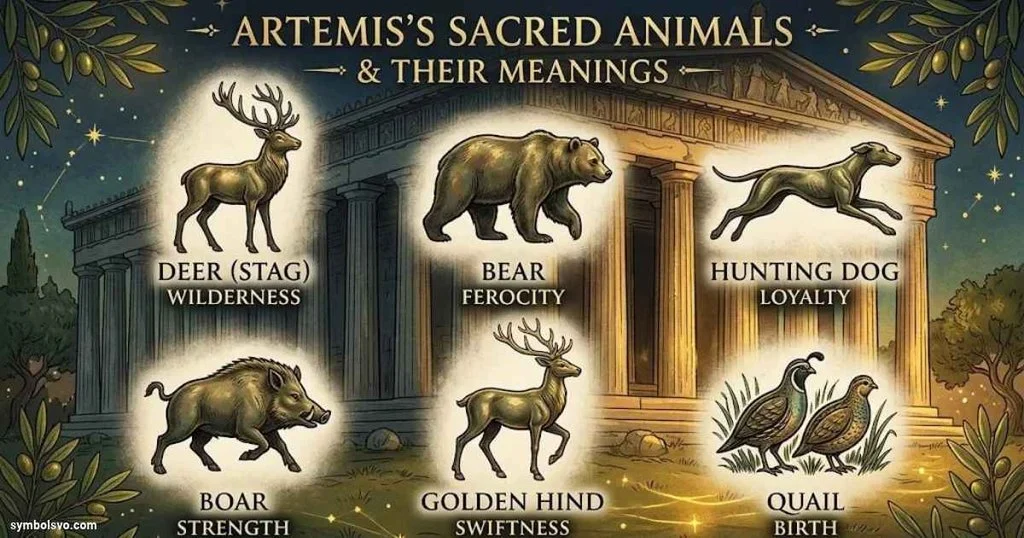
Artemis’s relationship with animals goes beyond her reputation as a hunter. Ancient Greeks also recognized her as a powerful guardian of wild creatures and natural spaces.
Her animal associations reflect the different sides of her divine identity. Some animals appeared in mythology, while others became important through specific religious traditions and artistic representations.
Why Were Animals Important to Artemis?
Artemis was sometimes described as Potnia Theron, meaning Mistress of Animals. This title reflects her authority over wild creatures and her connection with the natural world.
In early Greek artwork, she sometimes appeared holding or accompanied by animals. Later representations increasingly showed her as a young huntress carrying a bow and standing beside a deer or hunting dog.
Her relationship with animals involved several important ideas:
- Wildlife: Animals belonged to the natural world governed by Artemis.
- Hunting: She represented the skills and dangers associated with hunting.
- Protection: She watched over young animals and creatures living in wilderness areas.
- Divine authority: Her myths showed that humans could not freely disregard her sacred animals.
Animals Associated With Artemis
| Animal | Connection with Artemis | Symbolic association |
| Deer | Frequent companion in classical artwork | Grace and wilderness |
| Hind | Featured in the Ceryneian Hind myth | Sacred wildlife |
| Bear | Connected with Brauronian rituals | Initiation and protection |
| Hunting dog | Companion in hunting scenes | Loyalty and tracking |
| Boar | Appears in Greek hunting mythology | Wildness and danger |
| Stag | Appears in Artemis’s artistic imagery | Strength and the hunt |
One important distinction concerns the boar. It belongs to the wider world of Greek hunting mythology, but it does not have the same direct and consistent association with Artemis as the deer.
Why Does Artemis Protect Animals Yet Hunt Them?
At first glance, Artemis’s role as a wildlife protector seems contradictory. How could a goddess guard animals while representing hunting?
The answer lies in ancient Greek ideas about nature.
Hunting was an established part of life in ancient Greece. People relied on animals for food and materials. They also viewed hunting as a demanding activity requiring skill, courage, and respect for divine authority.
Artemis governed this relationship. She represented both the opportunities and dangers of entering the wilderness.
Her mythology repeatedly reminds hunters that animals and natural spaces fall under divine authority. Humans must recognize their limits.
Artemis’s Sacred Plants and Natural Associations
Artemis’s connection with nature also extends to plants, trees, forests, and mountains. However, not every plant mentioned in modern goddess traditions was an established symbol in ancient Greek worship.
Some associations come directly from mythology. Others developed through ancient herbal practices or later spiritual interpretations.
Cypress Tree
The cypress tree was familiar throughout the ancient Mediterranean world. Its evergreen appearance and long lifespan made it important in several religious and cultural traditions.
Cypress trees appeared in sacred landscapes and burial grounds. Their association with remembrance and enduring life developed across different Mediterranean traditions.
Some modern sources connect the cypress with Artemis. However, it should not be presented as one of her universally recognized sacred attributes.
Palm Tree
The palm tree has a stronger connection with Artemis because of her birth story on Delos.
Ancient tradition associates a palm tree with the place where Leto gave birth to Artemis and Apollo. This makes the tree an important element of the twins’ origin mythology.
Unlike a general spiritual association, this connection has a specific mythological foundation.
Mugwort
Mugwort, scientifically known as Artemisia vulgaris, is a medicinal plant with a long history of use in traditional herbal practices.
Its botanical name belongs to the same naming tradition associated with Artemis. However, the exact historical relationship between the goddess and the plant remains uncertain.
Mugwort has appeared in European folk medicine and later spiritual practices. Modern interpretations sometimes connect it with:
- Women’s health traditions.
- Herbal protection.
- Dreams and nighttime rituals.
- Traditional medicinal knowledge.
- Lunar symbolism.
These associations should not automatically be attributed to ancient Artemis worship.
The botanical name alone does not prove that ancient Greeks considered mugwort a sacred plant of Artemis.
Forests and Mountains
Forests and mountains are among the strongest natural associations of Artemis. Unlike some plant connections, her relationship with these landscapes forms a central part of her mythology.
Artemis frequently traveled through wild and mountainous regions with her companions. These places represented freedom from ordinary human settlements and social expectations.
Mountains also provided hunting grounds and natural habitats for animals.
Forests and mountains represent:
- Untamed nature and wilderness.
- Freedom and independence.
- Wildlife habitats.
- Sacred landscapes.
- Separation from ordinary human society.
Her connection with these places explains why artists often portray her among trees, mountains, and wild animals.
What Does Artemis Symbolize Spiritually?
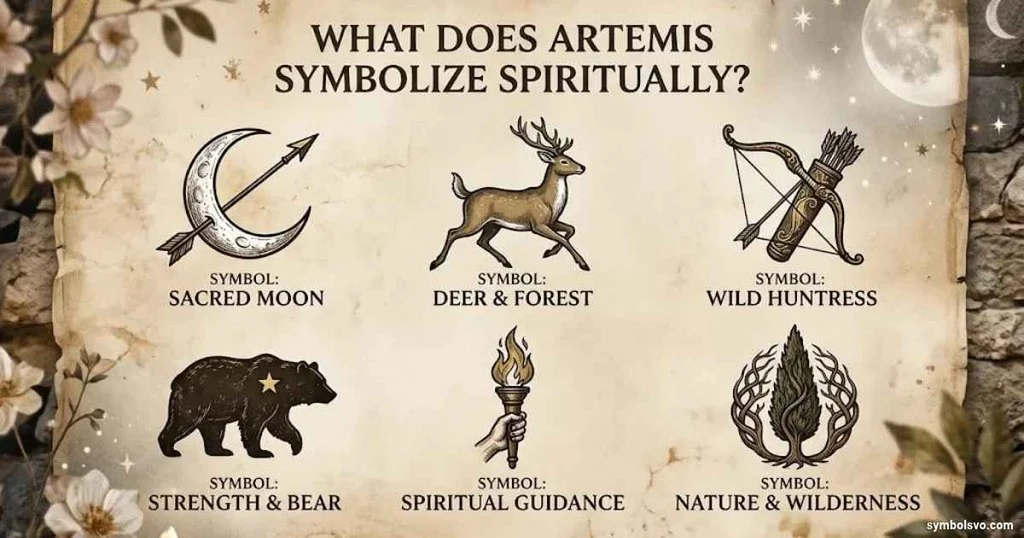
The spiritual meaning of Artemis extends beyond ancient hunting traditions. Modern readers often interpret her as a symbol of independence, courage, protection, and connection with nature.
These meanings reflect contemporary interpretations inspired by her mythology. Ancient Greek worship did not follow one universal system of spiritual symbolism.
Independence and Personal Freedom
Artemis is one of the strongest female figures in Greek mythology. She chose an independent life and refused to follow the traditional expectations associated with marriage.
Her identity as an unmarried goddess became an important part of her mythology.
For modern readers, this makes Artemis a symbol of personal autonomy and freedom of choice.
Her independence can represent:
- Making decisions without unnecessary pressure.
- Establishing personal boundaries.
- Developing confidence and self-reliance.
- Following individual goals.
- Protecting personal freedom.
Her mythology offers a powerful example of a female deity whose identity does not depend on marriage or romantic relationships.
Feminine Strength and Empowerment
Artemis represents a form of strength that combines physical ability, independence, and divine authority.
She does not rely on traditional feminine roles to establish her power. Instead, her hunting skills and command over wilderness define her identity.
Her connection with young women also makes her significant in discussions of female protection and development.
Modern interpretations associate her with female empowerment, confidence, and self-determination.
However, these contemporary meanings should not be confused with a modern feminist philosophy practiced in ancient Greece.
Protection and Personal Boundaries
Protection is another important part of Artemis’s identity.
Ancient traditions connected her with young girls, childbirth, and children. Women sometimes called upon Artemis during important stages of life, particularly those involving pregnancy and childbirth.
Her myths also show that she strongly defended her personal boundaries.
The story of Actaeon is a clear example. He violated her privacy and suffered a terrible punishment.
For modern readers, this story can represent:
- Respect for personal space.
- The importance of consent.
- Defending individual boundaries.
- Protection from unwanted interference.
- Respect for personal autonomy.
These are modern interpretations of the myth’s themes rather than direct translations of ancient religious beliefs.
Connection With Nature
Artemis’s relationship with forests and wild animals makes her a natural symbol of environmental awareness today.
Her mythology emphasizes that humans are not the only beings with a place in the natural world.
Animals, forests, and mountains all belong to a larger environment governed by divine powers.
Modern spiritual interpretations connect Artemis with:
- Wildlife conservation.
- Respect for animal habitats.
- Environmental responsibility.
- Outdoor exploration.
- Harmony with nature.
Her identity as Goddess of the Wilderness makes this one of the most recognizable modern interpretations.
Courage, Discipline, and Self-Reliance
Artemis was a skilled archer who could hunt in difficult landscapes. Her abilities required practice, patience, and physical strength.
Her bow therefore provides a useful modern metaphor for discipline and determination.
Her mythology can inspire ideas such as:
- Staying focused on important goals.
- Developing practical skills.
- Trusting your abilities.
- Facing difficult situations.
- Maintaining independence.
The central lesson is simple: strength requires both confidence and preparation.
Purity and Chastity
Artemis traditionally maintained an unmarried and chaste identity. This aspect distinguishes her from many other Greek goddesses.
However, ancient Greek chastity carried cultural and religious meanings that do not always match modern ideas about personal purity.
Artemis’s identity emphasized independence from marriage and sexual relationships. Her virginity also formed part of her divine authority.
For this reason, it is more accurate to discuss chastity, independence, and personal boundaries than to reduce her symbolism to moral purity.
Artemis in Ancient Greek Art and Religious Traditions
Ancient Greek artwork provides some of the clearest evidence for understanding Artemis’s symbols. Sculptures, pottery, coins, and religious objects show how different communities imagined the goddess.
Her appearance changed across historical periods and geographical locations.
How Artemis Appears in Ancient Greek Sculpture
Artists frequently represented Artemis as a young and athletic huntress.
Her traditional appearance included:
- A short hunting tunic or chiton.
- Hunting boots.
- A bow held in one hand.
- A quiver containing arrows.
- Deer or hunting dogs nearby.
- Hair arranged to remain practical during movement.
A bronze statuette in the Metropolitan Museum of Art, dating from the third to first centuries BCE, shows Artemis removing an arrow from her quiver. The museum identifies her as the goddess of hunting and hunters.
This object demonstrates how closely the bow, quiver, and athletic clothing belonged to her artistic identity.
Artemis of Ephesus
Artemis of Ephesus represents a distinctive regional form of the goddess.
Unlike the familiar Greek huntress with a bow and short tunic, the Ephesian goddess appeared in elaborate ceremonial clothing. Her statue included numerous decorative figures and objects associated with fertility and her role as a powerful divine protector.
Her appearance reflected local religious traditions in western Anatolia.
The objects covering her torso have generated considerable scholarly discussion. Researchers have interpreted them in different ways, including as breasts, eggs, beehives, or animal-related offerings.
The Getty Museum’s second-century CE statuette illustrates this distinctive artistic tradition.
The Ephesian Artemis also had an enormous sanctuary dedicated to her. The Temple of Artemis at Ephesus became one of the Seven Wonders of the Ancient World.
The temple’s history included destruction and rebuilding. A major structure was destroyed by fire in 356 BCE and later rebuilt on an impressive scale.
This regional form of Artemis shows how Greek deities could absorb local religious traditions and develop distinctive identities. Explore the Getty Museum’s Artemis of Ephesus statuette.
Artemis of Brauron
The sanctuary of Artemis at Brauron was one of the most important religious centers associated with the goddess in Attica.
It held particular significance for young girls and their transition toward adulthood.
The arkteia ceremony involved girls who participated in rituals associated with Artemis and the bear. These participants were known as arktoi, or bears.
The ceremony connected the goddess with childhood, religious initiation, and important stages of female development.
Brauron demonstrates that Artemis’s role extended far beyond hunting. She also held an important place in the lives of young women and their families.
Artemis and Ancient Greek Festivals
Ancient Greek communities organized festivals to honor their local deities. Artemis received worship through several regional celebrations.
Brauronia was particularly associated with her sanctuary at Brauron. Its rituals included activities connected with young girls and their religious development.
Other local festivals honored different aspects of Artemis. Their ceremonies varied according to the community and sanctuary.
It is important not to treat every celebration called an Artemisia as one identical festival. The name could refer to different local observances.
Artemis, Diana, and Selene: Understanding the Differences
Artemis is often confused with Diana and Selene because all three figures have connections with hunting or lunar imagery.
However, they come from different mythological traditions and do not represent exactly the same divine role.
| Goddess | Mythological tradition | Main identity |
| Artemis | Greek | Hunting, wilderness, young women, and wild animals |
| Diana | Roman | Hunting, wilderness, and later lunar associations |
| Selene | Greek | Personification of the moon |
| Hecate | Greek | Magic, crossroads, night, and supernatural powers |
Artemis vs. Diana
Diana was the Roman counterpart of the Greek goddess Artemis.
Roman religion adopted many Greek deities and connected them with existing Roman divine figures. Diana shared Artemis’s associations with hunting, wilderness, and the protection of women.
Both goddesses frequently appeared with:
- A bow and arrows.
- A quiver.
- Deer and hunting dogs.
- A short hunting garment.
- Natural landscapes.
However, Roman worship developed its own traditions. Diana had important sanctuaries and religious significance within Roman society.
The Metropolitan Museum of Art identifies Artemis as Diana’s Roman equivalent in its collection description of a bronze statue featuring the goddess and a deer.
Artemis vs. Selene
Selene was the Greek personification of the moon. Ancient mythology described her as the daughter of the Titans Hyperion and Theia and the sister of Helios and Eos.
Unlike Artemis, Selene represented the celestial moon itself.
Her mythology frequently describes her traveling across the night sky in a chariot. One famous story concerns her love for Endymion, a mortal who remained in eternal sleep.
Artemis gradually developed lunar associations through later religious and artistic traditions. This connection sometimes made the two goddesses appear similar.
The difference is important:
- Artemis: Primarily the goddess of hunting and wilderness.
- Selene: The divine personification of the moon.
Artemis vs. Hecate
Hecate was another Greek goddess associated with nighttime and supernatural powers.
Her traditional associations included magic, crossroads, spirits, and protective boundaries. Artists sometimes represented her carrying torches.
Artemis and Hecate became connected in certain later religious interpretations. Both could appear in nighttime imagery and were associated with powerful female divine identities.
However, they retained distinct mythological roles.
Artemis represented hunting and wild nature, while Hecate had stronger connections with magic and crossroads.
Famous Myths That Explain Artemis’s Symbols
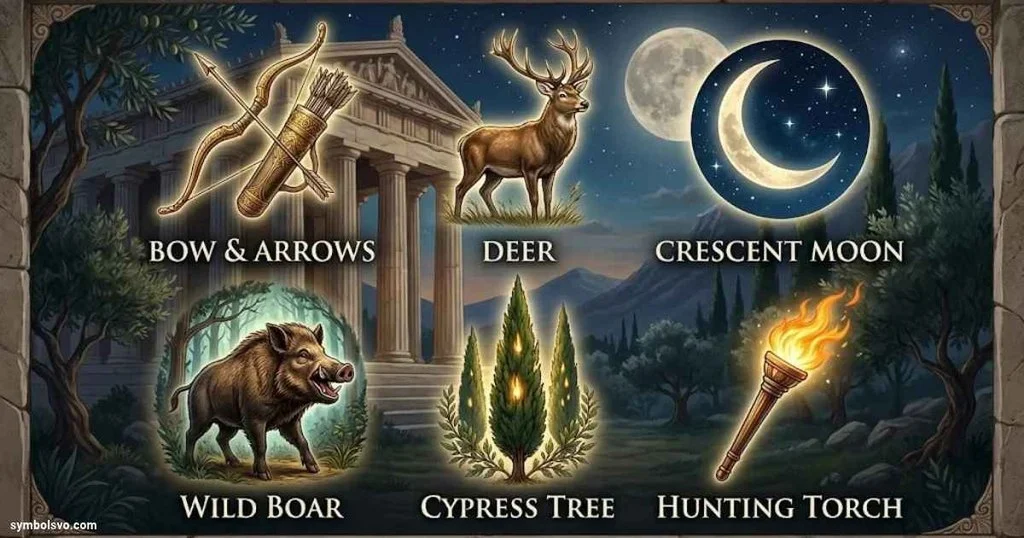
Artemis’s symbols become easier to understand when you examine the stories behind them. Her mythology explains why particular animals, weapons, and natural objects became connected with her identity.
Artemis and Actaeon
The story of Actaeon is one of the most famous myths involving Artemis.
Actaeon was a skilled hunter who accidentally saw Artemis bathing in a secluded place. The goddess considered this an unacceptable violation of her privacy.
She transformed him into a stag.
Actaeon’s hunting dogs failed to recognize their former master. They chased and attacked him, eventually killing him.
The story has several important connections with Artemis’s symbolism:
- Deer: Actaeon’s transformation connects him with the animal sacred to Artemis.
- Hunting dogs: His own dogs become instruments of his punishment.
- Wilderness: The story takes place in a secluded natural setting.
- Divine authority: Artemis demonstrates the consequences of violating her boundaries.
The myth appears in several ancient artistic traditions. Artists often portrayed Artemis watching as Actaeon faced his dogs.
Artemis and Orion
Orion was a famous hunter in Greek mythology. Different ancient accounts describe his relationship with Artemis in different ways.
Some traditions portray Orion as a hunting companion of the goddess. Others describe a conflict that eventually caused his death.
In one famous version, Artemis accidentally kills Orion after Apollo tricks her into shooting a distant target at sea.
Other accounts connect his death with a giant scorpion sent by the gods.
The story later became connected with the constellations of Orion and Scorpius.
It also reinforces Artemis’s identity as a powerful huntress whose mythology frequently involves the dangers of hunting.
Artemis and Callisto
Callisto was a follower of Artemis in Greek mythology.
According to one well-known version, Zeus approached Callisto while disguised as Artemis. She later became pregnant, which threatened her place among the goddess’s companions.
The story develops differently across ancient sources. Some versions describe Artemis punishing Callisto, while others emphasize Hera’s role in her transformation.
Callisto eventually became associated with the constellation Ursa Major, commonly known as the Great Bear.
Her story connects Artemis with:
- Female companionship.
- Chastity and divine expectations.
- Transformation and punishment.
- The bear and celestial imagery.
It also demonstrates how Greek myths developed multiple versions rather than following one fixed storyline.
Artemis and the Ceryneian Hind
The story of the Ceryneian Hind explains why this animal holds such a special place in Artemis’s mythology.
Heracles received the task of capturing the golden-horned hind alive. Because the animal belonged to Artemis’s sacred world, the mission presented a difficult challenge.
He eventually captured it after a lengthy pursuit.
Artemis objected to the capture, but Heracles explained that he acted under Eurystheus’s command. He returned the animal rather than keeping it.
The story reinforces the goddess’s authority over sacred wildlife and explains the hind’s connection with her.
Leto, Artemis, and the Birth on Delos
The birth story of Artemis and Apollo explains the importance of Delos in Greek mythology.
Leto faced difficulties finding a place to give birth because Hera opposed her. Eventually, Delos accepted her and became the birthplace of the divine twins.
The palm tree became an important part of the story through its connection with Leto’s childbirth.
Delos subsequently gained religious importance as the birthplace of Apollo and Artemis.
This myth explains the connection between Artemis, her mother, the palm tree, and the sacred island.
How Are Artemis Symbols Used Today?
The influence of Artemis continues beyond ancient temples and classical mythology. Her image appears in modern tattoos, jewelry, paintings, literature, and popular culture.
Many people choose her symbols because they represent independence, personal strength, wilderness, and feminine identity.
However, modern uses often combine historical attributes with contemporary interpretations.
Artemis Tattoos and Their Meanings
Artemis tattoos are popular among people interested in Greek mythology and goddess-inspired artwork.
Different designs highlight different aspects of her identity.
| Artemis tattoo design | Common modern interpretation |
| Bow and arrows | Focus, determination, and independence |
| Crescent moon | Lunar connection and transformation |
| Deer | Grace, freedom, and nature |
| Stag | Strength and wilderness |
| Artemis portrait | Female power and confidence |
| Bow with flowers | Connection with nature and personal growth |
| Hunting dogs | Loyalty and companionship |
A tattoo featuring Artemis’s bow may appeal to someone who values independence and determination. A deer design may better represent a connection with wildlife and natural environments.
The meaning ultimately depends on the person choosing the design.
Artemis-Inspired Jewelry
Artemis-inspired jewelry often combines recognizable mythological attributes with modern decorative styles.
Popular designs include:
- Crescent moon necklaces.
- Bow and arrow pendants.
- Deer-shaped charms.
- Silver goddess medallions.
- Nature-inspired bracelets.
- Mythological rings.
Silver frequently appears in modern Artemis jewelry because of its association with lunar imagery and classical goddess artwork.
However, silver should not be treated as an exclusive ancient attribute of Artemis.
Artemis in Modern Art and Popular Culture
Artemis remains a popular figure in books, movies, video games, and mythology-inspired artwork.
Modern creators often portray her as a confident huntress who protects nature and challenges traditional expectations.
Her recognizable attributes make her particularly useful in visual storytelling.
Common representations include:
- A huntress carrying a bow.
- A goddess surrounded by deer.
- A crescent moon above her head.
- A powerful woman standing in a forest.
- A protector of wild animals.
These representations often blend ancient Greek mythology with modern ideas about independence and environmental awareness.
Artemis as a Modern Symbol of Independence
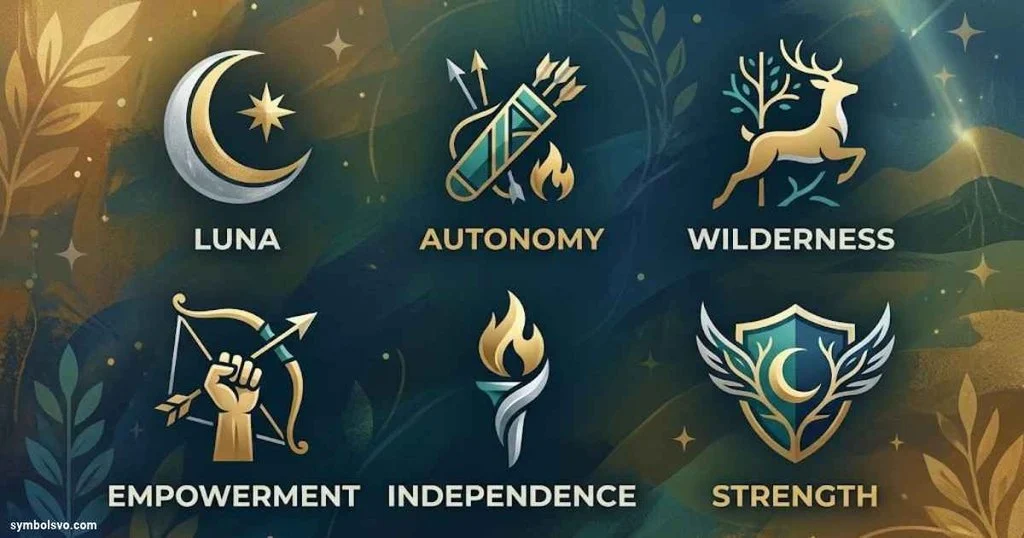
Artemis’s independent identity has helped her become a powerful symbol in modern culture.
Her mythology presents a goddess who chooses her own path and maintains control over her personal boundaries.
For many modern readers, this makes her an inspiring figure.
Her symbolism can represent:
- Freedom of choice.
- Confidence and self-respect.
- Female independence.
- Protection of personal boundaries.
- Strength through self-reliance.
- Respect for nature.
These meanings explain why Artemis continues to attract interest among readers, artists, and mythology enthusiasts.
Frequently Asked Questions About Artemis Symbols
What Are the Main Symbols of Artemis?
The main symbols of Artemis include the bow and arrows, deer, hunting dogs, quiver, and crescent moon. Bears also have a specific connection with her worship at Brauron. These symbols reflect her identity as the goddess of hunting, wilderness, and the protection of young women.
What Is the Most Important Symbol of Artemis?
The bow and arrows are arguably Artemis’s most recognizable symbols. They represent her identity as a skilled huntress and her authority over the wilderness. Ancient Greek sculptures and pottery frequently depict her carrying these weapons.
Why Is the Deer Sacred to Artemis?
The deer is closely associated with Artemis because of her role as guardian of wild animals and goddess of hunting. The Ceryneian Hind, a golden-horned deer in Greek mythology, provides one of the clearest examples of this sacred connection.
Why Does Artemis Carry a Bow and Arrows?
Artemis carries a bow and arrows because she is the Greek goddess of hunting and archery. Her weapons allow her to hunt wild animals and exercise divine authority. They also distinguish her from many other Olympian goddesses in ancient artwork.
Is Artemis the Goddess of the Moon?
Artemis became associated with the moon through later Greek and Roman religious traditions. However, Selene was the original Greek personification of the moon. Artemis’s strongest early associations were hunting, wilderness, wild animals, and young women.
What Animals Are Associated With Artemis?
The animals most closely associated with Artemis include deer, hinds, hunting dogs, and bears. Deer and dogs frequently appear in her artistic representations. Bears held particular religious importance in the rituals performed at her sanctuary in Brauron.
What Is Artemis’s Sacred Plant?
The palm tree has a direct connection with Artemis through the story of her birth on Delos. Cypress and mugwort also appear in modern discussions of Artemis’s natural associations. However, their historical connections should not be treated as equally established.
What Does the Crescent Moon Mean in Artemis Symbolism?
The crescent moon represents Artemis’s later lunar associations. Modern interpretations connect it with natural cycles, renewal, femininity, and celestial power. Historically, however, Selene was the distinct Greek goddess who personified the moon.
What Does the Bear Symbolize in Artemis’s Worship?
The bear is connected with the Brauronian rituals honoring Artemis. Young girls participated in ceremonies and were called arktoi, meaning bears. The tradition connects the animal with childhood, religious initiation, and the transition toward adulthood.
What Is the Ceryneian Hind?
The Ceryneian Hind was a sacred female deer in Greek mythology. It had golden antlers and bronze hooves and was associated with Artemis. Heracles captured the animal alive as part of his twelve labors before returning it.
Who Are Artemis’s Parents?
Artemis was the daughter of Zeus and Leto. Zeus was the king of the Olympian gods, while Leto was a daughter of the Titans Coeus and Phoebe.
Who Is Artemis’s Twin Brother?
Apollo is Artemis’s twin brother. He was associated with music, prophecy, healing, and archery. Both deities were skilled archers and shared important connections in ancient Greek mythology.
What Is Artemis’s Roman Name?
Artemis’s Roman counterpart is Diana. Both goddesses were associated with hunting, wilderness, and the protection of women. Roman religious traditions also strengthened Diana’s connection with lunar symbolism.
What Does Artemis Represent Spiritually?
Modern spiritual interpretations associate Artemis with independence, courage, protection, feminine strength, and a connection with nature. These meanings draw inspiration from her mythology rather than representing one universal ancient Greek belief system.
What Does Artemis Symbolize for Women?
Artemis often represents female independence, personal freedom, confidence, and self-reliance. Her unmarried identity and role as a protector of young women make her an important figure in modern discussions of feminine strength and autonomy.
What Is the Difference Between Artemis and Diana?
Artemis belongs to Greek mythology, while Diana belongs to Roman mythology. Diana became the Roman counterpart of Artemis and shared many of her attributes, including hunting, archery, and connections with wilderness.
What Is the Difference Between Artemis and Selene?
Artemis was primarily the Greek goddess of hunting and wilderness. Selene was the personification of the moon. Although later traditions connected Artemis with lunar imagery, the two originally represented distinct divine identities.
What Does an Artemis Tattoo Mean?
An Artemis tattoo can represent independence, courage, freedom, protection, and a connection with nature. A bow and arrow often suggests determination, while deer and crescent moon designs reflect wildlife and later lunar associations.
Conclusion
The symbols of Artemis reveal the many dimensions of one of Greek mythology’s most influential goddesses. Her bow and arrows represent her hunting abilities, while deer and hunting dogs connect her with wildlife and the wilderness.
Other symbols tell different stories. The bear reflects her religious traditions at Barron, the palm tree connects with her birth on Delos, and the crescent moon represents her later lunar associations.
Her mythology also explains why Artemis remains a powerful figure in modern culture. She represents independence, courage, protection, and personal freedom.
Understanding the difference between ancient religious traditions and modern spiritual interpretations makes her symbolism even more meaningful. Whether you encounter Artemis in classical sculpture, mythology, jewelry, or tattoos, her identity remains closely connected with the wild and the freedom to follow one’s own path.

I’m Daniel Brooks, a content creator and symbol enthusiast dedicated to researching the fascinating world of signs and symbols. I enjoy discovering the hidden meanings behind famous icons, emojis, historical emblems, and cultural symbols. Through my writing, I aim to provide trustworthy, well-researched, and reader-friendly information that helps people learn something new with every visit.
Books:
- The Complete Guide to World Symbols
- The Power of Universal Signs
 Mason Ellington
 Nathan Holloway