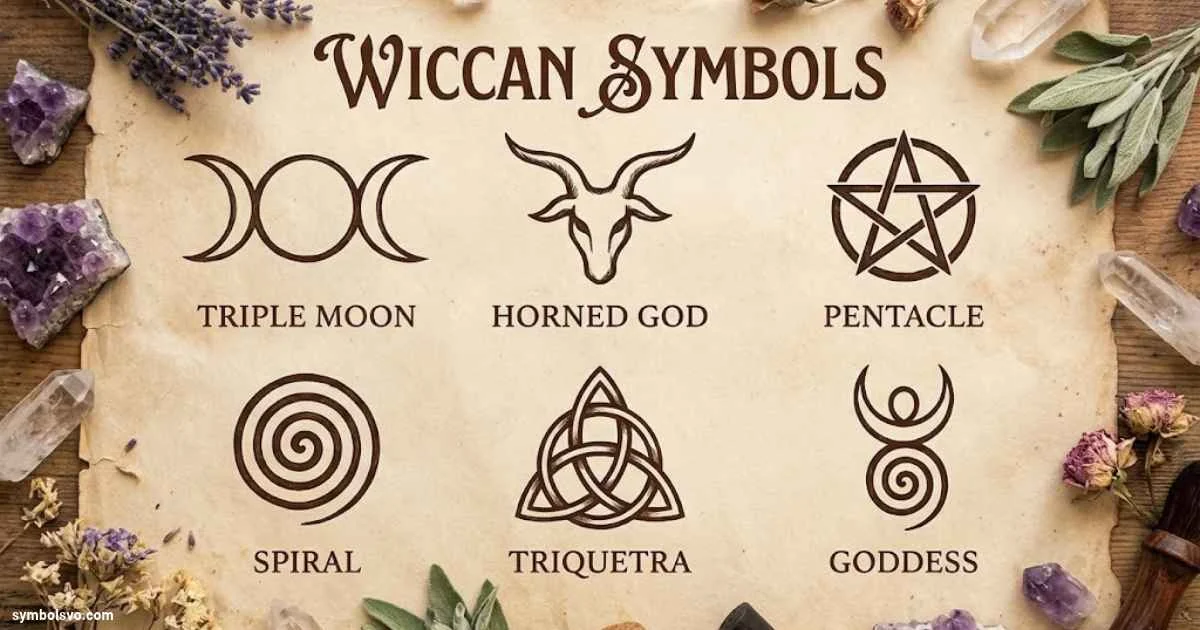
Wiccan symbols carry spiritual meanings that help people express their beliefs, connect with nature, and understand different aspects of modern Pagan practice. Some represent the elements, while others symbolize the Goddess, the God, protection, balance, or spiritual transformation.
Although many people associate these signs with witchcraft, not every symbol commonly used by Wiccans originated in Wicca. Some come from ancient Egyptian, Celtic, and Norse traditions, while others developed through modern Pagan spirituality.
Understanding these differences makes it easier to recognize what each symbol represents and how people use it today. This guide explores 23 well-known Wiccan symbols and their meanings, including their appearances, cultural backgrounds, and modern spiritual associations.
What Are Wiccan Symbols?
Wiccan symbols are visual signs used in modern Wicca and related Pagan traditions to represent spiritual beliefs, natural forces, deities, and personal intentions. They can appear on altars, ritual tools, jewelry, artwork, clothing, and other objects.
Wicca is a modern Pagan religion that developed in the twentieth century. Many Wiccans honor the natural world, observe seasonal celebrations, and recognize divine feminine and masculine principles. However, beliefs and practices differ between traditions and individual practitioners.
Some common purposes of Wiccan symbols include:
- Spiritual representation: Expressing beliefs about nature, divinity, and the universe.
- Elemental symbolism: Representing Earth, Air, Fire, Water, and Spirit.
- Protection: Serving as a reminder of safety, strength, or spiritual boundaries.
- Ritual practice: Helping practitioners focus their attention during ceremonies.
- Personal identity: Expressing an individual’s spiritual interests or religious affiliation.
Not every Pagan or witchcraft symbol is specifically Wiccan. A symbol may have an ancient cultural history and later become meaningful to modern Wiccans.
Wiccan Symbols and Their Meanings
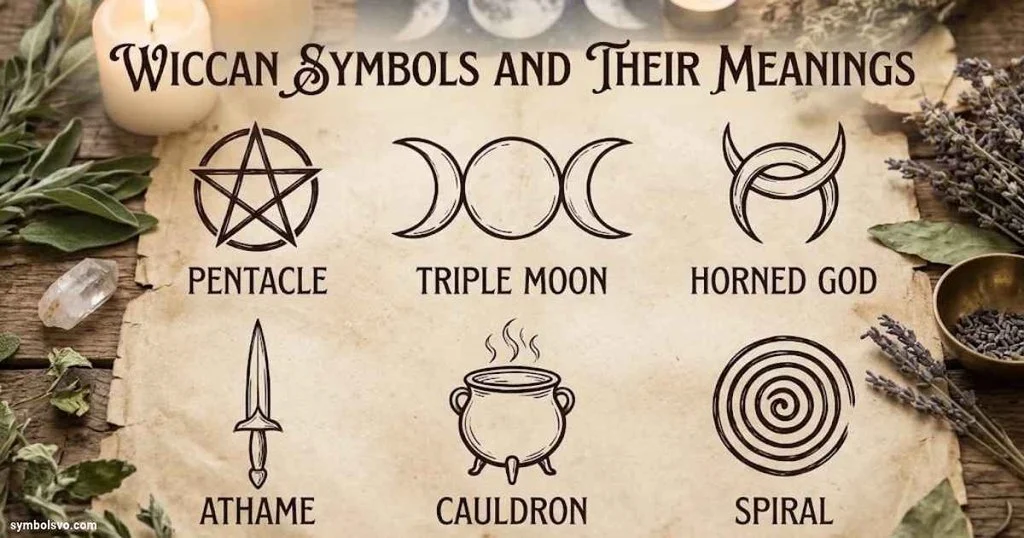
The following symbols are commonly associated with Wicca, modern Pagan spirituality, or related traditions. Their meanings can vary depending on the practitioner, religious path, and cultural context.
Pentacle Symbol
The pentacle is one of the most recognizable symbols associated with Wicca. It usually features a five-pointed star enclosed within a circle.
The five points are commonly connected with the five elements: Earth, Air, Fire, Water, and Spirit. The surrounding circle can represent unity, wholeness, and the interconnectedness of life.
Common meanings of the pentacle include:
- Protection and spiritual balance
- Connection with the five elements
- Harmony between nature and humanity
- Unity and wholeness
- Spiritual awareness
Wiccans may place a pentacle on an altar, use it in ritual settings, or wear it as jewelry. It is important to distinguish the pentacle from the pentagram. A pentacle commonly refers to a pentagram enclosed within a circle, although terminology varies.
Pentagram Symbol
The pentagram is a five-pointed star drawn with five connected lines. It can appear alone or inside a circle.
In modern Wiccan symbolism, its five points are frequently associated with Earth, Air, Fire, Water, and Spirit. The symbol can represent the relationship between these elements and the balance of the natural world.
The pentagram is commonly associated with:
- Balance and harmony
- The five elements
- Spiritual protection
- Connection with nature
- The relationship between physical and spiritual life
The pentagram has appeared in several historical cultures and belief systems. Its meaning has not always been the same. In modern Wicca, it is generally understood as a positive spiritual symbol rather than automatically representing evil or harmful practices.
Triple Moon Symbol
The Triple Moon symbol consists of three lunar shapes arranged side by side: a waxing crescent, a full moon, and a waning crescent.
It is strongly associated with the Triple Goddess concept in many modern Wiccan traditions. The three lunar phases are commonly interpreted as the Maiden, Mother, and Crone.
Its common meanings include:
- Feminine divinity
- The cycles of life
- Growth, maturity, and transformation
- Intuition and spiritual awareness
- The changing phases of the Moon
The Triple Moon is especially popular in Wiccan jewelry, altar decorations, and spiritual artwork. However, the Maiden, Mother, and Crone interpretation is a modern religious association rather than a universal belief shared by every Pagan tradition.
Horned God Symbol
The Horned God represents a masculine divine figure in many forms of modern Wicca. He is commonly connected with wild nature, animals, fertility, seasonal cycles, and the natural world.
His imagery often includes a male figure with antlers or horns. These features connect him symbolically with animals, forests, wilderness, and the rhythms of nature.
The Horned God can represent:
- Nature and wildlife
- Fertility and renewal
- Strength and vitality
- The changing seasons
- Masculine divinity
The Horned God is not necessarily a representation of the Christian devil. The two figures belong to different religious contexts. In Wicca, the Horned God is generally understood as a nature-associated deity or divine principle.
Triple Goddess Symbol
The Triple Goddess is a central spiritual concept in many Wiccan traditions. She is commonly represented through three aspects: Maiden, Mother, and Crone.
Each aspect reflects a different stage of life and a different expression of feminine divinity.
| Goddess Aspect | Common Meaning |
| Maiden | Youth, independence, beginnings, and possibility |
| Mother | Fertility, nurturing, creation, and abundance |
| Crone | Wisdom, experience, endings, and transformation |
The Triple Goddess is often connected with the three visible phases of the Moon represented by the Triple Moon symbol.
Her symbolism reminds practitioners that life moves through different stages. Growth, change, experience, and renewal are all natural parts of existence.
Hecate’s Wheel Symbol
Hecate’s Wheel, sometimes called the Strophalos, is a symbol associated with the Greek goddess Hecate in modern spiritual and Pagan contexts.
It is often depicted as a circular design with a central point and three connected or radiating sections. Some modern versions use a labyrinth-like pattern.
Hecate’s Wheel is commonly associated with:
- Crossroads and choices
- Transformation
- Wisdom and knowledge
- Protection
- Feminine spiritual power
Hecate has historical roots in ancient Greek religion. However, the wheel’s modern visual forms and interpretations should not automatically be treated as evidence of one universal ancient symbol. Modern practitioners may use it as a representation of Hecate’s spiritual associations.
Air Element Symbol
The Air symbol is commonly represented by an upright triangle with a horizontal line passing through it.
In Wiccan elemental symbolism, Air is associated with thought, communication, learning, and intellectual activity.
Air commonly represents:
- Intelligence and wisdom
- Communication and expression
- Mental clarity
- Creativity and inspiration
- Freedom and movement
Air is often associated with the eastern direction in some Wiccan traditions. Its colors may include yellow or white, although correspondences differ between groups.
Practitioners may use the Air symbol on altars or during rituals that focus on learning, concentration, or communication.
Earth Element Symbol
The Earth symbol is commonly represented by an inverted triangle with a horizontal line passing through it.
Earth represents the physical world and the natural foundations that support life. It is connected with stability, growth, nourishment, and material well-being.
Its common meanings include:
- Stability and security
- Nature and the environment
- Fertility and growth
- Patience and endurance
- Physical strength
Earth is associated with soil, plants, stones, mountains, and the natural landscape. Some Wiccan traditions connect it with the northern direction and colors such as green or brown.
Fire Element Symbol
The Fire symbol is usually shown as an upright triangle without a horizontal line.
Fire represents energy, transformation, passion, and action. It can create warmth and light, but it can also destroy and change what it touches.
Fire is commonly associated with:
- Passion and motivation
- Courage and determination
- Transformation and renewal
- Creativity and energy
- Strength and ambition
In some Wiccan traditions, Fire corresponds with the southern direction. Red, orange, and gold are common symbolic colors, although these associations are not universal.
Water Element Symbol
The Water symbol is commonly represented by an inverted triangle without a horizontal line.
Water is associated with emotions, intuition, healing, reflection, and the natural flow of life.
Its common meanings include:
- Emotional understanding
- Intuition and sensitivity
- Healing and renewal
- Adaptability and change
- Peace and reflection
Water may be represented through rivers, oceans, rain, lakes, and other natural sources. Some Wiccan traditions associate it with the western direction and colors such as blue.
Spirit Element Symbol
Spirit, sometimes called Aether, represents the spiritual dimension that connects the other four elements.
Its symbol varies between traditions. One common design is a circle or an upright triangle with a horizontal line, depending on the symbolic system being used.
Spirit can represent:
- Universal connection
- Spiritual awareness
- Unity and wholeness
- Consciousness
- The relationship between physical and spiritual life
In Wiccan elemental symbolism, Spirit is not always represented in the same way. Some practitioners use it as the fifth element that connects Earth, Air, Fire, and Water.
Solar Cross Symbol
The Solar Cross is generally represented by a circle containing a cross with four equal arms.
Its design resembles a wheel divided into four sections. Different historical cultures have used similar cross-and-circle motifs.
In modern Pagan and Wiccan contexts, it may be interpreted through the Sun, seasonal cycles, and the four directions.
Common modern associations include:
- The Sun and its cycles
- Seasonal change
- The four directions
- Nature and balance
- The passage of time
The Solar Cross has a broader historical background than modern Wicca. Its meaning depends on the culture and context in which it appears.
Sun Wheel Symbol
The Sun Wheel is a circular symbol associated with solar cycles, seasonal changes, and the movement of time.
Its design can vary. Some versions resemble a wheel with spokes, while others use a circular shape with additional lines or solar details.
The Sun Wheel commonly represents:
- Solar energy and light
- Seasonal cycles
- Renewal and growth
- Nature’s rhythms
- Life and vitality
Some modern Pagan practitioners connect solar symbolism with seasonal festivals and the Wheel of the Year. However, the Sun Wheel does not have one fixed meaning across all cultures or Wiccan traditions.
Ankh Symbol
The Ankh is an ancient Egyptian symbol shaped like a cross with a loop at the top. It is widely recognized as a hieroglyph associated with life.
In ancient Egyptian art, gods and goddesses are frequently shown holding the Ankh. It is also found in religious imagery and objects connected with life and the afterlife.
The Ankh is commonly associated with:
- Life and vitality
- Immortality
- Spiritual continuity
- Rebirth
- Divine power
Some modern Wiccans and Pagans use the Ankh because of its spiritual associations. However, it originated in ancient Egyptian culture and is not an exclusively Wiccan symbol.
Eye of Horus Symbol
The Eye of Horus, also known as the Wedjat Eye, is an ancient Egyptian symbol associated with protection, healing, and restoration.
It is usually represented as a stylized human eye with distinctive markings beneath it.
In Egyptian mythology, the symbol is connected with the story of Horus and the restoration of his injured eye. This association helped establish its importance in ancient Egyptian protective imagery.
Its common meanings include:
- Protection and safety
- Healing and restoration
- Wholeness and renewal
- Spiritual awareness
- Well-being
Some modern practitioners use the Eye of Horus in spiritual jewelry or decorative objects. Its original historical and religious context remains ancient Egyptian.
Eye of Ra Symbol
The Eye of Ra is another important symbol from ancient Egyptian religion. It is connected with Ra, the Sun god, and represents a powerful protective and destructive force.
It is frequently depicted through the eye of a deity or as a solar symbol associated with divine authority.
The Eye of Ra is commonly associated with:
- Solar power
- Divine authority
- Protection
- Strength and power
- Destruction of threats
The Eye of Ra and the Eye of Horus are sometimes confused because their visual forms can look similar. However, they have different mythological associations. The Eye of Horus is strongly connected with healing and restoration, while the Eye of Ra is associated with solar power and divine force.
Celtic Shield Knot Symbol
The Celtic Shield Knot is a decorative knot design associated with Celtic-inspired art and modern interpretations of protection.
It often features interwoven lines that create a continuous pattern. Some modern designs place the knot inside a circular or shield-like outline.
Its modern symbolic meanings include:
- Protection and security
- Strength and resilience
- Continuity and connection
- Unity and loyalty
- Endurance
The term Celtic Shield Knot is commonly used for modern decorative designs. Not every knot pattern has a documented ancient meaning, so its protective interpretation should be understood as a modern symbolic association rather than a proven universal historical belief.
Triquetra Symbol
The Triquetra is a three-pointed knot design made from three interconnected loops or curved sections.
It appears in historical artwork from different periods and is especially familiar in Celtic-inspired designs. It has also been used in Christian art to represent the Holy Trinity.
The Triquetra can symbolize:
- Three connected aspects of life
- Unity and eternity
- Spiritual connection
- Life, death, and rebirth
- Interdependence
Some modern Pagans and Wiccans interpret the three connected sections through nature, divine aspects, or cycles of life. These interpretations are not the only meanings associated with the symbol.
Triple Spiral or Triskele Symbol
The Triple Spiral, often called a Triskele or Triskelion, features three connected spirals or curved arms extending from a central point.
One of the best-known examples appears at Newgrange in Ireland, a prehistoric passage tomb with carved stone artwork dating back thousands of years.
Its original meaning is not known with certainty. Modern interpretations often connect the three spirals with movement, cycles, and transformation.
Common modern meanings include:
- Growth and development
- Life’s cycles
- Transformation
- Movement and progress
- The connection between three aspects of existence
Some Wiccans and modern Pagans use the Triple Spiral as a spiritual symbol. However, its prehistoric origin should not be confused with modern interpretations of its meaning.
Thor’s Hammer (Mjölnir) Symbol
Thor’s Hammer, known as Mjölnir, comes from Norse mythology. It is the weapon associated with Thor, the Norse god of thunder.
Historical Viking Age objects include hammer-shaped pendants, which are commonly interpreted as expressions of religious identity and devotion.
Mjölnir is commonly associated with:
- Strength and courage
- Protection
- Thunder and storms
- Divine power
- Norse religious identity
Some modern Heathens and Pagans wear Thor’s Hammer as a symbol of their spiritual beliefs. It is not originally a Wiccan symbol, although individuals from different Pagan traditions may find meaning in it.
Triple Horn of Odin Symbol
The Triple Horn of Odin consists of three drinking horns arranged in an interlocking design.
It is associated with Odin and the Norse mythological story of the Mead of Poetry. In modern contexts, the design is often connected with wisdom, knowledge, and inspiration.
Its modern meanings include:
- Wisdom and learning
- Inspiration and creativity
- Norse mythology
- Knowledge and poetry
- Spiritual devotion
The Triple Horn of Odin is particularly relevant to modern Norse Pagan and Heathen communities. It should not be presented as a universally recognized ancient Wiccan emblem.
Seax Wica Symbol
Seax-Wica is a modern Wiccan tradition founded by Raymond Buckland. It draws inspiration from Anglo-Saxon culture and mythology.
The tradition has its own religious practices, deities, and symbolic interests. Its name reflects the seax, a type of historical Germanic knife.
Seax-Wica should be understood as a specific Wiccan tradition rather than a single universal symbol used by all Wiccans.
Its broader symbolic associations may include:
- Anglo-Saxon cultural inspiration
- Nature-based spirituality
- Wiccan religious practice
- Traditional mythology
- Personal spiritual identity
People researching Seax-Wica should distinguish the tradition itself from symbols that modern websites may label as its official emblem without reliable historical or religious support.
Yin Yang Symbol
The Yin Yang symbol comes from Chinese philosophy and represents the relationship between two complementary forces.
It is usually shown as a circle divided into two curved sections, one dark and one light. Each section contains a small circle of the opposite color.
Its common meanings include:
- Balance and harmony
- Complementary forces
- Interdependence
- Change and transformation
- The relationship between opposing qualities
Some modern spiritual practitioners use the Yin Yang as a general representation of balance. However, it originates in Chinese philosophical traditions and is not specifically Wiccan.
The Five Elemental Symbols in Wicca
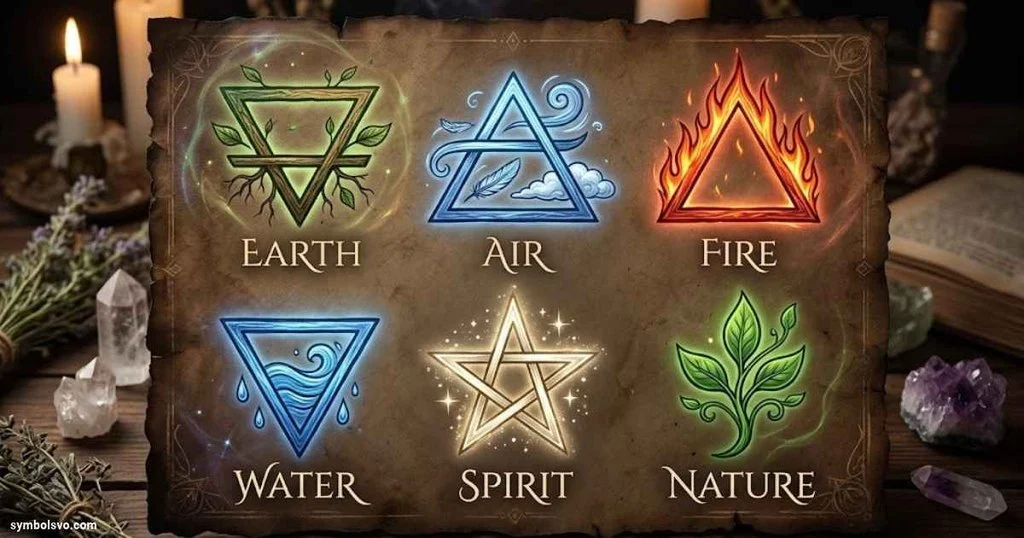
The five elements are important in many Wiccan traditions. They provide a symbolic framework for understanding nature, spiritual balance, and different aspects of human experience.
The four physical elements are Earth, Air, Fire, and Water. Spirit is often included as the fifth element that connects them.
| Element | Common Symbol | Common Associations |
| Earth | Inverted triangle with a horizontal line | Stability, growth, and nature |
| Air | Upright triangle with a horizontal line | Thought, communication, and wisdom |
| Fire | Upright triangle | Energy, passion, and transformation |
| Water | Inverted triangle | Emotions, intuition, and healing |
| Spirit | Varies by tradition | Unity, awareness, and connection |
These associations are common examples rather than universal rules. Colors, directions, ritual uses, and symbolic arrangements can differ between Wiccan traditions.
How the Earth Element Is Used in Wicca
Earth represents the physical foundation of life. It is associated with soil, plants, rocks, forests, and the natural environment.
In spiritual practice, Earth symbolism can help practitioners focus on stability, patience, responsibility, and personal growth.
How the Air Element Is Used in Wicca
Air represents the mind, communication, and intellectual activity. It is connected with learning, creativity, inspiration, and clear thinking.
Practitioners may use Air symbolism when focusing on communication, study, or mental clarity.
How the Fire Element Is Used in Wicca
Fire represents energy, passion, courage, and transformation. Its symbolism can encourage action and remind practitioners that change often requires effort.
Candles are sometimes used in rituals as visual representations of light, focus, and intention.
How the Water Element Is Used in Wicca
Water represents emotions, intuition, healing, and renewal. It is often connected with reflection, adaptability, and the natural movement of life.
Water may appear in ritual settings through a bowl, chalice, or other symbolic object.
How the Spirit Element Connects the Other Four Elements
Spirit represents the connection between the four physical elements. It can symbolize unity, consciousness, and the relationship between the material and spiritual worlds.
Rather than functioning as another physical substance, Spirit is often treated as the principle that brings the elemental system together.
Wiccan Goddess and God Symbols
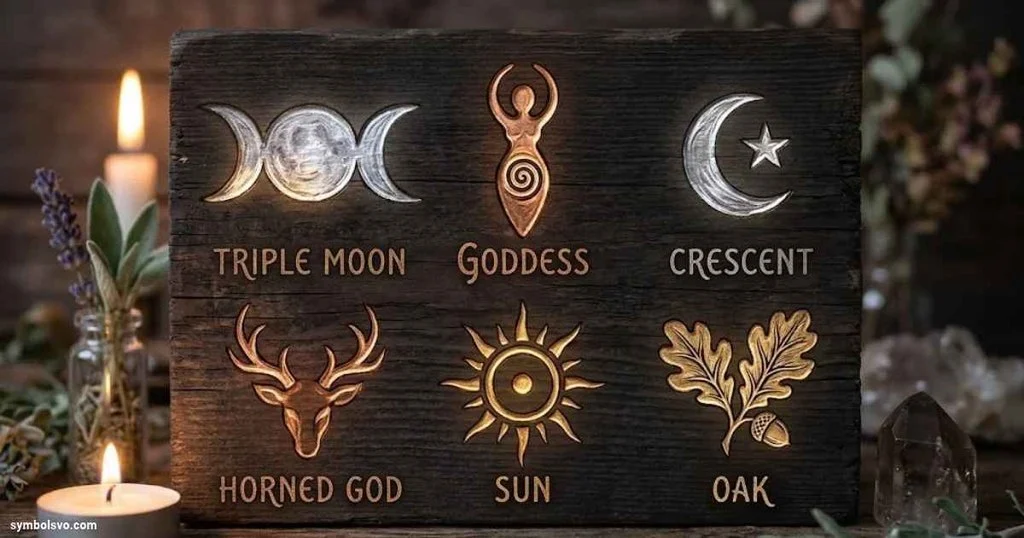
Many Wiccan traditions recognize divine feminine and masculine principles. Some honor a Goddess and a God, while others follow different spiritual approaches.
The Triple Moon and Triple Goddess are commonly associated with feminine divinity. The Horned God is a familiar representation of masculine divinity.
These symbols can help practitioners express their understanding of nature, creation, fertility, seasonal change, and spiritual balance.
However, Wicca is diverse. Not every practitioner follows the same theology or uses the same deity symbols.
Wiccan Symbols of Protection
Protection is a common theme in modern Pagan spirituality. Some practitioners use symbols as reminders of personal boundaries, spiritual intentions, and their connection with a particular tradition.
The following symbols are frequently associated with protection, although their historical origins and modern interpretations differ.
| Symbol | Common Protective Association |
| Pentacle | Spiritual balance and protection |
| Pentagram | Elemental harmony and spiritual focus |
| Eye of Horus | Ancient Egyptian protection and healing |
| Ankh | Life and spiritual continuity |
| Hecate’s Wheel | Modern associations with Hecate and spiritual guidance |
| Celtic Shield Knot | Modern interpretations of protection and resilience |
| Thor’s Hammer | Protection and strength in Norse traditions |
A symbol does not have one guaranteed effect. Its significance depends on the belief, culture, and intention of the person using it.
How Wiccans Use Symbols in Spiritual Practices
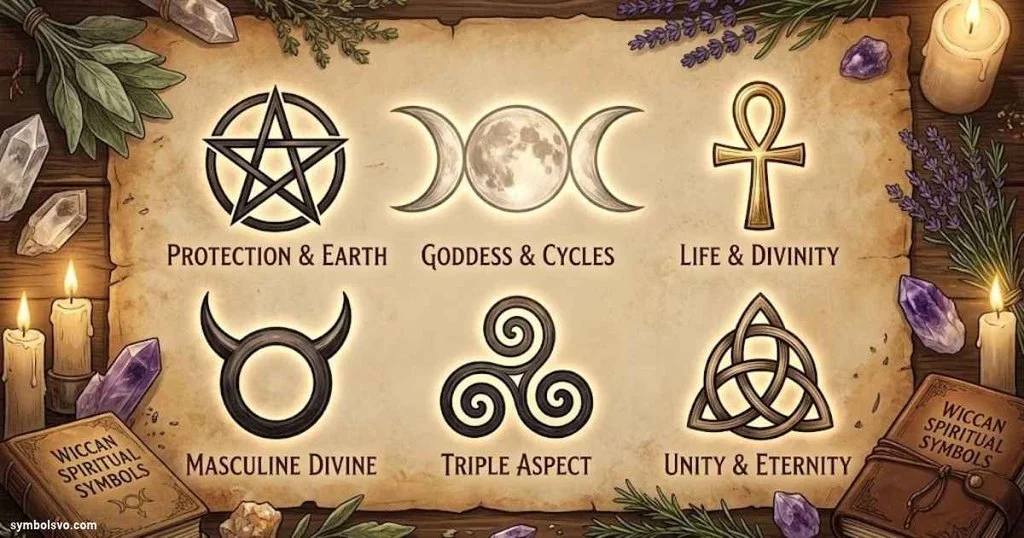
Wiccan symbols can appear in different parts of religious and personal spiritual life. Their purpose often depends on the tradition and the individual’s preferences.
Wiccan Symbols on Altars
A Wiccan altar is a space where practitioners may arrange ritual objects, candles, natural materials, and spiritual symbols.
A pentacle may represent the elements, while other objects can represent specific deities or personal intentions.
Common altar items include:
- A pentacle or other symbolic design
- Candles
- A chalice
- A wand
- An athame, a ritual knife used symbolically in some traditions
- Natural objects such as stones, leaves, or flowers
There is no single required altar arrangement followed by every Wiccan.
Using Symbols in Wiccan Rituals
Symbols can help practitioners focus their attention during religious ceremonies and personal rituals.
For example, an elemental symbol may represent a particular aspect of nature. A pentacle may serve as a reminder of the relationship between the five elements.
The meaning of each symbol depends on the ritual and the tradition being followed.
Symbols for Sacred Space and Protection
Some Wiccans use symbols when preparing a space for meditation, prayer, or ritual work.
A pentacle or another personally meaningful design may represent spiritual boundaries, safety, or a focused environment.
These practices vary. No single symbol or method is required across all forms of Wicca.
Symbols in Meditation and Divination
A symbol can act as a visual focus during meditation. Practitioners may reflect on its shape, history, or personal meaning.
Some Pagan traditions also use symbolic imagery in divination practices. However, not every Wiccan uses divination, and different systems have different interpretations.
Wiccan Symbol Jewelry, Amulets, and Talismans
Many people wear symbols as jewelry to express spiritual identity or personal beliefs.
The pentacle, Triple Moon, Ankh, and other designs can appear on necklaces, rings, bracelets, and pendants.
The terms amulet and talisman are sometimes used differently:
- Amulet: An object traditionally associated with protection or good fortune.
- Talisman: An object prepared or used with a particular intention or purpose.
Their meanings can overlap, and modern usage varies.
Celtic and Norse Symbols in Modern Pagan Traditions
Celtic and Norse imagery often appears in modern Pagan communities. However, these symbols have different historical backgrounds and should not automatically be classified as Wiccan.
Celtic-inspired designs include the Triquetra, Triple Spiral, and various interlaced knot patterns. Their historical meanings are not always known, and modern spiritual interpretations may differ from their original uses.
Norse symbols include Thor’s Hammer and imagery associated with Odin. These belong to Norse mythology and are particularly meaningful in modern Heathen traditions.
Wiccans may also appreciate or use symbols from these traditions, but that does not change their original cultural context.
Ancient Egyptian Symbols Used in Modern Spirituality
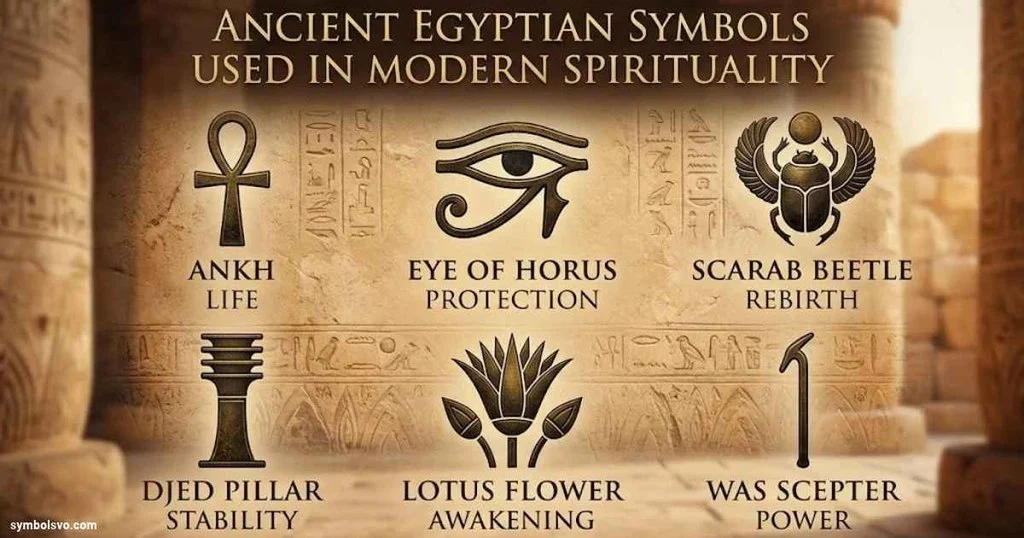
Ancient Egyptian religious imagery has influenced many modern spiritual practices.
The Ankh represents life in ancient Egyptian writing and religious art. The Eye of Horus is associated with protection, healing, and restoration. The Eye of Ra is connected with solar power and divine authority.
These symbols are sometimes used in modern Pagan settings, including by people who practice Wicca.
It is important to recognize their Egyptian origins rather than describing them as symbols created specifically for Wicca.
Wiccan Symbols vs. Pagan Symbols: What’s the Difference?
Wiccan symbols and Pagan symbols are related, but the terms do not mean exactly the same thing.
Wicca is one modern Pagan religion. Paganism is a broader category that includes many religious and spiritual traditions.
| Feature | Wiccan Symbols | Pagan Symbols |
| Meaning | Symbols used in Wicca and related practice | Symbols used across different Pagan traditions |
| Religious context | Modern Wiccan spirituality | Multiple religious and spiritual paths |
| Common examples | Pentacle, Triple Moon, elemental symbols | Symbols from Wiccan, Heathen, Druidic, and other traditions |
| Beliefs | Vary between Wiccan groups | Vary widely between traditions |
| Cultural origins | Modern Wiccan and adopted traditions | Ancient and modern cultural sources |
Some symbols are strongly associated with Wicca, while others are used by multiple Pagan communities.
For example, the pentacle is widely recognized in modern Wicca. Thor’s Hammer is more directly connected with Norse mythology and modern Heathen practice.
Understanding the difference helps avoid treating every Pagan symbol as a Wiccan symbol.
Frequently Asked Questions About Wiccan Symbols
What Is the Most Recognized Wiccan Symbol?
The pentacle is one of the most widely recognized symbols associated with Wicca. It usually features a five-pointed star inside a circle and is commonly connected with the five elements and spiritual balance.
What Do Wiccan Symbols Mean?
Wiccan symbols can represent nature, the elements, divine principles, protection, balance, and spiritual intentions. Their meanings depend on the symbol and the tradition using it.
What Is the Difference Between a Pentagram and a Pentacle?
A pentagram is a five-pointed star made from connected lines. A pentacle commonly refers to a pentagram enclosed within a circle. Both have different historical uses and modern interpretations.
What Are the Five Elements in Wicca?
The five elements commonly recognized in Wiccan symbolism are Earth, Air, Fire, Water, and Spirit. They represent different aspects of nature and spiritual experience.
What Does the Triple Moon Symbol Represent?
The Triple Moon commonly represents the Maiden, Mother, and Crone aspects of the Goddess in many modern Wiccan traditions. It is also associated with lunar phases and the cycles of life.
What Does the Horned God Symbol Mean?
The Horned God represents masculine divinity in many Wiccan traditions. He is commonly associated with wildlife, nature, fertility, and seasonal cycles.
Are Pagan Symbols and Wiccan Symbols the Same?
No. Wicca is one religion within the wider Pagan movement. Some symbols overlap between traditions, but others belong to distinct cultural or religious backgrounds.
Which Wiccan Symbols Are Associated With Protection?
The pentacle and pentagram are commonly associated with protection in modern Wicca. Other symbols, such as the Eye of Horus and Thor’s Hammer, have protective associations in their original cultural or religious traditions.
Can You Wear Wiccan Symbols as Jewelry?
Yes. Many people wear pentacle, Triple Moon, and other spiritually meaningful designs as jewelry. Some use them to express personal beliefs, while others appreciate their artistic or historical meaning.
Are Wiccan Symbols the Same as Witchcraft Symbols?
Not exactly. Witchcraft is a broad term that can refer to different practices and traditions. Wicca is a specific modern Pagan religion, and its symbols are not automatically shared by every witchcraft tradition.
What Is Hecate’s Wheel?
Hecate’s Wheel, also known as the Strophalos, is a symbol associated with Hecate in modern Pagan contexts. It is commonly interpreted through themes such as crossroads, transformation, and spiritual guidance.
Are Celtic Knots Wiccan Symbols?
Celtic knots are not exclusively Wiccan. They come from broader historical and artistic traditions. Some modern Wiccans and Pagans use them because of their visual designs and personal symbolic interpretations.
Final Thoughts on Wiccan Symbols and Their Meanings
Wiccan symbols offer a way to explore spiritual beliefs, nature, elemental forces, and different expressions of divine energy. The pentacle, Triple Moon, elemental signs, and other familiar designs each carry meanings that can vary between traditions and individuals.
Some symbols developed within modern Wicca, while others come from ancient Egyptian, Celtic, Norse, Greek, or Chinese traditions. Understanding their origins helps you appreciate their cultural backgrounds without confusing them with one another.
If you are learning about Wicca, researching Pagan symbolism, or exploring the meanings behind spiritual designs, the most important step is to consider each symbol in its proper historical and religious context.

Mason Ellington is a creative and dedicated Content Writer and Symbols Expert with a passion for words, communication, and symbolic meanings. He specializes in crafting engaging, informative, and well-structured content while exploring the deeper meanings and interpretations behind symbols. With a creative mindset and attention to detail, Mason transforms ideas into meaningful content that informs, inspires, and connects with readers. His expertise combines powerful storytelling, clear communication, and a deep understanding of symbolism.
 Daniel Brooks
 Nathan Holloway