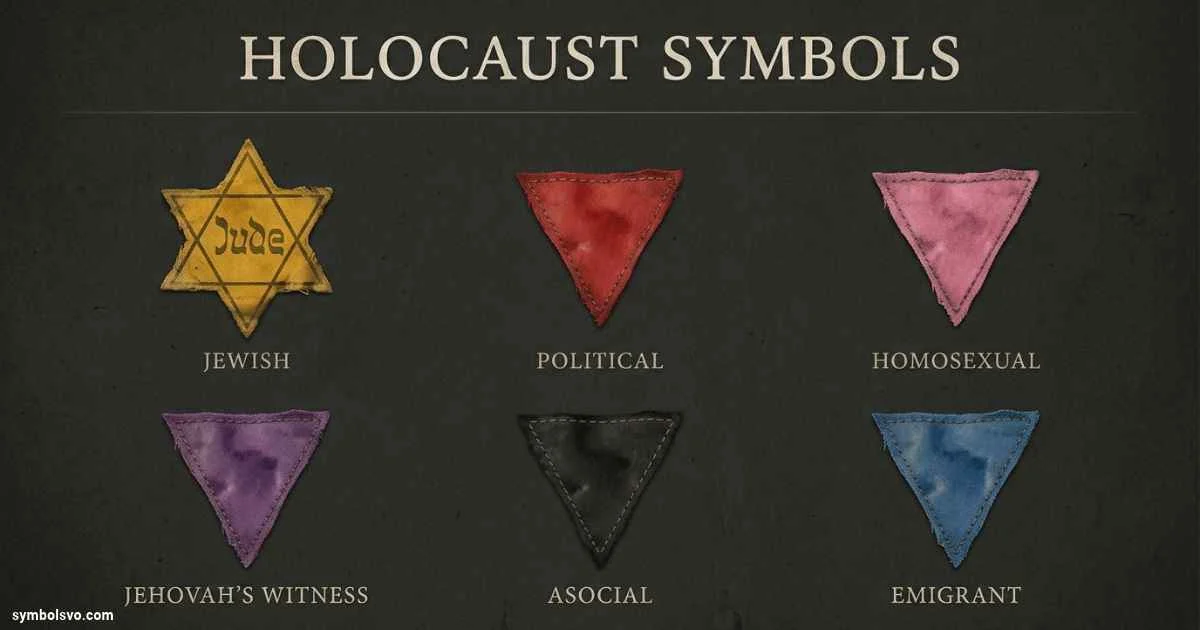
Holocaust symbols carry deep historical meanings connected to persecution, discrimination, suffering, remembrance, and survival. During the Holocaust, Nazi Germany used different signs, badges, colors, and markings to identify and separate prisoners in concentration camps. These symbols became part of the historical record of one of the darkest periods in human history.
Some of the most recognized Holocaust symbols include the Star of David, colored prisoner triangles, Nazi insignia, and the letter Z used to identify Romani prisoners at Auschwitz. Each marking had a specific purpose, and understanding its history helps explain how the Nazi regime treated different groups of people.
In this guide, you will discover different Holocaust symbols and their meanings, including Jewish and Nazi symbols, concentration camp identification badges, symbols associated with Romani victims, and modern symbols of hope and remembrance. You will also find historical drawings, image references, charts, and educational project ideas.
What Are The Holocaust Symbols
Holocaust symbols are signs, markings, badges, and visual representations associated with the persecution and mass murder carried out by Nazi Germany and its collaborators between 1933 and 1945.
Some symbols were deliberately created or used by the Nazis to identify people they considered enemies or undesirable. Others are used today by museums, educators, survivors, and memorial organizations to remember victims and teach future generations about the Holocaust.
These symbols generally fall into three main categories:
- Historical identification symbols: Badges and markings forced on concentration camp prisoners to identify their assigned prisoner category.
- Nazi symbols: Flags, emblems, and insignia used to represent Nazi ideology and propaganda.
- Remembrance symbols: Butterflies, memorial candles, stars, and other images used in Holocaust education and commemorations.
One important distinction is that not every Holocaust-related symbol was created by the Nazis. Some are modern memorial designs developed to honor victims and preserve their stories.
Different Holocaust Symbols
Several symbols are closely connected with Holocaust history. They represent different experiences, including antisemitism, imprisonment, racial persecution, and remembrance.
Here are some important examples:
| Symbol | Name | Historical meaning |
| ✡ | Star of David | Used by the Nazis as a forced identification badge for Jewish people |
| △ | Red triangle | Identified political prisoners |
| △ | Green triangle | Identified prisoners classified as criminals |
| △ | Pink triangle | Identified men imprisoned under Nazi laws targeting homosexuality |
| △ | Purple triangle | Identified Jehovah’s Witness prisoners |
| △ | Black triangle | Used for prisoners classified by the Nazis as “asocial” |
| △ | Brown triangle | Used to identify some Sinti and Roma prisoners |
| 卐 | Swastika | Nazi Party emblem associated with antisemitism, racism, and dictatorship |
| Z | Letter Z | Used in the identification system for Romani prisoners at Auschwitz |
| 🦋 | Butterfly | Modern memorial symbol honoring children murdered during the Holocaust |
| 🕯 | Memorial candle | Represents remembrance and mourning |
Important: The triangle shown above is a generic text character, not a reproduction of an actual concentration camp badge. Historical badges were fabric markings with specific colors, orientations, and additional letters.
The meanings of prisoner badges could also vary between camps. The table provides a general introduction rather than a complete record of every marking.
Symbolism Holocaust Symbols
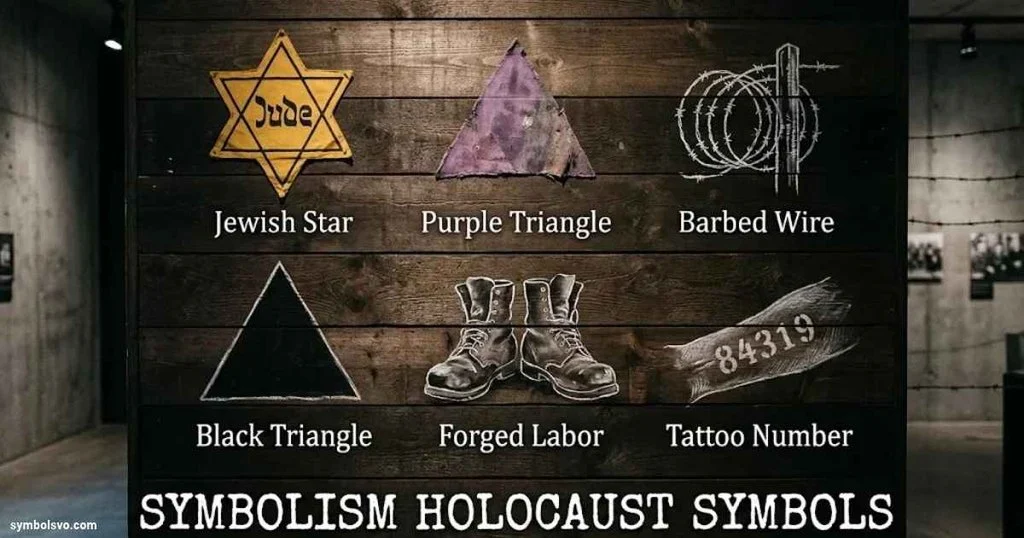
Holocaust symbols represent different aspects of Nazi persecution and the experiences of the people who suffered during this period.
Understanding their symbolism requires looking at the historical circumstances in which they were used.
Identification And Persecution
The Nazis used colored badges to classify prisoners according to the categories assigned to them by the regime.
These markings removed personal identity and made it easier for camp authorities to control, separate, and discriminate against prisoners.
Religious Identity
The Star of David became one of the most recognizable symbols associated with Jewish persecution during the Holocaust.
Jewish people in Nazi-controlled territories were forced to wear identifying badges in different forms and colors, depending on the location and period.
Political Oppression
Red triangles represented political prisoners in concentration camps. These included people who opposed Nazi rule, such as communists, socialists, and other political opponents.
Remembrance And Hope
Modern memorial symbols have a different purpose. Butterflies, candles, and eternal flames help communities remember victims, honor survivors, and educate younger generations.
The same symbol can have different meanings depending on its historical and cultural context. For this reason, Holocaust symbols should always be explained with accurate historical information.
Nazi Holocaust Symbols
Nazi Germany used symbols extensively in propaganda, political campaigns, military organizations, and concentration camps.
These symbols helped communicate Nazi ideology, promote racial hatred, and establish the visual identity of the regime.
Swastika
The swastika became the most recognizable symbol of the Nazi Party.
Before the Nazi era, this ancient hooked-cross design had been used for thousands of years in different cultures and religions, including Hinduism, Buddhism, and Jainism.
Adolf Hitler adopted it as the central emblem of the Nazi Party in 1920. Under Nazi rule, it became associated with antisemitism, racial supremacy, dictatorship, and persecution.
It is essential to distinguish the Nazi appropriation from the older religious and cultural uses of the symbol.
Holocaust Encyclopedia+1
Nazi Flag
The Nazi flag featured three main visual elements:
- Red background.
- White circular center.
- Black swastika in the middle.
The design became a major part of Nazi propaganda and appeared on flags, banners, uniforms, posters, and official materials.
SS Symbols
The Schutzstaffel (SS) was a major Nazi organization responsible for carrying out many aspects of the regime’s persecution and mass murder.
Its distinctive double-lightning-bolt insignia became associated with SS authority, terror, and the administration of concentration and extermination camps.
Nazi Eagle
The Nazi eagle was another important emblem used on official buildings, military uniforms, documents, and government materials.
It represented the authority of the Nazi state and was often displayed with the swastika.
These historical symbols should be studied as evidence of Nazi ideology and propaganda, not treated as ordinary decorative designs.
Jewish Holocaust Symbols
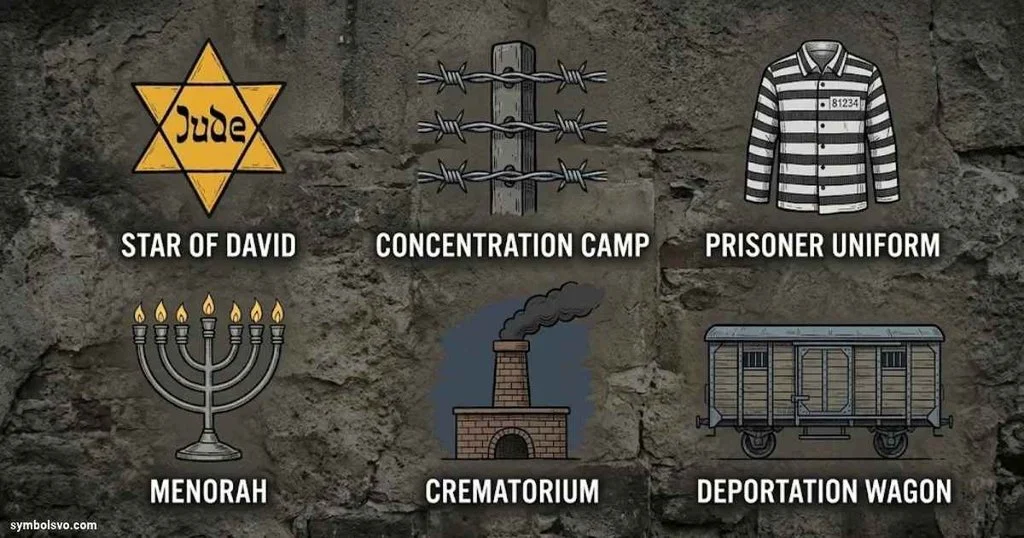
Jewish symbols have a long history of religious, cultural, and community significance. During the Holocaust, the Nazi regime misused some of these symbols to identify and persecute Jewish people.
The most recognized example is the Star of David.
Star Of David (✡)
The Star of David consists of two overlapping triangles that form a six-pointed star.
It is an important symbol of Jewish identity and is commonly associated with Jewish religion, culture, and community.
During the Holocaust, Nazi authorities forced Jewish people in many occupied territories to wear yellow identification badges featuring the Star of David.
The design and rules differed by location. In concentration camps, Jewish prisoners were generally identified by two yellow triangles forming a Star of David on their clothing.
Yellow Jewish Badge
The yellow badge was a tool of persecution rather than a symbol chosen by Jewish communities.
Its purpose was to make Jewish people publicly identifiable and subject them to discrimination, exclusion, and violence.
Star Of David And Holocaust Remembrance
Today, the Star of David can appear in Holocaust memorials, educational materials, and commemorative displays.
Its presence in these settings often represents Jewish identity, the victims of Nazi persecution, and the importance of remembering Jewish history.
The historical context matters: the Jewish Star of David existed long before the Holocaust and should never be confused with the forced yellow identification badge.
Holocaust Encyclopedia+1
Holocaust Symbols Triangles
Colored triangles were among the most important identification markings used in Nazi concentration camps.
The SS developed a prisoner classification system in which different triangle colors identified the categories assigned to inmates. These fabric badges were generally sewn onto prison uniforms.
Different Colored Triangle Meanings
The following chart explains several commonly documented triangle colors.
| Triangle color | Prisoner classification | Historical explanation |
| 🔴 Red | Political prisoners | People imprisoned for political opposition |
| 🟢 Green | Criminal prisoners | People classified as criminals by Nazi authorities |
| ⚫ Black | “Asocial” prisoners | People the regime labeled socially undesirable |
| 🟣 Purple | Jehovah’s Witnesses | People persecuted for their religious beliefs |
| 🩷 Pink | Homosexual prisoners | Primarily men imprisoned under laws targeting homosexuality |
| 🟤 Brown | Sinti and Roma | Used for Romani prisoners in some camps |
| 🔵 Blue | Emigrants | Used for certain prisoners classified as emigrants |
These colors were not simply decorative. They were part of an oppressive system designed to categorize and control human beings.
Red Triangle
The red triangle identified political prisoners. Many were people who opposed the Nazi government or participated in resistance activities.
Pink Triangle
The pink triangle was forced on men imprisoned under Nazi laws targeting homosexuality.
After the war, LGBTQ+ communities adopted the pink triangle as a symbol of remembrance, resistance, and solidarity.
Purple Triangle
The purple triangle identified Jehovah’s Witnesses, many of whom were imprisoned because they refused to support Nazi policies or participate in certain state activities.
Green Triangle
The green triangle identified prisoners classified as criminals by Nazi authorities.
Black Triangle
The black triangle was used for people categorized as “asocial” by the Nazi regime. This discriminatory classification included different groups, and the assignment could be arbitrary.
Historical clarification: The prisoner classification system varied between camps and periods. Some prisoners received combinations of badges. For example, a Jewish political prisoner could wear a badge combining a yellow triangle with a red one to form a Star of David.
Holocaust Encyclopedia+2
Roma person Holocaust Symbols
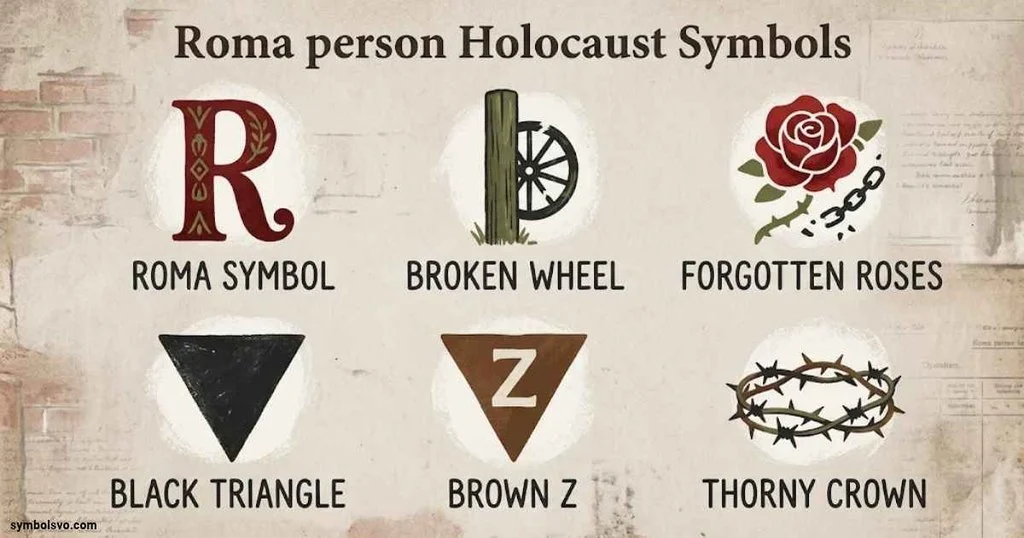
The Nazi regime persecuted Sinti and Roma communities through racial discrimination, forced deportation, imprisonment, and mass murder.
The word “Roma person” appeared frequently in historical Nazi documents, but it is an outdated and often offensive label. Sinti and Roma are the preferred terms when discussing these communities today.
Black Triangle
At Auschwitz, Sinti and Roma prisoners were classified as “asocial” and generally marked with black triangles.
This was part of the concentration camp identification system used by the SS.
Brown Triangle
Brown triangles were also used to identify Sinti and Roma prisoners in some concentration camps and historical classification systems.
However, the system was not identical everywhere. At Auschwitz, the museum’s historical records explain that Romani prisoners were classified with black triangles.
Romani Prisoner Identification
The Nazis used additional markings and registration numbers to identify Romani prisoners.
One particularly important marking was the letter Z, which appeared in the Auschwitz prisoner identification system.
The letter was connected to the German term “Zigeuner,” a derogatory historical label used by the Nazis for Romani people.
Approximately 23,000 Sinti and Roma were deported to Auschwitz, and around 21,000 died or were murdered there.
auschwitz.org+1
Holocaust Symbols Z
The letter Z has a specific historical connection to Romani prisoners at Auschwitz.
It was used as part of the prisoner numbering system introduced by Nazi authorities to identify Sinti and Roma inmates.
Unlike the colored triangles, which identified prisoner categories on uniforms, the Z marking was associated with the registration numbers assigned to these prisoners.
What Did The Z Symbol Mean?
The letter Z referred to the German word “Zigeuner,” which the Nazis used for Roma and Sinti people.
Beginning in February 1943, the Auschwitz authorities introduced separate number series for Romani male and female prisoners.
The letter Z was added to their prisoner numbers.
Examples Of The Z Marking
Historical prisoner records included identification numbers such as:
- Z-1
- Z-100
- Z-9293
These are illustrative examples of the historical numbering format, not a list of individual prisoners.
The Auschwitz Museum preserves records of these prisoner number series and their use.
Why Is The Z Symbol Important?
The Z marking helps historians understand how Nazi authorities organized and identified Romani prisoners.
It also provides an important connection to the experiences of Sinti and Roma families who were deported to Auschwitz.
The letter should not be presented as a modern symbol of Romani identity. It was an imposed Nazi identification marking connected to a discriminatory historical term.
auschwitz.org+2
Holocaust Symbols Of Hope
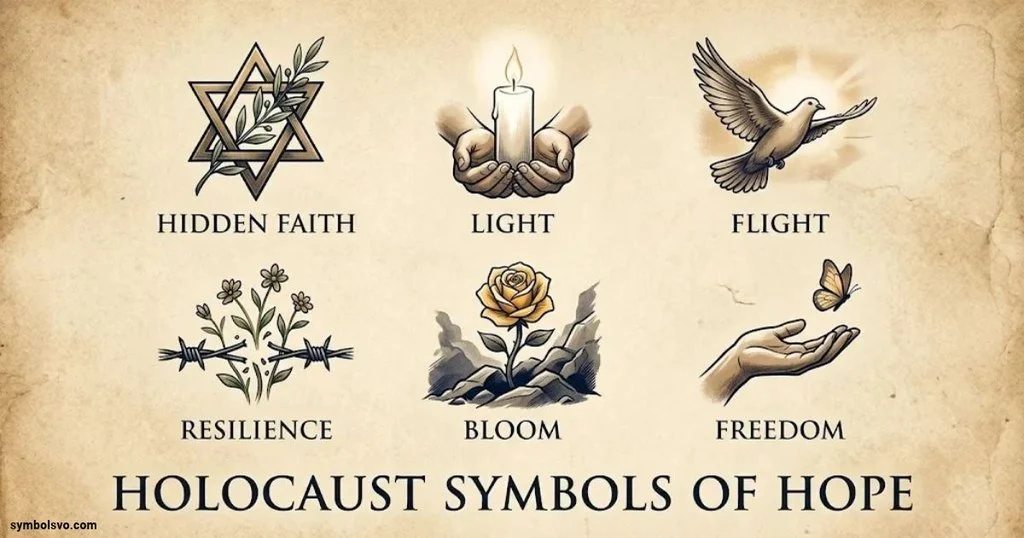
Although many Holocaust symbols represent persecution and suffering, some modern memorial symbols focus on hope, resilience, remembrance, and the lives of victims.
These symbols are used in educational projects, memorial ceremonies, and community activities.
Butterfly (🦋)
The butterfly is one of the most recognizable modern symbols of hope associated with Holocaust education.
It is closely connected with Pavel Friedmann’s poem “The Butterfly,” written while he was imprisoned at Theresienstadt.
The poem inspired later educational and memorial projects that use butterflies to honor children murdered during the Holocaust.
The Butterfly Project, for example, encourages students to create ceramic butterflies in memory of Jewish children who were murdered.
Holocaust Museum Houston+1
Memorial Candle (🕯)
A candle represents remembrance, mourning, and respect for those who lost their lives.
Jewish communities also have traditions of lighting memorial candles to remember deceased loved ones.
Eternal Flame
An eternal flame represents continuing remembrance.
The United States Holocaust Memorial Museum has an eternal flame in its Hall of Remembrance, where visitors can reflect on the victims and the importance of preserving historical memory.
United States Holocaust Memorial Museum
White Flowers
White flowers are sometimes used at Holocaust memorial ceremonies as expressions of respect, peace, mourning, and remembrance.
Their meaning depends on the memorial tradition and the community using them.
| Symbol | Common memorial meaning |
| 🦋 Butterfly | Hope, transformation, and remembrance |
| 🕯 Candle | Mourning and memory |
| Eternal flame | Continuing remembrance |
| White flower | Respect and peace |
| ✡ Star of David | Jewish identity and remembrance |
These are contemporary memorial uses, not a standardized official set of Holocaust symbols.
Holocaust Symbols Drawings
Drawings can help students understand the history of the Holocaust through visual learning. They can also communicate the importance of remembrance without reproducing disturbing historical imagery.
For school assignments, educational posters, and history projects, consider these drawing ideas.
Simple Holocaust Symbol Drawing Ideas
- Star of David: Draw a six-pointed star and explain its Jewish cultural and historical significance.
- Butterfly: Create a butterfly illustration representing remembrance of children murdered during the Holocaust.
- Memorial Candle: Draw a candle with a flame to represent the act of remembering victims.
- Eternal Flame: Illustrate a memorial flame to communicate the importance of preserving historical memory.
- Memorial Flowers: Draw white flowers as a tribute to victims and survivors.
Tips For Creating Historical Drawings
- Add a short explanation beneath every drawing.
- Use accurate historical information.
- Avoid turning symbols of persecution into decorative designs.
- Clearly distinguish historical Nazi markings from modern memorial symbols.
- Use respectful language when discussing Jewish and Romani victims.
For a school assignment, a drawing of a memorial candle, butterfly, or Star of David with a historical explanation can be more appropriate than reproducing Nazi propaganda.
Holocaust Symbols Images
Historical images help people understand what Holocaust symbols actually looked like and how they were used.
Museums and archives preserve photographs of prisoner uniforms, identification badges, Nazi propaganda, and memorial installations.
Here are some useful types of images to explore.
Historical Prisoner Badge Images
These images show the colored triangles and other identification markings forced onto concentration camp prisoners.
Jewish Star Images
Photographs of historical yellow Jewish badges demonstrate how Nazi authorities used the Star of David to identify and isolate Jewish people.
Nazi Propaganda Images
Historical Nazi flags, posters, and insignia provide evidence of how the regime used visual communication to spread its ideology.
Holocaust Memorial Images
Modern memorial photographs often show candles, butterflies, flowers, and monuments created to honor victims.
Where To Find Reliable Holocaust Images
For accurate historical photographs and educational references, explore these resources:
- United States Holocaust Memorial Museum — Historical photographs, artifacts, and educational articles.
- Auschwitz-Birkenau State Museum — Original camp history, prisoner records, and historical photographs.
- Yad Vashem — Holocaust documentation, photographs, and survivor testimonies.
Always check the historical description and source of an image before using it in an educational article or presentation.
Holocaust Symbols Chart
A Holocaust symbols chart makes it easier to compare different historical markings and understand their purposes.
The following chart brings together important symbols discussed in this article.
| Symbol or marking | Name | Meaning or historical use |
| ✡ | Star of David | Jewish identity; forcibly used on identification badges |
| 卐 | Swastika | Central emblem of Nazi ideology |
| 🔴 △ | Red triangle | Political prisoners |
| 🟢 △ | Green triangle | Criminal prisoners |
| 🩷 △ | Pink triangle | Men persecuted under anti-homosexuality laws |
| 🟣 △ | Purple triangle | Jehovah’s Witnesses |
| ⚫ △ | Black triangle | Prisoners labeled “asocial” |
| 🟤 △ | Brown triangle | Sinti and Roma prisoners in some camps |
| Z | Z marking | Romani prisoner identification at Auschwitz |
| 🦋 | Butterfly | Modern Holocaust remembrance and hope |
| 🕯 | Candle | Memorial and remembrance |
The colored circles and triangle characters in this chart are explanatory text representations, not authentic reproductions of historical fabric badges.
How To Read The Chart
When studying historical symbols, pay attention to three things:
- Origin: Who created or used the symbol?
- Purpose: Was it used for identification, propaganda, persecution, or remembrance?
- Context: Did its meaning change over time or between different locations?
This approach helps prevent misunderstandings, especially when two symbols look similar but have different historical meanings.
Project Holocaust Symbols
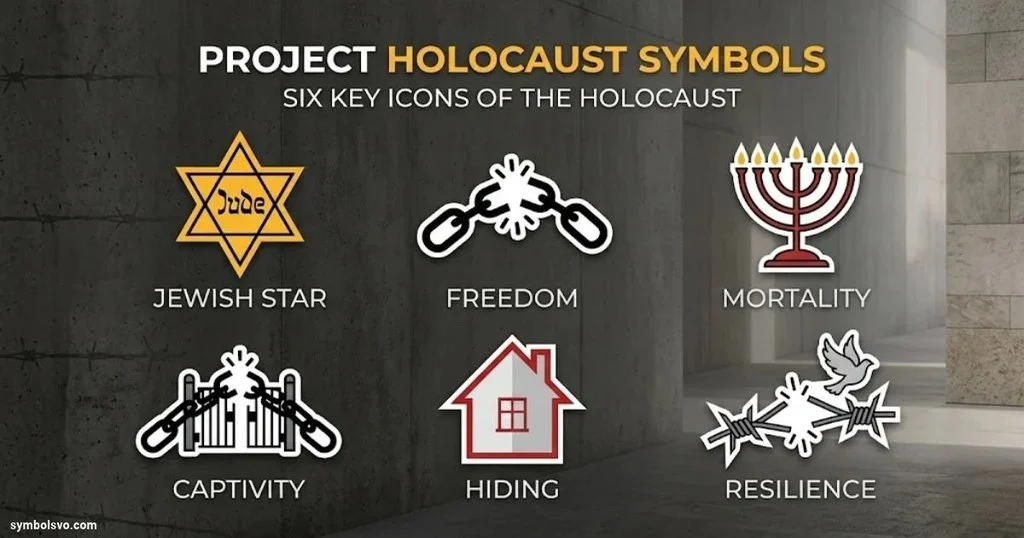
A Holocaust symbols project can help students explore the history of the Holocaust through research, drawing, charts, and presentations.
The main goal should be historical understanding, respect for victims, and awareness of the dangers of discrimination.
Holocaust Symbols Poster Project
Create an educational poster featuring important historical and memorial symbols.
Include:
- Star of David and its historical significance.
- Colored prisoner triangles and their meanings.
- Nazi swastika and its connection to Nazi ideology.
- The Z marking used for Romani prisoners at Auschwitz.
- Butterfly and candle memorial symbols.
Add short explanations beneath each symbol.
Holocaust Symbols Meaning Chart
Prepare a classroom chart that compares different historical markings.
You can use these columns:
| Symbol | Historical group or use | Explanation |
| Star of David | Jewish prisoners | Forced identification |
| Red triangle | Political prisoners | Political classification |
| Pink triangle | Gay men | Persecution under Nazi laws |
| Purple triangle | Jehovah’s Witnesses | Religious persecution |
| Z marking | Romani prisoners | Auschwitz identification system |
| Butterfly | Modern memorial projects | Remembrance of children |
Holocaust Remembrance Butterfly Project
Students can create paper or ceramic butterflies in memory of children murdered during the Holocaust.
This activity can be connected to the Butterfly Project, which uses art and education to honor the 1.5 million Jewish children murdered during the Holocaust.
Students can learn about individual children, write their names, and display their artwork as a collective memorial.
Holocaust Museum Houston+1
Historical Research Presentation
Choose one historical symbol and prepare a short presentation explaining:
- Its origin.
- Who used it.
- Why it was used.
- Which historical events it represents.
- How it is understood today.
Use reliable museum archives and historical documents rather than unverified online images.
Holocaust Remembrance Display
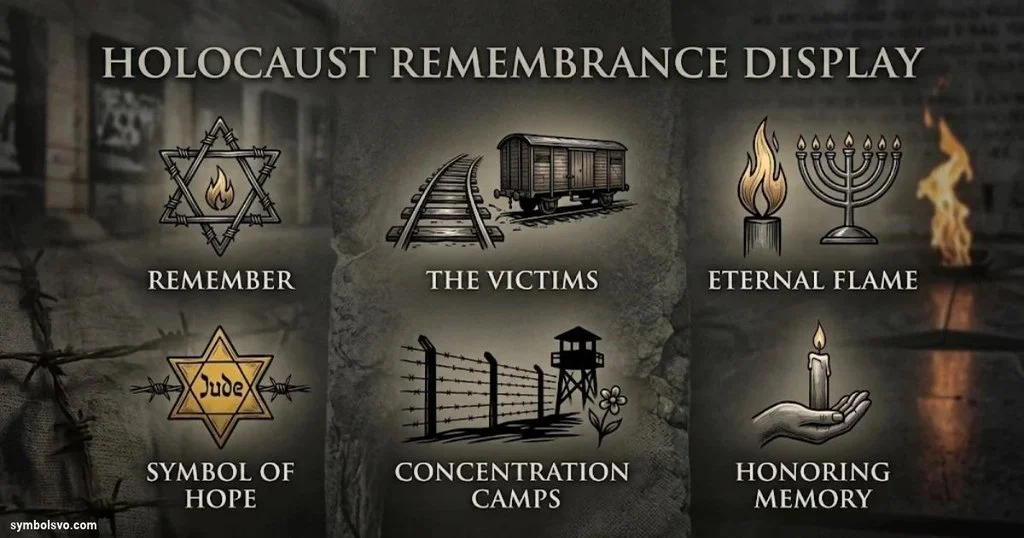
Create a respectful classroom display using memorial candles, butterflies, flowers, and historical photographs.
Include a short message about remembering victims, honoring survivors, and preventing hatred and discrimination.
A successful Holocaust symbols project should teach students why these symbols matter rather than simply asking them to memorize their names.
Frequently Asked Questions
What Is The Most Recognized Symbol Of The Holocaust?
The yellow Star of David is one of the most recognized symbols associated with Jewish persecution during the Holocaust. The Nazi swastika is also strongly associated with the regime responsible for the Holocaust.
What Did The Different Colored Triangles Mean In The Holocaust?
Colored triangles identified prisoner categories in Nazi concentration camps. Red generally represented political prisoners, green represented criminals, pink identified men imprisoned for homosexuality, and purple identified Jehovah’s Witnesses. Other colors were used for additional categories.
What Did The Letter Z Mean In The Holocaust?
At Auschwitz, the letter Z was used in prisoner identification numbers assigned to Sinti and Roma inmates. It came from the derogatory German word “Zigeuner,” used by the Nazis to describe these communities.
What Is The Symbol Of Hope For Holocaust Remembrance?
The butterfly is a well-known modern symbol of hope and remembrance in Holocaust education. It is particularly associated with memorial projects honoring Jewish children murdered during the Holocaust.
Why Did Nazis Use Symbols To Identify Prisoners?
The Nazis used identification badges to classify, control, and separate prisoners in concentration camps. Different colors, triangles, letters, and combinations helped camp authorities identify the categories assigned to individual prisoners.
Conclusion
Holocaust symbols preserve important historical information about the persecution, discrimination, and suffering caused by Nazi Germany. From the Star of David and colored prisoner triangles to the Z marking at Auschwitz, each historical marking tells part of a much larger story.
Modern memorial symbols, including butterflies, candles, and eternal flames, serve a different purpose. They help honor victims, remember children who lost their lives, recognize survivors, and encourage future generations to stand against hatred and injustice.
Understanding these symbols requires more than memorizing their meanings. Learning their origins, historical uses, and cultural significance helps us respect the people behind the history and keep their memories alive.

I’m Nathan Holloway, a passionate researcher and writer with a deep interest in symbols, signs, and their hidden meanings. I enjoy exploring how symbols have influenced different civilizations, religions, and modern communication. Through my work, I aim to make complex historical and cultural concepts easy to understand for readers of all backgrounds. Every article I write is carefully researched to provide reliable and engaging information.
Books:
- Beyond the Symbol
- The Secret Meanings of Everyday Signs
Author 2: Grace Whitmore
Description:
My name is Grace Whitmore, and I love discovering the stories behind the world’s most fascinating symbols. I spend my time researching ancient civilizations, mythology, spiritual traditions, and modern iconography to uncover the meanings people often overlook. I believe that every symbol has a history worth telling, and I enjoy sharing that knowledge in a simple and reader-friendly way.
Books:
- Echoes of Ancient Symbols
- The Symbolic World
 Mason Ellington
 Daniel Brooks