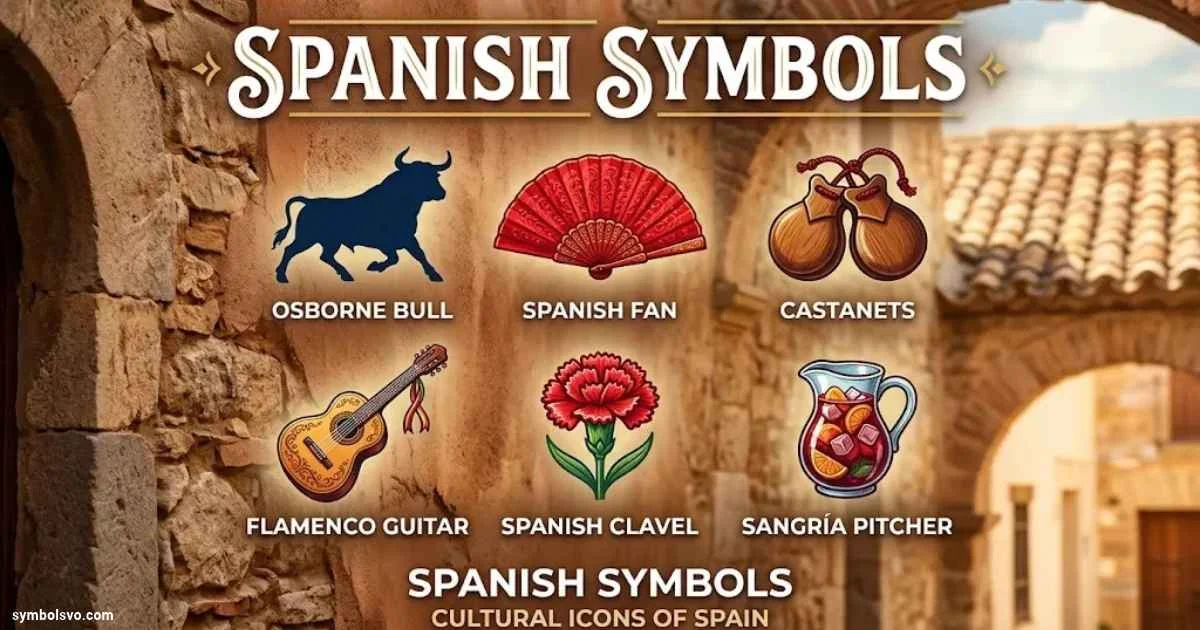
Spanish symbols make writing, reading, and communicating in Spanish more accurate and expressive. From accented letters such as á, é, í, ó, ú to special characters like ñ, ü, ¿, and ¡, these characters are an important part of the Spanish language. You may need them when writing Spanish words, creating social media captions, sending messages, or working on documents.
If you are looking for Spanish symbols to copy and paste, you can find the most commonly used characters in this guide. I have included their names, meanings, and examples so you can quickly identify the right character without searching through different websites.
You will also learn how to type Spanish accents and special characters on Windows, Mac, and Microsoft Word. The guide covers historical Spanish symbols, symbols used by conquistadors, and Spanish-inspired tattoo designs, giving you both practical and cultural information in one place.
Spanish Symbols Copy And Paste
Here is a collection of Spanish letters, accents, punctuation marks, and other useful characters that you can copy and paste directly into your text.
Spanish Letters And Special Characters
| Symbol | Copy And Paste | Name |
| á | á | Lowercase A with acute accent |
| é | é | Lowercase E with acute accent |
| í | í | Lowercase I with acute accent |
| ó | ó | Lowercase O with acute accent |
| ú | ú | Lowercase U with acute accent |
| Á | Á | Uppercase A with acute accent |
| É | É | Uppercase E with acute accent |
| Í | Í | Uppercase I with acute accent |
| Ó | Ó | Uppercase O with acute accent |
| Ú | Ú | Uppercase U with acute accent |
| ñ | ñ | Lowercase Eñe |
| Ñ | Ñ | Uppercase Eñe |
| ü | ü | U with diaeresis |
| Ü | Ü | Uppercase U with diaeresis |
Spanish Punctuation Symbols
| Symbol | Name | Copy |
| ¿ | Inverted question mark | ¿ |
| ¡ | Inverted exclamation mark | ¡ |
| ? | Question mark | ? |
| ! | Exclamation mark | ! |
| « » | Guillemets | « » |
| — | Em dash | — |
| – | En dash | – |
| … | Ellipsis | … |
Other Useful Symbols For Spanish Text
These characters are not exclusive to Spanish, but they are useful when writing prices, measurements, and online content.
| Symbol | Name | Copy |
| € | Euro sign | € |
| $ | Dollar sign | $ |
| % | Percent sign | % |
| @ | At sign | @ |
| # | Number sign | # |
| © | Copyright sign | © |
| ® | Registered sign | ® |
| ™ | Trademark sign | ™ |
| ° | Degree sign | ° |
| & | Ampersand | & |
How to use them: Select the character you need, copy it, and paste it into your document, message, website, or social media post. The accented letters and inverted punctuation marks are especially useful for correct Spanish spelling.
Spanish Symbols And Meanings
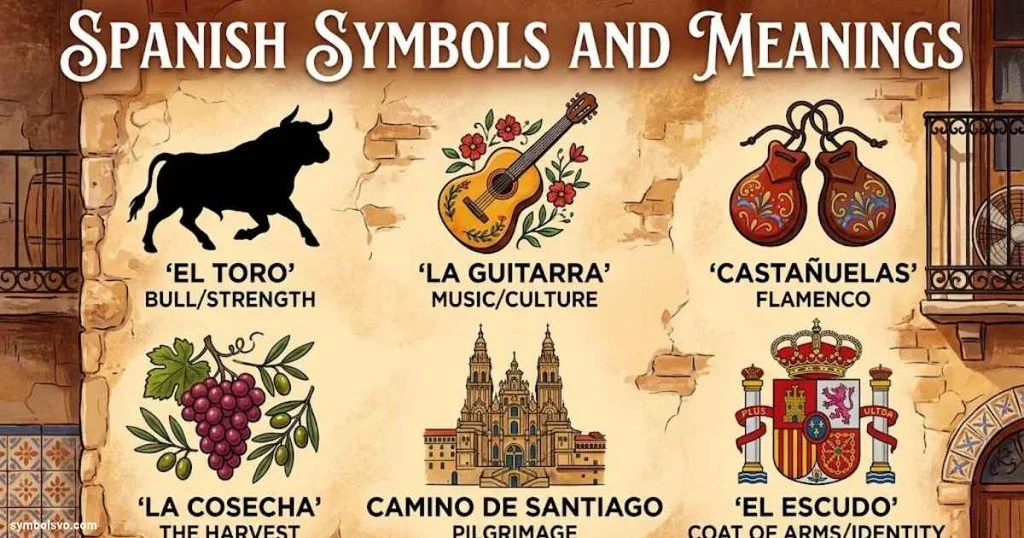
Spanish uses several special characters that change how words are pronounced, written, or understood. Some are letters with accents, while others are punctuation marks that help readers understand sentences.
Here are the most important Spanish symbols and their meanings.
| Symbol | Name | Meaning Or Use |
| Ñ | Eñe | A separate letter in the Spanish alphabet |
| Á | A with acute accent | Marks a stressed syllable |
| É | E with acute accent | Marks a stressed syllable |
| Í | I with acute accent | Marks a stressed syllable |
| Ó | O with acute accent | Marks a stressed syllable |
| Ú | U with acute accent | Marks a stressed syllable |
| Ü | U with diaeresis | Shows that the U is pronounced in certain letter combinations |
| ¿ | Inverted question mark | Opens a direct question |
| ¡ | Inverted exclamation mark | Opens an exclamation |
| € | Euro sign | Represents the euro currency |
1. The Ñ Symbol
The letter Ñ is one of the most recognizable features of Spanish writing. It has a small tilde above the letter N and represents a distinct sound.
Examples:
- Niño — Boy
- Niña — Girl
- España — Spain
- Año — Year
- Mañana — Tomorrow or morning
The letter Ñ is not simply an N with decoration. Replacing it with N can change a word’s meaning.
2. The Acute Accent (´)
Spanish uses an acute accent above vowels to show stress or distinguish certain words.
Examples:
- Café — Coffee
- Mamá — Mom
- Papá — Dad
- Inglés — English
- Canción — Song
3. The Diaeresis (¨)
The diaeresis appears above the letter U in certain Spanish words. It shows that the U should be pronounced in the combinations güe and güi.
Examples:
- Pingüino — Penguin
- Vergüenza — Shame or embarrassment
- Lingüística — Linguistics
4. Inverted Punctuation (¿ and ¡)
Spanish uses opening punctuation marks before questions and exclamations.
Examples:
- ¿Cómo estás? — How are you?
- ¿Dónde vives? — Where do you live?
- ¡Hola! — Hello!
- ¡Qué bonito! — How beautiful!
These marks help readers understand the tone of a sentence before reaching its ending.
Spanish Capital Accent Letters
Á
Copy
Copy
É
Copy
Copy
Í
Copy
Copy
Ó
Copy
Copy
Ú
Copy
Copy
Other Spanish Capital Letters
Ñ
Copy
Ü
Copy
¿
Copy
¡
Copy
Examples Of Spanish Words With Capital Accents
| Word | Correct Capitalization |
| Águila | Águila |
| Éxito | Éxito |
| Íntimo | Íntimo |
| Ópera | Ópera |
| Único | Único |
| Ñandú | Ñandú |
A common mistake is removing accent marks from uppercase letters. Spanish spelling rules still apply when an entire word or sentence is written in capital letters.
For example:
- Correct: MÉXICO
- Incorrect: MEXICO
- Correct: CANCIÓN
- Incorrect: CANCION
Remember that uppercase letters do not lose their accents simply because they are capitalized.
Spanish Symbols Over Letters
Spanish uses marks above letters to show pronunciation, stress, and spelling differences. These marks are called diacritical marks.
There are two main marks that Spanish learners should recognize: the acute accent and the diaeresis.
Acute Accent Over Spanish Vowels
The acute accent (´) is placed above vowels when Spanish spelling rules require it.
| Lowercase | Uppercase | Example |
| á | Á | Árbol |
| é | É | Éxito |
| í | Í | País |
| ó | Ó | Corazón |
| ú | Ú | Música |
The accent can indicate which syllable receives emphasis. It can also distinguish words that would otherwise have the same spelling.
For example:
- Sí — Yes
- Si — If
- Tú — You
- Tu — Your
- Él — He
- El — The
Tilde Over The Letter N
The tilde (~) above N creates the Spanish letter Ñ.
| Letter | Example | English Meaning |
| ñ | Niño | Boy |
| Ñ | Ñandú | Rhea |
| ñ | Mañana | Tomorrow |
| ñ | Español | Spanish |
The Ñ has its own place in the Spanish alphabet and is not simply an accented version of N.
Diaeresis Over The Letter U
The diaeresis (¨) is used over U in words containing güe and güi when the U must be pronounced.
Examples:
- Cigüeña — Stork
- Pingüino — Penguin
- Bilingüe — Bilingual
- Vergüenza — Embarrassment
Without the diaeresis, the U is normally silent in the letter combinations gue and gui.
For example, compare:
- Guerra — War (the U is silent).
- Pingüino — Penguin (the U is pronounced).
These small marks may look decorative, but they have an important role in Spanish spelling and pronunciation.
Spanish Symbols On Keyboard
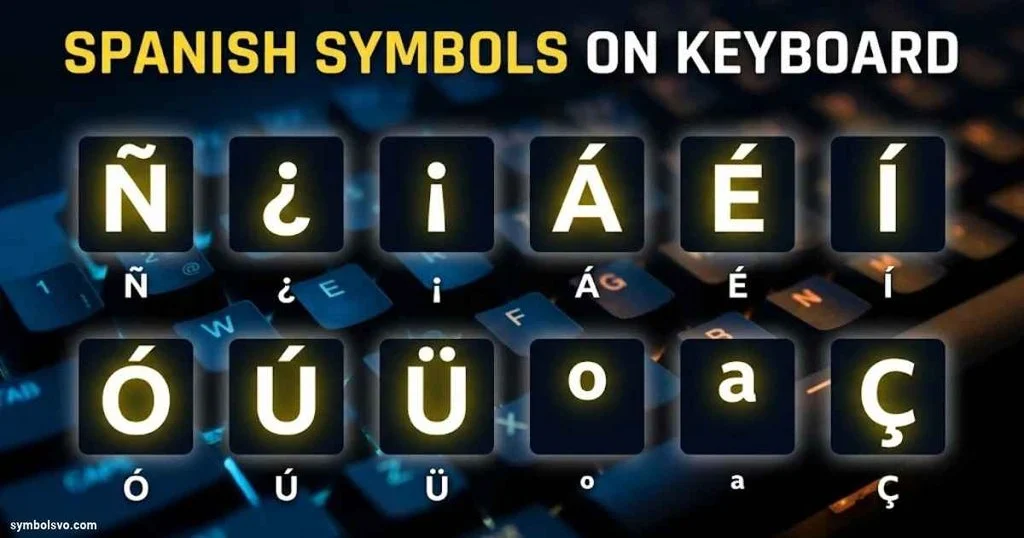
You can type Spanish symbols directly from your keyboard instead of copying them from another website. The method depends on your operating system and keyboard layout.
Here are some practical ways to enter Spanish characters.
Spanish Symbols On A Windows Keyboard
Windows users can use Alt codes with a numeric keypad to type many Spanish characters.
| Symbol | Alt Code |
| á | Alt + 0225 |
| é | Alt + 0233 |
| í | Alt + 0237 |
| ó | Alt + 0243 |
| ú | Alt + 0250 |
| Á | Alt + 0193 |
| É | Alt + 0201 |
| Í | Alt + 0205 |
| Ó | Alt + 0211 |
| Ú | Alt + 0218 |
| ñ | Alt + 0241 |
| Ñ | Alt + 0209 |
| ü | Alt + 0252 |
| Ü | Alt + 0220 |
| ¿ | Alt + 0191 |
| ¡ | Alt + 0161 |
How to use Alt codes:
- Open the document or text box where you want the symbol.
- Turn on Num Lock.
- Hold down the Alt key.
- Type the required code using the numeric keypad.
- Release Alt.
The character should appear in your text. These codes require a suitable numeric keypad and may not work through the number row at the top of every keyboard.
Use The Windows International Keyboard
Another option is to add the United States-International keyboard layout.
- Open Windows Settings.
- Select Time & Language.
- Open Language & Region.
- Find your language and open its language options.
- Add the United States-International keyboard if available.
- Switch to that keyboard when typing.
This layout lets you enter accented vowels using dead-key combinations. For example, press the apostrophe key followed by A to produce á. The tilde key followed by N produces ñ.
Type Spanish Symbols On Any Keyboard
If your keyboard does not support Spanish characters, you can use the character map or copy-and-paste method.
Windows Character Map provides a collection of special characters. Search for Character Map in the Start menu, open it, and select the character you need.
Spanish Symbols On Mac
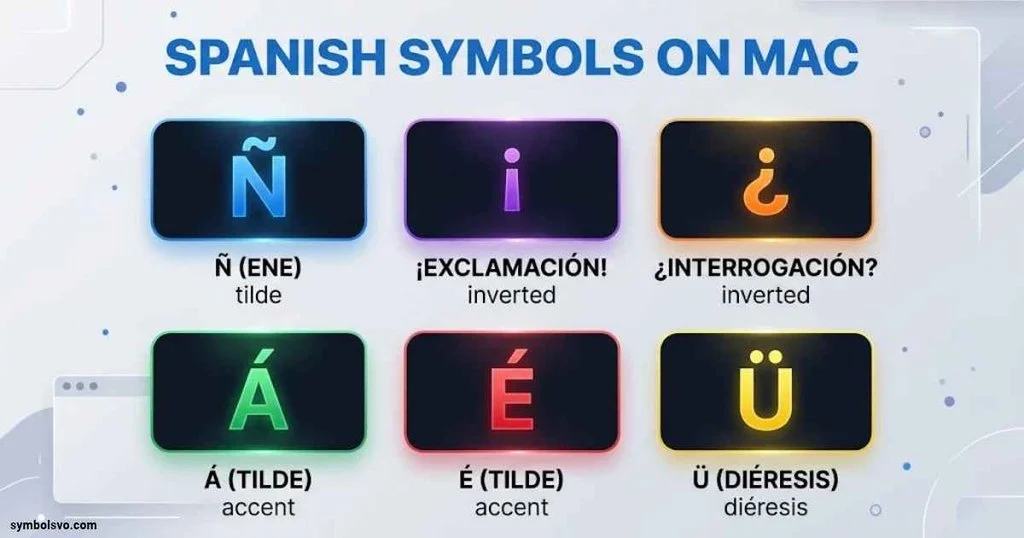
Mac computers provide built-in ways to type Spanish accents, Ñ, and other special characters.
You can use keyboard shortcuts or the Character Viewer to enter the symbols.
Mac Keyboard Shortcuts For Spanish Accents
On many Mac keyboard layouts, you can use the Option key to create accented characters.
| Symbol | Keyboard Shortcut |
| á | Option + E, then A |
| é | Option + E, then E |
| í | Option + E, then I |
| ó | Option + E, then O |
| ú | Option + E, then U |
| ñ | Option + N, then N |
| ü | Option + U, then U |
For uppercase letters, hold Shift when entering the final letter.
For example, Option + E followed by Shift + A produces Á on a compatible layout.
How To Type Spanish Symbols Using Mac Character Viewer
You can also use Character Viewer to find and insert special characters.
- Open the document or application where you want to type.
- Press Control + Command + Space.
- Character Viewer will appear.
- Search for the character, such as ñ or inverted question mark.
- Select the symbol to insert it.
Use A Spanish Keyboard Layout On Mac
If you frequently write in Spanish, adding a Spanish keyboard layout can make typing easier.
- Open System Settings.
- Select Keyboard.
- Find Text Input and choose Edit.
- Select the option to add a keyboard layout.
- Search for Spanish.
- Add the layout you prefer.
You can then switch between your regular keyboard and Spanish keyboard whenever needed.
Spanish Symbols In Word
Microsoft Word supports Spanish letters, accents, punctuation marks, and other special characters. You can insert them using keyboard shortcuts or the built-in symbol menu.
This is useful when writing essays, reports, academic assignments, or professional documents in Spanish.
Spanish Accent Shortcuts In Microsoft Word
Here are some commonly used Word shortcuts.
| Symbol | Shortcut |
| á | Ctrl + ‘ followed by A |
| é | Ctrl + ‘ followed by E |
| í | Ctrl + ‘ followed by I |
| ó | Ctrl + ‘ followed by O |
| ú | Ctrl + ‘ followed by U |
| Á | Ctrl + ‘ followed by Shift + A |
| É | Ctrl + ‘ followed by Shift + E |
| ñ | Ctrl + Shift + ~ followed by N |
| Ñ | Ctrl + Shift + ~ followed by Shift + N |
| ü | Ctrl + Shift + : followed by U |
| Ü | Ctrl + Shift + : followed by Shift + U |
These shortcuts work in standard desktop Word configurations using compatible keyboard layouts. The exact key combinations can vary with regional settings.
Insert Spanish Symbols Through The Word Symbol Menu
If keyboard shortcuts are difficult to remember, use the Insert menu.
- Open Microsoft Word.
- Place the cursor where you want the character.
- Click Insert.
- Select Symbol.
- Choose More Symbols if necessary.
- Find the required Spanish character.
- Click Insert.
You can insert characters such as:
- á, é, í, ó, ú
- Á, É, Í, Ó, Ú
- ñ, Ñ
- ü, Ü
- ¿, ¡
Copy And Paste Spanish Symbols Into Word
You can also copy characters from this guide and paste them into Microsoft Word.
For example:
Lowercase: á é í ó ú ñ ü
Uppercase: Á É Í Ó Ú Ñ Ü
Punctuation: ¿ ¡
This method is especially helpful if you only need Spanish symbols occasionally.
How Do I Add Spanish Symbols In Microsoft Word
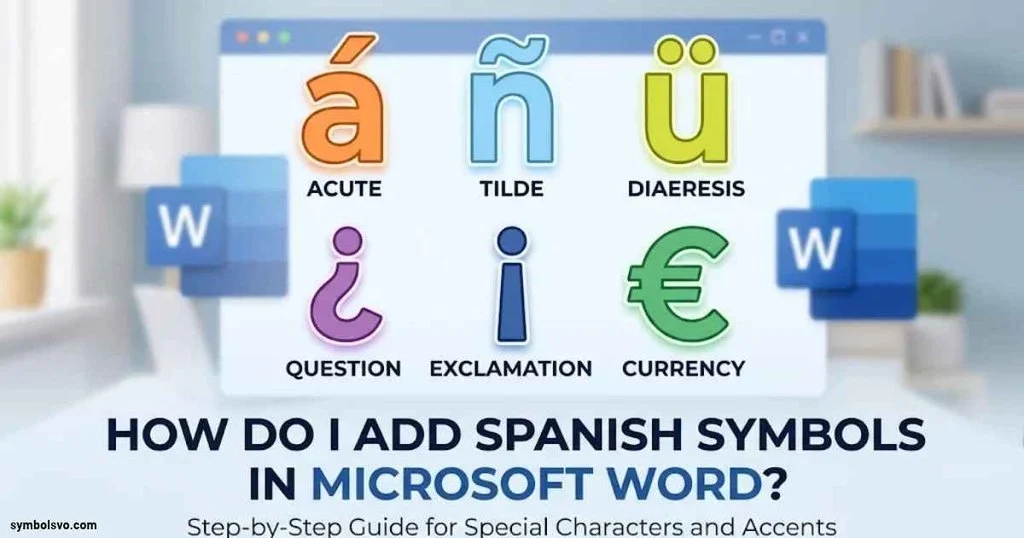
There are several ways to add Spanish symbols in Microsoft Word. The easiest method depends on how often you write in Spanish and which characters you need.
Here are three simple methods.
Method 1: Use The Insert Symbol Feature
This method is suitable for people who need to insert special characters occasionally.
- Open your Word document.
- Click where you want the symbol.
- Select the Insert tab.
- Click Symbol.
- Choose More Symbols.
- Locate the Spanish character.
- Click Insert.
You can repeat these steps whenever you need another character.
Method 2: Use Keyboard Shortcuts
Keyboard shortcuts are faster when you frequently type accented Spanish words.
For example:
- Ctrl + ‘ followed by A = á
- Ctrl + ‘ followed by E = é
- Ctrl + Shift + ~ followed by N = ñ
You can use the same approach for other supported accented letters.
Method 3: Change Your Keyboard Language
If you regularly write complete documents in Spanish, adding a Spanish keyboard layout may be more convenient.
On Windows:
- Open Settings.
- Select Time & Language.
- Open Language & Region.
- Add Spanish as a language if necessary.
- Add a Spanish keyboard.
- Switch keyboard layouts when writing.
This allows you to type Spanish punctuation and accented characters more naturally.
Which method should you choose?
- Use Insert Symbol for occasional characters.
- Use keyboard shortcuts for frequent accent marks.
- Use a Spanish keyboard layout for regular Spanish writing.
Symbols In Spanish Translation
The word symbol has several Spanish translations depending on the context. The most common translation is símbolo.
Here are some useful Spanish translations of symbol-related words.
| English Word | Spanish Translation |
| Symbol | Símbolo |
| Symbols | Símbolos |
| Special symbol | Símbolo especial |
| Text symbol | Símbolo de texto |
| Mathematical symbol | Símbolo matemático |
| Religious symbol | Símbolo religioso |
| National symbol | Símbolo nacional |
| Warning symbol | Símbolo de advertencia |
| Peace symbol | Símbolo de la paz |
| Love symbol | Símbolo del amor |
| Symbol meaning | Significado del símbolo |
| Symbol name | Nombre del símbolo |
| Ancient symbol | Símbolo antiguo |
| Cultural symbol | Símbolo cultural |
| Copy and paste symbols | Símbolos para copiar y pegar |
Common Spanish Phrases About Symbols
You may also find these phrases useful when searching for symbols or discussing them in Spanish.
- ¿Qué significa este símbolo? — What does this symbol mean?
- ¿Cómo se llama este símbolo? — What is this symbol called?
- Símbolos y significados — Symbols and meanings.
- Copiar y pegar símbolos — Copy and paste symbols.
- Símbolos especiales — Special symbols.
- Símbolos antiguos — Ancient symbols.
- Símbolos españoles — Spanish symbols.
One useful distinction is that símbolo generally means a symbol, while signo can mean a sign, mark, or symbol depending on the situation.
For example, a religious emblem may be called a símbolo religioso, while a punctuation mark can be described as a signo de puntuación.
Spanish To English
If you are translating Spanish symbols and characters into English, it helps to understand that some characters represent letters rather than complete words.
For example, Ñ is a Spanish letter. It does not have a direct English letter equivalent, although its sound can be explained using English pronunciation examples.
Here are some common Spanish words containing special characters and their English translations.
| Spanish Word | English Translation |
| Niño | Boy |
| Niña | Girl |
| España | Spain |
| Año | Year |
| Mañana | Tomorrow / Morning |
| Corazón | Heart |
| Canción | Song |
| Árbol | Tree |
| Música | Music |
| Café | Coffee |
| Pingüino | Penguin |
| Vergüenza | Shame / Embarrassment |
| Inglés | English |
| País | Country |
| Información | Information |
Spanish Accent Marks And English Pronunciation
Spanish accent marks do not always have a direct equivalent in English spelling. They help Spanish readers identify the correct pronunciation and stressed syllable.
For example:
- Canción: The accent marks the stressed final syllable.
- Café: The final E carries the stress.
- Árbol: The first syllable is stressed.
- Corazón: The final syllable is stressed.
Do Spanish Symbols Have English Equivalents?
Some Spanish characters have close English equivalents, while others do not.
- Á, É, Í, Ó, Ú: These are accented versions of familiar English vowels.
- Ñ: This represents a distinct Spanish consonant sound.
- Ü: This indicates that the U should be pronounced in certain Spanish letter combinations.
- ¿ and ¡: These punctuation marks have no standard English opening equivalents.
You should not remove these characters automatically when translating Spanish into English. First, identify the word and its meaning, then choose the correct English translation.
Symbol Name
Every Spanish special character has a name that helps identify it. Learning these names makes it easier to search for characters, discuss spelling, and use them correctly.
Here are the names of commonly used Spanish symbols and characters.
| Symbol | English Name | Spanish Name |
| Á | A with acute | A con tilde |
| É | E with acute | E con tilde |
| Í | I with acute | I con tilde |
| Ó | O with acute | O con tilde |
| Ú | U with acute | U con tilde |
| Ñ | Eñe | Eñe |
| Ü | U with diaeresis | U con diéresis |
| ¿ | Inverted question mark | Signo de interrogación de apertura |
| ¡ | Inverted exclamation mark | Signo de exclamación de apertura |
| ´ | Acute accent | Acento agudo |
| ¨ | Diaeresis | Diéresis |
| ~ | Tilde | Virgulilla / tilde |
Names Of Common Spanish Punctuation Marks
Spanish has several punctuation marks that are useful in everyday writing.
- Punto — Period or full stop.
- Coma — Comma.
- Dos puntos — Colon.
- Punto y coma — Semicolon.
- Signo de interrogación — Question mark.
- Signo de exclamación — Exclamation mark.
- Paréntesis — Parentheses.
- Comillas — Quotation marks.
- Guion — Hyphen.
- Raya — Dash.
The opening question mark is called signo de interrogación de apertura, while the closing question mark is called signo de interrogación de cierre.
Knowing these names helps when discussing grammar or asking someone how to type a particular character.
Spanish Characters In Cartoons
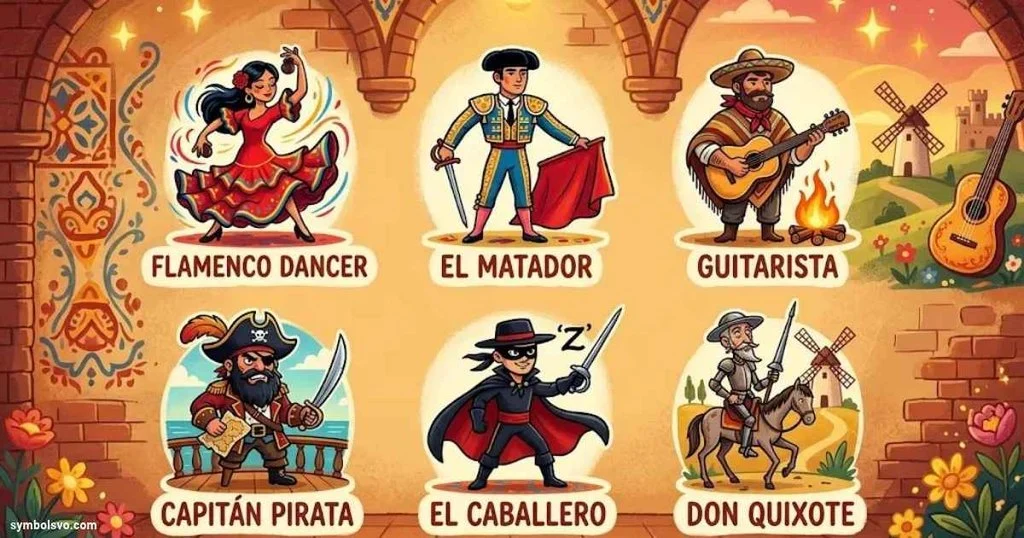
Spanish characters appear in cartoons through names, dialogue, subtitles, signs, and cultural references. Special letters such as Ñ and accented vowels are particularly useful when writing Spanish names correctly.
Animated characters with Spanish-language names or backgrounds may include accents or other Spanish spelling features.
Dora The Explorer
Dora is a well-known animated character who uses Spanish and English in her adventures. Her name is simple, but the show introduces many Spanish words and expressions.
Speedy Gonzales
This Looney Tunes character is associated with Mexican cultural references and Spanish-language expressions. The name Gonzales is commonly seen in Spanish-language contexts.
Manolo
Manolo is a character from The Book of Life. The film includes Mexican cultural themes, traditional imagery, and Spanish-inspired names.
Miguel
Miguel from Coco is part of a story inspired by Mexican culture and family traditions. The film features Spanish words, names, and cultural symbols.
Spanish Characters And Accent Marks In Cartoon Names
Some Spanish names and words include special characters that should not be removed.
Examples include:
- Piñata
- Señor
- Doña
- Muñoz
- Hernández
- García
- Martínez
These examples show how Spanish spelling appears in character names, subtitles, and cartoon dialogue.
If you are creating cartoon-inspired usernames, captions, or character descriptions, using the correct Spanish accents can make the text look more authentic.
Ancient Spanish Symbols
Ancient Spanish symbols reflect the different cultures, kingdoms, religions, and communities that shaped the Iberian Peninsula. There was no single ancient symbol system shared by everyone in Spain.
Different historical periods introduced different designs, including Roman emblems, Iberian inscriptions, Visigothic symbols, Christian crosses, and medieval heraldry.
Here are some important examples.
Iberian Symbols And Inscriptions
The ancient Iberian peoples used writing systems and decorative designs before the Roman conquest.
Their inscriptions appeared on:
- Coins
- Pottery
- Stone objects
- Metal items
- Memorials
Iberian scripts were used in different regions of the Iberian Peninsula. Their characters are historical writing signs rather than modern Spanish letters.
Roman Symbols In Hispania
The Romans controlled large parts of the Iberian Peninsula, which they called Hispania.
Their influence introduced symbols such as:
- Laurel wreaths — Victory and honor.
- Eagles — Roman military power and authority.
- Roman numerals — Numbers used in inscriptions and records.
- SPQR — An abbreviation for the Roman Senate and People of Rome.
These symbols belong to Roman history and should not be described as uniquely Spanish inventions.
Visigothic Symbols
The Visigoths ruled parts of the Iberian Peninsula after the decline of Roman power.
Their cultural and religious artwork included:
- Crosses — Christian faith.
- Decorative geometric patterns — Artistic and architectural decoration.
- Religious inscriptions — Christian beliefs and commemorations.
Visigothic metalwork and church decoration provide important examples of early medieval art in Spain.
Medieval Spanish Heraldic Symbols
During the Middle Ages, different Spanish kingdoms developed coats of arms and royal emblems.
Some well-known examples include:
- Castle — Associated with the Kingdom of Castile.
- Lion — Associated with the Kingdom of León.
- Cross of Saint James — Connected with the Christian military and pilgrimage traditions surrounding Santiago de Compostela.
- Crown — Royal authority and monarchy.
These symbols are useful for understanding the history of Spanish kingdoms and their cultural identities.
Spanish Symbols Used By Conquistadors
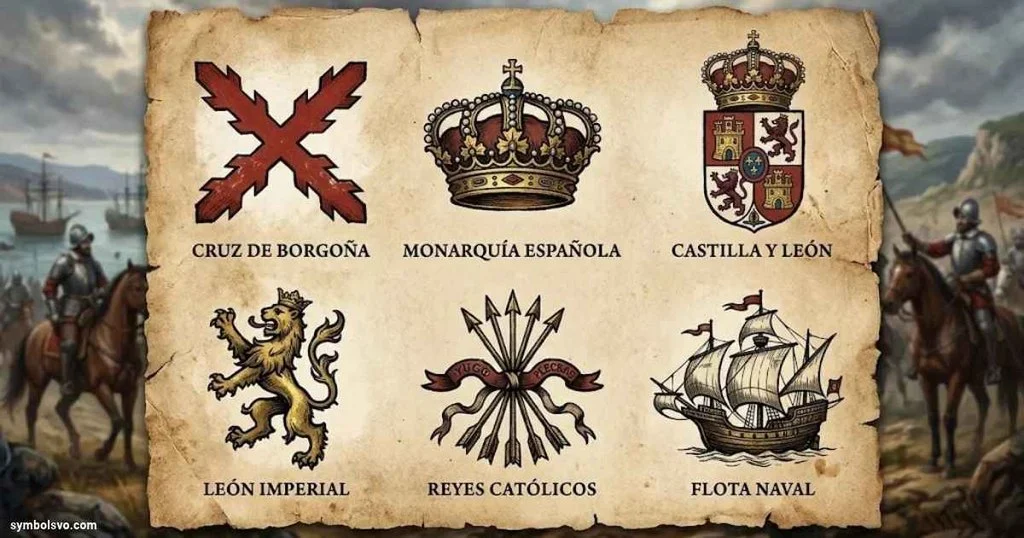
Spanish conquistadors were explorers, soldiers, and military leaders involved in Spain’s overseas expansion, particularly in the Americas during the 15th and 16th centuries.
They used flags, royal banners, Christian symbols, coats of arms, and military standards to represent their monarchy, religion, and military authority.
Here are some historical symbols associated with Spanish conquistadors.
Cross Of Burgundy
Cross Of Burgundy (Aspa De Borgoña)
This red, ragged-edged cross on a light background became an important military and royal emblem associated with the Spanish Habsburg monarchy. It appeared on flags and military standards.
Christian Cross
Christian Cross (✝)
The cross represented Christianity and the Catholic faith. Spanish expeditions often carried Christian religious imagery during conquest and missionary activities.
Royal Coat Of Arms
Royal Coat Of Arms
Spanish royal coats of arms represented the authority of the monarchy. Their designs changed across different rulers and historical periods.
Spanish Royal Flags
Royal Standards
Royal banners identified the authority of the Spanish Crown. Different designs were used depending on the ruler, expedition, and historical period.
Cross And Sword Imagery
Cross And Sword
Crosses and swords frequently appear together in historical representations of Spanish conquest. They can represent the connection between military expansion and religious conversion.
It is worth remembering that these symbols did not all have one universal design or meaning. Their use depended on the historical period, military group, royal authority, and location.
Spanish Symbols Tattoo
Spanish-inspired tattoos can represent language, family history, cultural pride, love, faith, and personal identity. Some people choose a single Spanish letter, while others prefer historical emblems, meaningful words, or traditional religious imagery.
If you are planning a Spanish tattoo, make sure you understand the meaning and spelling before choosing a design.
Spanish Letter Tattoos
Spanish letters can create simple and meaningful tattoo designs.
| Symbol | Possible Personal Meaning |
| Ñ | Connection to Spanish language or heritage |
| Á | A personalized initial or name |
| É | A personalized initial or name |
| Ü | A distinctive letter design |
The Ñ is especially recognizable because of its connection to Spanish spelling.
Spanish Word Tattoos
Short Spanish words can express emotions and personal values.
| Spanish Word | English Meaning |
| Amor | Love |
| Familia | Family |
| Fuerza | Strength |
| Esperanza | Hope |
| Vida | Life |
| Paz | Peace |
| Libertad | Freedom |
| Corazón | Heart |
| Siempre | Always |
| Fe | Faith |
Before getting a word tattooed, check its spelling, accent marks, and intended meaning.
Spanish Historical Symbol Tattoos
Historical Spanish emblems can inspire detailed tattoo designs.
Popular ideas include:
- Cross of Burgundy — A historical Spanish military emblem.
- Castle — Associated with Castilian heritage.
- Lion — Associated with the Kingdom of León.
- Spanish royal heraldry — Historical monarchy and family heritage.
- Christian cross — Religious faith.
Remember that historical emblems may have political, religious, or military associations. Research the particular design before using it.
Spanish Flag Tattoos
The Spanish flag is another popular choice for people who want to express a connection with Spain.
Its red and yellow colors and national coat of arms make it recognizable. Some tattoo designs use the complete flag, while others use a small flag outline or simplified colors.
Spanish Tattoo Design Ideas
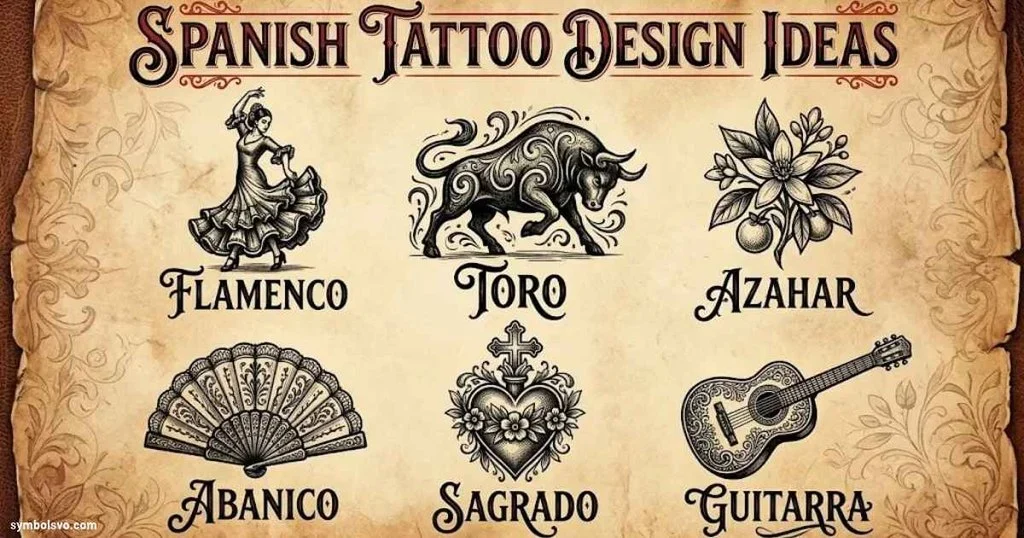
Here are some ideas to help you choose a design:
- Amor: A small lettering tattoo representing love.
- Familia: A tribute to family.
- Esperanza: A reminder of hope.
- Paz: A simple peace-inspired design.
- Corazón: A heart combined with Spanish lettering.
- Cross Of Burgundy: A historical emblem design.
- Spanish Flag: A tattoo representing national connection.
Choose a design that has a meaning you genuinely understand. If the tattoo includes Spanish text, ask a fluent Spanish speaker to check it before making it permanent.
Frequently Asked Questions
What Are The Most Common Spanish Symbols?
The most common Spanish special characters are á, é, í, ó, ú, ñ, ü, ¿, and ¡. They are used in Spanish spelling, pronunciation, and punctuation.
What Is The Most Recognizable Symbol In Spanish?
The letter Ñ is one of the most recognizable Spanish characters. It is a separate letter in the Spanish alphabet and appears in words such as España, niño, and mañana.
How Do I Type Spanish Symbols Without A Spanish Keyboard?
You can use Windows Alt codes, Mac Option shortcuts, Microsoft Word’s Insert Symbol feature, or copy and paste characters from a symbol collection. You can also add an international keyboard layout.
Why Does Spanish Use An Upside-Down Question Mark?
Spanish uses an opening question mark (¿) to show where a question begins. It helps readers recognize the sentence as a question before reaching its final punctuation mark.
Are Spanish Accents Required In Capital Letters?
Yes. Spanish accent marks must be retained in uppercase writing whenever spelling rules require them. For example, MÉXICO and CANCIÓN are correctly written with their accents.
Conclusion
Spanish symbols are an essential part of Spanish writing, pronunciation, and cultural expression. Characters such as Ñ, Á, É, Í, Ó, Ú, and Ü help preserve correct spelling, while inverted punctuation marks make questions and exclamations easier to recognize. Each character has a specific purpose and should be used correctly.
You can copy and paste these characters into messages, social media posts, websites, and documents. If you write in Spanish regularly, learning keyboard shortcuts for Windows, Mac, and Microsoft Word can save time and make your writing more accurate.
Spanish symbols also have historical and cultural value. From ancient Iberian inscriptions and medieval heraldry to conquistador emblems and modern tattoo designs, they represent different parts of Spanish history and identity. Choose the symbols that match your purpose, understand their meanings, and use the correct characters whenever you write in Spanish.

Mason Ellington is a creative and dedicated Content Writer and Symbols Expert with a passion for words, communication, and symbolic meanings. He specializes in crafting engaging, informative, and well-structured content while exploring the deeper meanings and interpretations behind symbols. With a creative mindset and attention to detail, Mason transforms ideas into meaningful content that informs, inspires, and connects with readers. His expertise combines powerful storytelling, clear communication, and a deep understanding of symbolism.
 Daniel Brooks
 Nathan Holloway