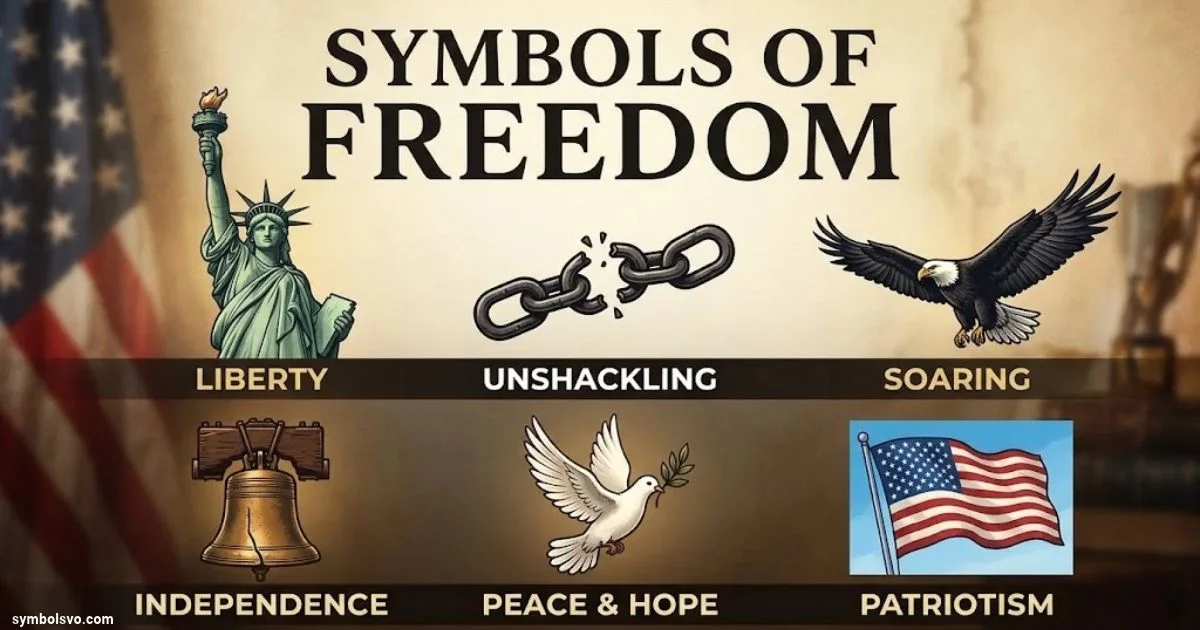
Freedom means different things to different people. For some, it represents independence from oppression. For others, it means having the courage to make their own choices, express their identity, or begin a new chapter in life.
Throughout history, people have used powerful images to communicate these ideas. A flying bird can represent the desire to live without restrictions. Broken chains can express liberation from slavery and injustice. A national monument can remind people of political independence and human rights.
These symbols of freedom appear in flags, artwork, religious traditions, historical monuments, literature, and tattoos. Some have clear historical origins, while others developed through common visual interpretations.
In this guide, you’ll discover 25 meaningful freedom symbols, their origins, and what they represent. You’ll also explore ancient emblems, cultural traditions, spiritual meanings, and symbols of personal independence.
What Are the Most Recognized Symbols of Freedom?
Several symbols have become closely associated with freedom, liberty, independence, and liberation. Their meanings often depend on the historical or cultural context in which people use them.
Here are some widely recognized examples:
| Symbol | Meaning | Main association |
| Broken Chains | Freedom from oppression and bondage | Abolition and liberation |
| Bald Eagle | Strength, liberty, and independence | United States |
| Statue of Liberty | Freedom, enlightenment, and hope | American history |
| Phrygian Cap | Liberty and freedom from slavery | Ancient Rome and France |
| Fawohodie | Freedom and independence | Akan culture |
| Flying Bird | Personal freedom and possibility | Common visual symbolism |
| Butterfly | Transformation and renewal | Personal growth |
| Liberty Bell | Liberty and equality | American history |
| Raised Fist | Resistance and solidarity | Social movements |
| Lotus Flower | Spiritual growth and purity | Hinduism and Buddhism |
| Phoenix | Rebirth and resilience | Mythology |
| White Dove | Peace and hope | Religious and cultural traditions |
There isn’t one universal symbol of freedom that carries the same meaning everywhere. Some symbols represent political liberty, while others communicate emotional independence or spiritual liberation.
Animal Symbols of Freedom and Their Meanings
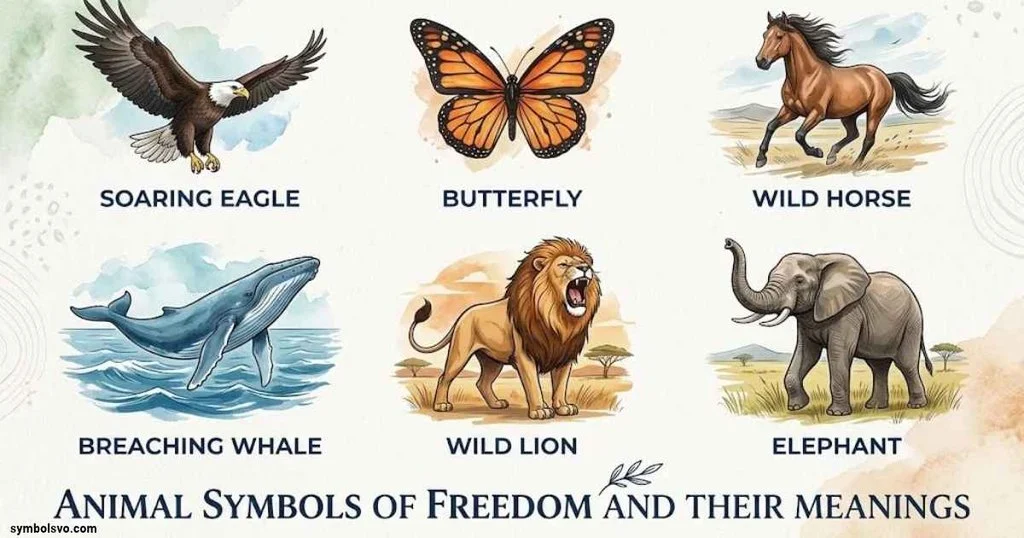
Animals often represent freedom because of their natural movements and behaviors. Birds fly across open skies, horses move freely through wide landscapes, and butterflies undergo remarkable transformations.
These qualities make animals powerful symbols of independence and possibility.
Eagle: A Symbol of Strength and Liberty
The eagle is one of the most recognizable animals associated with freedom. Its powerful wings, high flight, and ability to travel across large territories make it a natural symbol of independence.
The bald eagle has a particularly important place in American history. The United States adopted it as a national emblem in 1782. It appears on the Great Seal, official documents, military insignia, and other national representations.
In December 2024, federal legislation formally designated the bald eagle as the national bird of the United States.
Its symbolism commonly includes:
- Liberty and national independence
- Strength and courage
- Leadership and determination
- Freedom and self-reliance
- National identity
However, the eagle doesn’t represent freedom in exactly the same way across every culture. Its meaning depends on local traditions and historical use.
Flying Bird: Freedom Without Boundaries
A flying bird is one of the simplest visual representations of freedom. Unlike a bird sitting inside a cage, a bird in flight appears unrestricted.
Artists frequently use this image to communicate independence, hope, and the desire to explore new possibilities.
A flying bird can represent:
- Freedom from restrictions
- Personal independence
- New opportunities
- Emotional release
- The courage to follow your own path
A flock of birds flying together can also represent shared freedom and a sense of belonging.
The image is especially common in artwork, jewelry, and freedom tattoo designs.
White Dove: Peace and Hope
The white dove is widely recognized as a symbol of peace. Its gentle appearance and association with religious imagery have made it an important cultural symbol.
In Christianity, a dove appears in accounts of Jesus’ baptism and is associated with the Holy Spirit. In broader visual culture, the white dove often represents peace, reconciliation, and hope.
Its connection to freedom is more indirect. Peaceful societies can provide the conditions for people to enjoy their rights, express themselves, and live without fear.
The white dove can therefore communicate:
- Peace and reconciliation
- Hope after conflict
- Spiritual reassurance
- Harmony and compassion
- A peaceful future
Butterfly: Transformation and Personal Freedom
The butterfly represents transformation because of its remarkable life cycle.
It begins as a caterpillar, forms a chrysalis, and eventually emerges with wings. This natural change has made the butterfly a popular symbol of renewal and personal growth.
Many people connect its transformation with breaking away from difficult circumstances and discovering a new sense of independence.
A butterfly can represent:
- Personal transformation
- Freedom from past limitations
- New beginnings
- Growth and self-discovery
- Emotional renewal
Its meaning is especially popular in jewelry, artwork, and tattoos.
Phoenix: Rebirth After Difficult Times
The phoenix is a legendary bird associated with rebirth and renewal. In traditional accounts, it dies or burns before rising again.
This powerful story makes the phoenix a symbol of resilience and the ability to begin again after destruction.
Although the phoenix isn’t an established political emblem of liberty, people often connect it with personal liberation.
Its common meanings include:
- Rebirth and renewal
- Strength after hardship
- Personal transformation
- Hope after loss
- Freedom from the past
A phoenix tattoo can represent someone who has overcome a difficult experience and chosen to move forward.
Wild Horse: Independence and an Untamed Spirit
A wild horse running across an open landscape often represents independence and freedom.
Unlike a domesticated horse, a wild horse suggests movement without human control. Its strength and natural energy make it a common image of personal autonomy.
The wild horse can symbolize:
- Independence and self-direction
- Strength and determination
- An untamed spirit
- Adventure and exploration
- Freedom from control
This symbolism is especially common in modern artwork and personal designs.
Garuda: Power and Protection
Garuda is a powerful mythological being found in Hindu traditions and Buddhist imagery. It is commonly depicted as a large bird or a human-like figure with wings.
In Hindu mythology, Garuda is associated with Vishnu and is known for its strength and ability to overcome powerful obstacles.
Its symbolism includes protection, courage, power, and victory over harmful forces.
Garuda can connect with the idea of freedom through overcoming obstacles. However, it is important to respect its religious significance rather than treating it as a simple decorative freedom emblem.
Objects and Physical Symbols of Freedom
Many recognizable symbols of liberty come from historical objects, monuments, and visual representations of liberation.
These symbols often communicate freedom more directly than general natural imagery.
Broken Chains: Freedom From Oppression
Broken chains are among the strongest visual representations of liberation.
Chains have long been associated with imprisonment, slavery, forced labor, and restrictions. When an artist depicts them broken, the image communicates the end of confinement.
Broken chains have appeared in abolitionist imagery and other movements opposing oppression.
They commonly represent:
- Freedom from slavery
- Liberation from injustice
- Resistance against oppression
- Personal independence
- The end of restrictions
The symbol also appears at the feet of the Statue of Liberty. The National Park Service explains that the broken chains represent breaking free from tyranny and servitude.
Unlike some modern freedom metaphors, broken chains have a clear historical connection to emancipation and liberation.
Statue of Liberty: A Powerful Symbol of Liberty
The Statue of Liberty is one of the world’s most recognizable monuments representing freedom.
France gifted the statue to the United States. Sculptor Frédéric Auguste Bartholdi designed it, and the monument was dedicated on October 28, 1886.
Its official name is Liberty Enlightening the World.
Every major feature carries symbolic meaning:
- Torch: Represents enlightenment and the spreading of knowledge.
- Tablet: Displays July 4, 1776, the date of American independence.
- Crown: Its seven rays are commonly associated with the seven seas and continents.
- Broken chains: Represent liberation from tyranny and servitude.
The statue has also become a symbol of hope for immigrants seeking a new life.
Its history connects freedom with independence, opportunity, and human dignity.
Phrygian Cap: An Ancient Symbol of Liberty
The Phrygian cap has a long history as a symbol of freedom.
In ancient Rome, the pileus was a cap associated with people who had been freed from slavery. Later, the Phrygian cap became a recognizable emblem of liberty during the French Revolution.
Artists and revolutionaries used it to communicate resistance against tyranny and support for republican ideals.
The cap commonly represents:
- Freedom from oppression
- Political liberty
- Revolution and resistance
- Independence
- The rights of citizens
The Phrygian cap and Roman pileus are historically related in their later symbolism, but they are not exactly the same head covering. Understanding this distinction helps explain their historical development accurately.
Liberty Bell: A Symbol of Equality and Independence
The Liberty Bell is an important American historical symbol.
It bears the inscription:
“Proclaim LIBERTY Throughout all the Land unto all the Inhabitants Thereof.”
The bell originally hung in Pennsylvania’s State House, now known as Independence Hall.
Over time, its message became important to groups campaigning for greater freedom and equality. Abolitionists used the bell’s inscription in their opposition to slavery. Women’s suffrage advocates and civil rights leaders also drew inspiration from its message.
Today, the Liberty Bell represents:
- Liberty and equality
- American independence
- Freedom from oppression
- Human rights
- The ongoing pursuit of justice
Its meaning grew beyond its original role as a public bell.
Raised Fist: Resistance and Solidarity
The raised fist is a recognizable symbol of protest, resistance, and collective strength.
It has appeared in labor movements, anti-racist campaigns, and civil rights demonstrations. Its meaning often depends on the movement using it.
Unlike a symbol focused only on individual freedom, the raised fist frequently communicates collective action.
It can represent:
- Resistance against injustice
- Solidarity between people
- Strength through unity
- Equal rights
- Determination and courage
The raised fist is especially meaningful in images of peaceful protest and social movements.
Key and Open Door: Opportunity and Personal Choice
A key can symbolize freedom because it opens something that was previously locked.
It represents access, control, and the ability to make choices. An open door communicates a similar idea by showing that a person can move forward without facing a barrier.
These are mainly modern visual metaphors rather than established ancient freedom emblems.
They can represent:
- New opportunities
- Independence and control
- Escape from restrictions
- Personal choice
- New beginnings
A key and an open door work particularly well together in artwork about personal liberation.
Torch and Flame: Knowledge and Enlightenment
A torch often represents light, knowledge, and enlightenment.
Its connection to freedom becomes clear when light is used as a metaphor for understanding and the ability to make informed decisions.
The torch held by the Statue of Liberty is a famous example. The National Park Service identifies it as a symbol of enlightenment.
A flame can also represent hope, courage, and resistance. However, its meaning changes across religious, cultural, and political traditions.
Nature Symbols of Freedom
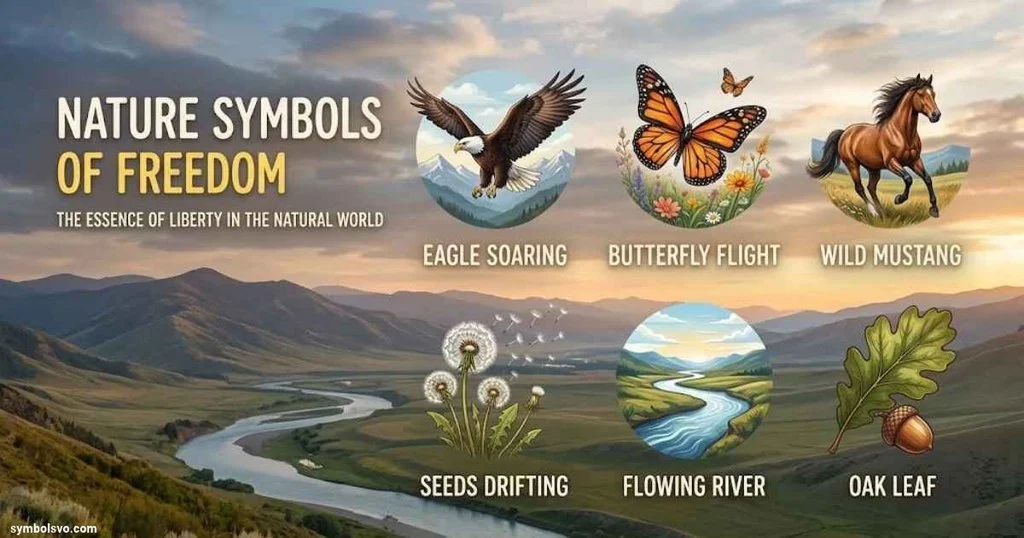
Nature offers many images that people use to express independence and possibility. These associations are often metaphorical rather than historically fixed.
Open Sky and Vast Horizon
An open sky creates a sense of space without visible boundaries. It often represents freedom, exploration, and unlimited possibilities.
A vast horizon can suggest a future that remains open to new experiences.
These images commonly represent:
- Personal independence
- Possibility and opportunity
- Freedom from restrictions
- Adventure and exploration
- A fresh perspective
An open sky is especially effective in photography, paintings, and inspirational artwork.
Open Ocean and Flowing Water
The ocean can represent freedom because of its enormous size and seemingly endless movement.
Flowing water also suggests change and the ability to move forward. A river that continues along its course can become a metaphor for following your own direction.
Common associations include:
- Exploration and adventure
- Personal growth
- Change and transformation
- Independence
- Moving beyond limitations
These meanings are common artistic interpretations, not universal cultural definitions.
Mountains: Strength and Independence
Mountains can represent the freedom to explore, challenge yourself, and overcome obstacles.
Climbing a mountain requires patience, effort, and determination. Reaching its summit can symbolize achievement and the ability to move beyond personal limitations.
Mountains commonly represent:
- Courage and resilience
- Independence
- Adventure
- Personal achievement
- Freedom to explore
Sunrise: Hope and New Beginnings
A sunrise often represents the beginning of something new.
After darkness, the appearance of sunlight creates a natural image of hope and renewal. People use this symbolism to express recovery, personal change, and a fresh start.
A sunrise can represent:
- Hope after hardship
- New beginnings
- Renewal and transformation
- Optimism
- Freedom to start again
Wildflowers: Growth and Individuality
Wildflowers grow in natural environments without the same control found in carefully maintained gardens.
For this reason, they can serve as a modern metaphor for individuality, resilience, and personal freedom.
They may represent the ability to grow in difficult circumstances and express one’s identity without strict expectations.
Ancient and Historical Symbols of Freedom
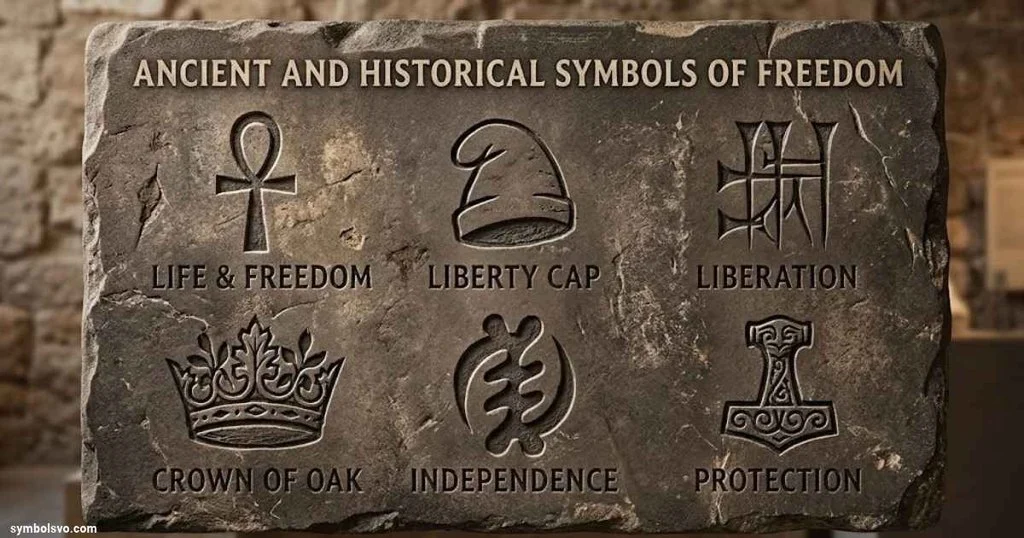
Some freedom symbols have roots in specific historical events and social practices. Their origins help explain why they carry such powerful meanings today.
Roman Symbols of Liberty: Libertas and the Pileus
Ancient Rome had several symbols associated with freedom.
Libertas was the Roman personification of liberty. Artists represented her as a female figure, often using visual elements associated with freedom and citizenship.
The pileus was a cap associated with freed enslaved people. It became an important visual representation of manumission, the formal process of freeing an enslaved person.
The vindicta rod also had a role in Roman manumission rituals. It was used during the formal procedure through which a person could be declared free.
Together, these symbols communicate important historical ideas:
- Freedom from slavery
- Legal status as a free person
- Liberty and citizenship
- The relationship between law and independence
These historical details explain why Roman liberty imagery influenced later European political symbolism.
Fawohodie: The Akan Symbol of Freedom
Fawohodie is an Adinkra symbol from Akan culture in Ghana.
It represents freedom, independence, and emancipation. It is also connected with the idea that freedom carries responsibility.
This is an important distinction. Freedom does not simply mean having no restrictions. It also involves making choices and accepting their consequences.
Fawohodie is commonly associated with:
- Independence
- Personal liberty
- Self-determination
- Emancipation
- Responsibility
Adinkra symbols communicate ideas through visual designs and are part of a wider cultural tradition. Fawohodie should therefore be understood within its Akan context rather than treated as a generic decorative symbol.
Broken Chains in Abolitionist History
Broken chains became a powerful image in campaigns against slavery and oppression.
The contrast between a chain and its broken links makes the message easy to understand. An unbroken chain suggests confinement, while a broken one communicates release.
The imagery appears in historical and modern representations of emancipation.
It continues to represent the struggle for human dignity, equal rights, and freedom from unjust control.
The French Tricolor and Marianne
The French Tricolor flag uses three vertical colors: blue, white, and red.
It became closely connected with the French Revolution and later republican identity.
Another important French symbol is Marianne, a female personification of the French Republic. Artists often depict her wearing a Phrygian cap, connecting her with liberty and revolutionary ideals.
Together, these symbols communicate:
- Republican government
- Liberty and citizenship
- Revolution and political change
- National identity
- Resistance against authoritarian rule
The famous painting Liberty Leading the People also helped establish this imagery in popular culture.
Mythological Symbols of Freedom
Mythological stories often explore the desire to escape limitations, overcome obstacles, or move beyond ordinary human experiences.
Pegasus: The Winged Horse
Pegasus is a winged horse from Greek mythology.
Its ability to fly makes it a natural image of movement beyond ordinary boundaries. In modern symbolism, Pegasus often represents imagination, inspiration, freedom, and transcendence.
Its wings communicate the possibility of reaching places that would otherwise seem impossible.
Pegasus is commonly used in artwork and tattoos to represent ambition and personal independence.
Icarus: Freedom and the Risk of Ambition
The story of Icarus explores the human desire to go beyond limitations.
In Greek mythology, Icarus escapes imprisonment with his father, Daedalus, using wings made from feathers and wax. He flies too close to the sun, causing the wax to melt.
His story is more complicated than a simple message about freedom.
Icarus can represent:
- The desire for independence
- Ambition and exploration
- Freedom from confinement
- The risks of ignoring limitations
- The consequences of excessive confidence
His story reminds readers that freedom and responsibility often exist together.
Libertas: The Roman Personification of Liberty
Libertas represented liberty in ancient Roman culture.
She became an important figure in Roman political imagery and later influenced European representations of freedom.
Her image often communicates civic independence and the value of living without unjust control.
Libertas is particularly relevant when discussing the historical development of freedom symbolism.
Phoenix: Mythological Rebirth
The phoenix also deserves a place in mythological freedom symbolism.
Its story of destruction and renewal has inspired people to use it as an image of recovery and personal change.
It represents the possibility of moving forward after a difficult experience.
Spiritual and Religious Symbols of Freedom
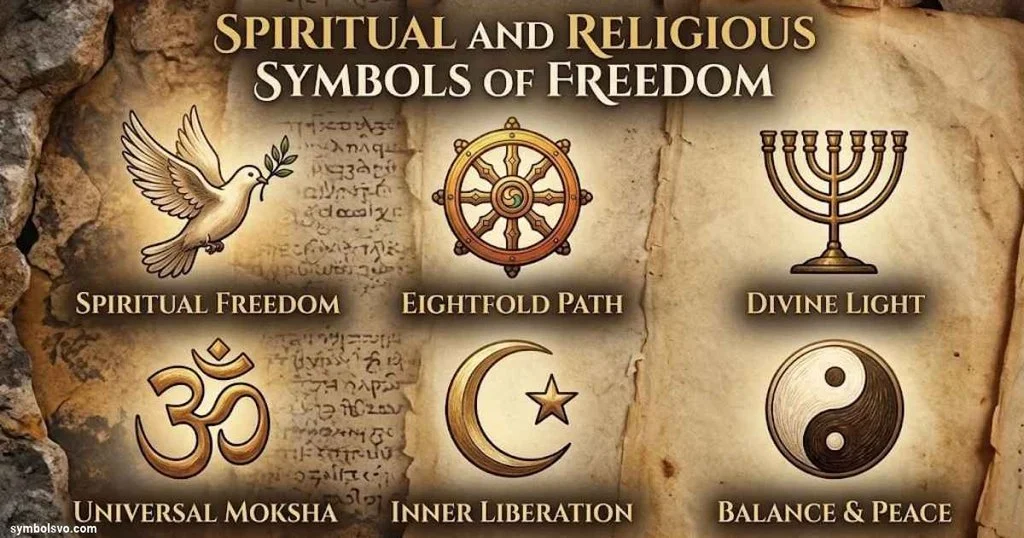
Spiritual freedom is different from political liberty. It often refers to freedom from suffering, ignorance, attachment, or spiritual limitations.
Religious traditions have their own concepts and symbols for these ideas.
Lotus Flower: Spiritual Growth and Liberation
The lotus flower has deep significance in Hinduism and Buddhism.
Its ability to grow from muddy water and produce a beautiful flower makes it a powerful image of spiritual development.
In Buddhist traditions, the lotus is associated with purity and enlightenment. In Hindu traditions, it appears in religious imagery connected with divine figures and spiritual qualities.
Its common meanings include:
- Spiritual growth
- Purity
- Enlightenment
- Renewal
- Rising above difficult circumstances
The lotus can represent spiritual freedom because it is associated with moving beyond ignorance and developing a deeper understanding of life.
Dharma Wheel: The Buddhist Path to Liberation
The Dharma Wheel, also called the Dharmachakra, is an important Buddhist symbol.
It represents the teachings of the Buddha and the path toward understanding and liberation from suffering.
Its eight spokes are commonly connected with the Noble Eightfold Path:
- Right Understanding
- Right Intention
- Right Speech
- Right Action
- Right Livelihood
- Right Effort
- Right Mindfulness
- Right Concentration
The wheel is not simply a general symbol of independence. Its deeper meaning relates to Buddhist teachings, ethical living, and the path toward enlightenment.
Moksha: Freedom From the Cycle of Rebirth
Moksha is a central concept in Hindu philosophy.
It refers to liberation from samsara, the cycle of birth, death, and rebirth. Different Hindu philosophical traditions explain the nature of Moksha in different ways.
It is associated with freedom from ignorance, attachment, and the limitations of worldly existence.
Moksha is a spiritual concept rather than a physical emblem. However, it is highly relevant when discussing spiritual symbols of freedom and liberation.
Ankh: The Ancient Egyptian Symbol of Life
The Ankh is an ancient Egyptian symbol shaped like a cross with a loop at the top.
It primarily represents life, vitality, and divine power. Ancient Egyptian artwork frequently shows gods holding the Ankh or offering it to kings.
Although people sometimes associate it with spiritual freedom and eternal existence, its central historical meaning is life.
Understanding this distinction prevents its meaning from being confused with symbols that directly represent political liberty.
White Dove: Spiritual Peace
The white dove also has an important place in Christian symbolism.
It is associated with the Holy Spirit and appears in accounts of Jesus’ baptism. In wider culture, it communicates peace, hope, and reconciliation.
Its relationship with freedom comes through the idea of spiritual peace and freedom from fear or conflict.
Christian Resurrection Imagery
The empty tomb is an important image in Christianity because it represents the resurrection of Jesus.
Christian teachings connect the resurrection with victory over death and the promise of spiritual life.
For believers, resurrection imagery can represent:
- Hope and renewal
- Freedom from sin
- Victory over death
- Spiritual transformation
- New life
These meanings belong to Christian theology and should be understood within that religious context.
Cultural Symbols of Freedom Around the World
Different societies use their own historical objects, flags, figures, and traditions to communicate freedom.
Some symbols have become internationally recognizable, while others carry specific meanings within their original cultures.
| Culture or historical context | Symbol | Meaning |
| United States | Bald Eagle | National identity and independence |
| United States | Statue of Liberty | Liberty and enlightenment |
| United States | Liberty Bell | Liberty and equality |
| France | Phrygian Cap | Revolutionary liberty |
| France | Marianne | French Republic and liberty |
| Ancient Rome | Libertas | Personification of liberty |
| Ancient Rome | Pileus | Freedom from slavery |
| Akan culture | Fawohodie | Independence and freedom |
| Hindu traditions | Moksha | Spiritual liberation |
| Buddhist traditions | Dharma Wheel | The path toward liberation |
| LGBTQ+ communities | Rainbow Pride Flag | Visibility, equality, and liberation |
American Freedom Symbols
The United States has several symbols connected with national independence and liberty.
The bald eagle represents national identity and strength. The Statue of Liberty communicates enlightenment and freedom, while the Liberty Bell has become associated with equality and civil rights.
Broken chains also appear in American liberty imagery, connecting freedom with emancipation and the struggle against slavery.
French Freedom Symbols
French freedom symbolism developed strongly during the French Revolution and later political movements.
The Phrygian cap, French Tricolor, and Marianne are important examples.
They represent revolutionary ideals, republican identity, and the idea that political power should not rest entirely with a monarch.
Roman Symbols of Liberty
Ancient Roman culture contributed several symbols that later influenced European liberty imagery.
These include Libertas, the pileus, and the vindicta rod.
Their meanings are closely connected with citizenship, legal freedom, and the formal process of freeing enslaved people.
Akan Freedom Symbol: Fawohodie
Fawohodie represents independence and freedom within Akan Adinkra tradition.
Its message also highlights responsibility. This makes it especially meaningful because it connects personal liberty with the choices people make after gaining freedom.
Hindu and Buddhist Symbols
Hindu and Buddhist traditions include several concepts and images connected with spiritual liberation.
The lotus, Dharma Wheel, Garuda, and Moksha are relevant examples, although each has a distinct religious meaning.
It is important not to treat these symbols as interchangeable. Their significance comes from specific teachings and traditions.
Rainbow Pride Flag: Freedom and Equal Rights
The Rainbow Pride Flag is a modern symbol associated with LGBTQ+ communities.
It communicates visibility, identity, equality, and the freedom to live openly. Its connection to freedom comes through the struggle for equal rights and protection from discrimination.
It is a specific community symbol rather than a universal emblem of political independence.
Colors That Represent Freedom
Colors can communicate freedom through flags, artwork, clothing, and public celebrations. However, their meanings change across cultures and political settings.
| Color | Common association | How it can relate to freedom |
| Blue | Peace, calmness, and possibility | Open skies and peaceful societies |
| White | Peace and hope | Reconciliation and new beginnings |
| Red | Courage, revolution, and sacrifice | Resistance and political struggle |
| Green | Growth and renewal | Hope and national or personal development |
Blue: Open Possibilities
Blue is often associated with the sky and ocean. These natural images can create a sense of openness and possibility.
In freedom-related artwork, blue can communicate peace, independence, and a future without visible boundaries.
White: Peace and Hope
White is commonly associated with peace and reconciliation.
The white dove is a familiar example. In many contexts, white can also communicate a fresh beginning or the hope of a peaceful future.
Red: Courage and Revolution
Red can represent courage, sacrifice, and revolutionary struggle.
Its meaning depends heavily on the flag, movement, or historical event in which it appears.
Green: Growth and Renewal
Green is often connected with nature, growth, and renewal.
In certain national and political contexts, it can also carry meanings related to independence, identity, and hope.
No color has one fixed meaning everywhere. Always consider the cultural or historical context before interpreting a flag or artwork.
Symbols of Personal Freedom and Inner Liberation
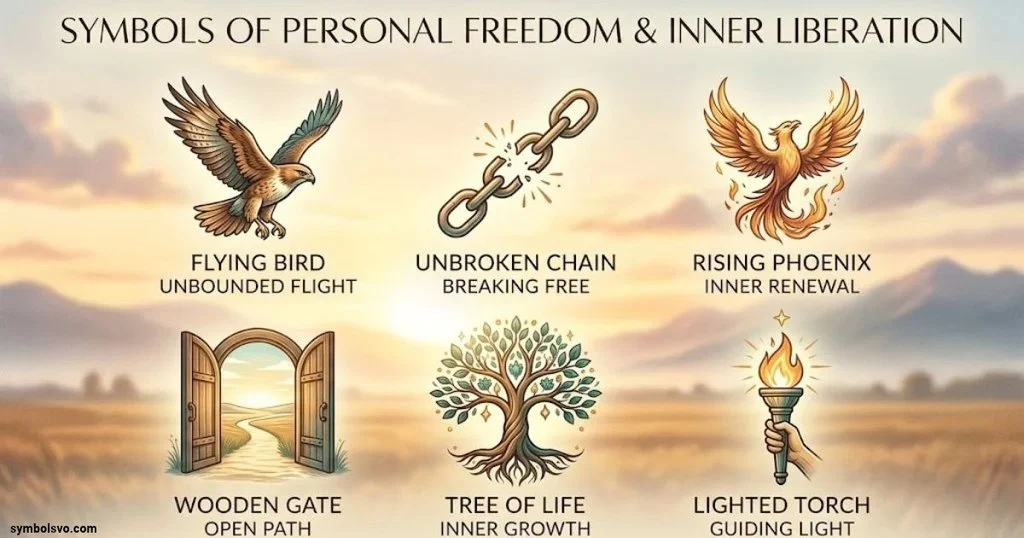
Not every kind of freedom involves national borders or political movements. Many people use symbols to express their personal experiences and emotional journeys.
These symbols of personal freedom often communicate independence, self-expression, and the ability to make meaningful choices.
Freedom From Limitations
Broken chains, open doors, and unlocked locks are useful images for expressing the end of restrictions.
They can represent leaving an unhealthy situation, overcoming social expectations, or gaining control over personal decisions.
Independence and Self-Determination
A compass, flying bird, or wild horse can represent the freedom to choose your own direction.
These images are especially relevant to people who value autonomy and personal responsibility.
Personal Transformation
Butterflies, phoenixes, and sunrises are common symbols of change.
They can represent moving beyond past experiences and creating a different future.
Emotional and Spiritual Freedom
Lotus flowers, flowing water, and open skies can communicate inner peace and spiritual growth.
Their meanings are often personal. Someone may choose a lotus to represent a spiritual journey, while another person may associate flowing water with emotional release.
These symbols can express:
- Confidence and self-discovery
- Freedom of expression
- Emotional resilience
- Inner peace
- Personal growth
- Freedom of choice
Freedom Symbols in Art, Literature, and Popular Culture
Artists and writers have used symbols to explore freedom, oppression, independence, and resistance.
A symbol can communicate a complicated idea without explaining it directly. A flag, bird, or human figure can become a powerful visual representation of an entire movement.
Liberty Leading the People by Eugène Delacroix
Liberty Leading the People is a famous painting by French artist Eugène Delacroix.
Created in 1830, it commemorates the July Revolution in France. The painting depicts Marianne as an allegorical figure of Liberty leading people over a barricade.
She holds the French Tricolor in one hand and a weapon in the other. A Phrygian cap appears on her head, reinforcing the painting’s connection with revolutionary liberty.
The artwork combines several symbols of independence:
- The French flag represents national identity.
- Marianne represents liberty and the republic.
- The Phrygian cap connects the image with revolutionary freedom.
- The people represent collective resistance.
The painting remains one of the best-known artistic representations of revolution and liberty.
I Know Why the Caged Bird Sings by Maya Angelou
Maya Angelou’s autobiography I Know Why the Caged Bird Sings uses the image of a caged bird to explore oppression and the desire for freedom.
The contrast between a caged bird and a free bird communicates the difference between restriction and independence.
This imagery has become a widely recognized literary metaphor for unequal opportunities, personal expression, and the struggle to live freely.
Narrative of the Life of Frederick Douglass
Frederick Douglass’s autobiography explores his experiences under slavery and his journey toward freedom.
The book highlights the relationship between literacy, knowledge, self-determination, and liberation.
It also shows that freedom involves more than physical release. Access to education and the ability to think and speak independently are important parts of human dignity.
1984 by George Orwell
George Orwell’s 1984 explores a society where the government controls information, language, and individual behavior.
The novel examines political oppression and the loss of independent thought.
Its themes connect closely with freedom of expression, personal autonomy, and the right to question authority.
Music and Protest Culture
Music has also played an important role in movements for freedom and equality.
Bob Dylan’s song Blowin’ in the Wind became associated with protest culture and questions about war, peace, and civil rights.
Protest songs can become symbols of collective resistance because they give people a shared way to express their experiences and demands.
Freedom Tattoo Symbols and Their Meanings
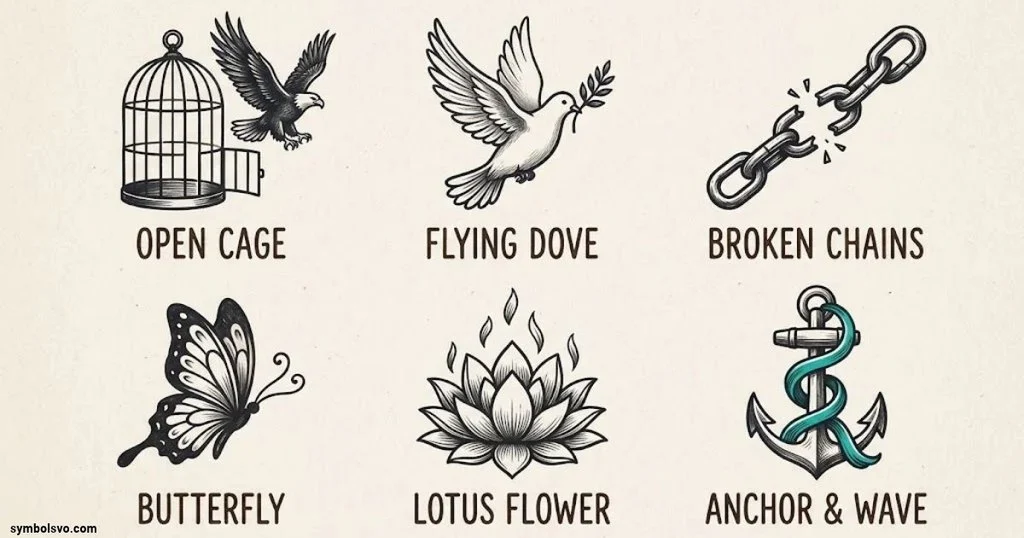
A freedom tattoo can represent a personal experience, a belief, or an important change in someone’s life.
Some people choose a symbol to remember how they overcame a difficult period. Others use tattoos to communicate independence, self-expression, or spiritual growth.
Here are some meaningful freedom tattoo ideas:
| Tattoo symbol | Possible meaning |
| Flying Bird | Independence and possibility |
| Eagle | Strength and liberty |
| Butterfly | Personal transformation |
| Phoenix | Rebirth and resilience |
| Broken Chain | Liberation from restrictions |
| Open Birdcage | Escape and personal choice |
| Feather | Lightness and personal meaning |
| Compass | Direction and self-determination |
| Lotus Flower | Spiritual growth |
| Open Road | New beginnings and exploration |
| Phrygian Cap | Historical liberty and revolution |
| Raised Fist | Resistance and solidarity |
Before choosing a design, consider a few important points:
- Understand the meaning: Research the symbol’s history instead of choosing it only for appearance.
- Consider cultural significance: Religious and cultural symbols may have meanings beyond their popular interpretations.
- Choose a personal connection: A symbol becomes more meaningful when it reflects your own experience.
- Think about the message: Decide whether you want to represent political liberty, personal independence, or spiritual freedom.
- Keep the design clear: Simple designs can communicate an idea without unnecessary details.
A meaningful tattoo doesn’t need to be large. A small flying bird, broken chain, or lotus flower can communicate a strong personal message.
How to Choose the Right Symbol of Freedom
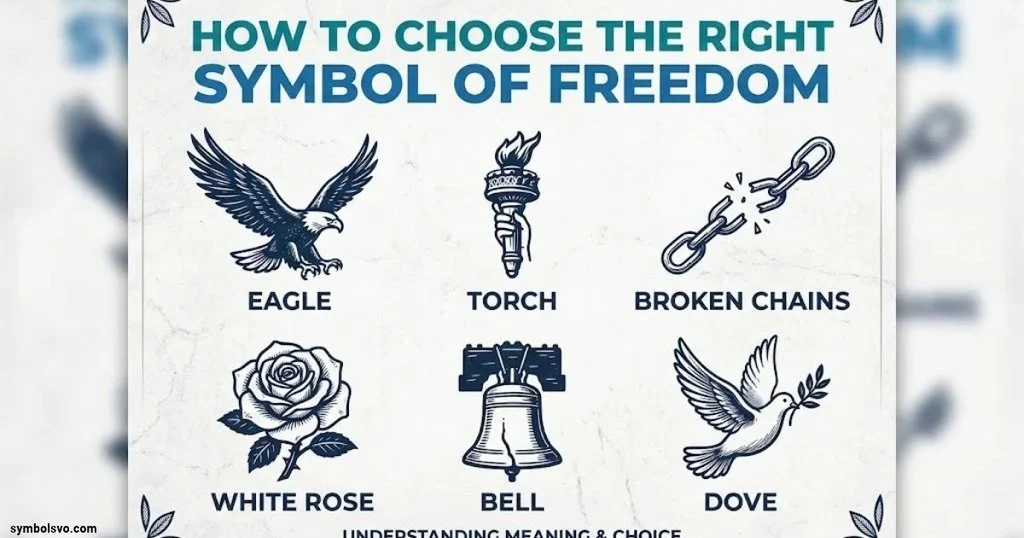
The best symbol depends on what freedom means to you.
Someone celebrating independence from oppression may prefer broken chains. Someone marking a personal transformation may connect more with a butterfly or phoenix.
Use this guide to compare common choices:
| Your intended meaning | Symbols to consider |
| National independence | Bald Eagle, Statue of Liberty |
| Freedom from oppression | Broken Chains, Broken Shackles |
| Political liberty | Phrygian Cap, Libertas |
| Personal independence | Flying Bird, Wild Horse |
| Spiritual liberation | Lotus, Dharma Wheel, Moksha |
| Hope and peace | White Dove, Sunrise |
| Personal transformation | Butterfly, Phoenix |
| Resistance and solidarity | Raised Fist |
| New opportunities | Key, Open Door, Open Road |
| Freedom and responsibility | Fawohodie |
Think about the message you want to communicate before choosing a design. A symbol with a meaningful history may express your idea more clearly than a decorative image with no personal connection.
Frequently Asked Questions About Symbols of Freedom
What Is the Universal Symbol of Freedom?
There is no single symbol that represents freedom universally. Broken chains, flying birds, and the Statue of Liberty are widely recognized examples, but their meanings depend on historical and cultural context.
What Is the Most Powerful Symbol of Freedom?
Broken chains are among the clearest symbols of liberation because they represent freedom from slavery, bondage, and oppression. The Statue of Liberty is another powerful example associated with liberty and enlightenment.
What Animal Symbolizes Freedom?
Birds are commonly associated with freedom because they can fly across open spaces. Eagles often represent strength and independence, while wild horses can symbolize an untamed spirit.
What Bird Represents Freedom?
A flying bird is a common symbol of freedom and possibility. The eagle is also widely associated with liberty, particularly in American national symbolism.
What Do Broken Chains Symbolize?
Broken chains represent liberation from oppression, slavery, imprisonment, and unjust restrictions. They communicate the end of confinement and the beginning of freedom.
What Does a Butterfly Symbolize in Terms of Freedom?
A butterfly often represents transformation, renewal, and personal growth. Its life cycle makes it a popular metaphor for leaving difficult experiences behind and beginning a new chapter.
What Color Represents Freedom?
Blue and white are commonly associated with peace, hope, and open possibilities. Red can represent revolution and sacrifice, while green may communicate growth and renewal. Their meanings vary between cultures and flags.
What Flower Represents Freedom?
The lotus flower is a meaningful choice because of its associations with purity, spiritual growth, and enlightenment in Hinduism and Buddhism. It can represent rising above difficult circumstances.
What Is the Meaning of Fawohodie?
Fawohodie is an Akan Adinkra symbol associated with freedom, independence, and emancipation. Its message also connects freedom with responsibility.
What Does the Phrygian Cap Represent?
The Phrygian cap is associated with liberty and freedom from oppression. It became a recognizable symbol during the French Revolution and was influenced by earlier Roman imagery connected with freed people.
What Are Spiritual Symbols of Freedom?
The lotus flower and Dharma Wheel are important examples in Buddhist traditions. Moksha is a Hindu concept of spiritual liberation. Each has a distinct religious meaning and should not be treated as interchangeable.
What Are Some Meaningful Freedom Tattoo Ideas?
Popular choices include flying birds, broken chains, butterflies, phoenixes, lotus flowers, eagles, and compasses. Choose a design that reflects your own experience and research its cultural meaning before getting it tattooed.
Conclusion: Freedom Has Many Meanings
Symbols of freedom communicate ideas that words sometimes struggle to express. Broken chains represent liberation from oppression, while the eagle and Statue of Liberty are closely associated with liberty and independence. The Phrygian cap and Fawohodie carry important historical and cultural meanings, while the butterfly and phoenix often represent personal transformation.
Freedom can mean political independence, personal choice, equal rights, or spiritual liberation. That’s why different cultures and individuals connect with different symbols.
When choosing a freedom symbol, consider its history, cultural meaning, and personal significance. The most meaningful choice is one that clearly represents the kind of freedom you want to express.

I’m Daniel Brooks, a content creator and symbol enthusiast dedicated to researching the fascinating world of signs and symbols. I enjoy discovering the hidden meanings behind famous icons, emojis, historical emblems, and cultural symbols. Through my writing, I aim to provide trustworthy, well-researched, and reader-friendly information that helps people learn something new with every visit.
Books:
- The Complete Guide to World Symbols
- The Power of Universal Signs
 Mason Ellington
 Nathan Holloway