
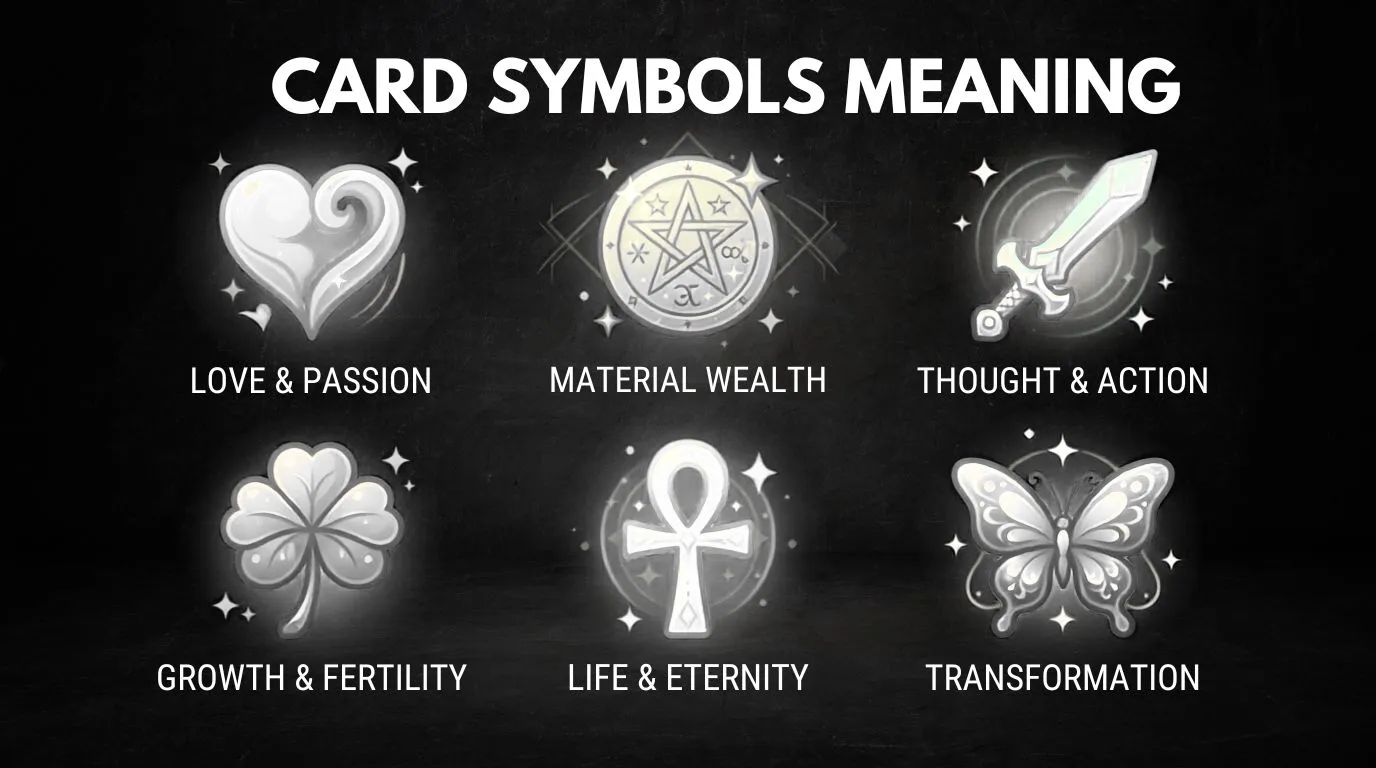
I’ve always been fascinated by the hidden stories cards tell, and I know you’ve felt that same pull when a symbol jumps out at you. You pick up a deck, see those shapes and colors, and suddenly wonder what message is waiting just for you.
That’s exactly why I put this together—so you can finally decode what those card symbols meaning truly hold without the confusion. You’re about to discover clear, practical insights that turn every reading into something personal and powerful.
Whether you’re just starting out or looking to go deeper, these titles will help you find the exact guidance you need right now. Let’s unlock those meanings together.
Quick Answer
Card symbols meaning refers to the historical, psychological, and spiritual symbolism behind the four suits: Hearts, Diamonds, Clubs, and Spades. Originating from medieval social classes, they represent the human experience, balancing light and shadow. Hearts symbolize emotion and water; Diamonds represent wealth and earth; Clubs signify intellect and fire; Spades embody struggle and air.
Quick Facts About Card Symbols Meaning
| Aspect | Information |
| Origin | Ancient China and Mamluk Egypt, evolving into Western Europe during the 14th century. |
| Historical Significance | Originally represented medieval social classes (Clergy, Nobles, Merchants, Peasants). |
| Main Meaning | The four seasons, the four elements of nature, and the core pillars of human society. |
| Spiritual Meaning | The journey of the soul through emotional, material, intellectual, and spiritual trials. |
| Cultural Importance | A universal visual language used in gaming, magic, art, divination, and psychology. |
| Modern Usage | Casino branding, pop culture, tattoo artistry, luxury fashion, and psychological archetypes. |
What Are Card Symbols?
At their core, card symbols, also known as pips, are the four distinct shapes used to categorize a standard deck of cards. Today, we recognize them instantly as Hearts, Diamonds, Clubs, and Spades. However, their journey to your kitchen table was a long and winding one.
Playing cards first emerged in ancient China during the Tang Dynasty as money-based games. As trade routes expanded, these concepts flowed into Persia and Mamluk Egypt. The Mamluk deck featured complex, hand-painted designs consisting of cups, coins, swords, and polo sticks.
[Mamluk Suits] -> [German/Swiss Suits] -> [French Suits (Modern)]
Cups -> Acorns -> Hearts
Coins -> Bells -> Diamonds
Swords -> Leaves -> Spades
Polo Sticks -> Hawks/Shields -> Clubs
When these cards arrived in Europe via trade ports in Italy and Spain during the late 1300s, European artisans adapted the symbols to reflect their own world. The French eventually standardized the deck in the late 15th century. They invented the simple, single-color stencils we use today because they were cheap and fast to print. This manufacturing choice turned a luxury item for kings into a global pastime for everyone.
Deep Symbolic Meaning of Card Symbols
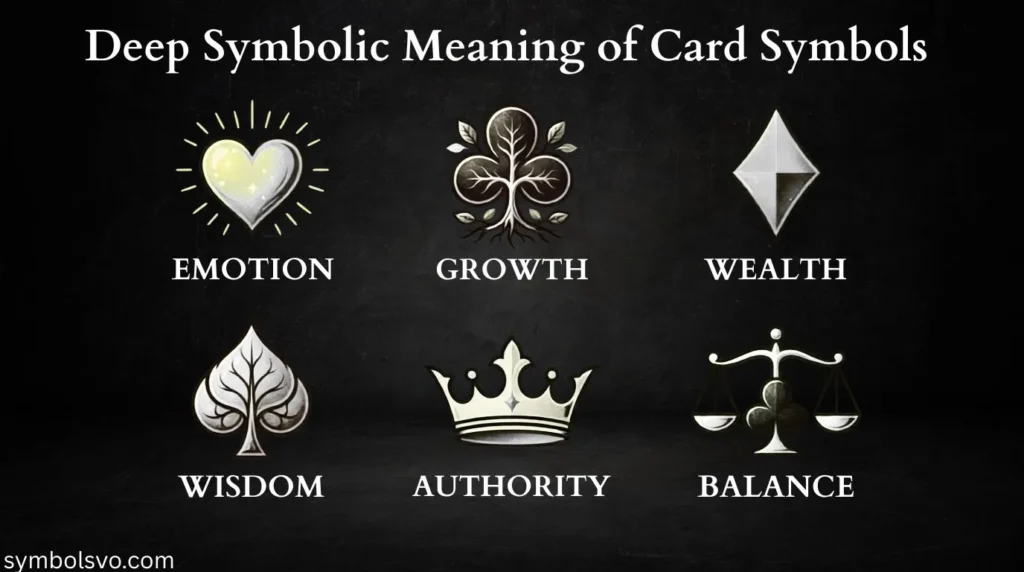
To fully grasp the card symbols meaning, we have to look at them through three distinct lenses: the spiritual, the psychological, and the cultural.
Spiritual Level
On a spiritual path, a deck of cards functions as a map of human consciousness. The four suits mirror the four classical elements of nature. Hearts represent water, flowing with intuition and love. Diamonds represent earth, grounding us in physical reality and manifestation. Clubs represent fire, sparking creativity, passion, and willpower. Spades represent air, lifting us into the realms of intellect, communication, and spiritual transitions.
Psychological Level
Psychologist Carl Jung wrote extensively about archetypes, which are universal symbols stored in the human collective unconscious. Card symbols fit perfectly into this theory.
- Hearts represent the Lover archetype, managing our deep need for connection, vulnerability, and emotional safety.
- Diamonds represent the Creator or Provider, driving our ambition to build security and collect resources.
- Clubs represent the Sage, fueled by curiosity, logic, and the pursuit of knowledge.
- Spades represent the Warrior, showing our willingness to face conflict, make tough choices, and accept endings.
Cultural Level
Historically, the suits mirrored the rigid structure of medieval European society. Hearts represented the Clergy (the church, love, and morality). Diamonds belonged to the Merchants (the wealthy trading class who controlled the coin). Clubs signified the Peasants and Farmers (the agricultural workers who tilled the land with wooden tools). Spades represented the Nobility and Military Knights (the rulers who carried swords to protect or conquer).
Types and Variations of Card Symbols
Let’s break down the individual card symbols meaning for each of the four standard suits, exploring their visual traits and deepest cultural connections.
Hearts (♥)
- Visual Description: A symmetrical, two-lobed shape tapering to a sharp point at the bottom, colored in vibrant red.
- Meaning: Love, deep emotion, relationships, family, and the human soul.
- Symbolism: It represents the literal heart as the seat of feelings, alongside the life-giving element of water.
- Cultural Connection: Tied closely to the Holy Grail in Christian lore, symbolizing purity and divine love.
- Where It Appears: Romantic literature, religious art, modern Valentine’s Day imagery, and dream symbolism regarding family healing.
Diamonds (♦)
- Visual Description: A sharp, four-sided lozenge or rhombus, rendered in striking red.
- Meaning: Material wealth, stability, clarity, determination, and the physical world.
- Symbolism: Reflects the shape of ancient coins or precious gemstones cut from the earth.
- Cultural Connection: Associated with the merchant guilds of Europe and the Roman god Mercury, the patron of trade.
- Where It Appears: Financial branding, luxury fashion logos, royal crests, and folk stories about hidden treasures.
Clubs (♣)
- Visual Description: A black, three-leafed clover shape (cloverleaf) resting on a short stem.
- Meaning: Growth, intellect, physical labor, willpower, and creative energy.
- Symbolism: Derived from the wooden club or staff, representing the natural world and the spark of fire.
- Cultural Connection: In Celtic traditions, the three-leaf clover signifies luck, balance, and the interconnectedness of life.
- Where It Appears: Heraldry, agricultural festivals, architectural motifs, and literary allegories about hard work.
Spades (♠)
- Visual Description: An upside-down black heart resting on a small triangular pedestal, resembling a stylized shovel or leaf.
- Meaning: Wisdom, dynamic change, struggle, intellect, and the inevitable passage of time.
- Symbolism: Represents the iron tip of a spear or a gravedigger’s shovel, linked to the element of air.
- Cultural Connection: Linked directly to military strategy, knightly chivalry, and the ancient warrior class.
- Where It Appears: Military insignia, classic war novels, gothic art, tattoo designs, and film noir imagery.
Card Symbols Meaning Love
Playing-card symbols can carry romantic or symbolic meanings, especially in tattoos, artwork, gifts, and personal designs. Hearts are the most obvious suit associated with love, affection, relationships, and emotional connection. Diamonds can represent value, attraction, or something precious, while clubs may suggest friendship, energy, or social connection. Spades are sometimes linked with strength, mystery, transformation, or difficult experiences. These meanings are not universal rules, so the interpretation often depends on the design and personal context.
Card Symbols Meaning Tattoo
Card symbols are popular tattoo elements because each suit can suggest a different idea. A heart commonly represents love and emotion, a diamond may symbolize value or ambition, a club can suggest friendship or determination, and a spade may represent strength, mystery, or change. A full deck, individual card, or combination of suits can also represent luck, risk, strategy, competition, or important life choices. The meaning ultimately depends on the person wearing the tattoo.
Club Card Symbol Meaning
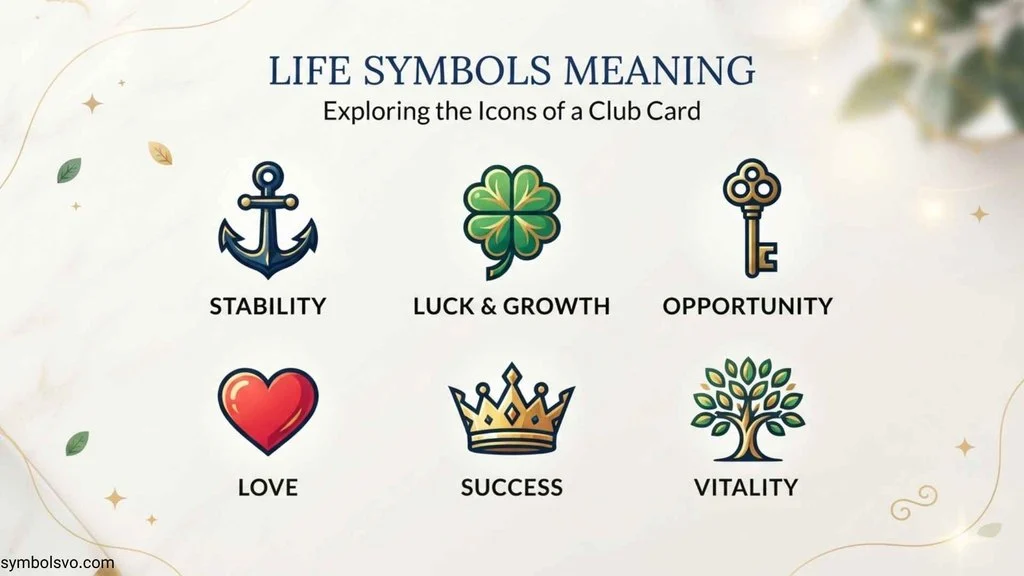
The club suit is traditionally represented by a three-lobed symbol that resembles a stylized leaf or trefoil. In many modern interpretations, clubs are associated with energy, action, friendship, ambition, and social relationships. In cartomancy, interpretations can vary depending on the system being used. Historically, the suit developed as one of the four standard suits in Western playing cards.
Card Suits Names
The four standard playing-card suits in the commonly used French-suited deck are:
- Hearts ♥
- Diamonds ♦
- Clubs ♣
- Spades ♠
Each suit contains 13 cards in a standard 52-card deck: ace through 10, followed by jack, queen, and king. Different countries and historical card traditions use other suit systems, so these names are specifically associated with the French-suited deck.
4 Suits of Cards Meaning
The four suits are often given symbolic meanings, although these interpretations are not official rules of playing cards. Hearts are commonly connected with emotions and relationships. Diamonds may represent wealth, material value, or resources. Clubs are sometimes associated with action, work, growth, or social life. Spades can symbolize strength, challenges, authority, mystery, or transformation. In games, however, suits generally have whatever meaning the particular game assigns to them.
Card Suit Symbols
The four familiar card suit symbols are ♥ heart, ♦ diamond, ♣ club, and ♠ spade. They are called suit symbols or suit marks and are used to identify the four categories within a standard deck. Their shapes are instantly recognizable and have become common symbols in typography, tattoos, logos, games, and popular culture.
Spade Card Symbol Meaning
The spade symbol is commonly associated with strength, mystery, seriousness, and transformation in modern symbolic interpretations. Its pointed shape has also contributed to associations with authority and power. In some fortune-telling traditions, spades may be connected with challenges or difficult situations. However, a spade does not have one fixed meaning across every card game, cultural tradition, or symbolic system.
Pokémon Card Symbols Meaning
Pokémon Trading Card Game cards contain several symbols that provide information about the card, including its type, rarity, set, energy requirements, and other game-related details. Some symbols identify card categories or special mechanics, while set and rarity marks can help players identify how a card fits within a particular expansion. Because Pokémon has introduced many card designs over the years, the meaning of a symbol can depend on the specific card generation or set.
Playing Card Symbols Meaning
Playing-card symbols can be understood in two ways: their practical role in card games and their symbolic interpretation. In a standard French-suited deck, hearts, diamonds, clubs, and spades simply identify suits. Outside games, people often attach broader meanings to them, such as love for hearts, wealth for diamonds, action or friendship for clubs, and strength or mystery for spades. These symbolic associations are interpretations rather than universal definitions.
SD Card Symbols Meaning
SD cards contain symbols and markings that provide technical information about their specifications and capabilities. Common markings can indicate capacity, speed class, UHS performance, video speed class, or application performance. For example, a number inside a C indicates a Speed Class rating, while a number inside a U relates to UHS Speed Class. These symbols are useful when choosing a memory card for cameras, phones, gaming devices, and other electronics.
Lorcana Card Symbols Meaning
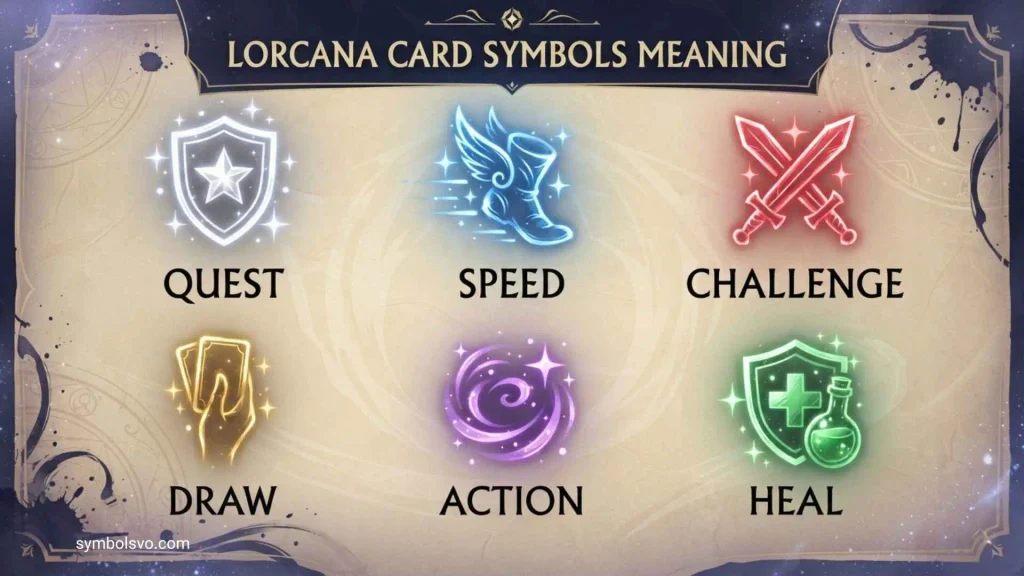
Disney Lorcana cards use symbols and visual indicators to communicate gameplay information. Card designs include details related to ink colors, card types, costs, strength, willpower, abilities, and other mechanics. Some symbols are primarily functional and help players understand how a card works during a game. The exact interpretation should be based on the current rules and the information printed on the card.
Micro SD Card Symbols Meaning
MicroSD cards use many of the same technical markings found on full-size SD cards. These can identify storage capacity, speed class, UHS class, video speed class, or application performance. A C10 marking, for example, refers to Class 10 Speed Class, while U1 and U3 identify UHS Speed Classes. Understanding these symbols can help users select a card suitable for recording video, storing photos, running applications, or expanding device storage.
MTG Card Symbols Meaning
Magic: The Gathering cards use symbols extensively to communicate gameplay information. Mana symbols show the types of resources used to cast spells, while set symbols identify the expansion in which a card was printed. Other symbols can indicate abilities, rarity, card types, or special mechanics. Because MTG has a large and evolving rules system, a symbol’s meaning may depend on where it appears on the card.
Poker Card Symbols Meaning
Poker uses the same four traditional suits found in a standard French-suited deck: hearts, diamonds, clubs, and spades. In most common poker variants, suits do not have an inherent ranking, and a flush in one suit is generally not automatically stronger than a flush in another. Their main purpose is to identify the suits of the five cards in a player’s hand and help determine combinations such as flushes and straight flushes.
Tarot Card Symbols Meaning
Tarot cards contain numerous visual symbols, including animals, colors, objects, numbers, landscapes, gestures, and celestial imagery. Their meanings vary between decks and reading traditions. The Major Arcana often uses symbolic imagery to explore themes such as beginnings, choices, change, knowledge, challenges, and personal development. The Minor Arcana includes four suits, traditionally connected with different areas of experience.
UNO Card Symbols Meaning
UNO uses simple visual symbols to communicate the actions of its cards. Number cards display their values, while action cards use symbols to indicate effects such as skipping a player, reversing the direction of play, or drawing additional cards. Wild cards allow players to change the current color or trigger a special effect depending on the particular version of UNO being played. Special editions may introduce additional symbols and rules.
Alice in Borderland Card Symbols Meaning
In Alice in Borderland, playing cards are used as a visual system for identifying different types of games. The four suits correspond to different styles of challenges. Hearts generally focus on psychological and interpersonal challenges, while Diamonds emphasize intelligence and strategy. Clubs tend to involve cooperation and teamwork, whereas Spades are associated with physical challenges. The suit therefore gives viewers an important clue about the nature of a game.
Credit Card Symbols Meaning
Credit cards can contain several symbols and marks that identify payment networks, security features, or card capabilities. Common examples include the contactless payment symbol, chip symbol, card-network logo, and sometimes additional marks related to digital wallets or security technology. The exact symbols vary by issuer and payment network. These markings help identify how the card can be used and what payment technologies it supports.
Skylander Card Symbols Meaning
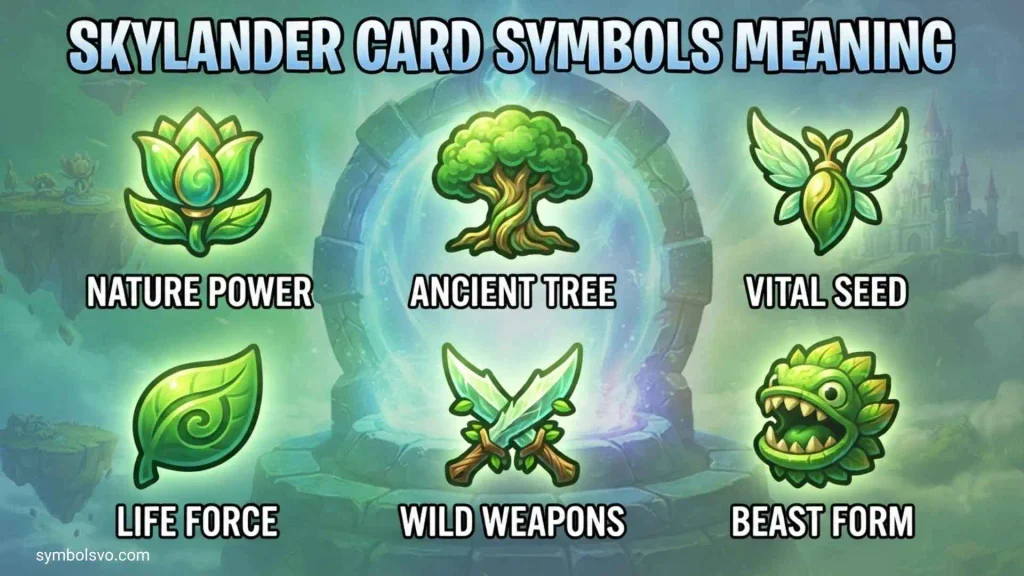
Skylanders-related cards and collectibles can contain symbols, numbers, artwork, and other identifiers connected with characters or gameplay. Their meaning can vary depending on the specific Skylanders product, card set, or game. When interpreting a particular card, the most useful clues are its printed text, character information, icons, and the product series to which it belongs.
Debit Card Symbols Meaning
Debit cards may display several symbols that indicate their payment and security features. The chip symbol identifies the embedded EMV chip, while the contactless symbol indicates that the card can support tap-to-pay transactions when enabled. Network logos identify the payment system through which transactions are processed. Some debit cards may also display additional symbols related to digital payments or card services.
Access Card Symbols Meaning
Access cards often contain symbols or markings that identify their purpose, technology, or issuing organization. Depending on the system, a card may use an RFID, NFC, magnetic-stripe, or smart-card technology. Some symbols indicate contactless functionality, while printed logos or numbers may identify the building, institution, or access system. The exact meaning depends on the specific access-control system.
Rider-Waite The Fool Card Symbols Meaning
In the Rider-Waite-Smith Tarot, The Fool is rich in visual symbolism. The figure is shown at the beginning of a journey, carrying a small bundle and accompanied by a dog. The cliff edge suggests an unknown future or willingness to step into unfamiliar territory. The bright landscape and upward-looking figure can suggest openness, possibility, freedom, and a new beginning. The card is commonly interpreted in relation to beginnings, spontaneity, exploration, and taking a leap into a new experience.
Deck of Card Symbols Meaning
A deck of cards contains four primary suit symbols in the French-suited tradition: hearts, diamonds, clubs, and spades. Beyond their function in games, these symbols have developed cultural associations over time. Hearts are frequently connected with emotions, diamonds with value, clubs with action or social energy, and spades with strength or mystery. Their interpretation changes depending on whether they are being used in games, art, fortune-telling, or popular culture.
Disney Lorcana Card Symbols Meaning
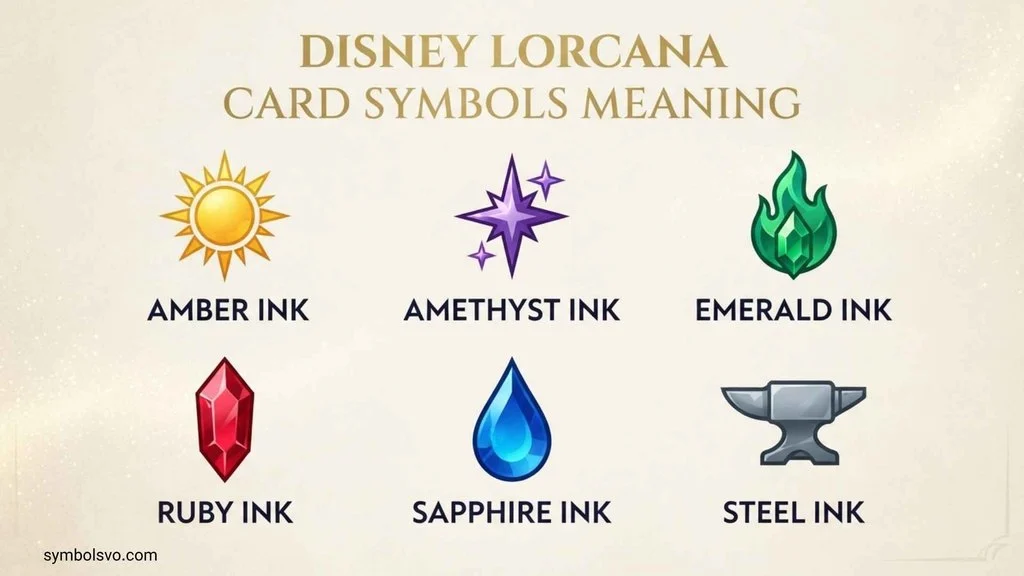
Disney Lorcana uses a variety of symbols to help players understand cards and gameplay. Symbols can communicate ink costs, card characteristics, abilities, and other game information. The visual design combines Disney characters with a collectible card-game structure, so some symbols are functional rather than symbolic in a traditional cultural sense. For accurate interpretation, the card’s text and the rules for its particular release should be considered together.
4 Card Symbols Meaning
The four classic card symbols are ♥, ♦, ♣, and ♠. They represent the four suits of a standard French-suited playing-card deck. In everyday symbolic interpretations, the heart is often associated with love and emotion, the diamond with value and wealth, the club with action or friendship, and the spade with strength, mystery, or challenges. These meanings are cultural interpretations rather than fixed rules of card games.
Card Symbols Across Different Cultures
The concept of dividing a deck into four symbolic categories appears across numerous global traditions, each giving unique flavors to the meanings.
Ancient Egypt
While the Egyptians did not use modern playing cards, their symbolic systems heavily inspired the Mamluk cards. For example, the Egyptian ritual cup symbolized the womb of creation and the divine feminine, which eventually evolved into the suit of Hearts.
Ancient Greece
Greek philosophers viewed the universe through the four elements. They believed that health and destiny depended on balancing these forces. This foundational logic directly shaped how European mystics later interpreted the four card suits.
Roman Culture
In Roman society, citizens were deeply divided by class and profession. The tools of their daily lives, like the military gladius (sword) and the merchant’s denarius (coin), laid the early conceptual groundwork for Spades and Diamonds.
Eastern Traditions
In ancient China and Japan, early card games utilized monetary values, such as strings of coins and tens of myriads. These symbols reflected local economic life and the spiritual pursuit of prosperity, blending practical survival with cosmic alignment.
Indigenous Traditions
Many Native American cultures utilize the Medicine Wheel, which divides the universe into four sacred directions, four colors, and four stages of life. When exposed to Western playing cards, many tribal elders recognized a familiar spiritual geometry in the four-part layout.
Modern Interpretations
Today, global pop culture has unified these symbols. They no longer belong to one single nation. From Tokyo anime to Las Vegas casinos, the four suits serve as a universal shorthand for risk, strategy, fate, and human desire.
Similar Symbols and Their Meanings
To understand card symbols meaning even better, it helps to compare them to their sister system: the Tarot deck. Modern playing cards are direct descendants of the Minor Arcana in Tarot.
| Playing Card Suit | Tarot Equivalent | Main Shared Meaning | Common Misconception |
| Hearts (♥) | Cups | Emotions, Intuition, Love | People think Hearts only mean romance; they actually cover all deep emotions, including grief. |
| Diamonds (♦) | Pentacles / Coins | Finances, Career, Physicality | Many assume Diamonds mean greed, but they truly symbolize stability and security. |
| Clubs (♣) | Wands / Staves | Action, Passion, Creativity | Often mistaken for violence due to the word “club,” they actually represent mental growth. |
| Spades (♠) | Swords | Strategy, Truth, Challenges | Widely feared as symbols of physical death, they actually represent mental clarity and fresh starts. |
Card Symbols in Mythology and Folklore
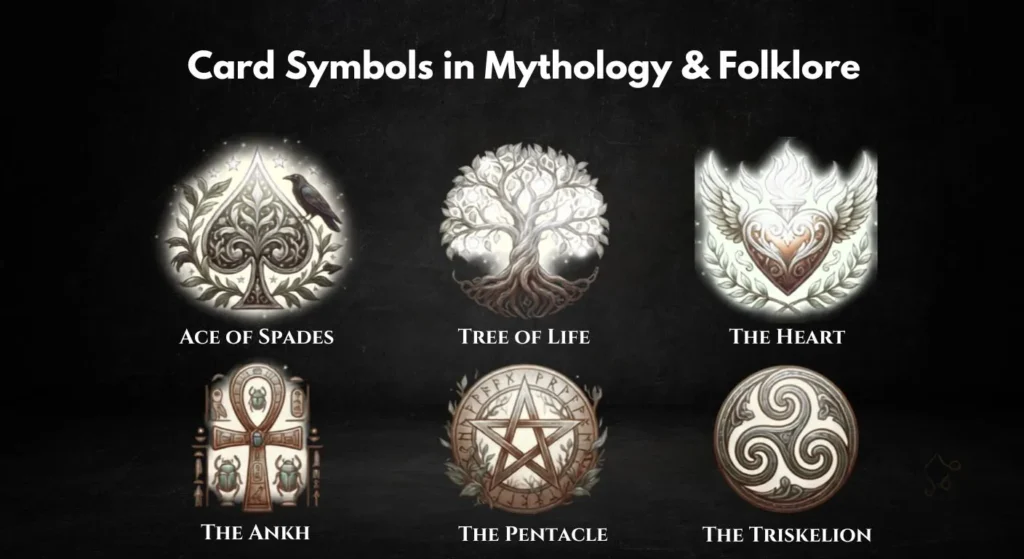
In European folklore, playing cards were often called “The Devil’s Picture Book,” because people believed they held magical powers.
One famous German legend tells of a gambler who tried to trick the devil using a deck of cards. The gambler noticed that whenever he played a Heart, a wave of unexplained compassion swept over the room, ruining the devil’s dark plans.
In Arthurian legends, the four symbols align beautifully with the four sacred relics of King Arthur’s court. The Holy Grail matches the Hearts. The brilliant round table grid reflects the Diamonds. The green staff of Merlin aligns with the Clubs. Excalibur, the legendary sword of truth and justice, perfectly mirrors the Spades.
Card Symbols in Art, Literature, Movies, and Pop Culture
Artists and writers have long used card symbols to tell deeper stories without using words.
Art and Literature
In Lewis Carroll’s classic Alice’s Adventures in Wonderland, the Queen of Hearts rules with absolute, unchecked emotion and fiery rage. Her subjects are living playing cards. By making the villain a Heart, Carroll played with the irony of love turning into tyranny.
Movies and Television
In the classic film Apocalypse Now, American soldiers leave the Ace of Spades on fallen enemies. This psychological tactic tapped into the historical meaning of the Spade as a herald of doom and grim transitions.
[Ace of Spades] -> Symbol of War -> Psychological Tool -> Pop Culture Icon
Tattoos and Fashion
In modern tattoo culture, a King of Hearts often represents a man who rules with his emotions, while a Queen of Spades can symbolize a resilient woman who has survived intense hardships. Luxury fashion brands like Dolce & Gabbana regularly print these symbols on high-end fabrics to evoke a sense of timeless elegance, royalty, and playfulness.
Spiritual and Dream Meaning of Card Symbols
If card symbols start showing up in your dreams or during meditation, your subconscious mind may be sending you a targeted message.
- Dreaming of Hearts: This is usually a gentle call to heal a strained relationship, forgive someone, or open your heart to emotional vulnerability.
- Dreaming of Diamonds: Your mind might be focusing on financial anxiety, career path changes, or a deep desire to build something permanent in the real world.
- Dreaming of Clubs: This indicates a surge of mental energy. It suggests you need to start a creative project, study a new skill, or trust your instincts.
- Dreaming of Spades: A Spade in a dream is a powerful wake-up call. It tells you to cut out toxic habits, speak your truth, or accept that a certain chapter of your life is ending so a better one can begin.
Positive and Negative Meanings of Card Symbols
No symbol is entirely good or entirely bad. Like the yin and yang, each suit holds a healthy balance of light and shadow.
| Suit | Positive Meaning (Light) | Negative Meaning (Shadow) |
| Hearts (♥) | Compassion, empathy, love, deep healing. | Emotional obsession, codependency, naivety. |
| Diamonds (♦) | Financial security, prosperity, focus, logic. | Material greed, vanity, exploitation of others. |
| Clubs (♣) | Intellect, curiosity, growth, collaboration. | Overthinking, restlessness, chaotic energy. |
| Spades (♠) | Wisdom, survival, strength, transformation. | Grief, harsh conflict, cold detachment. |
Why Humans Are Attracted to Card Symbols
Our lasting love affair with card symbols comes down to basic human psychology. The human brain is a natural pattern-recognition machine. We look at the chaotic world around us and constantly try to organize it into simple, recognizable boxes.
Card symbols take the messy, overwhelming complexity of human life and boil it down into four simple icons. Love, money, thought, and struggle. By holding these symbols in our hands, we feel a subtle sense of control over our own unpredictable destinies.
Modern Uses of Card Symbols
Away from the card table, these icons remain highly influential in our modern world.
- Corporate Branding: Online security firms and banks frequently use Diamond shapes in their logos to quietly project ironclad safety and high value.
- Social Media Culture: We use the red heart emoji billions of times every day to signal digital validation, warmth, and instant connection.
- Contemporary Spirituality: Modern mystics use standard playing cards for cartomancy, a traditional form of fortune-telling that predates modern Tarot popularity.
Interesting Facts About Card Symbols
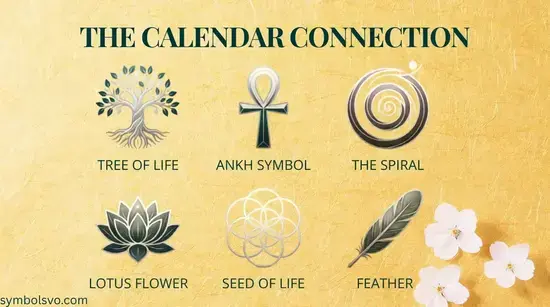
- The Calendar Connection: A standard deck of cards mirrors the structure of our calendar year. There are 52 cards for the 52 weeks, 4 suits for the 4 seasons, and 13 cards per suit for the 13 lunar cycles.
- The Mathematical Mystery: If you add up the values of every single card in a deck, counting Jacks as 11, Queens as 12, and Kings as 13, the total is 364. Add the Joker, and you get 365, the exact number of days in a year.
- The Suicidal King: The King of Hearts is the only king shown without a mustache, and he appears to be driving a sword into his own head. Historians believe this was a printing mistake by lazy artisans copying older designs.
- The Imperial Spades: The Ace of Spades features the largest, most detailed design because of historic tax laws. In 18th-century England, governments stamped that specific card to prove the required luxury tax had been paid.
- The Hidden Map: During World War II, the United States playing card company created secret “map decks” for American prisoners of war. When soaked in water, the paper peeled apart to reveal hidden escape routes.
Frequently Asked Questions
What do the 4 card symbols mean?
The four card symbols represent the key pillars of human existence: Hearts mean love and emotion; Diamonds mean wealth and material assets; Clubs mean intellect and growth; Spades mean struggle, wisdom, and change.
Why are card symbols red and black?
The red and black color scheme was standardized by French cardmakers in the 15th century. Using just two bright, high-contrast colors allowed them to mass-produce stenciled decks quickly and cheaply.
Which card symbol is the most powerful?
In standard card rankings and historical lore, Spades are considered the highest and most powerful suit, representing the ruling noble class, peak intellect, and ultimate authority.
Are playing card symbols related to Tarot?
Yes, playing cards are direct historical relatives of Tarot. Hearts match the Cups, Diamonds match the Pentacles, Clubs match the Wands, and Spades match the Swords.
What is the spiritual meaning of the Ace of Spades?
Spiritually, the Ace of Spades is a dual symbol. While it can warn of upcoming trials or major endings, it also represents deep spiritual awakening, ultimate truth, and the strength to overcome hard times.
Conclusion
Card symbols meaning is a beautiful reminder that everyday items often hide profound history right in plain sight. The next time you shuffle a deck of cards, remember that you are holding an ancient, universal mirror of the human experience. These timeless icons continue to remind us that life is a delicate balance of passion, intellect, fortune, and resilience. Approach the game of life with an open mind, and may you always play the hand you are dealt with grace.
Meta Description:
Discover the fascinating card symbols meaning! Explore the secret history, spiritual roots, and psychological power behind Hearts, Diamonds, Clubs, and Spades.

 Mason Ellington
 Daniel Brooks