Have you ever scrolled past profiles that just feel forgettable while yours blends into the background? I know that quiet frustration of wanting your online presence to truly stand out and reflect who you are.
That’s exactly why I started exploring Username Symbols and found simple, stylish ways to transform plain text into something eye-catching and memorable. You deserve a username that grabs attention and feels uniquely yours every time someone sees it.
In this post I’ll walk you through the best options so you can create a stronger digital identity without any guesswork. Let’s make your profile the one people remember.
Quick Answer
Username symbols are special characters, glyphs, and emojis integrated into digital handles to convey personal identity, status, aesthetics, or tribal belonging. They bridge the gap between ancient symbolic communication and modern digital branding, transforming a plain text name into a unique psychological and visual statement across online platforms.
Quick Facts About Username Symbols
| Aspect | Information |
| Origin | Ancient typography, coding scripts, and early internet chatrooms (IRC). |
| Historical Significance | Evolves from historical monograms, clan crests, and printer marks. |
| Main Meaning | Digital identity customization, individuality, and visual aesthetics. |
| Spiritual Meaning | Manifestation of personal energy, digital talismans, and self-expression. |
| Cultural Importance | Defines subcultures, gaming clans, aesthetic movements, and online status. |
| Modern Usage | Social media profiles, gaming tags, professional branding, and bio decoration. |
What Are Username Symbols?
Username symbols are unique characters outside the standard alphabet and numbering system used to decorate, modify, or elevate online handles. Think of characters like ★, ツ, ꧁ ꧂, or even simple punctuation marks like underscores and periods.
The story of these digital marks began during the dawn of computer programming and early internet chat relay channels. In those days, early internet users faced severe text limitations. To stand out in crowded text-only chat rooms, creative individuals started combining keyboard characters to mimic shapes, art, and faces.
Over time, this practice evolved into a massive cultural phenomenon. What started as basic hacks to bypass registration limits quickly transformed into a sophisticated language of digital aesthetics. Today, these characters act as the modern equivalent of a medieval knight’s shield, helping users stand out, express an emotional vibe, and claim a unique territory in a crowded online world.
Deep Symbolic Meaning of Username Symbols
Spiritual Level
On a deeper level, choosing specific username symbols acts as a form of digital manifestation. When a user places a star, a wave, or a geometric glyph next to their name, they are claiming that energy for their online persona. It functions like an electronic amulet or talisman, projecting intentions of growth, protection, or creativity into the digital spaces they inhabit daily.
Psychological Level
Psychologically, these symbols satisfy our deep human need for unique identity and tribal belonging. Carl Jung spoke extensively about archetypes and the power of universal symbols to communicate things words cannot express. A gamer choosing sharp, aggressive symbols like taps into the warrior archetype. Meanwhile, an artist using soft waves or celestial bodies communicates sensitivity and openness, using visual shorthand to find like-minded people.
Cultural Level
Culturally, username symbols define digital boundaries and social groups. Different online communities use specific typography to signal status or shared values. For example, the aesthetic groups on TikTok use elegant, minimal symbols to represent a clean lifestyle, while coding communities might use specific brackets to show expertise. It is a modern language of social alignment.
Types and Variations of Username Symbols
1. Aesthetic and Decorative Glyphs
- Visual Description: Delicate marks like ✧, ❀, ☾, or 𓆩𓆪.
- Meaning: Beauty, grace, mystery, and connection to nature or the cosmos.
- Symbolism: Represents creativity, peace, and an elevated artistic sense.
- Cultural Connection: Highly popular in modern social media aesthetics, writing circles, and lifestyle blogging.
- Where It Appears: Instagram bios, Pinterest handles, and creative writing forums.
2. Gaming and Clan Markers
- Visual Description: Sharp, bold shapes like 𐕣, 乂, ⚡, or 〠.
- Meaning: Power, competitive edge, dominance, and group loyalty.
- Symbolism: Represents strength, focus, and a warrior mindset.
- Cultural Connection: Deeply rooted in esports, competitive gaming tournaments, and global gaming communities.
- Where It Appears: Discord tags, Steam profiles, and multiplayer gaming handles.
3. Symmetrical Borders and Frames
- Visual Description: Intricate framing characters like ꧁…꧂ or ༒…༒.
- Meaning: Royalty, focus, self-importance, and protection of the core identity.
- Symbolism: Represents a sacred space or a highlighted ego.
- Cultural Connection: Derived from traditional Southeast Asian scripts and ancient royal borders.
- Where It Appears: Global gaming platforms and customized mobile forum handles.
Username Symbols Across Different Cultures
Ancient Egypt
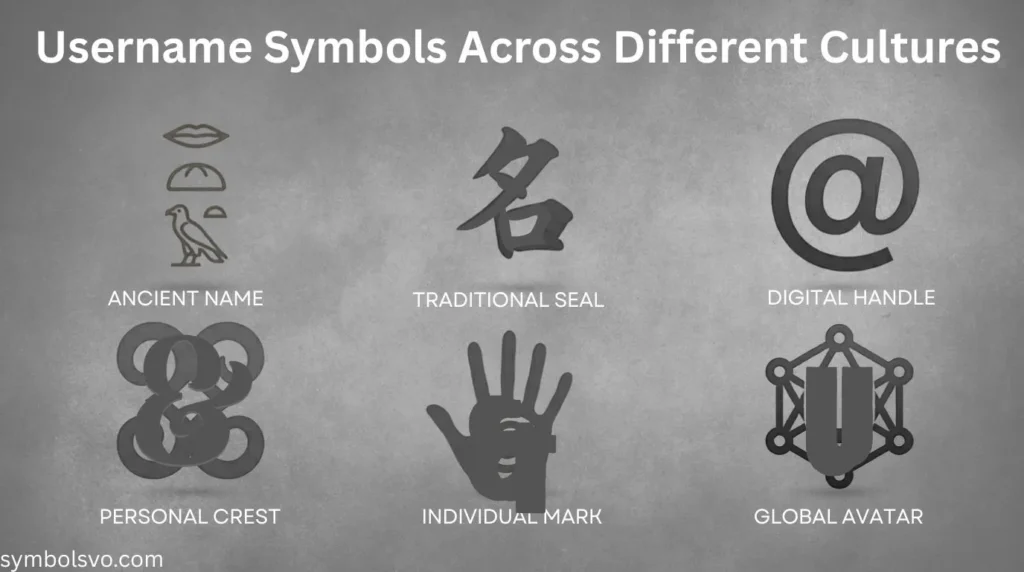
The concept of using symbols for personal names directly mirrors the ancient Egyptian cartouche. In Egypt, royal names were enclosed in a protective oval symbol to shield the pharaoh from evil spirits. Today, users do the exact same thing when they frame their usernames with protective brackets or aesthetic borders.
Ancient Greece
Ancient Greeks used monograms on coins and stones to represent cities, rulers, and personal authority. They blended the first few letters of a name into a single symbolic image. Modern digital handles use similar condensed glyphs to pack a vast amount of personal meaning into a tiny space.
Roman Culture
The Romans heavily relied on sigils and maker marks stamped onto bricks, pottery, and military gear to show ownership and origin. This matches how content creators use customized symbols today to watermark their digital work and claim intellectual ownership.
Eastern Traditions
In countries like Japan and China, calligraphy stamps known as Hanko or seals have been used for centuries to validate identity. The use of specific Kaomoji characters like ツ or traditional symbols in usernames shows a direct connection to this heritage of artistic, stamp-based identification.
Indigenous Traditions
Many Indigenous cultures use spirit animals and environmental symbols to tell a story about a person’s role in the community.Modern internet users mimic this tradition by adopting elemental symbols like fire, water, mountains, or animal glyphs to share their core traits with their digital tribe.
Modern Interpretations
In the present day, our symbols have become completely decentralized. We mix ancient runes, currency signs, and technological icons into a single username. This blend shows that modern human culture values instant visual communication over traditional language barriers.
Similar Symbols and Their Meanings
Understanding how username symbols compare to other historic identity markers helps highlight their importance in human history.
| Symbol Type | Similarities | Differences | Common Misconception |
| Username Symbols | Used for personal identity and making a statement. | Entirely digital, highly customizable, and easily changed. | People think they are just random computer glitches or meaningless typos. |
| Family Crests | Represent a specific name and group identity. | Inherited by bloodline, rigid in design, and legally regulated. | Many believe anyone can make a traditional crest without historical ties. |
| Monograms | Combine personal initials into a visual design. | Usually limited to standard letters and reserved for formal physical items. | Often confused with corporate logos rather than personal marks. |
Username Symbols in Mythology and Folklore
Though usernames are new, the symbols we put inside them carry deep roots in global folklore. People often choose characters that resemble ancient protective runes, like the Norse Aegishjalmur or the eye of protection.
In ancient stories, knowing someone’s true, secret name gave you power over them. By adding symbols to our digital names, we are creating a layer of folklore armor. We hide our true names behind stylized symbols, ensuring our digital presence feels safe from unwanted real-world intrusion while still looking legendary.
Username Symbols in Art, Literature, and Pop Culture
The creative world has fully embraced stylized text. In literature, authors like e.e. cummings abandoned traditional punctuation to create a specific emotional mood, a technique that directly inspired early internet users.
In modern movies and television shows centered around hacking or futuristic sci-fi, characters are always identified by complex, symbolic handles rather than real names. In the world of fashion, tattoos, and graphic design, these specific layout styles have crossed over into real life, with people printing their symbol-heavy internet handles onto streetwear, jewelry, and even getting them inked onto their skin.
Spiritual and Dream Meaning of Username Symbols
Seeing symbolic usernames in your dreams or during deep meditation often points to how you view your public reputation. If you dream of a username surrounded by bright, glowing stars, it usually signifies a subconscious desire for recognition, success, and validation from your peers.
On the other hand, dreaming of a broken, glitched, or crossed-out username can act as a gentle warning. It may mean you are losing touch with your authentic self by spending too much time curating an artificial online image. It serves as a reminder to balance your digital life with real-world connections.
Positive and Negative Meanings of Username Symbols
Depending on how they are used, these decorative marks can show both light and shadow traits.
| Positive Meaning | Negative Meaning |
| High creativity and artistic expression. | Concealment of deceptive or malicious intentions. |
| Deep pride in a specific community or subculture. | Overwhelming vanity and attention-seeking behavior. |
| Excellent digital organization and professionalism. | Intentional exclusion or elitism toward outsiders. |
Why Humans Are Attracted to Username Symbols
Our brains are naturally wired for pattern recognition. Before we learn to read words, we learn to read shapes and colors. This deep evolutionary trait explains why a unique symbol in an online sea of plain text instantly grabs our attention.
By choosing specific symbols, we tap into a shared human memory bank. We find comfort in decorating our names because it makes us feel human in a cold, automated world of algorithms. It turns a boring database entry into an artistic portrait of our living soul.
Modern Uses of Username Symbols
- Social Media Branding: Creating distinct, memorable aesthetic themes on Instagram and TikTok.
- Professional Coding Profiles: Distinguishing expert accounts on GitHub or developer forums.
- Esports Gaming Identity: Building a recognizable brand for professional gaming teams and streaming channels.
- Digital Artwork Watermarks: Adding unique text signatures to protect original illustrations online.
- Personal Expression: Sharing mood updates, relationship status, or personal beliefs without changing a full bio.
Interesting Facts About Username Symbols
- Some of the most popular username symbols are taken from ancient linguistic alphabets that are thousands of years old.
- The upside-down smile symbol was originally used by early developers to test font rendering limits on older computer screens.
- Certain complex symbols can confuse search engine algorithms, making an account completely unsearchable if overused.
- Modern video game developers design specific title rewards as symbols to show off a player’s rare in-game achievements.
- The use of specific text frames inspired the layout of modern premium digital passport designs.
Frequently Asked Questions
Can username symbols hurt my search engine visibility?
Yes, using too many complex or rare symbols can make it difficult for platforms to index your profile. If users cannot easily type the characters into a search bar, your account may become harder to find.
Why do some devices show boxes instead of the symbols?
This happens due to a lack of universal font compatibility. If a device does not have the specific Unicode package installed, it will display an empty square or question mark instead of the symbol.
Are these symbols allowed on all social media networks?
Every platform has its own set of guidelines. While sites like Discord and TikTok allow wide customization, professional networks like LinkedIn restrict special characters to maintain a formal environment.
Do username symbols change the way AI reads my profile?
Yes, AI search tools and screen readers parse symbols differently. An AI might read the symbol as its literal text definition, which can sometimes alter the intended context of your name.
Conclusion
Username symbols are far more than mere decorations on a digital screen. They are the beautiful continuation of an ancient human journey toward self-expression, storytelling, and tribal connection. By picking our symbols with intent, we create a timeless bridge between our inner worlds and the boundless digital landscape.

 Grace Whitmore
 Daniel Brooks