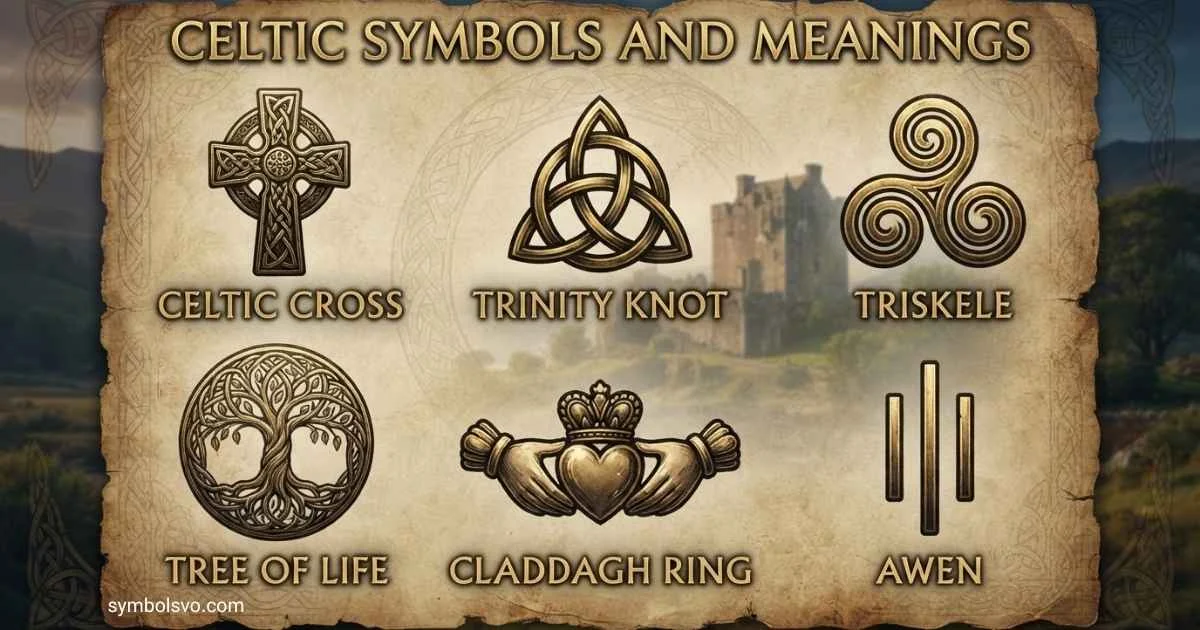
Celtic symbols have fascinated me because each knot, spiral, and ancient design can carry a story of connection, strength, nature, or spiritual belief. When I first explored their meanings, I found that even simple-looking patterns could have surprisingly rich histories.
You may recognize symbols like the Celtic knot, Triskelion, or Claddagh, but do you know what they traditionally represent? I’ll help you look beyond the beautiful patterns and understand the history, symbolism, and cultural context behind some of the most well-known Celtic symbols.
Whether you’re researching Celtic history, choosing a meaningful design, or simply curious about ancient symbols, you’ll find practical explanations here. I want to make these meanings easy for you to understand while also separating historical traditions from modern interpretations.
Celtic Symbols And Meanings
Celtic symbolism is best understood as a broad visual tradition rather than one fixed dictionary of symbols. Celtic-speaking peoples lived across different regions and periods, and their art changed over time.
Some of the most recognizable designs include:
| Symbol | Common modern meaning | Historical note |
| ☘ Shamrock | Ireland, luck, identity | Strongly associated with Irish culture |
| 🌀 Triple spiral / triskele | Movement, cycles, threefold connection | Triple spirals are prehistoric; later triskele forms have different histories |
| Triquetra | Threefold unity, continuity | Especially prominent in medieval Christian and Celtic-influenced art |
| Celtic knotwork | Continuity, connection, eternity | Common in medieval Insular art |
| Celtic cross | Faith, heritage, Irish identity | Closely associated with medieval and later Christian traditions |
| Spiral | Movement, growth, cycles | Spiral motifs are extremely old and predate Celtic culture |
| Claddagh | Love, loyalty, friendship | A later Irish tradition rather than an ancient Celtic symbol |
| Ogham | Early Irish writing | A historical writing system rather than a universal symbolic alphabet |
The word “meaning” needs some care here. Modern jewelry, tattoo, and gift websites often assign precise meanings to individual designs. In many cases, those meanings are modern interpretations rather than meanings recorded by ancient Celtic communities.
That distinction does not make the modern meanings useless. It simply helps you understand what is historical and what is contemporary symbolism.
Ancient Celtic Symbols
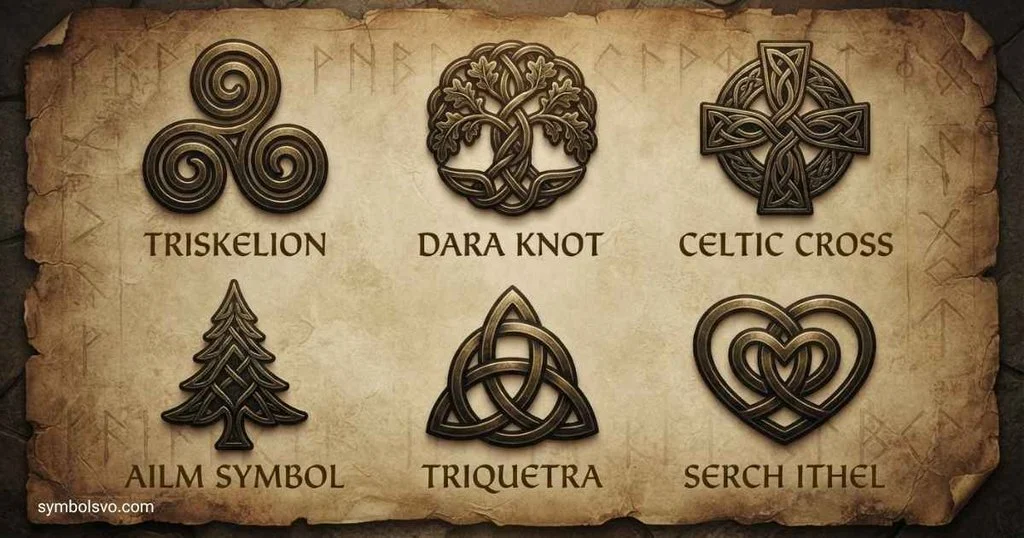
Ancient Celtic art contains a wide range of patterns, including spirals, geometric forms, animal imagery, curving lines, and later interlace.
One of the most important examples is the triskele or triple spiral. Triple-spiral carvings at Newgrange in Ireland date to the Neolithic period, around 3200 BCE. That means they are much older than the historical Celtic period. The precise meaning of the carvings is unknown because the people who created them left no written explanation.
Other motifs became especially important in later Celtic and Celtic-influenced art.
Common ancient or early motifs
- Spirals — Associated today with movement, cycles, growth, and continuity.
- Triple spirals — Often interpreted through the recurring importance of three, although their original meaning is uncertain.
- Interlace — Elaborate woven patterns that became prominent in medieval Insular art.
- Animal forms — Birds, snakes, dogs, horses, and other creatures appear in Celtic and Celtic-influenced art.
- Geometric patterns — Used extensively for decoration on objects, manuscripts, metalwork, and stone.
Ancient Celtic symbolism should not be reduced to a list of fixed definitions. Archaeological evidence tells us what designs existed, but it does not always tell us exactly what their creators intended.
Old Celtic Symbols And Meanings
Old Celtic symbols are often presented online as if every design has one ancient, universally accepted meaning. The evidence is more complicated.
For example, the triple spiral is unquestionably ancient in Ireland, but its original meaning is not recorded. Modern interpretations connect it with cycles, movement, transformation, and groups of three. These are reasonable symbolic readings, but they should not be presented as a recovered ancient definition.
Celtic knotwork also requires historical context. Elaborate interlace became particularly prominent in early medieval Irish and British art, including manuscripts and stone monuments. Many modern meanings, such as “eternal love” or “eternal friendship,” are later interpretations rather than definitions preserved in ancient Celtic texts.
A useful distinction is:
Ancient design ≠ documented ancient meaning
This is especially important when choosing a symbol for a tattoo or historical project.
Celtic Symbols And Meanings List
Here is a practical list of widely recognized Celtic or Celtic-associated symbols.
- Triskele / Triskelion — A threefold spiral or rotational design; commonly associated today with movement, cycles, progress, and the idea of three.
- Triquetra / Trinity Knot — Three interwoven loops; commonly interpreted as unity, continuity, and threefold connection.
- Celtic knot — Interlaced lines; commonly associated with continuity and interconnectedness.
- Celtic cross — A cross with a ring around the intersection; strongly associated with Irish Christian heritage.
- Spiral — A very old motif associated in modern interpretation with movement and cycles.
- Shamrock — A three-leaf plant strongly associated with Ireland.
- Claddagh — Two hands holding a heart beneath a crown; associated with friendship, love, and loyalty.
- Ogham — An early medieval writing system used primarily for inscriptions.
- Celtic tree motifs — Modern Celtic-inspired designs often use trees to represent life, roots, family, and connection.
- Celtic animal designs — Serpents, birds, horses, hounds, and other creatures appear in different Celtic and medieval traditions.
The Claddagh is especially worth separating from prehistoric Celtic symbolism. It is an Irish cultural emblem with a much later documented history, so calling it an “ancient Celtic symbol” would be misleading.
Celtic Symbols And Meanings Chart
The following chart gives a quick reference to popular Celtic and Celtic-associated designs.
| Symbol or design | Common meaning today | Best understood as |
| Triple spiral | Movement, cycles, progress | Ancient motif with uncertain original meaning |
| Triskele | Threefold connection, motion | Ancient and later forms with different histories |
| Triquetra | Unity, continuity, threefold connection | Early medieval/Celtic-influenced Christian art |
| Celtic knot | Eternity, connection, continuity | Medieval interlace with modern symbolic meanings |
| Celtic cross | Faith, heritage, Irish identity | Christian Irish tradition |
| Shamrock | Ireland, luck | Irish cultural symbol |
| Claddagh | Love, loyalty, friendship | Later Irish tradition |
| Ogham | Writing, early Irish inscriptions | Historical writing system |
| Spiral | Growth, motion, cycles | Very ancient visual motif |
| Tree design | Family, roots, life | Mainly modern symbolic interpretation |
This chart is useful for quick comparison, but the historical background matters more than a single modern keyword.
Simple Celtic Symbols And Meanings
Simple Celtic symbols are popular because they are easy to recognize and reproduce. They also work well for jewelry, logos, artwork, stationery, and small tattoos.
Simple designs to consider
Triskele
A three-arm spiral design is visually simple while still carrying a strong Celtic association.
Triquetra
The three-loop form is compact and works well as a small decorative mark.
Celtic cross
The basic cross-and-ring design can be simplified without losing its general visual identity.
Single spiral
A spiral can be drawn with a few smooth lines and still create a distinctly Celtic-inspired appearance.
Knotwork
A simple two- or three-loop knot can suggest the look of Celtic interlace without the complexity of a full manuscript-style design.
For a simple design, avoid adding too many tiny details. Fine interlacing can become difficult to distinguish when reproduced at a very small size.
Small Celtic Symbols And Meanings
Small Celtic symbols are particularly popular for pendants, bracelets, rings, minimalist artwork, and discreet tattoos.
Good choices include:
- Small triquetra — Compact three-loop design.
- Mini triskele — Three curved arms arranged around a center.
- Small Celtic cross — A recognizable heritage and Christian symbol.
- Tiny spiral — Simple and easy to reproduce.
- Small knot — Represents modern ideas of connection and continuity.
- Minimal shamrock — Strong Irish cultural association.
- Small Claddagh — Common choice for love, friendship, or family jewelry.
For very small designs, a simpler shape is usually more effective than a highly detailed knot. The design should remain recognizable when reduced in size.
If you want a symbol for jewelry or a tattoo, also check how the design looks from a distance. A complicated pattern can turn into a dark or unclear shape when made very small.
Celtic Symbols For The 4 Elements
Modern Celtic-inspired artwork sometimes connects Celtic designs with the four classical elements: earth, air, fire, and water.
There is no single historically verified Celtic four-element symbol system that assigns one specific ancient Celtic glyph to each element. Many charts found online are modern combinations of Celtic-inspired designs and elemental ideas.
A contemporary symbolic approach might use:
| Element | Modern Celtic-inspired association |
| Earth | Tree, stone, roots, grounded knotwork |
| Air | Spiral, bird, wind-like curves |
| Fire | Sun, flame, radiant spiral |
| Water | Wave, flowing spiral, river-like knotwork |
These can be beautiful designs, but they should be described as modern interpretations, not as a universally documented ancient Celtic elemental alphabet.
This distinction is especially useful if you are creating educational material or choosing a tattoo based on historical authenticity.
Celtic Symbols For Love
Celtic-inspired symbols are widely used to represent love, partnership, loyalty, and lasting connection.
The most recognizable choices include the Claddagh, triquetra, and various forms of knotwork.
Claddagh
The Claddagh consists of:
- Heart — Love
- Hands — Friendship
- Crown — Loyalty
The Claddagh is an Irish cultural symbol with a much later history than the ancient Celtic motifs discussed above.
Celtic knotwork
Modern interpretations often use endless interlacing to represent a relationship without a clear beginning or end.
Triquetra
The three interwoven loops are frequently used today to represent connectedness and unity. In Christian contexts, it has also been associated with the Trinity.
For a romantic tattoo or gift, it is better to choose a design based on the meaning you personally want rather than assuming that every knot had a specific ancient romantic meaning.
Protection Celtic Symbols And Meanings
Protection is one of the most common modern themes associated with Celtic-inspired symbols.
The Celtic cross, triskele, knotwork, and certain animal designs are sometimes chosen for this purpose. However, their protective meanings vary by tradition and are often modern interpretations.
Triskele
Its circular movement can be interpreted today as resilience, progress, and continuing forward.
Celtic cross
Its strongest historical association is Christian faith and Irish heritage. A person may also choose it as a personal symbol of spiritual protection.
Celtic knotwork
The continuous structure can represent an enduring bond or an idea of something that remains connected.
Animal imagery
Modern Celtic-inspired artwork may use animals such as wolves, hounds, ravens, horses, or serpents to express strength, loyalty, wisdom, or protection.
These meanings should be treated as symbolic associations rather than universal ancient rules.
Family Celtic Symbols And Meanings
Family is one of the most popular reasons people choose Celtic-inspired designs.
A Celtic knot is often selected because its interwoven structure provides a natural visual metaphor for relationships. Lines crossing and reconnecting can suggest family bonds and shared history.
A tree design is another popular modern choice. Roots can represent ancestry, while branches can represent descendants and different paths within a family.
The triskele can also work well for family symbolism because its threefold structure allows a person to create a personal interpretation around three connected family members or generations.
Other possibilities include:
- Interwoven knot — Family connection
- Tree design — Roots, ancestry, growth
- Triquetra — Three-part family bond
- Triskele — Three connected generations
- Claddagh — Love and loyalty within relationships
There is no single ancient Celtic “family symbol.” These are best understood as modern symbolic uses of Celtic and Celtic-inspired designs.
Mother Daughter Celtic Symbols And Meanings
Mother-daughter Celtic symbols are usually modern designs that use traditional-looking motifs to express a personal relationship.
The triquetra is a natural choice because its three interconnected sections can be adapted to represent a mother, daughter, and their shared bond.
A Celtic knot can represent a relationship that remains connected across distance and time.
A tree design can express ancestry and generations, with roots representing the older generation and branches representing younger generations.
For matching tattoos, mother and daughter might choose:
- Matching triquetras
- Two halves of one knot
- A small tree and a larger tree
- Matching triskele-inspired designs
- Interlocking knotwork
- The same symbol in different sizes
These meanings come primarily from modern personal symbolism. There is no historical evidence that ancient Celtic people used one particular knot specifically as a mother-daughter emblem.
Celtic Symbols And Meanings Trinity Knot
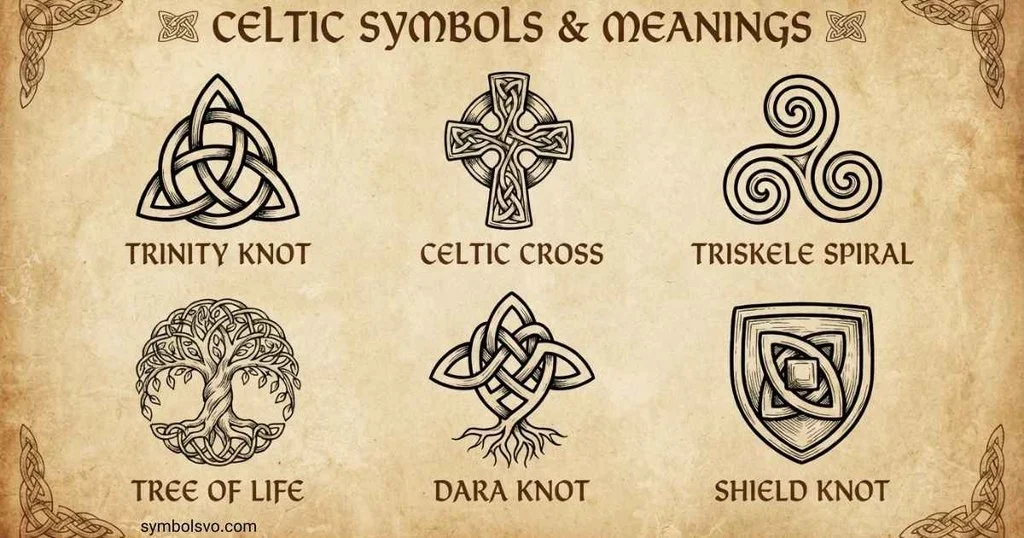
The Trinity Knot, also called the triquetra, is one of the most recognizable three-part designs associated with Celtic-inspired art.
Its basic form consists of three interlaced loops.
Today, people commonly associate it with:
- Unity
- Threefold connection
- Continuity
- Eternity
- Family
- Spiritual connection
- The Christian Trinity
The Christian interpretation is particularly important because the triquetra became prominent in medieval Christian art in Ireland and Britain.
The design should not automatically be described as a pre-Christian Celtic symbol with one fixed meaning. Its history spans different artistic and religious contexts, and modern meanings have expanded considerably.
For a tattoo, pendant, or family design, the three sections can be given a personal meaning such as past, present, and future or three generations. That is a modern interpretation, not a documented ancient definition.
Irish Celtic Symbols And Meanings
Ireland has some of the strongest associations with Celtic-inspired symbolism.
Important Irish symbols include the shamrock, Celtic cross, triskele, Claddagh, Ogham, and Celtic knotwork.
Shamrock
The three-leaf shamrock is strongly associated with Ireland. The National Museum of Ireland notes the tradition that St. Patrick used the shamrock to explain the Holy Trinity, while also pointing out that this tradition is relatively late.
Celtic cross
The ringed cross is strongly associated with Irish Christian heritage and medieval stone crosses.
Triskele
The triple-spiral motif is famously carved at Newgrange, although the monument predates Celtic culture.
Claddagh
The Claddagh is a later Irish symbol associated with love, friendship, and loyalty.
Ogham
Ogham is an early Irish writing system. Its characters were primarily used for inscriptions, particularly on stone monuments. It should not be confused with a universal ancient Celtic “symbol dictionary.”
Scottish Celtic Symbols And Meanings
Scottish Celtic symbolism includes a mixture of ancient motifs, medieval Christian art, Highland traditions, heraldic imagery, and modern Celtic revival designs.
The triskele, Celtic knotwork, Celtic cross, and various animal and plant motifs can appear in Scottish-inspired designs.
One symbol that deserves special care is the Celtic cross. Cross designs are widespread across Celtic Christian traditions and should not automatically be labeled exclusively Scottish or Irish.
Scottish symbolism is also strongly connected with:
- Clan identity
- Heraldry
- Highland culture
- Celtic revival art
- Christian stonework
- Gaelic heritage
Modern Scottish Celtic tattoos often combine knots with thistles, animals, swords, shields, or clan-related imagery. These combinations can be meaningful, but a modern tattoo design should not automatically be presented as an ancient Celtic artifact.
Welsh Celtic Symbols And Meanings
Welsh Celtic symbolism often overlaps with broader Celtic artistic traditions, but Wales also has distinctive national and cultural symbols.
The red dragon is the best-known national symbol of Wales. It is important to distinguish this from generalized Celtic knotwork.
Other designs used in Welsh or Celtic-inspired artwork include:
- Celtic knotwork
- Spirals
- Interlace
- Crosses
- Dragons
- Celtic-inspired animals and plants
The Welsh dragon has a long history as a national emblem, but it should not be described simply as an ancient Celtic symbol. Its development involves Welsh history, legend, and later national identity.
For a Welsh-themed tattoo, combining the dragon with knotwork can create a strong visual connection between Welsh identity and broader Celtic-inspired design.
Cornish Celtic Symbols And Meanings
Cornwall has a distinct Celtic heritage, reflected especially in its Cornish language and cultural revival.
The Cornish cross and Celtic-inspired knotwork are common choices for modern designs representing Cornish identity. The St Piran’s flag, with its white cross on black, is another important Cornish emblem, although it is a regional flag rather than an ancient Celtic symbol.
Cornish-inspired designs may combine:
- Cornish crosses
- Celtic knotwork
- Spirals
- Celtic lettering
- Sea and coastal imagery
- Modern Cornish heraldic elements
Because Cornwall has a distinct regional history, it is better to identify a design specifically as Cornish when there is evidence for that connection instead of labeling every Celtic-style pattern “Cornish.”
Gaelic Celtic Symbols And Meanings
“Gaelic” and “Celtic” are related terms, but they are not interchangeable.
Celtic is a broader cultural and linguistic category. Gaelic refers specifically to the Goidelic branch of Celtic languages, including Irish, Scottish Gaelic, and Manx.
Gaelic-associated symbolism can therefore be connected with different regions and traditions.
Examples include:
- Ogham — Historically associated particularly with early Irish inscriptions.
- Triskele — Strongly associated with Irish and Manx contexts in different forms.
- Celtic knotwork — Used extensively in Irish and Scottish medieval art.
- Claddagh — Irish cultural symbol.
- Shamrock — Strong Irish association.
If you are looking for a Gaelic tattoo, check whether you actually want a Gaelic-language inscription, a Celtic decorative design, or a symbol from Irish or Scottish culture. They are related but not identical choices.
Celtic Symbols And Meanings With Pictures
Pictures are especially helpful for Celtic symbols because several designs can look similar at first glance.
Triskele or triple spiral
A triskele is generally built around three arms or spirals radiating from a central point.
Visual idea: 🌀 with three distinct rotating arms.
Its modern meanings commonly include movement, cycles, progress, and threefold connection. The prehistoric triple spiral at Newgrange is much older than the Celtic period, and its original meaning remains uncertain.
Triquetra
The triquetra consists of three interwoven loops.
Visual idea: three connected, pointed loops forming a balanced three-part design.
It is frequently called the Trinity Knot and is strongly associated with medieval Christian and Celtic-influenced art.
Celtic knot
A Celtic knot consists of interwoven lines that repeatedly pass over and under each other.
Visual idea: an endless woven pattern.
Modern users commonly connect this design with eternity, friendship, family, and connection.
Celtic cross
A Celtic cross combines a cross with a circular ring around the intersection.
Visual idea: ✚ inside or intersecting a circle.
It is strongly associated with Christian Celtic heritage, especially Ireland.
Shamrock
The shamrock has three leaves.
Visual idea: ☘
It is one of the most recognizable symbols of Ireland. The association with St. Patrick and the Trinity is part of later Irish tradition.
Celtic Symbols And Meanings Tattoos
Celtic symbols are popular tattoo choices because many have strong visual shapes and can be adapted to different sizes.
Before choosing one, decide whether your priority is:
- Historical authenticity
- Family meaning
- Irish or Scottish heritage
- Spiritual symbolism
- Love or relationships
- Personal growth
- Aesthetic design
The triskele works well for people attracted to themes of movement and cycles. The triquetra suits people who want a three-part connection. Knotwork is useful when the main idea is continuity or relationships.
For historical accuracy, avoid relying solely on tattoo websites for ancient meanings. Many popular definitions are modern interpretations rather than translations of ancient Celtic beliefs.
Tattoos Celtic Symbols And Meanings Tattoos
Celtic tattoos can range from tiny minimalist marks to large sleeves filled with complex interlace.
Popular designs include:
| Tattoo design | Common modern interpretation |
| Triskele | Growth, motion, cycles |
| Triquetra | Unity, connection, threefold bond |
| Celtic knot | Continuity and lasting connection |
| Celtic cross | Faith and heritage |
| Claddagh | Love, loyalty, friendship |
| Celtic tree | Family, ancestry, growth |
| Celtic animal | Strength, loyalty, wisdom, or personal qualities |
| Ogham inscription | Personal name, word, or commemorative text |
A tattoo does not need an ancient meaning to have personal value. You can assign your own meaning while being honest about its historical background.
If using Ogham, verify the exact spelling and direction with a reliable linguistic source. A decorative “Celtic alphabet” from a random tattoo site may not accurately represent historical Ogham.
Celtic Symbols And Meanings Tattoos For Females
Celtic tattoos are not limited by gender, but some designs are popular among women because they can be adapted into delicate or minimalist forms.
Popular feminine-style Celtic tattoo ideas
Small triquetra
A fine-line triquetra can represent connection, spirituality, or three important people.
Floral knotwork
A Celtic-inspired knot combined with leaves or flowers can create a softer design while retaining the interwoven style.
Claddagh
The heart, hands, and crown make it a natural choice for love, friendship, loyalty, or family.
Small triskele
A simplified triskele can represent movement, growth, and personal change.
Celtic tree
A tree can symbolize family roots, ancestry, strength, and continued growth.
Matching mother-daughter knot
Two related knot designs can represent a lasting family relationship without requiring an identical tattoo.
For a small tattoo, choose a design with enough open space. Dense knotwork can lose its clarity as the tattoo ages.
Forearm Celtic Symbols And Meanings Tattoos
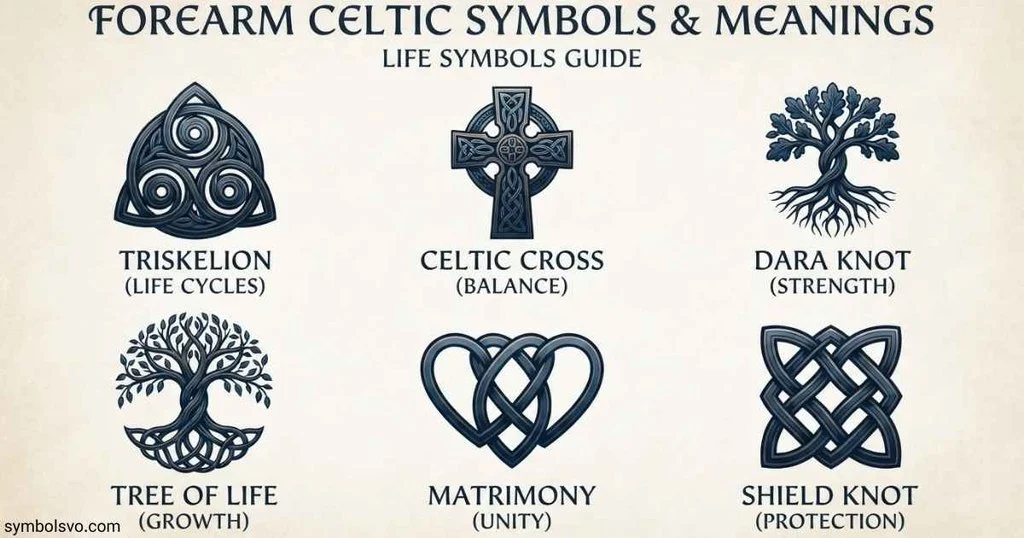
The forearm is a popular placement for Celtic tattoos because it offers a long, visible surface that works well with vertical and horizontal designs.
Good forearm options include:
- Vertical Celtic knot — A strong choice for an elongated design.
- Celtic cross — Works well as a centered symbol.
- Triskele — Suitable for a compact circular composition.
- Celtic tree — Can use the forearm’s length to show roots and branches.
- Celtic animal design — Can be combined with knotwork.
- Ogham inscription — Works naturally in a vertical layout.
- Long interlace band — Can wrap around the forearm.
Think about the direction of the design before getting it tattooed. A knot designed to be viewed from one angle may look different when the arm rotates.
Also consider line thickness and spacing. Very detailed Celtic knotwork needs enough room for the individual strands to remain visually separate over time.
Frequently Asked Questions
What is the most famous Celtic symbol?
The triskele, Celtic knot, Celtic cross, triquetra, and shamrock are among the most recognizable symbols associated with Celtic or Irish culture. Their histories and meanings are different, so none should be treated as one universal Celtic emblem.
What do Celtic knots symbolize?
Today, Celtic knots are commonly associated with continuity, connection, eternity, friendship, love, and family. These are largely modern symbolic interpretations; historical sources do not provide a fixed meaning for every individual knot design.
What does the Celtic trinity knot mean?
The triquetra or Trinity Knot is commonly interpreted as representing threefold unity, connection, continuity, and, in Christian contexts, the Holy Trinity. Its meaning depends on cultural and religious context.
What Celtic symbol represents family?
There is no single historically proven Celtic family symbol. Modern choices include Celtic knots, tree designs, triquetras, and triskele-inspired patterns because their interconnected forms can represent family relationships and generations.
Are Celtic symbols the same as Irish symbols?
No. Celtic is a broader cultural and linguistic category, while Irish symbols specifically relate to Ireland. Some symbols overlap, but an Irish symbol is not automatically ancient Celtic, and a Celtic design is not automatically Irish.
Conclusion
Celtic symbols bring together several layers of history, art, religion, regional identity, and modern interpretation. Spirals and triple-spiral motifs have extremely old roots, while medieval knotwork and Christian designs developed in later periods. Symbols such as the shamrock and Claddagh have strong Irish associations but should not be casually labeled as ancient Celtic symbols.
For modern use, Celtic-inspired designs offer many meaningful choices. A triquetra can express connection, a knot can represent continuity, a triskele can suggest movement and cycles, and a tree can provide a personal image of family and ancestry. These meanings can be valuable even when they are modern rather than historically documented.
If you are choosing a Celtic symbol for a tattoo, necklace, artwork, or family design, the best approach is to learn its actual history first and then decide what it means to you. That gives the symbol both cultural respect and personal meaning.

 Grace Whitmore
 Daniel Brooks