
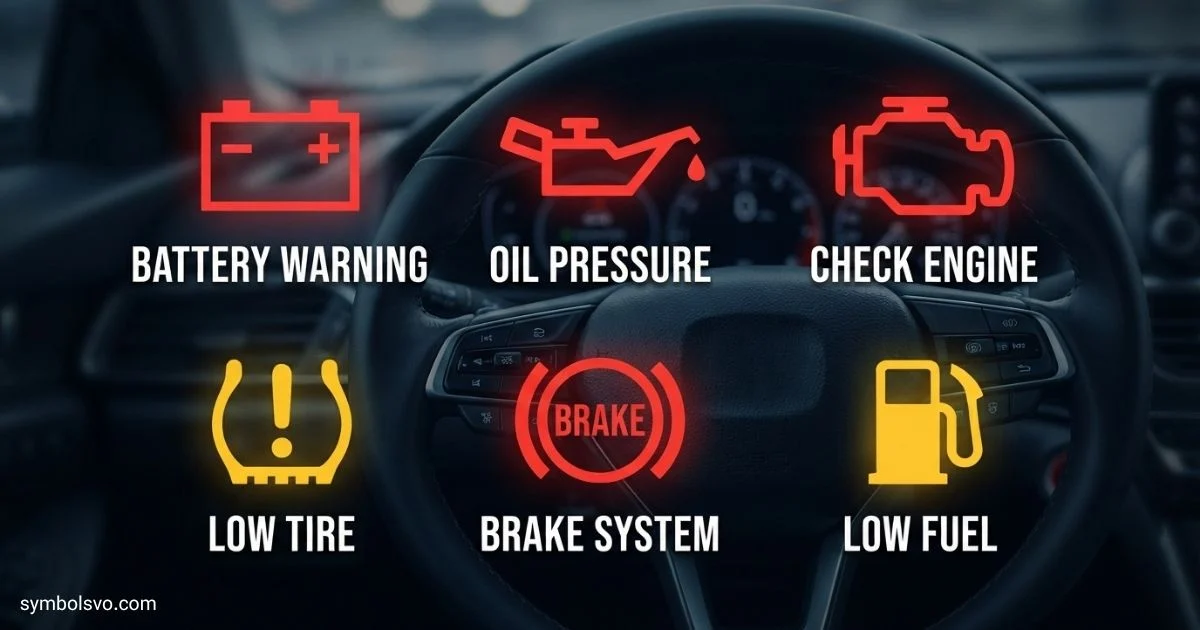
When a strange light appears on your dashboard, I know how quickly you can start wondering if something is seriously wrong. You may see a symbol you have never noticed before and have no idea what it means.
I want to make those confusing dashboard symbols easier for you to understand. From simple reminders to important warning lights, each symbol can tell you something useful about your vehicle.
You do not need to be a car expert to recognize these signs. In this guide, I’ll help you understand what common dashboard symbols mean, when they matter, and what you should do next.
Dashboard Symbols And Meanings
Dashboard symbols generally fall into a few major groups: warning lights, indicator lights, information displays, and system-status indicators.
The color often gives you a useful first clue:
| Color | General meaning |
| 🔴 Red | Serious warning or condition requiring prompt attention |
| 🟡 Yellow/Amber | Caution, fault, or service may be needed |
| 🟢 Green | System or feature is operating or active |
| 🔵 Blue | Information or active feature, often high-beam related |
| ⚪ White | Information or system status on some vehicles |
These colors are general conventions rather than universal rules.
Common Dashboard Warning Symbols
| Symbol | Name | General meaning |
| 🛢️ | Oil pressure warning | Engine oil pressure may be too low |
| 🌡️ | Engine temperature warning | Engine coolant temperature may be too high |
| 🔋 | Battery/charging warning | Charging system may have a fault |
| ⚠️ | Master warning | Vehicle has detected a condition requiring attention |
| ! | Brake warning | Brake system or parking brake warning |
| ABS | ABS warning | Anti-lock braking system fault may be present |
| 🛞 | Tire pressure warning | One or more tires may have low pressure |
| 🚗 | Check engine | Engine or emissions-related fault detected |
| 🧰 | Service/maintenance | Maintenance or service may be due |
| 👤 | Seat belt reminder | A seat belt may not be fastened |
| 🅿️ | Parking brake | Parking brake may be applied or system may have a warning |
| 🚘 | Traction/stability control | Stability or traction system status/fault |
A symbol should always be interpreted together with its color, accompanying message, and vehicle manual.
If a red oil-pressure or overheating warning appears while driving, safely stopping the vehicle and checking the owner’s instructions is generally more appropriate than continuing to drive and hoping the light disappears.
Car Dashboard Symbols With Names
Here are some of the dashboard symbols drivers see most often.
Engine And Mechanical Symbols
- Check engine light — Indicates that the engine-control or emissions system has detected a fault.
- Oil pressure warning — Can indicate inadequate engine oil pressure.
- Engine temperature warning — Warns that engine temperature may be too high.
- Battery warning — Indicates a possible charging-system problem.
- Transmission warning — On vehicles equipped with one, it can indicate a transmission-related fault.
Safety Symbols
- Airbag/SRS warning — Indicates a possible issue with the supplemental restraint system.
- Seat belt warning — Reminds occupants to fasten seat belts.
- Brake warning — Can indicate that the parking brake is applied or that a brake-system issue has been detected.
- ABS warning — Indicates a possible anti-lock braking system fault.
Driving Assistance Symbols
- Lane departure warning — Indicates that the vehicle’s lane-monitoring system has detected a relevant condition.
- Blind-spot warning — Shows that the blind-spot monitoring system has detected a vehicle or is reporting system status.
- Adaptive cruise control — Indicates that the feature is active or has a system message.
- Traction control — Shows traction-control activity or a system fault depending on the symbol and vehicle.
Car Dashboard Symbols With Names And Meanings
A name tells you what a symbol is called, but the meaning tells you what action may be appropriate.
| Dashboard symbol/name | What it usually means | What to do |
| Check engine | Engine/emissions fault detected | Check the vehicle information and arrange diagnosis if it remains on |
| Oil pressure | Oil pressure may be low | Stop safely and follow the owner’s manual instructions |
| Temperature | Engine may be overheating | Stop safely and allow the vehicle to cool as instructed |
| Battery | Charging system problem | Reduce unnecessary electrical load and seek service promptly |
| ABS | ABS system fault | Have the system checked; normal braking may still work, depending on the fault |
| Tire pressure | Tire pressure is low or TPMS has detected an issue | Check tire pressures as soon as safely possible |
| Airbag | SRS fault may exist | Have the system inspected |
| Brake | Brake system or parking-brake condition | Check the parking brake and follow the manual |
| Traction control | Traction/stability system is active or has detected a fault | Check the vehicle display/manual if the light remains on |
| Fuel | Fuel level is low | Refuel soon |
| High beam | High beams are switched on | Dim the lights when appropriate |
A flashing warning light can have a different and more urgent meaning than a steady light. Always check the instructions for your particular vehicle.
Car Dashboard Symbols And Meanings With Pictures
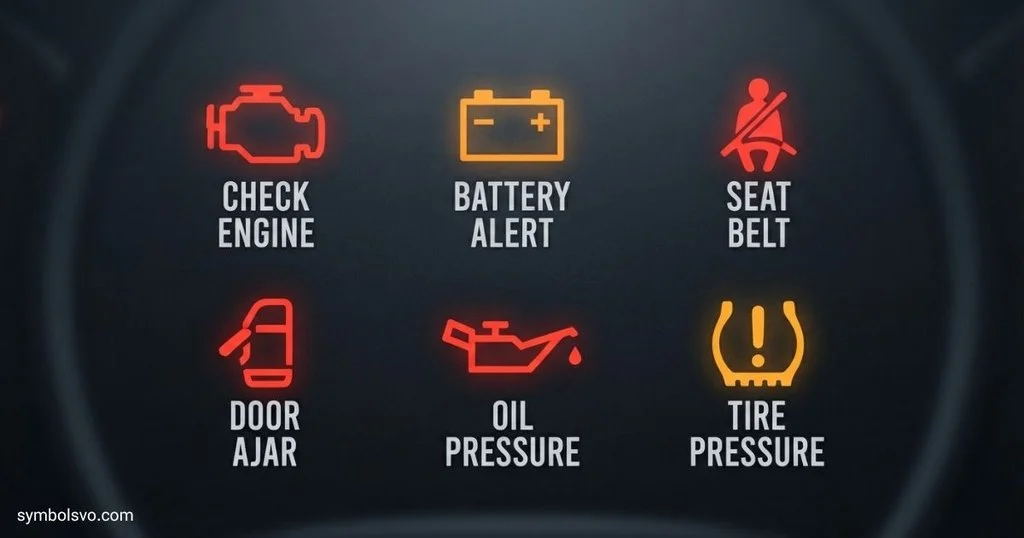
Pictures can make dashboard symbols much easier to recognize because many warning lights are designed around simple visual shapes.
Common examples include:
Oil pressure: 🛢️
Often shown as an oil-can shape.
Engine temperature: 🌡️
Usually represented by a thermometer over waves.
Battery: 🔋
Often displayed as a rectangular battery with positive and negative terminals.
Tire pressure: 🛞
Usually represented by an exclamation mark inside a tire-shaped outline.
Brake: (!)
Often shown as an exclamation mark inside a circle or alongside a brake-related marking.
Engine: ▣ / engine-shaped icon
The check-engine symbol normally resembles an engine outline.
Seat belt: belted-person icon
A seated person appears with a diagonal belt across the body.
The exact artwork is not identical across every manufacturer. For that reason, a generic picture can help recognition, but the symbol displayed by your own vehicle and the owner’s manual should take priority.
Nissan Dashboard Symbols And Meanings
Nissan vehicles use a range of warning and indicator lights across different models.
Common Nissan dashboard indicators include:
- Master warning light — Alerts the driver to a condition that may need attention.
- Check engine light — Indicates an engine-control or emissions-related issue.
- Oil pressure warning — Indicates a possible low engine oil pressure condition.
- High temperature warning — Warns about excessive engine coolant temperature.
- ABS warning — Indicates an ABS-related issue.
- Tire pressure warning — Indicates low tire pressure or a TPMS-related condition.
- Airbag warning — Indicates a possible supplemental restraint system problem.
- Vehicle Dynamic Control indicator — Relates to Nissan’s stability and traction-control system.
- Forward collision warning — Appears on equipped vehicles when the relevant driver-assistance system detects a condition.
- Intelligent Cruise Control indicators — Show the status of the available cruise-control system.
Nissan symbols vary considerably by model and model year. A Rogue, Altima, Sentra, Pathfinder, Frontier, and Ariya can have different displays and driver-assistance indicators.
Toyota Dashboard Symbols And Meanings
Toyota uses dashboard indicators for engine systems, braking, safety, driver assistance, and vehicle status.
Common Toyota symbols include:
- Master warning light
- Check engine warning
- Oil pressure warning
- Low engine coolant temperature or high temperature indicators
- ABS warning
- Brake system warning
- Tire pressure warning
- SRS airbag warning
- Slip indicator
- Parking brake indicator
- Low fuel indicator
- Lane-related driver-assistance indicators
- Pre-Collision System indicators
Toyota also uses different indicators for systems such as Dynamic Radar Cruise Control, Lane Tracing Assist, and other Toyota Safety Sense features.
A warning symbol may be accompanied by a message on the multi-information display. Reading that message can be more useful than interpreting the icon alone.
Hyundai Dashboard Symbols And Meanings
Hyundai dashboard symbols cover basic vehicle systems as well as modern driver-assistance features.
Common Hyundai indicators include:
- Engine oil pressure warning
- Engine coolant temperature warning
- Battery charging warning
- Check engine warning
- Brake warning
- ABS warning
- Tire Pressure Monitoring System warning
- Airbag warning
- Electronic Stability Control indicator
- Forward Collision-Avoidance Assist indicators
- Lane Keeping Assist indicators
- Blind-Spot Collision Warning indicators
- Parking brake indicator
Hyundai uses different combinations of symbols depending on the vehicle. An icon that appears on a Tucson may not be identical to one on an Elantra or Santa Fe.
If a warning appears together with a message such as a system malfunction notice, use the vehicle’s display and manual to identify the recommended action.
Ford Dashboard Symbols And Meanings
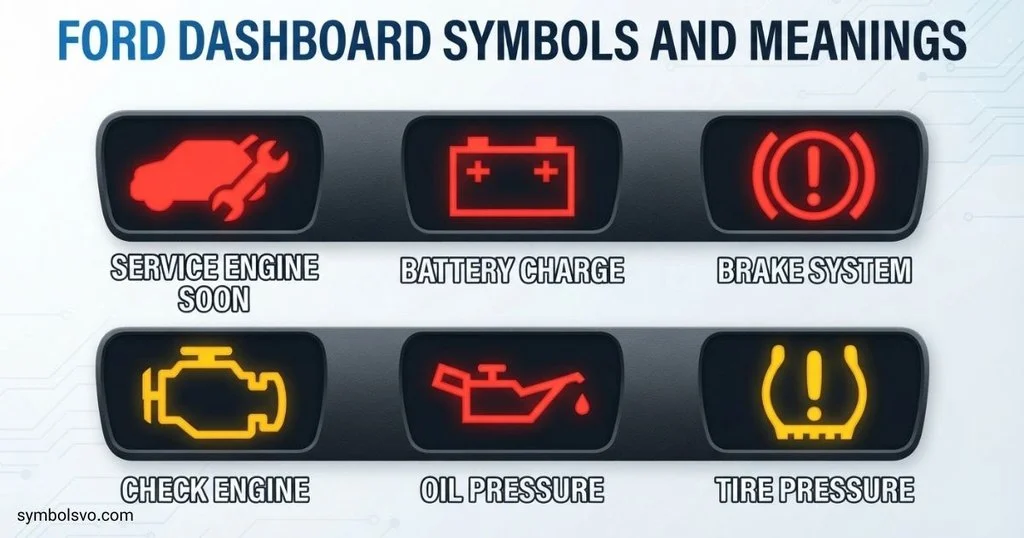
Ford vehicles use warning and indicator lights for powertrain, braking, safety, lighting, and driver-assistance systems.
Frequently seen Ford symbols include:
- Check engine light
- Oil pressure warning
- Engine coolant temperature warning
- Battery/charging system warning
- Brake system warning
- ABS warning
- Airbag warning
- Tire pressure warning
- Traction control
- Stability control
- Cruise control
- Lane-keeping indicators
- Pre-Collision Assist
- Blind Spot Information System indicators
- Parking brake
Ford’s digital instrument clusters can also display written messages alongside symbols. This is particularly helpful for advanced driver-assistance features.
For a Ford F-150, Escape, Explorer, Mustang, Bronco, or another model, check the model-specific owner’s manual because the exact warning-light set differs.
Chevy Dashboard Symbols And Meanings
Chevrolet vehicles, commonly called Chevy, use dashboard lights to show vehicle status and alert drivers to possible problems.
Common Chevy symbols include:
- Check engine light
- Oil pressure light
- Engine coolant temperature warning
- Battery/charging system light
- Brake system warning
- ABS warning
- Tire pressure warning
- Airbag warning
- StabiliTrak indicator
- Traction control indicator
- Lane Keep Assist indicator
- Forward Collision Alert
- Cruise control indicator
- High-beam indicator
Chevrolet models can use different displays and icons. A Silverado, Equinox, Tahoe, Traverse, Malibu, or other Chevy vehicle may therefore have features that are not present on another model.
If the instrument cluster shows a warning message in addition to the icon, read the message before deciding what action to take.
Jeep Dashboard Symbols And Meanings
Jeep dashboard symbols include standard warnings as well as indicators connected with four-wheel-drive and off-road systems.
Common Jeep indicators include:
- Check engine
- Oil pressure
- Engine temperature
- Battery/charging system
- Brake warning
- ABS
- Tire pressure
- Airbag
- Electronic Stability Control
- Traction control
- 4WD or 4×4 indicators
- Low-range indicators
- Cruise control
- Lane-related assistance indicators
Jeep models such as Wrangler, Grand Cherokee, Compass, and Gladiator can have substantially different off-road and drivetrain indicators.
A 4WD or low-range symbol may be especially important because it can indicate that a drivetrain mode has been selected rather than a fault.
Dodge Ram Dashboard Symbols And Meanings
“Dodge Ram” is a name many drivers still use when referring to Ram trucks. The Ram truck brand is now commonly identified simply as Ram.
Ram Trucks dashboard symbols vary between models such as the Ram 1500, 2500, and 3500.
Common indicators include:
- Check engine
- Oil pressure
- Engine temperature
- Battery/charging
- Brake warning
- ABS
- Tire pressure
- Airbag
- Electronic Stability Control
- 4WD
- Tow/haul
- Diesel exhaust-related indicators on equipped models
- Cruise control
- Adaptive cruise control on equipped models
Diesel Ram trucks can display additional powertrain and emissions-related warnings that gasoline models do not use. The model year and engine are therefore particularly important when identifying a symbol.
GMC Dashboard Symbols And Meanings
GMC uses dashboard symbols for standard vehicle systems and available driver-assistance technologies.
Common GMC warning and indicator lights include:
- Check engine
- Oil pressure
- Engine temperature
- Battery
- Brake
- ABS
- Tire pressure
- Airbag
- Traction control
- StabiliTrak
- Lane Keep Assist
- Forward Collision Alert
- Cruise control
- High-beam indicator
GMC trucks and SUVs can also have drivetrain, trailer, and towing-related indicators. A Sierra equipped for towing can therefore display information that would not appear on a smaller GMC model.
When a warning appears, the information screen may provide an explanation that is more specific than the dashboard icon itself.
Lexus RX 350 Dashboard Symbols And Meanings
Lexus RX 350 models use warning lights and indicators for engine systems, braking, safety equipment, tire pressure, and driver-assistance technology.
Common RX 350 indicators include:
- Master warning
- Check engine
- Oil pressure
- Engine temperature
- Battery/charging
- Brake system
- ABS
- Tire pressure
- SRS airbag
- Parking brake
- Slip indicator
- Dynamic Radar Cruise Control
- Lane Tracing Assist
- Pre-Collision System
- Blind Spot Monitor
- Low fuel
The exact symbol set depends on the RX 350 generation and model year. Older RX 350 vehicles can have substantially different instrument displays from newer models with larger digital clusters and expanded Lexus Safety System features.
For an exact identification, match the warning symbol to the owner’s manual for the specific RX 350 year.
Audi Dashboard Symbols And Meanings
Audi uses a large collection of dashboard symbols covering vehicle systems, safety, lighting, driver assistance, and service information.
Common Audi indicators include:
- Engine management/check engine
- Oil pressure
- Coolant temperature
- Battery/charging
- Brake system
- ABS
- Airbag
- Tire pressure monitoring
- Electronic Stabilization Control
- Glow plug indicator on applicable diesel models
- Parking brake
- Cruise control
- Lane departure warning
- Adaptive cruise control
- High-beam assist
Audi vehicles can display warning messages through the driver information system or digital instrument cluster. Some symbols also change depending on whether a system is active, unavailable, or malfunctioning.
For an Audi A4, Q5, Q7, A6, or another model, the owner’s manual should be used to confirm the exact meaning.
Mercedes Dashboard Symbols And Meanings
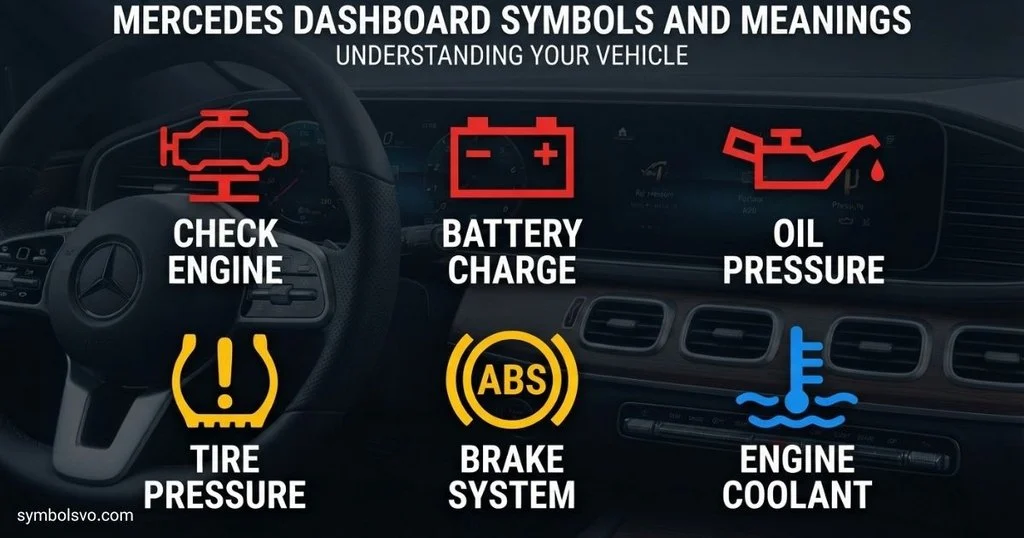
Mercedes-Benz vehicles use warning and indicator lights for mechanical systems, safety equipment, and driver-assistance functions.
Common Mercedes dashboard symbols include:
- Check engine
- Oil pressure
- Coolant temperature
- Battery
- Brake system
- ABS
- Tire pressure
- Airbag/SRS
- ESP®
- Parking brake
- Attention Assist
- Active Brake Assist
- Blind Spot Assist
- Lane Keeping Assist
- Cruise control
- High-beam indicator
Mercedes-Benz uses many model-specific displays. An A-Class, C-Class, E-Class, GLC, GLE, or S-Class may have different symbols and messages.
Some Mercedes warnings are accompanied by text that explains the issue. When available, that message should be considered alongside the warning icon.
Subaru Dashboard Symbols And Meanings
Subaru dashboard symbols include conventional warning lights and indicators for Subaru’s drivetrain and driver-assistance systems.
Common Subaru symbols include:
- Check engine
- Oil pressure
- Engine temperature
- Battery/charging
- Brake warning
- ABS
- Tire pressure
- Airbag
- Vehicle Dynamics Control
- Cruise control
- Lane-related assistance indicators
- EyeSight driver-assistance indicators on equipped vehicles
- X-MODE indicators on equipped models
- All-wheel-drive or drivetrain indicators
Subaru’s EyeSight system can produce several status and warning indicators. X-MODE and other drivetrain features can also add symbols that are not found on ordinary front-wheel-drive vehicles.
The correct interpretation depends on the Subaru model, year, equipment, and the exact symbol displayed.
Frequently Asked Questions
What do the symbols on my car dashboard mean?
Dashboard symbols communicate information about vehicle systems. They can indicate active features, maintenance needs, low fluid or tire pressure, or faults affecting systems such as the engine, brakes, airbags, or charging system.
What does a red dashboard symbol mean?
A red symbol generally indicates a warning or condition that deserves prompt attention. Some red lights can indicate serious problems, so check the owner’s manual and safely stop the vehicle when the warning requires it.
What does a yellow or amber dashboard light mean?
Yellow or amber generally indicates caution, a detected fault, or a condition that may need service. The exact meaning varies by symbol and vehicle.
Can I drive with a dashboard warning light on?
It depends on the warning. Some indicators are informational, while others can signal a serious problem. Red oil-pressure, overheating, or certain brake warnings can require immediate action. Always follow the vehicle manufacturer’s instructions.
Why are dashboard symbols different between car brands?
Manufacturers use some common conventions but also design model-specific symbols for their systems. Nissan, Toyota, Ford, Hyundai, Audi, Mercedes-Benz, and other brands can therefore use different icons and messages for similar features.
Conclusion
Dashboard symbols give drivers a quick way to understand what a vehicle is doing and when something may need attention. Common symbols cover the engine, oil pressure, temperature, battery, brakes, ABS, tire pressure, airbags, traction control, and driver-assistance systems.
The general color system can help you judge urgency, but it should never replace the owner’s manual. A symbol’s exact meaning can change between models and model years, and some vehicles combine a warning icon with a detailed message on the instrument display.
If you need to identify one specific dashboard light, use the exact vehicle make, model, year, and the symbol’s appearance. That information can turn a general dashboard guide into a much more accurate answer.

 Mason Ellington
 Daniel Brooks