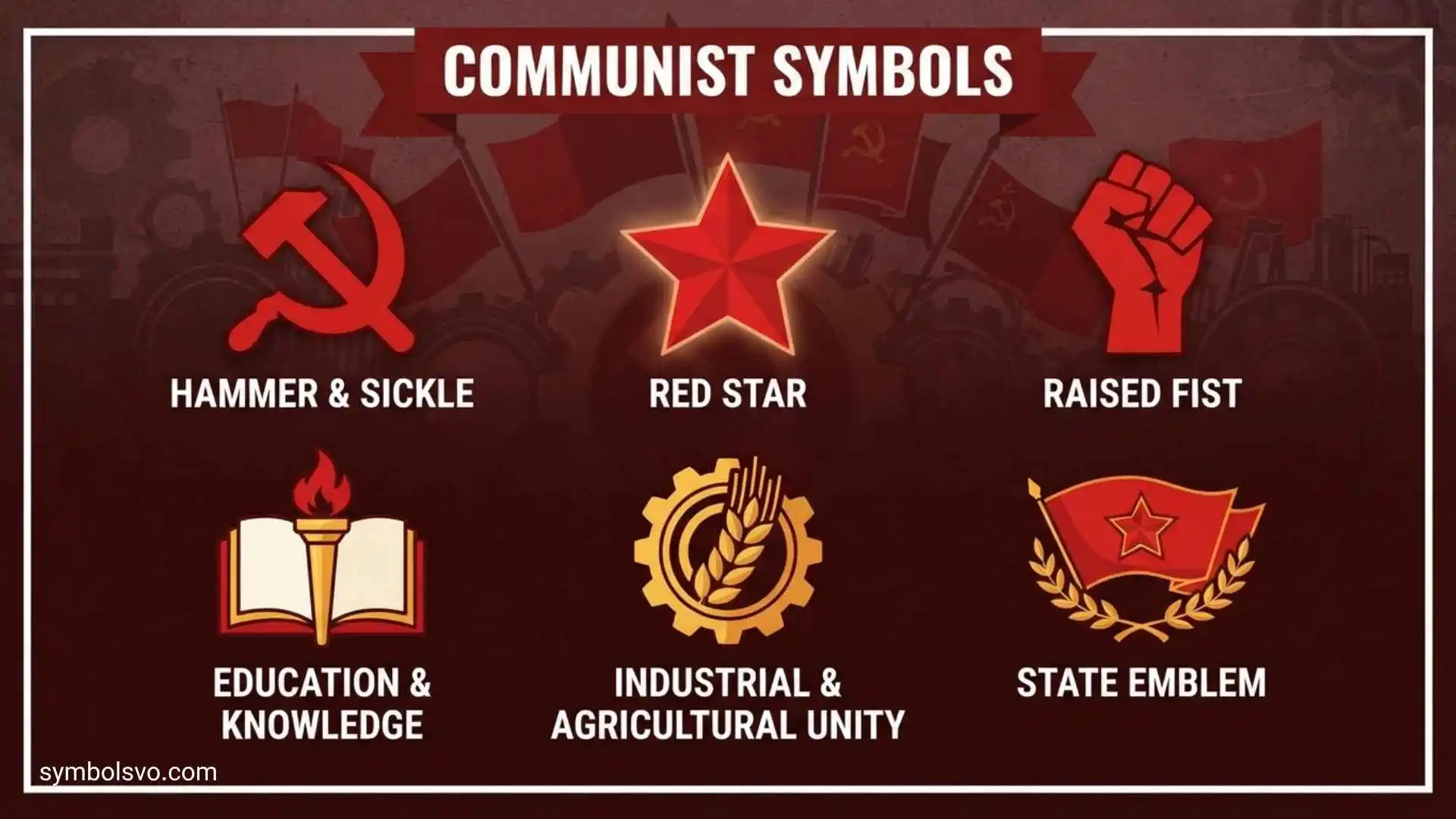
Communist Symbols can look simple, but many carry deep historical and political meanings. I’ll help you understand what these symbols represent, where they came from, and why they became so recognizable around the world.
You may already know a few famous symbols, but there is much more to discover. As you explore this guide, you’ll learn how different Communist Symbols have been used and what they can represent in different historical contexts.
I’ve kept this guide simple and practical so you can quickly understand the key ideas. You’ll discover the most important symbols, their meanings, and the historical context behind them without getting lost in complicated explanations.
Quick Answer
Communist symbols are specific visual emblems, icons, and flags used by Marxist-Leninist organizations and socialist states to represent the political solidarity of the working class. Rooted in nineteenth-century labor movements, these symbols use simple agricultural and industrial imagery to communicate abstract concepts of revolution, collective labor, and state-directed equality.
Quick Facts About Communist Symbols
| Aspect | Information |
| Origin | Western European trade unions and the 1917 Bolshevik Revolution in Russia. |
| Historical Significance | Served as the primary visual branding for the Soviet Union, Warsaw Pact nations, and Communist China. |
| Main Meaning | The revolutionary unity of industrial workers and agricultural peasants. |
| Spiritual Meaning | A secular religion prioritizing collective salvation through state labor and personal sacrifice. |
| Cultural Importance | Transformed global art trends, architecture, political propaganda, and contemporary fashion design. |
| Modern Usage | National flags, socialist political party branding, anti-capitalist protest movements, and pop culture imagery. |
What Are Communist Symbols?
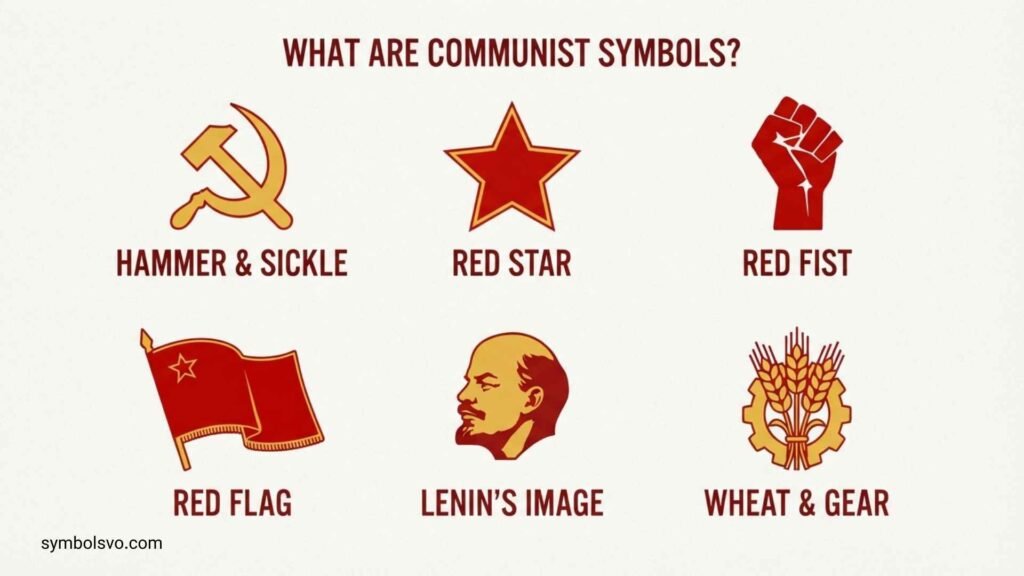
A communist symbol is a graphic emblem designed to communicate the core values of Marxist ideology instantly to mass audiences. The origins of these visual markers date back to European trade union movements of the mid-1800s. Early socialist groups needed simple, impactful icons that could be easily understood by a largely illiterate working class.
During the Russian Revolution of 1917, Vladimir Lenin and the Bolsheviks realized that building a new society required a complete overhaul of traditional imagery. They explicitly rejected old religious icons and royal coats of arms, replacing them with everyday items of human labor.
Over the decades, these basic images evolved into a highly coordinated system of state branding. As Marxism spread across the globe, different nations adapted these symbols to reflect their unique regional histories. This intentional evolution transformed simple tools of survival into terrifying or inspiring emblems of a global political movement.
The foundational geometry of the hammer and sickle. Source: Roman Kybus / Getty Images
Spiritual Level
On a spiritual level, communist iconography functions as the visual foundation of a secular political faith. Marxism actively rejected traditional religion, yet it filled the psychological void by creating its own sacred art. The symbols promise a form of earthly salvation, where the soul achieves true purpose by dissolving its selfish desires into the collective consciousness of the state.
Psychological Level
Psychologically, these symbols tap directly into the powerful archetype of the Liberator and the Just Warrior. Using basic Jungian symbolism, the icons trigger an intense emotional attraction by validating our natural hatred of oppression and our deep desire for fair treatment.
- The Hammer: Represents active force, masculine energy, and the reshaping of a broken world.
- The Sickle: Represents the natural cycles of nature, patience, and harvesting the fruits of collective labor.
By focusing on these archetypes, the symbols encourage individuals to willingly sacrifice their personal comfort for the benefit of a grand collective destiny.
Cultural Level
Culturally, these visual markers served as the ultimate symbol of social alignment. In communist societies, displaying the official emblems was a mandatory sign of community belief and loyalty to the state. In capitalist nations, wearing or spray-painting these same icons became a radical shorthand for rebellion, youth counterculture, and a rejection of consumerism.
Types and Variations of Communist Symbols
1. The Hammer and Sickle
- Visual Description: An industrial hammer crossed cleanly over a curved agricultural harvesting sickle.
- Meaning: The political alliance between factory workers and rural peasants.
- Symbolism: Unbreakable unity, proletarian strength, and the dignity of physical labor.
- Cultural Connection: The definitive symbol of the Soviet Union, appearing on everything from coins to military hardware.
- Where It Appears: State monuments, historical military medals, and the national flags of past socialist republics.
2. The Red Star
- Visual Description: A bold, five-pointed star filled completely with bright red or outlined in gold.
- Meaning: The rule of the Communist Party across all five inhabited continents of the globe.
- Symbolism: Enlightenment, revolutionary guidance, military protection, and global socialist triumph.
- Cultural Connection: Adopted heavily by the Soviet Red Army and international liberation movements.
- Where It Appears: Kremlin towers, military aircraft, national flags, and the berets of revolutionary leaders.
3. The Red Flag
- Visual Description: A solid field of bright red cloth, occasionally adorned with gold emblems in the upper corner.
- Meaning: The shared blood of the working class spilled during historical struggles against oppression.
- Symbolism: Defiance, revolutionary fire, absolute social equality, and the abolition of old national borders.
- Cultural Connection: Rooted deeply in the 1871 Paris Commune and early European labor strikes.
- Where It Appears: Political rallies, state parades, national flagpoles, and socialist protest marches.
Communist Symbols Across Different Cultures
Ancient Egypt
While communism is a modern political philosophy, its core symbols find surprising graphic roots in antiquity. Ancient Egyptian pharaohs carried the crook and flail as sacred symbols of royal authority. This historic pairing serves as an early cultural ancestor to the hammer and sickle, showing that humans have long used crossed agricultural tools to signal absolute control over a population.
Ancient Greece
In the democratic landscape of ancient Greece, the raised fist was occasionally used as a cultural gesture of defiance by citizens resisting tyranny. This ancient physical gesture was later integrated directly into modern communist imagery, serving as a universal visual statement of working class strength and revolutionary determination.
Roman Culture
The Romans utilized the fasces, a bundle of wooden rods bound together around an axe, to symbolize state unity and penal power. Communist designers actively studied this Roman focus on strength through numbers. They rejected the authoritarian axe but embraced the underlying message that single individuals are weak, while a bound group is completely unbreakable.
Eastern Traditions
When China adopted Marxist ideology in 1949, designers skillfully blended Western communist symbols with traditional Eastern beliefs. The large yellow star on the Chinese flag represents the Communist Party, while the four smaller stars symbolize the traditional social classes of Chinese culture unified under socialist guidance.
Indigenous Traditions
Many indigenous traditions around the world naturally practiced forms of communal land ownership and shared resource gathering. When modern socialist movements encountered these cultures, activists frequently blended traditional tribal symbols of the earth with the red flag, creating unique regional emblems that honored both ancestral heritage and modern class struggles.
Modern Interpretations
In the twenty-first century, these symbols have experienced a profound shift in meaning across global landscapes. In Western societies, they are often viewed as retro aesthetic trends or edgy anti-establishment icons, while in Eastern Europe, they remain deeply painful reminders of totalitarian control and decades of forced political conformity.
Similar Symbols and Their Meanings
To truly grasp how these political icons operate, it helps to compare them to other historic visual systems.
| Symbol Type | Purpose | Key Focus | Lifespan |
| Communist Symbol | State ideology and class unity | Collective labor and secular equality | Tied to the lifespan of the regime |
| Fascist Symbol | Ultra-nationalist state authority | Racial purity, military strength, and the state | Short-lived, highly destructive cycles |
| Anarchist Symbol | Absolute personal freedom | Abolition of all states and hierarchies | Eternal, decentralized movement |
A major misconception is that communist and anarchist symbols are identical because both groups participate in labor protests. In reality, they are fundamentally opposed. Communist symbols focus heavily on state organization, strict hierarchy, and collective discipline. Anarchist symbols, like the famous circled letter A, reject all state structures in favor of absolute personal freedom.
Communist Symbols in Mythology and Folklore
The creators of socialist imagery intentionally mined ancient folklore to give their new state symbols an aura of timeless authority. For instance, the myth of Prometheus, the Greek titan who stole fire from the gods to give it to suffering humanity, became a central theme in socialist storytelling.
The revolutionary red flame and the glowing red star were presented to the public as modern versions of Prometheus’s fire. In state folklore, the Communist Party was framed as a heroic entity rescuing common workers from the dark corporate gods of capitalism. By wrapping their political goals in these familiar mythic narratives, regimes successfully turned political dogmas into epic moral battles of good versus evil.
Communist Symbols in Art, Pop Culture, and Design
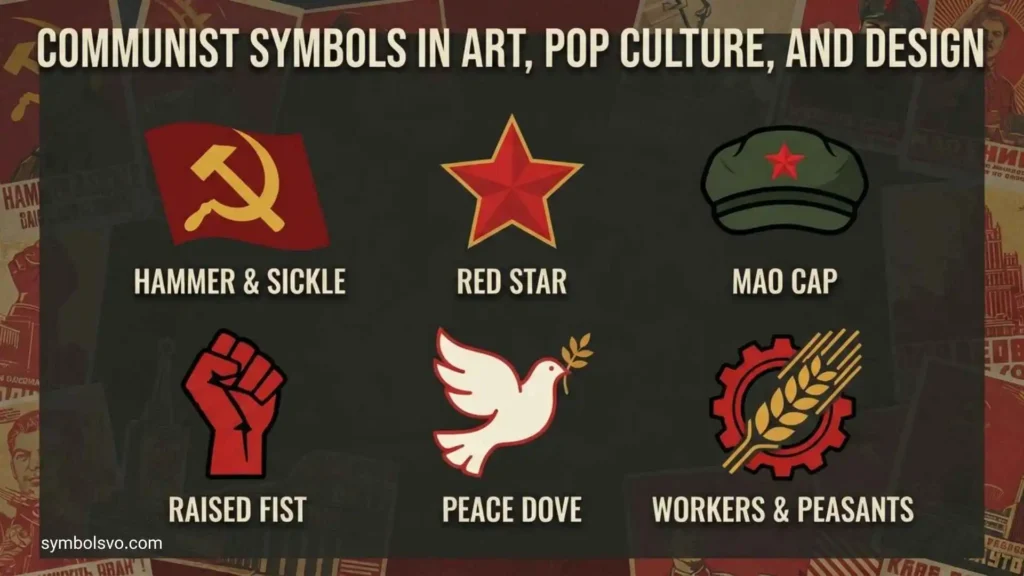
During the early years of the Soviet Union, avant-garde artists created an artistic movement known as Constructivism. They used bold geometric shapes, sharp angles, and brilliant red hues to turn political symbols into high art. This striking style completely redefined global graphic design, typography, and industrial poster art.
[ Industrial Factory Tool ] —> [ Avant-Garde Constructivism ] —> [ Global State Emblem ]
In contemporary pop culture, these historic emblems have undergone an ironic transformation. The famous portrait of Che Guevara wearing a starred beret has been printed on millions of consumer t-shirts, turning a radical anti-capitalist icon into a highly profitable fashion commodity. Similarly, the striking geometry of these symbols continues to influence modern fashion houses, movie posters, and album covers, proving that their visual power remains intact long after their original political contexts have faded.
Spiritual and Dream Meaning of Communist Symbols
Because our subconscious minds process emotions through complex visual metaphors, seeing a highly specific political icon in a dream has little to do with your actual voting habits. Instead, dreaming of a prominent communist symbol usually points to internal struggles regarding personal control, shared responsibilities, or social belonging.
If you see a giant hammer and sickle in a dream, your subconscious may be processing a need to work harder, or it might be warning you that you are sacrificing too much of your individual identity to please a group. Conversely, dreaming of a bright red star can represent a positive inner message about finding clear guidance, setting ambitious goals, or discovering a renewed sense of purpose during a dark period in your life.
Positive and Negative Meanings of Communist Symbols
Political icons hold a complex duality, representing beautiful utopian dreams to some and dark historical nightmares to others.
| Positive Meaning | Negative Meaning |
| Celebrates the dignity and worth of common laborers. | Recalls the historical horrors of the Gulag labor camps. |
| Inspires rapid industrial growth and literacy. | Represents the absolute crushing of individual free speech. |
| Encourages deep global solidarity across racial lines. | Signals aggressive, forced state-sponsored atheism. |
| Promotes the fair distribution of communal resources. | Recalls catastrophic state-directed economic failures. |
Why Humans Are Attracted to Communist Symbols
Our natural attraction to these bold graphic markers is deeply tied to human psychology and pattern recognition. The human brain naturally craves simple, high-contrast visual designs that can be decoded in a fraction of a second. The brilliant red and gold color palette used in socialist imagery triggers subconscious biological feelings of warmth, urgency, and high energy.
Furthermore, humans possess an intense, evolutionary need to belong to a protective league. These symbols satisfy that need by offering a ready-made collective identity. They make the individual feel part of a massive, unstoppable historical movement, effectively curing the isolation of modern life by replacing it with a grand sense of shared communal purpose.
Modern Uses of Communist Symbols
Despite the fall of major socialist regimes at the end of the twentieth century, these iconic symbols continue to find varied uses in contemporary life.
- Political Branding: Retained proudly by modern nations like China, Vietnam, Cuba, and Laos on official currency and flags.
- Protest Movements: Utilized globally by anti-austerity groups, labor unions, and student organizations fighting for wealth redistribution.
- Streetwear Fashion: Subverted by contemporary designers who use the stark geometry for edgy urban clothing lines.
- Social Media Icons: Adopted by digital subcultures to signal anti-capitalist viewpoints and political alignments online.
Interesting Facts About Communist Symbols
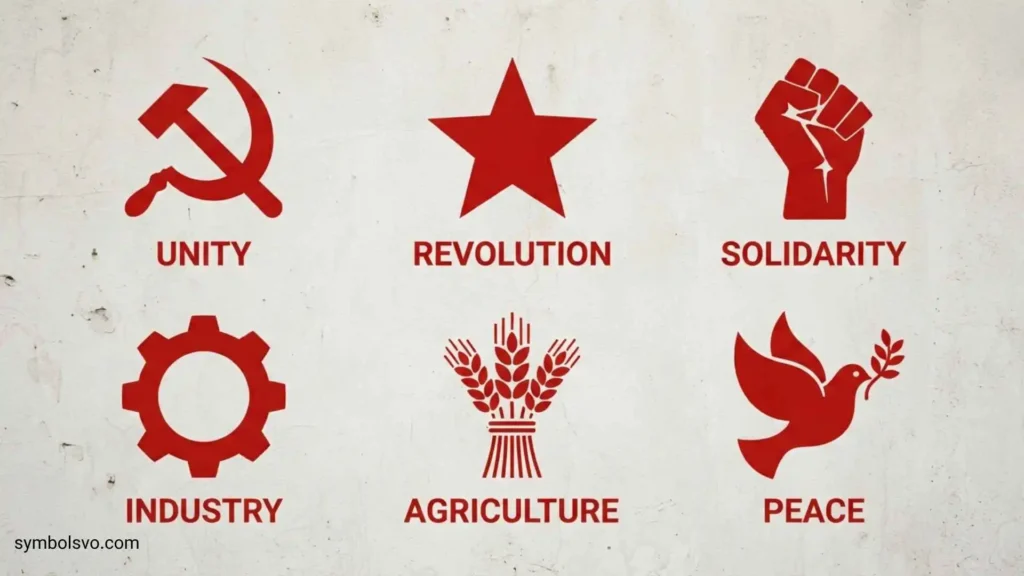
- The hammer and sickle symbol was chosen during a public design contest in 1918, beating out a design that featured a bloody sword.
- The unique red color of the Soviet flag was originally inspired by the flags used during the French Revolution of 1789.
- Displaying communist symbols is completely illegal in several European nations, including Poland, Lithuania, and Ukraine.
- The massive steel hammer and sickle monument in Moscow weighs over seventy-five tons and stands over seventy feet tall.
- The five points of the red star were originally said to represent the five fingers of the worker’s hand working in harmony.
Frequently Asked Questions
Is it illegal to display communist symbols?
It depends entirely on geography. In countries like the United States and the United Kingdom, it is fully protected as free speech. However, in several post-communist Eastern European nations, displaying these symbols in public is strictly banned by law.
Why is the color red always used for communist symbols?
The color red historically represents the blood of working class martyrs who died fighting for labor rights. Psychologically, red is also a high-visibility color that naturally triggers feelings of passion, revolution, and immediate urgency.
Who actually designed the original hammer and sickle?
The icon was designed by a Russian artist named Yevgeny Kamzolkin. Interestingly, Kamzolkin was not a communist himself, but a deeply religious artist who simply wanted to create a harmonious geometric design out of common tools.
What do the stars on the Chinese flag mean?
The largest yellow star represents the absolute leadership of the Communist Party of China. The four smaller stars surrounding it represent the four traditional social classes: the peasantry, the working class, the urban petty bourgeoisie, and the national entrepreneurs.
Conclusion
Communist symbols remain some of the most influential and controversial visual markers ever created by human civilization. By transforming everyday tools of survival into sweeping statements of state power, these icons showed the world how easily art can be used to direct human psychology on a massive scale. Whether they inspire dreams of an equal paradise or serve as stark warnings of state control, these symbols continue to remind us that a simple image can alter the entire course of human history.

I’m Nathan Holloway, a passionate researcher and writer with a deep interest in symbols, signs, and their hidden meanings. I enjoy exploring how symbols have influenced different civilizations, religions, and modern communication. Through my work, I aim to make complex historical and cultural concepts easy to understand for readers of all backgrounds. Every article I write is carefully researched to provide reliable and engaging information.
Books:
- Beyond the Symbol
- The Secret Meanings of Everyday Signs
Author 2: Grace Whitmore
Description:
My name is Grace Whitmore, and I love discovering the stories behind the world’s most fascinating symbols. I spend my time researching ancient civilizations, mythology, spiritual traditions, and modern iconography to uncover the meanings people often overlook. I believe that every symbol has a history worth telling, and I enjoy sharing that knowledge in a simple and reader-friendly way.
Books:
- Echoes of Ancient Symbols
- The Symbolic World
 Mason Ellington
 Grace Whitmore
 Daniel Brooks