Have you ever looked at a fire extinguisher and wondered what all those symbols really mean? I know the labels can seem confusing at first, but each symbol gives you an important clue about how the extinguisher should be used.
You need to understand these symbols because choosing the wrong extinguisher can make a fire more dangerous. I’ll walk you through the common markings in simple language so you can quickly understand what they indicate.
By the end, you’ll know how to read fire extinguisher symbols with confidence and recognize which types of fires they are designed to handle. A few minutes of learning today can help you make a smarter decision in an emergency.
What do The Symbols on A Fire Extinguisher Indicate Class
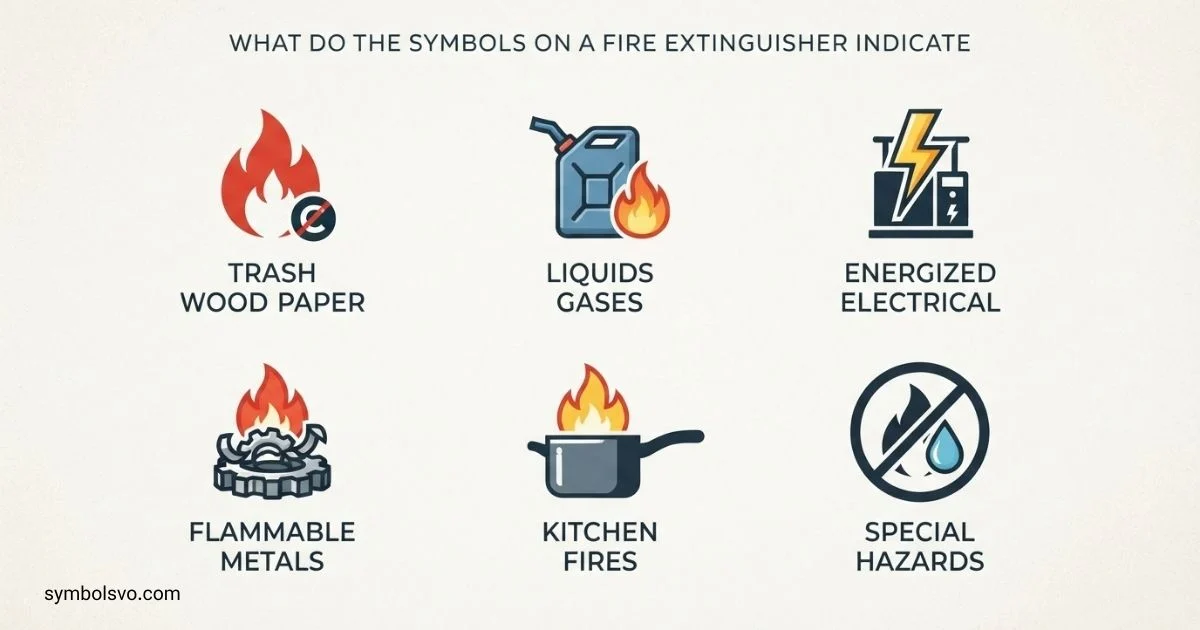
The symbols on a fire extinguisher commonly indicate the class or classes of fire for which the extinguisher is suitable. The exact classification system varies by country, so the symbols should always be read together with the extinguisher’s label and local fire-safety requirements.
In many systems, fire classes are identified by letters and pictograms.
| Fire class | General type of fire | Common example |
| A | Ordinary combustible solids | Wood, paper, cloth |
| B | Flammable liquids | Petrol, paint, solvents |
| C | Flammable gases in some classification systems | Propane, butane |
| D | Combustible metals | Magnesium, sodium |
| F | Cooking oils and fats in many systems | Deep-fat fryer |
A major point of confusion is Class C. Its meaning differs between standards. In the United States, Class C refers to fires involving energized electrical equipment. In systems commonly used in the UK and Europe, Class C generally refers to flammable gases, while electrical hazards are handled separately rather than as a fire class.
For this reason, do not rely on the letter alone when selecting an extinguisher. Read the extinguisher’s label and follow the instructions applicable to your location.
Common Fire Extinguisher Pictograms
Fire extinguisher labels often use pictograms to make the intended application easier to recognize. Typical imagery may show:
- A burning wood log or similar solid material for Class A.
- A container or flame associated with liquid fuel for Class B.
- A gas cylinder or gas-related image where Class C means flammable gases.
- A metal-related pictogram for Class D.
- A cooking pan or fryer for cooking-oil fires.
A symbol marked with a slash or cross can indicate that the extinguisher is not suitable for that type of fire. The exact presentation varies by standard and manufacturer.
Never assume that an extinguisher is safe for a particular fire simply because its cylinder looks similar to another extinguisher.
Fire Extinguisher Symbols for Drawings
A fire extinguisher symbol for drawings is a simplified graphic used to represent an extinguisher on architectural, engineering, fire-protection, or safety drawings.
Instead of drawing the complete extinguisher, a plan may use a small icon and a label. The purpose is identification and location.
A drawing might use a symbol resembling:
🧯
This emoji is useful in ordinary digital communication, but it should not automatically be treated as an official technical drawing symbol. Professional plans generally use the symbol convention required by the relevant building, fire, or drafting standard.
A fire-safety drawing may show:
- Extinguisher locations
- Fire alarm equipment
- Fire hose reels
- Fire doors
- Emergency exits
- Fire blankets
- Emergency lighting
- Fire hydrants
- Assembly points
The legend or key on the drawing is particularly important. It explains what each graphical mark means.
Why legends matter
Two plans can use different graphical conventions for the same piece of equipment. A symbol that looks like an extinguisher to a casual reader may have a different meaning in a particular drawing set.
Always check the legend, key, notes, and project standard rather than guessing from the appearance of an icon.
Fire Extinguisher Symbol in Plan
A fire extinguisher symbol in a plan identifies the location of an extinguisher within a building or area.
On a floor plan, it may be placed next to:
- An exit route
- A corridor
- A stairway
- A wall
- A fire equipment cabinet
- A designated fire point
- A location accessible to building occupants
The symbol is normally much smaller and simpler than a physical extinguisher. Its purpose is to communicate location rather than reproduce every detail of the equipment.
A typical plan might represent an extinguisher with a small graphical icon and an abbreviation such as FE, depending on the project’s drawing convention.
The exact symbol should be interpreted using the plan’s legend.
Fire extinguisher symbols on architectural drawings
Architectural drawings often contain many symbols for doors, stairs, equipment, fixtures, and safety systems. A fire extinguisher marker needs to remain visually distinct enough to identify the equipment quickly.
For this reason, professional drawing sets may use:
Symbol + label + legend reference
rather than relying on a symbol alone.
This is especially useful on large commercial plans where several types of fire-protection equipment appear in the same area.
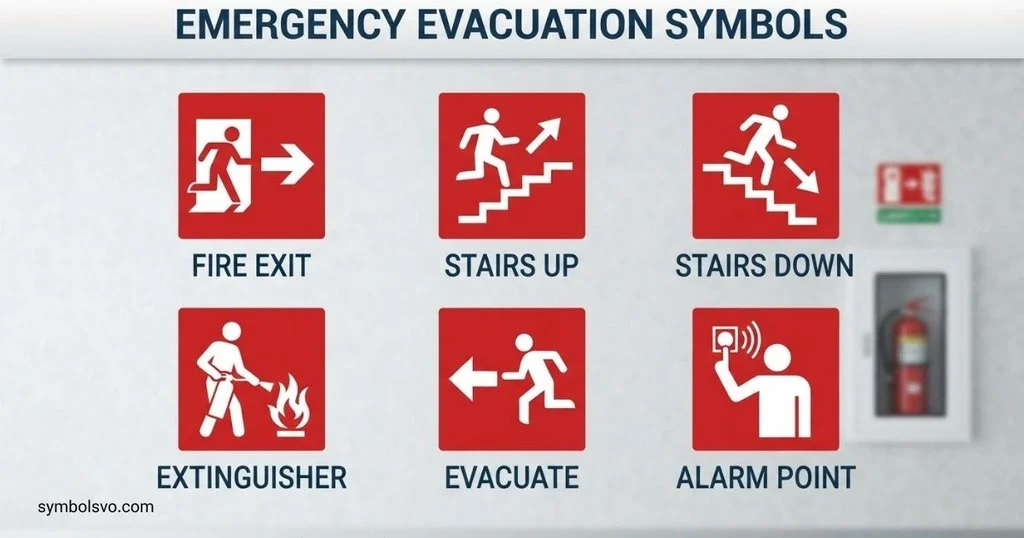
Fire Extinguisher Symbol For Evacuation Plan
A fire extinguisher symbol for an evacuation plan shows where firefighting equipment is located while the plan focuses on emergency movement and escape.
An evacuation plan may include several different types of information:
- You are here location
- Emergency exits
- Escape routes
- Fire extinguishers
- Fire alarms
- Fire hose reels
- Fire blankets
- Assembly points
- Emergency contact information
The extinguisher symbol should not be confused with the escape-route symbol. An extinguisher tells you where firefighting equipment is located; an exit or escape-route marking tells you how to leave the building.
For a simple digital illustration, a fire extinguisher can be represented by:
🧯 Fire extinguisher
However, an actual workplace evacuation plan should use the appropriate standardized signs and symbols required by local regulations or the applicable safety standard.
Fire equipment versus escape information
These symbols serve different purposes.
| Information | Purpose |
| Fire extinguisher | Shows firefighting equipment |
| Fire alarm | Shows an alarm activation point |
| Emergency exit | Shows a way out |
| Escape route | Shows the direction or path to safety |
| Assembly point | Shows where occupants should gather |
An evacuation plan should make these distinctions clear.
Class a Fire Extinguisher Symbol
The Class A fire extinguisher symbol identifies suitability for fires involving ordinary combustible materials.
Typical Class A materials include:
- Wood
- Paper
- Cardboard
- Cloth
- Many ordinary plastics
The exact pictogram depends on the standard being used. In systems that use pictograms for extinguisher classifications, Class A is commonly represented by an image associated with burning ordinary solid material.
A Class A extinguisher may be appropriate for certain ordinary combustible fires, but that does not mean every extinguisher carrying an A classification is suitable for every other fire hazard.
What Class A does not mean
Class A is not a general label meaning “safe for all fires.”
For example, a fire involving cooking oil requires an extinguisher specifically suitable for that hazard in systems where cooking oils and fats have their own classification. Electrical equipment also presents additional considerations.
The extinguisher label should therefore be checked before use.
If a fire is spreading rapidly, producing heavy smoke, blocking an escape route, or otherwise presenting serious danger, evacuation and emergency services should take priority over attempting to fight it.
Fire Extinguisher Marking on Floo
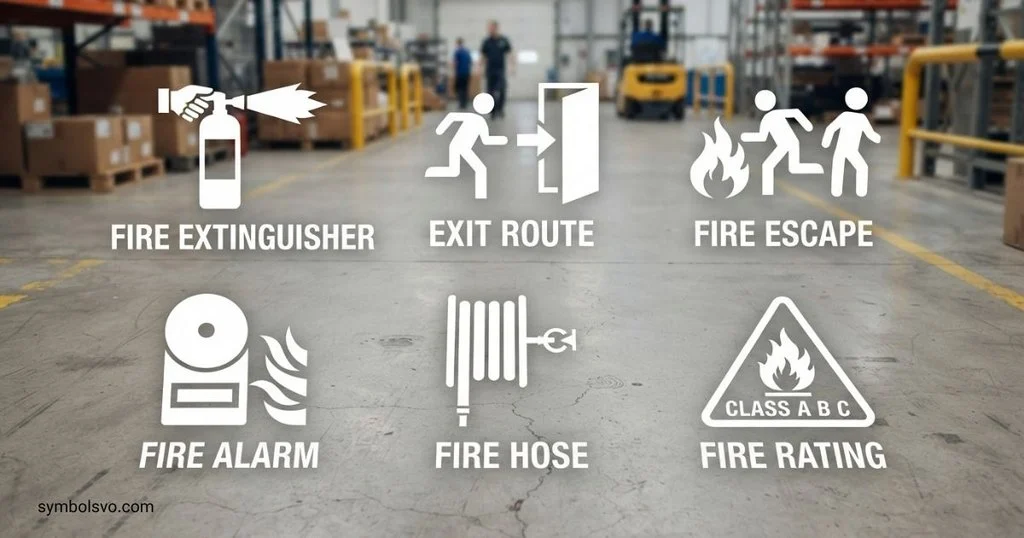
A fire extinguisher marking on the floor is used to make the equipment location easier to identify, especially in busy workplaces, warehouses, factories, commercial buildings, and public areas.
Floor markings can take several forms depending on the facility and applicable safety requirements. They may include:
- A colored boundary around the equipment
- A marked equipment zone
- A floor label
- A directional marking
- A combination of floor and wall signage
The purpose is generally to keep the fire extinguisher visible, identifiable, and accessible.
A floor marking should not be treated as a universal symbol with one identical design everywhere. Requirements can differ by country, industry, building type, and safety standard.
Why floor markings are useful
Fire equipment can become difficult to spot when it is surrounded by:
- Stored boxes
- Furniture
- Machinery
- Shelving
- Vehicles
- Temporary materials
A clear marked area helps draw attention to the extinguisher and can discourage people from placing objects in front of it.
The most important practical rule is simple: do not block or hide firefighting equipment.
Frequently Asked Questions
What do the symbols on a fire extinguisher mean?
They generally identify the types of fires for which the extinguisher is suitable or unsuitable. The exact symbols and classification system depend on the applicable standard and country.
What does the Class A symbol on a fire extinguisher mean?
Class A generally identifies fires involving ordinary combustible solid materials such as wood, paper, and cloth. Always check the complete extinguisher label for its approved applications.
What symbol shows a fire extinguisher on a floor plan?
A floor plan uses a simplified fire-extinguisher graphic or abbreviation determined by the drawing standard. The plan legend should be checked because symbols can vary between drawing systems.
Can I use the fire extinguisher emoji as an official safety symbol?
No. 🧯 is a Unicode emoji and is useful in ordinary text, websites, and messages, but it should not automatically be treated as an official fire-safety or engineering symbol.
Why are fire extinguishers marked on the floor?
Floor markings help identify the equipment location and keep the area around an extinguisher clear. The exact color, shape, and layout depend on the applicable safety requirements.
Conclusion
The symbols on a fire extinguisher are mainly there to communicate its intended fire classification and help users identify suitable and unsuitable applications. Because classification systems differ, the extinguisher label and local safety standard should always take priority over assumptions based on a letter or pictogram alone.
Fire extinguisher symbols also appear on floor plans, evacuation plans, architectural drawings, and floor markings. These symbols are designed to make emergency equipment easier to locate, while legends and standardized signage explain exactly what each marking represents.
For everyday digital text, 🧯 is a recognizable fire extinguisher emoji, but technical drawings and emergency plans require the appropriate professional symbol. The safest approach is to use the standard applicable to your building and never rely on an unfamiliar symbol when an emergency is occurring.

I’m Nathan Holloway, a passionate researcher and writer with a deep interest in symbols, signs, and their hidden meanings. I enjoy exploring how symbols have influenced different civilizations, religions, and modern communication. Through my work, I aim to make complex historical and cultural concepts easy to understand for readers of all backgrounds. Every article I write is carefully researched to provide reliable and engaging information.
Books:
- Beyond the Symbol
- The Secret Meanings of Everyday Signs
Author 2: Grace Whitmore
Description:
My name is Grace Whitmore, and I love discovering the stories behind the world’s most fascinating symbols. I spend my time researching ancient civilizations, mythology, spiritual traditions, and modern iconography to uncover the meanings people often overlook. I believe that every symbol has a history worth telling, and I enjoy sharing that knowledge in a simple and reader-friendly way.
Books:
- Echoes of Ancient Symbols
- The Symbolic World
 Mason Ellington
 Grace Whitmore
 Daniel Brooks