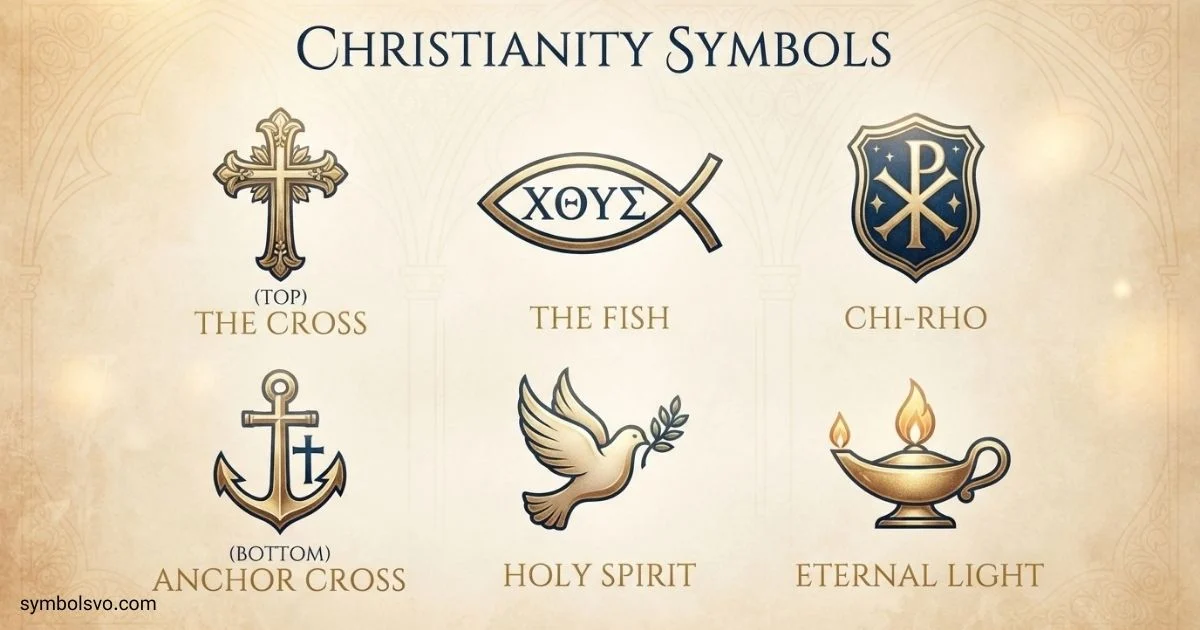
Christianity symbols can tell powerful stories about faith, hope, sacrifice, and devotion. When I look at these signs, I see more than simple shapes or objects—they carry deep meanings that have guided believers for centuries.
You may recognize the cross, dove, fish, or crown, but do you know what each one truly represents? I’ll help you understand the history and spiritual meaning behind these important Christian symbols in a simple and approachable way.
Whether you are learning about Christianity for the first time or simply want to understand these symbols better, you’ll find clear answers here. You’ll discover what these symbols mean, where they come from, and why they remain important today.
What Are The 3 Main Symbols Of Christianity
There is no single universally agreed list of exactly three Christian symbols, but the cross, fish, and Chi-Rho are among the most important historical symbols associated with Christianity.
1. The Cross ✝
The cross is the central and most recognizable Christian symbol. It recalls the crucifixion of Jesus Christ and, within Christian belief, is closely connected with his death, resurrection, sacrifice, and salvation.
Common cross forms include:
- ✝ — Latin cross
- ☦ — Orthodox cross
- ☨ — Cross of Lorraine
- ✚ — Heavy Greek cross
- ✣ — Four-petaled or decorative cross-like symbol
Not every cross-shaped Unicode character is specifically a Christian symbol. Some are simply geometric or decorative characters.
2. The Fish 𓆟
The Christian fish is commonly called Ichthys or Ichthus. The Greek word ichthys means “fish,” and its letters were used as an acrostic for “Jesus Christ, Son of God, Savior.” The symbol appears in early Christian art and inscriptions.
There is no standard Unicode character that specifically represents the traditional Christian Ichthys outline. The ordinary fish emoji 🐟 is a fish emoji, not an official Christian-symbol character.
3. The Chi-Rho ☧
The Chi-Rho combines the Greek letters Chi (Χ) and Rho (Ρ), the first two letters of Christos, the Greek word for Christ. It became an important Christian monogram, especially from the time of Constantine onward.
The Unicode character ☧ is officially named CHI RHO.
Christianity Symbols And Meanings
Christian symbols communicate ideas through simple visual forms. Their meanings are often rooted in Scripture, Christian tradition, historical artwork, and church practice.
| Symbol | Name | Common Christian meaning |
| ✝ | Latin cross | Christ’s crucifixion, sacrifice, salvation |
| ☦ | Orthodox cross | Christian faith and Christ’s crucifixion in Eastern Christian tradition |
| ☧ | Chi-Rho | Christ |
| 🐟 | Fish emoji | Fish in general; can be used informally for Ichthys |
| 🕊 | Dove | Holy Spirit, peace, purity |
| α Ω | Alpha and Omega | Beginning and end; God’s eternity |
| ⚓ | Anchor | Hope and steadfastness |
| 🐑 | Lamb | Christ, sacrifice, innocence |
| 🌿 | Palm branch | Victory, martyrdom, Palm Sunday |
| IHS | Holy Name monogram | Jesus |
| INRI | Crucifixion inscription | Traditional abbreviation associated with the inscription above Jesus’ cross |
Some of these are ordinary Unicode characters rather than specifically Christian Unicode symbols. For example, 🕊 is a dove character, not a character officially named “Christian Holy Spirit symbol.”
The meaning of a symbol also depends on context. A dove can represent peace in general, while in Christian art it can represent the Holy Spirit. Early Christian symbolism included the dove, lamb, Good Shepherd, anchor, and Christ monograms among many other images.
Christianity Symbol Name
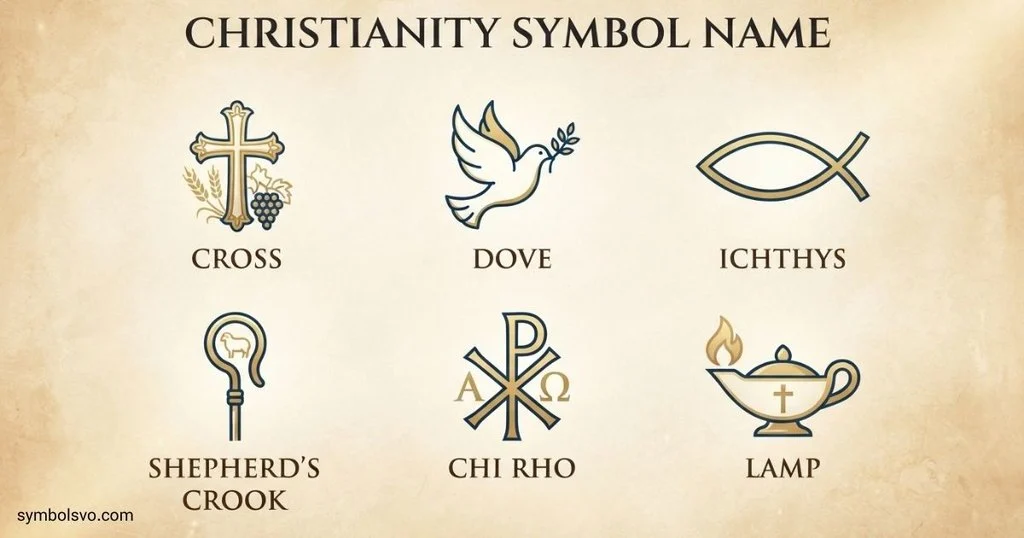
Here are some of the most recognizable Christian symbol names:
- Cross — The central symbol of Christianity.
- Crucifix — A cross showing the body of Christ.
- Ichthys — The Christian fish symbol.
- Chi-Rho — Greek Christogram.
- Alpha and Omega — Greek letters associated with God’s eternal nature.
- Dove — Often represents the Holy Spirit.
- Anchor — Traditionally associated with hope and steadfastness.
- Lamb of God — Symbolic representation of Christ.
- Good Shepherd — Represents Christ as shepherd and protector.
- IHS — A Christogram associated with the name of Jesus.
- INRI — Traditional Latin abbreviation associated with the inscription placed over Jesus’ cross.
- Crown — Can represent Christ’s kingship or heavenly glory.
- Palm branch — Associated with victory and martyrdom.
- Sacred Heart — A devotional Christian symbol particularly prominent in Catholic tradition.
Christian art has used both letters and pictures as symbolic language. The Chi-Rho, IHS, fish, cross, lamb, and shepherd are examples of symbols that developed within different periods of Christian history.
All Christianity Symbols
There is no universally fixed list of all Christianity symbols. Christian symbolism developed across centuries, regions, denominations, languages, and artistic traditions.
A broad reference list includes:
Symbols Of Christ
- ✝ — Cross
- ☧ — Chi-Rho
- IHS — Holy Name of Jesus
- INRI — Crucifixion inscription
- 🐟 — Fish/Ichthys
- 🐑 — Lamb
- Shepherd — Christ as the Good Shepherd
- Alpha and Omega — Eternal Christ
Symbols Of The Holy Spirit
- 🕊 — Dove
- Fire — Often associated with the Holy Spirit and Pentecost
Symbols Of Faith And Hope
- ⚓ — Anchor
- Cross — Faith and salvation
- Lamp or light — Spiritual guidance
- Crown — Victory or heavenly reward
Biblical And Church Symbols
- 🌿 — Palm branch
- 🍇 — Grapes and vine
- Bread and wine — Eucharistic symbolism
- Water — Baptism and spiritual cleansing
- Fish — Christ and Christian discipleship
- Lamb — Christ and sacrifice
These meanings are not always exclusive. A symbol can carry several layers of meaning depending on the artwork and tradition.
Different Christianity Symbols
Christianity includes many traditions, so the symbols seen in one church may differ from those used in another.
Some of the major forms include:
Western Christian symbols: Latin cross, crucifix, IHS, Sacred Heart, lamb, and various Marian symbols.
Eastern Christian symbols: Orthodox crosses, icons, Christograms, Alpha and Omega, and richly developed iconographic imagery.
Celtic Christian symbols: Celtic cross designs, interlaced patterns, and Christian imagery adapted to the artistic traditions of Ireland and the wider Celtic world.
Early Christian symbols: Fish, anchor, Good Shepherd, dove, vine, Chi-Rho, and other images found in early Christian art.
The differences do not necessarily mean that the traditions have completely different beliefs. Many symbols overlap, while their artistic form and devotional use vary.
Christianity Symbols Cross
The cross is the most important symbol in Christian tradition, but there is more than one cross design.
Latin Cross
✝
The Latin cross has a longer vertical section below the shorter horizontal bar. It is especially familiar in Western Christianity.
Greek Cross
✚
A Greek cross has arms of approximately equal length. Crosses of this general form have been used throughout Christian art and architecture.
Orthodox Cross
☦
The Orthodox cross commonly includes additional horizontal elements, including a lower slanted bar in the familiar Russian-style form. Cross forms vary across Eastern Christian traditions.
Celtic Cross
☘︎ + cross design
The Celtic cross is generally recognized by a cross surrounded by a ring. It developed within the artistic traditions of the Celtic Christian world and is especially associated with Ireland and Scotland.
A Celtic cross is not represented perfectly by a single standard Unicode character. Many online “Celtic cross symbols” are decorative combinations or images rather than Unicode characters.
Christianity Symbols Fish
The Christian fish is one of the best-known symbols from early Christianity.
Ichthys — ΙΧΘΥΣ
The Greek word ichthys means fish. Its letters became associated with the phrase “Jesus Christ, Son of God, Savior.” Historical Christian evidence for the fish symbol appears in inscriptions, monuments, catacombs, mosaics, and other early Christian contexts.
The fish can therefore communicate several ideas:
- Jesus Christ
- Christian identity
- Salvation
- Baptism
- Discipleship
- Biblical fishing imagery
The fish is sometimes shown as a simple outline made from two curved arcs. That outline should not be confused with 🐟, which is simply Unicode’s fish emoji.
For copy-and-paste purposes:
🐟
can be used as a general fish character, but it is not the same thing as the traditional Ichthys design.
Christianity Symbols Of God
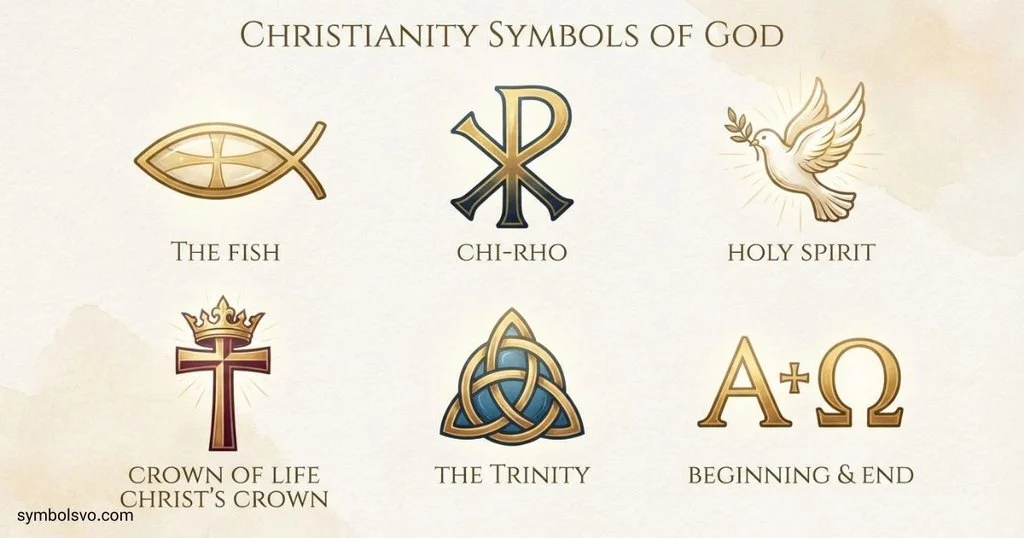
Christian symbolism uses several images and signs to express ideas about God, Christ, the Trinity, and divine eternity.
Alpha And Omega
Α Ω
Alpha is the first letter of the Greek alphabet and Omega is the last. Together they are used in Christian symbolism to express the beginning and the end, particularly in connection with God or Christ.
Trinity
The Trinity is often represented through:
- Three interlocking circles
- The Triquetra in some Christian traditions
- Threefold arrangements
- The cross combined with other Christian signs
The meaning of a symbol such as the triquetra can vary by historical and cultural context, so it should not automatically be labeled an exclusively Christian symbol.
Chi-Rho
☧
The Chi-Rho represents Christ and became especially important in Christian art after the fourth century. It was sometimes displayed with Alpha and Omega, emphasizing Christ’s eternal significance.
Early Christianity Symbols
Early Christians used symbolic imagery in places such as catacombs, tombs, inscriptions, and other forms of art. Symbols provided ways to express Christian ideas through images and signs.
Important early examples include:
- Fish
- Anchor
- Chi-Rho
- Good Shepherd
- Dove
- Lamb
- Vine
- Cross
- Jonah
- Noah
- Palm branch
Early Christian symbolism often drew from biblical stories and existing Jewish and Mediterranean visual traditions. The fish, for example, had both Christian acrostic associations and additional symbolic interpretations connected with water and baptism.
The Good Shepherd was another important early image. It presented Christ through the familiar biblical image of a shepherd caring for his sheep.
Ancient Christianity Symbols
Ancient Christian symbols developed over several centuries rather than appearing as one complete set at a single moment.
Some particularly important ancient examples are:
| Ancient symbol | Meaning or association |
| Fish | Christ and Christian identity |
| Anchor | Hope and steadfastness |
| Chi-Rho | Christ |
| Dove | Spirit, peace, or soul depending on context |
| Lamb | Christ and sacrifice |
| Good Shepherd | Christ’s care for believers |
| Vine | Christ, Church, and spiritual life |
| Cross | Christ’s crucifixion and salvation |
| Alpha and Omega | Beginning and end |
| Palm | Victory and martyrdom |
The Chi-Rho became particularly prominent during the fourth and fifth centuries and appeared on buildings, coins, sarcophagi, monuments, and other objects.
Early Christian art also used biblical figures and stories symbolically. Jonah, Daniel, Noah, and others could communicate ideas about danger, deliverance, resurrection, faith, and salvation.
Orthodox Christianity Symbols
Eastern Orthodox Christianity has a rich visual tradition in which the cross and icons hold central places.
The Orthodox cross is commonly shown as:
☦
The familiar form includes three horizontal elements, although Orthodox cross designs vary by region and tradition.
Other important Orthodox symbols and visual elements include:
- Orthodox cross
- Icons of Christ
- Icons of the Theotokos
- Christograms
- Alpha and Omega
- Processional crosses
- Church icons
- Iconostasis
The cross is described as the central sacred symbol of Eastern Orthodoxy. Orthodox churches also place major importance on icons representing Christ, Mary, apostles, angels, and saints.
A Unicode character can represent an Orthodox-style cross in text, but it cannot reproduce the detailed iconography found in an Orthodox church.
Celtic Christianity Symbols
Celtic Christianity developed in the British Isles and became associated with distinctive artistic traditions. One of its best-known visual forms is the Celtic cross, which combines a cross with a surrounding ring.
Common Celtic Christian imagery includes:
- Celtic cross
- Interlaced knotwork
- Spirals
- Christian crosses
- Sacred wells and water imagery
- Biblical animals
- Manuscript decoration
- Insular-style patterns
The Celtic cross is especially notable because it combines Christian symbolism with artistic traditions associated with Celtic cultures. Historical discussions of Celtic Christianity also point to interactions between Christian practices and local cultural traditions.
Not every knot, spiral, or Celtic-looking design is specifically Christian. Some predate Christianity or have modern decorative interpretations, so context matters.
Christianity Symbols And Churches
Christian symbols appear throughout church buildings, but their placement and meaning vary among denominations.
You may find crosses:
- Above church entrances
- On towers
- On altars
- Behind the altar
- On processional objects
- On vestments
- In stained glass
- On gravestones
Eastern Orthodox churches are particularly known for icons and the iconostasis, the screen separating the sanctuary from the main worship space. The arrangement includes important icons of Christ and the Theotokos.
Other Christian churches may use:
- Baptismal fonts
- Candles
- Stained-glass crosses
- Pulpit symbols
- Communion imagery
- Alpha and Omega
- Fish symbols
- Dove imagery
A church’s symbols can therefore provide clues about its tradition, theology, history, and artistic culture.
Images Of Christianity Symbols With Names
When looking for images of Christian symbols, it helps to identify the symbol before interpreting the picture.
Here is a simple image-name reference:
- ✝ Latin cross — The most widely recognized Christian cross.
- ☦ Orthodox cross — A distinctive Eastern Christian cross form.
- ☧ Chi-Rho — A Christogram made from Greek letters.
- Ichthys — The traditional Christian fish.
- Dove — Often used for the Holy Spirit.
- Anchor — A historical Christian symbol associated with hope.
- Lamb — Often represents Christ.
- Celtic cross — Cross with a surrounding ring.
- Alpha and Omega — Symbols of beginning and end.
When using an image online, check its source and licensing before publishing it on a website or commercial project.
Christianity Symbols Copy And Paste
If you need Christian symbols for social media, messages, profiles, documents, or decorative text, the following characters are easy to copy.
Christian Cross Symbols
✝ ✞ ✟ ☦ ☨ ✚
Christian Monogram
☧
Greek Letters
Α Ω α ω
General Christian-Themed Characters
🕊 🐟 ⚓ 🐑 🌿
Remember that these characters do not all have Christian meanings in Unicode itself. For example, 🐟 is a fish emoji and 🕊 is a dove character. Their Christian meaning comes from how they are used.
For example:
Faith ✝ Hope ⚓ Love
Jesus Christ ☧
Christ is risen ✝
Α Ω
If a symbol does not display correctly on a particular device, the issue may be related to the font, application, or platform. For detailed church artwork or complex crosses, an image or SVG is usually more reliable than plain text.
Anti Christianity Symbols
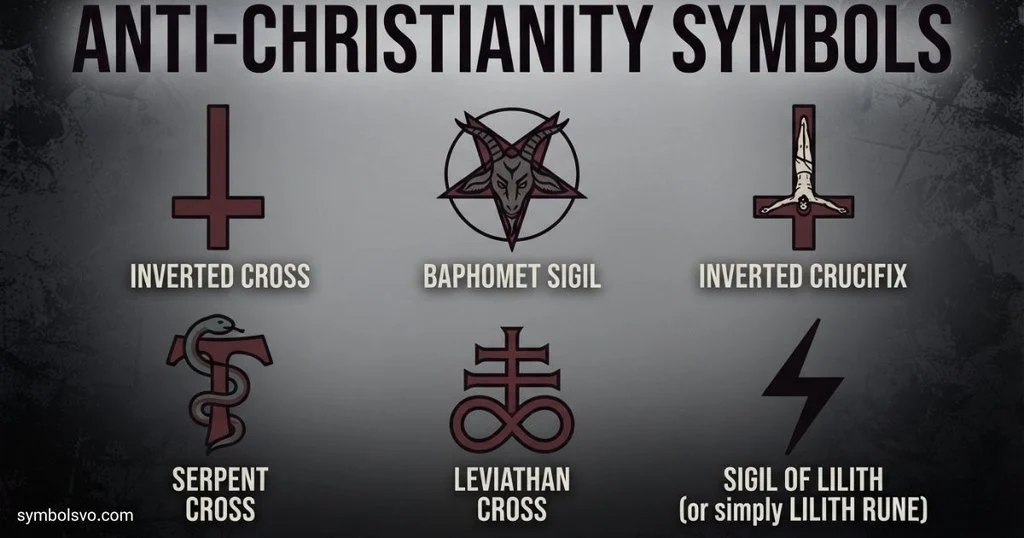
“Anti Christianity symbols” refers to symbols, imagery, or signs used to criticize, reject, oppose, parody, or challenge Christianity. This is different from ordinary Christian symbols that have negative interpretations in some contexts.
There is no single universal catalog of anti-Christian symbols. Their meanings depend heavily on history, culture, religion, art, and the person using them.
Some examples encountered in historical or contemporary discussions include:
- Inverted cross — Its meaning is context-dependent. It can represent St. Peter in Christian tradition, but in modern popular culture it is also sometimes used as an anti-Christian or provocative symbol.
- Broken cross — May be used in protest or rejection of Christianity, but it does not have one universal meaning.
- Cross with hostile or satirical imagery — Often expresses criticism rather than a standardized symbol.
- Anti-religious artwork — May use Christian imagery in deliberately oppositional ways.
The inverted cross is a particularly important example of why context matters. The Cross of St. Peter has a longstanding Christian association with the apostle Peter, while the same inverted shape can be used in modern anti-Christian imagery. Treating every inverted cross as automatically “anti-Christian” is therefore inaccurate.
Christian symbols can also be reinterpreted in art, protest, literature, film, and popular culture. The safest approach is to identify the historical meaning first and then examine how the particular creator or community is using it.
Frequently Asked Questions
What is the most important symbol of Christianity?
The cross is generally regarded as the central and most recognizable symbol of Christianity. It recalls the crucifixion of Jesus and is closely associated with Christian beliefs about salvation and resurrection.
What are the three main Christian symbols?
There is no official universal list of exactly three, but the cross, fish or Ichthys, and Chi-Rho are three historically important Christian symbols.
What does the Christian fish symbol mean?
The fish, or Ichthys, is associated with Jesus Christ and was formed from the Greek word for fish. Its letters became an acrostic for “Jesus Christ, Son of God, Savior.”
What does ☧ mean?
☧ is the Unicode character CHI RHO. It represents the Greek letters Chi and Rho and is a traditional Christian monogram for Christ.
Is the Orthodox cross different from the Latin cross?
Yes. The familiar Orthodox cross often has additional horizontal elements, including a lower slanted bar in the commonly recognized form. Different Eastern Christian traditions use variations of the cross.
Conclusion
Christianity has a rich symbolic tradition that includes the cross, fish, Chi-Rho, dove, anchor, lamb, Alpha and Omega, and many other signs. Some began in early Christian communities, while others developed through later church traditions and regional forms of Christian art.
For text and digital use, characters such as ✝, ☦, ☧, ✞, and Α Ω can be copied and pasted easily. However, not every Christian symbol has a dedicated Unicode character, so images or specialized artwork are often needed for detailed crosses, icons, and traditional designs.
The best way to understand a Christian symbol is to consider its historical and religious context. A single shape can have different meanings across traditions, so identifying the symbol is only the first step; its use, history, and surrounding imagery complete the picture.

 Grace Whitmore
 Daniel Brooks