
Demon Symbols can look mysterious, powerful, and even confusing at first. I know it can be difficult to understand what different symbols mean, especially when their origins and interpretations vary.
In this guide, you’ll discover the meanings, origins, and common types of Demon Symbols in simple language. I’ll help you understand the ideas behind these symbols without making the topic unnecessarily complicated.
You can use this guide to explore Demon Symbols with a clearer perspective and learn why certain designs have become widely recognized. Let’s uncover their meanings and the stories connected to them.
Quick Answer
Demon symbols are ancient shapes, letters, or sigils used across history to represent, summon, or ward off supernatural entities. While often associated with evil in modern media, these symbols originally served as powerful cultural tools for protection, spiritual transformation, and exploring the hidden depths of human psychology.
Quick Facts About Demon Symbols
| Aspect | Information |
| Origin | Ancient Mesopotamia, Greece, and medieval European grimoires. |
| Historical Significance | Used for protection, magical binding, and spiritual alchemy. |
| Main Meaning | The manifestation of hidden, chaotic, or forbidden forces. |
| Spiritual Meaning | Facing the inner shadow to achieve personal transformation. |
| Cultural Importance | Defines the boundaries between sacred rules and social taboos. |
| Modern Usage | Popular in heavy metal culture, horror films, tattoos, and fashion. |
What Are Demon Symbols?
To truly understand demon symbols, we have to look past modern horror movies. In ancient times, the word demon did not mean a red creature with a pitchfork. It comes from the Greek word daemon, which referred to a neutral guiding spirit or a force of nature.
Over time, as different religions grew, these spirits were recast as dark, rebellious entities. Demon symbols evolved alongside this change. They became a visual language used by magicians, priests, and alchemists.
In the medieval period, books called grimoires were published. These books listed hundreds of specific shapes called sigils. Each sigil was believed to be the unique spiritual signature of a specific entity. Having the symbol meant you had power over the entity, allowing you to either trap it or ask it for help.
Deep Symbolic Meaning of Demon Symbols
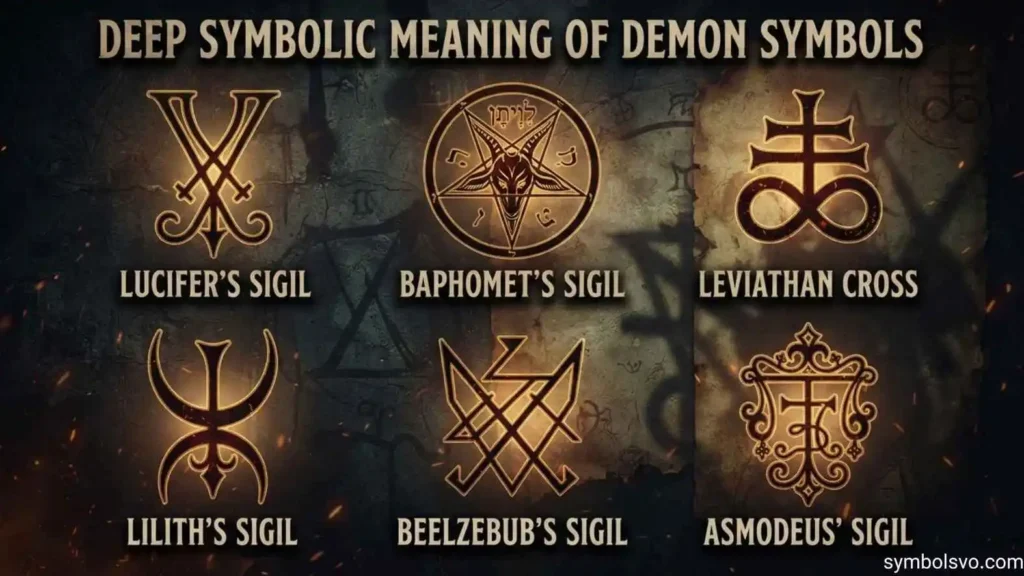
To fully understand these symbols, we must look at them through three distinct lenses: the spiritual, the psychological, and the cultural.
Spiritual Level
On a spiritual level, these symbols represent the untamed forces of the universe. They are often linked to spiritual alchemy, which is the process of turning your flaws into strengths. Instead of seeing a symbol as purely evil, many ancient traditions saw it as a representation of hidden knowledge or fluid fire. It is the raw power that exists before it is tamed by human laws.
Psychological Level
The famous psychologist Carl Jung spoke deeply about the shadow archetype. The shadow is the part of our mind where we hide our fears, anger, and hidden desires. Demon symbols are the visual forms of this psychological shadow. When people look at these symbols, they are often facing things they are afraid to admit about themselves. This makes the icons deeply magnetic and emotionally intense.
Cultural Level
Every culture needs rules to survive. Symbols of dark entities often serve as boundaries for what a community considers safe or unsafe. They represent chaos, rebellion, and the destruction of order. By understanding what a society fears, you can learn exactly what that society values most.
Types and Variations of Demon Symbols
There are countless variations of these symbols found throughout history. Here are some of the most famous and widely recognized examples.
The Sigil of Lucifer
- Visual Description: A complex geometric design featuring a large X, a V shape at the bottom, and various lines and small circles.
- Meaning: Independence, light-bringing, and knowledge.
- Symbolism: It represents the Morning Star and the pursuit of wisdom outside of traditional boundaries.
- Cultural Connection: Found in the Italian grimoire known as the Grimorium Verum.
- Where It Appears: Occult literature, modern gothic jewelry, and philosophy books.
The Sigil of Baphomet
- Visual Description: An inverted five-pointed star (pentagram) containing the head of a goat.
- Meaning: The balance of opposites and the physical nature of humanity.
- Symbolism: The goat represents the earth, while the upside-down star shows a focus on the physical world rather than the spiritual sky.
- Cultural Connection: Originally linked to the Knights Templar, it was later adopted by modern satanic organizations.
- Where It Appears: Pop culture, heavy metal album covers, and modern altars.
(An illustration of geometric symmetry often found in ancient occult sigils)
The Leviathan Cross
- Visual Description: A double-barred cross sitting on top of an infinity symbol.
- Meaning: The element of sulfur, eternal balance, and deep water.
- Symbolism: The double cross represents protection and balance, while the infinity loop represents the eternal nature of the universe.
- Cultural Connection: Used heavily in ancient alchemy to label chemicals.
- Where It Appears: Alchemical texts, modern tattoos, and rock music merchandise.
Demon Symbols Across Different Cultures
The way people view these dark shapes changes wildly depending on where and when they lived.
Ancient Egypt
In Egypt, chaotic entities like Apep or Ammit were represented by hybrid animals. Ammit had the head of a crocodile and the body of a hippo. These symbols were used in funerary art to warn people about the dangers of living an unjust life.
Ancient Greece
As mentioned before, Greeks used the term daemon. Their symbols were often simple geometric shapes or protective eyes. They were used to bring good luck, protect crops, and guide travelers safely home.
Roman Culture
The Romans feared restless spirits called Lemures. They used specific household symbols, iron keys, and water rituals to keep these spirits away from their families during night festivals.
Eastern Traditions
In Japan, the Oni is a fierce creature represented by horns, wild hair, and iron clubs. While they can be destructive, statues of Oni symbols are actually placed on the roofs of buildings to scare away other evil spirits.
Indigenous Traditions
Many tribal cultures use symbols of tricksters or shape-shifters. These symbols are carved into wood or painted on skin during storytelling ceremonies to teach children about the dangers of greed and pride.
Similar Symbols and Their Meanings
It is easy to confuse demon symbols with other ancient markings. Let’s compare them to see how they differ.
| Symbol Category | Main Purpose | Visual Style | Example |
| Demon Symbols | Invoking or binding specific entities | Geometric lines, letters, and animal traits | Sigil of Asmodeus |
| Alchemical Symbols | Labeling natural elements and chemicals | Simple circles, crosses, and planetary signs | Sulfur Symbol |
| Warding Symbols | Keeping negative energies far away | Symmetrical lines, eyes, and repeating knots | Evil Eye / Hamsa |
Many people mistake an alchemical symbol for a dark occult sign simply because both look old and mysterious. Understanding the history helps clear up these common misunderstandings.
Demon Symbols in Mythology and Folklore
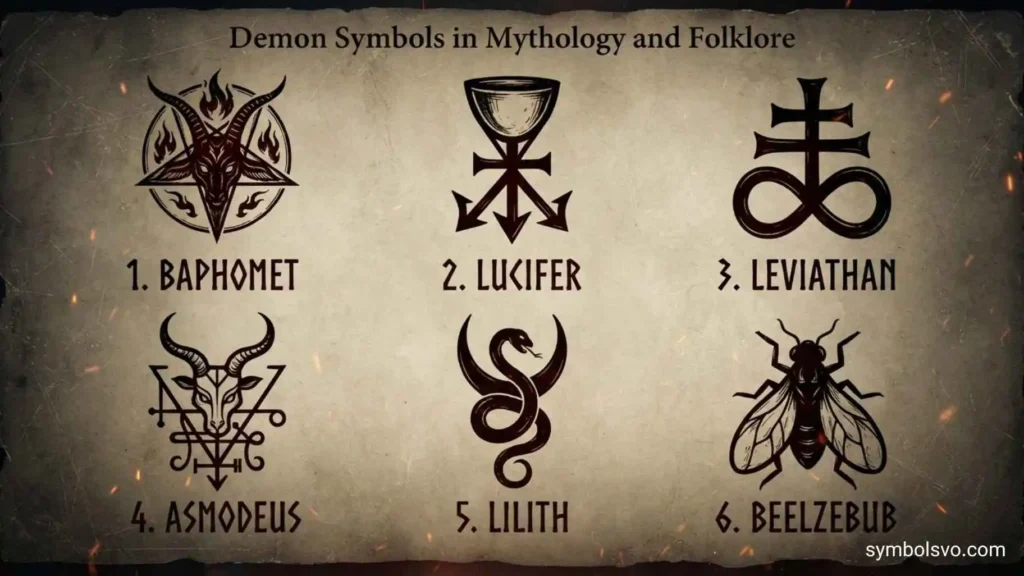
In ancient folklore, stories are filled with tales of Solomon, a wise king who supposedly received a magical ring from an angel. This ring bore a symbol known as the Seal of Solomon. According to legend, the king used this symbol to command and bind seventy-two different spirits, forcing them to help build his great temple.
These stories traveled through the centuries, inspiring people to draw protective boundaries around their homes. In old European folklore, people would chalk intricate geometric symbols on their doors and fireplaces to block dark entities from entering through the chimneys.
Demon Symbols in Art, Literature, Movies and Pop Culture
From classical paintings to modern television, these icons are everywhere. Dante Alighieri described terrifying symbols of the underworld in his famous poem, The Divine Comedy. Artists like John Martin painted massive, dark cityscapes covered in mysterious runes.
In modern times, Hollywood loves using these symbols for instant dramatic effect. Movies like The Exorcist and Hereditary feature ancient sigils to create a sense of mystery and dread. In the world of fashion and tattoos, young people often wear these symbols as signs of rebellion, strength, or a love for dark fantasy aesthetics.
Spiritual and Dream Meaning of Demon Symbols
Seeing these symbols in a dream or during meditation can be a startling experience. However, dream experts suggest that these images usually represent internal blocks.
If you dream of a dark sigil, it might mean you are feeling overwhelmed by a secret, a bad habit, or a hidden fear. It is a cautionary message telling you to look closely at your life and fix what is broken. On a positive note, conquering or facing the symbol in your dream shows that you are ready to reclaim your personal power.
Positive and Negative Meanings of Demon Symbols
Context changes everything. A single symbol can mean two completely different things depending on how you look at it.
The Concept of Light and Shadow: Every symbol has a dual nature. What destroys can also rebuild.
- Positive Interpretation: Personal freedom, standing up against unfair rules, uncovering hidden truths, and mental strength.
- Negative Interpretation: Destruction, chaos, uncontrolled anger, selfishness, and spiritual darkness.
Why Humans Are Attracted to Demon Symbols
Why do we look into the dark? Psychologists point out that humans have a natural drive for pattern recognition and a deep curiosity about things that are forbidden.
We love scary stories and mysterious icons because they let us experience fear in a safe environment. Wearing or studying a dark symbol makes us feel connected to an ancient, secret history. It taps into our collective cultural memory and gives us a creative way to express our own inner battles.
Modern Uses of Demon Symbols
Today, these symbols have moved from secret leather books into mainstream culture.
- Tattoos: People get sigils to represent overcoming a dark time in their lives.
- Jewelry: Silver rings and pendants featuring ancient crosses or stars are popular in gothic fashion.
- Gaming: Video games use these symbols to decorate dark dungeons and fantasy spells.
- Social Media: Aesthetic accounts use occult imagery to build unique visual themes.
Interesting Facts About Demon Symbols
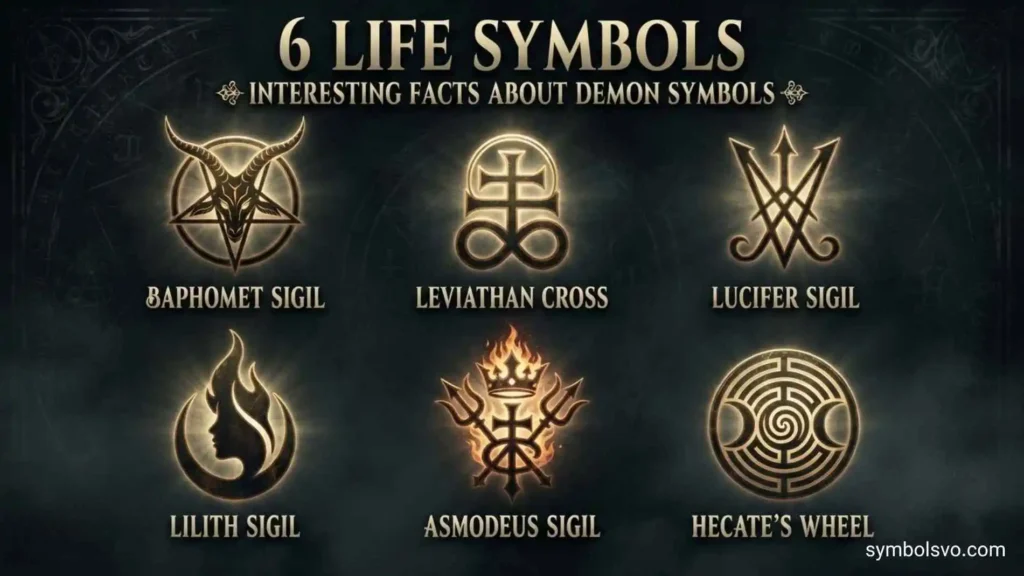
- Many ancient protective symbols were intentionally ugly because people believed evil forces would be disgusted and run away.
- The word occult simply means hidden, it had nothing to do with evil when it was first used.
- The inverted cross was originally a symbol of humility used by Saint Peter, not a dark occult icon.
- Ancient Mesopotamians used symbols of the demon Pazuzu to protect pregnant people from other dangerous spirits.
- Alchemists used dark symbols as a secret code so kings could not steal their scientific formulas.
Frequently Asked Questions
Are demon symbols always bad?
No, they are not. Historically, many of these symbols were used for protection, science, or psychological expression. Their meaning depends entirely on the culture and the individual using them.
What is a sigil?
A sigil is a unique geometric symbol created by combining letters, numbers, or planetary paths. It acts like a signature for a specific spiritual force or idea.
Why do horror movies use these symbols?
Movies use them because they instantly create a spooky, ancient atmosphere. They trigger our natural fear of the unknown and make the story feel more realistic.
Can a symbol hurt someone?
Symbols are tools of communication and expression. They hold cultural and psychological power, but they do not have a physical power to cause harm on their own.
Conclusion
Demon symbols are much more than relic items from old horror stories. They are historical footprints that show how humans have tried to understand fear, power, and the unknown for centuries. By exploring their origins, we realize that studying the dark is often just another way of searching for the light. These symbols remind us that true strength comes from understanding every part of our history and ourselves..

I’m Daniel Brooks, a content creator and symbol enthusiast dedicated to researching the fascinating world of signs and symbols. I enjoy discovering the hidden meanings behind famous icons, emojis, historical emblems, and cultural symbols. Through my writing, I aim to provide trustworthy, well-researched, and reader-friendly information that helps people learn something new with every visit.
Books:
- The Complete Guide to World Symbols
- The Power of Universal Signs
 Mason Ellington
 Grace Whitmore