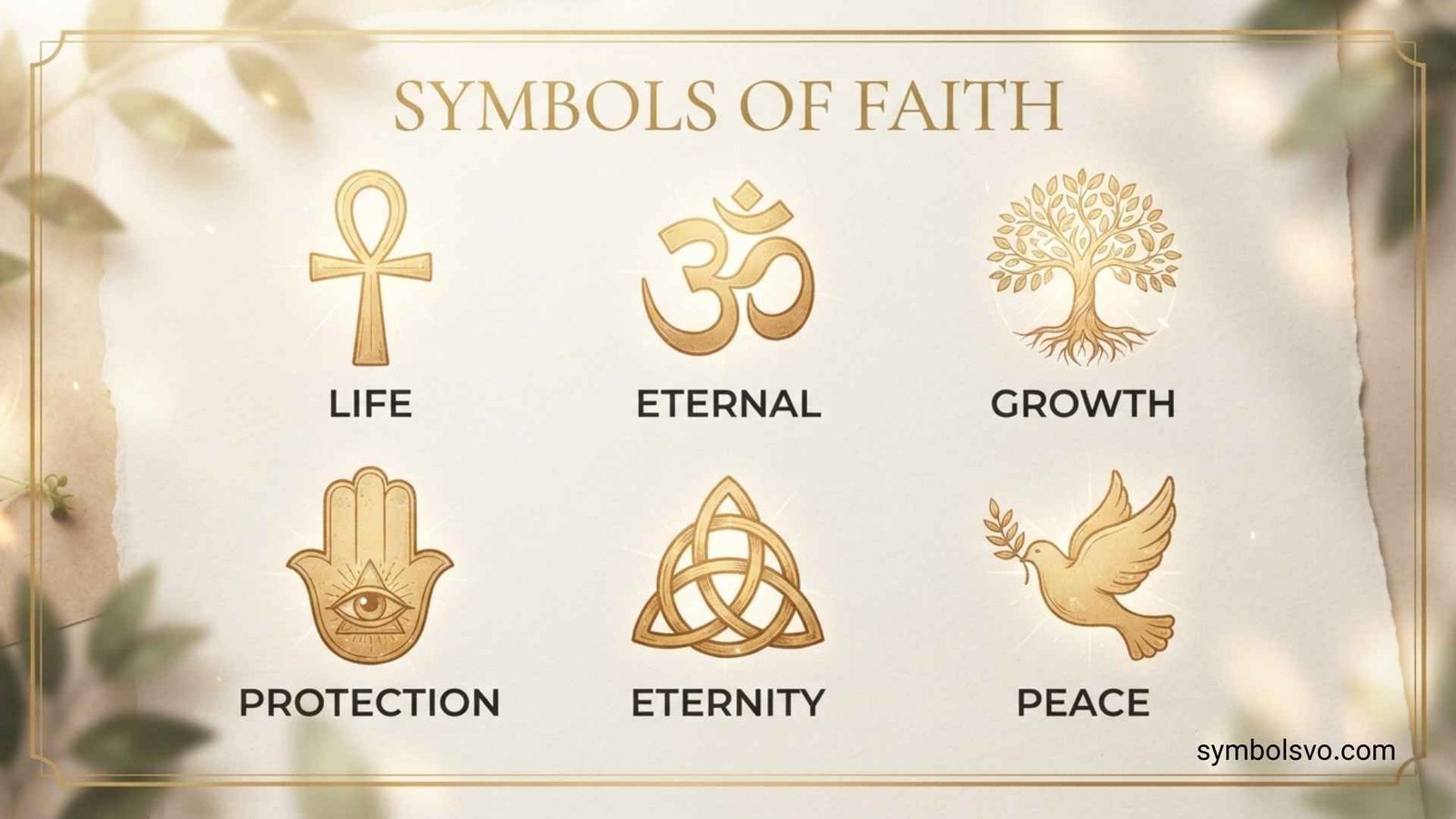
Symbols of Faith can express hope, belief, love, peace, and spiritual connection without saying a single word. I find these symbols fascinating because a simple shape or object can carry a deep meaning that connects people across generations and cultures.
When you explore Symbols of Faith, you begin to see how people use sacred signs to express what matters most to them. You may already recognize some familiar symbols, but their history and meaning can be much deeper than you expect.
I’ll help you understand these meaningful symbols in a simple and practical way. You can discover what different Symbols of Faith represent, why they matter, and how they continue to inspire people today..
Quick Answer
Symbols of faith are sacred visual representations, signs, or objects that embody profound spiritual beliefs, religious philosophies, and cultural values. They serve as tangible links to the divine, helping individuals express complex spiritual truths, find comfort, and maintain a shared sense of community identity across generations.
Quick Facts About Symbols of Faith
| Aspect | Information |
| Origin | Prehistoric rock art, ancient civilizations, and early tribal rituals. |
| Historical Significance | Used to unite communities, pass down sacred knowledge, and identify believers secretly. |
| Main Meaning | A visible sign of an invisible reality or a deeply held spiritual truth. |
| Spiritual Meaning | Divine protection, inner transformation, and the awakening of soul consciousness. |
| Cultural Importance | Anchors societal morals, preserves history, and builds strong community bonds. |
| Modern Usage | Popular in tattoos, jewelry, high fashion, brand logos, and personal wellness spaces. |
What Are Symbols of Faith?
At their core, symbols of faith are much more than simple drawings or geometric shapes. They are visual containers for deep spiritual truths. Long before humans wrote books or built grand libraries, they used simple marks on stone to express their relationship with the universe.
These emblems evolved out of a need to communicate things that words could not express. In ancient times, when most people could not read, a single image could tell a whole story of creation, morality, and survival. Over centuries, these signs grew from tribal markings into powerful global identities.
They became important because they offered safety, direction, and a sense of belonging. During times of war or persecution, a hidden symbol could help a traveler find a trusted friend or a safe house. Today, they continue to evolve, carrying ancient wisdom into our fast-paced modern world.
Deep Symbolic Meaning of Symbols of Faith
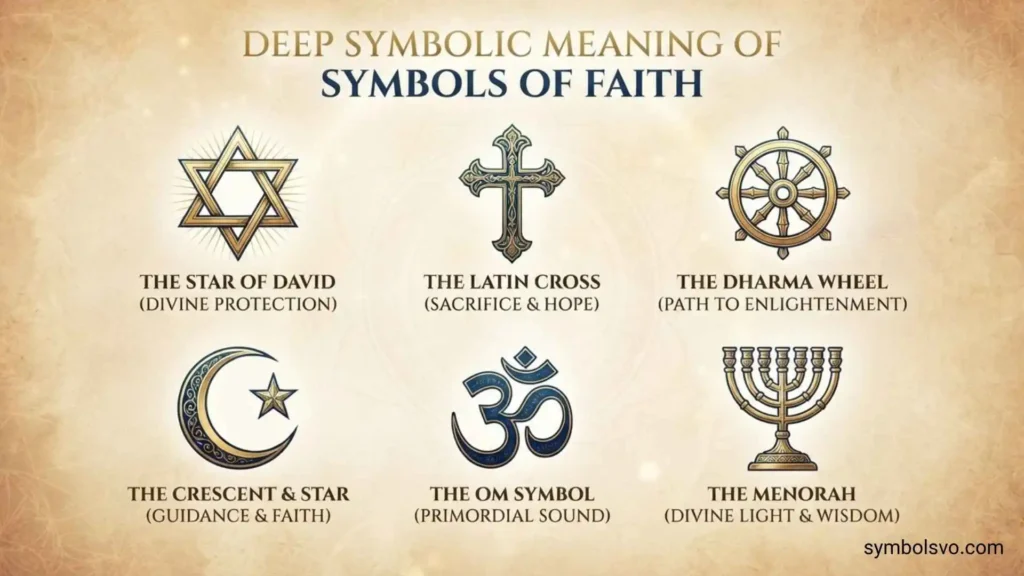
To truly understand these holy icons, we must look at them through three different lenses: the spiritual, the psychological, and the cultural.
Spiritual Level
On a spiritual level, these icons act as doors to the divine. They help a believer focus their mind during prayer or meditation. Many traditions believe these shapes hold real spiritual energy, offering protection from negative forces and helping the soul transform. They remind us that our physical life is connected to a much larger, eternal reality.
Psychological Level
Psychologist Carl Jung believed that certain images belong to a collective unconscious shared by all humans. These archetypes trigger deep emotional responses inside us. When you look at a sacred symbol, your brain recognizes a pattern of balance, light, or unity. This recognition brings an immediate sense of emotional comfort and inner peace.
Cultural Level
Culturally, these signs act as social glue. They bring people together under a shared set of morals and beliefs. For example, seeing a familiar emblem outside a building tells a traveler that the people inside share their values. They preserve traditional interpretations of history and keep ancient storytelling alive.
Types and Variations of Symbols of Faith
The Christian Cross
- Visual Description: Two intersecting lines, with one vertical bar crossed by a shorter horizontal bar.
- Meaning: Victory over death, divine love, and unconditional forgiveness.
- Symbolism: Ultimate sacrifice, redemption, and the intersection of heaven and earth.
- Cultural Connection: Central to global Christian identity and Western history.
- Where It Appears: Church architecture, religious jewelry, classical paintings, and gravestones.
The Star of David
- Visual Description: A six-pointed star formed by two interlocking equilateral triangles.
- Meaning: The protective shield of King David and the connection between God and humanity.
- Symbolism: Dualism, balance between heaven and earth, and spiritual sovereignty.
- Cultural Connection: The ultimate symbol of Jewish identity, resilience, and Israeli heritage.
- Where It Appears: Synagogues, the flag of Israel, sacred texts, and family heirlooms.
The Star and Crescent
- Visual Description: A crescent moon resting next to a lone five-pointed star.
- Meaning: Guidance, light in the darkness, and openness to divine wisdom.
- Symbolism: The lunar calendar of faith, spiritual focus, and sovereign honor.
- Cultural Connection: Widely recognized across Islamic nations and Middle Eastern history.
- Where It Appears: Mosque minarets, national flags, traditional coins, and jewelry.
The Lotus Flower
- Visual Description: A beautiful multi-petaled blossom rising clean out of muddy waters.
- Meaning: Purity, spiritual awakening, and complete detachment from worldly struggles.
- Symbolism: Rising above adversity, inner beauty, and the journey toward enlightenment.
- Cultural Connection: Deeply revered in Buddhist, Hindu, and ancient Egyptian traditions.
- Where It Appears: Meditation halls, statues of the Buddha, yoga studios, and ancient temple walls.
The Om (Aum)
- Visual Description: A sacred Sanskrit character featuring elegant curves, a crescent, and a dot.
- Meaning: The primordial sound of the universe and the absolute source of existence.
- Symbolism: The four states of consciousness, which include waking, dreaming, deep sleep, and absolute truth.
- Cultural Connection: The foundational root of Hindu philosophy and Vedic chanting.
- Where It Appears: Sacred mantras, temple entryways, meditation music, and spiritual tattoos.
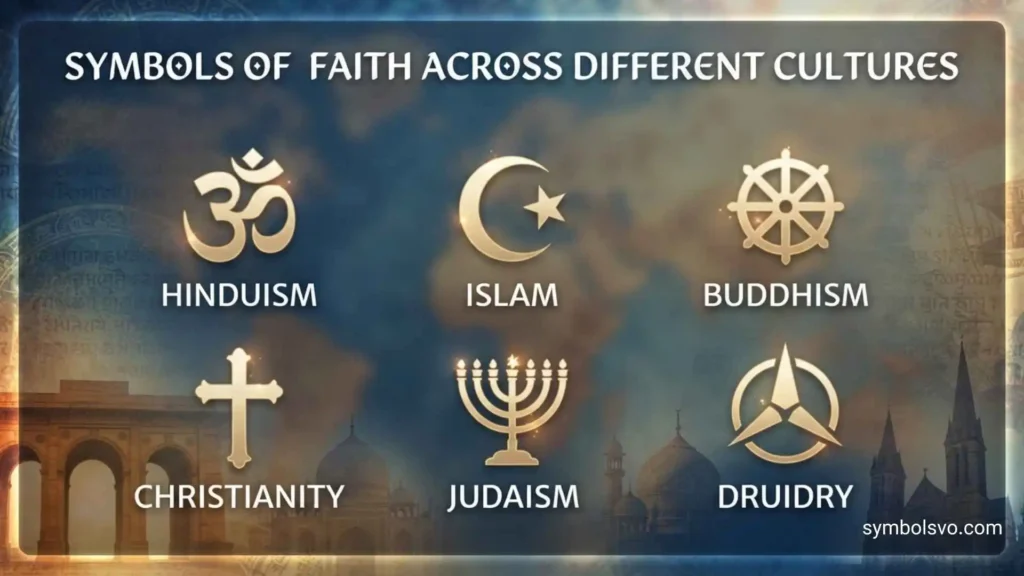
Symbols of Faith Across Different Cultures
Ancient Egypt
The Egyptians used the Ankh, a cross with a looped top, to represent eternal life. Pharaohs and gods were often painted holding the Ankh to their lips to show they held the breath of life. It was a sign that the soul lives on long after the physical body dies.
Ancient Greece
In Greece, the Olive Branch was a sacred sign of peace and divine favor from the goddess Athena. Winners of the ancient Olympic games wore crowns made of olive leaves to show their spiritual discipline and physical triumph.
Roman Culture
Early Christians in Rome used the Chi-Rho, a symbol created by overlapping the first two letters of the Greek word for Christ. Emperor Constantine placed this emblem on his army’s shields, transforming a hidden sign of faith into a grand symbol of state power.
Eastern Traditions
Eastern philosophies rely heavily on the Yin Yang, a circle divided into swirling black and white halves. This icon shows that dark and light, or masculine and feminine energies, are not enemies. Instead, they must balance each other perfectly to create universal harmony.
Indigenous Traditions
Native American alternative have long used the Medicine Wheel, a circle divided into four equal quadrants. This wheel represents the four directions, the four seasons, and the vital balance between a person’s physical, mental, emotional, and spiritual health.
Modern Interpretations
Today, our global culture blends these ancient signs together. People often wear symbols from cultures outside their own heritage simply because the message of peace, love, or resilience speaks directly to their individual lifestyle.
Similar Symbols and Their Meanings
It is easy to confuse certain sacred icons because they look very similar, but their histories can be quite different.
| Symbol A | Symbol B | Key Difference | Common Misconception |
| The Christian Cross | The Egyptian Ankh | The Cross focuses on sacrifice and redemption, while the Ankh focuses on eternal life and fertility. | People often think the Cross grew directly out of the Ankh, but they developed independently. |
| Star of David | The Seal of Solomon | The Star of David is a flat geometric star, while Solomon’s Seal often features interwoven lines used in folklore. | Many assume they are identical, but Solomon’s Seal has a history deeply rooted in ancient mysticism. |
Symbols of Faith in Mythology and Folklore
In ancient myths, these signs were often magical objects given to humans by the gods. In Norse folklore, Thor’s Hammer, known as Mjolnir, was worn as an amulet by sailors and warriors. It was a sign of faith in the god of thunder, meant to protect them from dangerous storms and malevolent giants.
In Celtic lore, the Triquetra, or trinity knot, was drawn with a single continuous line. Folktales say this kept evil spirits away because a continuous line had no beginning and no end, trapping negative energy within its loops. These stories helped shape the modern meanings of protection and eternity that we associate with these shapes today.
Symbols of Faith in Art, Literature, Movies, and Pop Culture
Artists have always used sacred imagery to add deeper meaning to their work. During the Renaissance, painters hid specific flowers or hand gestures in their portraits to signal a character’s secret piety or hidden sins.
In modern movies, directors use these timeless patterns to build epic stories. Think of the unique emblems used in fantasy films like The Lord of the Rings or sci-fi stories like Star Wars. The Jedi insignia resembles an ancient path of light and wings, calling back to traditional symbols of faith and spiritual guardianship.
In fashion and tattoos, these icons are more popular than ever. A person might get a tattoo of a tree of life to celebrate surviving a difficult illness. In this way, ancient holy signs continue to decorate our modern world, carrying their timeless strength into street style and digital media.
Spiritual and Dream Meaning of Symbols of Faith
When a sacred emblem appears in your dreams, it often carries a message from your subconscious mind. Dreaming of a bright, shining icon usually indicates that you are looking for clarity, guidance, or emotional healing during a stressful transition in your waking life.
Plaintext
[Dream Symbol] —> [Subconscious Need] —> [Spiritual Message]
Lotus Flower —> Emotional Peace —> Trust the process of growth.
Sacred Shield —> Need for Safety —> You are protected from harm.
If you see these shapes during meditation, it means your mind is settling into a deep state of focus. However, these visions can also carry a soft warning. If the icon in your dream appears broken or buried in dirt, it might be a gentle reminder that you have been neglecting your inner life, prompting you to reconnect with your core values.
Positive and Negative Meanings of Symbols of Faith
Most spiritual icons hold a balance of light and shadow. Their meaning depends entirely on the intention of the person using them.
| Positive Meaning (The Light) | Negative Meaning (The Shadow) |
| Sacrifice and Devotion: Giving up personal comfort to help others. | Persecution: Using a holy sign to exclude or harm outsiders. |
| Protection and Safety: Feeling guarded by a higher power. | Superstition: Fearing disaster if a ritual is not done perfectly. |
| Community Unity: Bringing people together in love and charity. | Dogmatism: Forcing rigid ideas on others without compassion. |
Why Humans Are Attracted to Symbols of Faith
Our brains are hardwired to look for patterns in the world around us. From the time we are infants, we look at shapes to make sense of our environment. This natural pattern recognition blends perfectly with our deep psychological need for emotional security.
When life feels chaotic or unpredictable, looking at a sacred emblem acts as an emotional anchor. It bypasses our logical, worrying mind and speaks directly to our feelings. It reminds us of our ancestral memory, making us feel connected to millions of people who have walked the same path before us. We are attracted to them because they prove we are not alone.
Modern Uses of Symbols of Faith
- Meaningful Tattoos: People ink these shapes onto their skin as permanent reminders of survival, sobriety, or personal philosophy.
- Fine Jewelry: Wearing a delicate pendant allows individuals to keep their personal beliefs close to their chest throughout the workday.
- Mindful Home Decor: Placing lotus flowers or mandalas in living rooms creates a peaceful atmosphere for relaxation.
- Digital Expression: Social media users place these tiny emblems in their profiles to quickly find like-minded global communities.
Interesting Facts About Symbols of Faith
- Early Christians did not use the cross as their main sign; they used a simple drawing of a fish called the Ichthys.
- The Lotus flower can keep its seeds alive for over a thousand years, waiting for the perfect water conditions to bloom.
- The five points of the Star and Crescent emblem are often said to represent the five pillars of spiritual action in Islam.
- Many ancient symbols, like the Celtic Triskele, mimic patterns found naturally in whirlpools, shells, and distant galaxies.
- The geometric design of the Star of David provides a perfectly balanced structure used frequently in classical architecture.
Frequently Asked Questions
Can I wear a symbol of faith if I am not religious?
Yes, many people wear these designs to honor the cultural history, psychological meaning, or artistic beauty behind them. It is always best to research the history first to show proper respect.
What is the oldest known symbol of faith?
Simple solar wheels and hand stencils found in deep caves are among the oldest, dating back over forty thousand years to early human rituals.
Why do some symbols have both good and bad meanings?
Human history is complex. A symbol can be hijacked by political groups or misread by other cultures, changing its public meaning while keeping its original holy roots intact.
How do symbols of faith help with anxiety?
Focusing on a balanced, geometric icon helps slow your breathing and grounds your mind, acting as a simple visual anchor during stressful moments.
Conclusion
Symbols of faith are far more than historical footnotes; they are the living vocabulary of the human heart. They remind us that our daily struggles are part of a grand, beautiful journey toward understanding and light. By honoring these sacred emblems, we keep a vital channel of wisdom open for generations to come. May you find strength and quiet comfort in whichever sign guides your personal journey..

I’m Nathan Holloway, a passionate researcher and writer with a deep interest in symbols, signs, and their hidden meanings. I enjoy exploring how symbols have influenced different civilizations, religions, and modern communication. Through my work, I aim to make complex historical and cultural concepts easy to understand for readers of all backgrounds. Every article I write is carefully researched to provide reliable and engaging information.
Books:
- Beyond the Symbol
- The Secret Meanings of Everyday Signs
Author 2: Grace Whitmore
Description:
My name is Grace Whitmore, and I love discovering the stories behind the world’s most fascinating symbols. I spend my time researching ancient civilizations, mythology, spiritual traditions, and modern iconography to uncover the meanings people often overlook. I believe that every symbol has a history worth telling, and I enjoy sharing that knowledge in a simple and reader-friendly way.
Books:
- Echoes of Ancient Symbols
- The Symbolic World
 Mason Ellington
 Grace Whitmore
 Daniel Brooks