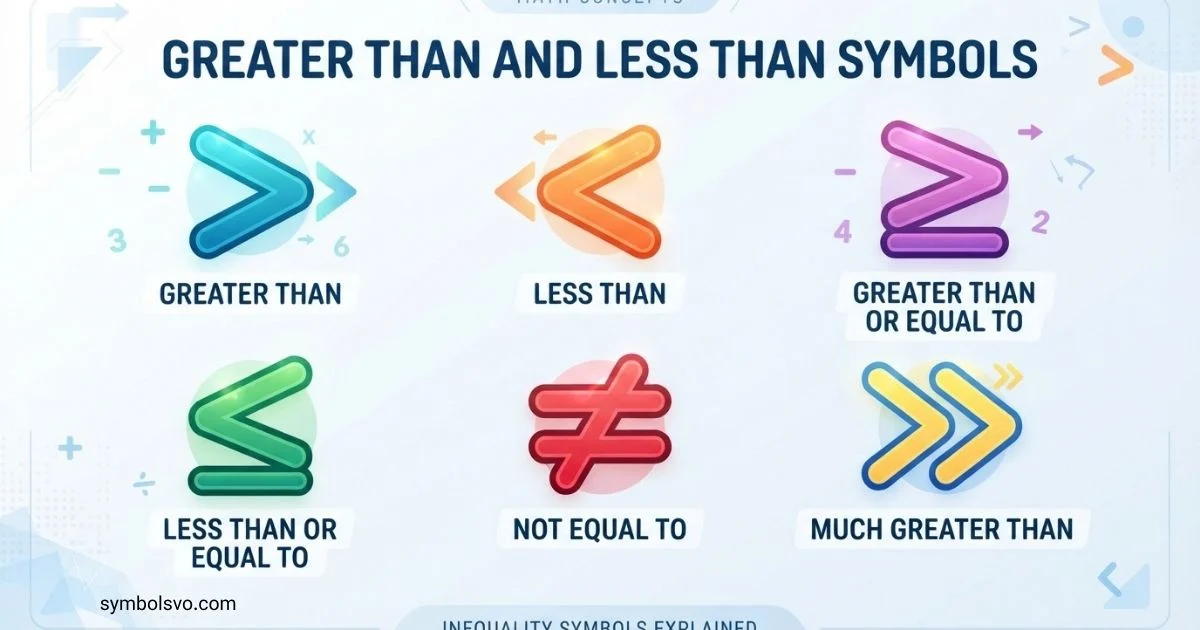
I know greater than and less than symbols can look confusing at first, especially when you need to decide which way the sign should point. Once you understand the simple rule behind them, they become much easier.
You can use these symbols to compare numbers, values, measurements, and expressions in just a few seconds. I’ll break down what each symbol means and show you clear examples you can remember.
Whether you’re a student, teacher, parent, or simply brushing up on math, you’ll find this guide practical and easy to follow. By the end, you’ll feel confident using > and < correctly.
What Are Greater Than Less Than Symbols?
Greater than and less than symbols are mathematical comparison symbols. They show whether one number or expression has a larger or smaller value than another.
The two basic symbols are:
| Symbol | Name | Meaning |
| > | Greater than | The value on the left is larger |
| < | Less than | The value on the left is smaller |
For example:
8 > 3
This means 8 is greater than 3.
Another example is:
2 < 7
This means 2 is less than 7.
The symbols compare the values on both sides. The statement is read from left to right.
You can also copy these symbols:
> <
The easiest way to understand them is to remember that the wide, open side faces the larger number, while the pointed end faces the smaller number.
Greater Than And Less Than Symbol Meaning
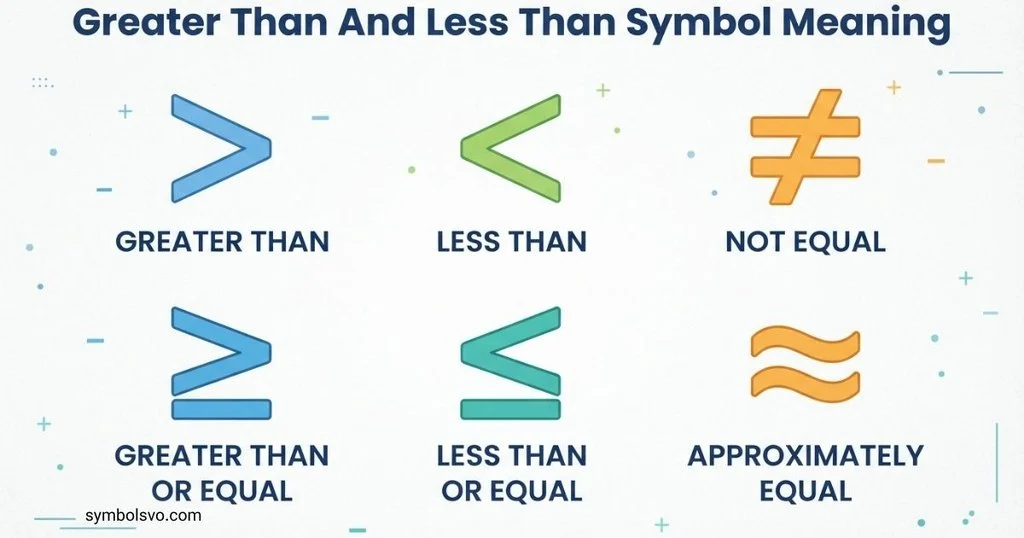
The meaning depends on the direction of the symbol.
Greater Than: >
The symbol > means the value on the left is larger than the value on the right.
10 > 6
Read it as:
Ten is greater than six.
More examples:
- 15 > 9
- 100 > 25
- 7 > 1
- 50 > 49
Less Than: <
The symbol < means the value on the left is smaller than the value on the right.
4 < 12
Read it as:
Four is less than twelve.
Examples:
- 3 < 8
- 20 < 30
- 6 < 10
- 45 < 90
The direction matters. Writing 3 > 8 would be incorrect because 3 is not greater than 8.
Greater Than Less Than Symbols Mathematics
In mathematics, greater-than and less-than signs are used to compare quantities.
Suppose you have:
A > B
This tells you that the value of A is larger than B.
If you have:
A < B
A is smaller than B.
These symbols are especially common in:
- Number comparisons
- Place value
- Fractions
- Decimals
- Algebra
- Inequalities
- Graphs
- Word problems
- Statistics
- Measurement
They can compare whole numbers, negative numbers, fractions, decimals, variables, and mathematical expressions.
For example:
0.75 > 0.5
because 0.75 is larger.
Likewise:
−2 < 5
because −2 is located to the left of 5 on a number line.
With fractions:
3/4 > 1/2
because 3/4 is equal to 0.75, while 1/2 is equal to 0.5.
Greater Than Less Than Symbols Explained
A simple way to explain the symbols is to imagine that the symbol is pointing toward the smaller value.
Consider:
9 > 4
The open side faces 9, which is larger. The point faces 4, which is smaller.
Now switch the numbers:
4 < 9
The open side still faces 9. The point still faces 4.
This gives you one important rule:
The wide opening faces the greater number.
You can also think of the symbol as a mouth that wants the larger number:
8 > 2
The “mouth” opens toward 8.
2 < 8
The “mouth” still opens toward 8.
This trick is useful for beginners, but it is better to understand the actual mathematical relationship rather than relying only on the visual trick.
How Do You Read Greater Than Less Than Symbols?
Read the comparison from left to right.
For example:
12 > 5
Say:
Twelve is greater than five.
For:
3 < 11
Say:
Three is less than eleven.
The same approach works with variables and expressions.
x > 4
Read:
x is greater than four.
y < 10
Read:
y is less than ten.
For an inequality such as:
2x + 1 > 9
you can read it as:
Two x plus one is greater than nine.
When you see ≥, say “greater than or equal to.”
x ≥ 7
means:
x is greater than or equal to seven.
When you see ≤, say “less than or equal to.”
x ≤ 7
means:
x is less than or equal to seven.
How To Use The Greater Than Less Than Symbols
To use these symbols correctly, first compare the two values. Then place the symbol between them.
Follow these steps:
- Identify the two numbers or expressions.
- Determine which value is larger.
- Put the open side toward the larger value.
- Put the pointed side toward the smaller value.
- Read the statement from left to right.
For example, compare 14 and 9.
Because 14 is larger:
14 > 9
Now compare 5 and 18.
Because 5 is smaller:
5 < 18
You can also use the symbols with expressions.
3x > 12
This means 3x has a value greater than 12.
Be careful when solving inequalities. If you multiply or divide both sides by a negative number, the inequality direction reverses.
For example:
−2x > 8
Divide by −2:
x < −4
The sign changes from > to < because you divided by a negative number.
Greater Than Less Than Equal To Symbol
When equality is possible, use ≥ or ≤.
| Symbol | Meaning | Example |
| > | Greater than | 8 > 5 |
| < | Less than | 3 < 7 |
| ≥ | Greater than or equal to | 8 ≥ 8 |
| ≤ | Less than or equal to | 5 ≤ 5 |
The difference is whether equality is included.
For example:
x > 5
means x must be greater than 5. The number 5 itself is not included.
x ≥ 5
means x can be greater than 5 or equal to 5.
Likewise:
x < 10
does not include 10.
x ≤ 10
does include 10.
The Unicode Standard identifies ≤ as U+2264, “Less-Than Or Equal To,” and ≥ as U+2265, “Greater-Than Or Equal To.”
How To Explain Greater Than Less Than Symbols
For a beginner, start with actual objects or numbers instead of algebra.
Imagine two groups of apples:
🍎 🍎 🍎 🍎 🍎
and
🍎 🍎
The first group has more apples, so:
5 > 2
Then reverse the comparison:
2 < 5
Next, introduce the visual rule:
The open side faces the larger number.
After that, explain that the pointed side faces the smaller number.
A good teaching sequence is:
Objects → Numbers → Symbols → Number lines → Expressions → Inequalities
Avoid introducing several new comparison symbols at once. Start with > and <, then introduce ≥ and ≤ after the basic idea is understood.
Greater Than Less Than Symbols For Kids
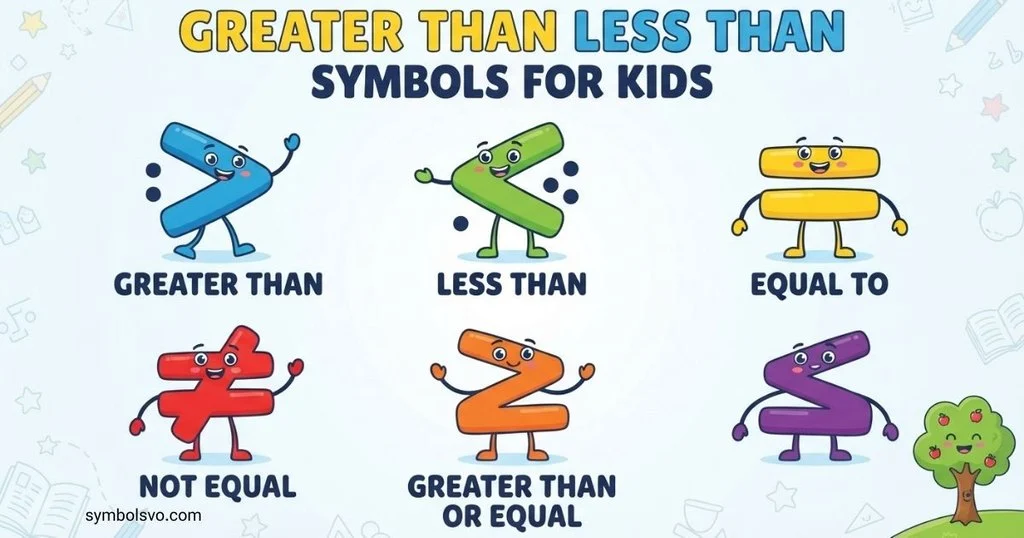
Kids often learn these symbols by comparing numbers they already understand.
Try these simple examples:
- 5 > 2
- 3 < 9
- 7 > 4
- 1 < 6
- 10 > 8
A number line can also help.
On a standard number line, numbers increase as you move to the right:
1 → 2 → 3 → 4 → 5 → 6
So 6 is greater than 2:
6 > 2
And 2 is less than 6:
2 < 6
A Simple Kid-Friendly Trick
Think of the symbol as a hungry mouth.
7 > 3
The open side faces 7 because 7 is larger.
3 < 7
The open side still faces 7.
This is a helpful memory trick, but children should eventually understand why the comparison is true.
Greater Than Less Than Symbols: How To Remember
The most useful memory rule is:
Open side = greater number.
Pointed side = smaller number.
For example:
9 > 2
The wide opening faces 9.
2 < 9
The wide opening still faces 9.
Another method is to remember the word “less” with the pointed side. The symbol < points toward the smaller value.
You can practice with pairs:
| Compare | Answer |
| 8 and 3 | 8 > 3 |
| 2 and 9 | 2 < 9 |
| 7 and 7 | 7 = 7 |
| 12 and 5 | 12 > 5 |
| 4 and 15 | 4 < 15 |
For equal numbers, neither greater-than nor less-than is correct. Use =.
Greater Than Less Than Examples
Here are examples using different types of numbers.
Whole Numbers
18 > 11
18 is greater than 11.
4 < 20
4 is less than 20.
Decimals
2.8 > 2.3
2.8 is greater than 2.3.
0.4 < 0.9
0.4 is less than 0.9.
Negative Numbers
Negative numbers can be confusing.
−2 > −7
Although 7 is larger than 2 as a positive number, −2 is farther to the right on the number line, so −2 is greater than −7.
Fractions
5/6 > 1/6
The denominators are the same, so compare the numerators.
Equal Values
10 = 10
Do not use > or < because the two values are equal.
Mixed Comparison
3.5 > 3
because 3.5 is larger than 3.
Greater Than Less Than Worksheets With Answers
Practice worksheets are useful because repeated comparison helps make the symbols automatic.
Worksheet
Fill in each blank with >, <, or =.
- 7 ___ 4
- 3 ___ 9
- 12 ___ 12
- 15 ___ 8
- 2 ___ 11
- 20 ___ 25
- 16 ___ 10
- 6 ___ 6
- 14 ___ 19
- 30 ___ 13
Answers
- 7 > 4
- 3 < 9
- 12 = 12
- 15 > 8
- 2 < 11
- 20 < 25
- 16 > 10
- 6 = 6
- 14 < 19
- 30 > 13
For a harder worksheet, use decimals:
- 0.7 ___ 0.5
- 1.2 ___ 1.8
- 2.5 ___ 2.5
- 4.09 ___ 4.9
- 6.75 ___ 6.5
Answers:
- 0.7 > 0.5
- 1.2 < 1.8
- 2.5 = 2.5
- 4.09 < 4.9
- 6.75 > 6.5
Algebra Greater Than Less Than Symbols
In algebra, greater-than and less-than symbols create inequalities.
Examples include:
x > 5
x < 12
x ≥ 4
x ≤ 20
The variable can represent many possible values.
For example:
x > 3
means that x can be 4, 5, 6, 7, and so on if we are working with whole numbers. If decimals or real numbers are allowed, values such as 3.1 and 3.75 can also satisfy the inequality.
When solving inequalities, many of the same rules used for equations apply.
Consider:
x + 4 > 10
Subtract 4 from both sides:
x > 6
Now consider:
2x < 14
Divide both sides by 2:
x < 7
The special rule appears when multiplying or dividing by a negative number:
−3x ≤ 12
Divide by −3 and reverse the sign:
x ≥ −4
This sign reversal is one of the most important rules in algebraic inequalities.
Greater Than Less Than Symbols Multiplication
Greater-than and less-than symbols can appear in multiplication problems, especially when comparing products or solving inequalities.
For example:
4 × 5 > 3 × 5
Calculate both sides:
20 > 15
The comparison is true.
You can also compare expressions:
2 × 8 < 3 × 7
because:
16 < 21
There is an important algebra rule when multiplying inequalities.
If you multiply both sides by a positive number, the inequality direction stays the same.
For example:
3 < 5
Multiply by 2:
6 < 10
But multiplying by a negative number reverses the direction.
Start with:
3 < 5
Multiply both sides by −2:
−6 > −10
The direction changes from < to >.
This happens because multiplying by a negative number reverses the positions of values on the number line.
TI-84 Plus Greater Than Less Than Symbols
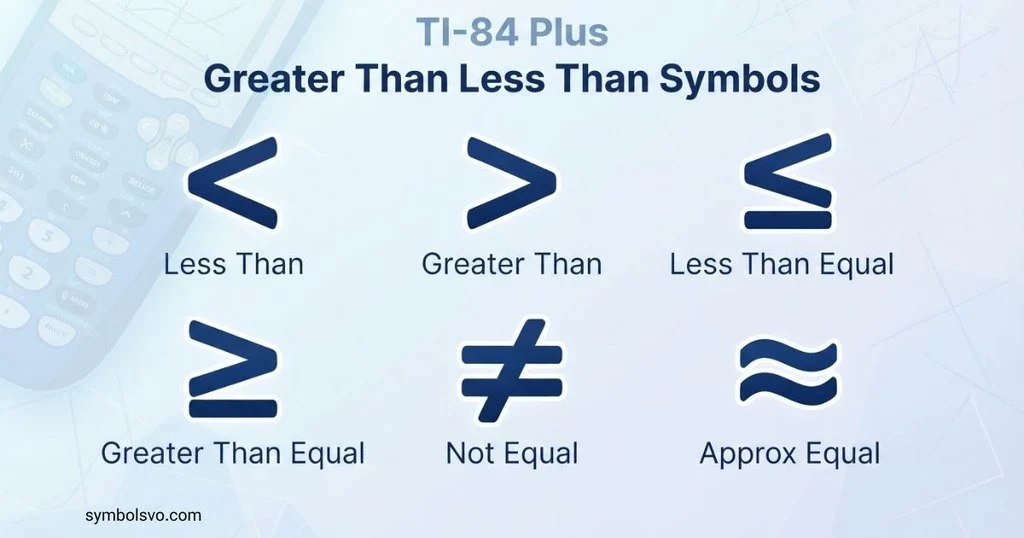
The TI-84 Plus family supports comparison and inequality symbols. Texas Instruments lists < as less than, > as greater than, ≤ as less than or equal to, and ≥ as greater than or equal to in its reference documentation.
On TI-84 Plus models, comparison symbols can be accessed through the calculator’s TEST functions. Texas Instruments’ reference guide lists:
- < — Less than
- > — Greater than
- ≤ — Less than or equal to
- ≥ — Greater than or equal to
The exact interface can vary depending on the TI-84 Plus model, operating system, and application being used.
For inequality graphing, the TI-84 Plus family can also use inequality relations in graphing applications. Texas Instruments documents an Inequality Graphing application for entering inequalities and graphing their solution regions.
If you need to enter a comparison for a calculation, check the calculator’s TEST menu. If you are graphing an inequality, use the appropriate inequality graphing controls rather than treating the relation as ordinary multiplication or subtraction.
Frequently Asked Questions
What are the two main greater than and less than symbols?
The two main symbols are >, which means greater than, and <, which means less than. The open side faces the larger value.
Which way does the greater than symbol point?
The greater-than symbol > has its pointed end toward the smaller value and its open side toward the larger value. For example, 9 > 4.
What is the difference between < and ≤?
< means strictly less than, so equality is not included. ≤ means less than or equal to, so the two values can be equal.
Do greater than and less than symbols work with negative numbers?
Yes. The symbols work with negative numbers, but you need to consider their positions on the number line. For example, −2 > −8 because −2 is farther to the right.
Why does an inequality sign change when dividing by a negative number?
Multiplying or dividing both sides of an inequality by a negative number reverses their order on the number line. Therefore, the inequality symbol must also reverse.
Conclusion
Greater than and less than symbols make mathematical comparisons easy to write. > means greater than, while < means less than. When equality is allowed, use ≥ or ≤. The most useful visual rule is to place the open side toward the larger value.
These symbols appear everywhere from basic number exercises to algebra, inequalities, graphs, multiplication, and calculator work. Learning how to read them and practicing with different kinds of numbers will make them much easier to use.
For students, the best approach is to combine the visual memory trick with real understanding. Compare the values first, decide which is larger or smaller, and then choose the correct symbol. With regular practice, even algebraic inequalities and calculator problems become much more comfortable.

I’m Daniel Brooks, a content creator and symbol enthusiast dedicated to researching the fascinating world of signs and symbols. I enjoy discovering the hidden meanings behind famous icons, emojis, historical emblems, and cultural symbols. Through my writing, I aim to provide trustworthy, well-researched, and reader-friendly information that helps people learn something new with every visit.
Books:
- The Complete Guide to World Symbols
- The Power of Universal Signs
 Mason Ellington
 Grace Whitmore