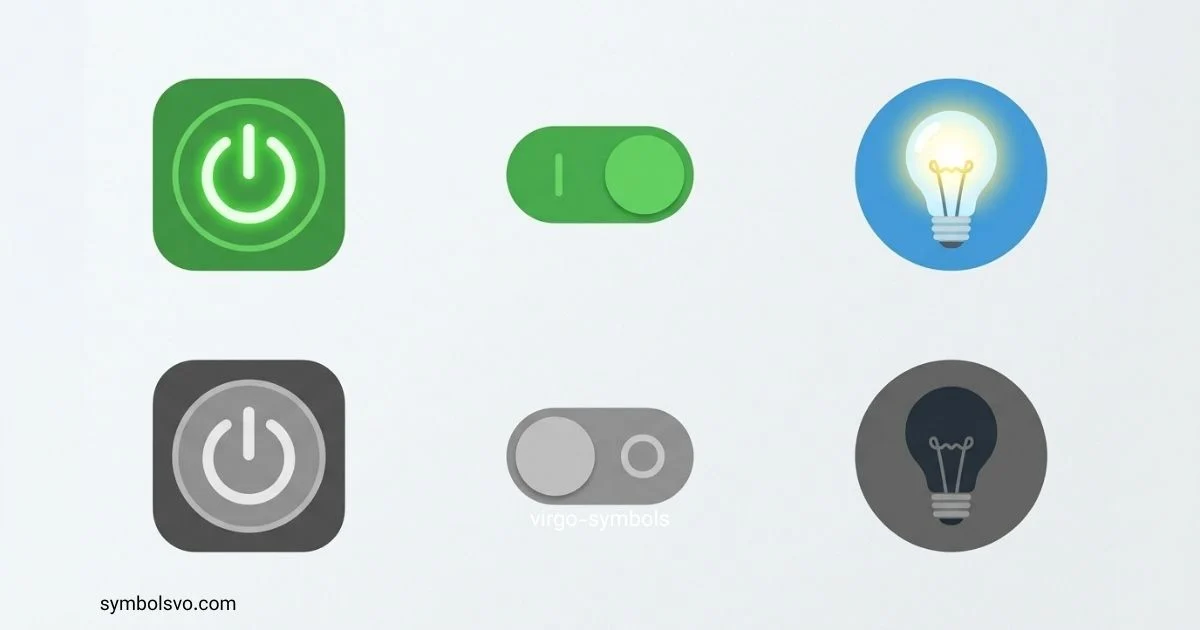
I used to think on and off symbols were simple, but some icons can be surprisingly confusing. You see them on phones, computers, appliances, switches, and countless other devices.
If you have ever wondered what these symbols actually mean or why different devices use different versions, you are not alone. I’ll help you understand them in a clear and practical way.
By the end, you’ll know how to recognize common on and off symbols, understand their meanings, and use that knowledge confidently whenever you encounter them.
What Are The On And Off Symbols?
The basic on and off symbols are graphical signs used to show the operating or power state of a device.
The most familiar symbols include:
| Symbol | Common name | General meaning |
| ⏻ | Power symbol | Power control or power state |
| ⏽ | Power on symbol | On |
| ⭘ | Heavy circle | Off |
| ⏼ | Power on-off symbol | On/off or push-push power control |
| I | I marking | On |
| O | O marking | Off |
The exact symbol used depends on the equipment and the type of control. International equipment-symbol standards include separate graphical symbols for ON, OFF, standby, and ON/OFF controls. The current IEC 60417 database lists symbols such as 5007 for “ON” power, 5008 for “OFF” power, 5009 for standby, and 5010 for “ON/OFF” push-push operation.
These symbols are useful because they communicate a function without depending on a particular language.
On And Off Symbols Meaning
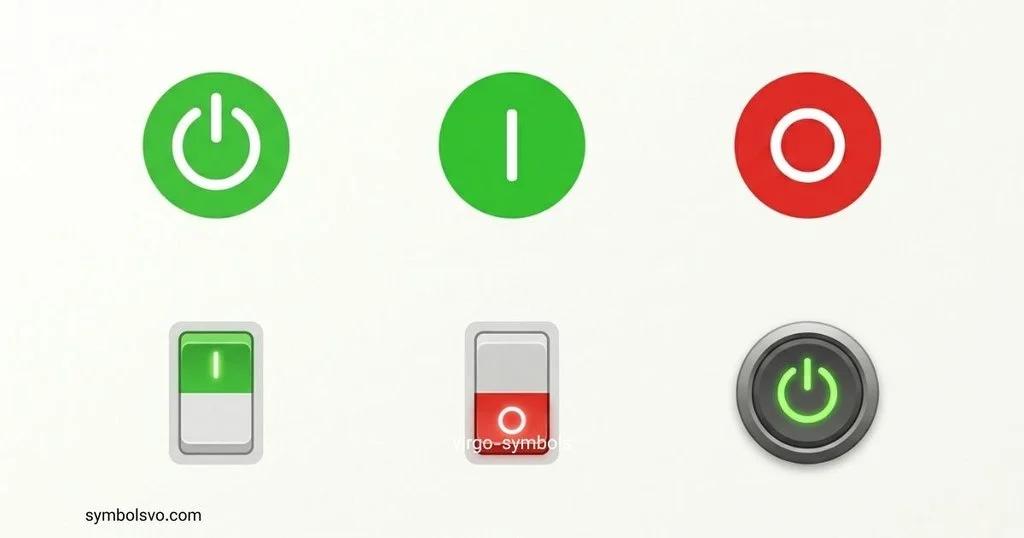
The meaning of the common power symbols is easiest to understand by looking at their shapes.
I or a vertical line generally represents the powered-on state.
O or a circle generally represents the powered-off state.
A line inside or connected to a circle represents the familiar combined power symbol.
The combined form is widely recognized because it visually combines the two concepts. Unicode includes several distinct power characters rather than treating every power icon as the same character.
For quick reference:
- I — On
- O — Off
- ⏽ — Power on
- ⭘ — Power off reference symbol
- ⏻ — Power symbol
- ⏼ — Power on-off
- ⏾ — Power sleep
Context still matters. A symbol printed on a physical switch may describe the switch position, while a symbol shown on a display may describe the current state of the device.
On And Off Symbols With Explanation
The easiest way to understand on and off symbols is to separate the common designs.
The Line Symbol
The vertical line represents the on state in the familiar I/O convention.
I = On
You may see it on rocker switches, appliance controls, power supplies, and other equipment.
The Circle Symbol
The circle represents the off state in the common I/O convention.
O = Off
On a simple rocker switch, one side may be marked with I and the other with O.
The Combined Power Symbol
The familiar power icon is:
⏻
It combines the circular form with a vertical line. Unicode officially names U+23FB POWER SYMBOL.
The On-Off Symbol
Another Unicode character is:
⏼
This is U+23FC, officially named POWER ON-OFF SYMBOL. It is associated with a control that switches between power states.
The important point is that ⏻, ⏽, ⏼, and ⭘ are related but are not simply interchangeable Unicode characters.
Which Is On And Off Symbols?
If you are looking at a basic switch marked I and O, the answer is:
I = On
O = Off
For the familiar graphical power symbols:
⏽ = Power On
⭘ = Power Off
⏻ = Power symbol
⏼ = Power On-Off
Unicode specifically identifies U+23FD ⏽ as POWER ON SYMBOL and points to U+2B58 ⭘, HEAVY CIRCLE, for the power-off symbol.
A useful memory trick is:
Line = On
Circle = Off
This works well for the standard I/O convention. However, always follow labels and instructions on specialized equipment because a particular control may have additional operating positions.
On And Off Symbols Circle And Line
The circle-and-line design is one of the most recognizable power icons.
⏻
The circular part represents the power-off concept, while the vertical line represents the on concept. The combined design has become a familiar way of identifying a power control.
Unicode records the character ⏻ as U+23FB POWER SYMBOL. It is associated with ISO 7000 and also has a reference to IEC 5009 and IEEE 1621.
You can copy it here:
⏻
You can also copy the related symbols:
⏼ ⏽ ⭘ ⏾
These characters are Unicode text characters, so their appearance can vary somewhat depending on the font and application. A physical equipment icon may also be a vector or graphic rather than a text character.
Universal On And Off Symbols
Power symbols are designed to make controls easier to understand across languages.
The International Electrotechnical Commission maintains IEC 60417, a database of graphical symbols used on equipment. The database includes symbols for identifying equipment, indicating functional states, designating connections, and giving operating instructions.
Some relevant standardized entries include:
| IEC reference | Meaning |
| 5007 | “ON” power |
| 5008 | “OFF” power |
| 5009 | Standby |
| 5010 | “ON/OFF” push-push |
| 5011 | “ON/OFF” push button |
Calling these symbols “universal” is useful in everyday conversation, but it does not mean every power control in every country must use exactly the same graphic. Standards define particular symbols and applications, while manufacturers can also provide additional labels or markings.
Power Switch On And Off Symbols
A power switch may use one of several markings depending on its design.
A basic rocker switch commonly has:
I — On
O — Off
A push-button device may instead use:
⏻
A device with a push-push power control may use a combined on/off symbol.
The distinction is important because the symbol can tell you what kind of control you are looking at.
For example:
- I/O switch: separate on and off positions
- Power button: one control may toggle the state
- Standby control: the device may remain partially powered
- Momentary button: pressing the button may send a command rather than mechanically hold an on/off position
The IEC database distinguishes these functional states instead of treating every power icon as identical.
On And Off Symbols On A Switch
On a physical switch, the position of the marking is often just as important as the symbol itself.
For a typical rocker switch:
- The side marked I indicates the on position.
- The side marked O indicates the off position.
- Pressing the I side normally turns the controlled equipment on.
- Pressing the O side normally turns it off.
Some switches use a separate indicator light. In that case, the light shows an operating condition, while the printed symbol identifies the switch function.
A switch may also have markings such as:
I — On
O — Off
⏻ — Power
Standby symbol — Standby
Do not assume that the physical position of a switch is identical on every device. Equipment manuals take priority when a control has unusual positions or multiple functions.
Switch On And Off Symbols
Switches can use text, letters, numbers, or graphical symbols.
Common examples include:
| Marking | Typical interpretation |
| I | On |
| O | Off |
| I/O | On/off |
| ⏻ | Power |
| ⏽ | On |
| ⭘ | Off |
| Standby symbol | Standby state |
The difference between I/O and ⏻ is especially useful to understand. I/O markings describe the two-state convention directly, while the power icon is a graphical representation designed for quick recognition.
For copy and paste, the main Unicode power characters are:
⏻ ⏼ ⏽ ⭘ ⏾
Unicode identifies the first three and the sleep symbol with specific official names; ⭘ is Unicode’s HEAVY CIRCLE and is referenced for power-off use.
Electrical On And Off Symbols
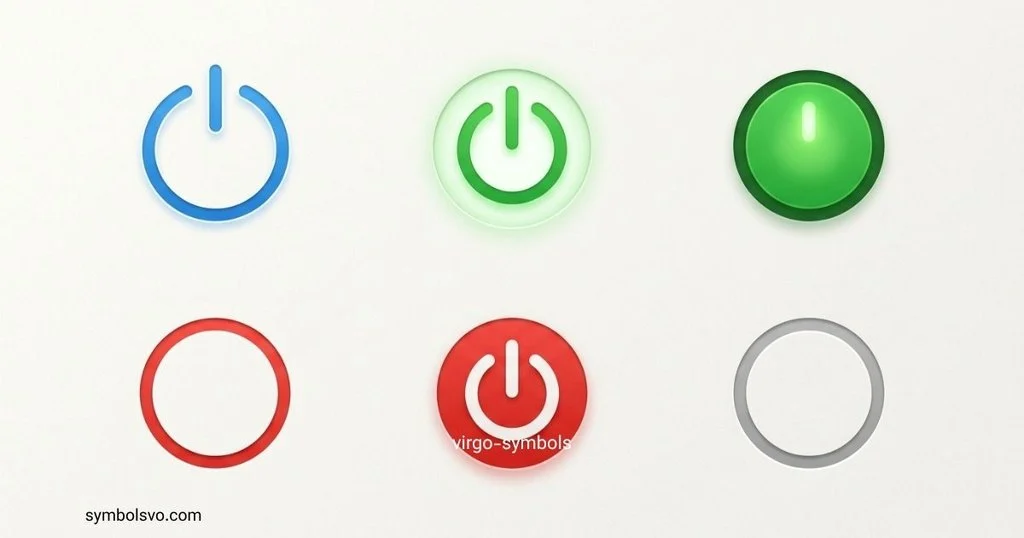
Electrical equipment uses standardized graphical symbols to communicate operating states and functions.
The on/off symbols may appear on:
- Power supplies
- Circuit breakers and controls
- Electrical appliances
- Electronic equipment
- Test equipment
- Industrial machines
- Control panels
- Computers and peripherals
The symbol itself does not necessarily tell you everything about the electrical circuit. For example, a power symbol on an appliance indicates a user control or state, while an electrical schematic uses specialized circuit symbols to represent components and connections.
IEC 60417 covers graphical symbols used on equipment, while circuit diagrams can involve other standards and conventions. The current IEC database describes its symbols as equipment symbols used to identify parts, indicate functional states, designate connections, and provide operating information.
For electrical work, never use an icon alone as a substitute for a circuit diagram, rating label, or manufacturer instructions.
Switch On/Off Symbol In Circuit
In a circuit, an on/off switch controls whether current can flow through the intended path.
A simplified switch can be represented conceptually as:
Power source → Switch → Load
When the switch is closed, the circuit has a conducting path. When the switch is open, the intended path is interrupted.
This should not be confused with the graphical power symbol ⏻. The power symbol identifies a control or power function; it does not by itself represent the complete electrical behavior of a circuit.
For a simple conceptual example:
ON: [Source] ─── [Closed switch] ─── [Load]
OFF: [Source] ─── [Open switch] ─── [Load]
Actual circuit diagrams use specific switch symbols and conventions. If you are working with mains electricity or unfamiliar equipment, use the appropriate technical documentation rather than relying on a symbol alone.
On/Off Symbol I/O
The I/O convention is one of the easiest power markings to understand.
I = On
O = Off
The letters are based on the visual idea of a line and a circle. On equipment, you may see them printed separately on a rocker switch or combined into a control label.
The related graphical symbols are more specific:
- ⏽ — POWER ON SYMBOL
- ⭘ — HEAVY CIRCLE, referenced by Unicode for power-off use
- ⏼ — POWER ON-OFF SYMBOL
- ⏻ — POWER SYMBOL
Unicode’s character chart confirms the official names and relationships of these power characters.
So if you see I/O on a basic physical switch, remember the simple rule:
I = 1 = On
O = 0 = Off
The binary analogy is commonly used to explain the convention, but the visible markings themselves are the practical reference for the user.
Choke On And Off Symbols
Choke controls are different from ordinary electrical power controls.
A choke is used on certain internal-combustion engines during starting, especially when the engine is cold. Its control may have symbols showing the choke position rather than simple electrical on/off states.
The exact markings vary by equipment.
On STIHL products, manuals commonly distinguish STOP-0, I, and starting or choke positions. For example, a STIHL manual identifies STOP-0 as the engine-off position and I as the normal run position.
Some STIHL manuals show a choke symbol for cold starting. The correct position depends on the engine and model, so the machine’s own instruction manual should be followed.
A useful distinction is:
| Control marking | General function |
| 0 / STOP | Engine stopped |
| I | Normal run |
| START | Starting position |
| Choke symbol | Choke setting for starting |
A choke symbol should therefore not be interpreted as simply “off.” It describes an engine-starting condition.
Stihl On And Off Symbols
STIHL equipment can use several control markings rather than a single universal on/off icon.
For example, STIHL documentation identifies:
STOP-0 — engine off and ignition switched off
I — normal run position
START — starting position on applicable controls
Choke position — used for cold starting when specified
A STIHL chainsaw manual, for example, describes the master control lever with stop, normal-run, warm-start, and cold-start positions. It also states that moving the control to 0 stops the engine.
Another STIHL manual describes the slide-control positions as STOP-0, I, and START, with STOP-0 stopping the engine and I serving as the normal run position.
The exact symbol can differ between product types and generations. That is why the model-specific STIHL manual is the safest reference.
If you see a choke icon on a STIHL machine, do not treat it as a normal electrical on/off symbol. The choke controls the engine’s starting setup. STIHL itself advises users to read the applicable instruction manual before operating, maintaining, repairing, or otherwise working with its products.
Frequently Asked Questions
What does the circle symbol mean on a power switch?
On the common I/O convention, the circle or O represents the off state. Unicode also uses ⭘, HEAVY CIRCLE, as the referenced character for a power-off symbol.
What does the line symbol mean on a switch?
The line or I generally represents the on state. The related Unicode character ⏽ is officially named POWER ON SYMBOL.
What is the correct on and off power symbol?
For separate states, ⏽ represents power on, while ⭘ is the Unicode character referenced for power off. ⏻ is officially named POWER SYMBOL, and ⏼ is POWER ON-OFF SYMBOL.
Is I or O on a switch?
On a standard I/O power switch, I means on and O means off. This convention is widely used on equipment controls and is reflected in standardized equipment symbols.
What does the choke symbol mean on a STIHL machine?
A choke symbol indicates a choke or starting position used for certain engine-starting conditions, commonly a cold start. The exact operation depends on the STIHL model, so follow the model-specific manual.
Conclusion
On and off symbols make equipment easier to operate by communicating power and operating states through simple visual marks. The most familiar convention is I for on and O for off, while graphical symbols such as ⏻, ⏽, ⏼, and ⭘ provide related standardized representations.
The circle and line combination is especially recognizable, but the symbols should not all be treated as identical. Unicode gives several of these characters their own official names, and IEC 60417 distinguishes different equipment functions such as on, off, standby, and on/off controls.
For ordinary switches, remembering line = on and circle = off is a useful starting point. For electrical circuits, engines, choke controls, and STIHL equipment, use the specific markings and manufacturer’s instructions because the symbols can describe functions beyond a simple power state..

I’m Nathan Holloway, a passionate researcher and writer with a deep interest in symbols, signs, and their hidden meanings. I enjoy exploring how symbols have influenced different civilizations, religions, and modern communication. Through my work, I aim to make complex historical and cultural concepts easy to understand for readers of all backgrounds. Every article I write is carefully researched to provide reliable and engaging information.
Books:
- Beyond the Symbol
- The Secret Meanings of Everyday Signs
Author 2: Grace Whitmore
Description:
My name is Grace Whitmore, and I love discovering the stories behind the world’s most fascinating symbols. I spend my time researching ancient civilizations, mythology, spiritual traditions, and modern iconography to uncover the meanings people often overlook. I believe that every symbol has a history worth telling, and I enjoy sharing that knowledge in a simple and reader-friendly way.
Books:
- Echoes of Ancient Symbols
- The Symbolic World
 Mason Ellington
 Grace Whitmore
 Daniel Brooks