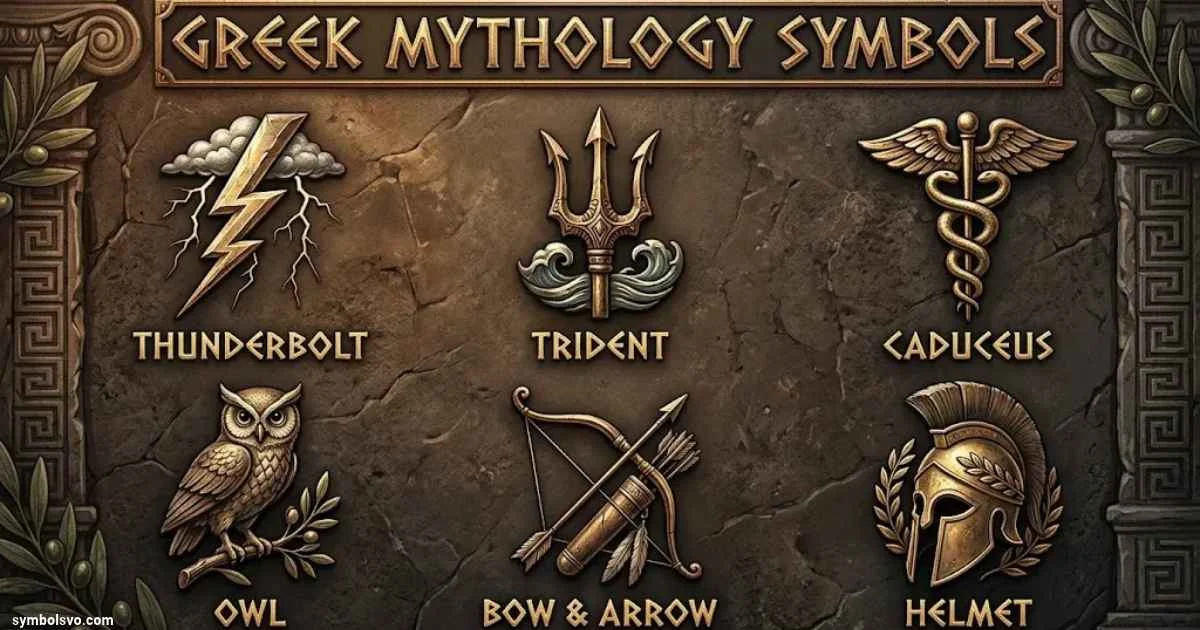
Greek mythology is filled with powerful symbols that reveal the stories, beliefs, and personalities of ancient gods and heroes. From Zeus’s mighty thunderbolt to Athena’s wise owl, these symbols helped people recognize divine figures and understand their powers. Many also represented important ideas such as love, wisdom, protection, strength, victory, and the mysteries of life and death.
Greek mythology symbols appear throughout ancient Greek pottery, sculptures, coins, temples, and literary works. Some represent individual gods and goddesses, while others connect to legendary creatures, heroic weapons, sacred plants, and extraordinary events. For example, Poseidon’s trident represents his connection to the sea, while Persephone’s pomegranate recalls her journey between the living world and the underworld.
These ancient images still influence modern art, literature, jewelry, and tattoos. Understanding their original stories makes their meanings much more interesting. This guide explores famous Greek mythology symbols and meanings, including those associated with gods, goddesses, animals, mythological creatures, weapons, flowers, and important cultural traditions.
What Are Greek Mythology Symbols?
Greek mythology symbols are objects, animals, plants, weapons, and visual attributes associated with ancient Greek gods, goddesses, heroes, and mythological creatures. They help identify important characters and communicate ideas connected to their stories, powers, and religious roles.
Ancient Greeks often represented their gods through recognizable attributes. Zeus might appear holding a thunderbolt, Athena wearing a helmet with a shield, and Poseidon carrying a three-pronged trident. These objects helped viewers identify the figures even when their names weren’t written nearby.
Symbols also carried broader associations. An olive tree could connect to Athena and the legendary founding traditions of Athens. A pomegranate could recall Persephone’s connection to the underworld and the changing seasons.
Greek symbolism appeared in several important settings:
- Religious practices: Sacred animals, offerings, plants, and objects appeared in worship and ceremonies.
- Ancient artwork: Sculptures, pottery, and paintings used recognizable attributes to represent mythological figures.
- Coins: City-states placed gods, animals, and sacred objects on currency to express civic identity.
- Literature: Ancient poets and storytellers used symbolic objects and creatures to develop memorable myths.
- Architecture: Temples and public buildings displayed mythological figures and decorative imagery.
One important distinction matters: not every object associated with a deity had one fixed symbolic meaning. Some were identifying attributes, while others gained broader meanings through particular myths and artistic traditions.
Greek Gods and Their Symbols
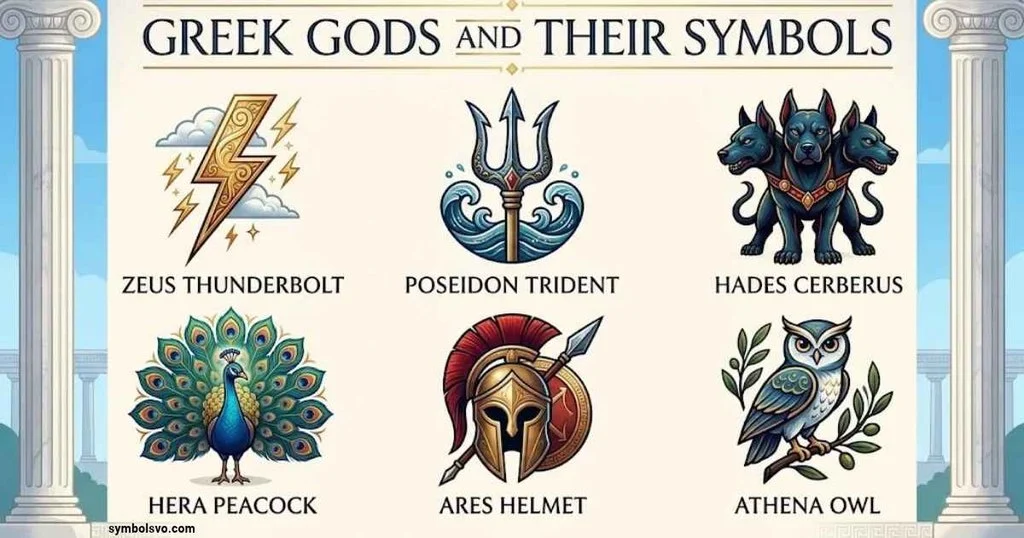
The gods and goddesses of Greek mythology had distinct personalities, powers, and responsibilities. Their symbols often reflected their divine roles and helped ancient artists identify them.
The twelve Olympians are especially important, although other deities such as Hades, Persephone, Eros, and Asclepius also have recognizable attributes.
Zeus Symbols: Thunderbolt, Eagle, and Oak Tree
Zeus was the king of the Olympian gods and ruler of the sky. He controlled thunder, lightning, and storms while maintaining divine authority over gods and mortals.
His most recognizable symbol was the thunderbolt.
- Thunderbolt: Represents Zeus’s power over lightning and his authority as king of the gods.
- Eagle: A sacred animal associated with divine sovereignty and strength.
- Oak tree: A sacred tree connected to Zeus, especially through the ancient sanctuary at Dodona.
- Scepter: Represents kingship and divine authority.
- Throne: Reflects his position as ruler of Olympus.
The eagle frequently appears in artistic representations of Zeus. His thunderbolt became one of the most recognizable ancient Greek symbols of supernatural power.
Hera Symbols: Peacock, Crown, and Scepter
Hera was the queen of the Olympian gods and the wife of Zeus. She was associated with marriage, queenship, and the protection of married women.
Her symbols often reflected her royal position.
- Peacock: A familiar animal associated with Hera in Greek and later classical artistic traditions.
- Crown or diadem: Represents her status as queen of the gods.
- Scepter: Symbolizes authority and royal power.
- Pomegranate: Appears in certain traditional associations with marriage and fertility.
The peacock is particularly recognizable in later depictions of Hera. Its elaborate feathers make it a fitting artistic companion for the queen of Olympus.
Poseidon Symbols: Trident, Horse, and Dolphin
Poseidon ruled the seas and was also associated with earthquakes and horses. Sailors and coastal communities respected him because his power could bring both favorable voyages and destructive storms.
His primary attribute was the trident, a three-pronged weapon.
Other important symbols include:
- Trident: Represents Poseidon’s control over the sea and his divine power.
- Horse: Connects him to horses and their mythological origins.
- Dolphin: Reflects his maritime associations.
- Bull: Appears in several myths connected to Poseidon and his worship.
Poseidon’s trident remains one of the easiest Greek divine attributes to recognize. Artists frequently depict him holding it beside waves, horses, or sea creatures.
Hades Symbols: Cerberus, Bident, and Helm of Invisibility
Hades ruled the underworld, the realm of the dead. Unlike Zeus and Poseidon, he rarely appeared as a central figure in the affairs of the living.
His symbols reflect his authority over the underworld.
- Cerberus: The multi-headed dog that guarded the entrance to the underworld.
- Bident: A two-pronged weapon associated with Hades in artistic representations.
- Helm of invisibility: A magical object that concealed its wearer.
- Cypress: A tree associated with death and funerary traditions.
The helm of invisibility also appears in the stories of other mythological figures. Perseus, for example, received a helmet of invisibility during his quest to defeat Medusa.
Athena Symbols: Owl, Olive Tree, and Aegis
Athena was the goddess of wisdom, strategic warfare, and craftsmanship. She also served as the patron goddess of Athens.
Her symbols reflect intelligence, practical skill, and military protection.
- Owl: Represents Athena’s connection to wisdom and knowledge.
- Olive tree: Recalls the legendary gift through which Athena became the patron of Athens.
- Aegis: A protective divine attribute often decorated with the head of Medusa.
- Helmet: Represents military leadership and protection.
- Spear: Reflects strategic warfare.
- Shield: Represents defense and divine protection.
The owl is perhaps her most famous animal symbol. Ancient Athenian coins frequently featured Athena’s head on one side and an owl on the other.
These coins helped establish the owl as a recognizable emblem of Athens.
Apollo Symbols: Lyre, Laurel, and Bow
Apollo was associated with music, prophecy, healing, archery, and the arts. He was also closely connected to the sanctuary at Delphi, one of the most important religious centers in ancient Greece.
His most recognizable symbols include:
- Lyre: Represents music, poetry, and artistic expression.
- Laurel: Connects Apollo to the myth of Daphne.
- Bow and arrows: Represent archery and divine power.
- Tripod: Associated with prophecy and the Delphic oracle.
The laurel became particularly important in Greek traditions of achievement and honor. Laurel wreaths later appeared in artistic representations of victory, poetry, and distinction.
Apollo also became increasingly associated with the sun in later Greek and Roman traditions. However, Helios was the distinct personification of the sun in earlier Greek mythology.
Artemis Symbols: Bow, Deer, and Hunting Dog
Artemis was Apollo’s twin sister and the goddess of hunting, wilderness, and childbirth. She protected young animals and was closely associated with untamed natural spaces.
Her main symbols include:
- Bow and arrows: Represent hunting and archery.
- Deer: Connect to her role as a goddess of wild animals.
- Hunting dogs: Reflect her association with hunting.
- Cypress: Appears in traditional artistic associations with the goddess.
Artemis is often portrayed carrying a bow and accompanied by a deer. These attributes distinguish her from other Greek goddesses in ancient sculpture and pottery.
Aphrodite Symbols: Dove, Rose, and Seashell
Aphrodite was the goddess of love, beauty, desire, and attraction. Her mythology includes stories about romance, jealousy, marriage, and the relationships between gods and mortals.
Her recognizable symbols include:
- Dove: Represents love and is frequently associated with Aphrodite.
- Rose: Reflects beauty and romantic associations.
- Seashell: Appears in artistic representations of her birth from the sea.
- Myrtle: A sacred plant associated with the goddess.
- Swan: Appears in traditional artistic imagery connected to beauty.
The seashell became especially famous through later artistic depictions of Aphrodite emerging from the water.
Ares Symbols: Spear, Sword, and Helmet
Ares represented the violent and destructive side of warfare. Unlike Athena, who was associated with military strategy, Ares embodied the aggression and chaos of battle.
His symbols include:
- Spear: Represents combat and military aggression.
- Sword: A weapon associated with fighting.
- Helmet: Reflects his warrior identity.
- Shield: Represents battlefield defense.
- Armor: Identifies him as a god of war.
Ancient artists frequently depicted Ares wearing armor or carrying weapons.
Hermes Symbols: Winged Sandals and Caduceus
Hermes was the messenger of the gods and the protector of travelers, merchants, and heralds. He also guided the souls of the dead toward the underworld.
His recognizable attributes include:
- Winged sandals: Represent speed and travel.
- Caduceus: His herald’s staff, traditionally shown with two entwined snakes and wings.
- Winged helmet: Represents his speed and divine role.
- Tortoise: Connects to the myth of his invention of the lyre.
The caduceus is often confused with the Rod of Asclepius. However, they represent different figures and traditions. The caduceus belongs to Hermes, while Asclepius’s staff is associated with healing and medicine.
Demeter Symbols: Wheat, Grain, and Torch
Demeter was the goddess of agriculture, grain, and the fertility of cultivated land. Her mythology explains important aspects of harvest and seasonal change.
Her main symbols include:
- Wheat and grain: Represent agriculture and the harvest.
- Torch: Recalls her search for her missing daughter Persephone.
- Poppy: Appears in traditional agricultural and fertility associations.
- Cornucopia: Represents abundance and agricultural prosperity.
Demeter’s story is closely connected to the changing seasons. Her grief during Persephone’s absence explains the decline of vegetation in the mythological account.
Hephaestus Symbols: Hammer, Anvil, and Tongs
Hephaestus was the god of fire, metalworking, and craftsmanship. He created remarkable weapons, armor, and objects for the gods.
His main attributes include:
- Hammer: Represents metalworking and construction.
- Anvil: The surface used to shape and forge metal.
- Tongs: Help handle heated materials.
- Forge: Represents craftsmanship and the power of fire.
These objects identify Hephaestus as the divine craftsman of Olympus.
Dionysus Symbols: Grapevine, Ivy, and Thyrsus
Dionysus was the god of wine, religious celebration, fertility, and theatrical performance. His worship involved festivals, music, and dramatic rituals.
His recognizable symbols include:
- Grapevine: Represents wine production and viticulture.
- Ivy: A plant closely associated with Dionysus.
- Thyrsus: A staff decorated with foliage and often topped with a pine cone.
- Leopard: An animal appearing in Dionysian imagery.
- Drinking vessel: Connects to wine and celebration.
The thyrsus is particularly recognizable in artistic representations of Dionysus and his followers.
Hestia Symbols: Hearth and Sacred Fire
Hestia was the goddess of the hearth and domestic life. Her responsibilities connected the household with the wider religious community.
Her primary symbols include:
- Hearth: Represents the center of household life.
- Sacred fire: Connects to domestic and civic religious traditions.
- Home: Represents family, hospitality, and stability.
Hestia’s symbolism is quieter than Zeus’s thunderbolt or Poseidon’s trident. Yet the hearth played an important role in ancient Greek household religion.
Other Important Greek Deities and Their Symbols
Several other Greek deities have recognizable symbolic attributes.
| Deity | Main symbols | Associations |
| Eros | Bow and arrows | Love and desire |
| Persephone | Pomegranate, flowers, torch | Seasons and underworld |
| Nike | Wings and victory wreath | Victory and achievement |
| Asclepius | Staff with one serpent | Healing and medicine |
| Eirene | Cornucopia and child Plutus | Peace and prosperity |
These figures broaden the range of Greek god symbols beyond the twelve Olympians.
Greek Mythology Animals and Their Meanings
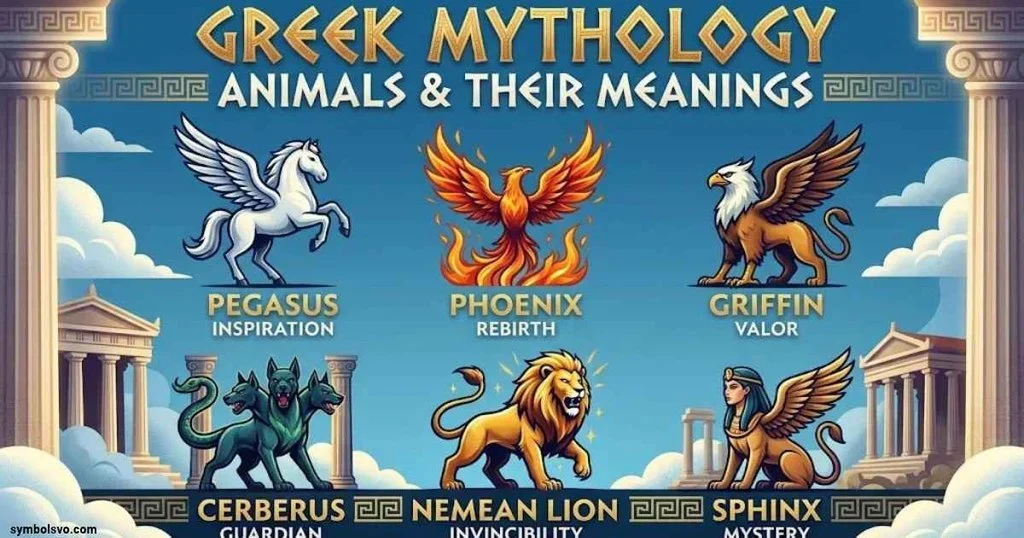
Animals played important roles in Greek mythology. Some were sacred companions of particular gods, while others appeared as independent characters in legendary stories.
Their associations depended on the myths, religious traditions, and artistic representations in which they appeared.
Owl: Wisdom and Athena
The owl is one of the most recognizable Greek mythology animals. It was closely associated with Athena and became an important emblem of Athens.
Its large eyes and ability to see in darkness made it a fitting artistic companion for a goddess associated with wisdom and intelligence.
The owl appeared on ancient Athenian silver coins. These coins circulated widely and helped spread the bird’s connection with the city.
Eagle: Zeus and Divine Authority
The eagle was associated with Zeus and frequently represented divine sovereignty.
Its powerful flight and commanding appearance made it suitable for artistic representations of the king of the gods.
The eagle commonly represents:
- Divine authority.
- Strength and power.
- Sovereignty.
- Connection with the heavens.
Peacock: Hera and Royal Majesty
The peacock is traditionally associated with Hera. Its elaborate feathers complement her position as queen of Olympus.
In later classical imagery, the bird became an especially recognizable attribute of the goddess.
Dove: Aphrodite and Love
The dove was associated with Aphrodite and appeared in artistic representations of love and beauty.
Its gentle appearance made it a suitable companion for the goddess of desire and attraction.
The dove remains one of the most recognizable animals in modern depictions of Aphrodite.
Dolphin: Poseidon and the Sea
Dolphins appear throughout Greek maritime mythology and artistic traditions.
Their connection with the sea makes them natural companions of Poseidon. They also appear in stories involving sailors, sea journeys, and divine intervention.
Horse: Poseidon and Divine Power
Poseidon was closely connected to horses. Greek mythology even attributes the creation of the horse to him in certain traditions.
Horses also appear in heroic stories, chariot scenes, and accounts of divine travel.
The animal therefore connects Poseidon with both maritime and terrestrial power.
Snake: Healing, Danger, and Transformation
Snakes carried several meanings in Greek mythology and religion.
Their associations depended heavily on the story or deity involved.
- Asclepius: The serpent appears on his staff and connects to healing.
- Medusa: Snakes form part of the terrifying imagery of the Gorgon.
- Guardian figures: Serpents sometimes protect sacred spaces and treasures.
- Transformation: Serpent imagery appears in myths involving change and supernatural power.
The snake should not be assigned one universal meaning. Its interpretation depends on its mythological context.
Deer: Artemis and the Wilderness
The deer was closely associated with Artemis and her role as protector of wild animals.
One famous story involves Actaeon, a hunter who accidentally sees Artemis bathing. The goddess transforms him into a stag, and his own hunting dogs attack him.
The myth connects the deer with hunting, wilderness, and the consequences of violating divine boundaries.
Bull: Strength and Poseidon’s Power
The bull appears in several important Greek myths.
Poseidon is associated with the animal, while the Cretan Bull and Minotaur connect bulls with the mythology of Crete.
The animal often represents physical power and dangerous strength within these stories.
Swan: Beauty and Transformation
The swan appears in Greek mythology through several divine and romantic stories.
One famous example involves Zeus transforming himself into a swan to approach Leda. The bird also appears in traditional artistic associations with Aphrodite.
Leopard: Dionysus and Wild Nature
The leopard is closely associated with Dionysus in classical artistic imagery.
It connects to the god’s association with wild nature, ecstatic worship, and the unpredictable energy of religious celebration.
Tortoise: Hermes and Creativity
The tortoise plays a memorable role in the myth of Hermes and the invention of the lyre.
According to tradition, Hermes used a tortoise shell to create the instrument’s body. The story connects the animal with invention and craftsmanship.
Famous Greek Mythological Creatures and Their Symbolism
Greek mythology contains extraordinary creatures that combine human, animal, and supernatural characteristics. Many appear in stories involving heroic challenges, divine punishment, and mysterious places.
Pegasus: Freedom and Divine Inspiration
Pegasus was a winged horse born from Medusa’s body after Perseus killed her.
He later became connected to the hero Bellerophon, who rode him during the battle against the Chimera.
Pegasus is widely associated with:
- Flight and freedom.
- Heroic adventure.
- Divine inspiration.
- Extraordinary power.
In modern culture, the winged horse often represents imagination and artistic creativity.
Cerberus: Guardian of the Underworld
Cerberus was the monstrous dog guarding the entrance to Hades’s realm.
Ancient descriptions vary, but he is commonly represented with three heads.
His primary responsibility was preventing the dead from leaving the underworld and stopping unauthorized living visitors from entering.
Heracles captured Cerberus during his final labor and brought him to the surface.
Cerberus therefore represents guardianship, supernatural danger, and the boundary between life and death.
Medusa and the Gorgons: Protection and Transformation
Medusa was one of the three Gorgons in Greek mythology. Unlike her immortal sisters Stheno and Euryale, Medusa was mortal.
Her gaze could turn people into stone.
The Gorgon head became a recognizable image known as the Gorgoneion. Ancient Greeks placed this frightening face on shields, armor, buildings, and other objects to ward off danger.
Medusa’s imagery has several important associations:
- Protection against harmful forces.
- Supernatural danger.
- Divine punishment.
- Transformation.
- Fear and power.
Modern interpretations sometimes connect Medusa with female strength and resilience. These readings are contemporary interpretations rather than a single universal meaning found throughout ancient Greek tradition.
Minotaur: The Labyrinth and Human Nature
The Minotaur was a creature with the body of a man and the head of a bull.
He lived inside the Labyrinth built by Daedalus for King Minos of Crete.
The Athenian hero Theseus eventually entered the Labyrinth and defeated the creature. Ariadne helped him escape by providing a thread that guided him back through the maze.
The Minotaur is associated with:
- The Labyrinth.
- Dangerous creatures.
- Heroic challenges.
- The conflict between civilization and the monstrous.
Phoenix: Death and Rebirth
The phoenix is a legendary bird connected with renewal and extraordinary longevity.
Ancient Greek writers discussed the phoenix through traditions influenced by earlier cultures, including Egyptian ideas about sacred birds.
Later versions developed the familiar story of a bird that dies and rises again from its own remains.
Today, the phoenix commonly represents:
- Rebirth.
- Renewal.
- Endurance.
- Transformation.
- Recovery after hardship.
It is important to remember that the familiar modern phoenix story developed through several cultural traditions rather than one fixed Greek myth.
Nemean Lion: Strength and Heroism
The Nemean Lion was a powerful monster defeated by Heracles during his first labor.
Its skin was famously resistant to ordinary weapons. Heracles eventually strangled the creature and used its own claws to remove its hide.
He later wore the lion skin as a protective garment.
The Nemean Lion became a powerful symbol of heroic strength and victory over seemingly impossible challenges.
Sphinx: Riddles and Mystery
The Greek Sphinx was a supernatural creature associated with the city of Thebes.
It had a woman’s head, a lion’s body, and often wings.
The Sphinx challenged travelers with a riddle. Oedipus solved it and brought an end to the creature’s threat.
The Sphinx is associated with:
- Mystery.
- Intelligence.
- Knowledge.
- Difficult challenges.
- The consequences of ignorance.
Greek Mythology Heroes and Their Symbols
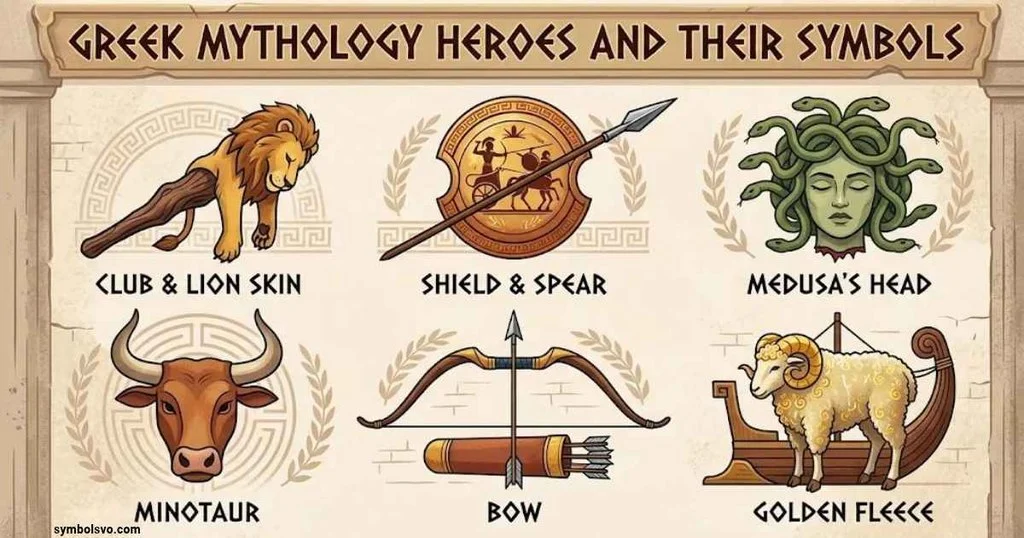
Greek heroes often carried distinctive weapons, clothing, and magical objects. These attributes helped identify them and recall their greatest adventures.
Heracles: Club and Nemean Lion Skin
Heracles, also known by his Roman name Hercules, was famous for extraordinary strength and endurance.
His most recognizable attributes were his wooden club and the skin of the Nemean Lion.
His twelve labors included defeating dangerous creatures, capturing powerful animals, and completing seemingly impossible tasks.
The club represents physical strength, while the lion skin recalls his victory over the nearly invulnerable monster.
Perseus: Medusa’s Head and Reflective Shield
Perseus was the hero who defeated Medusa.
He received several magical gifts during his quest, including:
- A curved sword.
- A reflective shield.
- Winged sandals.
- A helmet of invisibility.
The reflective shield allowed him to avoid looking directly at Medusa’s deadly face.
After defeating her, Perseus used the Gorgon’s head as a powerful weapon in later adventures.
Theseus: Sword and the Labyrinth
Theseus is best known for entering the Labyrinth and defeating the Minotaur.
His story includes two especially important objects:
- Sword: Connects to his identity as a heroic warrior.
- Ariadne’s thread: Helped him find his way out of the maze.
Ariadne’s thread has become a familiar metaphor for guidance through a complicated problem.
Achilles: Armor, Shield, and Spear
Achilles was one of the greatest Greek warriors in the Trojan War tradition.
His most famous equipment included his armor, spear, and extraordinary shield.
The shield of Achilles receives an elaborate description in Homer’s Iliad. Its decoration includes scenes representing different aspects of human life and the wider world.
His famous heel later became a metaphor for a person’s single vulnerable point.
Odysseus: Bow and Trojan Horse
Odysseus was famous for intelligence, patience, and strategic thinking.
His bow played an important role in the story of his return to Ithaca.
The Trojan Horse is another major object connected with the broader Trojan War tradition. The Greeks used the wooden horse as a deceptive strategy to enter Troy.
It became an enduring symbol of clever planning and military deception.
Jason: Golden Fleece
Jason led the Argonauts on a dangerous journey to obtain the Golden Fleece.
The fleece belonged to a golden ram and was kept in Colchis under the protection of a dragon.
Jason’s quest involved Medea, the Argo, and numerous supernatural challenges.
The Golden Fleece is associated with heroic ambition, adventure, and the pursuit of a difficult goal.
Bellerophon: Pegasus
Bellerophon became famous for riding Pegasus and defeating the Chimera, a terrifying creature with features of several animals.
His story also includes a warning against excessive pride. After achieving remarkable victories, he attempted to reach Olympus and was punished for his ambition.
Ariadne: Thread and Labyrinth
Ariadne was the daughter of King Minos and helped Theseus defeat the Minotaur.
She gave him a thread that allowed him to retrace his steps through the Labyrinth.
Her thread is often used as a symbol of guidance, problem-solving, and finding a way through confusion.
Greek Mythology Weapons and Objects and Their Meanings
Divine weapons and magical objects often played central roles in Greek myths. They gave gods and heroes extraordinary abilities and helped shape legendary events.
| Greek mythology object | Associated figure | Main association |
| Thunderbolt | Zeus | Divine authority |
| Trident | Poseidon | Sea and earthquakes |
| Scepter | Zeus and Hera | Kingship |
| Helm of invisibility | Hades | Concealment |
| Bident | Hades | Underworld |
| Aegis | Athena and Zeus | Divine protection |
| Spear | Athena and Ares | Warfare |
| Sword | Perseus and Theseus | Heroic combat |
| Lyre | Apollo and Hermes | Music |
| Caduceus | Hermes | Heraldry and communication |
| Rod of Asclepius | Asclepius | Healing |
| Golden Fleece | Jason’s quest | Heroic achievement |
| Labyrinth | Minotaur | Complexity and confinement |
| Cornucopia | Various deities | Abundance |
| Thyrsus | Dionysus | Religious ritual |
Thunderbolt: Divine Power and Authority
Zeus’s thunderbolt was his most recognizable weapon. It represented his ability to control storms and punish those who challenged divine authority.
Trident: Poseidon’s Power Over the Sea
Poseidon’s three-pronged weapon was associated with his rule over the oceans. Mythological traditions also connected him with earthquakes and horses.
Scepter: Kingship and Divine Authority
The scepter was a staff of authority carried by kings and powerful divine figures.
In mythology and ancient artwork, it helped communicate political and supernatural status.
Helm of Invisibility: Concealment and Supernatural Power
The magical helmet associated with Hades could make its wearer invisible.
It appears in several mythological stories and became an important object in Perseus’s adventure.
Aegis: Divine Protection
The aegis was a protective attribute associated especially with Zeus and Athena.
Athena is frequently depicted with an aegis bearing the head of Medusa. This image connects divine protection with the frightening power of the Gorgon.
Caduceus: Hermes and Communication
Hermes carried the caduceus as his herald’s staff.
Its traditional form includes two intertwined snakes and wings. It represents Hermes’s role as messenger and his associations with negotiation, commerce, and travel.
Rod of Asclepius: Healing and Medicine
The Rod of Asclepius consists of a staff with a single serpent wrapped around it.
Asclepius was the Greek god associated with healing and medicine. His staff remains a widely recognized medical emblem.
Remember the difference:
- Caduceus: Two snakes and wings, associated with Hermes.
- Rod of Asclepius: One snake, associated with healing.
Golden Fleece: Adventure and Achievement
The Golden Fleece was the object of Jason’s famous quest.
Obtaining it required courage, teamwork, and help from Medea. It became one of the most memorable objects in Greek heroic mythology.
Labyrinth: Complexity and the Minotaur
The Labyrinth was an elaborate maze designed to contain the Minotaur.
Its twisting passages made escape extremely difficult. The story has influenced modern uses of the word labyrinth to describe complicated situations.
Ariadne’s Thread: Guidance and Escape
Ariadne’s thread helped Theseus navigate the maze.
Today, the expression refers to something that provides direction through a difficult problem.
Cornucopia: Abundance and Prosperity
The cornucopia, or horn of plenty, is a container overflowing with food and produce.
It became associated with fertility, harvest, and abundance in Greek and later classical traditions.
Golden Apple: Discord and Desire
The golden apple played an important role in the events leading to the Trojan War.
Eris, the goddess of discord, threw a golden apple marked for the fairest goddess. Hera, Athena, and Aphrodite competed for it.
Paris eventually awarded it to Aphrodite, setting in motion a chain of events connected to the Trojan War.
Thyrsus: Dionysian Ritual and Celebration
The thyrsus was a staff associated with Dionysus and his followers.
Decorated with foliage and often topped with a pine cone, it appeared in representations of Dionysian religious celebrations.
Greek Mythology Plants, Flowers, and Nature Symbols
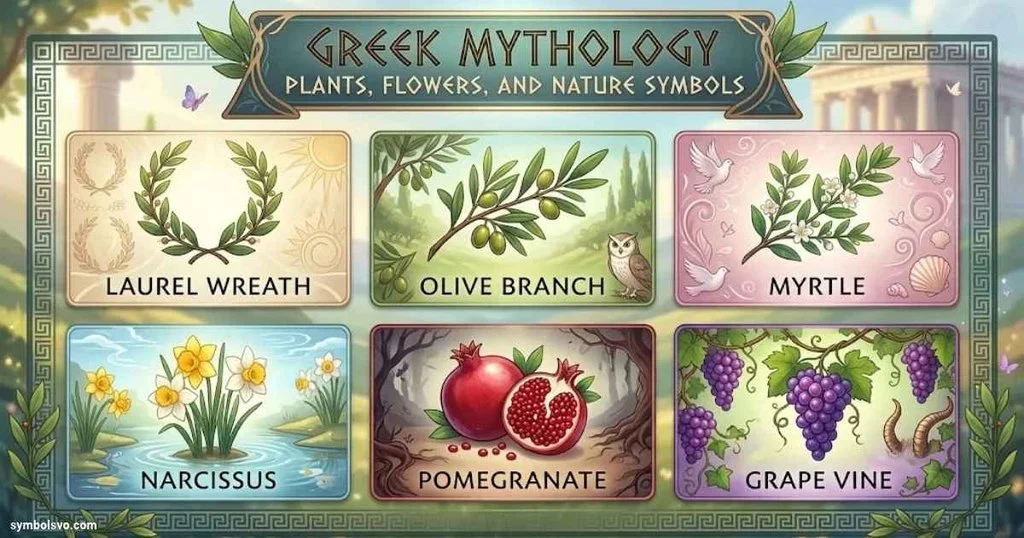
Plants and flowers had important roles in Greek mythology. Some were associated with particular deities, while others appeared in stories about transformation, agriculture, and divine relationships.
Olive Tree: Athena, Peace, and Prosperity
The olive tree was sacred to Athena and played an important role in the legendary founding traditions of Athens.
According to the myth, Athena and Poseidon competed to become the city’s patron deity.
Poseidon offered a horse or, in some versions, a source of seawater. Athena offered the olive tree, which provided food, oil, and wood.
The people chose Athena’s gift.
The olive tree became associated with:
- Athena and wisdom.
- Agricultural prosperity.
- Peace and civic life.
- The identity of Athens.
Laurel Wreath: Apollo and Victory
The laurel tree is closely associated with Apollo through the story of Daphne.
In the myth, Daphne transforms into a laurel tree while escaping Apollo. He then adopts the laurel as a sacred plant.
Laurel wreaths later became associated with victory, achievement, poetry, and honor.
Rose: Aphrodite and Beauty
The rose is traditionally associated with Aphrodite and her connection to love and beauty.
In later classical and European artistic traditions, it became an especially recognizable romantic flower.
Its modern associations with affection and romance developed through many cultural influences.
Myrtle: Love and Aphrodite
Myrtle was a sacred plant associated with Aphrodite.
It appeared in religious and decorative traditions connected with love, marriage, and beauty.
Ivy: Dionysus and Celebration
Ivy was one of Dionysus’s recognizable plants.
It frequently appears in depictions of the god and his followers. Its evergreen leaves also made it suitable for wreaths used in Dionysian imagery.
Grapevine: Wine and Dionysian Worship
The grapevine was closely connected to Dionysus, the god of wine.
It represented viticulture, wine production, religious festivals, and the social traditions surrounding drinking.
Pomegranate: Persephone and the Underworld
The pomegranate is one of the most important plants in the story of Persephone.
According to the Homeric Hymn to Demeter, Persephone ate pomegranate seeds while in the underworld. This act connected her to Hades’s realm and contributed to the arrangement that allowed her to spend part of the year with her mother.
The pomegranate therefore connects to:
- Persephone’s underworld journey.
- The relationship between mother and daughter.
- Seasonal change.
- Fertility and agricultural cycles.
Wheat and Grain: Demeter and Agriculture
Wheat and grain were central attributes of Demeter.
As the goddess of agriculture, she represented the crops that sustained human communities.
Her mythology helped explain the relationship between divine power, harvest, and seasonal fertility.
Poppy: Demeter and Fertility
Poppies appear in traditional artistic and religious associations with Demeter.
They connect to agricultural landscapes and fertility traditions.
Cypress: Death and Funerary Associations
Cypress trees were associated with death and funerary practices in the ancient Mediterranean world.
Their connection to mourning and burial makes them relevant to the wider symbolism of the Greek underworld.
Oak Tree: Zeus and Sacred Nature
The oak tree was sacred to Zeus, particularly at Dodona, where an ancient oracle operated.
Its association with the god connects the tree to divine power and sacred communication.
Greek Mythology Symbols and Their Meanings
Different Greek mythology symbols communicate different ideas. Some connect to particular gods, while others appear across several stories and traditions.
The following categories make it easier to understand their broader associations.
Greek Mythology Symbols for Wisdom and Knowledge
Wisdom was an important concept in Greek mythology, especially through Athena.
Recognizable symbols include:
- Owl: Athena’s sacred bird and an emblem of wisdom.
- Olive tree: Athena’s gift to Athens.
- Athena’s helmet: Strategic thinking and disciplined warfare.
- Apollo’s attributes: Music, prophecy, and knowledge.
The owl remains one of the strongest visual associations with wisdom in classical mythology.
Greek Mythology Symbols for Love and Beauty
Aphrodite and Eros are the most recognizable figures associated with love and desire.
Their symbols include:
- Dove: Aphrodite and romantic associations.
- Rose: Beauty and affection.
- Myrtle: Love and sacred devotion.
- Seashell: Aphrodite’s birth imagery.
- Bow and arrows: Eros and the power of desire.
These images appear frequently in classical art and later romantic traditions.
Greek Mythology Symbols for Strength and Power
Several gods and heroes represent different forms of strength.
Important symbols include:
- Zeus’s thunderbolt: Divine power.
- Poseidon’s trident: Power over the sea.
- Heracles’s club: Physical strength.
- Nemean Lion skin: Heroic achievement.
- Ares’s spear: Military aggression.
- Zeus’s eagle: Divine sovereignty.
These symbols are particularly recognizable in heroic artwork and classical sculpture.
Greek Mythology Symbols for Protection
Protection appears throughout Greek mythology in the form of divine objects and supernatural guardians.
Important examples include:
- Gorgoneion: The protective image of the Gorgon head.
- Athena’s aegis: Divine defense.
- Shield: Military and supernatural protection.
- Cerberus: Guardian of the underworld.
- Perseus’s reflective shield: Protection against Medusa’s deadly gaze.
The Gorgoneion is particularly important because frightening imagery could serve a protective purpose in ancient art.
Greek Mythology Symbols for Victory and Achievement
Victory had strong religious and cultural significance in ancient Greece.
Its recognizable symbols include:
- Nike’s wings: Victory and divine triumph.
- Laurel wreath: Honor and achievement.
- Athena’s olive wreath: Associations with Athens and victory.
- Heracles’s lion skin: Heroic accomplishment.
- Victory monuments: Public celebrations of military and athletic success.
Nike, the goddess of victory, frequently appears with wings in ancient artistic representations.
Greek Mythology Symbols for Transformation and Rebirth
Transformation is a recurring theme in Greek mythology. Gods often changed their forms, while mortals sometimes became plants, animals, or natural objects.
Important examples include:
- Daphne’s laurel tree: Transformation and escape.
- Narcissus flower: The transformation of Narcissus.
- Persephone’s seasonal journey: The cycle of vegetation and return.
- Cygnus: Several Greek myths describe figures transformed into swans.
- Phoenix: Later traditions of renewal and rebirth.
These stories explore change, identity, loss, and the relationship between humans and nature.
Greek Mythology Symbols for Death and the Underworld
The underworld was an important part of ancient Greek beliefs about the afterlife.
Its recognizable symbols include:
- Cerberus: Guardian of Hades’s realm.
- Pomegranate: Persephone’s connection to the underworld.
- Cypress: Funerary and mourning associations.
- River Styx: A boundary between the world of the living and the dead.
- Charon: The ferryman who transported souls across underworld waters.
- Hades’s bident: An attribute associated with the ruler of the dead.
Together, these figures and objects form an important part of Greek mythology’s imagery of death.
Greek Mythology Symbols for Peace and Prosperity
Peace and prosperity were important to agricultural and civic communities.
Symbols associated with these ideas include:
- Olive branch: Peace and Athena’s connection with Athens.
- Cornucopia: Abundance and plenty.
- Wheat: Agricultural prosperity.
- Eirene: The goddess who personified peace.
- Olive wreath: Honor and victory.
These symbols connect mythology with everyday life in ancient Greek society.
Greek Mythology Symbols for Creativity and Inspiration
Greek mythology also celebrates music, storytelling, and artistic skill.
Important symbols include:
- Apollo’s lyre: Music and poetry.
- The Muses: Inspiration for artistic and intellectual pursuits.
- Pegasus: Later associations with poetic inspiration.
- Hermes’s tortoise-shell lyre: Invention and craftsmanship.
- Dionysus’s theatrical traditions: Drama and performance.
The Muses were particularly important because each was associated with a different artistic or intellectual field.
Greek Mythology Symbols in Ancient Greek Art and Culture
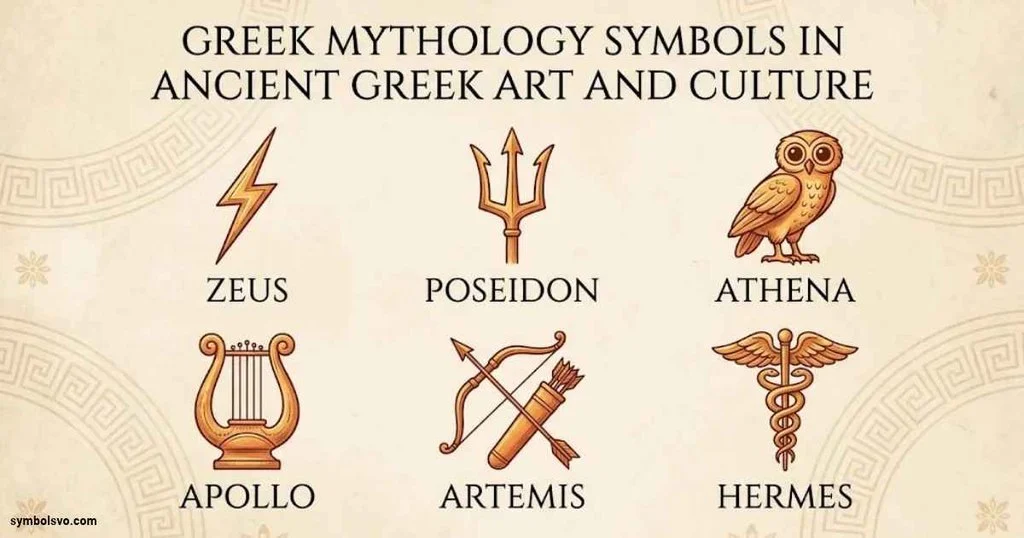
Greek mythology was not limited to storytelling. Artists and religious communities used mythological imagery throughout public and private life.
Ancient pottery, coins, sculptures, and temples provide important evidence of how Greeks represented their gods.
Greek Symbols in Ancient Pottery and Vase Paintings
Greek pottery frequently displayed mythological scenes.
Black-figure and red-figure techniques allowed artists to depict gods, heroes, battles, and supernatural creatures.
Common subjects included:
- Heracles fighting monsters.
- Achilles and other heroes from the Trojan War.
- Athena carrying her shield and spear.
- Dionysus surrounded by followers.
- Perseus confronting Medusa.
- Theseus defeated the Minotaur.
These scenes helped preserve famous stories and made mythological characters recognizable.
Greek Mythology Symbols in Sculptures
Sculptors used physical attributes to identify divine figures.
Athena might wear a helmet and carry a shield. Zeus could hold a thunderbolt, while Poseidon often carried a trident.
The objects, clothing, posture, and accompanying animals all helped viewers understand the identity of a figure.
Greek Mythology Symbols on Ancient Coins
Ancient Greek coins often displayed images connected to the issuing city.
Athens provides one of the clearest examples.
Its famous silver tetradrachms featured Athena on one side and an owl on the other. The coins also included an olive branch and the letters identifying Athens.
These images connected religious identity with economic and civic life.
Greek Mythology Symbols in Temples and Religious Practices
Temples contained sculptures, decorative reliefs, and objects connected to worship.
Religious communities also used offerings, altars, sacred plants, and animal imagery.
Some objects had practical religious purposes, while others helped identify the deity honored at a particular sanctuary.
Greek mythology and ancient Greek religion were closely connected, although myths and actual religious practices were not always identical.
How to Identify Greek Gods Through Their Symbols
You can often recognize a Greek deity by examining several visual details.
Use these clues:
| Visual attribute | Likely figure |
| Thunderbolt and eagle | Zeus |
| Peacock and crown | Hera |
| Trident and sea creatures | Poseidon |
| Owl, helmet, and shield | Athena |
| Lyre and laurel | Apollo |
| Bow and deer | Artemis |
| Dove and rose | Aphrodite |
| Spear and armor | Ares |
| Winged sandals and staff | Hermes |
| Wheat and torch | Demeter |
| Hammer and anvil | Hephaestus |
| Grapevine and thyrsus | Dionysus |
| Hearth and sacred fire | Hestia |
One symbol alone does not always establish a figure’s identity. Consider the entire scene and its historical context before making a conclusion.
Greek Mythology Symbols vs. Ancient Greek Cultural Symbols
Not every symbol associated with ancient Greece comes from mythology.
Some belong to decorative art, writing systems, architecture, or civic traditions.
Understanding these differences prevents confusion between mythological attributes and broader Greek cultural imagery.
Greek Key Symbol: The Meander Pattern
The Greek key is a geometric decorative design made from connected lines that turn repeatedly.
It is also called the meander pattern.
Ancient Greek artists used it on pottery, architecture, mosaics, and other decorative surfaces.
Today, the pattern is often interpreted as representing eternity, continuity, or an unending journey. However, these meanings should not be treated as one universally established ancient Greek belief.
Greek Alphabet and Its Historical Importance
The Greek alphabet was an important development in the history of writing.
Its letters were used for inscriptions, literature, trade, mathematics, and philosophical texts.
Examples include:
- Alpha.
- Beta.
- Gamma.
- Delta.
- Omega.
The alphabet is a writing system rather than a collection of mythological symbols.
Although some Greek letters appear in religious and artistic contexts, their basic purpose was communication.
Olive Branch and Laurel Wreath
The olive branch and laurel wreath both have important cultural and mythological associations.
The olive branch connects with Athena and the traditions of Athens. It also became a recognizable emblem of peace.
The laurel wreath connects with Apollo and later traditions of victory and achievement.
Both continue to appear in modern art, awards, and decorative designs.
Greek Mythology Symbols vs. Greek Religious Symbols
These categories overlap, but they are not identical.
| Mythological symbols | Religious and cultural symbols |
| Zeus’s thunderbolt | Sacred offerings |
| Athena’s owl | Temple objects |
| Poseidon’s trident | Religious altars |
| Medusa’s head | Votive objects |
| Apollo’s lyre | Sacred inscriptions |
| Persephone’s pomegranate | Ritual vessels |
Mythological stories influenced religious imagery, but ancient Greek religion also involved local customs, ceremonies, and traditions that cannot be reduced to mythology alone.
Greek Mythology Symbols in Modern Culture and Tattoos
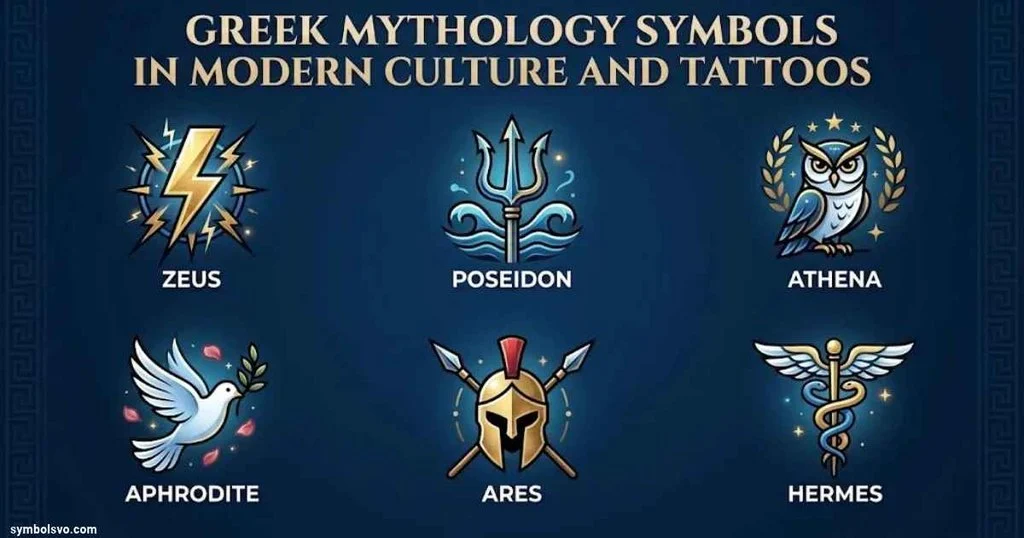
Greek mythology continues to influence modern designs, especially tattoos.
People choose mythological imagery for its connection to particular stories, personal values, or artistic appeal.
However, modern tattoo interpretations do not always match ancient meanings exactly.
Medusa Tattoo: Protection and Power
Medusa is one of the most popular mythological figures in contemporary tattoo culture.
Her image has a long history in ancient art, where the Gorgoneion served an important protective purpose.
Modern designs may represent:
- Resilience.
- Personal strength.
- Protection.
- Survival.
- Transformation.
Some people also connect Medusa with female empowerment. This is a contemporary interpretation rather than a single meaning shared by all ancient sources.
Athena Tattoo: Wisdom and Strength
Athena tattoos often feature her owl, helmet, shield, or spear.
These elements connect to her mythological identity as a goddess of wisdom, strategic warfare, and craftsmanship.
Popular design choices include:
- Athena’s face with a helmet.
- An owl with an olive branch.
- A shield featuring the Gorgon head.
- Athena holding a spear.
Zeus Tattoo: Power and Authority
Zeus tattoos commonly feature a thunderbolt, eagle, or powerful portrait of the god.
These designs represent his position as ruler of Olympus and his association with the sky and storms.
Poseidon Tattoo: Sea and Strength
Poseidon tattoos often feature his trident, waves, horses, or dolphins.
They appeal to people interested in maritime mythology and the power of the natural world.
Persephone Tattoo: Change and Duality
Persephone offers several meaningful tattoo design possibilities.
Common elements include:
- Pomegranate.
- Flowers.
- Torches.
- Dark and light imagery.
- Seasonal plants.
Her story connects the world of the living with the underworld. Modern interpretations often explore change, personal growth, and duality.
Pegasus Tattoo: Freedom and Inspiration
Pegasus tattoos frequently represent freedom, imagination, and ambition.
The winged horse’s connection to Bellerophon also gives the design a heroic background.
Other Popular Greek Mythology Tattoo Symbols
Several other symbols work well in mythological tattoo designs.
| Tattoo symbol | Mythological association | Common modern interpretation |
| Apollo’s lyre | Apollo | Creativity and music |
| Artemis’s bow | Artemis | Independence and wilderness |
| Heracles’s club | Heracles | Strength and endurance |
| Nike’s wings | Nike | Victory and achievement |
| Laurel wreath | Apollo and victory traditions | Honor and success |
| Cerberus | Hades | Guardianship |
| Greek key | Ancient Greek decorative art | Continuity and eternity |
How to Choose a Greek Mythology Tattoo Symbol
Before choosing a design, learn the original story behind it.
A symbol might have a different historical meaning than its popular modern interpretation.
Consider these points:
- Choose a deity, hero, or creature whose story interests you.
- Understand the symbol’s original mythological association.
- Decide whether you prefer historical imagery or a modern interpretation.
- Consider how different elements work together.
- Avoid combining unrelated symbols without understanding their backgrounds.
A thoughtful design can communicate much more than an attractive image.
Ancient Meanings vs. Modern Interpretations of Greek Mythology Symbols
Greek mythology symbols have changed through centuries of artistic and cultural reinterpretation.
A symbol appearing in an ancient Greek temple might carry a different meaning in a modern painting or tattoo.
Understanding this difference is essential for historical accuracy.
Why Greek Mythology Symbols Have Different Meanings
Several factors explain why interpretations vary.
Historical periods: Greek artistic traditions changed from the Archaic period through the Classical and Hellenistic periods.
Regional traditions: Different Greek cities and communities sometimes emphasized different gods, myths, and religious practices.
Literary accounts: Ancient writers did not always describe mythological figures in exactly the same way.
Artistic interpretation: Sculptors and painters sometimes used attributes differently depending on their artistic goals.
Later cultural influences: Roman traditions, Renaissance art, and modern popular culture reshaped many familiar mythological images.
Ancient Greek Symbolism Supported by Historical Evidence
Some associations have strong support in surviving artwork and historical records.
| Symbol | Historical association |
| Athena’s owl | Athenian coins and civic identity |
| Zeus’s thunderbolt | Divine power and authority |
| Poseidon’s trident | Sea god’s identifying attribute |
| Apollo’s lyre | Music and artistic traditions |
| Gorgoneion | Protective imagery |
| Demeter’s grain | Agriculture and harvest |
| Dionysus’s thyrsus | Dionysian religious imagery |
These examples demonstrate how mythological symbolism appeared in actual ancient objects and artistic traditions.
Popular Modern Meanings That Need Historical Context
Some modern interpretations are useful but should not automatically be presented as ancient beliefs.
For example:
- The phoenix is commonly used to represent rebirth, but its story developed through multiple cultural traditions.
- Medusa is often associated with female empowerment today, but ancient representations also served protective and frightening purposes.
- The Greek key is frequently interpreted as eternity, although its ancient decorative use does not establish one universal meaning.
- Roses are connected with Aphrodite, but every rose color does not have a documented ancient Greek meaning.
- The owl is associated with Athena, but not every owl image in ancient Greece necessarily represented the goddess.
Historical context helps separate documented traditions from later interpretations.
How Greek Mythology Symbols Changed Over Time
The development of Greek symbolism can be understood through several historical periods.
Archaic Greek period: Artists developed recognizable ways of representing gods, heroes, and mythological creatures through pottery, sculpture, and other objects.
Classical Greek period: Mythological figures became prominent subjects in sculpture, architecture, coins, and painted pottery.
Hellenistic period: Artists explored more dramatic expressions, emotional scenes, and complex mythological compositions.
Roman period: Roman artists adopted and adapted many Greek gods, stories, and artistic attributes.
Renaissance and Neoclassical periods: European artists revived Greek mythological subjects in paintings, sculptures, and decorative works.
Modern culture: Mythological symbols continue to appear in books, movies, tattoos, fashion, jewelry, and popular art.
The meaning of a symbol often depends on when, where, and how someone used it.
Frequently Asked Questions About Greek Mythology Symbols
What Are the Most Famous Greek Mythology Symbols?
Some of the most famous Greek mythology symbols include Zeus’s thunderbolt, Athena’s owl, Poseidon’s trident, Hera’s peacock, Aphrodite’s dove, Apollo’s lyre, Hermes’s winged sandals, and Medusa’s Gorgon head. These symbols help identify important gods and explain their powers, responsibilities, and mythological stories.
What Are the Symbols of the Greek Gods and Goddesses?
Greek gods and goddesses have different identifying attributes. Zeus carries a thunderbolt, Athena is associated with an owl and olive tree, Poseidon carries a trident, and Aphrodite is connected with doves and roses. Other recognizable attributes include Apollo’s lyre, Artemis’s bow, and Hermes’s winged sandals.
What Is Zeus’s Main Symbol?
Zeus’s main symbol is the thunderbolt. It represents his control over lightning, storms, and divine power. He is also associated with the eagle, oak tree, scepter, and throne. Ancient artwork frequently depicts him holding a thunderbolt as the ruler of Olympus.
What Is Athena’s Symbol?
Athena’s most recognizable symbol is the owl. She is also associated with the olive tree, helmet, spear, shield, and aegis. These attributes reflect her connections to wisdom, strategic warfare, craftsmanship, and the protection of Athens.
What Does the Owl Symbolize in Greek Mythology?
The owl is associated with Athena and represents wisdom, intelligence, and watchfulness. It became an important emblem of Athens and appeared on ancient Athenian coins. Its association with the goddess made it one of the most recognizable animals in Greek mythology.
What Does Poseidon’s Trident Represent?
Poseidon’s trident represents his divine authority over the sea. It is also connected to his power over earthquakes and horses. Ancient and later artistic representations frequently show him carrying this three-pronged weapon.
Which Greek Mythology Symbol Represents Love?
The dove, rose, and myrtle are commonly associated with Aphrodite, the goddess of love and beauty. Eros’s bow and arrows also represent the power of desire and romantic attraction. These symbols appear frequently in classical mythology and later artistic traditions.
Which Greek Mythology Symbol Represents Strength?
Heracles’s club and the Nemean Lion skin are strong symbols of physical strength and heroic achievement. Zeus’s thunderbolt represents divine power, while Poseidon’s trident represents supernatural authority over the sea.
Which Greek Mythology Symbol Represents Wisdom?
The owl of Athena is the most recognizable Greek mythology symbol for wisdom. Athena’s olive tree, helmet, and shield also connect to her identity as a goddess of knowledge and strategic warfare.
Which Greek Mythology Symbols Represent Protection?
The Gorgoneion, Athena’s aegis, and protective shields are important examples. Medusa’s frightening head was used in ancient Greek art as an apotropaic image intended to ward off harmful forces. Cerberus also represents guardianship through his role as the underworld’s guardian.
What Does Medusa Symbolize in Greek Mythology?
Medusa represents supernatural danger and appears in ancient protective imagery. Her Gorgon head was placed on shields and other objects to ward off evil. Modern interpretations also associate her with resilience, survival, and female empowerment.
What Does the Pomegranate Represent in Greek Mythology?
The pomegranate is associated with Persephone and her time in the underworld. After eating its seeds, she became connected to Hades’s realm and could not remain permanently with her mother. The fruit therefore plays an important role in myths about seasonal change, fertility, and the underworld.
What Does Pegasus Symbolize?
Pegasus is commonly associated with freedom, flight, and divine inspiration. In Greek mythology, he was the winged horse connected to Bellerophon and the defeat of the Chimera. Later artistic traditions expanded his connection with poetry and imagination.
What Does the Golden Fleece Represent?
The Golden Fleece represents the object of Jason’s legendary quest. Obtaining it required courage, planning, and help from Medea. It is commonly associated with adventure, heroic ambition, and the pursuit of an extraordinary goal.
Is the Caduceus a Greek Medical Symbol?
The caduceus belongs to Hermes and represents his role as a messenger and herald. Although some modern medical organizations use it, the traditional Greek medical symbol is the Rod of Asclepius, which features a single serpent wrapped around a staff.
What Is the Difference Between the Caduceus and Rod of Asclepius?
The caduceus has two intertwined snakes and is traditionally associated with Hermes. The Rod of Asclepius has one serpent and belongs to Asclepius, the god of healing. The two symbols have different mythological origins and should not be confused.
Are Greek Key Patterns Related to Greek Mythology?
The Greek key, also known as the meander pattern, is an ancient decorative design. It appeared on pottery, architecture, and other artistic objects. Although modern interpretations often connect it with eternity and continuity, it is not specifically a symbol belonging to a Greek god.
Which Greek Mythology Symbols Are Popular for Tattoos?
Popular choices include Medusa, Athena’s owl, Zeus’s thunderbolt, Poseidon’s trident, Persephone’s pomegranate, Pegasus, Apollo’s lyre, and the laurel wreath. Each design has a different mythological background, so understanding its original story helps create a more meaningful tattoo.
Conclusion
Greek mythology symbols offer a fascinating look into the beliefs, stories, and artistic traditions of ancient Greece. From Zeus’s thunderbolt and Athena’s owl to Medusa’s protective image and Persephone’s pomegranate, each symbol connects to a larger mythological story.
These symbols also reveal how ancient Greeks understood nature, divine authority, love, warfare, agriculture, and the afterlife. Their appearance in pottery, sculptures, coins, and religious settings shows that mythology was deeply connected to everyday cultural life.
Today, Greek mythology symbols and their meanings continue to inspire artists, writers, designers, and tattoo enthusiasts. Learning their original stories makes these ancient images more than attractive designs. It helps preserve the history and imagination behind one of the world’s most influential mythological traditions.

I’m Daniel Brooks, a content creator and symbol enthusiast dedicated to researching the fascinating world of signs and symbols. I enjoy discovering the hidden meanings behind famous icons, emojis, historical emblems, and cultural symbols. Through my writing, I aim to provide trustworthy, well-researched, and reader-friendly information that helps people learn something new with every visit.
Books:
- The Complete Guide to World Symbols
- The Power of Universal Signs
 Mason Ellington