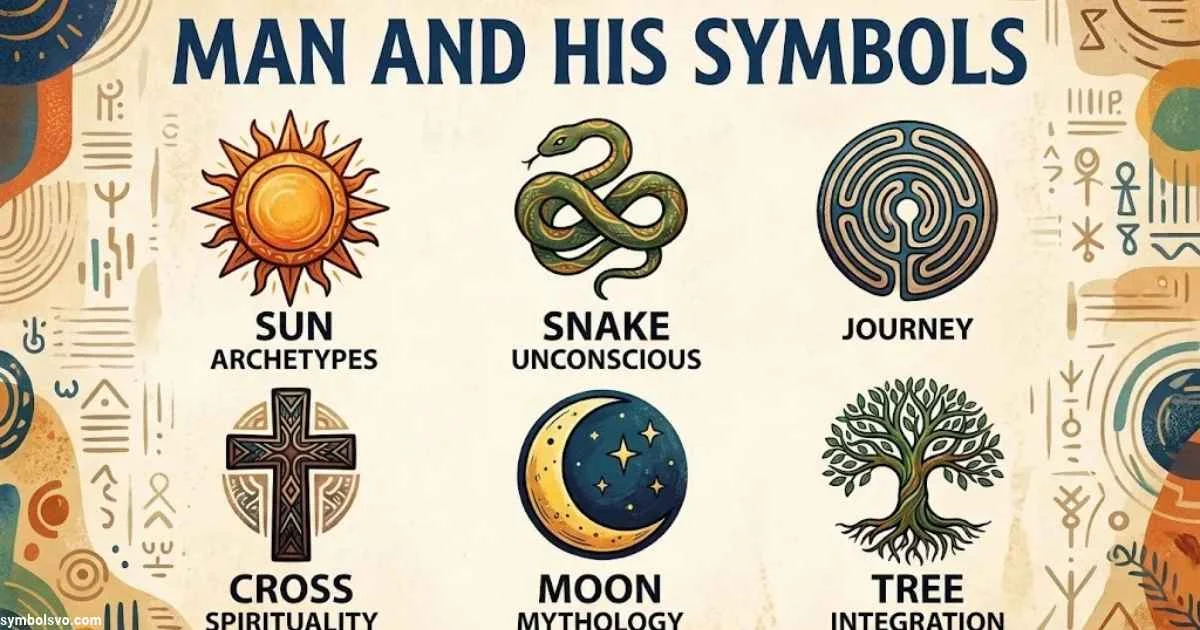
Carl Jung’s Man and His Symbols is a fascinating book about the hidden meaning of dreams, symbols, and the human mind. It explores how everyday images, objects, stories, and experiences can carry deeper psychological meanings. The book introduces readers to Jung’s ideas about the unconscious mind and explains how symbols can reveal thoughts and feelings that people may not fully understand.
If you are searching for a Man and His Symbols summary, book details, page count, or information about its different editions, this guide covers everything you need to know. You will also learn about its authors, main chapters, full-text availability, EPUB and Kindle editions, audiobook options, and where to buy a copy.
If you are discovering Carl Jung’s work for the first time or looking for a particular edition, this article will help you understand the book before reading it. It also explores some memorable ideas and quotes associated with its central themes.
Carl Jung Man and His Symbols
About the author and the book
Carl Gustav Jung (1875–1961) was a Swiss psychiatrist and the founder of analytical psychology. He is widely recognized for his work on dreams, archetypes, personality, mythology, and the unconscious mind.
Man and His Symbols is one of his best-known books for general readers. Unlike many academic psychology books, it introduces complex psychological ideas through understandable explanations, illustrations, myths, and examples from everyday life.
The book was first published in 1964, three years after Jung’s death. Jung developed its original concept, planned its structure, and wrote the first major chapter. His close collaborators completed the remaining contributions, with Marie-Louise von Franz taking responsibility for completing the work after his death.
The main contributors include:
- Carl G. Jung: Swiss psychiatrist and founder of analytical psychology.
- Marie-Louise von Franz: Jungian psychologist who wrote about individuation and the unconscious.
- Joseph L. Henderson: Psychiatrist who explored ancient myths and their relationship with modern people.
- Aniela Jaffé: Writer who examined symbolism in visual art.
- Jolande Jacobi: Psychologist who discussed symbols in individual psychological analysis.
- John Freeman: Journalist who wrote the introduction and helped coordinate the project.
One interesting detail is that the book grew out of a television interview with Jung. After the interview, he became interested in explaining his psychological theories to ordinary readers rather than limiting them to specialists.
The result was a collaborative book that introduced Jung’s ideas about dreams, symbols, and the unconscious to a much wider audience.
Man and His Symbols Summary
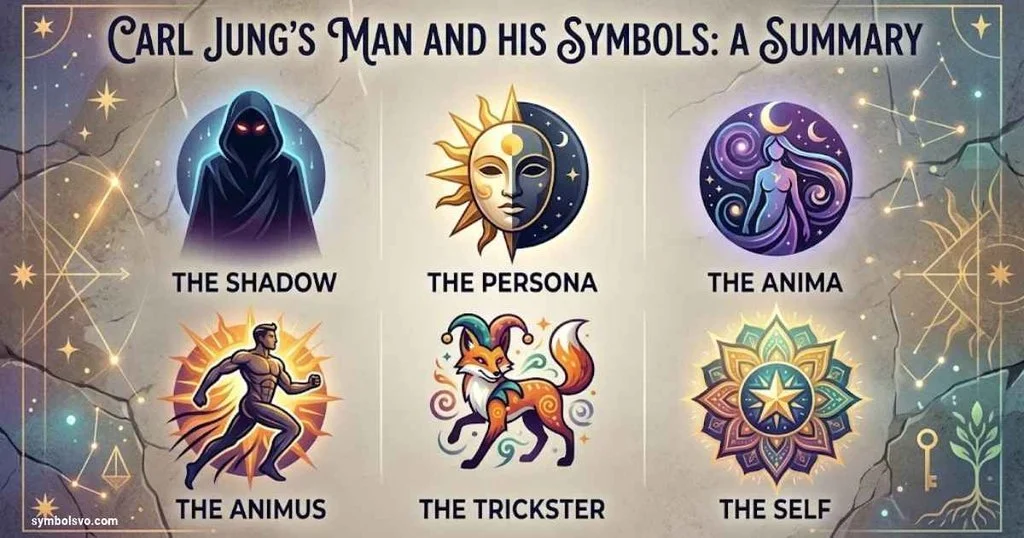
The main message of Man and His Symbols is that human beings communicate through more than words. Dreams, images, stories, and symbols can express aspects of the unconscious mind.
Jung believed that the unconscious plays an important role in human behavior and personality. People may experience emotions, fears, desires, and conflicts without fully understanding where they come from. Symbols appearing in dreams can offer clues about these hidden experiences.
The book contains five principal parts, including contributions from Jung and his colleagues.
Approaching the Unconscious — Carl G. Jung
The opening chapter introduces the unconscious mind and explains why dreams deserve attention.
Jung distinguishes between ordinary signs and symbols. A sign generally points to something already understood, while a symbol can express an idea with deeper meanings that are not immediately clear.
He explains that dreams are personal experiences and should not be interpreted through a single universal formula. The same image can have different meanings for different people.
The chapter also introduces archetypes and explains how symbolic patterns appear in dreams, myths, and everyday life.
Ancient Myths and Modern Man — Joseph L. Henderson
This chapter examines the connection between ancient mythology and modern psychological experiences.
Henderson explains how myths, legends, and traditional stories express recurring human struggles. These stories often involve challenges, transformation, conflict, and the search for identity.
The chapter shows how ancient symbolic patterns can remain meaningful even when people no longer live in the cultures that originally created them.
The Process of Individuation — Marie-Louise von Franz
Individuation is one of the most important concepts in Jungian psychology.
It describes the process of becoming a more complete and integrated individual. This involves recognizing different parts of the personality, including aspects that a person may avoid or fail to understand.
Von Franz explores how dreams and symbols can reflect this psychological development.
The chapter encourages readers to understand themselves more deeply rather than simply following social expectations.
Symbolism in the Visual Arts — Aniela Jaffé
This section examines how artists communicate psychological ideas through visual images.
Jaffé discusses how artwork can contain symbolic meanings that go beyond its visible appearance. Colors, shapes, objects, and figures can express emotions and ideas that are difficult to describe in ordinary language.
The chapter also connects modern art with the symbolic language of the unconscious.
Symbols in an Individual Analysis — Jolande Jacobi
Jacobi focuses on the use of symbols in individual psychological analysis.
She explains how dreams and symbolic experiences can help psychologists understand a person’s inner conflicts, personality, and emotional development.
The chapter emphasizes that personal history and individual circumstances matter when interpreting symbols.
Science and the Unconscious — Marie-Louise von Franz
The final contribution explores the relationship between scientific thinking and the unconscious mind.
Von Franz considers how patterns, discoveries, and experiences can reveal connections between conscious understanding and unconscious processes.
The chapter broadens the discussion beyond dreams and shows how symbolic thinking can influence different areas of human knowledge.
Overall lesson: The book encourages readers to pay attention to their dreams, understand their inner experiences, and recognize that symbols can communicate meanings beyond their visible forms.
Man and His Symbols Pages
The original 1964 American edition of Man and His Symbols published by Doubleday contains 320 pages. However, the page count can differ between editions, publishers, and formats.
For example, some later paperback catalogues list different physical page counts. This happens because publishers may change the book’s layout, dimensions, illustrations, and introductory material.
How Many Pages Should You Expect?
| Edition information | Page count |
| Original Doubleday edition | 320 |
| Some later paperback catalogue editions | 320 |
| Some other editions | May vary |
How Long Does It Take to Read?
Your reading time depends on your reading speed and how carefully you study the illustrations and psychological concepts.
Here is a general estimate:
| Reading speed | Estimated reading time |
| 20 pages per hour | 16 hours |
| 25 pages per hour | 13 hours |
| 30 pages per hour | 11 hours |
| 40 pages per hour | 8 hours |
These estimates use a 320-page edition and assume continuous reading.
If you want to understand the psychological ideas rather than simply finish the book, take your time with the chapters about dreams, archetypes, and individuation.
Man and His Symbols Book
This book is available in different physical editions, including hardcover and paperback versions. Some editions have different covers, page layouts, and publication details.
When choosing a copy, consider the following:
- Hardcover: A suitable option for readers who want a durable physical copy.
- Paperback: Usually easier to carry and convenient for everyday reading.
- Illustrated editions: Worth considering because visual examples are an important part of the book.
- Older editions: May appeal to collectors and readers interested in the original publication.
- Newer editions: Can be more convenient to find through modern booksellers.
Before purchasing, check the publication year, ISBN, publisher, and page count. These details help you identify the correct edition.
It is also worth checking the condition of secondhand copies. Older books may have damaged covers, missing pages, faded printing, or handwritten notes.
Man and His Symbols Book Cover
The cover of Man and His Symbols has appeared in several designs over the years. The original and later editions may look quite different because publishers have used different artwork, typography, and layouts.
Some editions feature abstract artwork or symbolic imagery, while others use simpler designs with the title and author’s name.
What Should You Check on the Book Cover?
If you are trying to identify a particular edition, look for these details:
- The complete title: Man and His Symbols.
- Carl G. Jung’s name.
- The publisher’s name.
- The publication year.
- The ISBN printed on the back cover.
- Any additional contributor or editor information.
Remember that a different cover does not necessarily mean the book contains different content. Publishers regularly redesign covers when releasing new editions.
If you are buying a collectible copy, compare the cover with the edition’s bibliographic details rather than relying on its appearance alone.
Man and His Symbols Full Text
Many readers search for the complete text of Man and His Symbols because they want to read the book online or access it without purchasing a physical copy.
However, the complete book is a copyrighted publication. A freely available PDF or scanned copy found on an unfamiliar website is not automatically an authorized edition.
You should use legitimate sources when looking for the full text.
Where Can You Read the Book?
Here are some practical options:
- Google Books: Check whether a particular edition offers a preview or additional reading access.
- Public libraries: Search library catalogues for a physical copy or an authorized digital edition.
- University libraries: Academic libraries may provide access to psychology books and digital collections.
- Authorized ebook retailers: Check whether an official electronic edition is available in your country.
- Secondhand bookstores: Look for older printed editions if you prefer reading the original physical book.
Google Books provides bibliographic information and previews for some editions, but preview access does not mean the entire book is available for free.
Is Man and His Symbols Available as a Free PDF?
You may find websites claiming to offer a free PDF download. However, you should check whether the file is legally distributed before downloading it.
A legitimate library lending service or publisher-authorized digital edition is a safer option.
If you want to read the book without purchasing it, check your local library or university library first.
Man and His Symbols EPUB
EPUB is a popular ebook format designed for digital reading. It allows text to adjust to different screen sizes, making it convenient for phones, tablets, and dedicated ebook readers.
Readers searching for Man and His Symbols EPUB generally want a digital version that they can read without carrying a physical book.
Where to Look for an EPUB Edition
You can check these sources:
- Google Play Books: Search for the book and review the available digital formats.
- Kobo: Check its catalogue for an authorized ebook edition.
- Publisher websites: Look for official digital editions and format information.
- Library ebook services: Some libraries offer digital borrowing through supported reading platforms.
What to Check Before Downloading
Before downloading an EPUB file, confirm:
- The complete title and author information.
- Whether the edition is authorized.
- Whether the file is compatible with your reading device.
- Whether illustrations are included.
- Whether the ebook has any regional restrictions.
Not every ebook store offers EPUB downloads. Some services use their own applications or protected reading formats.
Avoid suspicious websites that ask you to install unknown software to access a book.
Man and His Symbols Audiobook
An audiobook can be a convenient way to explore Jung’s ideas while commuting, walking, or completing everyday tasks.
If you prefer listening instead of reading, you can search for an authorized audio edition of Man and His Symbols.
Where to Find the Audiobook
Check the following platforms for current availability:
- Audible
- Apple Books
- Google Play Books
- Audiobook retailers
- Public library audiobook services
Availability can depend on your country, account region, and the edition being distributed. Therefore, check the actual catalogue listing before purchasing.
Is the Audiobook a Good Choice?
The audiobook may suit readers who enjoy learning through listening.
However, there is one thing to consider: illustrations play a significant role in this book. Some psychological explanations refer to visual examples that are easier to understand when viewed directly.
For the best experience, consider combining the audiobook with a printed or digital copy that includes the illustrations.
Man and His Symbols Kindle
Kindle is Amazon’s digital reading platform. It allows readers to purchase and access ebooks through Kindle devices, mobile applications, and supported reading software.
If you are searching for Man and His Symbols Kindle, you are probably looking for a digital edition that can be read on a Kindle device or application.
How to Find the Kindle Edition
Follow these steps:
- Open the Amazon website or Kindle Store available in your region.
- Search for Man and His Symbols.
- Check the author’s name and publication details.
- Look for the Kindle format if one is listed.
- Review the edition information before purchasing.
- Confirm that the book is available for your account region.
Can You Read the Kindle Edition on a Phone?
If an authorized Kindle edition is available, you may be able to read it through the Kindle application on a supported smartphone or tablet.
This can make the book easier to access when you do not have a dedicated Kindle device.
One thing to remember is that Kindle availability and supported features can vary between editions and regions. Check whether the particular edition includes its illustrations before buying.
Man and His Symbols Amazon
Amazon is one of the major online marketplaces where readers can search for books by title, author, publisher, and ISBN.
You can search for Man and His Symbols on Amazon to compare available editions.
When reviewing a listing, pay attention to these details:
| Detail | What to check |
| Book title | Man and His Symbols |
| Author | Carl G. Jung and other contributors |
| Format | Hardcover, paperback, or Kindle |
| Publisher | Confirm the edition’s publisher |
| ISBN | Compare the edition identifier |
| Condition | New, used, or collectible |
| Reviews | Read feedback about the specific edition |
| Delivery | Check shipping availability in your country |
Is Man and His Symbols Available on Amazon?
Amazon listings can change over time. Some editions may be available directly from Amazon, while others may be offered by third-party sellers.
For readers in Pakistan, international shipping, delivery charges, and import costs may affect the final price.
It is best to compare the complete listing details before placing an order. Do not assume that every listing represents the same edition.
Man and His Symbols Buy
If you want to buy Man and His Symbols, start by deciding which format suits your reading habits and budget.
The book has been published in different editions, so checking the ISBN can help you avoid purchasing the wrong version.
Where to Buy Man and His Symbols
Consider these purchasing options:
- Amazon: Search for physical and digital editions, depending on regional availability.
- Local bookstores: Ask for the title using its complete name and author.
- Online bookstores: Compare available editions and delivery options.
- Used-book sellers: Look for affordable older copies.
- Library book sales: Check for secondhand copies in good condition.
Tips for Buying the Right Edition
Before making a purchase, consider the following:
Check the ISBN: The original American edition carries ISBN 0385052219. Other editions have different ISBNs.
Compare page counts: Different editions may contain different layouts and pagination.
Check illustrations: The book’s visual material is an important part of the reading experience.
Review the condition: If you are buying a used copy, check the pages, binding, and cover.
Compare the final price: Include delivery and any additional charges when comparing sellers.
The best edition is the one that provides the complete reading experience you want at a reasonable price.
Man and His Symbols Quotes
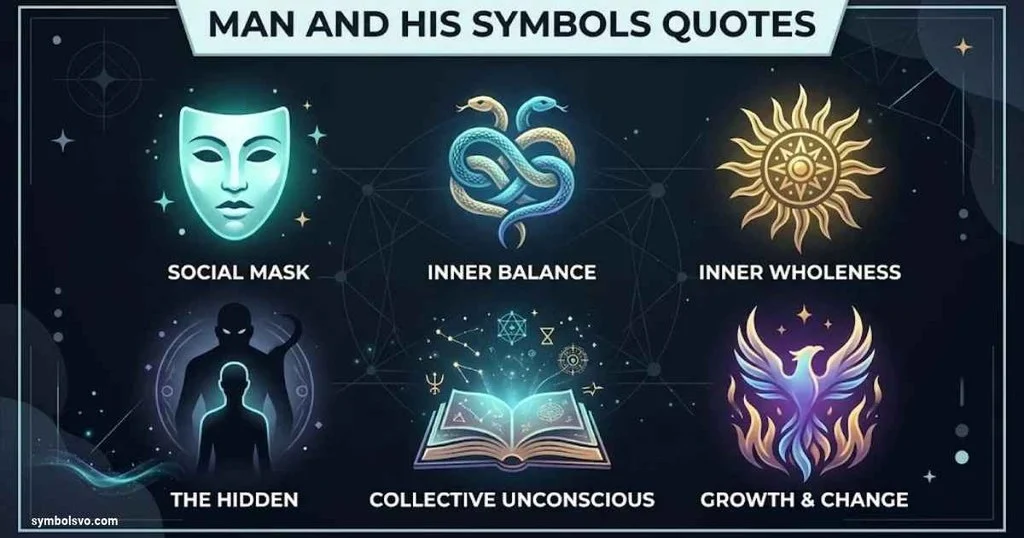
Man and His Symbols explores several powerful ideas about dreams, identity, the unconscious, and human development.
Many readers search for quotes from the book because its psychological ideas can encourage deeper thinking about everyday experiences.
Rather than treating a short quotation as a universal psychological rule, it is helpful to understand the ideas behind it.
Memorable Ideas From Man and His Symbols
Here are some original paraphrased reflections based on the book’s central themes:
- Dreams can reveal thoughts and feelings that remain outside ordinary awareness.
- Symbols often communicate ideas that are difficult to explain through words alone.
- Understanding yourself requires paying attention to both conscious and unconscious experiences.
- The same dream image may carry different meanings for different people.
- Ancient myths can help explain recurring patterns in human experience.
- Personal growth involves recognizing parts of yourself that you may prefer to ignore.
- Visual images can express emotions and psychological experiences.
- Self-understanding is a continuing process rather than a single achievement.
- The unconscious can influence behavior in ways people do not immediately recognize.
- Personal experiences provide important context when exploring dream symbols.
A Short Quote From the Book
One memorable distinction Jung makes when discussing symbolic language is:
A symbol is more than an ordinary sign.
This is a brief paraphrase of his explanation rather than a verbatim quotation.
What Can Readers Learn From These Ideas?
The book encourages readers to become more curious about their dreams and inner experiences.
Its central message is that understanding human psychology requires looking beyond what people say and do consciously. Personal memories, emotions, cultural stories, and symbolic images can all contribute to a deeper understanding of the mind.
These ideas make the book particularly interesting for people studying psychology, philosophy, literature, art, and human behavior.
Frequently Asked Questions
Is Man and His Symbols a Good Book for Beginners?
Yes. The book was developed to explain Jung’s psychological ideas to general readers. It introduces dreams, archetypes, symbolism, and individuation through explanations and illustrations. Some concepts can be challenging, but readers do not need an advanced psychology degree to begin.
Did Carl Jung Write the Entire Book Man and His Symbols?
No. Jung planned the book and wrote its opening chapter, Approaching the Unconscious. Four other principal contributions were written by Marie-Louise von Franz, Joseph L. Henderson, Aniela Jaffé, and Jolande Jacobi. John Freeman wrote the introduction.
What Is the Main Message of Man and His Symbols?
The central message is that symbols and dreams can reveal aspects of the unconscious mind. Jung believed that understanding these experiences could help individuals develop greater self-awareness and psychological wholeness.
Is Man and His Symbols Difficult to Read?
The writing is generally accessible to interested general readers, but some psychological concepts require careful attention. Reading one chapter at a time and reflecting on its examples can make the material easier to understand.
How Many Chapters Are in Man and His Symbols?
The book has an introduction by John Freeman and five principal sections written by Jung and his collaborators. These sections explore the unconscious, mythology, individuation, visual art, individual analysis, and science.
Conclusion
Man and His Symbols is a valuable introduction to Carl Jung’s psychological ideas, especially his work on dreams, archetypes, and the unconscious mind. Its chapters explore how symbols appear in personal experiences, ancient mythology, visual art, and everyday life. The contributions from Jung and his colleagues make the book a broad exploration of human psychology.
If you are planning to read it, choose an edition that suits your preferences. You can explore physical copies, check authorized EPUB and Kindle editions, or look for audiobook availability. Always compare the publisher, ISBN, illustrations, and page count before purchasing.
The most valuable lesson from this book is that understanding yourself involves looking beyond surface-level experiences. Dreams, emotions, memories, and symbols can encourage deeper reflection. If you enjoy psychology and want to explore the hidden dimensions of the human mind, Man and His Symbols is worth adding to your reading list.

I’m Nathan Holloway, a passionate researcher and writer with a deep interest in symbols, signs, and their hidden meanings. I enjoy exploring how symbols have influenced different civilizations, religions, and modern communication. Through my work, I aim to make complex historical and cultural concepts easy to understand for readers of all backgrounds. Every article I write is carefully researched to provide reliable and engaging information.
Books:
- Beyond the Symbol
- The Secret Meanings of Everyday Signs
Author 2: Grace Whitmore
Description:
My name is Grace Whitmore, and I love discovering the stories behind the world’s most fascinating symbols. I spend my time researching ancient civilizations, mythology, spiritual traditions, and modern iconography to uncover the meanings people often overlook. I believe that every symbol has a history worth telling, and I enjoy sharing that knowledge in a simple and reader-friendly way.
Books:
- Echoes of Ancient Symbols
- The Symbolic World
 Mason Ellington
 Daniel Brooks