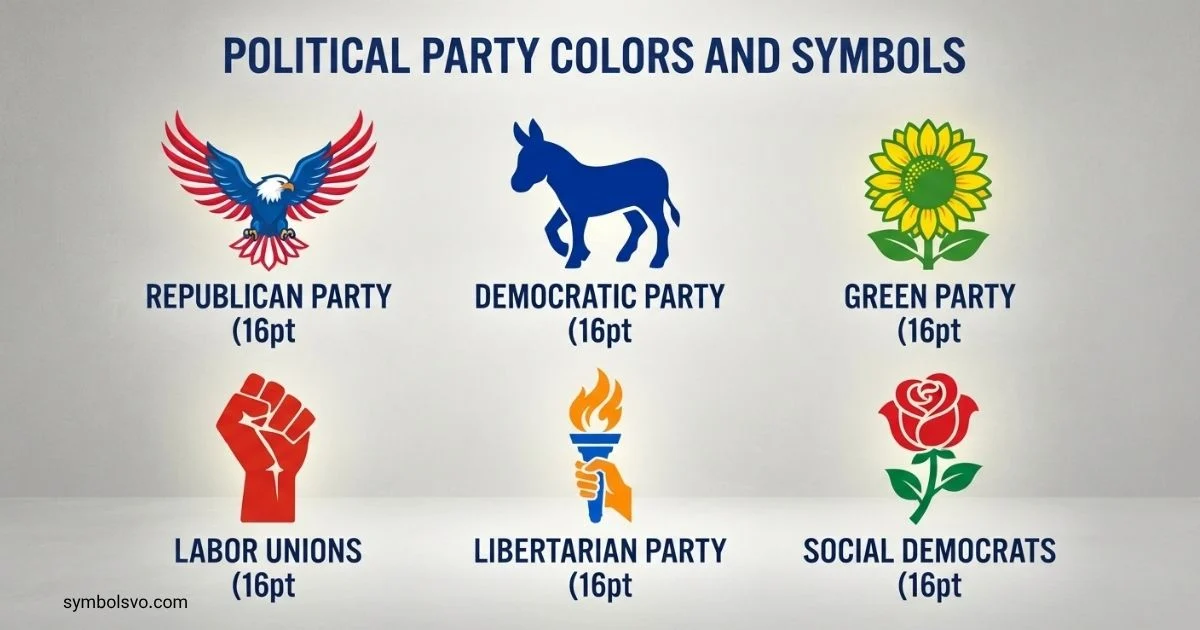
When you see a political party’s color or symbol, you may recognize it instantly—but have you ever wondered what it really represents? I’ll help you understand the meanings, history, and purpose behind these familiar political identifiers.
You may notice these colors and symbols on ballots, campaign materials, flags, signs, and digital media. They can make political parties easier to recognize and help communicate ideas, values, and identity at a glance.
In this guide, you’ll discover how political party colors and symbols are used, why they matter, and what different designs can represent. I’ll keep everything simple and practical so you can quickly understand the topic.
Quick Answer
Political party colors and symbols are distinct visual identifiers used by political organizations to communicate ideology, unite voters, and create immediate brand recognition. Rooted in war heraldry, labor movements, and psychological color associations, they compress complex political platforms into simple, emotionally charged visuals that build deep cultural and tribal loyalty.
Quick Facts About Political Party Colors and Symbols
| Aspect | Information |
| Origin | Ancient battlefield standards, medieval heraldry, and 19th-century worker movements. |
| Historical Significance | Turned abstract ideologies into clear visuals for illiterate populations during early elections. |
| Main Meaning | Visual shorthand for a party’s core values, beliefs, and vision for society. |
| Spiritual Meaning | Modern secular totems that satisfy the human need for community and shared ritual. |
| Cultural Importance | Shapes voting behavior, defines media maps, and inspires public art and protest fashion. |
| Modern Usage | Digital campaign logos, election broadcast maps, and viral social media identity badges. |
What Are Political Party Colors and Symbols?
Political party colors and symbols are specific colors, graphics, and emblems used to represent a political movement’s core beliefs. Their history dates back to ancient times, when armies carried carved wooden standards into battle. These early markers helped soldiers identify their allies through the thick dust of war. In the medieval period, noble families used heraldic shields and family crests to display their authority and allegiances.
As modern democracies grew in the 19th century, parties faced a major hurdle. Many eligible voters could not read or write. To solve this issue, parties created simple visual identifiers. For example, the British Labour Party chose a bright red banner to connect with working-class crowds.
Over time, television networks and digital media helped lock these visual identities in place. Today, a single color choice or simple logo tells voters exactly what a party stands for, turning a complex political platform into a quick, intuitive visual cue.
Deep Symbolic Meaning of Political Party Colors and Symbols
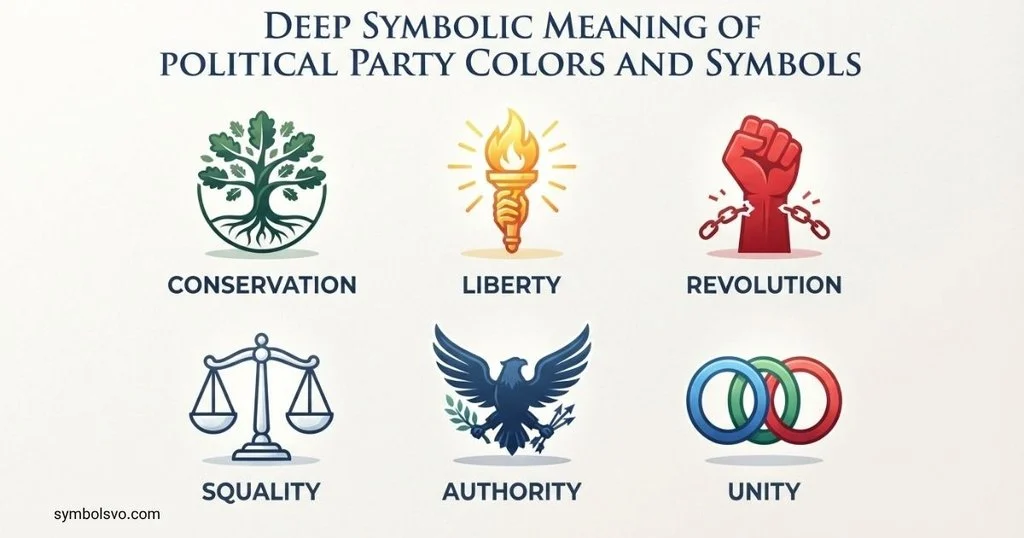
Spiritual Level
On a spiritual level, these images operate much like ancient sacred geometry or tribal totems. They trigger an inner transformation by allowing individuals to tie their personal moral values to a much larger cause. When a voter wears a specific color or pin, they are participating in a shared secular ritual. This connection helps fulfill a deep human longing to align individual consciousness with a supportive, like-minded community.
Psychological Level
These visuals run deeply into human archetypes and psychological color theories. Parties carefully select colors and emblems to tap into universal emotional triggers.
- Blue (The Ruler/Protector): Inspires a sense of calm, stability, and long-standing tradition.
- Red (The Rebel/Revolutionary): Triggers intense energy, passion, sacrifice, and immediate action.
- Green (The Caregiver/Nurturer): Speaks directly to themes of life, balance, renewal, and environmental care.
By relying on these deep-seated human reactions, a symbol creates a strong emotional attraction that sways voters long before they read an official policy guide.
Cultural Level
Culturally, these signs define our social groups and community beliefs. They serve as a quick visual language that signals a person’s worldview to their neighbors. For instance, displaying a political symbol on a lawn or bumper is a clear cultural statement. It shows exactly where a person stands on key social values, acting as a quiet handshake with some people while setting a clear boundary with others.
Types and Variations of Political Party Colors and Symbols
1. The Dynamic Animal
- Visual Description: Bold silhouettes or classic illustrations of animals like eagles, lions, or elephants.
- Meaning: Raw power, collective resilience, pride, and sharp instinct.
- Symbolism: Represents protective strength, historical roots, and an unyielding defense of values.
- Cultural Connection: Derived from ancient animal fables where specific beasts stood for key human traits.
- Where It Appears: Campaign posters, ballot papers, and editorial political cartoons.
2. The Plant or Flower
- Visual Description: Clean, stylized graphics of roses, carnations, or leafy trees.
- Meaning: Democratic growth, grassroots organizing, peace, and natural renewal.
- Symbolism: Represents a fresh start, caring for the working class, and deep community roots.
- Cultural Connection: Tied closely to historic worker strikes and legendary agricultural festivals.
- Where It Appears: European democratic logos, environmental campaign flyers, and protest buttons.
3. The Industrial Tool
- Visual Description: Simple drawings of hammers, sickles, torches, or scales of justice.
- Meaning: Hard labor, shared equality, bright progress, and fair balance.
- Symbolism: Represents the power of the working class and a focus on building a fair society.
- Cultural Connection: Born from the fast growth of industrial trade unions during the 20th century.
- Where It Appears: Traditional socialist banners, legal reform group logos, and national flags.
Political Party Colors and Symbols Across Different Cultures
Ancient Egypt
In royal Egyptian politics, colors carried immense state and spiritual weight. The pharaohs wore a double crown that combined the white color of Upper Egypt with the red color of Lower Egypt. This visual branding sent a clear message across the Nile valley, showing the complete unification of the state under one divine ruler.
Ancient Greece
During the early days of Athenian democracy, citizens used colored stones to cast their secret votes in public forums. A white stone meant total approval, while a black stone signaled a clear rejection. This simple color-coded system allowed a diverse group of citizens to make major state choices quickly and fairly.
Roman Culture
In the massive stadiums of ancient Rome, chariot racing groups were split into highly organized political factions named after vivid colors, such as the Blues and the Greens. These colors quickly became symbols for distinct social classes and political views. The color rivalries routinely caused massive street protests, proving that color loyalty could shake an empire.
Eastern Traditions
In classic Chinese culture and modern governance, colors carry heavy philosophical meanings. The color red is a traditional symbol of good luck, joy, and fire. Today, it remains the primary color of state authority, smoothly blending ancient cultural beliefs about energy and fortune with modern political ideals.
Indigenous Traditions
Many Native American tribal structures use the four distinct colors of the traditional medicine wheel, which are black, white, red, and yellow. These colors represent the four cardinal directions and key natural forces. This balanced visual system ensures that all tribal discussions and leadership choices remain deeply connected to the earth and ancestral wisdom.
Modern Interpretations
In our globalized world, colors can swap meanings surprisingly fast. For example, during the 2000 US presidential election, major television networks permanently assigned red to the Republican party and blue to the Democratic party on their maps. This event flipped the classic European setup, where red traditionally represents left-wing worker parties and blue belongs to conservative groups.
Similar Symbols and Their Meanings
It is incredibly useful to look at how political party colors and symbols compare to other global symbols.
| Symbol Type | Primary Purpose | Core Audience | Long-term Focus |
| Political Symbol | Guiding state policy and unity | Active citizens and voters | Shifts with societal changes |
| National Flag | Uniting a country under law | Every citizen within borders | Built to stay permanent |
| Corporate Logo | Promoting a commercial service | Global consumers and buyers | Changes with market trends |
A common misconception is that political symbols are just generic logos. In reality, a corporate logo aims to drive a consumer purchase, whereas a political symbol asks for something much deeper, which is your trust, your personal philosophy, and your vote to shape the future of a country.
Political Party Colors and Symbols in Mythology and Folklore
Political strategists have long borrowed imagery from ancient folklore to give their parties instant authority. For instance, the use of a majestic eagle or a fierce lion relies heavily on old myths about royal power and sky gods.
When a party adopts a mythological creature or a legendary sword as an emblem, they are tapping into centuries of storytelling. The audience feels a familiar wave of respect and awe. By connecting their modern campaigns to these ancient legends, politicians can make their new platforms feel like a natural, honorable continuation of a sacred cultural history.
Political Party Colors and Symbols in Art, Pop Culture, and Design
During the mid-20th century, bold political imagery jumped from street banners right into high-end art galleries. Activists and avant-garde designers used sharp geometric shapes and contrasting colors to craft unforgettable anti-war posters that permanently changed modern graphic design.
[ Battlefield Standard ] —> [ Heraldic Shield ] —> [ Modern Ballot Icon ]
In today’s pop culture, these symbols are regularly reimagined. They star in dystopian television shows, inspire streetwear fashion collections, and feature heavily in digital internet memes. When a political symbol goes viral as an online meme, its meaning can shift in hours, proving that modern pop culture can reinvent a traditional political image faster than any official campaign team.
Spiritual and Dream Meaning of Political Party Colors and Symbols
Because our subconscious minds process thoughts using universal metaphors, seeing political colors or symbols in your dreams rarely relates to everyday legislation. Instead, dreaming of a bright red political banner might point to hidden personal anger, an awakening passion, or a deep need to stand up for yourself in a difficult relationship.
On the other hand, seeing a calm blue party crest during sleep could represent a subconscious search for order, a need for mental peace, or a desire for a protective figure in your life. These vivid dreams serve as an inner mirror, showing how you handle power, authority, and control in your waking life.
Positive and Negative Meanings of Political Party Colors and Symbols
Every political sign holds a delicate balance of light and shadow, changing completely based on a person’s life experiences and historical perspective.
| Positive Meaning | Negative Meaning |
| Builds a deep sense of shared purpose. | Creates a harsh, us-versus-them division. |
| Simplifies complex ideas for easier voting. | Oversimplifies nuanced issues into slogans. |
| Sparks healthy civic pride and action. | Can blind people to a party’s real flaws. |
| Reminds a community of its finest history. | Can trigger painful historical memories. |
Why Humans Are Attracted to Political Party Colors and Symbols
Our deep psychological connection to these colors and markers is built right into human biology. The human brain is naturally wired for pattern recognition, always looking for fast ways to sort a complicated world into safe and unsafe categories.
We naturally crave a feeling of belonging to a supportive group. Because many traditional community hubs have faded over time, people use political colors as a fresh way to find their crowd. Walking into a crowded rally filled with your chosen color activates a strong sense of group safety, fulfilling a deep tribal instinct that has guided humanity for thousands of years.
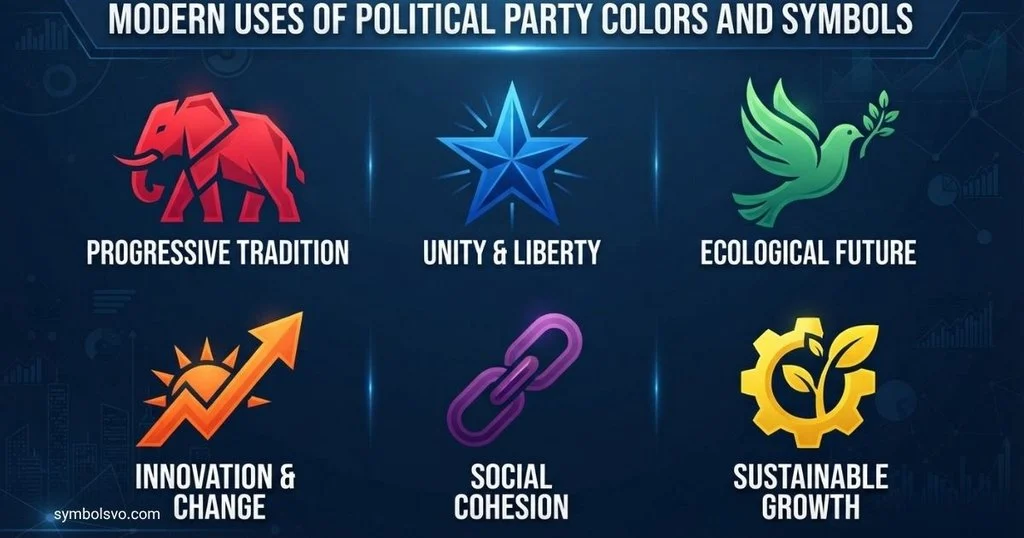
Modern Uses of Political Party Colors and Symbols
In our hyper-connected world, political branding has adapted to fit perfectly into every part of our lives.
- Digital Branding: Streamlined logos designed to look sharp as circular profile pictures on social media apps.
- Protest Fashion: Striking, single-color clothing items worn by thousands to create an undeniable visual wave during a march.
- Interactive Maps: Colorful, real-time election tracking graphics used by news networks on election night.
- Merchandise: Casual hats, pins, and coffee mugs that let voters turn their personal philosophy into an everyday lifestyle statement.
Interesting Facts About Political Party Colors and Symbols
- The famous American political donkey symbol was originally used by critics to mock Andrew Jackson, but he liked it so much he kept it for his campaign.
- The color pink is increasingly used by new global political movements to represent a modern, inclusive alternative to traditional red or blue.
- Many political party logos are deliberately designed using a specific shade of blue that scientific studies prove makes people feel safe and secure.
- The use of green by environmental parties worldwide is one of the few instances where a political color carries the exact same meaning across almost every continent.
- In some countries, it is strictly illegal to use specific historical or national symbols on political ballot papers to prevent unfair psychological influence.
Frequently Asked Questions
Why do political parties use specific animals as symbols?
Parties choose animals that represent positive traits like strength, intelligence, or hard work. These familiar creatures give the party a distinct personality that voters can easily remember and rally behind.
How do political colors affect voters psychologically?
Colors bypass our logical thinking and speak directly to our emotions. A bright color can make a voter feel energized and ready for a big change, while a dark, traditional color can make them feel safe and protected.
Why do political colors mean different things in different countries?
Color meanings are shaped by local history. While red represents conservative politics in the United States, it has stood for socialist worker movements across Europe and Asia for generations.
Can a political party change its symbol?
Yes, parties often update their symbols to appear fresh and modern. They might change a complex, old-fashioned drawing into a clean, minimalist logo to connect better with younger voters.
Conclusion
Political party colors and symbols are far more than simple decorations for election campaigns. They are the living expression of our timeless human need to communicate through shared visual stories. By connecting deep psychological triggers with our everyday civic choices, these vivid marks provide a sense of home, identity, and shared purpose in an incredibly complex world. The next time you see a campaign banner or an election map, take a moment to look past the surface, you are viewing a powerful visual language that has quietly shaped human history since the dawn of civilization.

 Grace Whitmore
 Daniel Brooks