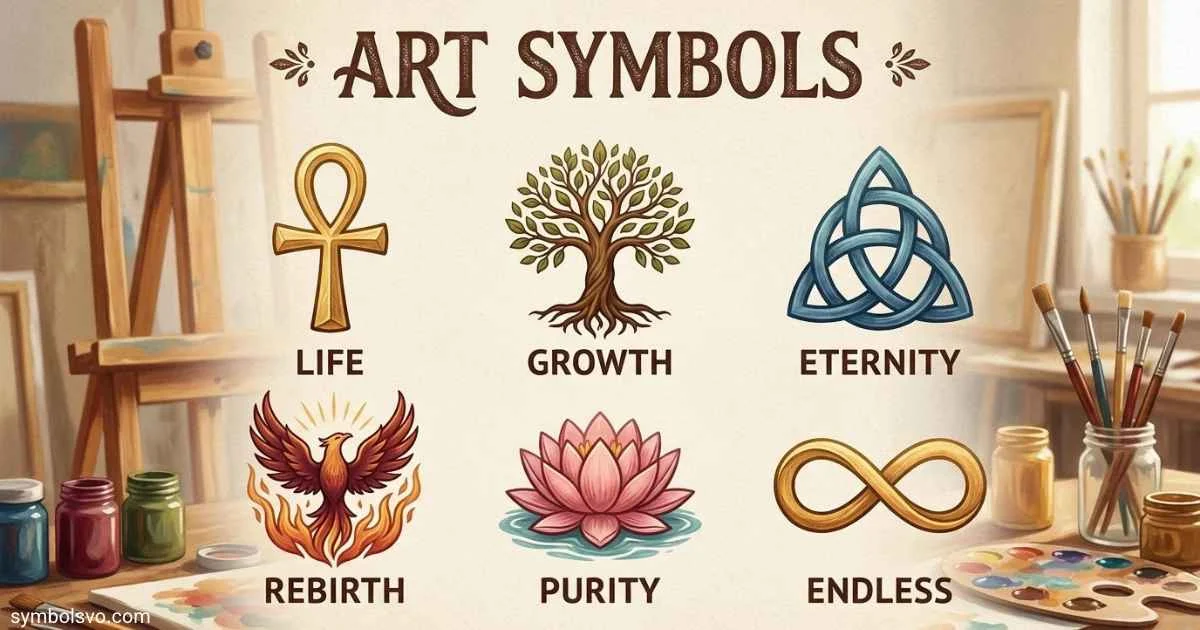
A skull on a table, a white dove in the sky, or a mirror beside a wealthy couple can tell a story that goes far beyond what you see. In art, everyday objects, animals, colors, and natural elements often carry deeper meanings shaped by religion, history, and culture.
Understanding art symbols helps you discover these hidden layers. A flower might suggest beauty or renewal, while an hourglass can remind viewers that time never stops. In religious paintings, a cross may express faith and redemption. In a modern artwork, a broken object might suggest loss, conflict, or a changing identity.
However, symbols rarely have just one meaning. The same snake can represent temptation in a Christian painting and healing in an ancient Greek context. Its meaning depends on the artist’s intentions, the surrounding imagery, and the period in which the artwork was created.
This guide explores art symbols and their meanings, from familiar religious images and animal symbolism to color meanings, vanitas paintings, and contemporary visual storytelling. You’ll also discover famous artworks that show how artists use symbols to communicate ideas without explaining everything in words.
What Is Symbolism in Art?
Symbolism in art is the use of images, objects, colors, animals, and other visual details to communicate ideas beyond their literal appearance. Instead of stating a message directly, an artist can express it through recognizable symbols and visual relationships.
For example, a painting of a wilting flower might suggest fading beauty or the passage of time. A dove carrying an olive branch can communicate peace and reconciliation. Meanwhile, a broken musical instrument might suggest discord or disruption when the surrounding composition supports that reading.
Artists use symbols for several reasons:
- To communicate beliefs: Religious paintings often include objects associated with sacred figures, spiritual teachings, and salvation.
- To express emotions: Dark skies, stormy seas, and damaged objects can help convey fear, grief, or uncertainty.
- To explore life’s big questions: Skulls, candles, and hourglasses remind viewers of mortality and the limits of earthly achievements.
- To comment on society: Modern artists may use consumer products, machines, or digital screens to explore power, technology, and human relationships.
- To tell stories visually: A small object can reveal information about a character, a historical event, or the central theme of an artwork.
Symbol, Motif, Allegory, and Visual Metaphor: What’s the Difference?
These terms overlap, but each describes a different way of creating meaning.
| Term | Meaning | Example |
| Symbol | An image associated with a particular idea | A skull representing mortality |
| Motif | A recurring image or design | Repeated flowers throughout a painting |
| Allegory | A work or scene that communicates an abstract idea through figures and events | A figure personifying Justice |
| Visual metaphor | An image that compares one idea with another | A cage suggesting a person’s lack of freedom |
A symbol doesn’t always have one fixed meaning. A snake may represent temptation in one artwork and healing in another. Context makes the difference.
Art Symbols and Their Meanings: Common Symbols in Paintings
The following common symbols in paintings offer a starting point for understanding visual storytelling. Each meaning reflects established associations in particular artistic or cultural traditions, not a universal rule that applies to every artwork.
Religious and Spiritual Symbols in Art
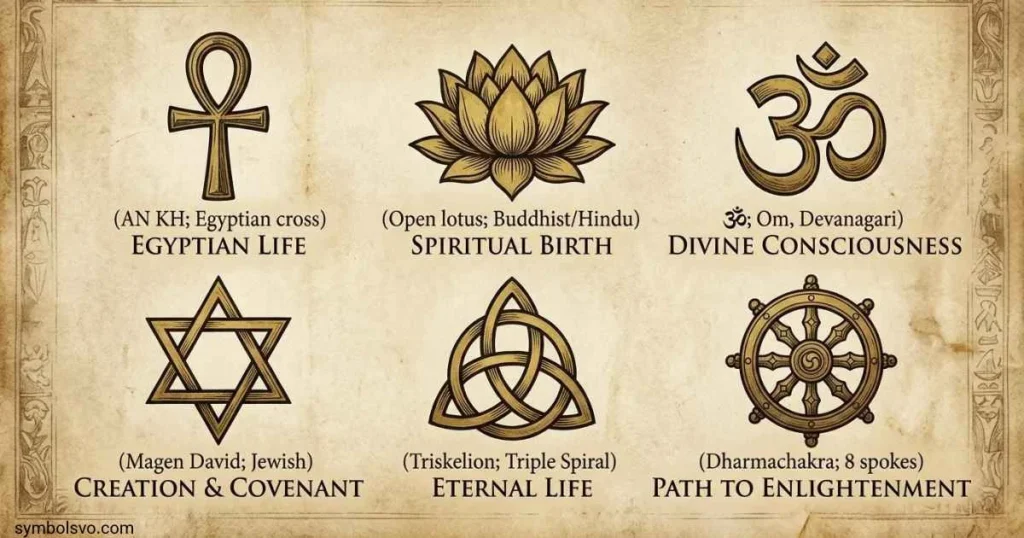
Religious imagery has shaped painting for centuries. Artists used recognizable symbols to communicate stories, identify sacred figures, and explore ideas that viewers might otherwise struggle to express visually.
The Cross: Faith, Sacrifice, and Redemption
The cross is one of the most recognizable religious symbols in art. In Christianity, it refers to the crucifixion of Jesus Christ and commonly represents sacrifice, redemption, faith, and the hope of salvation.
Its appearance can change its meaning within a scene. A cross held by a saint may identify that figure or recall a particular religious story. A cross in the background may establish the Christian setting or emphasize a theme of suffering and spiritual hope.
The cross also appears in different forms, including plain crosses, crucifixes showing Christ, and elaborate designs used in church decoration. These forms aren’t interchangeable in every historical or religious context.
The Lotus Flower: Purity and Enlightenment
The lotus flower carries important spiritual associations in Buddhist and Hindu art. Because it grows in muddy water yet produces a flower above the surface, it can suggest purity, spiritual growth, and the possibility of awakening.
In Buddhist imagery, lotus thrones often support Buddhas and bodhisattvas. The flower helps communicate their sacred status and spiritual significance.
In Hindu traditions, the lotus is associated with several deities, including Lakshmi and Brahma. Its meaning therefore extends beyond a general idea of beauty.
Key point: The lotus is not simply a symbol of purity. Its meaning depends on the deity, religious tradition, and visual setting.
The Dove: Peace and the Holy Spirit
A dove can represent peace, gentleness, purity, or a divine message. In Christian art, the bird is especially associated with the Holy Spirit, including depictions of the baptism of Jesus.
Doves also appear in biblical imagery connected with Noah’s flood. In that story, a dove returns with an olive leaf, signaling that the floodwaters have receded.
Outside religious settings, the dove has become a widely recognized emblem of peace. Its meaning can therefore range from a specific Christian reference to a broader appeal for reconciliation.
The Olive Branch: Peace and Reconciliation
The olive branch is another familiar symbol of peace. Its association with Noah’s flood gives it a prominent place in biblical visual storytelling.
Over time, the branch became a broader emblem of reconciliation, agreement, and the end of conflict. Artists and designers use it in religious scenes, civic imagery, and political representations.
When an olive branch appears beside a dove, the two symbols reinforce each other. However, an olive branch shown in an agricultural or domestic scene may simply describe the setting rather than communicate a deeper message.
Gold and Halos: Divine Light and Sacred Status
Gold has a long history in religious art. Byzantine mosaics and medieval Christian paintings often use gold backgrounds to create a radiant setting that differs from ordinary physical space.
The color can suggest sacred glory, divine light, wealth, or prestige. Its meaning depends on how the artist uses it.
A halo serves a more specific purpose. In Christian iconography, a halo often identifies a holy figure. Similar visual devices appear in other religious traditions, although their forms and meanings vary.
Gold and halos shouldn’t be treated as identical symbols. Gold is a material and color with several associations, while a halo usually marks spiritual status.
Symbols of Death, Time, and Impermanence
Some of the most powerful painting symbols remind viewers that life, beauty, wealth, and achievement don’t last forever. European artists explored these themes through skulls, clocks, extinguished candles, and fragile objects.
Two important terms help explain this tradition:
- Memento mori: Latin for “remember that you must die.”
- Vanitas: A tradition of art that reflects on mortality and the temporary nature of earthly possessions and pleasures.
The National Gallery in London discusses these ideas in its memento mori glossary.
The Skull: Mortality and the Meaning of Life
A skull is among the clearest symbols of death in art. In many European paintings, it reminds viewers that physical beauty, social position, and material success eventually come to an end.
During the Renaissance and Baroque periods, skulls appeared in portraits, devotional works, and still-life paintings. Their presence could encourage moral reflection rather than simply create a frightening scene.
In a vanitas painting, a skull may appear beside jewelry, books, musical instruments, or expensive objects. The contrast suggests that earthly achievements cannot defeat mortality.
However, skulls don’t always mean death. In some contemporary artworks, they can represent rebellion, danger, cultural identity, or a challenge to conventional ideas.
The Extinguished Candle: Life’s Fragility
A candle that has gone out can suggest death, fading vitality, or the end of a period of life. Its meaning becomes especially clear when it appears beside a skull or other vanitas symbols.
A burning candle can also communicate spiritual light, hope, remembrance, or the presence of life. An extinguished flame creates a contrast with these associations.
Consider the setting before interpreting the candle. In a religious scene, it might have a devotional meaning. In a vanitas still life, it may reinforce the idea that life is temporary.
Clocks and Watches: The Passage of Time
Clocks and watches often symbolize the passage of time. Their presence can draw attention to aging, mortality, deadlines, or the fleeting nature of human achievement.
In vanitas paintings, timekeeping devices remind viewers that life continues to move forward regardless of wealth or status.
A clock doesn’t automatically symbolize death, though. In a portrait, it may indicate the sitter’s interests, possessions, or social standing. In a modern artwork, it might explore routine, urgency, or the pressure of everyday life.
The Hourglass: Time Is Running Out
The hourglass makes the passage of time visible. As sand falls from the upper chamber to the lower one, the viewer sees a limited supply gradually disappear.
Artists have used hourglasses to represent mortality, transience, and the limits of human control. They sometimes appear alongside skulls, clocks, or decaying flowers to strengthen these themes.
The hourglass can also communicate patience or the need to wait. Its precise meaning depends on the scene.
Soap Bubbles: Beauty That Doesn’t Last
Soap bubbles are fragile, attractive, and short-lived. These qualities make them effective symbols of fleeting pleasure and the impermanence of life.
In European art, bubbles can appear in paintings that contrast youthful beauty with mortality. Their delicate surfaces suggest how quickly something impressive can disappear.
A bubble may also suggest playfulness or childhood when the artwork doesn’t emphasize death. Again, context determines the interpretation.
Animal Symbolism in Art
Animals offer artists a rich vocabulary of recognizable forms and cultural associations. A lion may communicate authority, while a butterfly suggests transformation. Yet animal symbolism often changes across religious traditions and historical periods.
The Lion: Courage, Strength, and Royalty
The lion frequently represents courage, strength, leadership, and royal authority. Its physical power made it a natural choice for rulers, heraldic designs, and monumental artworks.
Christian iconography gives the lion additional meanings. The Lion of Judah has biblical associations, while the winged lion is the traditional emblem of Saint Mark in Christian art.
A lion may also symbolize Christ in particular medieval traditions. Therefore, its interpretation depends on whether it appears in a royal portrait, religious narrative, coat of arms, or contemporary composition.
The Peacock: Beauty, Pride, and Immortality
The peacock’s elaborate feathers make it a striking symbol of beauty, display, and pride. In some traditions, its apparent splendor can suggest vanity or excessive concern with appearances.
Peacocks also have associations with immortality and renewal in certain historical Christian contexts. Other cultural traditions give the bird distinct meanings.
When a peacock appears in a painting, examine what surrounds it. Beside luxurious fabrics and jewelry, it might reinforce themes of wealth and display. In a religious setting, it may carry spiritual associations.
The Serpent: Temptation, Wisdom, and Healing
The snake is one of the most context-dependent visual symbols in art.
In Christian paintings, a serpent often recalls the Garden of Eden and the story of temptation. Its presence may connect a scene with disobedience, sin, or the loss of innocence.
Ancient Greek traditions offer another interpretation. The staff associated with Asclepius, the Greek god of medicine, features a single serpent winding around a staff. This emblem remains closely connected with medicine and healing.
A snake shedding its skin can also suggest renewal or transformation. These meanings coexist, but they belong to different stories and traditions.
The Butterfly: Transformation and Rebirth
The butterfly’s life cycle provides a natural image of change. Its movement from caterpillar to chrysalis to adult butterfly has made it a symbol of transformation, renewal, and personal growth.
In selected religious and historical contexts, butterflies have also been associated with the soul or resurrection. These meanings shouldn’t be applied automatically to every image of a butterfly.
In a still-life painting, the butterfly might emphasize the beauty and fragility of nature. In contemporary art, it may communicate a change in identity or a new stage of life.
Everyday Objects and Their Symbolic Meanings
Ordinary objects often reveal how people lived, what they valued, and how artists wanted viewers to understand a scene. A mirror, key, or book may function as a real object while carrying an additional symbolic role.
The Mirror: Truth, Vanity, and Self-Knowledge
Mirrors can suggest self-awareness, vanity, truth, or the difference between appearance and reality.
In allegorical paintings, a mirror may be associated with the examination of one’s character. In other works, it can draw attention to beauty, social status, or the act of looking itself.
Jan van Eyck’s The Arnolfini Portrait (1434) provides a famous example. Its convex mirror reflects the room and two figures in the doorway, extending the visible space beyond the main scene. The National Gallery’s catalog explores the mirror’s construction and the painting’s debated interpretations.
The mirror’s role is partly visual and partly interpretive. It demonstrates the artist’s technical skill, but claims about exactly what every object symbolizes remain open to discussion.
Keys: Access, Knowledge, and Authority
Keys open doors, secure possessions, and control access. These practical functions have given them several symbolic meanings, including authority, knowledge, responsibility, and permission.
In Christian iconography, keys are strongly associated with Saint Peter. They refer to his traditional role in connection with the keys of the kingdom of heaven.
In a secular painting, keys may suggest wealth, household authority, or control over a private space. The surrounding figures and objects help establish which reading fits best.
Books: Wisdom, Learning, and Faith
Books often symbolize knowledge, education, wisdom, and intellectual life. In religious paintings, they may refer to scripture, theological learning, or a sacred figure’s identity.
An open book may suggest active study or the sharing of knowledge. A closed book could simply indicate an object at rest, although a carefully constructed allegory might give it a more specific meaning.
In portraiture, a book can communicate the sitter’s education, profession, or social aspirations. Its contents and placement can matter as much as the object itself.
Broken Objects and Found Objects
Broken objects may suggest damage, disruption, loss, or fragmentation. A musical instrument with a broken string, for example, can reinforce a theme of discord when the surrounding scene supports that interpretation.
Hans Holbein the Younger’s The Ambassadors includes a lute with a broken string. The National Gallery connects the instrument and other objects with ideas of division and religious discord during a period of European upheaval.
Found objects work differently. In modern and contemporary art, artists may select an ordinary item and place it in a new setting. Its meaning can shift because the artist changes how viewers encounter it.
The object might invite questions about consumer culture, labor, identity, or the definition of art. However, not every broken or repurposed object carries an established symbolic message.
Color Symbolism in Art: What Do Colors Mean in Paintings?
Color can guide attention, create mood, and establish relationships between different parts of a composition. It can also carry historical or religious associations, especially when artists use particular colors to identify figures or communicate familiar ideas.
Still, color symbolism in art isn’t universal. Red may suggest love in one setting and danger in another. Blue may carry religious significance in a medieval painting while functioning mainly as a visual or emotional choice in a modern one.
Gold: Divinity, Wealth, and Sacred Radiance
Gold has long appeared in religious paintings, illuminated manuscripts, and decorative art. Its reflective surface creates a sense of brilliance that ordinary pigments cannot fully reproduce.
In Byzantine and medieval Christian art, gold backgrounds often distinguish sacred figures from everyday surroundings. Rather than representing a realistic sky or room, the background can suggest a heavenly or timeless setting.
Gold also represents wealth, prestige, and earthly power. In a royal portrait, it may emphasize status rather than spiritual devotion.
Red: Love, Passion, Sacrifice, and Danger
Red is visually powerful, making it useful for drawing attention to important figures and objects.
Common associations include:
- Love, romance, and desire.
- Passion and intense emotion.
- Blood, sacrifice, and martyrdom.
- Danger, violence, and warning.
- Authority and power.
In Christian paintings, red garments may refer to martyrdom or Christ’s Passion. In a portrait, red clothing may instead emphasize wealth, fashion, or status.
The subject matters more than the color alone. A red flower and a red battlefield don’t communicate the same message.
Blue: Devotion, Heavenly Associations, and Status
Blue carries important associations in many religious paintings. In Western Christian art, the Virgin Mary frequently appears wearing a blue mantle.
During parts of the medieval and Renaissance periods, artists used ultramarine, a pigment traditionally made from lapis lazuli. Its cost and visual richness made it a valued material for important commissions.
Blue can also suggest calmness, distance, or melancholy in other contexts. These associations aren’t fixed, and artists often use blue for compositional reasons rather than to communicate a specific symbolic message.
White: Purity, Innocence, and Light
White often represents purity, innocence, spiritual light, or holiness in Western religious art. White garments can help distinguish sacred figures or emphasize moments of revelation.
However, white doesn’t mean the same thing in every culture. In some societies, white has strong associations with mourning and funerary traditions.
When interpreting white clothing, flowers, or backgrounds, consider the artwork’s cultural setting. A universal definition would miss important differences.
Quick Reference: Meaning of Colors in Art
| Color | Common associations | Important context |
| Gold | Divinity, radiance, wealth, prestige | Religious backgrounds or displays of power |
| Red | Love, passion, sacrifice, danger | Subject, clothing, and surrounding imagery |
| Blue | Devotion, heavenly associations, calmness | Religious tradition, pigment, and period |
| White | Purity, innocence, light, mourning | Cultural and religious conventions |
| Black | Grief, authority, mystery, solemnity | Clothing, setting, and historical context |
| Green | Nature, renewal, fertility, hope | Landscape, religious imagery, or cultural meaning |
The table offers a starting point, not a universal color dictionary. Artists can use colors symbolically, emotionally, decoratively, or for several purposes at once.
Nature and Landscape Symbols in Art
Nature can communicate powerful ideas without including human figures or recognizable objects. Mountains, rivers, trees, and flowers often help establish a painting’s emotional tone while connecting its subject to broader themes.
Mountains: Permanence, Majesty, and Spiritual Elevation
Mountains can symbolize strength, permanence, majesty, or spiritual elevation. Their scale often makes people appear small, creating a sense of awe or humility.
In some Asian landscape traditions, mountains play an important role in representing the relationship between humanity and the natural world. Religious and spiritual interpretations may connect high places with sacred power or transcendence.
A mountain can also represent an obstacle that a figure must overcome. The meaning depends on how the artist presents the landscape and the people within it.
Water: Life, Purification, and Emotional Change
Water has many symbolic meanings in paintings because it can sustain life, cleanse, destroy, or separate people from their surroundings.
Calm water may support a feeling of peace, stillness, or reflection. Turbulent seas can suggest danger, instability, or a struggle against forces beyond human control.
Religious imagery adds further meanings. Water may connect with baptism, purification, renewal, or a story of deliverance.
In modern art, water can also explore memory, environmental change, or the relationship between humans and nature. These interpretations depend on the work rather than on water alone.
Trees: Life, Growth, and Interconnectedness
Trees frequently symbolize life, growth, longevity, and stability. Their roots, trunk, and branches provide a natural structure for exploring ideas about connection and continuity.
The Tree of Life is an especially important motif found across multiple religious and cultural traditions. Its meaning varies, but it often relates to life, creation, spiritual connection, or the relationship between different realms.
Other tree images can carry more specific meanings:
- A flowering tree may suggest renewal or fertility.
- A bare tree may evoke winter, loss, or dormancy.
- A broken trunk may suggest damage or vulnerability.
- A deeply rooted tree may suggest stability or continuity.
A dead tree doesn’t always represent death, just as a flowering tree doesn’t always represent rebirth. Look at the full composition before deciding what the artist intended.
Flowers and Fruit: Beauty, Abundance, and Transience
Flowers often communicate beauty, affection, growth, or the passing of time. Their meaning can become more specific when the artist uses a recognizable species with established cultural associations.
Fruit may represent abundance, fertility, temptation, or prosperity. In Christian paintings, particular fruits can refer to biblical narratives, although the interpretation should fit the specific scene.
Flowers and fruit also appear in vanitas still lifes. Fresh blossoms may contrast with wilting petals or decaying produce, reminding viewers that beauty and abundance are temporary.
Famous Examples of Symbolism in Art
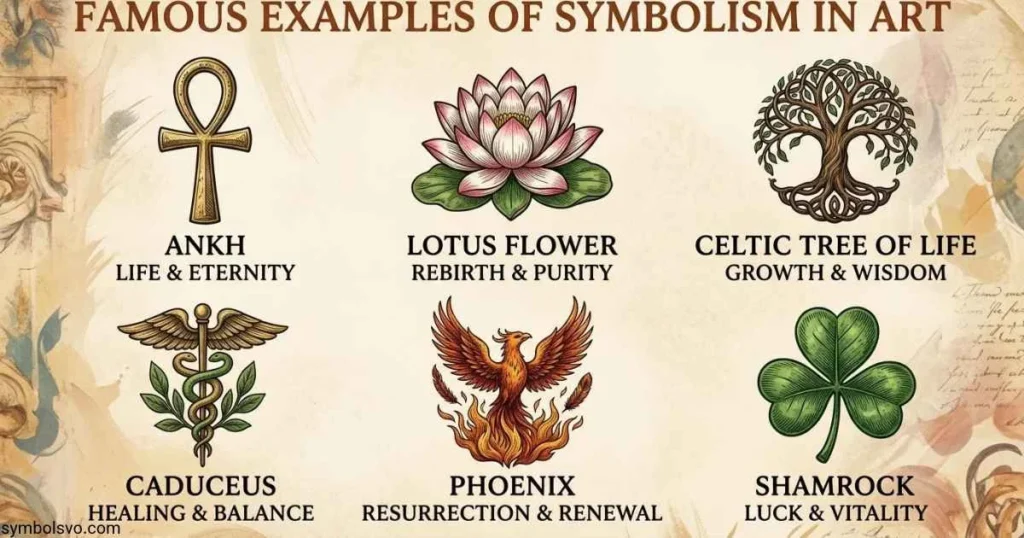
Studying real paintings makes art symbolism easier to understand. Instead of memorizing a list of definitions, you can see how objects, colors, and composition work together to create meaning.
The Arnolfini Portrait by Jan van Eyck
Jan van Eyck painted The Arnolfini Portrait in 1434. The work shows a richly dressed couple standing in an interior, surrounded by carefully rendered furniture and other objects.
The convex mirror on the back wall reflects the room from an unusual angle. It also reveals two figures in the doorway, extending the scene beyond the main pair.
The National Gallery identifies the couple as probably Giovanni di Nicolao di Arnolfini and his wife, while noting that several interpretations of the painting’s details have been debated.
What makes it important? The painting shows why symbolic interpretation requires caution. An object may have religious or cultural associations without proving that every detail represents a specific hidden event.
The Ambassadors by Hans Holbein the Younger
Hans Holbein the Younger painted The Ambassadors in 1533. The composition features two richly dressed men surrounded by scientific instruments, books, musical equipment, and other objects.
At first glance, the painting celebrates learning, wealth, and accomplishment. Yet several details complicate that impression.
A distorted shape across the foreground resolves into a skull when viewed from the correct angle. This technique, called anamorphosis, makes the skull a striking example of memento mori imagery.
The lute’s broken string adds another possible association with discord. A partially concealed crucifix appears in the upper-left corner, introducing a religious dimension to the scene. The National Gallery discusses these objects and their historical context in its catalog entry for the painting.
The painting’s power comes from the contrast between worldly accomplishment and human mortality. Its objects invite viewers to think about knowledge, faith, and the limits of human control.
Dutch Vanitas Still-Life Paintings
Seventeenth-century Dutch vanitas paintings often combine objects such as skulls, watches, books, musical instruments, candles, and flowers.
Each item contributes to a larger reflection on mortality and the temporary nature of earthly possessions. A watch suggests passing time, while a skull reminds viewers that death eventually overtakes everyone. Wilting flowers can reinforce the short life of beauty.
The combination matters. A single book might represent knowledge, but a book beside a skull and an extinguished candle can suggest the limits of human learning and achievement.
These paintings don’t necessarily condemn all material possessions. Instead, many invite viewers to consider how they balance worldly pleasures with spiritual or moral concerns.
Primavera by Sandro Botticelli
Sandro Botticelli’s Primavera, created in the late fifteenth century, brings together mythological figures in a richly detailed garden.
Flowers and plants play an important visual role, connecting the scene with spring, fertility, and renewal. The figures draw on classical mythology, showing how Renaissance artists adapted ancient stories for new audiences.
The painting has attracted several interpretations, and scholars continue to discuss its precise meaning. It is therefore better to treat it as a layered mythological composition than to assign one simple definition to every figure or flower.
Lesson for readers: A famous painting may contain established symbols and unresolved questions at the same time. Good interpretation recognizes both.
How to Interpret Symbols in a Painting
You don’t need to be an art historian to begin recognizing symbolic elements in artwork. A careful approach can help you distinguish plausible interpretations from guesses.
Start With the Main Subject and Objects
First, identify what the painting actually shows. Look for objects that appear unusually prominent, recur throughout the composition, or seem important to the central subject.
Ask yourself:
- Which objects attract my attention first?
- Are any objects unusual for the setting?
- Do certain images appear more than once?
- Are the objects connected to a known story or tradition?
Don’t assume every detail hides a message. Some objects simply establish a realistic setting or reveal the artist’s interest in observation.
Examine Colors, Light, and Composition
Next, notice how the artist directs your attention. Strong contrasts, bright colors, and unusual placement can make an object stand out.
Look at the relationship between light and darkness. A beam of light illuminating one figure may emphasize that person’s importance or create a dramatic effect. However, the effect doesn’t automatically prove a religious meaning.
Composition also matters. A skull placed prominently in the foreground may carry a different emphasis from one hidden in the corner of a portrait.
Research the Historical and Cultural Context
A symbol’s meaning often becomes clearer when you know when and where the artist worked.
Check the artist’s background, the date of the work, its original purpose, and the beliefs common in that setting. Museum catalogs and scholarly publications can help establish which interpretations have historical support.
For example, a lion in a medieval Christian painting may have an iconographic meaning that differs from a lion in a modern political poster.
Look at How Symbols Work Together
A painting often communicates through relationships between objects rather than isolated definitions.
Imagine a still life containing a skull, a watch, a fading flower, and a burning candle. Together, these objects may suggest mortality and the passage of time. Separately, each could have a different purpose.
This is why symbolic interpretation of art should begin with the whole composition. The relationships between details often matter more than any single object.
Separate Evidence From Personal Interpretation
Personal responses can enrich your experience of art, but they aren’t the same as documented historical meanings.
A painting may remind you of a particular memory or emotion. That’s a valid response. However, claiming that the artist deliberately included an object to express that emotion requires additional evidence.
A reliable interpretation distinguishes among:
- Documented meaning: Supported by historical records, established iconography, or strong scholarly evidence.
- Plausible interpretation: Consistent with the artwork and its context but not definitively established.
- Personal response: The meaning or feeling an individual viewer draws from the work.
Keeping these categories separate makes your interpretation more thoughtful and accurate.
Why Art Symbols Have Different Meanings Across Cultures
One of the most important things to remember about art symbols and their meanings is that cultures don’t always interpret the same image in the same way.
Religious beliefs, historical events, local customs, and artistic traditions shape how people understand visual imagery. A symbol that seems familiar today may have carried a more specific meaning when an artist first used it.
Consider three examples:
- The lotus flower: It has important spiritual associations in Buddhist and Hindu traditions, but its meaning varies between religious contexts.
- The serpent: It can represent temptation in Christian imagery and healing in the ancient Greek tradition associated with Asclepius.
- White: It may suggest purity or spiritual light in one setting and mourning in another.
Historical context also matters. A color that was expensive to produce could communicate wealth or importance in one period. A similar color choice today may reflect personal taste or a deliberate reference to older art.
When interpreting a painting, ask three questions: What does the symbol mean in this culture? What did it mean when the artist created the work? How does it relate to the rest of the composition?
These questions help prevent a common mistake: assuming that every symbol has one universal definition.
Symbolism in Modern and Contemporary Art
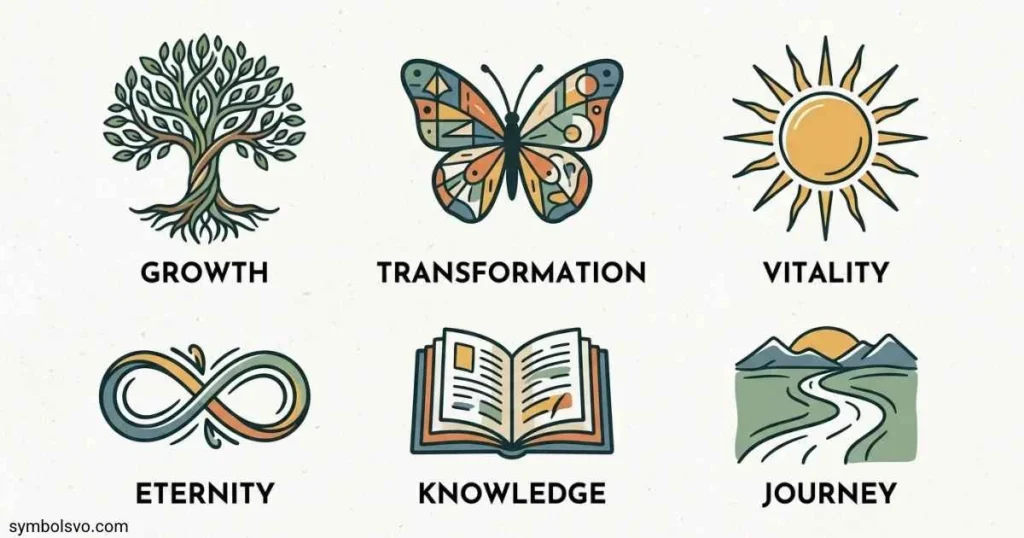
Modern and contemporary artists continue to use visual symbols to explore identity, technology, politics, memory, and everyday life. However, their approach can differ from the more established symbolism found in historical religious paintings.
Some artists draw on familiar symbols. Others invent personal imagery or use ordinary objects in unexpected ways.
Personal and Psychological Symbols
Artists often use recurring images to explore memory, relationships, identity, and emotion. A particular room, photograph, or object may carry personal significance that isn’t immediately obvious to viewers.
Unlike traditional Christian iconography, personal symbolism may not have a widely recognized definition. Understanding it may require knowledge of the artist’s statements, biography, or other works.
This doesn’t mean viewers can’t interpret the imagery themselves. It means their interpretations should remain open to other possibilities.
Found Objects and Everyday Materials
An ordinary object can acquire new meaning when an artist removes it from its usual setting and presents it as art.
For example, a discarded household item might prompt questions about consumer culture, waste, or the value society places on everyday things. The object itself hasn’t necessarily changed, but the context in which viewers encounter it has.
Found-object art therefore demonstrates how meaning can emerge from selection, placement, and presentation. The artist doesn’t always need to transform an object physically to change how people understand it.
Technology and Digital Symbols
Phones, screens, cameras, and digital interfaces increasingly appear in contemporary artworks. Depending on the context, these objects may explore communication, surveillance, social connection, or isolation.
A smartphone in a painting might suggest constant connection. In another work, the same object could emphasize distraction or distance between people sharing a room.
Technology doesn’t automatically symbolize alienation or surveillance. Artists may celebrate its possibilities, criticize its effects, or explore both sides at once.
Political and Social Symbolism
Artists also use recognizable imagery to comment on power, inequality, conflict, identity, and environmental concerns.
A broken object might represent social disruption in a particular artwork. A repeated corporate logo might question consumer culture. A national flag may communicate belonging, protest, or competing political ideas.
These interpretations depend on the artwork’s subject and historical setting. The strongest analysis connects the proposed meaning to visible details and reliable evidence.
Symbolism Across Different Art Movements
Different artistic traditions developed distinctive ways of using symbols. The following table highlights broad patterns without suggesting that every work from a movement follows the same rules.
| Art movement or tradition | Common symbolic themes |
| Byzantine art | Sacred figures, halos, gold backgrounds, divine authority |
| Medieval Christian art | Biblical stories, saints, salvation, moral instruction |
| Renaissance art | Classical mythology, Christian iconography, humanism, allegory |
| Baroque art | Dramatic religious narratives, mortality, light and darkness |
| Dutch Golden Age | Vanitas imagery, domestic life, material wealth, mortality |
| Modern art | Abstraction, individual expression, social change, psychological themes |
| Contemporary art | Identity, technology, politics, consumer culture, environmental concerns |
These categories overlap. Renaissance artists, for example, explored religious themes alongside classical mythology. Contemporary artists also continue to reinterpret traditional symbols rather than abandoning them.
Understanding an artwork’s movement gives you useful background, but the painting itself should always guide your interpretation.
Art Symbols and Their Meanings: Quick Reference Guide
Use this table to look up common art symbols and their typical associations. The meanings are starting points, not fixed rules.
| Art symbol | Common symbolic meanings |
| Cross | Christianity, sacrifice, redemption |
| Lotus flower | Purity, enlightenment, spiritual growth |
| Dove | Peace, Holy Spirit, purity |
| Olive branch | Peace, reconciliation |
| Skull | Mortality, death, impermanence |
| Extinguished candle | Death, fading vitality |
| Clock | Passing time, life’s brevity |
| Watch | Time, impermanence |
| Hourglass | Mortality, passage of time |
| Soap bubbles | Fragility, fleeting pleasure |
| Lion | Courage, strength, royalty |
| Peacock | Beauty, pride, immortality in selected traditions |
| Serpent | Temptation, wisdom, healing |
| Butterfly | Transformation, rebirth |
| Mirror | Self-knowledge, vanity, truth |
| Keys | Access, authority, knowledge |
| Books | Learning, wisdom, religious knowledge |
| Gold | Divinity, radiance, wealth |
| Red | Love, passion, sacrifice, danger |
| Blue | Devotion, heavenly associations, status |
| White | Purity, innocence, light, mourning in some cultures |
| Mountains | Majesty, permanence, spiritual elevation |
| Water | Life, purification, renewal, danger |
| Trees | Growth, longevity, interconnectedness |
| Flowers | Beauty, renewal, affection, transience |
| Fruit | Abundance, fertility, temptation, prosperity |
| Halos | Holiness, sacred status |
| Chains | Bondage, oppression, release |
| Scales | Justice, balance, judgment |
| Crown | Royalty, authority, power |
| Anchor | Hope, stability, steadfastness |
| Ship | Journey, exploration, life’s passage |
| Broken objects | Disruption, loss, fragmentation when supported by context |
| Found objects | Repurposing, context-dependent meaning |
| Lute with a broken string | Discord or disruption in relevant historical contexts |
| Tree of Life | Life, creation, spiritual connection in various traditions |
Frequently Asked Questions About Art Symbols
What are the most common symbols in art?
Common symbols include the cross, dove, skull, hourglass, lion, butterfly, mirror, key, book, and lotus flower. Colors such as red, blue, white, and gold also carry symbolic associations in many artistic traditions.
Their meanings depend on cultural and historical context.
What is the purpose of symbolism in art?
Artists use symbolism to communicate ideas, emotions, beliefs, and social messages through visual details. A single object can add meaning to a painting without requiring a written explanation.
Symbols can also connect an artwork to a religious tradition, historical event, or familiar story.
What do symbols in paintings mean?
Symbols in paintings can represent religious beliefs, human emotions, mortality, knowledge, authority, or natural cycles. For example, a skull often represents mortality in European vanitas art, while a lotus can communicate spiritual growth in Buddhist and Hindu traditions.
The meaning depends on the image, its cultural setting, and the artist’s choices.
What colors symbolize different emotions in art?
Red is often associated with passion or danger, while blue may suggest calmness or carry religious associations. White can represent purity or mourning, and gold may communicate sacred radiance or wealth.
These associations vary across cultures and periods. Artists also use colors for visual balance and emotional effect without assigning them a specific symbolic meaning.
What symbols represent life and death in art?
Trees, flowers, and certain religious images may represent life, growth, or renewal. Skulls, extinguished candles, hourglasses, and decaying flowers often communicate mortality and the temporary nature of life.
In vanitas paintings, artists frequently combine several of these images to encourage reflection on earthly achievements and human mortality.
What is the difference between a symbol and a visual metaphor?
A symbol is an image associated with an idea, such as a skull representing mortality. A visual metaphor compares one thing with another, such as a cage suggesting a lack of freedom.
The two can overlap. A cage can function as a symbol of imprisonment while also serving as a visual metaphor for emotional or social restriction.
How can you identify hidden symbols in a painting?
Start by examining the main subject, unusual objects, colors, and repeated details. Then research the artist, historical period, and cultural traditions connected with the work.
Compare your interpretation with museum catalogs or scholarly sources. Avoid assuming that every object has a hidden meaning, especially when the evidence is uncertain.
Why do artists use animals as symbols?
Animals offer recognizable qualities that artists can connect with broader ideas. Lions often suggest strength or authority, while butterflies can represent transformation. Snakes have associations with temptation, healing, and renewal in different traditions.
The surrounding imagery determines which interpretation makes the most sense.
Conclusion: Understanding the Language of Art Symbols
Art symbols help artists communicate ideas that go beyond the visible subject of a painting. A skull can prompt reflection on mortality, a dove can suggest peace, and a mirror can raise questions about truth or self-knowledge.
Yet symbols rarely work in isolation. Their meanings emerge from the relationship between objects, colors, composition, cultural traditions, and historical circumstances.
When you look at a painting, take time to notice the details. Ask why the artist included a particular object, how it relates to the other elements, and whether historical evidence supports your interpretation.
The goal isn’t to find a secret message in every corner. It’s to understand how visual choices shape meaning. Once you recognize the symbolic language of art, familiar paintings can reveal new stories, cultural ideas, and perspectives on human life.

I’m Daniel Brooks, a content creator and symbol enthusiast dedicated to researching the fascinating world of signs and symbols. I enjoy discovering the hidden meanings behind famous icons, emojis, historical emblems, and cultural symbols. Through my writing, I aim to provide trustworthy, well-researched, and reader-friendly information that helps people learn something new with every visit.
Books:
- The Complete Guide to World Symbols
- The Power of Universal Signs
 Nathan Holloway
 Mason Ellington