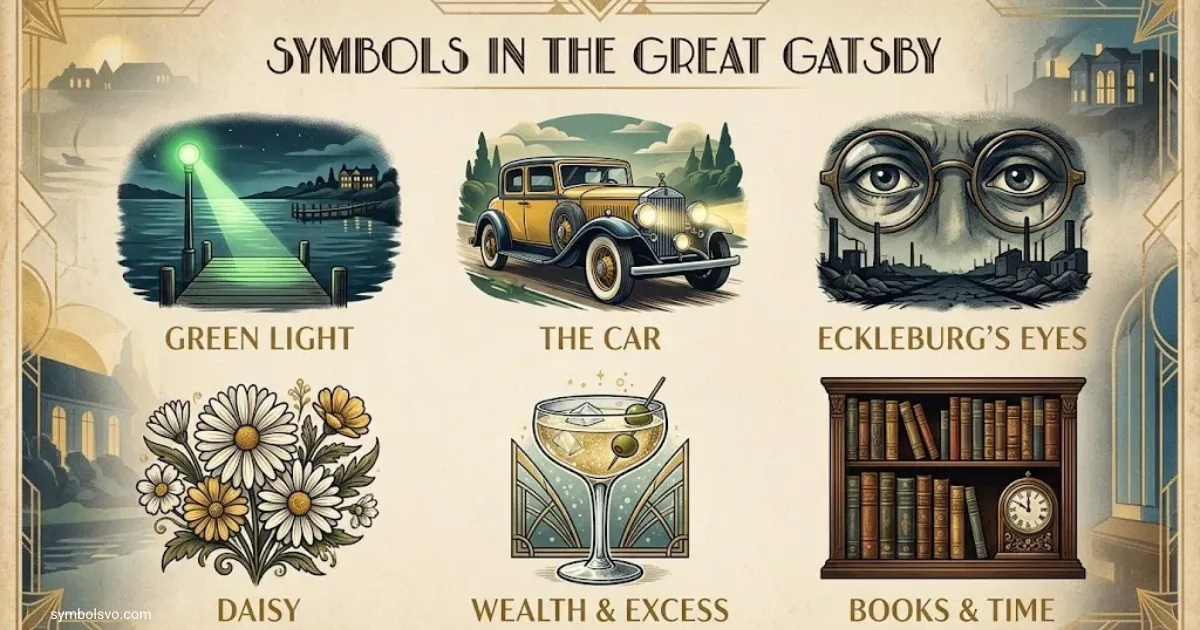
F. Scott Fitzgerald’s The Great Gatsby is more than a story about wealth, romance, and extravagant parties. Beneath its glamorous surface lies a sharp examination of ambition, social class, moral responsibility, and the American Dream. Through carefully chosen objects, colors, settings, and recurring images, Fitzgerald reveals what his characters want and what their world refuses to give them.
The symbols in The Great Gatsby help readers understand these deeper ideas. A distant green light represents more than a lamp across the water. A lavish mansion reveals more than financial success. Even a seemingly ordinary clock becomes meaningful when Gatsby tries to reconnect with the woman he has spent years idealizing.
Understanding symbolism in The Great Gatsby makes the novel’s characters and conflicts easier to interpret. It also explains why Fitzgerald’s story remains relevant: the desire for wealth, love, recognition, and a better future can inspire people while blinding them to reality.
This guide explores 15 major symbols, their meanings, the scenes in which they appear, and their connections to the novel’s central themes.
What Is Symbolism in The Great Gatsby?
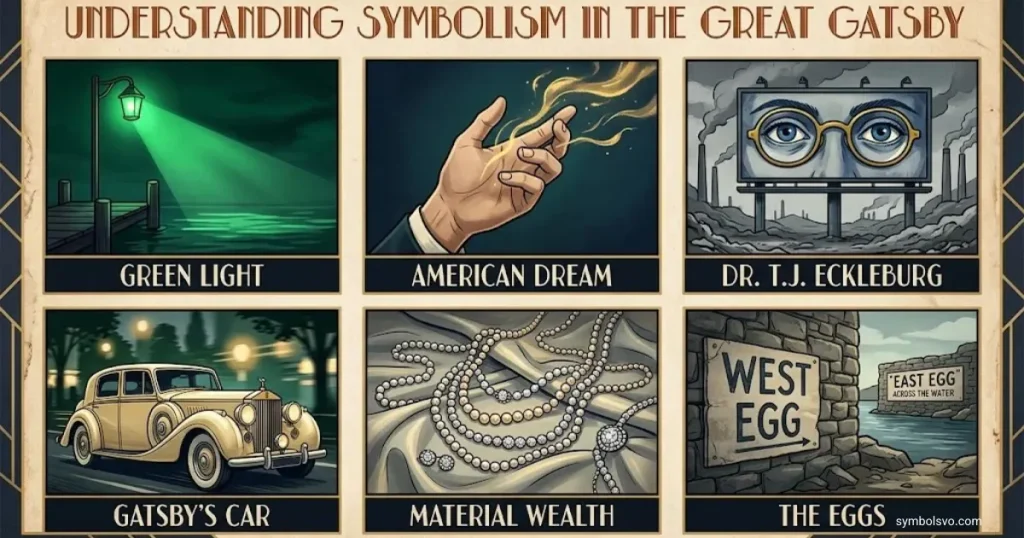
Literary symbolism occurs when a concrete object, place, color, or action represents an idea beyond its literal meaning. Writers use symbols to express complicated emotions and themes without explaining everything directly.
In The Great Gatsby, Fitzgerald uses symbolism to explore the gap between what people desire and what they actually achieve. His characters live among expensive homes, fashionable clothes, automobiles, and lavish parties. Yet their material comfort often hides loneliness, insecurity, dishonesty, and unequal social power.
For example, Gatsby’s mansion demonstrates his enormous wealth. However, it also reveals his determination to create a new identity and win Daisy Buchanan’s affection. The house represents both his apparent success and the emotional goal that money cannot guarantee.
Three literary concepts help explain Fitzgerald’s approach:
- Symbol: An object or image that carries a deeper meaning. The green light is one of the novel’s most recognizable examples.
- Motif: A recurring image or idea that develops throughout a story. Fitzgerald repeatedly uses color, wealth, distance, and time to reinforce his themes.
- Theme: A broader idea that a literary work explores. The American Dream, social inequality, and the conflict between illusion and reality are major themes in the novel.
These concepts often overlap. A symbol may become a motif when it appears repeatedly, and both can help develop a theme.
Fitzgerald does not give every symbol one fixed meaning. The significance of an image often depends on the scene, the character observing it, and the events surrounding it. That ambiguity makes the novel richer than a simple list of objects and definitions.
The Major Symbols in The Great Gatsby and Their Meanings
The following symbols reveal how Fitzgerald connects personal desires with the larger problems of his society. Some represent Gatsby’s private hopes, while others expose the inequality and carelessness surrounding him.
| Symbol | Main meaning | Related theme |
| Green light | Hope and unattainable desire | American Dream |
| Doctor T. J. Eckleburg’s eyes | Judgment and moral uncertainty | Spiritual emptiness |
| Valley of Ashes | Poverty and industrial neglect | Social inequality |
| East Egg and West Egg | Inherited and newly acquired wealth | Class division |
| Gatsby’s mansion | Reinvention and material success | Identity |
| Yellow car | Wealth and destructive carelessness | Responsibility |
| Clock | Time and the desire to repeat the past | Memory |
| Daisy’s voice | Wealth and privilege | Social status |
| Gatsby’s parties | Excess and superficial popularity | Loneliness |
| Shirts and clothing | Wealth and constructed identity | Materialism |
| White imagery | Elegance and apparent innocence | Appearance vs. reality |
| Gold and yellow | Luxury and conspicuous display | Wealth and corruption |
| Gray imagery | Neglect and lifelessness | Industrial decay |
| Water and distance | Separation and longing | Unattainable love |
| Owl-Eyed Man and library | Authenticity and appearances | Identity and deception |
The Green Light: Hope, Desire, and the American Dream
The green light in The Great Gatsby is arguably the novel’s most important symbol. It shines from the end of Daisy Buchanan’s dock across the water from Gatsby’s mansion. Although it appears to be an ordinary navigational light, Gatsby gives it extraordinary meaning.
In Chapter 1, Nick Carraway sees Gatsby standing alone outside his mansion, reaching toward a distant light. At this point, Nick doesn’t understand what Gatsby wants. The scene creates a sense of mystery around Gatsby’s ambitions.
Later, readers learn that the light marks the location of Daisy’s home. Gatsby has built his life around the hope of reuniting with her and recovering the happiness he believes they once shared.
The light also represents the American Dream. Gatsby believes that effort, money, and determination can help him achieve an ideal future. However, he doesn’t simply want a relationship with Daisy as she exists in the present. He wants her to fulfill the perfect vision he has carried for years.
Their reunion in Chapter 5 changes the symbol’s meaning. Once Daisy stands beside him, the light loses some of its mystery. Gatsby can finally see the person and place he once viewed from a distance. Yet reality cannot match the dream he has constructed.
By Chapter 9, Nick connects the green light to humanity’s continuing pursuit of a future that always seems just beyond reach. The symbol therefore moves beyond Gatsby’s personal romance to express the persistent attraction of hope.
What the green light represents:
- Hope for a better future.
- Gatsby’s longing for Daisy.
- Ambition and the pursuit of success.
- The distance between dreams and reality.
- The promise and limitations of the American Dream.
As SparkNotes’ analysis of the green light explains, the symbol connects Gatsby’s love for Daisy with money and broader American aspirations. Its power comes from the way these desires overlap.
The Eyes of Doctor T. J. Eckleburg: Judgment and Moral Uncertainty
Main appearance: Chapters 2, 7, and 8
The enormous eyes of Doctor T. J. Eckleburg appear on a faded billboard overlooking the Valley of Ashes. They belong to an advertisement for an eye doctor whose business has apparently disappeared. Nevertheless, the painted eyes remain above the industrial wasteland.
Their presence creates an unsettling contrast. The eyes seem to watch the people passing beneath them, but they belong to an abandoned commercial advertisement rather than an actual observer.
This distinction matters because Fitzgerald never directly confirms that the eyes represent God. Instead, George Wilson eventually interprets them as the eyes of God while struggling to understand the events surrounding Myrtle’s death.
For Wilson, the billboard provides an apparent source of judgment in a world where people seem to escape responsibility. His interpretation reveals his desperation as much as it reveals the symbol itself.
The eyes can suggest several connected ideas:
- Moral judgment: The impression that wrongdoing is being observed.
- Spiritual emptiness: The absence of a clear, dependable moral authority.
- Commercial decay: An advertisement that remains after its original purpose has vanished.
- Ambiguity: The difference between what an object is and what people believe it means.
The billboard’s location strengthens its significance. It overlooks the Valley of Ashes, where industrial waste and economic hardship contrast with the luxurious lives of wealthy characters.
Fitzgerald leaves the symbol unresolved. That uncertainty reflects a society in which people search for moral meaning while continuing to act selfishly.
The Valley of Ashes: Poverty, Inequality, and Industrial Decay
Main appearance: Chapters 2, 7, and 8
The Valley of Ashes in The Great Gatsby is a bleak industrial landscape between West Egg and New York City. Gray ash covers the surroundings, creating a sharp contrast with the bright houses and extravagant lifestyles of the wealthy.
The valley is not merely an unpleasant place characters travel through. It represents the people and conditions hidden beneath the surface of economic prosperity.
George Wilson operates a struggling garage there, while his wife, Myrtle, dreams of escaping her circumstances. Their lives contrast with those of Tom and Daisy Buchanan, who enjoy wealth, comfort, and social protection.
This contrast reveals a central problem in the novel: prosperity does not benefit everyone equally. The wealthy enjoy luxury while poorer people live amid the waste produced by the industrial world.
The ashes also suggest moral decay. Characters such as Tom and Daisy pursue their desires without fully considering the damage they cause. Meanwhile, people with fewer resources bear the consequences of their decisions.
The valley therefore represents:
- Poverty and economic inequality.
- Industrial waste and environmental degradation.
- The social costs of wealth and consumption.
- Neglect of people outside the wealthy elite.
- The moral emptiness beneath the Jazz Age’s glamour.
The setting also gives the novel a physical image of social division. Readers can see the distance between the lives of the rich and those struggling to survive.
For a deeper interpretation, see SparkNotes’ guide to the novel’s symbols.
East Egg and West Egg: Old Money vs. New Money
Main appearance: Chapters 1, 3, and 6
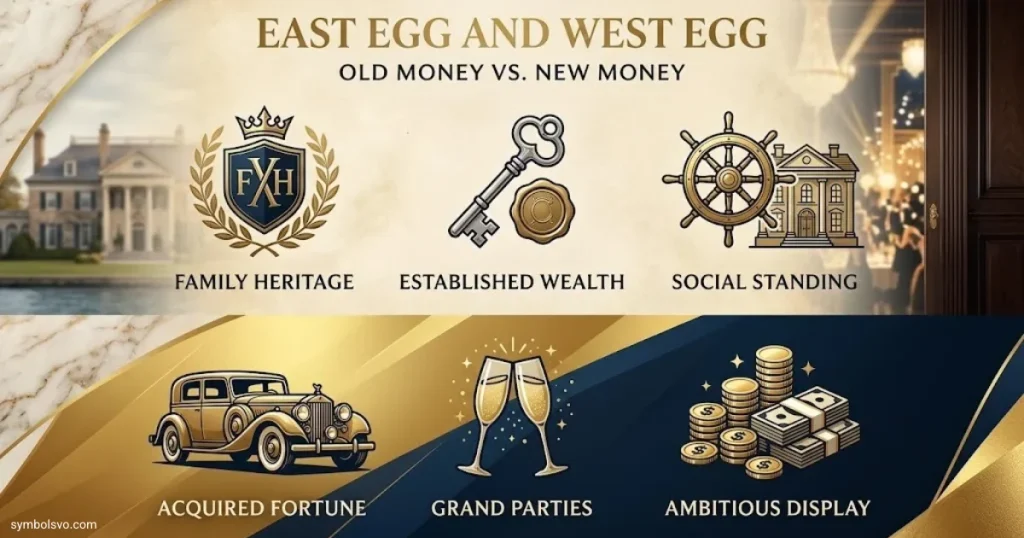
East Egg and West Egg are fictional communities on Long Island, but their differences represent more than geography. They establish the social hierarchy that shapes Gatsby’s ambitions.
East Egg represents old money, or wealth inherited across generations. Tom and Daisy Buchanan live there. Their financial security comes with established connections, social standing, and a sense of entitlement.
West Egg represents new money, or recently acquired wealth. Gatsby lives there, surrounded by luxury he has obtained through his own efforts and questionable business dealings. Although he possesses enormous wealth, he lacks the social acceptance enjoyed by families such as the Buchanans.
| Feature | East Egg | West Egg |
| Associated wealth | Inherited wealth | Newly acquired wealth |
| Main association | Tradition and privilege | Ambition and reinvention |
| Representative characters | Tom and Daisy Buchanan | Jay Gatsby |
| Social position | Established elite | Wealthy outsiders |
| Symbolic tension | Entitlement | Desire for acceptance |
The distinction reveals why Gatsby’s fortune cannot solve every problem. He can purchase an impressive mansion, expensive clothes, and a glamorous lifestyle. Yet he cannot easily purchase the history and social legitimacy that East Egg represents.
His pursuit of Daisy is therefore connected to more than romantic love. Winning her would appear to confirm that he has entered the world he admires.
However, Fitzgerald exposes the limits of social mobility. Gatsby’s wealth brings him close to the elite, but it doesn’t erase the class boundaries that separate him from Daisy’s world.
Gatsby’s Mansion: Wealth, Reinvention, and Materialism
Main appearance: Chapters 1, 3, 5, and 9
Gatsby’s mansion represents the remarkable financial success he wants everyone to see. Its size, furnishings, and grounds establish him as a wealthy man who can compete with the elite.
Yet the house has a deeper purpose. Gatsby purchased his mansion partly because it stands across the water from Daisy’s home. Its location turns a property into a physical expression of his longing.
The mansion also reflects self-invention. Gatsby has deliberately constructed a new identity to distance himself from his modest beginnings as James Gatz. His home supports the image of a sophisticated, successful man who appears to have achieved everything he once lacked.
The parties held there create another contradiction. Crowds fill the mansion, but few guests understand Gatsby personally. They enjoy his hospitality without necessarily caring about his life.
When Daisy visits, the house becomes a stage for Gatsby’s hopes. He wants its luxury to demonstrate that he is worthy of her and capable of providing the life he imagines they should share.
The mansion consequently symbolizes both achievement and emptiness. Gatsby can purchase the outward signs of success, but his possessions cannot guarantee emotional security, lasting friendship, or acceptance into inherited privilege.
Gatsby’s Yellow Car: Wealth, Carelessness, and Destruction
Main appearance: Chapter 7
Gatsby’s conspicuous automobile reflects the wealth and status he has acquired. Its striking appearance makes it difficult to separate the vehicle from the extravagant lifestyle surrounding its owner.
However, the car becomes much more than a sign of financial success when Myrtle Wilson dies in a collision involving it.
The accident occurs as the characters return from New York. Daisy is driving the car when it strikes Myrtle, although Gatsby later takes responsibility for the incident to protect Daisy.
This detail is essential to the symbol’s meaning. The car is associated with Gatsby’s wealth, but Daisy is the driver who hits Myrtle. The novel’s events must not be simplified into a claim that Gatsby personally drove the car during the collision.
The accident exposes the destructive consequences of carelessness. Tom and Daisy’s social position helps shield them from the consequences of their actions, while Myrtle and George suffer devastating losses.
The car therefore represents:
- Conspicuous wealth and status.
- The speed and recklessness of modern life.
- The danger of irresponsible behavior.
- The unequal consequences of privilege.
- The destructive gap between appearance and reality.
Its significance comes from the way a luxury object becomes connected to tragedy. Fitzgerald uses the incident to challenge the assumption that wealth and sophistication necessarily produce responsibility.
The Clock: Time, Memory, and the Desire to Repeat the Past
Main appearance: Chapter 5
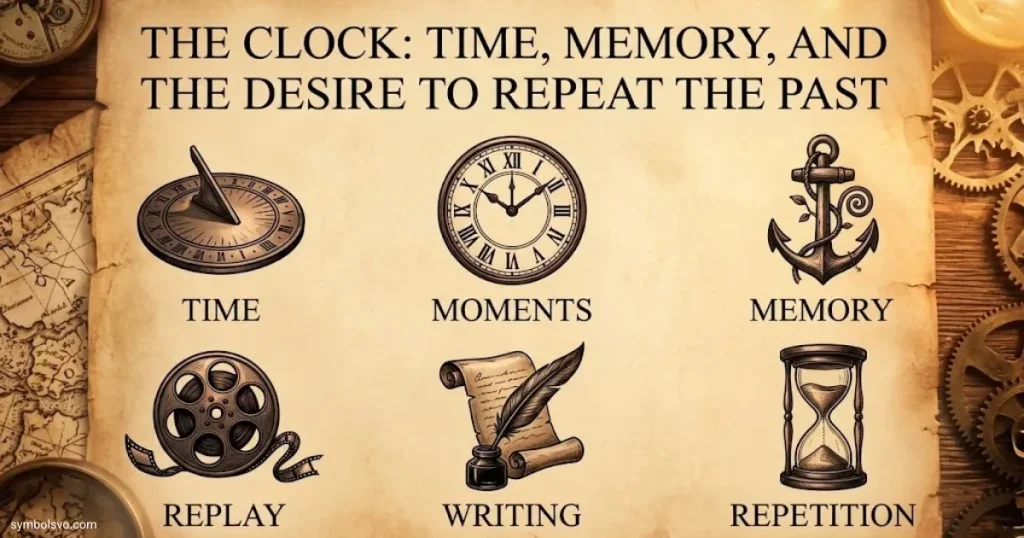
During Gatsby and Daisy’s reunion, Gatsby nearly knocks over a clock while trying to manage his nervousness. The moment appears small, but it captures one of his deepest conflicts.
Gatsby wants to restore his relationship with Daisy to the way he remembers it before their separation. He has spent years imagining their reunion and preparing himself to make it happen.
The clock represents the passage of time, which Gatsby wishes he could control. His nervous gesture suggests how fragile his attempt to recover the past really is.
A clock can measure time, but it cannot reverse it. Daisy has lived through years of experiences that Gatsby cannot erase. Their reunion must happen in the present, even though Gatsby wants it to recreate an idealized past.
This tension becomes clearer when Gatsby insists that the past can be repeated. His confidence reveals the strength of his hope, but it also exposes his inability to accept that people and circumstances change.
The clock thus symbolizes:
- The passage of time.
- Memory and nostalgia.
- Gatsby’s desire to restore an earlier relationship.
- The conflict between idealized memories and present reality.
- The limits of controlling one’s future by recreating the past.
The scene is especially effective because Fitzgerald uses a simple physical action to reveal a complicated emotional struggle.
Daisy’s Voice: Wealth, Privilege, and Attraction
Main appearance: Chapters 7 and 8
Daisy’s voice becomes an important symbol when Gatsby explains that it is full of money. His observation reveals something fundamental about his attraction to her.
Daisy represents more than romantic possibility. She belongs to a world of inherited wealth, comfort, and established social privilege. Her voice carries the associations Gatsby connects with that world.
This doesn’t mean Daisy’s voice has one literal or universally accepted meaning. Rather, Gatsby’s response reveals how he interprets her. He hears the promise of a life that he has worked to enter but never fully secured.
His attraction is therefore tied to his ambition. Daisy appears to offer love and the social recognition that money alone cannot buy.
However, Gatsby’s idealization creates a problem. He sees Daisy partly as a person and partly as a symbol of the life he wants. That makes it difficult for him to recognize the limits of their relationship.
Her voice ultimately connects wealth, privilege, desire, and social status. Through it, Fitzgerald shows how economic aspiration can become entangled with romantic longing.
Gatsby’s Parties: Excess, Popularity, and Loneliness
Main appearance: Chapter 3 and later chapters
Gatsby’s extravagant parties represent the excess and excitement associated with the Jazz Age, the period of American cultural change and consumer prosperity during the 1920s.
His mansion fills with music, food, drinks, dancing, and guests who often arrive without receiving a personal invitation. The celebrations make Gatsby appear popular and influential.
Yet the parties reveal a contradiction. Although hundreds of people enjoy his hospitality, few know the man behind the spectacle. Guests spread rumors about him, consume his resources, and leave without forming meaningful relationships.
Gatsby’s parties also serve a personal purpose. He hopes Daisy might attend one of them, allowing him to reconnect with her. His lavish entertainment therefore becomes part of his broader attempt to create a world that will attract her.
The celebrations symbolize:
- Excess: The extravagant consumption associated with wealthy society.
- Superficial relationships: Connections built around entertainment rather than genuine friendship.
- Loneliness: Gatsby’s isolation despite being surrounded by people.
- Social performance: The effort to appear successful, exciting, and important.
- Unfulfilled desire: The use of wealth to pursue a deeply personal goal.
The parties become especially revealing after Gatsby dies. Many guests who enjoyed his hospitality do not attend his funeral. Their absence exposes the difference between being surrounded by people and being genuinely cared for.
Gatsby’s Shirts and Clothing: Material Wealth and Reinvented Identity
Main appearance: Chapter 5
Gatsby’s expensive clothing represents his transformation from a young man with modest beginnings into a wealthy figure who wants to impress Daisy.
During her visit to his mansion, Gatsby displays his collection of fine shirts. Daisy becomes emotional as he throws them onto a table, reacting to the beauty and abundance of the garments.
The scene connects clothing with more than financial success. Gatsby’s shirts offer visible proof that he has achieved the kind of wealth he once lacked.
However, the moment also reveals the limits of material possessions. Gatsby wants Daisy to see that he can provide a luxurious life, but expensive clothes cannot recover their lost years or guarantee that she will choose him.
His wardrobe also supports his constructed identity. Clothing helps him present himself as a man who belongs among the wealthy elite, even though his background differs from theirs.
In this sense, Gatsby’s shirts symbolize wealth, ambition, and self-invention. They also expose the emotional weight he places on possessions as evidence that his dream might finally come true.
White Clothing and Imagery: Elegance, Innocence, and Appearance
White imagery appears throughout the novel, particularly in descriptions of Daisy and Jordan Baker. Their clothing and surroundings often create an impression of lightness, elegance, and refinement.
At first, these details can make the women appear sheltered from the harsher realities of the world around them. Their polished presentation contrasts with the gray industrial landscape of the Valley of Ashes.
However, Fitzgerald complicates this impression. Daisy and Jordan’s elegant appearance does not establish their moral innocence or make them immune to selfish behavior.
This contrast illustrates appearance versus reality. White imagery can suggest innocence or purity, but the characters’ actions challenge any simple interpretation of those qualities.
Consider the difference between appearance and deeper meaning:
- Literal appearance: Light-colored clothing and bright interiors.
- Possible association: Elegance, beauty, and apparent innocence.
- Deeper significance: The gap between polished appearances and complicated moral choices.
White imagery should not be treated as a fixed code. Its meaning depends on the character, scene, and surrounding details.
Gold and Yellow: Luxury, Glamour, and Corruption
Gold and yellow are related colors, but their symbolic roles deserve careful distinction.
Gold often suggests luxury, prestige, and the attraction of wealth. It fits the glamorous world Gatsby wants to enter and the inherited privilege associated with characters such as Daisy.
Yellow, meanwhile, can reinforce the artificial brightness and conspicuous display of wealthy society. Gatsby’s striking car is an important example because its appearance connects luxury with the tragedy that follows.
These colors help Fitzgerald question the relationship between material success and genuine fulfillment. A wealthy lifestyle may look impressive, but its surface beauty can conceal insecurity, selfishness, and destructive choices.
| Color | Common association | Interpretive significance |
| Gold | Luxury and prestige | The attraction of wealth and status |
| Yellow | Conspicuous display and artificial glamour | The darker side of material ambition |
| Both | Desirability and outward appeal | The tension between appearance and reality |
These associations are useful starting points rather than absolute rules. Fitzgerald’s color imagery works through context, and not every reference to gold or yellow carries the same implication.
Gray Imagery: Neglect and Lifelessness
Gray imagery is closely connected to the Valley of Ashes, where industrial waste covers the landscape and creates a feeling of lifelessness.
The color contrasts with the bright houses, fashionable clothing, and luxurious surroundings associated with the wealthy characters. This difference makes social inequality visible through setting and imagery.
Gray also reinforces the idea of neglect. While the rich enjoy the benefits of a prosperous society, people such as George Wilson struggle in an environment marked by industrial decay.
The contrast does not mean that every gray object symbolizes evil or sadness. Rather, Fitzgerald repeatedly uses the valley’s bleak appearance to support his criticism of a society that overlooks the human costs of prosperity.
Gray imagery connects industrial waste with poverty, neglect, and moral decay. It gives readers a visual reminder that the glamorous world of the novel depends on a much less glamorous social reality.
Water and Distance: Separation Between Gatsby and Daisy
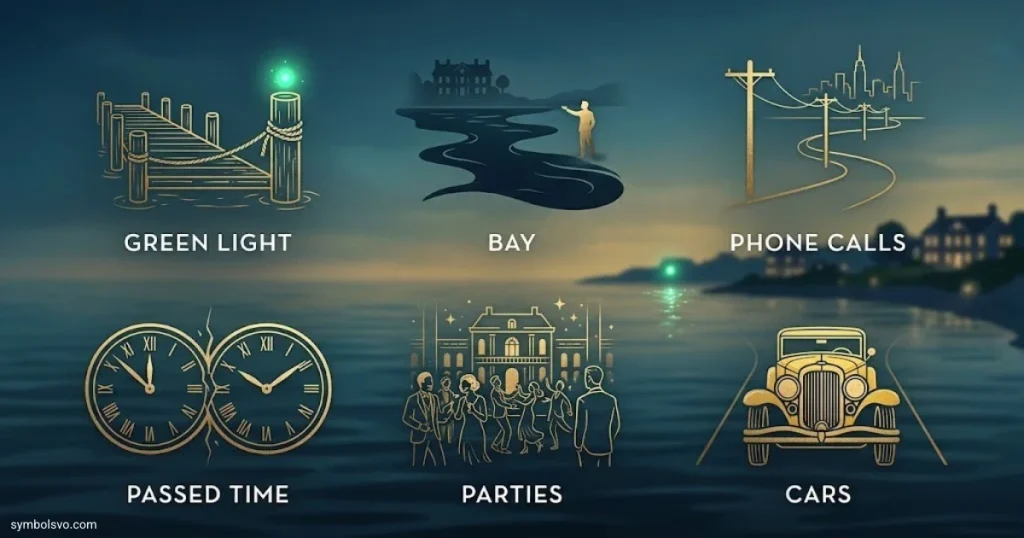
The water between Gatsby’s mansion and Daisy’s dock creates one of the novel’s clearest images of separation.
Gatsby can see the green light from his property, yet the bay keeps him physically apart from Daisy’s world. That distance reflects his emotional situation: he can imagine the future he wants, but he cannot simply cross into it.
Water also helps sustain Gatsby’s idealized vision. From across the bay, Daisy becomes part of a distant dream rather than a person whose choices and limitations he must fully confront.
Once Gatsby and Daisy reunite, the distance between their homes no longer carries the same mystery. Their actual relationship introduces complications that his imagined future could not resolve.
The water therefore connects to:
- Physical separation between Gatsby and Daisy.
- Emotional longing and unattainable desire.
- The difference between imagination and reality.
- The green light and Gatsby’s idealized future.
- The social distance between aspiration and acceptance.
Water is not always a symbol of separation in every literary work. In this novel, its significance emerges from its specific relationship to Gatsby’s home, Daisy’s dock, and the green light.
The Owl-Eyed Man and Gatsby’s Library: Authenticity and Appearance
The Owl-Eyed Man appears at Gatsby’s party in Chapter 3 and discovers that the books in Gatsby’s library are real. He seems surprised because he expects the impressive surroundings might be a carefully constructed display rather than evidence of genuine substance.
The books are authentic, but that discovery does not automatically prove that Gatsby’s public identity is entirely authentic. His wealth, background, and personal history remain more complicated than the impressive house suggests.
The library therefore introduces an important distinction: something can be genuine without making every part of its owner’s identity genuine.
The Owl-Eyed Man also reappears at Gatsby’s funeral in Chapter 9. His presence contrasts with the absence of most party guests and suggests that he recognizes something more substantial about Gatsby than mere entertainment.
The scene connects the library and its observer to authenticity, constructed identity, and the difference between superficial appearances and meaningful recognition.
It also reinforces one of the novel’s recurring questions: how can people distinguish genuine character from a carefully maintained public image?
Color Symbolism in The Great Gatsby
Fitzgerald’s use of color extends beyond individual objects. Repeated color imagery creates connections between characters, places, and ideas throughout the novel.
The following table summarizes the most useful associations for literary analysis.
| Color | Symbolic associations | Example |
| Green | Hope, desire, ambition, the future | The light at Daisy’s dock |
| White | Elegance and apparent innocence | Clothing associated with Daisy and Jordan |
| Gold | Wealth, prestige, and luxury | The world of inherited privilege |
| Yellow | Conspicuous display and artificial glamour | Gatsby’s car |
| Gray | Neglect, lifelessness, and industrial decay | The Valley of Ashes |
How Fitzgerald Uses Color Contrast
Color becomes especially meaningful when Fitzgerald places contrasting environments beside each other.
The brightness and luxury associated with wealthy communities stand against the gray industrial wasteland. This contrast makes the social divide visible without requiring a direct explanation of every character’s financial position.
Green also carries several connected meanings. It represents Gatsby’s hope for Daisy, his desire for a better future, and the financial ambition that shapes his life.
White imagery can suggest elegance without guaranteeing innocence. Gold can make wealth appear attractive without proving that it brings happiness. Yellow can suggest glamour while appearing alongside destructive consequences.
These overlapping meanings make color symbolism in The Great Gatsby an effective way to explore the conflict between outward appearance and inner reality.
For students, the strongest analysis connects a color to a specific scene before explaining its broader significance. That approach avoids treating every color as though it had one universal definition.
How The Great Gatsby’s Symbols Connect to Its Major Themes
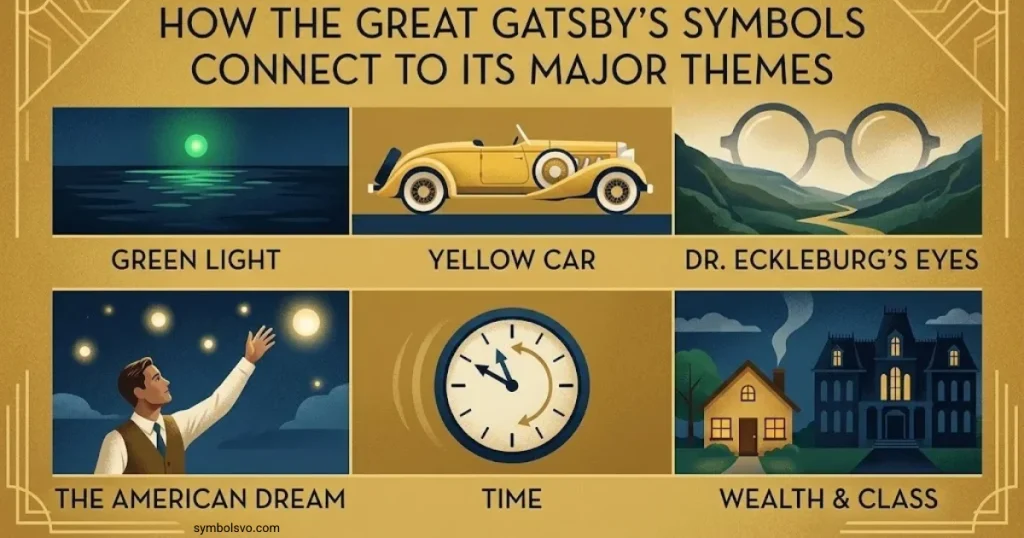
The most effective The Great Gatsby literary analysis doesn’t treat each symbol as an isolated detail. Instead, it explains how different symbols work together to develop Fitzgerald’s larger ideas.
The American Dream and Unattainable Ambition
The American Dream promises the possibility of a better life through ambition and effort. Gatsby appears to embody that promise because he transforms himself from a young man with limited resources into an extraordinarily wealthy figure.
His mansion, expensive clothing, and green light reflect different parts of that ambition. The mansion displays his success, the clothing reinforces his new identity, and the light represents the future he continues to pursue.
However, Gatsby’s experience exposes the limitations of his dream. Although he acquires wealth, he cannot erase the past or guarantee Daisy’s love. He also struggles to overcome the class barriers separating him from the established elite.
Fitzgerald’s criticism is not simply that ambition leads to failure. Gatsby’s hope gives him remarkable determination. The problem lies in his belief that money and persistence can recreate an idealized past and deliver everything he desires.
Wealth, Materialism, and Social Class
Gatsby’s mansion, Daisy’s voice, and the contrast between East Egg and West Egg show how wealth shapes relationships and social status.
Money provides Gatsby with access to luxury, but inherited privilege gives Tom and Daisy a different kind of security. Their family background grants them social standing that Gatsby cannot obtain through purchases alone.
The Valley of Ashes introduces the other side of this system. While wealthy characters enjoy comfort, George and Myrtle Wilson live with economic hardship and limited opportunities.
Together, these symbols expose the unequal distribution of privilege. Fitzgerald suggests that financial success does not automatically produce fairness, happiness, or genuine social acceptance.
Appearance vs. Reality and Self-Invention
Gatsby’s library, clothing, mansion, and parties all contribute to the image he presents to society.
Some aspects of that image are genuine. He really possesses considerable wealth, and his mansion really contains expensive furnishings. Yet his carefully managed appearance conceals the complexities of his past and the insecurity beneath his confidence.
The Owl-Eyed Man’s discovery of real books illustrates this tension. The books are authentic, but their presence does not settle every question about Gatsby’s identity.
This theme extends beyond Gatsby. Daisy and Jordan appear elegant and refined, yet their behavior complicates the impression their surroundings create.
Fitzgerald repeatedly asks readers to look beyond appearances and examine the motives, choices, and contradictions beneath them.
Moral Decay, Carelessness, and Responsibility
The Valley of Ashes, Doctor T. J. Eckleburg’s eyes, and Gatsby’s yellow car connect the novel’s physical setting to its moral conflicts.
The valley represents the neglected people and places that exist alongside great wealth. The billboard eyes suggest a world searching for judgment or moral authority. The car’s involvement in Myrtle’s death reveals how irresponsible behavior can destroy lives.
The aftermath of the accident makes the class conflict especially clear. Gatsby accepts responsibility for Daisy’s actions, while Tom and Daisy eventually withdraw from the consequences of the tragedy.
Fitzgerald uses these events to question a society in which wealth offers protection from accountability. His criticism focuses not only on individual carelessness but also on the unequal power that allows some people to escape its consequences.
Time, Memory, and Idealized Love
The clock scene, the green light, and the distance between Gatsby’s mansion and Daisy’s home all reveal his struggle with time.
Gatsby wants to recover a past relationship and make it match the perfect memory he has preserved. His desire is powerful, but it prevents him from fully accepting that Daisy has changed and that their circumstances are different.
The green light initially represents a future he imagines achieving. Once Gatsby reunites with Daisy, however, reality begins to challenge that vision.
The clock captures the same conflict in a smaller moment. Gatsby can nearly knock over a clock, but he cannot reverse the years that separate his memories from the present.
Together, these symbols show how nostalgia can inspire hope while also preventing people from seeing their lives clearly.
The Great Gatsby Symbols by Chapter
Readers often need to locate a particular symbol quickly for an assignment or essay. This chapter guide identifies important moments without repeating the full analysis of each symbol.
| Chapter | Important symbol or scene | Significance |
| Chapter 1 | Green light | Introduces Gatsby’s longing and distant dream |
| Chapter 2 | Valley of Ashes and billboard eyes | Establishes industrial decay and moral uncertainty |
| Chapter 3 | Gatsby’s parties and library | Contrasts public spectacle with questions of authenticity |
| Chapter 5 | Green light and clock | Connects Gatsby’s reunion with his desire to recover the past |
| Chapter 6 | Gatsby’s self-invention | Reveals the ambitions behind his constructed identity |
| Chapter 7 | Yellow car | Connects wealth and carelessness to the novel’s tragedy |
| Chapter 8 | Green light and Gatsby’s dream | Highlights the persistence of his longing |
| Chapter 9 | Green light and the closing reflection | Connects Gatsby’s dream to humanity’s continuing pursuit of the future |
When writing an essay, consult the relevant chapter in your own copy of the novel. Page numbers vary by edition, so chapter references are often more reliable.
How to Analyze Symbolism in The Great Gatsby
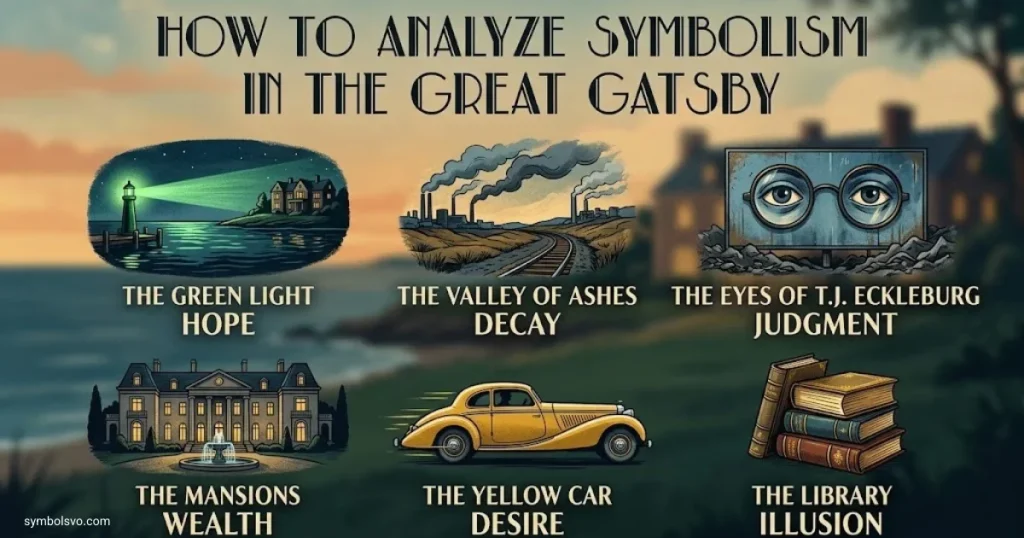
A strong literary analysis does more than identify a symbol and give it a one-word meaning. It explains how Fitzgerald uses a specific detail to develop a larger idea.
Follow these steps to build a clear interpretation.
Identify the Symbol
Start by identifying the object, color, setting, or recurring image you want to discuss.
For example, the green light is an identifiable object that appears at a meaningful moment in Gatsby’s life. Its connection to Daisy gives it significance beyond its literal function.
Explain Its Literal Meaning
Describe what the object actually is or what happens in the scene.
The green light shines at the end of Daisy’s dock. Gatsby can see it from across the bay, but the water separates him from it.
Beginning with the literal detail keeps your interpretation grounded in the novel.
Connect the Symbol to a Character
Ask who interacts with the symbol and what that interaction reveals.
Gatsby reaches toward the green light because he associates it with Daisy and the future he wants. His reaction tells readers more about his desires than the light’s physical appearance alone could explain.
Support Your Interpretation With Textual Evidence
Use a relevant quotation or a specific scene from the novel.
For instance, Gatsby’s first appearance beside the green light in Chapter 1 establishes his longing before readers fully understand its source. The reunion in Chapter 5 then changes the light’s significance.
Explain how the evidence supports your interpretation instead of inserting quotations without analysis.
Connect the Symbol to a Larger Theme
Finally, explain why the symbol matters beyond the immediate scene.
The green light connects Gatsby’s romantic longing to the American Dream because both involve pursuing an ideal future that remains difficult to attain.
A useful formula for literary analysis is:
Symbol + textual evidence + interpretation + theme = a stronger analytical paragraph.
For example, a student could argue that Fitzgerald uses the green light to show how Gatsby’s hope sustains his ambition while preventing him from accepting reality. That interpretation is more meaningful than simply stating that green represents hope.
Why Are Symbols Important in The Great Gatsby?
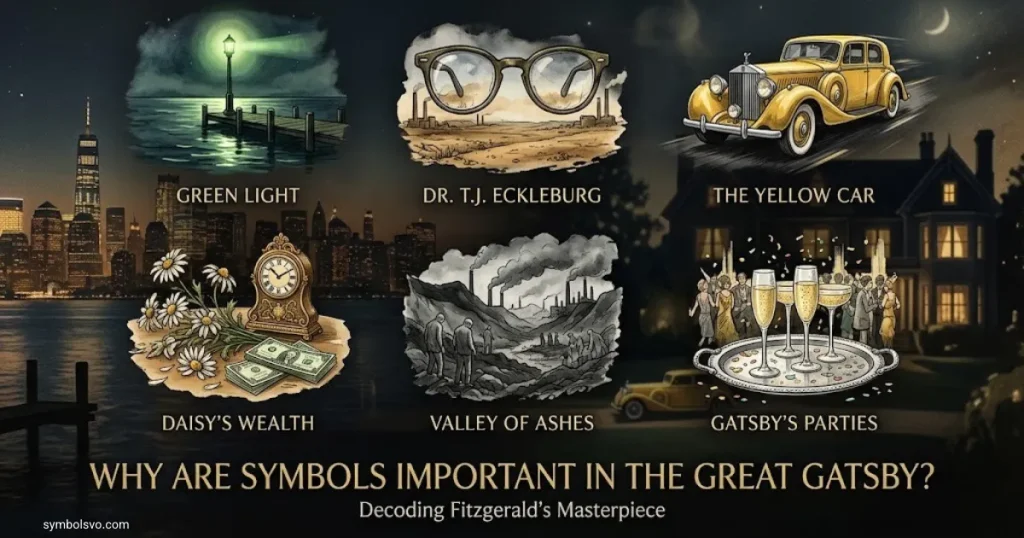
The significance of symbols in The Great Gatsby lies in their ability to connect private emotions with broader social problems.
Without symbolism, Gatsby’s mansion would simply be an expensive house, the Valley of Ashes would merely be an unpleasant setting, and the green light would remain a distant lamp. Fitzgerald gives these details additional meaning by linking them to characters’ desires and the novel’s central conflicts.
Symbols also allow readers to recognize contradictions. Gatsby’s wealth demonstrates success, yet it cannot secure the relationship he wants. The parties show popularity, yet Gatsby remains isolated. Daisy’s elegance suggests refinement, yet her choices complicate that appearance.
These contrasts help Fitzgerald explore several enduring questions:
- Does financial success guarantee happiness?
- Can someone reinvent their identity completely?
- Why do social class and inherited privilege matter?
- Can people recover an idealized version of their past?
- What happens when powerful people avoid responsibility?
The symbols do not provide simple answers. Instead, they give readers a way to examine the tensions that shape the characters’ lives.
That is why symbolism in The Great Gatsby remains central to understanding the novel. Its images make abstract ideas visible, memorable, and open to thoughtful interpretation.
Frequently Asked Questions About Symbols in The Great Gatsby
What are the main symbols in The Great Gatsby?
The major symbols include the green light, the eyes of Doctor T. J. Eckleburg, the Valley of Ashes, East Egg and West Egg, Gatsby’s mansion, the yellow car, and the clock. Fitzgerald also uses color imagery, clothing, parties, and Daisy’s voice to develop themes of wealth, ambition, social class, and the American Dream.
What does the green light symbolize in The Great Gatsby?
The green light represents Gatsby’s hope of reuniting with Daisy and achieving the future he imagines. It also symbolizes the American Dream and the human tendency to pursue goals that remain just beyond reach.
What do the eyes of Doctor T. J. Eckleburg represent?
The billboard eyes can suggest observation, judgment, spiritual emptiness, and moral uncertainty. George Wilson interprets them as the eyes of God, but Fitzgerald never confirms that interpretation as the symbol’s single definitive meaning.
What does the Valley of Ashes symbolize?
The Valley of Ashes represents poverty, industrial waste, neglect, and economic inequality. Its bleak landscape contrasts with the wealthy communities of East Egg and West Egg, exposing the social costs hidden beneath material prosperity.
What do East Egg and West Egg represent?
East Egg represents established privilege and inherited wealth, while West Egg represents newly acquired wealth and social ambition. Their contrast demonstrates that possessing money does not automatically grant someone the status enjoyed by the established elite.
What does Gatsby’s yellow car symbolize?
Gatsby’s conspicuous car represents wealth and status, but its involvement in Myrtle Wilson’s death connects it to carelessness and destructive consequences. Daisy is driving when the collision occurs, an important detail when interpreting responsibility in the novel.
What does the clock symbolize in Chapter 5?
The clock represents time, memory, and Gatsby’s desire to repeat the past. His near-accidental knocking of it over reflects the fragility of his attempt to restore an earlier relationship with Daisy.
What does Daisy’s voice symbolize?
Daisy’s voice symbolizes wealth, privilege, and attraction in Gatsby’s eyes. His response reveals that he associates her not only with romantic love but also with the social world he wants to enter.
What do colors symbolize in The Great Gatsby?
Green commonly connects to hope and desire, white to elegance and apparent innocence, gold to luxury, yellow to conspicuous display, and gray to industrial neglect. These are interpretive patterns rather than fixed definitions, so the context of each scene matters.
How does symbolism support the American Dream theme?
Symbols such as the green light, Gatsby’s mansion, and his expensive clothing show his pursuit of success and acceptance. Their meanings reveal the gap between his material achievements and his inability to secure the future he imagines.
What is the difference between a symbol and a motif?
A symbol is a specific object, image, or detail that represents a deeper idea. A motif is a recurring element that helps develop a pattern or theme. A symbol such as the green light can also function as a motif when it reappears throughout the novel.
Final Thoughts on The Great Gatsby Symbols and Their Meanings
The symbols in The Great Gatsby transform a story about one man’s pursuit of love into a broader examination of wealth, social class, ambition, and the American Dream.
The green light reveals Gatsby’s enduring hope. The Valley of Ashes exposes the costs of economic inequality. The eyes of Doctor T. J. Eckleburg raise questions about morality, while the clock captures Gatsby’s struggle to reconcile his memories with reality.
Other symbols deepen the same conflicts. Gatsby’s mansion and clothing demonstrate his reinvention, his parties expose the shallowness of social popularity, and the yellow car reveals the destructive consequences of carelessness.
Together, these images explain why Fitzgerald’s novel continues to invite literary analysis. Its symbols rarely offer simple answers. Instead, they encourage readers to look beyond appearances and question the values that shape the characters’ choices.
Ultimately, Gatsby’s tragedy comes from the distance between the life he possesses and the perfect future he believes he can achieve. Through symbolism, Fitzgerald shows how hope can inspire extraordinary ambition while an idealized dream can also make reality difficult to accept.

I’m Nathan Holloway, a passionate researcher and writer with a deep interest in symbols, signs, and their hidden meanings. I enjoy exploring how symbols have influenced different civilizations, religions, and modern communication. Through my work, I aim to make complex historical and cultural concepts easy to understand for readers of all backgrounds. Every article I write is carefully researched to provide reliable and engaging information.
Books:
- Beyond the Symbol
- The Secret Meanings of Everyday Signs
Author 2: Grace Whitmore
Description:
My name is Grace Whitmore, and I love discovering the stories behind the world’s most fascinating symbols. I spend my time researching ancient civilizations, mythology, spiritual traditions, and modern iconography to uncover the meanings people often overlook. I believe that every symbol has a history worth telling, and I enjoy sharing that knowledge in a simple and reader-friendly way.
Books:
- Echoes of Ancient Symbols
- The Symbolic World
 Daniel Brooks
 Mason Ellington