New Jersey Symbols tell a story that goes far beyond official emblems and state traditions. As I explore each symbol with you, you will discover how history, nature, culture, and local pride come together to represent the Garden State.
Every symbol carries a piece of New Jersey’s identity, waiting for you to uncover it.
I believe these meaningful icons can help you feel more connected to the state’s unique past and personality.
From the state bird and flower to the flag, seal, and other important icons, this guide makes everything simple and engaging. You will learn what each symbol means, why it was chosen, and how it continues to shape New Jersey today.
Quick Answer
New jersey symbols are the officially designated flora, fauna, objects, and historical emblems that represent the unique identity, cultural heritage, and ecological diversity of the state of New Jersey. These state markers, ranging from the eastern goldfinch to the heavy agricultural plows on the state seal, celebrate the state’s historical transformation, industrious community spirit, and rich natural landscapes.
Quick Facts About New Jersey Symbols
| Aspect | Information | Origin |
| Historical Significance | Grounded in the American Revolution and early agricultural independence. | Created by the State Legislature and visionary local citizens. |
| Main Meaning | Hard work, natural wealth, and resilient community freedom. | Derived from colonial struggles and deep geographic pride. |
| Spiritual Meaning | Harmony with the earth, inner endurance, and abundant renewal. | Rooted in old folklore, Native American heritage, and natural rhythms. |
| Cultural Importance | Fosters local identity, unifies diverse communities, and drives conservation. | Celebrated in public schools, local festivals, and historical sites. |
| Modern Usage | Displayed on license plates, official branding, and educational campaigns. | Used to promote ecological tourism and preserve historical memories. |
What Are New Jersey Symbols?
New jersey symbols serve as the tangible tokens of the state’s deep character and evolution. Officially, they are individual species, items, or concepts voted into law by the State Legislature to serve as permanent ambassadors of the region.
The historical background of these emblems traces back to the birth of the United States. As one of the original thirteen colonies, New Jersey needed visual representations to establish its independent identity apart from British rule. Over time, these representations evolved from purely political markers into deeply personal, ecological symbols.
They became highly important because they gave a rapidly diversifying population a shared cultural foundation. Whether it is a wild bird found in a suburban backyard or an ancient fossil from a local quarry, each selection tells a story of survival, industry, and environmental appreciation.
Deep Symbolic Meaning of New Jersey Symbols
Spiritual Level
On a spiritual level, these tokens speak directly to our connection with the natural world and the universal cycle of renewal. They represent inner transformation and the grounding energy of the earth. Choosing humble, resilient creatures and plants as state icons reflects a collective soul that values quiet strength over loud dominance. It is a reminder that true consciousness involves honoring the soil beneath our feet and finding peace in the simple, enduring elements of nature.
Psychological Level
Psychologically, the state markers tap into deep human emotions and classic archetypes. They symbolize the “Provider” and the “Protector” through figures like Liberty and Prosperity on the state seal. This imagery triggers a strong sense of comfort, security, and shared destiny. Jungian symbolism suggests that a community’s chosen icons reflect its collective unconscious, revealing a deep seated desire for balance between industrial progress and emotional grounding.
Cultural Level
Culturally, these icons build an unbreakable bond of social significance and community belief. Traditional interpretations of the state symbols are woven directly into local art, historic preservation efforts, and annual community festivals. They act as bridges connecting older generations of residents with new immigrants, providing a mutual vocabulary of pride and belonging that transcends language barriers.
Types and Variations of New Jersey Symbols
The State Bird: Eastern Goldfinch
- Visual Description: A small, bright yellow bird with striking black wings and a black cap on its head.
- Meaning: Joy, positivity, and the vibrant return of sunny days.
- Symbolism: It symbolizes the bright spirit of the local people and the beauty of the shifting seasons.
- Cultural Connection: Widely loved by local birdwatchers and gardeners who plant native flowers to attract them.
- Where It Appears: School educational materials, nature center guides, and local wildlife art.
The State Tree: Red Oak
- Visual Description: A tall, majestic hardwood tree with deeply lobed leaves that turn a brilliant, fiery red in autumn.
- Meaning: Strength, endurance, and deep, immovable roots.
- Symbolism: Represents the sturdy foundation of the state’s communities and their ability to withstand difficult storms.
- Cultural Connection: Planted heavily in public parks and historic battlefields to honor lasting memories.
- Where It Appears: State forestry logos, conservation posters, and community arboretums.
The State Animal: The Horse
- Visual Description: A powerful, sleek equine figure representing both historic farm work and modern equestrian sports.
- Meaning: Freedom, noble grace, and tireless industry.
- Symbolism: Connects directly to the state’s long history of agricultural labor and transportation.
- Cultural Connection: Celebrated across massive horse farms in places like Monmouth County, driving local agro tourism.
- Where It Appears: The official state seal, equestrian event posters, and local farm signs.
New Jersey Symbols Across Different Cultures
While these specific state emblems are uniquely American, the core energies they represent can be found throughout the history of human civilization.
- Ancient Egypt: The concept of agricultural abundance seen in the state’s cornucopia mimics the Egyptian worship of the Nile River’s annual harvest blessings.
- Ancient Greece: The goddess figures of Liberty and Prosperity on the state seal are direct descendants of classic Greek archetypes representing freedom and agricultural health.
- Roman Culture: The Roman goddess Ceres, who represents agriculture and motherly love, is the direct inspiration for the figure of Prosperity holding the horn of plenty.
- Eastern Traditions: The vibrant yellow energy of the goldfinch aligns closely with Eastern views of the solar plexus chakra, representing personal power, warmth, and community joy.
- Indigenous Traditions: Long before European settlement, the Lenape Native Americans held a deep spiritual reverence for the red oak and the local wildlife, viewing them as sacred brothers in a connected ecosystem.
New Jersey State Flower
New Jersey ka official state flower violet hai. Violet ko 1913 mein New Jersey ka state flower designate kiya gaya tha. Ye chhota, colorful flower fields, lawns, meadows aur woodland areas mein naturally grow karta hai. Violet New Jersey ke natural landscape aur spring season ka ek familiar symbol hai.
New Jersey State Bird
New Jersey ka state bird Eastern Goldfinch hai. Is small songbird ke males ke feathers breeding season mein bright yellow hote hain, jabki wings aur head par black markings hoti hain. Eastern Goldfinch ko 1935 mein official state bird banaya gaya.
New Jersey State Flag
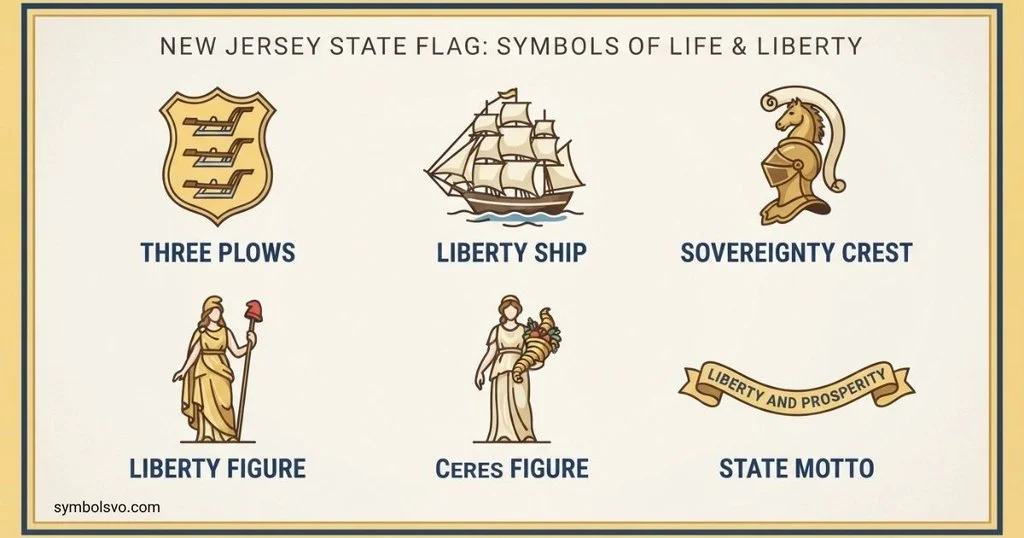
New Jersey state flag ka main background color buff, yani yellowish-tan shade, hai. Flag ke center mein New Jersey ka state seal ya coat of arms displayed hota hai. Official state colors buff aur Jersey blue hain. Flag 1896 mein officially adopted hua tha, aur iske colors Revolutionary War ke dauran New Jersey military regiments se connected hain.
New Jersey State Fruit
New Jersey ka state fruit blueberry hai. Blueberry ko 2004 mein official state fruit banaya gaya. New Jersey mein cultivated blueberry ki history particularly important hai because Elizabeth Coleman White ne Whitesbog area mein cultivated blueberry industry ke development mein major role play kiya.
New Jersey State Symbol
New Jersey ke official state symbols state ki history, agriculture, wildlife, culture aur natural environment ko represent karte hain. Important symbols mein the violet, Eastern Goldfinch, red oak, horse, blueberry, honeybee, brook trout, bog turtle, black swallowtail butterfly, Hadrosaurus foulkii, USS New Jersey, Thomas Edison, Franklinite aur cranberry juice shamil hain.
New Jersey ka Great Seal bhi ek major state symbol hai. Is seal mein shield par three plows, Liberty, Ceres, horse-head crest aur “Liberty and Prosperity” motto shamil hain.
New Jersey State Things
New Jersey ki identity ko samajhne ke liye uske official symbols aur famous state characteristics dono important hain. The Garden State ka nickname, violet flower, Eastern Goldfinch, red oak, blueberry, horse, state flag aur Great Seal New Jersey ki commonly recognized features hain.
State ke official designations mein wildlife, plants, food and agriculture, history, transportation aur culture se related symbols bhi shamil hain. Isliye New Jersey ke “state things” sirf ek flower ya animal tak limited nahi hain.
New Jersey Symbols for Kids
Kids ke liye New Jersey symbols ko simple categories mein samajhna easy hota hai:
- 🌸 State Flower: Violet
- 🐦 State Bird: Eastern Goldfinch
- 🌳 State Tree: Red Oak
- 🫐 State Fruit: Blueberry
- 🐴 State Animal: Horse
- 🐝 State Bug: Honeybee
- 🐟 State Fish: Brook Trout
- 🐢 State Reptile: Bog Turtle
- 🦋 State Butterfly: Black Swallowtail
- 🚢 State Ship: USS New Jersey
- 🦕 State Dinosaur: Hadrosaurus foulkii
- 💎 State Mineral: Franklinite
- 🧃 State Juice: Cranberry Juice
Iconic New Jersey Symbols
Some of the most iconic New Jersey symbols are the Garden State nickname, state flag, Great Seal, horse, violet, Eastern Goldfinch, red oak and blueberry. These symbols connect New Jersey with its agricultural history, natural environment and American history.
The state seal is particularly recognizable because it combines several ideas into one design, including agriculture, freedom, prosperity and New Jersey’s early history.
New Jersey Symbols and Facts
New Jersey has a wide range of official symbols. The first official symbol was the violet, selected as the state flower in 1913. Since then, many additional symbols have been adopted. The New Jersey Legislature’s current educational list includes 21 official designations, ranging from the state flower and bird to the state mineral and juice.
Some interesting examples include Thomas Edison as the state inventor, Hadrosaurus foulkii as the state dinosaur, Franklinite as the state mineral, and cranberry juice as the state juice. These choices reflect different parts of New Jersey’s scientific, historical, natural and agricultural heritage.
Pictures of New Jersey Symbols
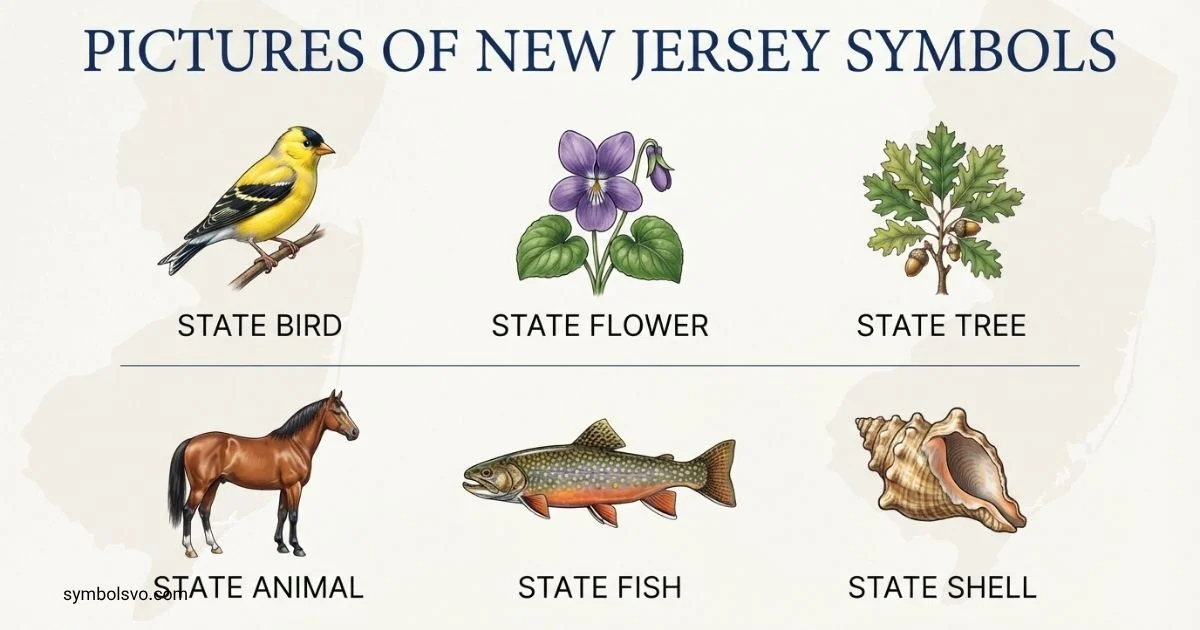
Pictures of New Jersey symbols can make the topic much easier for students and readers to understand. Useful visuals include the New Jersey state flag, Great Seal, violet, Eastern Goldfinch, red oak, blueberry, horse, honeybee and brook trout.
For a children’s educational page, you can organize the pictures into a simple grid with the symbol’s name, category and one short fact underneath each image. This creates a useful visual reference while keeping the information easy to scan.
State Animal of New Jersey
The official state animal of New Jersey is the horse. It became the state animal in 1977. Horses have a long connection with New Jersey agriculture, transportation and equestrian activities, and the horse is also represented in the state’s Great Seal.
The horse’s presence on the state seal makes it especially important as a historical New Jersey symbol. The horse-head crest is associated with New Jersey’s independence and its position among the early states.
New Jersey State Motto
New Jersey’s motto is “Liberty and Prosperity.” The words appear on the scroll at the bottom of the state’s Great Seal. The motto expresses ideas of freedom and economic well-being associated with the state’s history.
An important detail for accurate content is that New Jersey’s official FAQ describes “Liberty and Prosperity” as an unofficially accepted state motto, because it appears on the state seal rather than having been formally adopted as a standalone motto.
What Is the New Jersey State Tree?
The New Jersey state tree is the red oak. It was selected as the official state tree in 1950. Red oaks are large hardwood trees recognized by their lobed leaves and acorns, and their foliage can turn red during autumn.
The red oak is more than just a botanical symbol. It represents part of New Jersey’s forest environment and is associated with strength, longevity and the state’s natural heritage.
New Jersey Logos
New Jersey does not have one single “state logo” that represents every aspect of the state. Different government agencies, programs and public organizations may use their own logos and branding.
The New Jersey state seal is the primary official emblem used to represent the state government. Individual programs can also have separate visual identities. For example, New Jersey State Parks introduced refreshed branding featuring elements such as a bird, pine tree, rolling hills and an ocean wave.
Symbols of New Jersey
The symbols of New Jersey represent many different aspects of life in the state. Among the best-known are:
| Category | New Jersey Symbol |
| State Flower | Violet |
| State Bird | Eastern Goldfinch |
| State Tree | Red Oak |
| State Fruit | Blueberry |
| State Animal | Horse |
| State Bug | Honeybee |
| State Fish | Brook Trout |
| State Reptile | Bog Turtle |
| State Butterfly | Black Swallowtail |
| State Dinosaur | Hadrosaurus foulkii |
| State Ship | USS New Jersey |
| State Mineral | Franklinite |
| State Juice | Cranberry Juice |
| State Colors | Buff and Jersey Blue |
| State Folk Dance | Square Dance |
| State Motto | Liberty and Prosperity |
These designations show how New Jersey uses official symbols to celebrate its environment, agriculture, culture, history and scientific achievements.
What Is New Jersey State Motto?
The New Jersey state motto is “Liberty and Prosperity.” It appears directly on the state’s Great Seal. The motto reflects two important ideas associated with New Jersey: freedom and prosperity.
The motto is closely connected to the state’s revolutionary-era history. The Great Seal also displays 1776, the year associated with New Jersey’s independence declaration and revolutionary history.
New Jersey State Mascot
New Jersey does not have a single official state mascot in the same way that it has official state symbols such as the flower, bird or tree. The horse is the official state animal and is therefore sometimes informally treated as a representative New Jersey animal, but “state animal” and “state mascot” are not the same official designation.
For accurate educational or SEO content, it is better to describe the horse as New Jersey’s official state animal rather than claiming that New Jersey has an official state mascot.
New Jersey National Animal
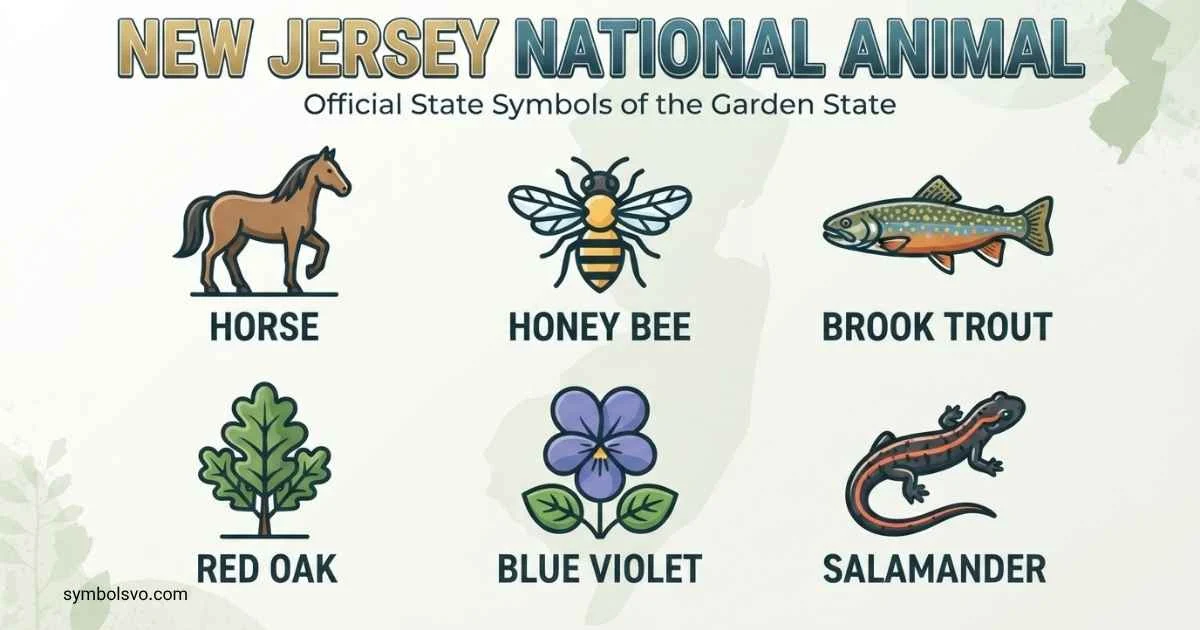
New Jersey does not have an official national animal because New Jersey is a U.S. state, not a nation. Its official state animal is the horse.
If you are looking for New Jersey’s representative animal symbol, the horse is the correct state designation. It has historical importance in New Jersey and also appears as the horse-head crest on the Great Seal.
New Jersey Icons
Popular New Jersey icons include the Garden State nickname, state flag, Great Seal, horse, violet, Eastern Goldfinch, red oak and blueberry. Other symbols such as the USS New Jersey, Thomas Edison and Hadrosaurus foulkii highlight the state’s military, scientific and prehistoric history.
New Jersey’s official symbols are especially useful for understanding how the state combines its natural environment with its agricultural, historical and cultural identity.
New Jersey Emblem
The Great Seal of New Jersey serves as the state’s principal official emblem. It was created in 1777 and contains several important elements. The center shield has three plows, representing New Jersey’s agricultural tradition. Two figures, Liberty and Ceres, stand beside the shield, while a horse’s head appears above it.
The scroll beneath the design carries the words “Liberty and Prosperity” and the year 1776. Together, these elements connect the emblem to New Jersey’s agricultural heritage, freedom, prosperity and revolutionary history.
New Jersey Colors
The official colors of New Jersey are Buff and Jersey Blue. Buff is a yellowish-tan color, while Jersey Blue is a dark blue. These colors appear prominently in the state’s flag and have historical connections to the colors selected for New Jersey military regiments during the Revolutionary War.
For an article about New Jersey symbols, these colors are important because they help distinguish the state flag and provide a direct connection between modern New Jersey and its Revolutionary-era history.
Similar Symbols and Their Meanings
It can be helpful to compare New Jersey’s iconography with adjacent regional markers to understand its distinct identity.
| Symbol Category | New Jersey Emblem | Neighboring New York Emblem | Key Symbolic Difference |
| State Bird | Eastern Goldfinch | Eastern Bluebird | New Jersey emphasizes vibrant solar joy; New York focuses on quiet tranquility. |
| State Tree | Red Oak | Sugar Maple | New Jersey honors structural strength; New York honors sweet agricultural production. |
| State Animal | The Horse | The Beaver | New Jersey celebrates cooperative labor; New York highlights wilderness fur trading history. |
A common misconception is that these icons are identical across neighboring states. In reality, New Jersey specifically chose symbols that highlight a balance between heavy agricultural labor and rich, coastal biodiversity.
New Jersey Symbols in Mythology and Folklore
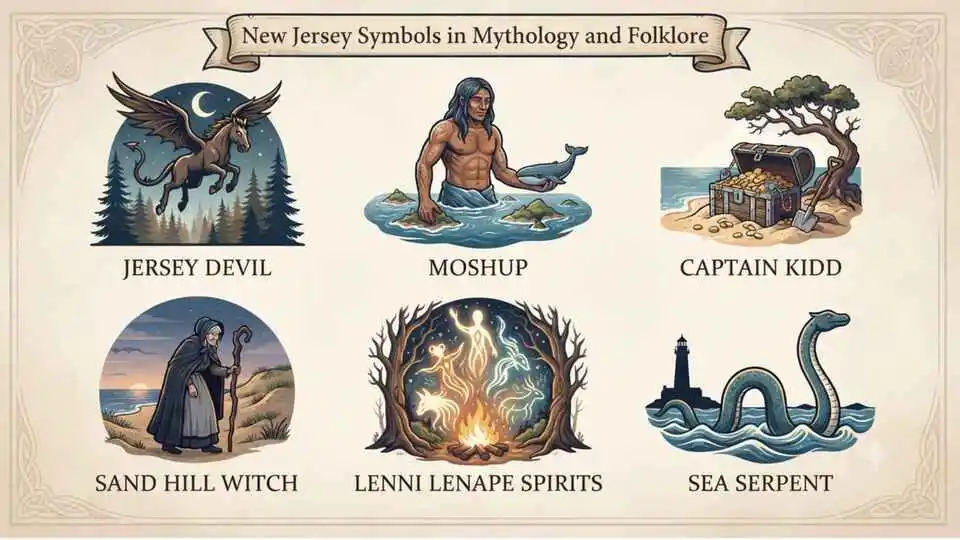
The rich landscape of the state has birthed wild legends and deep folklore that run parallel to its official tokens. The most famous piece of local folklore is the legendary Jersey Devil, a mythical creature said to inhabit the dark, lonely pine barrens.
While the horse and the goldfinch represent the light, cultured, and industrious side of human nature, the folklore of the Jersey Devil represents the untamed, mysterious shadow of the dense wilderness. These stories shaped modern meanings by showing that the local identity embraces both the beautifully organized farmland and the deep, mysterious secrets of nature.
New Jersey Symbols in Art, Literature, and Pop Culture
You can find these state emblems hiding in plain sight across many mediums of modern design and media. Local painters frequently capture the fiery red oak leaves and the bright yellow goldfinch to evoke a immediate sense of home. In literature and poetry, the rolling hills and agricultural icons serve as backdrops for stories about working class resilience.
In television and movies, references to the state’s unique icons often highlight the grit and hidden beauty of the region. Even in modern fashion, jewelry, and tattoos, young residents frequently use the outline of the state tree leaf or the historic horse head crest as a badge of honor and personal expression.
Spiritual and Dream Meaning of New Jersey Symbols
Dreaming of these specific state markers often brings positive and cautionary messages from your subconscious mind.
- The Goldfinch in Dreams: Seeing this bright bird in a dream suggests a time of upcoming joy, emotional healing, and a reminder to appreciate the small blessings in your life.
- The Red Oak in Dreams: Standing under a giant oak tree in a dream indicates that you possess the deep inner strength needed to survive a current life challenge. It is a sign to stay grounded.
- The Plow or State Seal in Dreams: This imagery can serve as a gentle cautionary message that you need to put more hard work and steady labor into your personal goals before you can harvest the rewards.
Positive and Negative Meanings of New Jersey Symbols
| Positive Meaning (Light) | Negative Meaning (Shadow) |
| Abundance and Prosperity: Celebrating the rewards of honest, ethical community labor. | Over Industrialization: The risk of forgetting the fragile earth in pursuit of constant financial gain. |
| Unwavering Liberty: Protecting personal freedom and welcoming diverse cultures. | Stubborn Resistance: Becoming too rigid and refusing to adapt to healthy social changes. |
| Natural Conservation: Honoring wild birds and ancient forests for future generations. | Complacency: Taking natural beauty for granted until it faces environmental danger. |
Why Humans Are Attracted to New Jersey Symbols
Our deep attraction to these tokens is rooted in psychological pattern recognition and collective memory. Humans naturally look for visual shortcuts to explain complex feelings of home, safety, and identity.
By anchoring our emotions to a specific bird, tree, or animal, we turn an abstract geographic boundary into a living, breathing family. This collective symbolism creates a comforting protective shield around our personal memories, making us feel connected to a larger human story.
Modern Uses of New Jersey Symbols
Today, these timeless icons are experiencing a massive renaissance among younger generations. You will find them elegantly stamped onto local sustainable branding, printed on trendy home decor, and used as primary themes for contemporary spiritual practices. Environmental groups use the goldfinch and the red oak as rallying points for vital conservation campaigns, proving that these old tokens still hold immense power to unite people for a good cause.
Interesting Facts About New Jersey Symbols
- The horse was officially named the state animal in 1977 after a determined group of school children launched a massive statewide writing campaign.
- The Great Seal of New Jersey was originally designed way back in 1776 by a talented artist named Pierre Eugene Du Simitiere.
- The three plows pictured on the official state shield represent the three oldest agricultural counties in the state.
- The state shell is the knobbed whelk, a beautiful marine snail shell that reminds everyone of the state’s historic connection to the Atlantic coast.
- The state dance is the square dance, a traditional community art form that reflects the cooperative spirit of early farming families.
Frequently Asked Questions
What is the primary meaning of the New Jersey state seal?
The state seal primarily represents freedom and abundance through the figures of Liberty and Prosperity, while the three plows highlight the state’s deep agricultural foundations.
Why is the horse the state animal of New Jersey?
The horse represents the incredible strength, historic labor, and equestrian heritage that helped build the state’s early economy and transportation networks.
What does the red oak symbolize?
The red oak symbolizes structural endurance, historic memory, and the deep, unyielding roots of the local communities.
Can anyone use these official symbols for branding?
So While the official state seal is reserved for formal government business, individual natural elements like the goldfinch and red oak leaf are widely used by local artists and businesses.
Conclusion
New jersey symbols provide a beautiful window into the heart of a region that balances industrial grit with breathtaking natural wonder. By understanding the deep history, psychological archetypes, and spiritual layers of these tokens, we can truly appreciate the resilient spirit of the people who call this state home. Thus Let these timeless emblems remind you to stay deeply rooted like the great red oak, while always keeping your spirit light and joyful like the golden bird in the sky.

I’m Daniel Brooks, a content creator and symbol enthusiast dedicated to researching the fascinating world of signs and symbols. I enjoy discovering the hidden meanings behind famous icons, emojis, historical emblems, and cultural symbols. Through my writing, I aim to provide trustworthy, well-researched, and reader-friendly information that helps people learn something new with every visit.
Books:
- The Complete Guide to World Symbols
- The Power of Universal Signs
 Mason Ellington
 Grace Whitmore