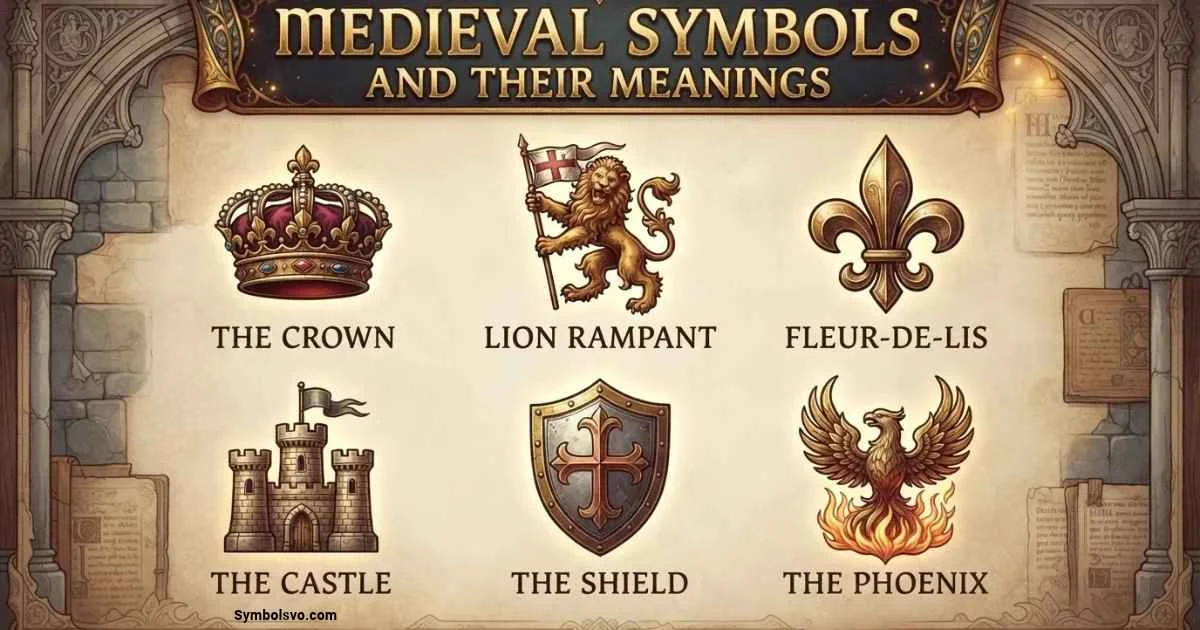
Medieval symbols tell fascinating stories about how people understood religion, nature, royalty, and everyday life. From the Christian cross and the Virgin Mary’s white lily to powerful lions, mythical dragons, and royal roses, these images carried messages that went far beyond decoration. They appeared in churches, castles, illuminated manuscripts, paintings, gardens, clothing, and family emblems.
During the Middle Ages, which historians generally date from approximately 500 to 1500 CE, visual imagery played an important role in European society. Religious institutions used symbols to communicate biblical teachings, artists included meaningful objects in paintings, and noble families displayed heraldic designs to establish their identity. Even ordinary plants and animals could carry spiritual or moral associations.
However, medieval symbolism wasn’t a single universal language. A rose might represent divine love in a religious painting but identify a royal family on a shield. A dragon could represent evil in one image and appear as a decorative creature in another.
Understanding these differences makes medieval symbols much more interesting. This guide explores their historical meanings, religious connections, botanical associations, artistic uses, and importance in medieval culture.
What Are Medieval Symbols?
Medieval symbols were visual signs, objects, colors, numbers, animals, and natural elements that communicated particular ideas during the Middle Ages. People used them to represent religious beliefs, political authority, family identity, moral values, and cultural traditions.
Unlike ordinary decorations, many symbols carried meanings that viewers could recognize through familiar stories, religious teachings, and artistic conventions.
For example, a medieval painting showing a white lily beside the Virgin Mary wasn’t simply displaying a beautiful flower. The lily commonly represented purity and virginity. Similarly, a lamb appearing beside Jesus Christ could refer to his sacrificial role in Christian theology.
Medieval symbolism developed through several influences:
- Christian theology: Biblical stories, saints, religious teachings, and Christian traditions.
- Classical mythology: Greek and Roman stories, creatures, and artistic conventions.
- Medieval bestiaries: Illustrated books explaining animals through natural descriptions and moral lessons.
- Royal heraldry: Coats of arms, shields, badges, and dynastic emblems.
- Natural history: Plants, flowers, fruits, and animals observed in everyday life.
- Medieval literature: Religious poetry, allegories, romances, and moral writings.
Why Were Symbols Important in Medieval Times?
Symbols helped people understand ideas that were sometimes difficult to communicate through words alone.
Although literacy varied considerably across medieval society, religious imagery allowed churches to present familiar biblical stories visually. A person entering a cathedral could recognize Christ, Mary, angels, saints, and important religious events through their traditional visual attributes.
Symbols also served practical purposes.
- Churches used images to communicate religious teachings.
- Artists included recognizable objects to identify biblical figures.
- Knights displayed coats of arms during tournaments and battles.
- Royal families used emblems to communicate political identity.
- Manuscript illustrators decorated pages with religious and natural imagery.
- Garden designers used enclosed spaces and selected plants to create meaningful settings.
How Did Medieval Symbolism Develop?
Medieval visual culture didn’t appear suddenly. It developed through centuries of artistic exchange and religious change.
Early Christian communities adopted visual traditions from the Roman world. Byzantine artists contributed important religious imagery, including iconic representations of Christ and the Virgin Mary. During the Romanesque and Gothic periods, European churches developed increasingly elaborate sculpture, stained glass, and architectural decoration.
By the late Middle Ages, illuminated manuscripts, devotional paintings, heraldic designs, and elaborate religious imagery had become important parts of European artistic culture.
Medieval Symbols and Their Meanings: An Overview
The following table introduces some recognizable medieval symbols and their common historical associations.
| Medieval symbol | Common meaning or association |
| Christian cross | Christ’s Crucifixion and salvation |
| Chi-Rho | Jesus Christ |
| Christian fish | Christian faith |
| Dove | Holy Spirit and peace |
| Lamb | Jesus Christ and sacrifice |
| White lily | Purity and the Virgin Mary |
| Red rose | Love, martyrdom, and religious devotion |
| Grapes | Eucharist and Christ’s blood |
| Serpent | Temptation and original sin |
| Dragon | Evil and spiritual danger |
| Lion | Strength, courage, and royal authority |
| Unicorn | Purity and Marian allegory |
| Eagle | Power and St. John the Evangelist |
| Fleur-de-lis | French royal identity and Marian associations |
| Enclosed garden | Paradise and Mary’s virginity |
| Three | Holy Trinity |
| Five wounds | Christ’s Passion |
These meanings provide a useful starting point. However, historical context matters. Not every medieval image of an animal or flower carried a religious message.
Medieval Religious Symbols and Their Meanings
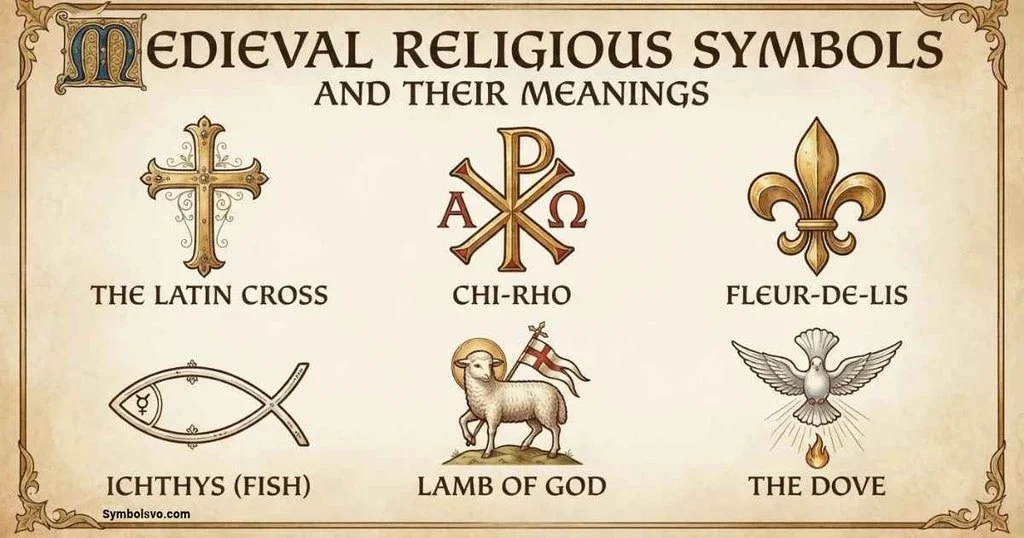
Christianity strongly influenced medieval European art, architecture, education, and public life. Consequently, medieval religious symbols appeared throughout churches, monasteries, manuscripts, paintings, tombs, and devotional objects.
Many symbols communicated biblical events or represented important Christian teachings.
The Christian Cross
The cross is one of the most recognizable medieval Christian symbols. It represents the Crucifixion of Jesus Christ and serves as a central image of Christian faith.
Medieval artists used different cross designs depending on the purpose and artistic setting.
- Latin cross: A vertical structure with a shorter horizontal arm, commonly associated with Christ’s Crucifixion.
- Crucifix: A cross displaying the figure of Jesus.
- Greek cross: A cross with four arms of approximately equal length.
- Processional cross: A cross carried during religious ceremonies and processions.
Churches displayed crosses on altars, walls, manuscripts, and religious objects. Some medieval crosses also contained precious metals, gemstones, or elaborate decorative patterns.
The cross communicated sacrifice, redemption, suffering, and the Christian hope of salvation.
The Chi-Rho Symbol
The Chi-Rho is an ancient Christian monogram formed by combining the Greek letters Chi (Χ) and Rho (Ρ). Both letters appear in the Greek spelling of Christ’s name.
Artists frequently incorporated the Chi-Rho into manuscripts, church decorations, and religious objects.
Its importance comes from its direct association with Jesus Christ. It also connects medieval Christian art with earlier traditions of Christian visual identity.
The Ichthys (Christian Fish)
The Ichthys, commonly called the Christian fish, represents Christian faith and has roots in early Christianity.
The Greek word ichthys means fish. Early Christians also interpreted its letters as an abbreviation connected to Jesus Christ, the Son of God, and Savior.
Although the fish symbol existed before the medieval period, Christians continued using fish imagery in religious art and decorative traditions.
Fish could also appear in biblical scenes involving:
- Jesus feeding a multitude.
- The calling of fishermen as disciples.
- The miraculous catch of fish.
- The story of Jonah.
Its meaning depends on the particular biblical or artistic context.
The Dove
The dove represents the Holy Spirit, peace, and divine presence in Christian symbolism.
One of its most important biblical associations comes from the baptism of Jesus. The Gospels describe the Holy Spirit descending like a dove.
Medieval painters used the dove to represent the Holy Spirit in scenes such as the Annunciation and Pentecost.
It also appeared in religious manuscripts, church decorations, and depictions of saints.
The Lamb of God (Agnus Dei)
The lamb is one of the most important animal symbols in medieval Christian art.
Known as Agnus Dei, meaning Lamb of God, it represents Jesus Christ and his sacrificial role in Christian theology.
The symbolism connects with biblical references to Christ as the Lamb who takes away the sins of the world.
Medieval artists frequently portrayed a lamb carrying a cross or banner. This image connected Christ’s innocence with his sacrifice.
The lamb also appeared in religious objects, church sculpture, manuscripts, and decorative designs.
The Halo and Aureole
A halo is a circular shape surrounding the head of a holy figure. It communicates holiness, spiritual importance, or divine association.
Medieval artists used halos to identify Christ, the Virgin Mary, angels, and saints.
An aureole, sometimes called a mandorla when it takes an almond-like shape, surrounds the entire body rather than just the head.
Common visual forms included:
- Circular halos.
- Cross-shaped halos associated particularly with Christ.
- Decorative gold halos.
- Full-body aureoles around important religious figures.
These features helped viewers recognize sacred figures within complicated religious compositions.
Alpha and Omega
Alpha and Omega are the first and last letters of the Greek alphabet.
In Christian theology, they represent the beginning and the end. The expression connects with the Book of Revelation, where God and Christ are described using this imagery.
Medieval churches and manuscripts sometimes displayed these letters beside religious figures or within decorative compositions.
They communicated eternity, divine authority, and the belief that God stands beyond the limits of time.
The Holy Trinity
The Holy Trinity represents the Father, Son, and Holy Spirit as three distinct persons within one God.
The number three therefore became especially important in medieval Christian symbolism.
Artists represented the Trinity in different ways, including:
- Three interrelated figures.
- Three circles or connected shapes.
- The Father, Son, and Holy Spirit represented together.
- The dove represents the Holy Spirit alongside Christ and God the Father.
Not every three-part design represents the Trinity. Its meaning depends on the subject and surrounding imagery.
The Five Wounds of Christ
The Five Wounds of Christ refer to the injuries traditionally associated with the Crucifixion: two hands, two feet, and the side of Jesus.
During the later Middle Ages, devotion to Christ’s suffering became especially prominent in European Christianity.
Artists and religious writers used these wounds to encourage reflection on sacrifice, suffering, redemption, and salvation.
The number five became an important part of this devotional tradition.
Medieval Christian Symbols Associated With the Virgin Mary
The Virgin Mary occupied a central place in medieval Christian devotion. Artists used flowers, colors, gardens, stars, and other objects to communicate her purity, motherhood, and spiritual importance.
These images formed an important part of medieval religious imagery.
The White Lily
The white lily is among the most recognizable flowers associated with the Virgin Mary.
It commonly represents purity, innocence, and virginity.
One of its strongest associations appears in paintings of the Annunciation, when the angel Gabriel announces that Mary will become the mother of Jesus.
Artists often placed a white lily in the composition to reinforce Mary’s purity.
The flower became a recognizable feature of medieval Christian paintings and devotional art.
The Rose
The rose represents several ideas in medieval Christian art, including love, spiritual beauty, and devotion.
White roses could suggest purity, while red roses sometimes carried associations with love, sacrifice, and martyrdom.
Mary also became associated with the rose through devotional titles and religious imagery.
The flower appeared in gardens, paintings, manuscript borders, and decorative church designs.
The Enclosed Garden (Hortus Conclusus)
The Latin expression Hortus Conclusus means enclosed garden.
It comes from the Song of Songs, where the phrase describes a locked garden and sealed fountain.
Christian interpreters connected this imagery with the Virgin Mary’s purity and perpetual virginity.
Medieval paintings often showed Mary inside a walled garden surrounded by flowers, trees, fountains, and carefully arranged plants.
The garden represented a protected sacred space. Its enclosure also reflected the belief in Mary’s unique spiritual status.
The Sealed Fountain and Well
A sealed fountain or enclosed well could symbolize purity, spiritual protection, and Marian virginity.
These images developed through biblical interpretation, particularly the Song of Songs.
Artists sometimes included fountains, wells, and flowing water in representations of paradise and the Virgin Mary.
Water also carried broader Christian associations with baptism, cleansing, and spiritual renewal.
The Blue Mantle
Blue became strongly associated with the Virgin Mary in medieval and Renaissance religious art.
Artists frequently portrayed Mary wearing a blue mantle or robe.
Blue could communicate heavenly status, dignity, and spiritual importance. The expensive pigment ultramarine, made from lapis lazuli, also gave blue clothing special visual prestige.
However, medieval artists did not use blue exclusively for Mary. Its meaning depended on the artwork and its cultural setting.
The Crescent Moon
The crescent moon became an important feature in some representations of the Virgin Mary.
Its connection comes partly from the Woman of the Apocalypse in the Book of Revelation, who appears with the moon beneath her feet.
Medieval and later Christian artists connected this biblical figure with Marian imagery.
The crescent could therefore communicate Mary’s heavenly status and association with the triumph of good over evil.
Star of the Sea (Stella Maris)
Stella Maris, meaning Star of the Sea, is a traditional title associated with the Virgin Mary.
It presents Mary as a source of spiritual guidance and protection.
The image became especially meaningful in Christian communities connected with maritime travel and pilgrimage.
Stars also appeared in Marian paintings, decorative borders, and religious objects.
Medieval Plant Symbols and Their Meanings
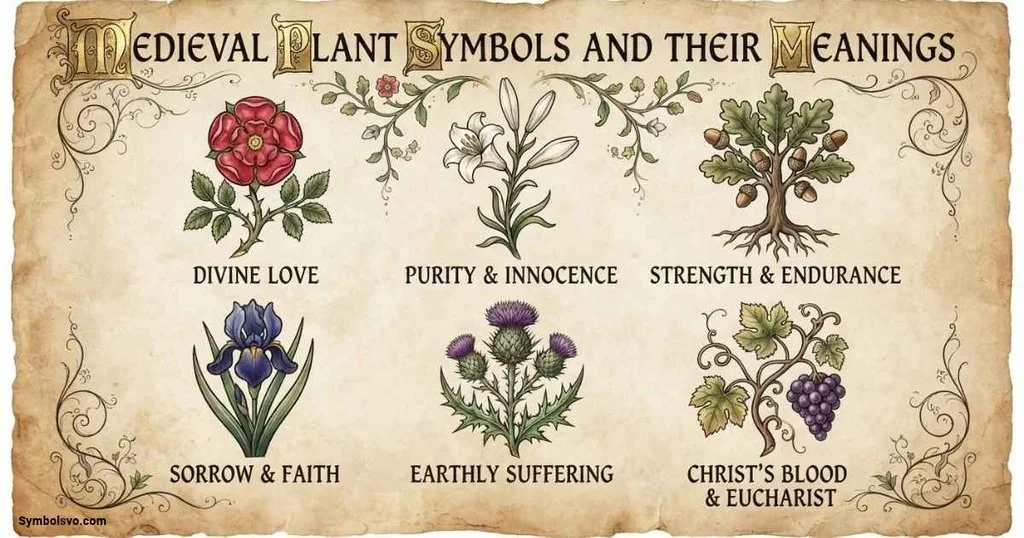
Plants played several roles in medieval society. People grew them for food, medicine, decoration, and religious ceremonies. Artists also used flowers, fruits, and leaves to communicate spiritual ideas.
Medieval plant symbolism developed through biblical interpretation, Christian traditions, botanical knowledge, and artistic conventions.
However, not every plant carried a symbolic meaning. Some appeared in paintings simply because they belonged to the natural world or helped create a convincing setting.
Daisy Symbolism
The daisy was a familiar flower in European gardens and natural landscapes.
Its name comes from the expression “day’s eye,” referring to the flower’s tendency to open during daylight and close at night.
In Christian floral imagery, daisies could suggest innocence, simplicity, and purity. Their small white petals and yellow centers also made them useful decorative elements in medieval artistic compositions.
Daisies appeared in religious and secular imagery, although their meaning depended on the surrounding subject.
Marigold Symbolism
Marigolds belong to a group of flowering plants with a long history of cultivation and traditional use.
Their bright yellow and orange flowers made them visually distinctive. Medieval and later European traditions associated certain flowers with religious celebrations and the Virgin Mary.
When discussing marigolds in medieval art, it’s important to identify the actual plant. The modern common name can refer to different species, and later flower traditions shouldn’t automatically be applied to medieval illustrations.
Red Rose Symbolism
The red rose carried several associations in medieval European culture.
In Christian imagery, roses could represent divine love, spiritual beauty, and martyrdom. Their red color also created a natural visual connection with blood and sacrifice.
Roses became particularly important in English heraldry during the late medieval period.
The House of Lancaster and the House of York became associated with red and white roses during the Wars of the Roses (1455–1487). These were dynastic badges, not simply flower meanings.
White Rose Symbolism
White roses commonly suggested purity, innocence, and spiritual beauty in Christian imagery.
They also became associated with the House of York in English royal history.
The distinction matters because the White Rose of York served as a political and dynastic emblem. Its historical meaning differs from the religious symbolism of a white flower in a painting.
Iris Symbolism
The iris is a distinctive flower with large petals and a striking shape.
Its appearance in Christian art sometimes encouraged associations with the Virgin Mary and religious devotion.
Some interpretations connect the sword-like shape of the iris with Mary’s sorrow, particularly her suffering during Christ’s Passion.
However, this interpretation needs to be connected to a specific artwork or historical source rather than treated as a universal meaning.
Speedwell Flower Symbolism
Speedwell refers to several flowering plants belonging to the genus Veronica.
These plants grow in different habitats and produce small blue, purple, or white flowers.
Although speedwell appears in European botanical traditions, its specific medieval religious symbolism is less firmly established than that of the rose or lily.
For historical accuracy, it’s better to discuss its botanical identity, traditional uses, and documented appearances than assign it an invented spiritual meaning.
Strawberry Symbolism
Strawberries appear in several medieval and early Renaissance religious paintings.
Their fruit, flowers, and distinctive three-part leaves made them recognizable decorative elements.
In Christian interpretations, strawberries could suggest purity, righteousness, and paradise. Their low-growing habit also allowed artists to include them close to the Virgin Mary or other sacred figures.
The plant’s appearance in religious compositions reflects the broader medieval practice of using familiar natural objects to communicate spiritual ideas.
Carnation Symbolism
Carnations have a long history in European decorative and artistic traditions.
Their associations with love and affection became particularly familiar in later flower symbolism. In religious paintings, however, carnations could carry meanings connected with love, marriage, and devotion.
A carnation’s exact significance depends on the artwork, its date, and the figures surrounding it.
Holly and Ivy Symbolism
Holly and ivy are evergreen plants that retain their leaves during winter.
Their ability to remain green when many other plants lose their foliage made them useful symbols in seasonal decoration.
Holly also developed strong associations with later Christmas traditions. However, modern Christmas meanings shouldn’t automatically be assigned to every medieval depiction of these plants.
Ivy appeared in decorative patterns, manuscripts, and architectural ornament. Its climbing growth also offered artists an attractive natural motif.
Grape Symbolism
Grapes hold an important place in Christian symbolism because of their connection to wine and the Eucharist.
During the Last Supper, Jesus associated wine with his blood. Christian theology later connected this imagery with the sacrament of Communion.
Grape vines and clusters of fruit therefore became recognizable elements in religious paintings, church carvings, and manuscript decoration.
Grapes could also represent abundance, fertility, harvest, and the rewards of cultivation.
Their meaning depended on whether the image focused on religious worship, agriculture, or everyday life.
Orange Symbolism
Oranges and other citrus fruits entered European markets through long-distance trade and agricultural exchange.
They appeared in some late medieval and early Renaissance artistic settings, where their unusual appearance and value could make them interesting objects.
An orange might suggest wealth, trade, luxury, or the natural abundance of a garden.
However, its presence doesn’t automatically indicate a specific Christian meaning.
Walnut Symbolism
Walnuts were useful food products in medieval households.
People valued their edible kernels, oil, and other practical applications. Medieval medical traditions also discussed walnuts within broader theories of health and nutrition.
In botanical illustrations, the walnut’s hard shell and distinctive interior structure made it an interesting subject.
Its practical importance is better documented than any universal religious symbolism.
Aubergine Symbolism
Aubergines, also called eggplants, reached parts of medieval Europe through trade and agricultural exchange.
They were already cultivated in regions connected to the wider Islamic world before becoming more familiar in European gardens and kitchens.
Medieval illustrations sometimes recorded unfamiliar crops and their physical characteristics.
The aubergine is therefore useful when exploring medieval botanical knowledge, food history, and cultural exchange. Its symbolic meaning should only be discussed when supported by a particular historical example.
Other Plants Found in Medieval Gardens
Medieval gardens contained many useful plants beyond flowers and ornamental trees.
| Plant | Historical use or association |
| Lavender | Fragrance and household use |
| Sage | Culinary and medicinal traditions |
| Rosemary | Cooking and traditional household uses |
| Thyme | Seasoning and herbal preparations |
| Bay | Cooking and ceremonial traditions |
| Hazel | Nuts and practical garden cultivation |
| Willow | Useful wood and traditional remedies |
| Chestnut | Food and woodland resources |
| Comfrey | Traditional herbal applications |
| Holly | Evergreen decoration |
These plants help explain the relationship between medieval botanical knowledge, household practices, medicine, and garden design.
Medieval Nature Symbols and Their Meanings
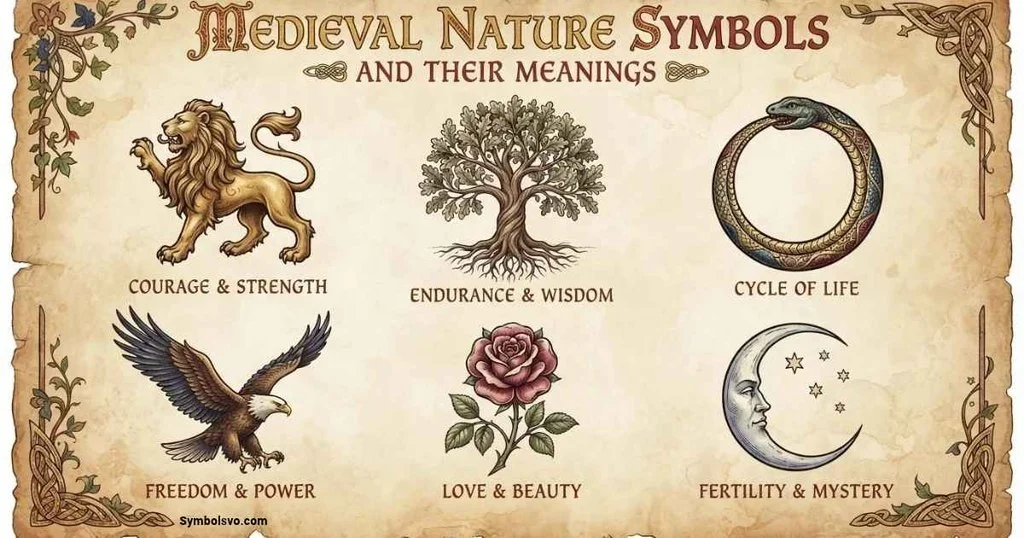
Nature offered medieval artists a rich collection of recognizable images. Animals, birds, insects, and mythical creatures appeared in manuscripts, church carvings, paintings, and decorative objects.
The medieval bestiary played an especially important role in this tradition.
Bestiaries described animals through a mixture of inherited natural knowledge, religious interpretation, and moral storytelling. The Getty Museum’s research on medieval bestiaries explains how these books connected animal descriptions with Christian lessons and artistic imagery.
The Dove
The dove commonly represents the Holy Spirit and peace.
Its most recognizable Christian association comes from the baptism of Jesus, when the Holy Spirit descended like a dove.
Artists also used dove imagery to communicate innocence, divine guidance, and spiritual presence.
The Serpent
The serpent is strongly associated with the Garden of Eden and the story of Adam and Eve.
According to the biblical account in Genesis, the serpent tempted Eve to eat the forbidden fruit from the Tree of Knowledge.
Christian interpretations connected the serpent with temptation, deception, sin, and the Fall of Humanity.
Medieval artists frequently included serpents in scenes showing Adam and Eve.
The creature became a recognizable visual representation of humanity’s disobedience and separation from paradise.
The Dragon
Dragons appeared frequently in medieval manuscripts, paintings, bestiaries, and church decorations.
Christian artists often used dragons to represent evil, spiritual danger, and forces opposed to God.
One famous example involves Saint George, who defeats a dragon to save a princess.
The story became an important example of good overcoming evil.
Saint Michael also appears in medieval art defeating a dragon or dragon-like creature. This imagery connects his role as a heavenly warrior with the triumph of divine authority.
Not every medieval dragon carried precisely the same meaning. Some appeared as decorative creatures, while others served specific religious or moral purposes.
The Butterfly
Butterflies undergo a striking transformation from caterpillar to chrysalis and finally into adult insects.
This natural process encouraged later Christian interpretations involving transformation, resurrection, and new life.
Butterflies also appeared in decorative art and natural illustrations.
However, it’s important not to assume that every butterfly in a medieval image represents the Resurrection. Some illustrations simply depict natural creatures.
The Lion
The lion represented strength, courage, authority, and royal power.
It also had important Christian associations.
Medieval bestiaries sometimes connected the lion with Jesus Christ, particularly through the biblical image of the Lion of Judah.
Lions appeared on coats of arms, royal objects, sculptures, and decorative vessels.
The Metropolitan Museum of Art discusses the lion’s important place in medieval religious and heraldic symbolism.
The Metropolitan Museum of Art
The Unicorn
The unicorn is one of the most fascinating creatures in medieval symbolism.
Bestiaries described it as a mysterious animal with a single horn. Christian interpretations sometimes connected it with Christ and the Virgin Mary.
In the famous medieval allegory of the unicorn hunt, the creature could represent Christ entering the world through Mary’s virginity.
Unicorns also appeared in tapestries, manuscripts, decorative objects, and secular works.
Their symbolism could therefore include purity, spiritual mystery, and religious allegory.
The Eagle
The eagle represented strength, authority, and elevated spiritual vision.
Christian art also associated the eagle with St. John the Evangelist, one of the four Gospel writers.
The eagle became his traditional symbol because of its association with the opening of John’s Gospel and the elevated nature of its theological vision.
Eagles also appeared in imperial imagery, royal emblems, and heraldic designs.
The Lamb
The lamb represented innocence, sacrifice, and Jesus Christ.
Its association with the Lamb of God made it especially important in medieval religious imagery.
Artists used the lamb in paintings, manuscripts, church decorations, and religious objects to communicate Christ’s sacrifice and the promise of salvation.
Other Medieval Animal Motifs
Medieval artists also included many smaller creatures in religious and secular compositions.
- Rabbits: Sometimes associated with fertility and reproduction.
- Snails: Frequently appeared in manuscript marginalia, sometimes in humorous or unusual scenes.
- Birds: Could represent spiritual ideas, natural beauty, or specific biblical stories.
- Foxes: Often appeared in bestiaries and moral stories associated with cunning and deception.
- Pelicans: Christian imagery sometimes showed a pelican feeding its young with its own blood, an allegory of Christ’s sacrifice.
These examples show how medieval artists used animals to communicate ideas about human behavior, Christian faith, and the natural world.
Medieval Garden Symbols and the Meaning of Paradise Gardens
Medieval gardens served practical and spiritual purposes.
People grew herbs, vegetables, fruits, and flowers for household use. Monasteries also maintained gardens for food production, medicine, contemplation, and religious life.
At the same time, gardens became important images in medieval literature and religious art.
The Garden of Eden and the enclosed garden became especially influential in Christian symbolism.
The Garden of Eden
The Garden of Eden comes from the biblical Book of Genesis.
According to the biblical story, God created Adam and Eve and placed them in a beautiful garden. The garden contained abundant vegetation and the Tree of Life.
However, the serpent tempted Eve to eat fruit from the Tree of Knowledge. Adam also ate the forbidden fruit, leading to their expulsion from paradise.
Medieval artists used this story to explore several religious themes:
- Creation and divine perfection.
- Original sin and temptation.
- The relationship between humanity and God.
- The loss of paradise.
- The possibility of redemption.
The Garden of Eden became an important subject in medieval paintings, manuscripts, and religious sculpture.
The Enclosed Garden (Hortus Conclusus)
The Hortus Conclusus represents an enclosed garden, usually surrounded by walls.
Its religious meaning developed through medieval interpretations of the Song of Songs.
Christian commentators connected the enclosed garden and sealed fountain with the Virgin Mary’s purity and virginity.
In paintings, the garden often contains flowers, trees, fountains, and carefully arranged spaces.
The National Gallery identifies the enclosed garden as an important Christian image associated with Mary’s virginity and purity.
Paradise Gardens
Paradise gardens represented idealized spaces of beauty, peace, and divine order.
Artists used elements such as:
- Flowering plants.
- Fruit trees.
- Freshwater fountains.
- Enclosed walls.
- Green lawns.
- Carefully arranged pathways.
These features helped communicate the idea of a protected and harmonious environment.
The image is also connected with descriptions of paradise in biblical and religious literature.
Mary’s Garden and Marian Symbolism
Mary’s garden became an important theme in late medieval religious paintings.
Artists sometimes placed the Virgin Mary inside a walled garden with flowers and fountains.
Common elements included:
| Garden element | Common association |
| White lily | Purity and virginity |
| Rose | Love and spiritual beauty |
| Fountain | Purity and spiritual renewal |
| Enclosing wall | Protection and virginity |
| Fruit trees | Abundance and paradise |
| Green lawn | Life and natural beauty |
The garden created a visual setting that helped viewers understand Mary’s religious importance.
What Did Medieval Gardens Look Like?
Medieval gardens varied according to wealth, location, and purpose.
A royal garden differed considerably from a monastery’s practical growing space. However, many medieval gardens used enclosed layouts with defined planting areas.
Common features included:
- Walled or hedged boundaries.
- Rectangular or square planting beds.
- Narrow paths.
- Raised beds.
- Fruit trees.
- Medicinal herbs.
- Flowering plants.
- Water features.
Some gardens served mainly practical purposes, while others offered places for recreation and contemplation.
Plants Commonly Grown in Medieval Gardens
Medieval households and religious communities cultivated a wide range of useful plants.
Culinary herbs:
- Sage
- Rosemary
- Thyme
- Parsley
- Mint
- Dill
Medicinal plants:
- Lavender
- Comfrey
- Chamomile
- Fennel
- Hyssop
Food crops:
- Cabbage
- Onions
- Peas
- Beans
- Leeks
- Turnips
Fruit plants:
- Apples
- Pears
- Cherries
- Strawberries
- Grapes
The exact selection depended on regional climate, trade, available resources, and local gardening traditions.
Medieval Religious Gardens
Monasteries maintained gardens for several reasons.
They provided food, medicinal ingredients, and useful plants for religious communities. Their enclosed spaces also offered quiet places for prayer and reflection.
A cloister garden often occupied a central courtyard surrounded by covered walkways.
Its design separated the garden from the surrounding buildings and created a peaceful environment.
The University of St Andrews’ research on medieval monastic gardens explains how these spaces combined practical horticulture with religious life.
Medieval Symbols in Art, Paintings, and Illuminated Manuscripts
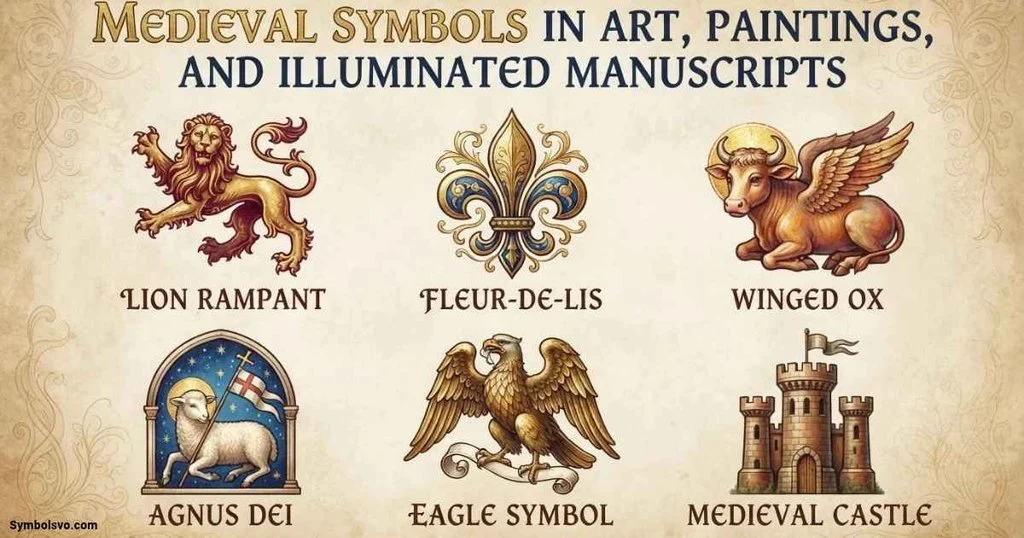
Medieval artists used symbolism to communicate stories, beliefs, and important cultural ideas.
Paintings and manuscripts often contained more than one symbolic detail. A religious scene might include a flower representing purity, an animal representing evil, and a color associated with heavenly authority.
These details helped viewers understand the subject and its deeper meaning.
Medieval Iconography
Medieval iconography refers to the study and interpretation of images, figures, objects, and visual themes in medieval art.
It helps historians identify religious figures and understand the messages behind their representations.
For example:
- St. Peter often appears holding keys.
- St. Catherine of Alexandria is traditionally associated with a wheel.
- St. John the Evangelist appears with an eagle.
- St. Jerome is often shown with a lion.
- St. Michael appears defeating a dragon or Satan.
These recognizable attributes helped viewers identify saints even when several religious figures appeared together.
Symbols in Medieval Paintings
Medieval Christian paintings frequently included symbolic objects.
A painting of the Annunciation might show Mary with a white lily. A Crucifixion scene might include a skull, representing mortality and the location traditionally associated with Adam’s burial.
Other common elements included:
- Books representing religious knowledge.
- Crowns representing authority.
- Keys representing spiritual responsibility.
- Swords representing justice or martyrdom.
- Fruit representing temptation or abundance.
- Gold backgrounds representing heavenly glory.
The meaning of an object depended on the scene. A crown worn by a king communicated something different from a crown placed on the Virgin Mary.
Illuminated Manuscripts
Illuminated manuscripts were handwritten books decorated with elaborate illustrations, colorful initials, and sometimes gold or silver.
They became important works of medieval religious and literary culture.
Monks and professional scribes produced manuscripts for churches, wealthy patrons, universities, and private devotion.
Their decorations included:
- Biblical scenes.
- Religious figures.
- Decorative borders.
- Floral patterns.
- Animals and mythical creatures.
- Elaborate opening letters.
The illustrations helped readers understand the text while making the manuscripts visually impressive.
Books of Hours
A Book of Hours was a private devotional book containing prayers and religious texts arranged around the hours of the day.
These books became especially popular during the later Middle Ages.
Many included calendar pages showing saints’ feast days and seasonal activities.
Their illustrations could contain flowers, birds, fruit, animals, and decorative borders.
Some famous examples include the Très Riches Heures du Duc de Berry and the Hours of Étienne Chevalier, illustrated by Jean Fouquet.
These manuscripts provide valuable evidence about medieval religious devotion, artistic practices, clothing, architecture, and everyday life.
Medieval Marginalia
Marginalia refers to illustrations and decorations placed in manuscript margins.
Unlike the main text, these images sometimes contained humorous, strange, or imaginative subjects.
Medieval marginalia could feature:
- Rabbits carrying weapons.
- Snails confronting knights.
- Musicians and performers.
- Hybrid human-animal creatures.
- Mythical beasts.
- Plants and decorative foliage.
Some marginal images carried moral or religious meanings. Others served decorative or entertaining purposes.
It’s important not to interpret every unusual creature as a hidden religious message. Context matters.
Medieval Bestiaries
A bestiary was an illustrated book describing animals and their supposed characteristics.
Medieval bestiaries combined natural observations with biblical interpretation, inherited classical knowledge, and moral lessons.
The lion, unicorn, dragon, fox, eagle, and other creatures appeared frequently.
For example, the lion could represent Christ because of its positive religious associations. The unicorn could symbolize Christ in certain Christian interpretations, while the fox often represented cunning and deception.
Bestiaries helped spread animal symbolism beyond books into paintings, sculpture, tapestries, and decorative objects.
Seasonal and Botanical Manuscript Illustrations
Many medieval manuscripts included illustrations showing the changing seasons.
Calendar pages sometimes depicted agricultural activities associated with different months.
Examples included:
- Plowing fields during spring.
- Harvesting crops during summer.
- Collecting grapes during autumn.
- Preparing for winter during colder months.
These illustrations reveal how closely medieval society depended on agriculture.
They also provide valuable information about historical clothing, farming tools, food production, and garden plants.
The Tacuinum Sanitatis is another important example. Based on the work of Ibn Butlan, it presented knowledge about health, food, plants, and daily living through illustrated scenes.
Medieval Church Symbols and Gothic Cathedral Decorations
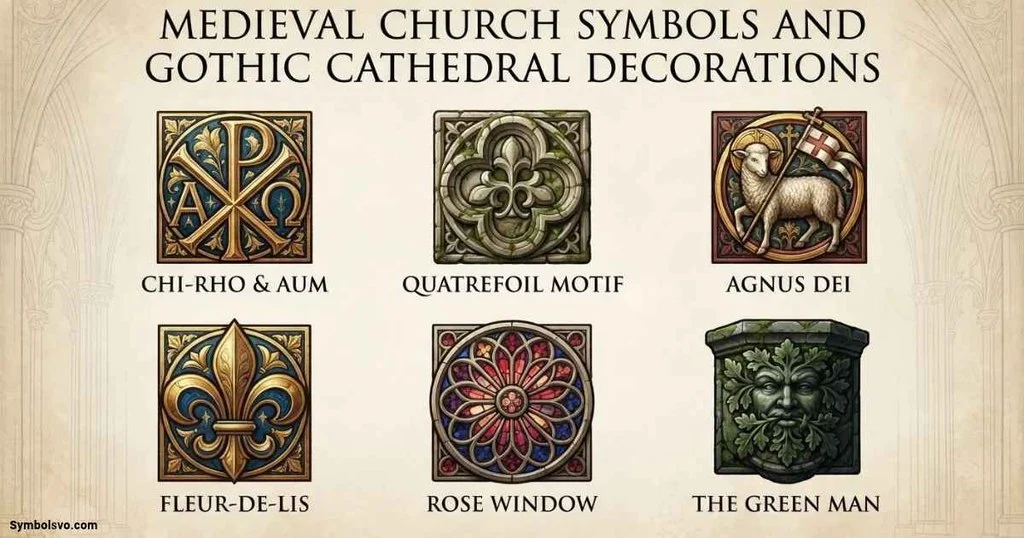
Churches were among the most important places for medieval symbolic art.
Their walls, windows, entrances, columns, and ceilings contained religious imagery that communicated Christian beliefs.
During the Romanesque and Gothic periods, architectural decoration became increasingly elaborate.
Gothic Cathedral Symbolism
Gothic architecture developed during the Middle Ages and became known for its pointed arches, ribbed vaults, flying buttresses, and large stained-glass windows.
These features served important structural purposes.
However, medieval viewers also encountered religious imagery throughout Gothic churches.
Tall interiors directed attention upward, while stained glass filled buildings with colored light.
Religious sculptures and paintings presented stories from the Bible and the lives of saints.
Plant and Flower Carvings
Stone carvers frequently included natural forms in medieval church decoration.
Common designs featured:
- Oak leaves.
- Ivy.
- Grapevines.
- Flower patterns.
- Tree branches.
- Decorative foliage.
These carvings could serve purely ornamental purposes or contribute to religious imagery.
Gothic buildings often combined natural forms with geometric patterns and human figures.
Gargoyles and Grotesques
Gargoyles are carved architectural features that project from buildings and carry rainwater away from walls.
Their unusual shapes often resemble animals, monsters, or imaginary creatures.
Grotesques look similar but don’t necessarily function as water outlets.
Medieval churches sometimes included frightening creatures in their decorative programs. These figures could create striking contrasts with sacred imagery.
However, not every gargoyle represented the devil or a specific religious concept. Many served architectural, decorative, or imaginative purposes.
Medieval Church Animals
Animals appeared throughout medieval church decoration.
Lions, eagles, lambs, dragons, and serpents had recognizable associations within Christian art and medieval storytelling.
Artists used these creatures to communicate moral lessons, religious narratives, and ideas about good and evil.
Stained Glass Symbols
Stained-glass windows became an important feature of medieval church architecture.
They allowed artists to tell religious stories through colored glass.
Windows could portray:
- Jesus Christ.
- The Virgin Mary.
- Biblical events.
- Christian saints.
- Angels.
- Royal donors.
- Heraldic emblems.
The colors and figures helped viewers recognize important subjects.
Stained glass also transformed natural light into a dramatic part of the church interior.
Lincoln Cathedral and the Lincoln Imp
Lincoln Cathedral is famous for its medieval architecture and the popular legend of the Lincoln Imp.
The Lincoln Imp is a small grotesque figure associated with local folklore.
According to the legend, a mischievous imp entered the cathedral and caused trouble before being turned to stone.
The story connects the figure with ideas about evil, mischief, and divine protection.
However, the imp’s legendary story should be distinguished from the cathedral’s documented architectural history.
The cathedral also contains important medieval sculpture, including the Angel Choir, which features elaborate religious decoration.
Other Important Medieval Cathedrals
Several European cathedrals preserve important examples of medieval symbolism.
| Cathedral | Notable historical features |
| Lincoln Cathedral, England | Gothic architecture, Angel Choir, and Lincoln Imp folklore |
| Lichfield Cathedral, England | Gothic architecture and medieval sculpture |
| Exeter Cathedral, England | Elaborate Gothic stonework and vaulted ceiling |
| Salisbury Cathedral, England | Medieval Gothic architecture and historic sculpture |
| Beverley Minster, England | Gothic architecture, carved details, and religious decoration |
These buildings help researchers understand how medieval communities combined architecture, sculpture, religious teaching, and artistic expression.
Medieval Colors and Number Symbolism
Colors and numbers played important roles in medieval religious art.
Artists used them to distinguish figures, emphasize important scenes, and communicate familiar theological ideas.
However, medieval color meanings weren’t always fixed. Pigment availability, artistic traditions, regional preferences, and the subject all influenced their use.
Red Symbolism
Red commonly appeared in Christian imagery associated with blood, sacrifice, martyrdom, and divine love.
Artists used red garments to emphasize important figures and create visual contrast.
The color also appeared in royal heraldry and decorative manuscripts.
White Symbolism
White commonly represented purity, innocence, and holiness.
It appeared in depictions of the Virgin Mary, angels, saints, and religious ceremonies.
White flowers, particularly lilies, became important elements in Marian imagery.
Blue Symbolism
Blue developed a strong association with heavenly imagery and the Virgin Mary.
Ultramarine, produced from lapis lazuli, was particularly valuable.
Artists sometimes reserved this expensive pigment for important religious figures.
Blue clothing in medieval paintings could therefore communicate spiritual significance as well as wealth and artistic prestige.
Gold Symbolism
Gold represented divine glory, heavenly light, and spiritual importance.
Artists used gold leaf in illuminated manuscripts, religious paintings, altarpieces, and decorative objects.
Its reflective surface created a visual effect that ordinary pigments couldn’t reproduce.
Gold also communicated wealth and royal authority.
Green Symbolism
Green appeared frequently in natural and decorative imagery.
It could suggest vegetation, growth, springtime, and renewal.
In religious compositions, green sometimes contributed to ideas about life and spiritual restoration.
However, its meaning depended on the subject and artistic setting.
The Number Three
Three held special significance because of the Holy Trinity.
Medieval artists sometimes organized religious compositions into three-part arrangements.
The number also appeared in biblical narratives and Christian theological traditions.
The Number Five
Five became particularly important through devotion to the Five Wounds of Christ.
Artists and religious writers used this association to encourage reflection on Christ’s suffering and sacrifice.
The Number Seven
Seven appears throughout Christian theology and biblical traditions.
Important examples include:
- Seven deadly sins.
- Seven heavenly virtues.
- Seven sacraments.
- Seven days of creation.
- Seven gifts of the Holy Spirit.
These associations made seven an important number in medieval religious literature and art.
The Number Twelve
Twelve had several biblical associations.
It represented the twelve apostles and the twelve such as groups of Israel.
The number also appeared in descriptions of the heavenly Jerusalem in the Book of Revelation.
Medieval artists used twelve-part arrangements in religious decoration, architectural programs, and manuscript illustrations.
Medieval Royal Symbols and Heraldic Emblems
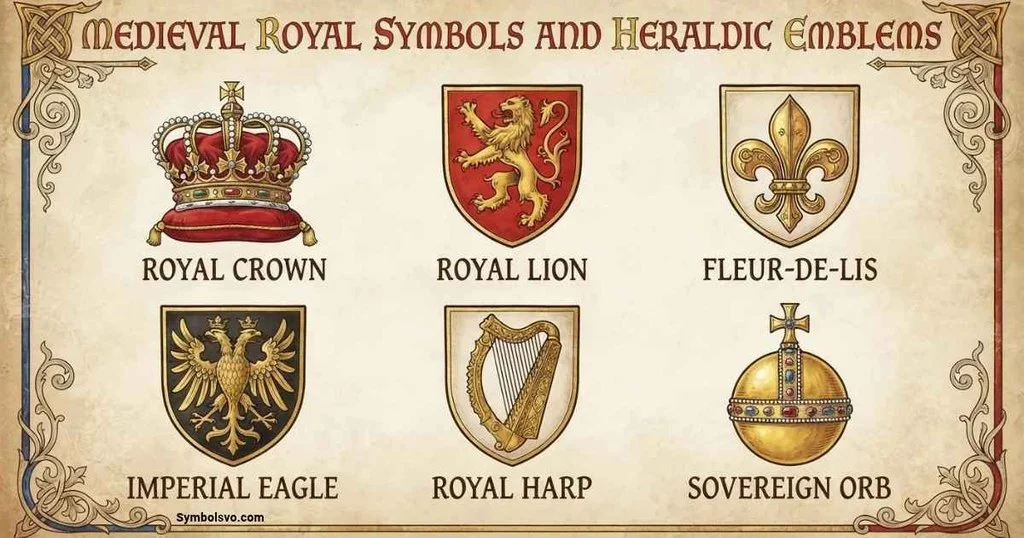
Royal and noble families used heraldic symbols to communicate identity, authority, and political connections.
Heraldry became especially important during the High Middle Ages.
Knights displayed designs on shields, banners, clothing, and equipment. These visual identifiers helped distinguish individuals and families.
The Lion in Medieval Heraldry
The lion was one of the most recognizable heraldic animals.
It represented strength, courage, authority, and nobility.
Heraldic lions appeared in several positions, including:
- Rampant: Standing upright on one hind leg.
- Passant: Walking with one foreleg raised.
- Statant: Standing on all four legs.
The lion became particularly important in European royal heraldry.
The Fleur-de-Lis
The fleur-de-lis is a stylized flower with three main petals.
It became closely associated with the French monarchy and appeared on royal shields, banners, coins, and decorative objects.
The design also developed religious associations, including connections with the Virgin Mary and the Holy Trinity.
Its exact origins remain debated, but its importance in French royal identity is well established.
The Red Rose of Lancaster
The red rose became associated with the House of Lancaster during the Wars of the Roses.
This dynastic conflict involved rival branches of the English royal family competing for the throne.
The red rose became an important symbol of Lancastrian identity.
The White Rose of York
The white rose represented the House of York.
Like the Lancastrian emblem, it became a recognizable badge during the Wars of the Roses.
The two roses later gained a combined meaning through Tudor royal imagery.
The Tudor Rose
The Tudor rose combines the red rose of Lancaster with the white rose of York.
Henry VII adopted it following his victory at the Battle of Bosworth in 1485 and his marriage to Elizabeth of York.
The combined flower communicated the union of the two rival dynastic houses.
The Tudor rose belongs to the transition from the medieval period into the early modern era.
Medieval Shields and Heraldic Colors
Heraldic shields used specific colors, patterns, and figures to identify families and individuals.
Traditional heraldic colors included:
- Gold or yellow (or).
- Silver or white (argent).
- Red (gules).
- Blue (azure).
- Black (sable).
- Green (vert).
Heraldry also followed established rules about arranging colors and figures.
These designs helped people recognize noble identities during warfare, tournaments, official ceremonies, and political events.
Other Medieval Heraldic Symbols
Several other creatures and designs appeared frequently in medieval heraldry.
| Symbol | Common association |
| Eagle | Power and imperial authority |
| Falcon | Hunting and noble status |
| Lion | Courage and strength |
| Unicorn | Purity and heraldic prestige |
| Cross | Christian faith |
| Fleur-de-lis | French royal identity |
| Boar | Strength and ferocity |
| Swan | Noble family identity and status |
A heraldic emblem’s meaning could depend on family history rather than a general symbolic dictionary.
Famous Medieval Symbolic Examples and Historical Sites
Surviving medieval buildings, manuscripts, and decorative objects provide valuable evidence of historical symbolism.
They allow historians to examine how medieval people used images in real settings rather than relying entirely on modern interpretations.
Lincoln Cathedral and the Lincoln Imp
Lincoln Cathedral is an important example of medieval English architecture.
Its stone carvings include decorative figures, religious imagery, and unusual creatures. The Lincoln Imp remains one of its best-known features.
Local folklore describes the imp as a mischievous creature that entered the cathedral and was punished for its behavior.
The story became part of the building’s cultural identity. It also demonstrates how medieval architectural figures can inspire legends that survive for centuries.
The Angel Choir at Lincoln Cathedral
The Angel Choir is a notable part of Lincoln Cathedral’s medieval architectural history.
Its decoration includes numerous carved angels and elaborate Gothic details.
Angel imagery communicated the presence of heavenly beings and reinforced the religious purpose of the building.
The choir also demonstrates the skill of medieval stone carvers and the importance of sculpture in Gothic church design.
The Hours of Étienne Chevalier
The Hours of Étienne Chevalier is a famous illuminated manuscript associated with the French royal treasurer Étienne Chevalier.
Jean Fouquet created its remarkable illustrations during the fifteenth century.
The manuscript contains elaborate religious scenes and provides an important example of late medieval French painting.
Its imagery demonstrates how artists combined biblical narratives, architectural settings, clothing, and symbolic objects to create complex visual compositions.
The Tacuinum Sanitatis
The Tacuinum Sanitatis is a medieval illustrated work based on the health teachings of Ibn Butlan, a physician from Baghdad who lived during the eleventh century.
It discusses subjects connected with health and everyday living, including:
- Food and nutrition.
- Fruits and vegetables.
- Herbs and plants.
- Seasonal conditions.
- Daily activities.
- Environmental influences.
Its illustrated manuscripts provide valuable information about medieval food culture, botanical knowledge, medicine, clothing, and agricultural practices.
The work also demonstrates the influence of Arabic medical scholarship on European intellectual traditions.
Medieval Paradise Imagery in European Art
Medieval artists frequently used gardens, flowers, fountains, and trees to represent paradise.
These images connected the natural world with religious ideas about creation and divine perfection.
An enclosed garden might communicate Mary’s purity, while a garden containing Adam and Eve could refer to the biblical story of humanity’s creation and fall.
Such imagery demonstrates the close relationship between medieval Christian art, biblical interpretation, and natural symbolism.
How to Identify Medieval Symbols in Historical Art
Recognizing medieval symbols requires more than memorizing the meanings of individual flowers, animals, and objects.
You need to examine the entire composition and understand its historical setting.
The following approach can help you interpret medieval artwork more accurately.
Look at the Historical Period
Medieval art changed considerably between approximately 500 and 1500 CE.
Early medieval artwork often reflected different artistic traditions from the elaborate Gothic paintings and manuscripts of the late Middle Ages.
Consider:
- The estimated date of the artwork.
- Its geographical origin.
- Its artistic style.
- Its religious or secular purpose.
A symbol used in a twelfth-century manuscript might have a different visual context from a similar image in a fifteenth-century painting.
Identify the Main Figure
Start by identifying the person, animal, or subject at the center of the composition.
Look for familiar attributes.
For example:
- Keys may identify St. Peter.
- An eagle may identify St. John.
- A wheel may identify St. Catherine.
- A white lily may suggest the Virgin Mary.
- A lamb may represent Jesus Christ.
These clues can help establish the subject before you interpret smaller details.
Examine Nearby Objects and Plants
Objects surrounding the main figure often provide additional information.
Look for:
- Flowers and fruit.
- Books and scrolls.
- Crowns and swords.
- Animals and insects.
- Religious vessels.
- Trees and fountains.
A single object may have several possible meanings. The surrounding figures and narrative usually help determine the most likely interpretation.
Consider the Artistic Setting
The same symbol can serve different purposes in different settings.
A lion on a royal shield might represent family identity or authority. A lion in a Christian bestiary might communicate a religious lesson.
Consider whether you’re examining:
- A church sculpture.
- A stained-glass window.
- An illuminated manuscript.
- A religious painting.
- A royal seal.
- A medieval tomb.
- A decorative household object.
Check Historical Sources
Reliable interpretation requires evidence.
Useful sources include medieval manuscripts, museum collections, historical church records, biblical texts, bestiaries, and scholarly art-history publications.
Avoid assigning a symbolic meaning simply because a modern website lists it.
A flower appearing in an old painting doesn’t automatically mean the artist intended a specific religious message.
Medieval Symbolism vs. Modern Interpretations
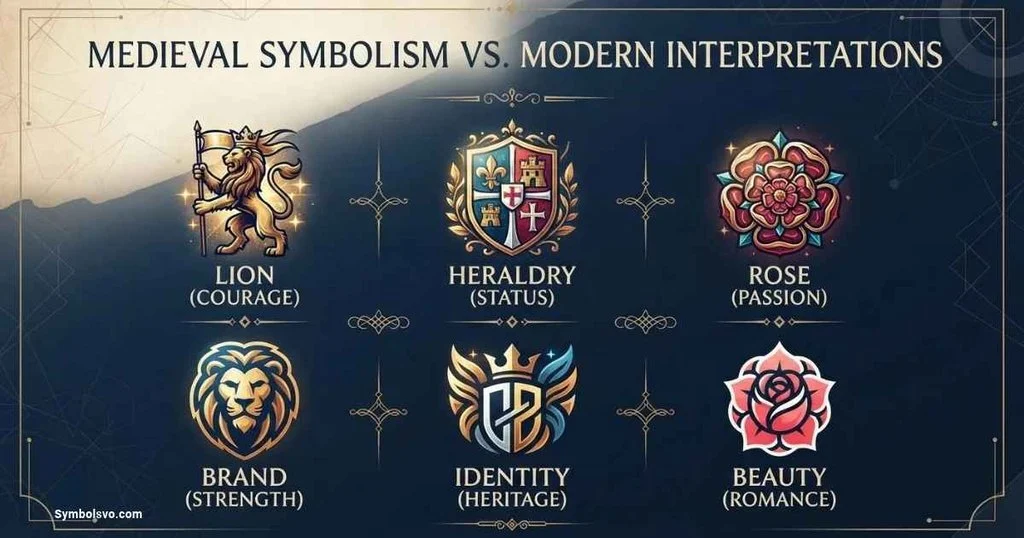
One of the biggest challenges when studying medieval symbols is separating historical meanings from modern interpretations.
Many popular symbolism guides combine medieval Christian traditions with later European folklore, Victorian flower language, and contemporary spiritual beliefs.
These traditions sometimes overlap, but they aren’t identical.
For example, the red rose has religious associations with love and sacrifice. It also became a dynastic badge in late medieval England.
Similarly, butterflies can represent transformation in modern symbolic interpretations, but this doesn’t mean every medieval butterfly illustration carried a message about resurrection.
Consider these important distinctions:
| Symbol | Historical context | Common modern interpretation |
| Rose | Christian devotion and royal heraldry | Romantic love |
| Lily | Purity and Marian imagery | Innocence and peace |
| Dove | Holy Spirit and biblical imagery | Peace |
| Dragon | Spiritual danger and evil | Power and strength |
| Butterfly | Natural and artistic imagery | Transformation |
| Enclosed garden | Paradise and Marian purity | Safety and personal growth |
| Lion | Christological and heraldic imagery | Leadership and courage |
The best way to understand a medieval symbol is to examine its original artwork, historical period, and cultural setting.
This approach prevents modern meanings from replacing documented historical evidence.
Frequently Asked Questions About Medieval Symbols
What are medieval symbols and their meanings?
Medieval symbols were visual representations of religious beliefs, cultural traditions, political authority, and moral ideas. Common examples include the Christian cross for salvation, the dove for the Holy Spirit, the lion for strength, and the white lily for purity.
What were the most common medieval Christian symbols?
Some of the most recognizable medieval Christian symbols included:
- The cross, representing Christ’s Crucifixion.
- The dove, representing the Holy Spirit.
- The lamb, representing Jesus Christ.
- The Chi-Rho, representing Christ.
- The white lily, representing Mary’s purity.
- The fish, representing Christian faith.
- The halo, representing holiness.
These symbols appeared in churches, manuscripts, paintings, and religious objects.
What did plants symbolize in medieval times?
Plants represented different ideas depending on their historical and religious context. Roses could symbolize divine love, lilies represented purity, and grapes connected with the Eucharist. Plants also appeared in medieval art as decorative elements and representations of paradise.
What flowers were important in medieval religious art?
Several flowers appeared regularly in medieval Christian imagery:
- White lily: Purity and the Virgin Mary.
- Rose: Love, devotion, and spiritual beauty.
- Daisy: Innocence and simplicity in some interpretations.
- Iris: Marian associations in certain artistic contexts.
- Strawberry: Paradise and religious symbolism in some paintings.
Their meanings depended on the artwork and historical tradition.
Why was the rose associated with the Virgin Mary?
The rose became associated with the Virgin Mary through Christian interpretations of spiritual beauty, purity, and divine love. Medieval devotional traditions also used the rose in religious poetry and imagery.
What did the dove represent in medieval Christianity?
The dove primarily represented the Holy Spirit. Its most important biblical association comes from the baptism of Jesus, when the Holy Spirit descended like a dove. It also became associated with peace and divine presence.
What did the dragon symbolize in medieval church carvings?
Dragons often represented evil, temptation, and spiritual danger in medieval Christian imagery. They appeared in religious sculpture and stories involving saints such as Saint George and Saint Michael. However, some dragons served purely decorative purposes.
What did the serpent represent in the Garden of Eden?
The serpent represented temptation and deception in the biblical story of Adam and Eve. It tempted Eve to eat the forbidden fruit, leading to the Fall of Humanity. Christian interpretations connected the serpent with original sin and humanity’s separation from paradise.
What did the number three symbolize in medieval Christianity?
The number three represented the Holy Trinity: the Father, the Son, and the Holy Spirit. It became an important number in Christian theology, religious artwork, and medieval devotional traditions.
What did the Five Wounds of Christ represent?
The Five Wounds represented the injuries Jesus received during the Crucifixion: two hands, two feet, and his side. They became important subjects of medieval Christian devotion and represented Christ’s suffering, sacrifice, and redemption.
Why were medieval gardens enclosed by walls?
Walls protected gardens from animals, unwanted visitors, and harsh conditions. In religious imagery, enclosed gardens also represented paradise and the Virgin Mary’s purity. Monasteries used enclosed gardens for growing food, cultivating medicinal plants, and providing quiet spaces for prayer.
What is the meaning of the Hortus Conclusus?
Hortus Conclusus is Latin for enclosed garden. In medieval Christian art, it commonly represented the purity and virginity of the Virgin Mary. The imagery developed through interpretations of the Song of Songs.
What were Books of Hours used for?
Books of Hours were private Christian devotional books containing prayers and religious texts arranged around particular times of the day. Many included illustrated calendars, biblical scenes, floral decorations, and images of saints.
Why did medieval churches feature flowers and animals?
Churches used flowers and animals for decoration and religious storytelling. Certain plants represented purity, paradise, or sacrifice, while animals could communicate moral lessons and biblical teachings. Others simply reflected popular decorative styles.
What is the difference between the Red Rose of Lancaster and the White Rose of York?
The red rose became associated with the House of Lancaster, while the white rose represented the House of York. Both became important dynastic emblems during the Wars of the Roses. Henry VII later adopted the combined Tudor rose to represent the union of the two houses.
What is the Lincoln Imp and what does it represent?
The Lincoln Imp is a small grotesque figure associated with Lincoln Cathedral in England. Local folklore describes it as a mischievous creature that was turned to stone after causing trouble inside the cathedral. Its story became part of Lincoln’s cultural heritage.
How can you identify symbols in medieval paintings?
Start by identifying the main figures and examining the objects surrounding them. Look for familiar attributes such as lilies, crowns, keys, animals, and religious objects. Then consider the painting’s date, location, subject, and historical purpose before deciding what its symbols represent.
Conclusion: Understanding the Meaning of Medieval Symbols
Medieval symbols provide a fascinating look into the beliefs, traditions, and everyday experiences of people who lived during the Middle Ages. They appeared throughout religious paintings, Gothic cathedrals, illuminated manuscripts, royal shields, gardens, and decorative objects.
The Christian cross, Virgin Mary’s lily, the lion, the dragon, and the enclosed garden each communicated ideas that medieval viewers could recognize through familiar stories and cultural traditions.
Flowers and plants also played an important role. Roses, grapes, lilies, and other botanical images connected the natural world with religious devotion, royal identity, and ideas about paradise.
However, understanding these symbols requires attention to historical context. Their meanings weren’t always universal, and modern interpretations don’t necessarily reflect medieval beliefs.
By examining surviving artwork, manuscripts, buildings, and historical records, you can better understand what these symbols meant and why medieval artists used them.
Ultimately, medieval symbolism wasn’t simply a decorative tradition. It was an important part of how medieval society expressed faith, communicated ideas, remembered history, and understood the world around it.

I’m Nathan Holloway, a passionate researcher and writer with a deep interest in symbols, signs, and their hidden meanings. I enjoy exploring how symbols have influenced different civilizations, religions, and modern communication. Through my work, I aim to make complex historical and cultural concepts easy to understand for readers of all backgrounds. Every article I write is carefully researched to provide reliable and engaging information.
Books:
- Beyond the Symbol
- The Secret Meanings of Everyday Signs
Author 2: Grace Whitmore
Description:
My name is Grace Whitmore, and I love discovering the stories behind the world’s most fascinating symbols. I spend my time researching ancient civilizations, mythology, spiritual traditions, and modern iconography to uncover the meanings people often overlook. I believe that every symbol has a history worth telling, and I enjoy sharing that knowledge in a simple and reader-friendly way.
Books:
- Echoes of Ancient Symbols
- The Symbolic World
 Mason Ellington
 Daniel Brooks