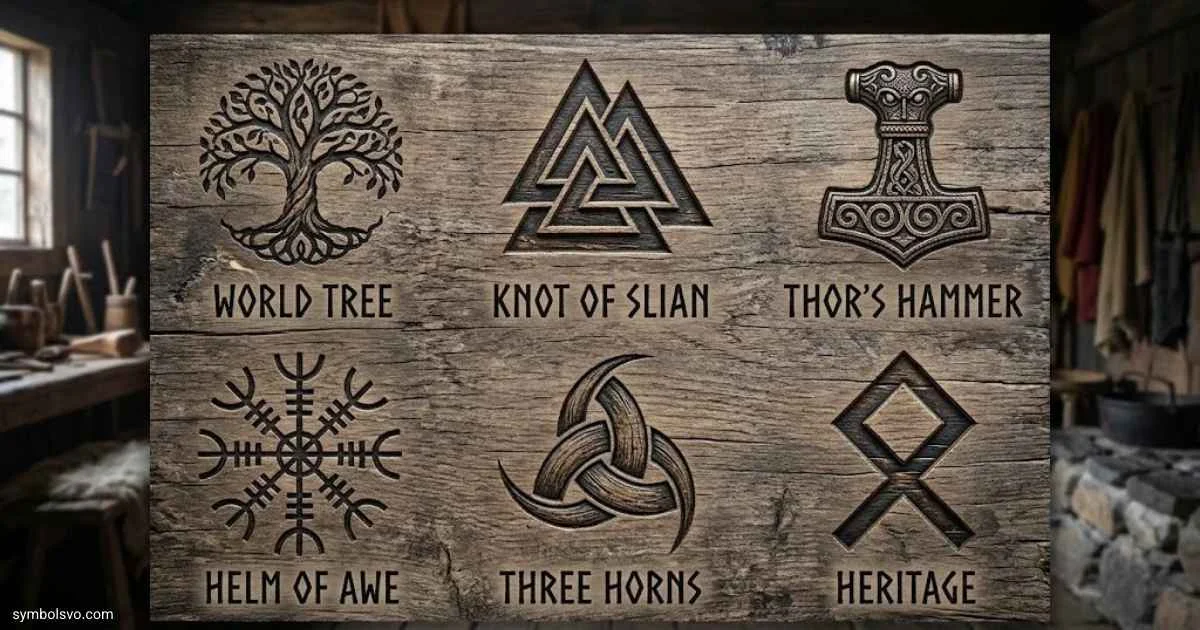
Viking symbols and meanings continue to attract readers interested in Norse mythology, Scandinavian history, ancient art, and spiritual traditions. From Thor’s hammer to Odin’s ravens, these symbols connect us to stories, beliefs, and objects associated with the people of the Viking Age.
However, not every design sold as a Viking symbol actually comes from the Viking Age. Some symbols have strong archaeological connections, while others became popular through later Icelandic manuscripts, modern interpretations, or contemporary Norse-inspired culture.
Understanding these differences makes it easier to appreciate ancient Norse symbols without confusing historical evidence with modern beliefs.
In this guide, you’ll discover 20 important Viking and Norse-related symbols, their commonly understood meanings, their connections to mythology, and what historians know about their origins.
What Are Viking Symbols?
Viking symbols are designs, images, and written characters associated with the material culture, mythology, and religious traditions of Scandinavia and other regions connected to Viking activity.
The Viking Age is generally dated from around 793 to 1066 CE. During this period, Scandinavian communities traded, traveled, settled, and interacted with people across Europe and beyond.
Their surviving material culture includes runestones, jewelry, carved objects, ship decorations, and other archaeological finds. These objects provide valuable evidence of Norse culture, craftsmanship, communication, and religious life.
Some symbols had clear connections to particular stories or deities. Others are harder to interpret because their original meaning was never recorded or the evidence is incomplete.
For example, Thor’s hammer appears in Viking Age archaeological finds, including pendants. In contrast, Vegvisir is documented in much later Icelandic magical manuscripts rather than securely dated Viking Age artifacts.
It’s also important to distinguish between several related categories:
- Norse mythology symbols: Images associated with Norse gods, creatures, and mythological stories.
- Viking runes: Characters belonging to historical runic writing systems.
- Norse animal symbolism: Animals appearing in mythology, artwork, and religious or cultural contexts.
- Ancient Scandinavian symbols: A broad category that includes designs from different periods and communities.
- Modern Viking symbols: Designs used today in jewelry, tattoos, clothing, and contemporary spiritual practices.
These categories overlap, but they aren’t interchangeable. A symbol’s appearance in a modern design doesn’t automatically establish its historical meaning.
Viking Symbols and Their Meanings
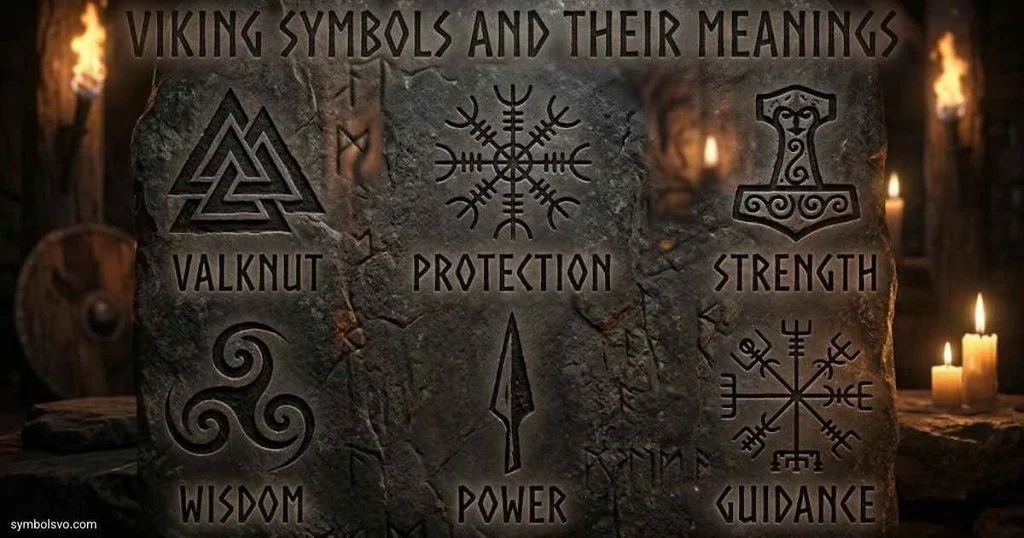
The following symbols are among the best-known designs associated with Viking history and Norse mythology. Their historical evidence varies, so each explanation distinguishes documented connections from interpretations that remain uncertain.
Mjölnir: Thor’s Hammer
Mjölnir, commonly called Thor’s Hammer, is one of the most recognizable symbols associated with the Viking Age.
In Norse mythology, Mjölnir belongs to Thor, the god associated with thunder and the protection of the gods and their world. The hammer plays an important role in stories about Thor’s battles against giants and other threats.
Its mythological associations include:
- Thor and thunder.
- Protection and strength.
- The defense of the gods and their community.
- Blessing and ceremonial significance in some contexts.
Archaeological evidence makes Mjölnir particularly important among ancient Viking symbols. Hammer-shaped pendants have been found in Viking Age contexts, showing that the design was more than a modern invention.
People today often choose Mjölnir jewelry to express an interest in Norse mythology, Scandinavian heritage, or personal resilience. These modern interpretations can be meaningful, although an individual’s reasons for wearing the symbol may differ from historical practices.
Historical note: The hammer’s connection to Thor is well established in Norse mythology, but the precise meaning of every surviving hammer pendant cannot be determined from its shape alone.
Valknut: The Interlocking Triangles
The Valknut is a design made from three interlocking triangles. Its name is commonly interpreted as a modern compound associated with the slain and a knot, although the historical origin of the name is not securely established.
The motif appears in archaeological and artistic contexts associated with the Norse world. Some examples occur alongside imagery connected with Odin or scenes interpreted as relating to death and the afterlife.
Because of these associations, the Valknut is frequently connected with:
- Odin.
- Death and the afterlife.
- Fallen warriors.
- Fate and the relationship between life and death.
However, the exact meaning of the Valknut symbol remains debated. There is no surviving Viking Age explanation that definitively identifies what the three triangles meant.
The symbol is often linked to Valhalla, the hall associated with Odin where certain slain warriors are received in Norse mythology. This is a common interpretation, not a proven universal meaning.
Today, the Valknut appears on jewelry, clothing, artwork, and tattoos. Anyone using it should understand that its modern associations can vary, and the symbol has also been adopted by some extremist groups. Its meaning therefore depends partly on the context in which it appears.
Yggdrasil: The World Tree
Yggdrasil, often called the World Tree, is a central feature of Norse cosmology.
Old Norse mythological sources describe a great tree connected with different parts of the cosmos. Its roots, branches, and surrounding locations link important places and beings within the mythological universe.
Yggdrasil is associated with the Nine Worlds, although the surviving sources don’t provide a single, simple diagram that resolves every detail of their arrangement.
Its major mythological connections include:
- The Norns, who are associated with fate.
- The Well of Urd.
- Various gods and mythological creatures.
- The structure and interconnectedness of the cosmos.
Because of these connections, Yggdrasil is often interpreted as representing life, interconnectedness, continuity, and cosmic order.
These are useful ways to understand its modern symbolism, but it’s important to distinguish them from direct historical claims about what every Viking believed.
In modern art and jewelry, the Tree of Life design inspired by Yggdrasil is popular among people interested in Norse mythology and Nordic heritage.
Viking Runes: The Ancient Norse Writing Systems
Viking runes are among the most historically grounded elements of this topic. Unlike many modern decorative designs, runes were part of actual writing systems used by Germanic-speaking peoples.
The word Futhark comes from the names of the first six runes in the traditional sequence.
Two important runic systems are:
| Runic system | Number of characters | Historical context |
| Elder Futhark | 24 | Used before the Viking Age, particularly during the early Germanic Iron Age |
| Younger Futhark | 16 | Developed around the beginning of the Viking Age and used extensively in Scandinavia |
The Viking Age Younger Futhark had fewer characters than the Elder Futhark. As spoken language changed, individual runes could represent more than one sound.
Runes were carved into stone, wood, metal, and other materials. Inscriptions could record names, commemorate the dead, identify ownership, or communicate short messages.
The Viking Ship Museum explains that runes were phonetic characters and that surviving inscriptions appear on a wide range of objects. The National Museum of Denmark also documents how Viking Age runestones commemorated individuals and their achievements.
Some modern practices associate individual runes with concepts such as wealth, protection, or wisdom. However, these meanings shouldn’t be treated as universal definitions that apply to every historical inscription.
Runes were first and foremost a writing system. Their use in particular ritual or magical contexts must be evaluated through the relevant historical evidence.
Gungnir: Odin’s Spear
Gungnir is the spear associated with Odin in Norse mythology.
Mythological accounts describe it as an extraordinary weapon made by skilled dwarven craftsmen. Its stories connect it with Odin’s authority, warfare, and supernatural power.
Gungnir is often interpreted in modern symbolic discussions through ideas such as:
- Authority and leadership.
- Determination and purpose.
- Precision and focus.
- Odin’s role in Norse mythology.
These interpretations reflect the spear’s place in the stories rather than a single documented Viking Age explanation of the symbol.
Gungnir is also associated with the wider mythology surrounding Odin, who is connected with wisdom, poetry, knowledge, and war. This makes the spear a useful subject for understanding how individual objects can acquire significance through the stories attached to them.
Huginn and Muninn: Odin’s Ravens
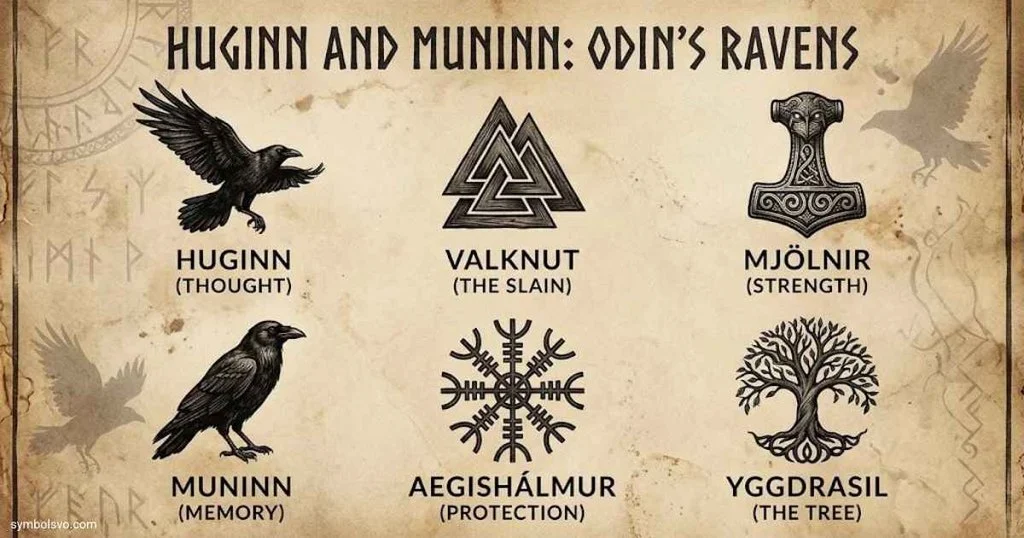
Huginn and Muninn, whose names are commonly translated as “thought” and “memory,” are the two ravens associated with Odin.
In Norse mythology, the ravens travel throughout the world and report what they observe to the god. Their stories connect them with information, awareness, and the gathering of knowledge.
Their names provide a useful way to understand their literary significance:
- Huginn represents thought in the usual translation of the name.
- Muninn represents memory in the usual translation of the name.
- Together, they are associated with Odin’s awareness of events beyond his immediate surroundings.
The ravens are among the most recognizable creatures in Norse mythology symbols and modern Norse-inspired artwork.
Raven imagery also appears in broader discussions of Scandinavian art and mythology. However, not every historical raven image can confidently be identified as Huginn or Muninn.
Today, Odin’s ravens are often interpreted as symbols of knowledge, observation, memory, and intellectual curiosity.
Fenrir: The Great Wolf
Fenrir, also called the Fenris Wolf, is one of the major creatures in Norse mythology.
He is the son of Loki and the giantess Angrboða. The gods become concerned about the danger Fenrir may pose, and the story of his binding becomes an important part of his mythology.
Fenrir is closely connected with Ragnarök, the series of events associated with the destruction and transformation of the mythological world.
His story involves themes of fate, fear, conflict, and the consequences of attempts to control a dangerous future.
Modern interpretations of wolf symbolism in Norse mythology sometimes emphasize strength, independence, loyalty, or freedom. Fenrir’s specific story, however, is more complicated than a simple representation of bravery.
Other wolves appear in Norse mythology, including Geri and Freki, who are associated with Odin. These figures have different roles and should not automatically be given the same meaning as Fenrir.
Jörmungandr: The Midgard Serpent
Jörmungandr, also called the Midgard Serpent, is a giant serpent in Norse mythology.
The stories describe the creature as encircling the world of humans. Its relationship with Thor is especially important, and their conflict becomes one of the central confrontations associated with Ragnarök.
Jörmungandr is often discussed in connection with:
- The boundaries of the world.
- Thor and his mythological battles.
- Destruction and cosmic conflict.
- The events of Ragnarök.
The serpent’s circular position around the world makes it easy to understand why modern readers associate it with cycles and interconnectedness. Those are interpretations of its imagery, however, rather than a definitive explanation of a standardized Viking symbol.
Jörmungandr should also be distinguished from other mythological serpents, including Níðhöggr, which is associated with Yggdrasil in Norse cosmological traditions.
Sleipnir: Odin’s Eight-Legged Horse
Sleipnir is Odin’s extraordinary eight-legged horse.
Norse mythology describes Sleipnir as a remarkable mount capable of carrying Odin on journeys between different realms. The horse’s unusual appearance makes it distinctive among mythological animals.
Sleipnir is commonly associated with:
- Odin.
- Travel between mythological realms.
- Speed and extraordinary movement.
- The relationship between the gods and the wider cosmos.
In modern artwork, Sleipnir can represent a journey, transition, or connection between worlds. These interpretations draw on its mythological role rather than a single known historical definition.
The horse also demonstrates how animals in Norse stories could be more than ordinary creatures. They could have supernatural qualities and play essential roles in the mythology of the gods.
The Horns of Odin: The Three-Horn Motif
The Horns of Odin is a modern name commonly associated with a design made from three interlocking drinking horns.
A related three-horn motif appears on the Snoldelev Stone in Denmark, a historical runestone associated with the Viking Age. The stone provides archaeological evidence for the motif itself, but the precise meaning of the design is less certain.
The modern name connects the three horns with Odin and the Mead of Poetry, a mythological substance associated with poetry and inspiration.
This connection makes the design popular among people interested in Norse mythology, storytelling, and artistic expression.
However, the existence of a historical three-horn motif doesn’t prove that its original users understood it in exactly the same way as modern enthusiasts do.
The Horns of Odin meaning should therefore be explained as a modern interpretation connected with Norse mythology, not as an unquestionable translation of the original carving.
The Triskele: A Three-Part Motif
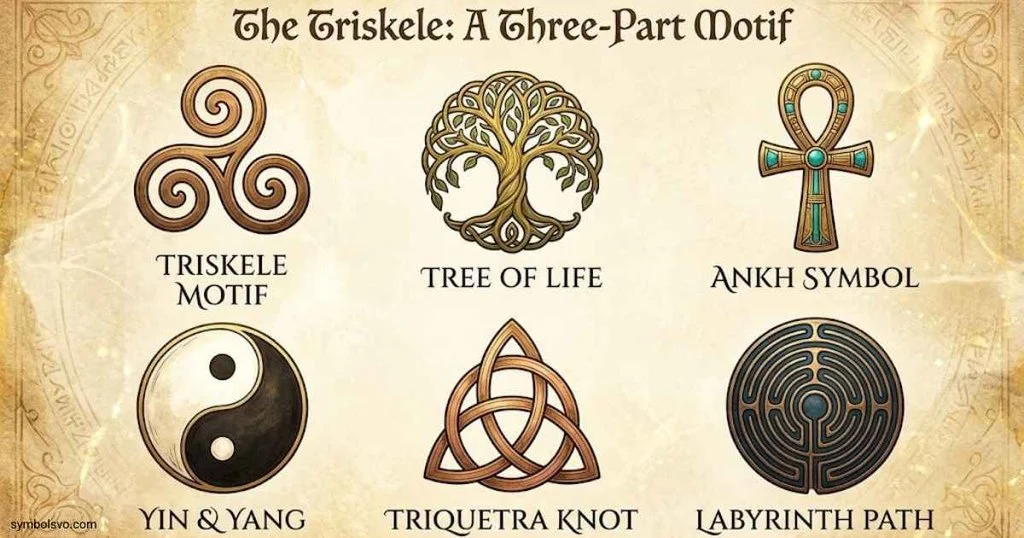
The word triskele, also spelled triskelion, generally refers to a design built around three connected or rotating elements.
It is important not to confuse every triskele design with the three interlocking drinking horns associated with the modern Horns of Odin motif. The shapes may share a three-part structure without having the same origin or meaning.
Three-part designs appear in several artistic traditions, including Celtic and broader European contexts. Their meanings depend on the specific design, period, and cultural setting.
Modern interpretations may connect a triskele with movement, cycles, or the relationship between three elements. Those interpretations should not automatically be attributed to Viking Age communities.
When discussing ancient Norse symbols, identifying the actual design is more useful than assuming all three-part motifs represent the same belief.
Ægishjálmur: The Helm of Awe
Ægishjálmur, commonly translated as the Helm of Awe, is widely promoted as a Viking symbol of protection, courage, and intimidation.
The name has a connection to Old Norse literary tradition. In the story of Fáfnir, an ægishjálmr is associated with the frightening or overwhelming power of the dragon.
However, the written reference to the name and the familiar geometric design are two different things. The existence of the name in a medieval story doesn’t prove that the modern-looking symbol was used in the same form during the Viking Age.
The familiar design belongs to the tradition of Icelandic magical staves documented in later manuscripts. These sources must be distinguished from Viking Age archaeological evidence.
Today, the Helm of Awe is often associated with:
- Protection.
- Courage.
- Fearlessness.
- Strength in difficult circumstances.
These are common modern interpretations. A historically accurate explanation should make clear that the popular design is not securely established as a standard Viking Age emblem.
Vegvisir: The Icelandic Wayfinder
Vegvisir, often called the Viking Compass, is a popular symbol associated with guidance and finding one’s way.
Its documented history is more recent than many people assume. One of the earliest known records appears in the Icelandic Huld manuscript, compiled by Geir Vigfússon in 1860. The manuscript associates the sign with avoiding getting lost in storms or bad weather.
This makes Vegvisir an important example of why Viking symbols and meanings should be discussed with attention to historical dates.
The evidence does not securely establish Vegvisir as a Viking Age symbol. It belongs to the later Icelandic magical-stave tradition.
Today, people often use Vegvisir to express ideas such as:
- Guidance through uncertainty.
- Finding direction.
- Navigating difficult experiences.
- Staying on course.
These meanings are understandable modern interpretations of its recorded association with finding one’s way. They should not be confused with proof that Viking Age sailors used the design as a compass.
The Web of Wyrd: A Modern Symbol of Fate
The Web of Wyrd is a modern design commonly associated with fate and destiny.
The term wyrd has historical connections with fate in early Germanic and Old English traditions. Norse mythology also includes the Norns, figures associated with the destinies of gods and humans.
The familiar Web of Wyrd design is often drawn as intersecting lines arranged around a geometric framework. Modern interpretations connect it with the idea that events and choices form part of a larger pattern.
However, the historical concept of fate and the modern geometric emblem are not the same thing.
There is no secure evidence establishing the familiar Web of Wyrd design as a standardized Viking Age symbol. Its modern use should be distinguished from the older literary traditions about fate.
The Viking Longship
The Viking longship was a real vessel with major importance in Scandinavian history.
Longships were designed for travel across waterways and could support journeys along coastlines and rivers. Their relatively shallow draft helped make certain routes accessible that might have been difficult for deeper vessels.
Ships supported many activities, including trade, migration, exploration, communication, and warfare. They helped connect Scandinavian communities with regions across Europe and beyond.
The longship is commonly associated today with:
- Travel and exploration.
- Maritime skill.
- Adventure and discovery.
- Scandinavian craftsmanship.
Unlike the Valknut or Mjölnir, a longship is not one single standardized sacred symbol. It is a historical object that has become a powerful visual representation of the Viking Age.
The Viking Axe
The Viking axe was a practical tool as well as an object associated with historical warfare.
Axes varied in form and size, and their uses depended on their construction and context. Axes were part of the wider material culture of Viking Age communities, where tools and objects could serve practical purposes as well as carry decorative features.
In modern Norse-inspired art, the axe often represents strength, determination, and warrior identity.
These associations are understandable contemporary interpretations of its historical role. However, there is no reason to assume that every Viking Age axe was created as a symbolic object or that all axe imagery carried the same meaning.
The distinction matters because Viking warrior symbols are often presented online as though every object had a fixed religious definition. Archaeological objects need to be understood through their actual context.
Ravens in Norse Symbolism
Ravens deserve attention beyond their role as Odin’s two named companions.
Ravens appear in Norse mythology and have also become recognizable elements of modern Scandinavian-inspired artwork. Their association with Odin makes them especially prominent in popular representations of Norse culture.
Depending on the context, raven imagery may be connected with:
- Odin and his mythological companions.
- Observation and knowledge.
- Battle-related imagery.
- Memory and thought.
These associations aren’t interchangeable. A pair of ravens shown with Odin may suggest Huginn and Muninn, while a raven appearing alone in an artwork may have a different intended meaning.
This is a useful reminder that Norse animal symbolism depends on more than the animal itself. The surrounding imagery and historical source also matter.
Wolves in Norse Mythology
Wolves occupy several different roles in Norse mythology.
Fenrir is the most famous mythological wolf, but Odin is also associated with Geri and Freki. The úlfheðnar, whose name is associated with wolves, are discussed in historical and literary contexts involving warrior traditions.
Modern Viking symbols for strength frequently include wolves because of their powerful appearance and place in Norse stories.
However, wolves do not represent one universal idea across all these traditions. Fenrir is associated with a specific mythological conflict, while Geri and Freki have a different relationship with Odin.
When interpreting wolf imagery, it’s better to identify the particular figure or context than to assign a single meaning to every wolf design.
Boars in Norse Mythology
Boars appear in stories involving important Norse deities.
Gullinbursti is a golden-bristled boar associated with Freyr. Hildisvíni, whose name is often translated as “battle swine,” is associated with Freyja in Norse mythological tradition.
These animals are part of a wider body of stories in which gods have special creatures, possessions, and companions.
Modern discussions of boar symbolism sometimes emphasize prosperity, fertility, abundance, or courage. Such interpretations may reflect wider cultural associations with the animal, but they shouldn’t be presented as a universal meaning proven for every Viking Age depiction.
The mythological identities of Gullinbursti and Hildisvíni are more specific and historically grounded than general claims that every boar image represented wealth or fertility.
The Triquetra: The Three-Cornered Knot
The Triquetra, sometimes called the Trinity Knot, is a three-cornered interlaced design.
It is commonly associated with Celtic and broader medieval artistic traditions. Although modern discussions sometimes group it with Viking or Norse symbols, it should not automatically be treated as a distinctively Viking emblem.
Its meaning can vary across historical and religious contexts. Modern interpretations often connect the design with unity, continuity, or three related elements.
Those ideas may be meaningful to people who use the symbol today, but a specific Viking Age interpretation is not securely established.
The Triquetra is a good example of how modern collections of Nordic symbols sometimes bring together designs from different traditions. Similar shapes don’t necessarily have the same history.
Troll Cross: A Modern Protective Design
The Troll Cross is commonly marketed as a Scandinavian protective symbol. It is generally shown as a looped or bent piece of metal.
Modern accounts often associate it with protection against harmful supernatural beings. However, the claim that this familiar design was widely used by Vikings is not supported by secure Viking Age evidence.
It is more accurate to discuss the Troll Cross in the context of modern Scandinavian folklore-inspired designs rather than present it as a confirmed emblem of Viking religious life.
Its contemporary popularity demonstrates how later folklore and modern cultural products can become connected with the broader idea of Viking heritage.
Viking Runes and Their Meanings
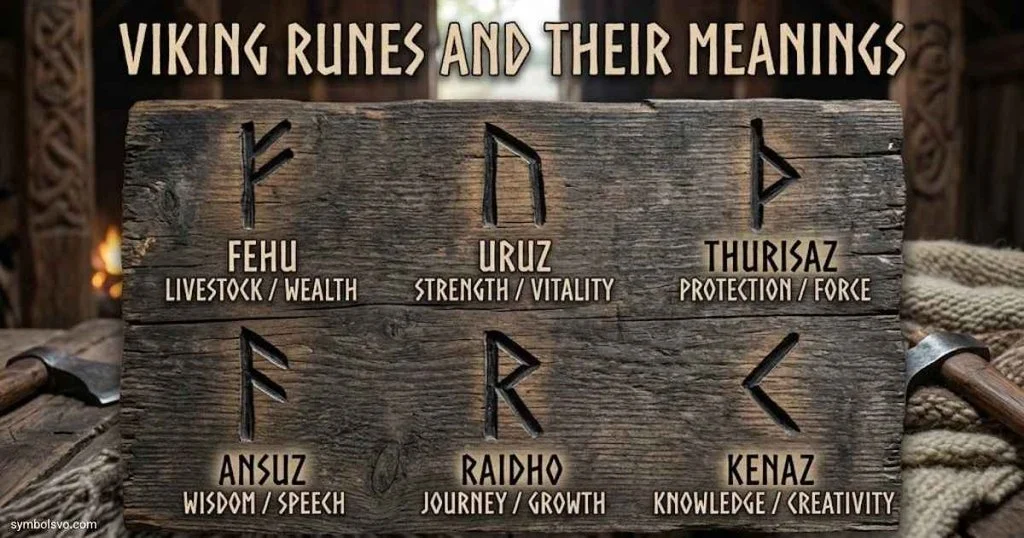
Runes deserve their own section because they are often mixed together with magical symbols and decorative designs.
What Is the Elder Futhark?
The Elder Futhark contains 24 runes and was used by Germanic-speaking communities before the Viking Age.
It appears on objects from the early Germanic Iron Age and is important for studying the development of runic writing.
Although modern websites often assign individual Elder Futhark runes spiritual meanings, historical interpretation requires attention to the rune’s name, language, inscription, and context.
What Is the Younger Futhark?
The Younger Futhark contains 16 runes and became the main runic writing system in Viking Age Scandinavia.
The smaller number of characters meant that some runes represented multiple sounds. This system was used for inscriptions on runestones and smaller objects.
The Viking Ship Museum provides a useful overview of the Younger Futhark and its place in Viking Age writing.
Were Runes Used for Magic?
Runes are sometimes described as though their primary purpose was divination or magic. That is misleading.
They were a writing system, and many surviving inscriptions communicate names, memorial messages, ownership, or other information.
Some historical sources do connect runes with ritual or magical activities. However, those examples do not mean that every rune was a magical sign or that every inscription was a spell.
Modern rune reading and divination are contemporary practices that may draw on historical names and traditions, but they should be distinguished from what can be demonstrated about Viking Age writing.
Viking Symbols of Protection, Strength, and Good Fortune
Many readers search for Viking symbols of protection or designs associated with courage, knowledge, and good fortune. These categories are useful, provided that the article distinguishes historical evidence from modern interpretations.
| Theme | Relevant symbol or figure | Important context |
| Protection | Mjölnir | Hammer pendants have archaeological evidence from the Viking Age |
| Guidance | Vegvisir | A later Icelandic magical stave, not securely established as a Viking Age symbol |
| Awe and intimidation | Ægishjálmur | The name appears in Norse literary tradition, while the familiar geometric design belongs to later magical-stave traditions |
| Wisdom and memory | Huginn and Muninn | Odin’s ravens are figures in Norse mythology |
| Cosmic connections | Yggdrasil | The World Tree is part of Norse cosmology |
| Fate | The Norns | Mythological figures associated with destiny |
| Warrior identity | Viking axe imagery | A historical object with modern symbolic associations |
| Mythological conflict | Fenrir | A wolf whose story is connected with Ragnarök |
Viking Symbols Associated With Protection
Mjölnir is one of the strongest examples because hammer pendants are documented in Viking Age archaeological contexts.
Vegvisir and Ægishjálmur are also widely used today in designs intended to express protection. Their historical context is different, however, and their later origins should be explained accurately.
Viking Symbols Associated With Strength and Warriors
Mjölnir, Gungnir, Fenrir, and axe imagery appear frequently in modern Norse-inspired artwork.
Their associations come from different sources: mythology, historical objects, and modern interpretations. A clear article should explain those differences instead of assigning every design the same meaning.
Viking Symbols Associated With Wisdom and Knowledge
Huginn and Muninn have a direct connection to thought and memory through their names and mythological roles.
Odin is also associated with wisdom and knowledge in Norse mythology. These connections make Odin’s ravens and related imagery useful subjects for readers interested in Viking symbols for wisdom.
Viking Symbols Associated With Fate and the Cosmos
Yggdrasil, the Norns, and stories about Ragnarök provide important context for understanding fate and cosmic order in Norse mythology.
The Valknut is often interpreted in connection with death and Odin, but its exact meaning remains uncertain. The Web of Wyrd, meanwhile, is a modern design associated with fate rather than a securely established Viking Age emblem.
Animals in Viking and Norse Symbolism
Animals are prominent in Norse mythology, but it is important to distinguish mythological creatures from real animals depicted in historical art.
| Animal or creature | Important connection | Common modern interpretation |
| Raven | Huginn and Muninn, Odin | Thought, memory, observation |
| Wolf | Fenrir, Geri, Freki | Strength, conflict, independence |
| Serpent | Jörmungandr | Cosmic conflict and destruction |
| Horse | Sleipnir | Travel and connection between realms |
| Boar | Gullinbursti, Hildisvíni | Sometimes associated with prosperity or fertility |
| Bear | Warrior-related traditions and animal imagery | Strength and ferocity |
These modern interpretations can help readers understand contemporary artwork, but they aren’t a substitute for examining the original myth or artifact.
For example, a depiction of Fenrir has a different mythological context from a depiction of one of Odin’s wolves. Likewise, a horse carving cannot automatically be identified as Sleipnir without supporting evidence.
How Were Viking Symbols Used?
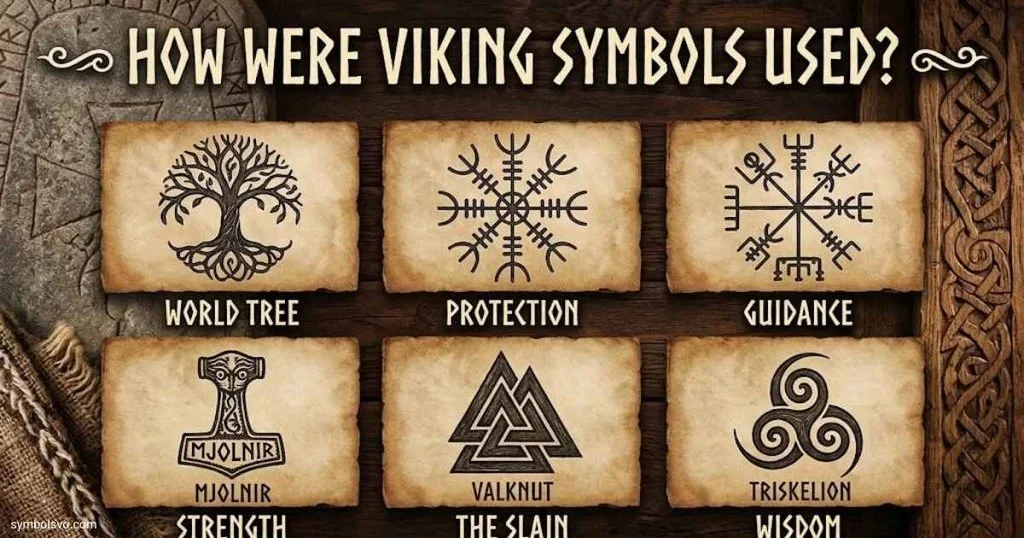
Symbols on Jewelry and Amulets
Jewelry was an important part of Scandinavian material culture. Archaeological discoveries include necklaces, brooches, beads, pendants, and other personal ornaments made from materials such as silver, bronze, amber, glass, and bone.
Hammer-shaped pendants are particularly relevant to discussions of Viking jewelry because of their connection with Thor and the evidence of their use during the Viking Age.
However, not every pendant had the same function. Objects could have religious, social, personal, decorative, or other significance.
A careful interpretation considers the object’s material, location, date, design, and archaeological context rather than assuming that all jewelry was worn as a protective talisman.
Symbols on Rune Stones and Inscriptions
Runestones provide some of the most valuable evidence for Viking Age writing and commemorative practices.
Many stones were raised to remember deceased relatives or record the achievements of individuals. Their inscriptions can include personal names, family relationships, journeys, and other details about life during the period.
The National Museum of Denmark explains that Viking Age runestones were often intended to be seen by people passing along roads and near bridges. Their inscriptions provide information about individuals, families, and commemorated achievements.
These stones help historians understand the historical use of runes and the settings in which particular images appeared.
Symbols on Ships and Everyday Objects
Viking Age craftsmanship included decorative work on many types of objects, including ships, tools, personal possessions, and household items.
Ship remains and surviving artistic objects help researchers study the design and skills of Scandinavian craftspeople.
A carved animal or interlaced pattern might have been decorative, meaningful, or both. Its exact purpose depends on the evidence available for that particular object.
This is why archaeological context matters more than a modern product description when deciding whether a design is genuinely connected with the Viking Age.
Which Symbols Are Actually From the Viking Age?
One of the most important questions about Viking symbols and meanings is whether a design can be linked to the period historically.
The following table offers a practical starting point.
| Symbol or design | Historical evidence | What to remember |
| Mjölnir | Viking Age hammer pendants have been found | A strong example of a historically documented Norse-related motif |
| Runes | Extensive inscriptions and archaeological evidence | A real writing system, not simply a collection of magical signs |
| Valknut | Related motifs appear in archaeological and artistic contexts | The exact meaning remains debated |
| Yggdrasil | Described in Norse mythological sources | A central feature of Norse cosmology |
| Three-horn motif | Found on the Snoldelev Stone | Its original meaning is not definitively known |
| Vegvisir | Documented in nineteenth-century Icelandic manuscripts | Not securely established as a Viking Age symbol |
| Ægishjálmur | Name appears in Norse literary tradition; familiar design belongs to later magical-stave traditions | The name and modern graphic form have different histories |
| Web of Wyrd | Modern design associated with older concepts of fate | Not securely established as a standardized Viking Age emblem |
| Triquetra | Strong connections to Celtic and wider medieval artistic traditions | Not exclusively Norse |
| Troll Cross | Associated with later Scandinavian folklore-inspired usage | Not securely documented as a Viking Age emblem |
Why Historical Context Matters
A symbol appearing in a nineteenth-century manuscript is evidence of a tradition in the nineteenth century. It does not, by itself, prove that the design was used hundreds of years earlier.
The same principle applies to literary references. A medieval story mentioning a named object does not necessarily establish that a modern geometric drawing of that object existed in the Viking Age.
When evaluating authentic Viking Age symbols, ask three questions:
- When was the object or manuscript created?
- Where was it found or recorded?
- What does the original evidence actually establish?
These questions help separate archaeological facts from assumptions and modern interpretations.
Viking Symbols in Modern Culture
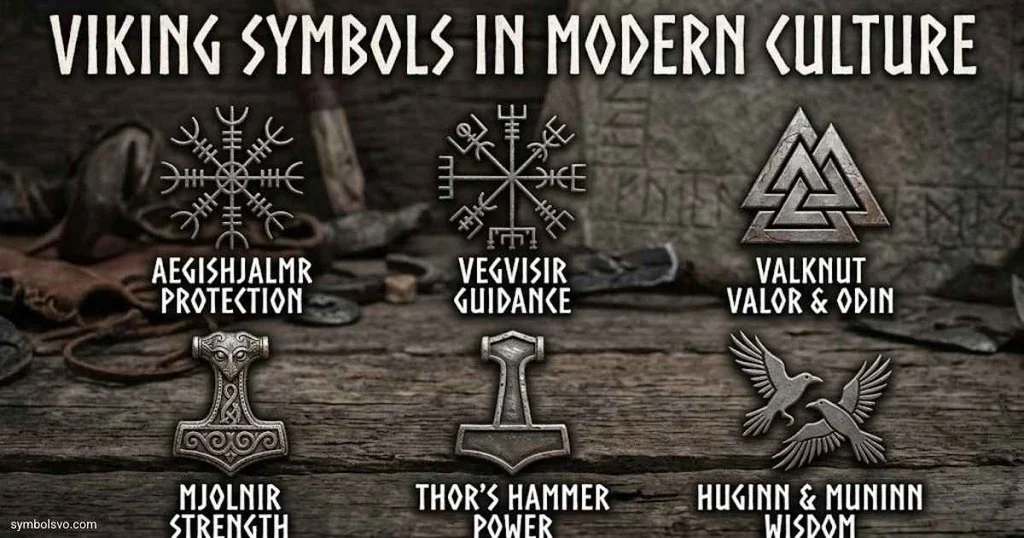
Today, Viking symbols appear on necklaces, rings, clothing, artwork, tattoos, and home decorations. They are also used by people interested in Norse mythology, Scandinavian ancestry, historical reenactment, and modern pagan traditions.
Mjölnir, the Valknut, runes, Vegvisir, and Ægishjálmur are among the designs frequently seen in contemporary Norse-inspired products.
Their modern meanings may differ from their historical or literary contexts. Someone might choose a symbol because it represents family heritage, personal resilience, a favorite myth, or an interest in history.
It’s also worth recognizing that some Norse-related designs have been appropriated by extremist movements. That does not mean every person using a Norse symbol supports extremism. The specific design, its surrounding imagery, and the context of its use all matter.
Understanding these distinctions allows readers to explore Norse symbolism without assuming that every modern interpretation is ancient or that every symbol carries one universal meaning.
Frequently Asked Questions About Viking Symbols and Meanings
What Is the Most Famous Viking Symbol?
Mjölnir, Thor’s hammer, is among the most recognizable symbols associated with the Viking Age. Its mythological connection to Thor and the archaeological evidence of hammer-shaped pendants make it especially important.
What Viking Symbol Represents Protection?
Mjölnir is a strong historical example because hammer pendants have been found in Viking Age contexts. Vegvisir and Ægishjálmur are commonly used in modern protective designs, but they belong to later Icelandic magical-stave traditions rather than securely established Viking Age symbolism.
What Does the Valknut Mean?
The Valknut is a design made from three interlocking triangles. It is often associated with Odin and death-related imagery, but its exact meaning remains uncertain. No surviving Viking Age source definitively explains it.
Is Vegvisir Really a Viking Symbol?
Vegvisir is an Icelandic magical stave documented in nineteenth-century manuscripts. The Huld manuscript, compiled in 1860, is one of its earliest known sources. There is no secure evidence establishing it as a symbol used during the Viking Age.
What Do Viking Runes Mean?
Runes were characters used in historical writing systems. Their primary function was to represent sounds, although inscriptions could have different purposes depending on their context. Modern spiritual meanings should be distinguished from the evidence of historical inscriptions.
What Does Yggdrasil Represent?
Yggdrasil is the World Tree in Norse cosmology. It connects different parts of the mythological universe and is associated with the Nine Worlds and the Norns. Modern interpretations often emphasize interconnectedness and cosmic order.
Did Vikings Use Symbols for Protection?
Some objects, including hammer-shaped pendants, are documented in Viking Age archaeological contexts and are connected with Norse religious traditions. However, the purpose of every surviving object cannot be established with certainty, and not every decorative item should be described as a protective charm.
Are Celtic Symbols the Same as Viking Symbols?
No. Celtic and Norse traditions developed in different cultural and historical settings, although artistic influences and motifs sometimes crossed boundaries. The Triquetra is more strongly associated with Celtic and broader medieval artistic traditions than with a uniquely Viking symbolic system.
Are Modern Viking Symbols Historically Accurate?
Some are based on documented Viking Age objects, inscriptions, or mythological sources. Others come from later Icelandic magical traditions or modern interpretations. Checking the date and source of a design helps establish which category it belongs to.
Conclusion: Understanding Viking Symbols and Their Meanings
The study of Viking symbols and meanings brings together archaeology, mythology, runic writing, Scandinavian history, and modern cultural interpretation.
Symbols such as Mjölnir, runes, and Norse mythological figures have meaningful connections to historical evidence or surviving literary sources. Other popular designs, including Vegvisir and the familiar geometric form of Ægishjálmur, belong to later Icelandic traditions and should not automatically be labeled Viking Age symbols.
The most useful approach is to look beyond a design’s modern popularity. Learn where it appears, when it was recorded, and what its original context can tell us.
Whether you’re researching ancient Norse symbols, exploring Norse mythology, or learning about Viking-inspired jewelry, understanding the difference between historical evidence and modern interpretation will give you a clearer picture of this fascinating cultural heritage.

I’m Daniel Brooks, a content creator and symbol enthusiast dedicated to researching the fascinating world of signs and symbols. I enjoy discovering the hidden meanings behind famous icons, emojis, historical emblems, and cultural symbols. Through my writing, I aim to provide trustworthy, well-researched, and reader-friendly information that helps people learn something new with every visit.
Books:
- The Complete Guide to World Symbols
- The Power of Universal Signs
 Nathan Holloway
 Mason Ellington