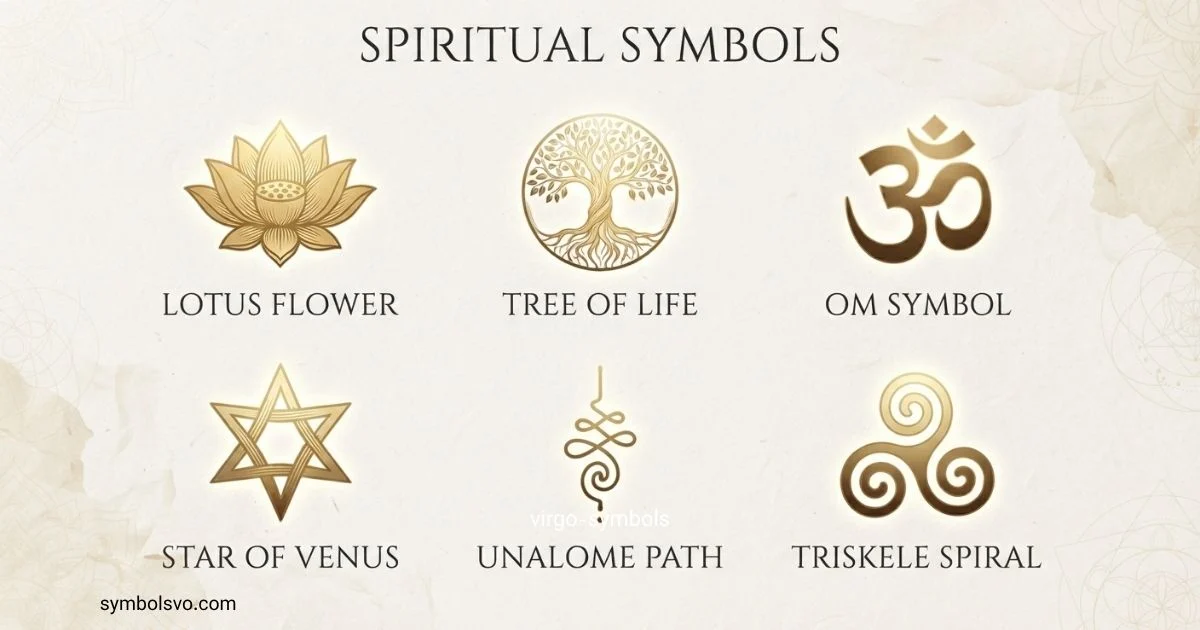
I have always found spiritual symbols fascinating because a simple shape, sign, or image can carry a much deeper meaning. Across cultures and traditions, people have used these symbols to express faith, hope, protection, transformation, and connection.
When you explore spiritual symbols, you discover more than beautiful designs. You begin to see how different cultures have used familiar signs to represent powerful ideas, and you may even find symbols that personally resonate with you.
In this guide, I’ll help you understand the meanings, origins, and common uses of spiritual symbols in a simple way. Whether you are curious about ancient traditions or looking for a meaningful symbol, you can use this guide to explore them with greater understanding.
Spiritual Symbols And Meanings List
Here is a useful starting list of well-known spiritual symbols and their common associations:
| Symbol | Name | Common spiritual association |
| ☯ | Yin-Yang | Balance and complementary forces |
| ☮ | Peace symbol | Peace and harmony |
| ☸ | Dharma Wheel | Buddhist teaching and the path |
| ☯ | Yin-Yang | Balance and harmony |
| ॐ | Om | Sacred sound and spiritual practice in Hindu traditions |
| ☥ | Ankh | Life in ancient Egyptian religion |
| 🕉 | Om symbol | Sacred syllable and spiritual practice |
| ✡ | Star of David | Jewish identity and religious tradition |
| ☦ | Orthodox cross | Eastern Christian tradition |
| ✝ | Latin cross | Christianity |
| 🪷 | Lotus | Purity, growth, and spiritual awakening in several Asian traditions |
| ☪ | Star and crescent | Common symbol associated with Islam |
| ☯ | Yin-yang | Interdependence and balance |
| ∞ | Infinity | Endless or limitless continuation |
Some of these are Unicode characters, while others may be represented through emoji or specialized typography. Their visual appearance can vary between platforms.
A symbol’s meaning also depends on context. For example, the lotus is widely associated with spiritual growth in several Asian religious traditions, but its exact significance differs between Buddhism, Hinduism, and other contexts.
Powerful Spiritual Symbols And Meanings
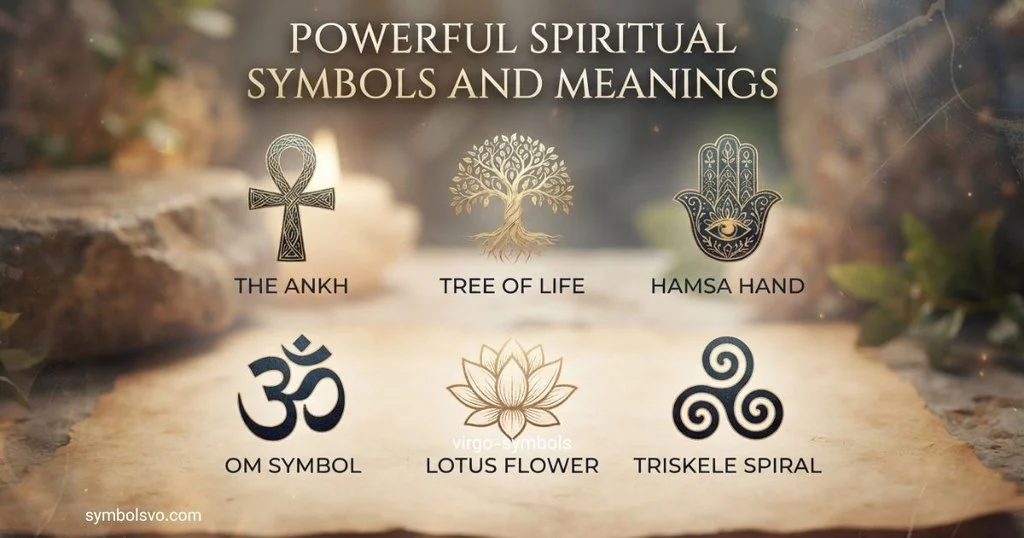
The word “powerful” is subjective. A symbol may feel powerful because of its religious history, cultural importance, personal meaning, or visual impact.
Some commonly recognized examples include:
- ☥ Ankh — associated with life in ancient Egyptian religion.
- ॐ Om — a sacred syllable and symbol in Hindu traditions, also used in some Buddhist and Jain contexts.
- ☸ Dharma Wheel — associated with Buddhist teachings and the path of Dharma.
- ☯ Yin-Yang — represents complementary forces and balance in Chinese philosophy.
- 🪷 Lotus — commonly associated with purity, spiritual development, and awakening in South and East Asian traditions.
- ✡ Star of David — an important symbol of Jewish identity and tradition.
- ✝ Cross — a central symbol of Christianity, with different cross forms carrying different historical meanings.
- ☪ Star and crescent — widely associated with Islam in modern visual culture, although it is not a universal symbol of the religion.
- ∞ Infinity — often used in modern spirituality to express endlessness or continuity.
- 𓂀 Eye of Horus — an ancient Egyptian symbol associated with protection, restoration, and royal power.
A symbol becomes meaningful through the tradition and context behind it. It is better to understand that background than to treat a symbol as having a universal supernatural power.
Ancient Spiritual Symbols
Ancient spiritual symbols appear in religious art, architecture, manuscripts, jewelry, burial objects, and ritual traditions. Their original meanings can be more specific than modern social-media interpretations suggest.
Some notable examples include:
Ankh
☥ — Ankh
The ankh is an ancient Egyptian hieroglyph commonly translated as “life” or associated with life and vitality. Egyptian deities are frequently depicted holding it in ancient art.
Eye Of Horus
𓂀 — Eye of Horus
The Eye of Horus is an ancient Egyptian symbol connected with Horus and commonly associated with protection, healing, restoration, and well-being.
The Egyptian hieroglyphic character shown above is often used online as an approximation of the Eye of Horus, but its appearance and historical context should not be confused with a generic Unicode “spiritual eye” character.
Yin-Yang
☯ — Yin-Yang
The yin-yang symbol comes from Chinese philosophical traditions and expresses complementary aspects rather than a simple battle between good and evil.
Om
ॐ — Om
Om is a sacred syllable and symbol used in Hindu traditions and also appears in Buddhist and Jain contexts.
Ancient symbols deserve careful treatment because modern websites sometimes assign meanings that are not supported by historical evidence. If you are using one in a tattoo or artwork, checking its cultural background is worthwhile.
Enlightenment Spiritual Symbols
Enlightenment is associated with different ideas depending on the spiritual tradition. There is no single universal symbol of enlightenment.
Commonly associated imagery includes:
- 🪷 Lotus — growth from difficult conditions toward spiritual awakening.
- ☸ Dharma Wheel — Buddhist teachings and the path toward liberation.
- ॐ Om — sacred sound and spiritual practice.
- ☯ Yin-Yang — balance and the relationship between complementary forces.
- ☀ Sun imagery — often used symbolically for light, awareness, and illumination.
- ✦ Star imagery — may represent guidance, inner light, or aspiration in modern spiritual art.
- ☸ Eight-spoked Dharma Wheel — associated with the Noble Eightfold Path in Buddhism.
The lotus is particularly common in visual representations of spiritual awakening because it grows in muddy water while producing a flower above the surface. Its meaning, however, varies among traditions.
Healing Spiritual Symbols
Healing symbols often represent restoration, renewal, peace, protection, or the hope of recovery. Their meanings are usually cultural or spiritual rather than medical.
Some examples include:
| Symbol | Association |
| 🪷 | Renewal, purity, spiritual growth |
| ☥ | Life and vitality |
| ☸ | Buddhist teaching and spiritual practice |
| ॐ | Meditation and sacred practice |
| ☯ | Balance and harmony |
| 🌀 | Cycles, movement, transformation |
| 🌿 | Nature, renewal, and growth |
The Rod of Asclepius is another important symbol when discussing healing, but it is primarily a historical medical symbol rather than a general spiritual symbol. It should not be confused with the caduceus, which has two snakes and wings.
Spiritual symbols can be meaningful in meditation, artwork, jewelry, or personal reflection. They should not be treated as substitutes for medical diagnosis or treatment.
Spiritual Symbols For Protection
Protection is one of the most common reasons people choose spiritual symbols for jewelry, artwork, home décor, and tattoos.
Some symbols traditionally associated with protection include:
- 𓂀 Eye of Horus — protection and restoration in ancient Egyptian contexts.
- Hamsa — a hand-shaped symbol used in Jewish, Christian, and Islamic cultural contexts, particularly in the Middle East and North Africa, with meanings that vary by tradition.
- ☥ Ankh — life and vitality in ancient Egyptian symbolism.
- Om — sacred spiritual practice in Hindu traditions and other South Asian religious contexts.
- ☸ Dharma Wheel — Buddhist teachings and spiritual practice.
- 🪬 Hamsa emoji — a modern digital representation of the hand symbol.
The Hamsa is especially important to use respectfully because it has a long and varied cultural history. Its interpretation can include protection, blessing, divine presence, or good fortune depending on the tradition.
A protection symbol does not have one guaranteed supernatural effect. Its value may instead come from religious faith, cultural meaning, personal identity, or the reminder it provides.
Egyptian Spiritual Symbols
Ancient Egyptian culture produced many symbols with religious and funerary meanings. Several remain popular today.
| Symbol | Name | Common historical association |
| ☥ | Ankh | Life |
| 𓂀 | Eye of Horus | Protection, restoration, well-being |
| 𓆣 | Scarab-related imagery | Renewal and rebirth |
| Djed | Djed pillar | Stability and endurance |
| Was | Was scepter | Power and authority |
| Shen ring | Shen ring | Protection and eternity |
| Tyet | Isis knot | Associated with Isis and protection |
The scarab was important in ancient Egyptian religious symbolism, especially through the association of the scarab beetle with Khepri and the rising sun.
The Djed was associated with stability and was connected with Osiris in Egyptian religious tradition.
Modern tattoo and jewelry designs sometimes simplify these symbols. If historical accuracy matters, use museum collections, Egyptological sources, or scholarly references rather than relying only on modern symbolic lists.
Japanese Spiritual Symbols
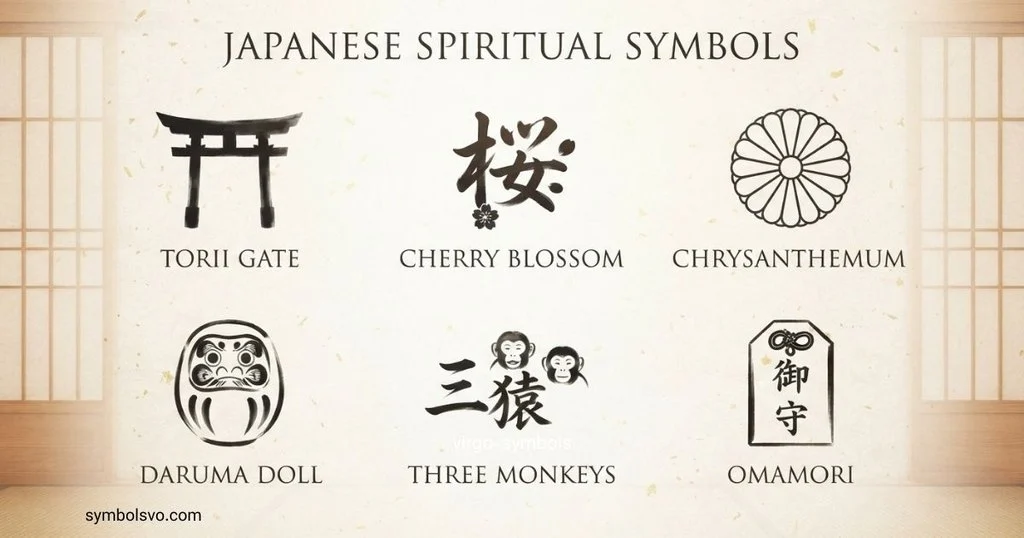
Japanese spiritual symbols come from several traditions, including Shinto, Buddhism, and other cultural practices. Some symbols are religious, while others are strongly connected with Japanese art and cultural identity.
Examples include:
- Torii gate ⛩ — marks an entrance associated with Shinto sacred space.
- Ensō 円相 — a circular brushstroke associated with Zen Buddhist art and practice.
- 蓮 (hasu) — lotus imagery, important in Buddhist contexts.
- 卍 — an ancient symbol with meanings in multiple cultures; in Japan it is traditionally associated with Buddhist temples and may appear on maps as a temple marker.
- Tomoe 巴 — a comma-like crest motif with historical and religious associations.
- Sakura 桜 — cherry blossoms, often associated with impermanence and the transient nature of life in Japanese cultural interpretation.
The Japanese use of the 卍 symbol deserves special care. It is an ancient symbol with a history that predates the twentieth-century Nazi appropriation of a related form. In Japanese Buddhist contexts, it can represent temples and Buddhist traditions. Its appearance and orientation can differ from the Nazi swastika.
Spiritual Symbols Tattoos
Spiritual symbols are popular tattoo choices because a small image can carry a personal story or cultural reference.
Common choices include:
- 🪷 Lotus
- ☯ Yin-yang
- ☥ Ankh
- ॐ Om
- ☸ Dharma Wheel
- Hamsa
- Ensō
- Eye of Horus
- Crosses
- Sacred geometry patterns
Before getting a spiritual symbol tattoo, learn its actual cultural and religious background. A symbol that looks attractive may have a specific meaning that differs from what a social-media post claims.
Choosing A Spiritual Tattoo
Think about three things:
- Meaning: What does the symbol represent in its original tradition?
- Context: Does the symbol have religious or cultural significance?
- Design: Will simplifying or combining it with another image change its meaning?
You should also verify the exact shape. Small differences in religious symbols can matter, especially when the design comes from a specific tradition.
Spiritual Symbols Chart: Unalome Meaning
The Unalome is a modern spiritual and tattoo motif inspired by Buddhist symbolism, especially representations associated with the path toward awakening. Its common visual form begins with a winding or spiral-like path and progresses toward a straighter line.
The Unalome is often interpreted as representing:
- The twists and turns of life
- Personal growth
- Learning through experience
- Movement toward clarity
- A spiritual journey
- Awakening
A simplified chart can help:
| Visual idea | Common interpretation |
| Spiral or winding beginning | Confusion, struggle, or life’s twists |
| Gradual movement upward | Growth and experience |
| Straighter path | Increasing clarity |
| Final point | Awakening or spiritual goal |
The popular tattoo interpretation should not be treated as a single fixed ancient definition. The Unalome has been adapted in modern spiritual culture, and its exact significance can vary.
For a spiritual symbols chart, it is useful to place the Unalome beside other symbols rather than claiming that every culture gives it the same meaning.
Spiritual Symbols Text
Text-based spiritual symbols are useful for bios, captions, usernames, messages, journal entries, and decorative writing.
Here are several Unicode symbols that can be copied:
| Symbol | Common name or description |
| ☯ | Yin-yang |
| ☮ | Peace symbol |
| ☸ | Dharma Wheel |
| ☥ | Ankh |
| ✡ | Star of David |
| ✝ | Latin cross |
| ☦ | Orthodox cross |
| ☪ | Star and crescent |
| ॐ | Om |
| ☀ | Sun |
| ☾ | Crescent moon |
| ✦ | Four-pointed star |
| ✧ | White four-pointed star |
| ∞ | Infinity |
| 🪷 | Lotus emoji |
These characters are text symbols or emoji, so their appearance can change according to the font or platform.
For example:
Peace: ☮
Balance: ☯
Sacred sound: ॐ
Life: ☥
Infinity: ∞
Dharma: ☸
Their meanings are contextual, so using them in a profile or message does not automatically communicate a specific religious belief.
Spiritual Symbols Copy And Paste
If you need spiritual symbols for a caption, message, bio, or design, the easiest approach is to copy the character directly from a list.
Copy And Paste Symbols
☯ — Yin-yang
☮ — Peace
☸ — Dharma Wheel
☥ — Ankh
✡ — Star of David
✝ — Latin cross
☦ — Orthodox cross
☪ — Star and crescent
ॐ — Om
∞ — Infinity
☀ — Sun
☾ — Crescent moon
✦ — Four-pointed star
✧ — White four-pointed star
🪷 — Lotus
🪬 — Hamsa
You can copy a symbol by selecting it and using your device’s normal copy command.
Keep in mind that Unicode symbol and spiritual meaning are separate things. Unicode defines characters and their encoding; cultures and traditions give symbols their meanings.
If a symbol appears as an empty box or looks different on your device, the issue may be font or platform support. Emoji can also have significantly different artwork across operating systems.
7 Spiritual Symbols
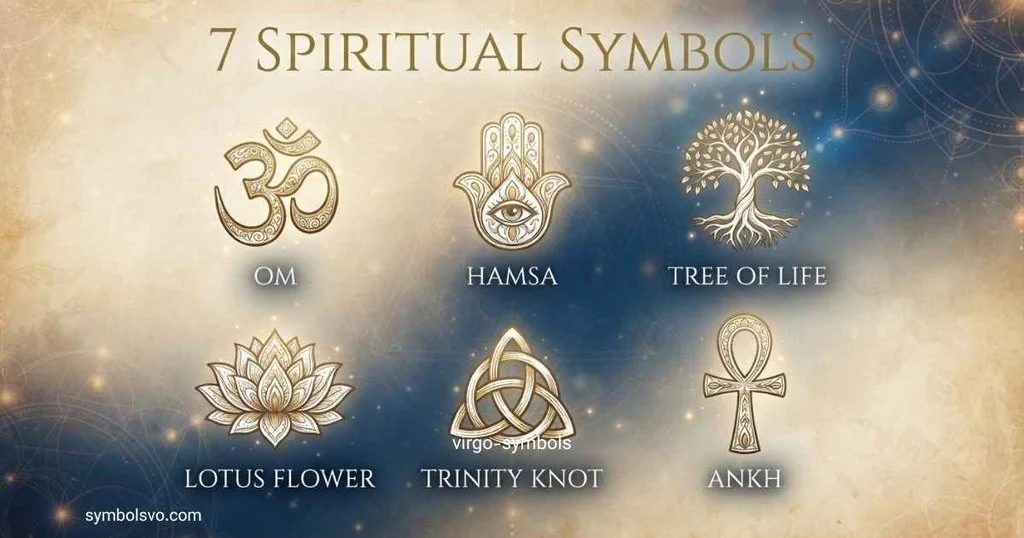
Here are seven widely recognized spiritual or religious symbols, with their common associations:
- ☯ Yin-Yang — balance and complementary forces in Chinese philosophy.
- ☥ Ankh — life in ancient Egyptian religious symbolism.
- ॐ Om — sacred syllable and spiritual practice in Hindu traditions.
- ☸ Dharma Wheel — Buddhist teachings and the path of Dharma.
- 🪷 Lotus — spiritual growth, purity, and awakening in several Asian traditions.
- ✝ Cross — Christianity and the central Christian symbol of the crucifixion of Jesus, with many cross forms used across Christian traditions.
- ☮ Peace Symbol — peace and opposition to war in its modern historical use.
These seven are not a universal ranking of spiritual symbols. They are simply a practical selection of symbols that are widely recognized and have rich cultural or religious associations.
Frequently Asked Questions
What is the most powerful spiritual symbol?
There is no universally accepted “most powerful” spiritual symbol. The significance of a symbol depends on the religious tradition, culture, and personal beliefs connected to it.
What symbol represents spiritual awakening?
The lotus is commonly used to represent spiritual growth or awakening in several Asian religious traditions. The Dharma Wheel and other Buddhist imagery can also relate to teachings and the path toward liberation.
What symbol is used for protection?
The Eye of Horus and Hamsa are commonly associated with protection in their respective cultural traditions. Their meanings vary according to historical and religious context.
What symbol represents healing?
Healing symbolism varies widely. The Eye of Horus has historical associations with restoration and well-being in ancient Egyptian religion, while lotus imagery is often connected with renewal and spiritual development.
Can I use spiritual symbols as text?
Yes. Many symbols are available as Unicode characters or emoji and can be copied into text, profiles, captions, and messages. However, not every spiritual image has a Unicode character, and the visual appearance may vary between devices.
Conclusion
Spiritual symbols can communicate ideas that are difficult to express with words alone. From the ancient Egyptian ankh to the Buddhist Dharma Wheel, Japanese torii, lotus, Unalome, and modern Unicode symbols, each has a history and context worth understanding.
For copy-and-paste use, symbols such as ☯, ☮, ☸, ☥, ॐ, ✝, ∞, and 🪷 can add meaning to text, bios, captions, artwork, and personal notes. Their digital appearance may change across fonts and devices, but the underlying characters remain useful for everyday communication.
The best way to use a spiritual symbol is to understand what it represents before adopting it. Cultural context matters, especially for religious tattoos, jewelry, and artwork. A little research can help you choose a symbol that is both visually meaningful and respectful of its tradition.

 Grace Whitmore
 Daniel Brooks