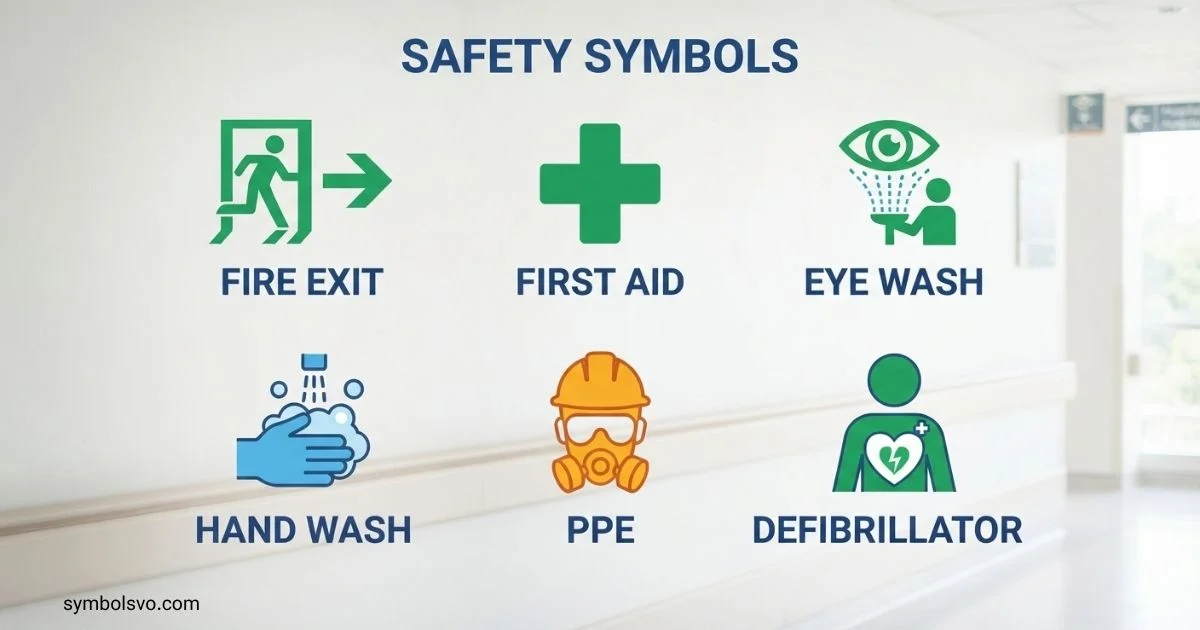
When I see a safety symbol, I know it can communicate an important message in just seconds. These simple signs can warn you about hazards, guide your actions, and help keep people safe in everyday situations.
You may see safety symbols at work, on roads, around machinery, in public buildings, or near hazardous materials. I want to help you understand what these symbols mean so you can recognize important warnings quickly and confidently.
In this guide, you’ll discover common safety symbols, their meanings, colors, shapes, and practical uses. By the end, you’ll have a clear understanding of how these signs communicate danger, warnings, instructions, and essential safety information.
Safety Symbols With Names
Safety symbols are visual signs used to communicate hazards, required actions, prohibited actions, emergency information, or safe conditions. Their appearance can vary depending on the standard being used.
Here are some widely recognized safety-related symbols and pictograms:
| Symbol or pictogram | Name | Meaning |
| ☣ | Biohazard | Biological hazards or potentially infectious materials |
| ☢ | Radioactive | Ionizing radiation or radioactive materials |
| ⚠ | Warning | General warning or caution |
| ☠ | Skull and crossbones | Poison or severe acute toxicity in appropriate contexts |
| 🔥 | Flame | Fire or flammable material in general text use |
| ⚡ | Electrical hazard | Electricity or electric shock hazard |
| 🧯 | Fire extinguisher | Fire-extinguishing equipment |
| 🚭 | No smoking | Smoking is prohibited |
| ⛔ | Prohibited/stop-style symbol | An action or entry is prohibited depending on the sign |
| 🥽 | Eye protection | Protective eyewear is required or recommended |
| 🧤 | Protective gloves | Hand protection is required or recommended |
Some of these characters are ordinary Unicode emoji or symbols rather than standardized workplace safety pictograms. For official signs, always rely on the actual sign and the applicable safety standard rather than substituting a text character.
Safety Symbols With Names And Pictures
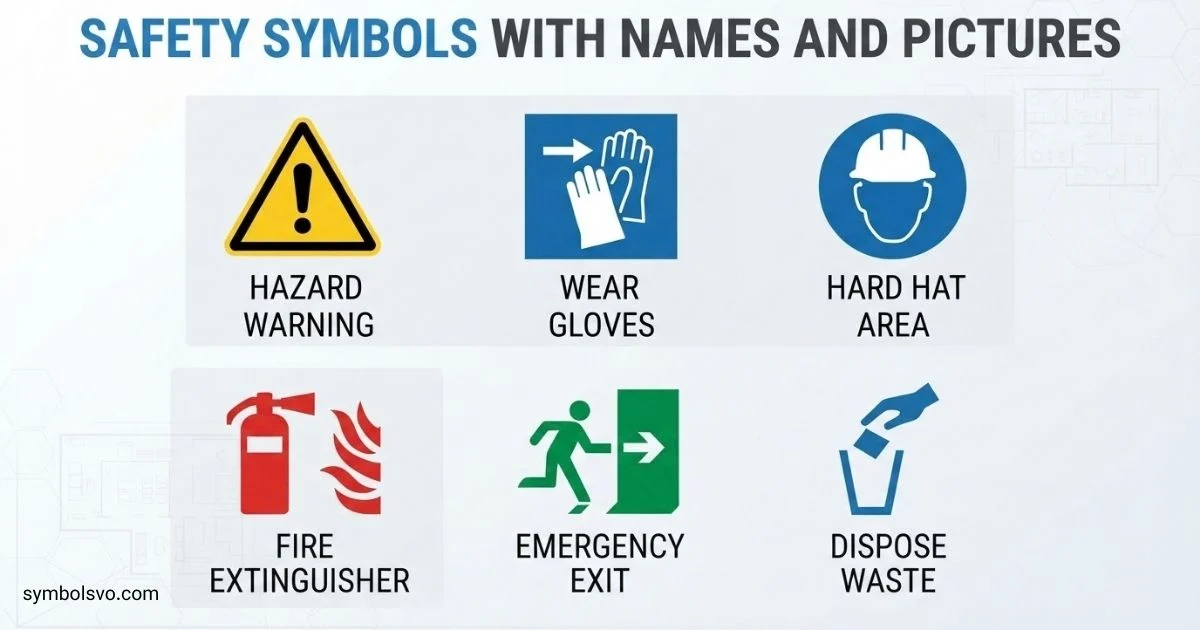
Safety symbols are easier to learn when the visual form is shown beside the name and meaning. Common examples include warning signs, mandatory protective-equipment signs, prohibition signs, and hazard pictograms.
A useful way to recognize them is by their purpose:
- Warning symbols alert you to a possible hazard.
- Prohibition symbols tell you that an action is not allowed.
- Mandatory symbols tell you what protective action is required.
- Emergency symbols help identify exits, first-aid equipment, or emergency facilities.
- Hazard pictograms identify specific physical or health hazards.
For chemical labels under OSHA’s Hazard Communication Standard, pictograms use a black hazard symbol on a white background inside a red diamond-shaped frame. OSHA’s current HCS requires eight pictograms, while the broader GHS system contains nine because the environmental pictogram is not mandatory under OSHA’s HCS.
Safety Symbols And Meanings
The meaning of a safety symbol depends on the standard, location, color, shape, and surrounding information. A symbol should therefore be interpreted together with the sign or label where it appears.
Common Safety Symbol Meanings
- ⚠ Warning — Alerts people to a hazard or condition requiring attention.
- ☣ Biohazard — Identifies biological hazards.
- ☢ Radioactive — Indicates radiation or radioactive material.
- ☠ Skull and crossbones — Commonly associated with severe poisoning or acute toxicity.
- 🔥 Flame — Commonly represents fire or flammability.
- ⚡ Electrical hazard — Warns about electricity or electric shock.
- 🚭 No smoking — Indicates that smoking is prohibited.
- 🥽 Eye protection — Indicates that protective eyewear is required or expected.
- 🧤 Gloves — Indicates the need for hand protection.
- 🧯 Fire extinguisher — Identifies fire-fighting equipment.
For chemical hazards, the meaning becomes more specific. OSHA’s eight required HCS pictograms include the flame, flame over circle, gas cylinder, corrosion, exploding bomb, health hazard, exclamation mark, and skull and crossbones.
A red-diamond chemical pictogram should not be interpreted simply as a general “danger” sign. Its particular graphic identifies a specific hazard class or group of hazards.
Safety Symbols And Signs
Safety symbols and safety signs are related, but they are not exactly the same thing.
A symbol or pictogram is the graphic itself. A safety sign is the complete visual communication, which can include the symbol, colors, words, border, shape, and supplementary information.
For example, a workplace sign might combine a graphic of protective eyewear with text such as “Eye Protection Required.”
Common sign categories include:
| Sign type | Main purpose | Example |
| Warning | Alerts people to hazards | Electrical hazard |
| Prohibition | Stops an unsafe action | No smoking |
| Mandatory | Requires an action | Wear eye protection |
| Emergency | Shows emergency equipment or routes | Emergency exit |
| Fire equipment | Identifies fire equipment | Fire extinguisher |
| Hazard label | Identifies a specific hazard | Chemical pictogram |
The colors and shapes used on safety signs can carry meaning, so changing the design of an official sign may reduce its effectiveness.
5 Safety Symbols
If you need only five basic safety symbols for a school project or quick study sheet, these are useful examples:
- ⚠ — Warning
Alerts people to a hazard or condition requiring attention. - ☣ — Biohazard
Identifies a biological hazard. - ☢ — Radioactive
Indicates ionizing radiation or radioactive material. - ☠ — Skull and crossbones
Commonly signals severe acute toxicity or poisoning when used in the appropriate hazard context. - ⚡ — Electrical hazard
Warns about electrical danger, including possible electric shock.
The actual design of a regulated workplace sign may differ from these plain-text characters. Use the official sign provided by your school, employer, or applicable safety standard when safety depends on precise signage.
20 Safety Signs And Symbols With Names
Here is a broader reference list of 20 common safety-related signs and symbols.
| # | Symbol/sign | Name | Basic meaning |
| 1 | ⚠ | Warning | Hazard or caution |
| 2 | ☣ | Biohazard | Biological hazard |
| 3 | ☢ | Radioactive | Radiation hazard |
| 4 | ☠ | Skull and crossbones | Severe toxicity/poison |
| 5 | ⚡ | Electrical hazard | Electrical danger |
| 6 | 🔥 | Flame | Fire or flammability |
| 7 | 🚭 | No smoking | Smoking prohibited |
| 8 | 🧯 | Fire extinguisher | Fire equipment |
| 9 | 🥽 | Eye protection | Wear protective eyewear |
| 10 | 🧤 | Hand protection | Wear protective gloves |
| 11 | 😷 | Respiratory protection | Use suitable respiratory protection |
| 12 | 🪖 | Head protection | Wear a safety helmet |
| 13 | 🥾 | Foot protection | Wear protective footwear |
| 14 | 🦺 | High-visibility clothing | Wear visible protective clothing |
| 15 | 🧪 | Chemical hazard | Chemical-related hazard context |
| 16 | 💨 | Gas hazard | Gas or airborne hazard context |
| 17 | ⛔ | Prohibited action | An action is not allowed |
| 18 | 🚪 | Emergency exit | Emergency escape route |
| 19 | 🩹 | First aid | First-aid equipment or area |
| 20 | 🚿 | Emergency shower | Emergency washing facility |
Several entries above are text or emoji representations rather than official standardized workplace pictograms. They are useful for learning and digital content, but they should not be treated as substitutes for regulated safety signage.
Laboratory Safety Symbols With Names
Laboratories use safety symbols to warn students, researchers, technicians, and visitors about hazards involving chemicals, equipment, heat, electricity, radiation, biological materials, and glassware.
Common laboratory safety symbols include:
- ☣ Biohazard — Biological or potentially infectious materials.
- ☢ Radiation — Ionizing radiation or radioactive materials.
- ⚠ General warning — A hazard requiring attention.
- ☠ Toxic hazard — Serious poisoning risk in the appropriate context.
- 🔥 Flammable — Flammable materials or fire risk.
- ⚡ Electrical hazard — Electrical equipment or shock risk.
- 🧪 Chemical hazard — Chemical-related danger.
- 🥽 Eye protection — Protective eyewear.
- 🧤 Gloves — Hand protection.
- 🚿 Emergency shower — Emergency washing facility.
- 🧯 Fire extinguisher — Fire-fighting equipment.
- 🚭 No smoking — Smoking is prohibited.
Laboratory signs should always be read before handling an unfamiliar material or piece of equipment. A symbol provides a quick warning, but the label, Safety Data Sheet, laboratory procedure, and instructor or supervisor instructions provide the detailed safety information.
Lab Safety Symbols
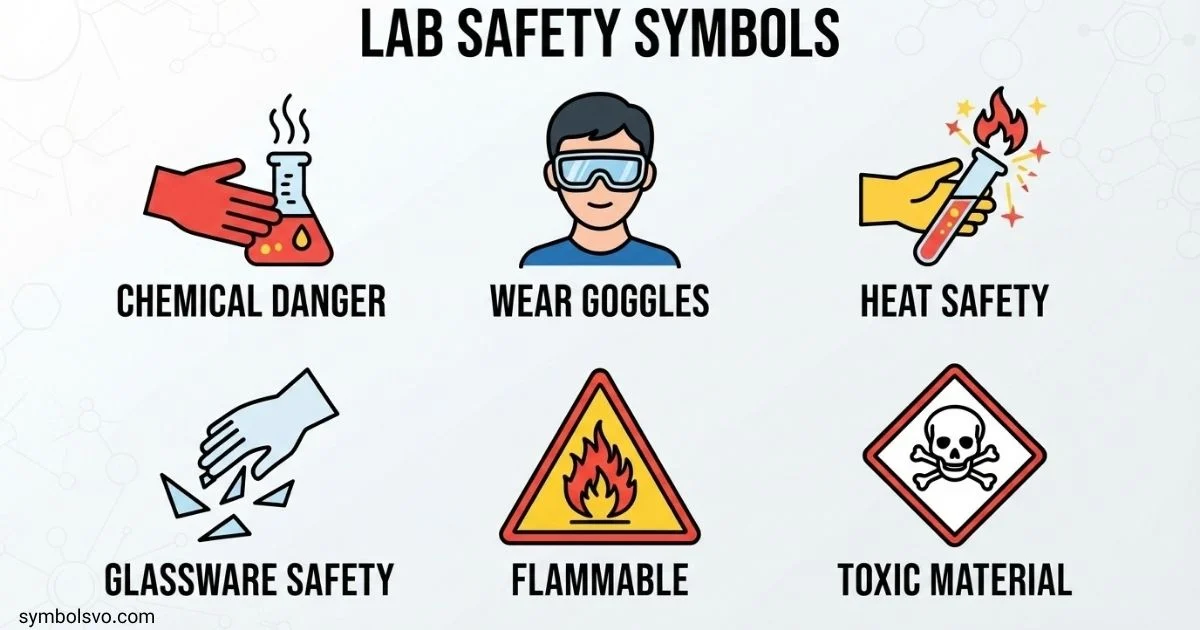
Lab safety symbols are especially important because laboratories can contain several different hazards in the same room.
A student might encounter signs for:
Chemical hazards: corrosive, flammable, toxic, oxidizing, or reactive substances.
Physical hazards: hot surfaces, sharp equipment, glassware, pressure, electricity, or moving machinery.
Biological hazards: microorganisms, biological specimens, or potentially infectious material.
Radiation hazards: radioactive materials or radiation-producing equipment.
Personal protective equipment: eye protection, gloves, laboratory coats, face protection, or other required equipment.
One symbol does not necessarily describe every danger associated with a substance. For example, a chemical can be both flammable and toxic, so its label may contain more than one applicable pictogram.
Science Safety Symbols
Science classrooms and laboratories use safety symbols to help students recognize hazards before starting an experiment.
Some of the most useful symbols to learn are:
- Flammable — Keep ignition sources away from flammable materials.
- Corrosive — Material can cause serious damage to skin, eyes, or certain metals.
- Toxic — Indicates a hazardous level of toxicity in the applicable context.
- Explosive — Indicates an explosion hazard.
- Oxidizing — Indicates a material that can cause or intensify fire.
- Gas under pressure — Indicates a pressurized gas hazard.
- Biohazard — Indicates biological hazards.
- Radioactive — Indicates radiation hazards.
- Electrical hazard — Warns of electrical danger.
- Eye protection — Indicates that protective eyewear is required.
Teaching these symbols before an experiment helps students recognize warnings before they begin handling equipment or substances.
Science Lab Safety Symbols
Science lab safety symbols combine general classroom safety with hazard-specific laboratory warnings.
A simple student reference can look like this:
| Hazard | Symbol/pictogram | What students should understand |
| Fire | 🔥 | Keep flames and ignition sources away from flammable materials |
| Chemical | 🧪 | Follow the chemical label and laboratory instructions |
| Eye hazard | 🥽 | Wear appropriate eye protection |
| Biohazard | ☣ | Avoid contact and follow biological safety procedures |
| Radiation | ☢ | Follow radiation-control procedures |
| Electrical | ⚡ | Do not touch or operate equipment without permission |
| Toxicity | ☠ | Avoid exposure and follow handling instructions |
| Explosion | 💥 | Follow special precautions and keep away from unsafe ignition or reaction conditions |
| Corrosion | GHS corrosion pictogram | Prevent contact with skin, eyes, and incompatible materials |
| Oxidizer | GHS flame-over-circle pictogram | Keep away from incompatible combustible materials |
The correct response is always based on the specific hazard and the instructions provided by the laboratory.
Chemistry Safety Symbols
Chemistry laboratories commonly use hazard pictograms from the Globally Harmonized System of Classification and Labelling of Chemicals, or GHS.
The main OSHA-required chemical pictograms include:
| Pictogram | Name | Typical hazard |
| Flame | Flammable | Flammables, pyrophorics, self-heating materials, some self-reactives and organic peroxides |
| Flame over circle | Oxidizer | Oxidizing substances |
| Exploding bomb | Explosive | Explosives and certain self-reactive substances or organic peroxides |
| Gas cylinder | Gas under pressure | Compressed, liquefied, dissolved, or refrigerated gases |
| Corrosion | Corrosive | Skin corrosion, serious eye damage, or corrosive-to-metal hazards |
| Skull and crossbones | Acute toxicity | Severe acute toxicity |
| Health hazard | Serious health hazard | Carcinogenicity, respiratory sensitization, reproductive toxicity, and certain other chronic hazards |
| Exclamation mark | Harmful/irritant | Irritation, sensitization, harmful acute toxicity, and certain other hazards |
OSHA specifies the hazard classes associated with each pictogram under its Hazard Communication Standard.
Chemical Safety Symbols
Chemical safety symbols are designed to communicate hazards found on chemical labels and containers.
The GHS-style pictograms are particularly important because their meanings are more specific than general warning icons.
Flame
🔥 Flame pictogram
Used for hazards such as flammable substances, pyrophoric materials, self-heating substances, and certain self-reactive substances and organic peroxides.
Flame Over Circle
Flame over circle pictogram
Identifies oxidizers, which can cause or intensify fire.
Exploding Bomb
Exploding bomb pictogram
Identifies certain explosive, self-reactive, and organic peroxide hazards.
Corrosion
Corrosion pictogram
Indicates hazards such as skin corrosion, serious eye damage, or corrosion to metals.
Gas Cylinder
Gas cylinder pictogram
Identifies gases under pressure.
Health Hazard
Health hazard pictogram
Can indicate serious health hazards such as carcinogenicity, respiratory sensitization, reproductive toxicity, mutagenicity, target-organ toxicity, or aspiration toxicity.
Exclamation Mark
Exclamation mark pictogram
Can indicate hazards such as skin or eye irritation, skin sensitization, harmful acute toxicity, narcotic effects, or respiratory tract irritation.
Skull And Crossbones
Skull and crossbones pictogram
Indicates acute toxicity that can be fatal or toxic under the applicable classification.
The environmental pictogram is part of GHS, but it is not mandatory under OSHA’s Hazard Communication Standard because environmental hazards are outside OSHA’s jurisdiction.
Fire Safety Symbols
Fire safety symbols help people identify fire hazards, fire equipment, escape routes, and related emergency information.
Common fire-related signs include:
- 🧯 Fire extinguisher — Identifies fire-extinguishing equipment.
- 🔥 Flame — Commonly represents fire or flammability.
- 🚒 Fire equipment — May identify fire-response equipment or facilities depending on the sign system.
- 🚭 No smoking — Prohibits smoking where it could create a fire risk.
- Emergency exit signs — Identify routes used to leave an area during an emergency.
- Flammable-material signs — Warn that a substance or area presents a fire risk.
Fire signs should remain visible and unobstructed. A symbol is most useful when people already know what it means and can quickly act on the warning.
Electrical Safety Symbols
Electrical safety signs warn people about electricity, electrical equipment, exposed conductors, high voltage, and possible electric shock.
The lightning-bolt style warning is commonly associated with electrical hazards:
⚡ Electrical hazard
Other signs may include words such as Danger, Warning, or High Voltage together with a standardized warning symbol.
Common locations include:
- Electrical panels
- Transformers
- Power rooms
- Machinery
- High-voltage equipment
- Construction areas
- Utility installations
- Laboratory equipment
Never rely on a symbol alone when working with electricity. Proper isolation, authorization, protective equipment, training, and applicable electrical procedures are essential.
Explosive Safety Symbols
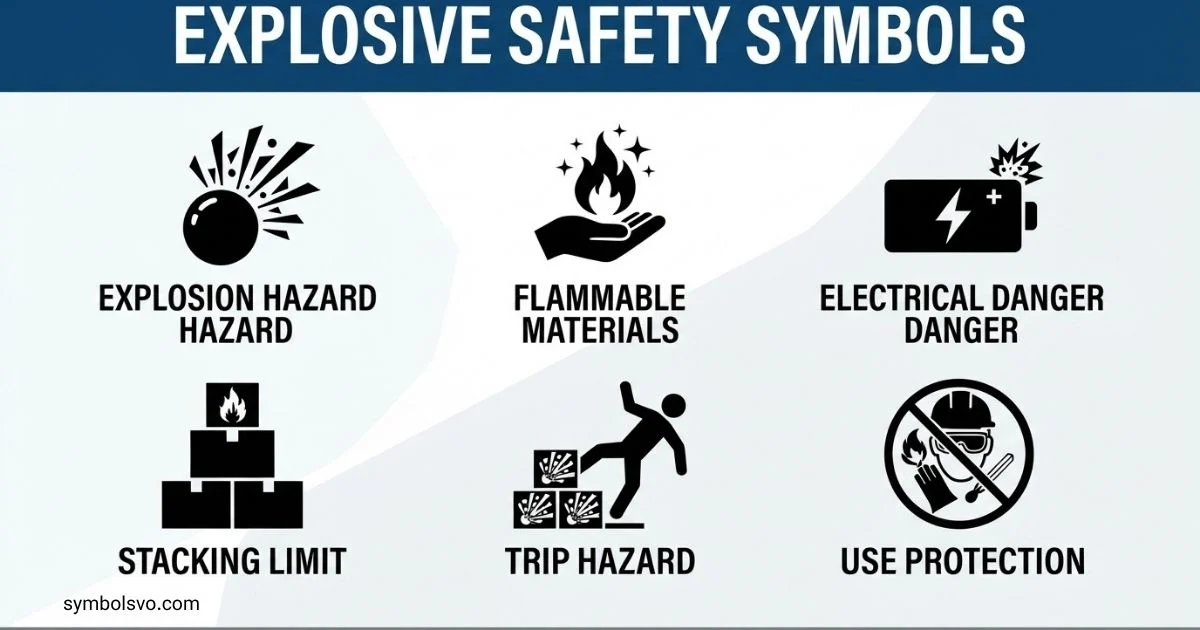
The exploding bomb pictogram is the key GHS hazard symbol associated with explosives. OSHA lists it for explosives and certain self-reactive substances and organic peroxides.
A simplified text representation is:
💥 Explosive hazard
However, the emoji is not the official GHS pictogram. The official chemical pictogram has a black exploding-bomb graphic inside a red diamond frame.
An explosive warning should be taken seriously. OSHA’s hazard communication information includes precautions such as obtaining special instructions, understanding safety precautions before handling, and using appropriate protective measures for applicable explosive hazards.
OSHA Safety Symbols
OSHA uses safety signs, labels, and hazard communication requirements in different workplace contexts. One of the most recognizable OSHA-related systems is the Hazard Communication Standard, which uses pictograms on labels for classified chemical hazards.
Under OSHA’s HCS, a chemical pictogram consists of a black hazard symbol on a white background surrounded by a red diamond-shaped frame. OSHA requires eight pictograms under the HCS.
The eight required pictogram types are:
- Flame
- Flame over circle
- Exclamation mark
- Exploding bomb
- Corrosion
- Gas cylinder
- Health hazard
- Skull and crossbones
OSHA also explains that labels can contain other required information, including the product identifier, signal word, hazard statements, pictograms, and precautionary statements.
The signal words Danger and Warning are not themselves pictograms. They communicate the relative severity of the hazard. OSHA specifies that when “Danger” is required, “Warning” does not also appear as the signal word on that label.
Lab Safety Symbols Worksheet
A lab safety symbols worksheet can help students learn to identify hazards before performing an experiment.
Simple Matching Worksheet
Match each symbol or hazard with its correct meaning.
| Symbol or hazard | Answer |
| 1. ☣ | A. Electrical hazard |
| 2. ☢ | B. Biohazard |
| 3. ⚡ | C. Radioactive hazard |
| 4. 🔥 | D. Fire or flammability |
| 5. 🥽 | E. Eye protection |
| 6. ☠ | F. Severe toxicity |
Answer key:
- B — Biohazard
- C — Radioactive hazard
- A — Electrical hazard
- D — Fire or flammability
- E — Eye protection
- F — Severe toxicity
For older students, a better worksheet can use the actual GHS pictograms and ask learners to match each pictogram with its hazard class. That approach is more accurate for chemistry and laboratory safety because the GHS symbols communicate specific chemical hazards.
A useful worksheet can also include these questions:
- What does the flame pictogram mean?
- What hazard does the skull and crossbones indicate?
- What does the gas cylinder represent?
- What should you do when you see an eye-protection sign?
- Why should chemical labels be read before use?
The worksheet should reinforce safe behavior rather than encourage students to identify a symbol and then handle a hazardous substance without supervision.
Frequently Asked Questions
What are the main types of safety symbols?
Common categories include warning, prohibition, mandatory-action, emergency, fire-equipment, and hazard-identification symbols. Chemical labels also use specific GHS pictograms.
What are the five most important safety symbols?
There is no universal official list of only five “most important” symbols. For basic education, warning, biohazard, radioactive, electrical hazard, and fire-related symbols are useful examples.
What do the OSHA chemical symbols mean?
OSHA’s Hazard Communication Standard uses eight required pictogram types: flame, flame over circle, exclamation mark, exploding bomb, corrosion, gas cylinder, health hazard, and skull and crossbones.
Are safety symbols the same as Unicode symbols?
No. Some safety-related characters have Unicode equivalents, but official workplace and chemical signs are graphical symbols designed according to particular standards. A Unicode character should not automatically be treated as an official safety sign.
Why are safety symbols important in laboratories?
They allow people to recognize hazards quickly before handling chemicals, equipment, biological materials, radiation sources, or other potentially dangerous materials. They work alongside labels, procedures, training, and safety information.
Conclusion
Safety symbols provide a fast visual language for identifying hazards and communicating safe actions. From general warning signs to biohazard and radiation symbols, each sign helps people recognize a potential risk before an accident occurs.
Laboratories and chemistry classrooms require special attention because several hazard types can exist in the same environment. GHS and OSHA chemical pictograms make important distinctions between flammable, corrosive, explosive, oxidizing, toxic, pressurized, and serious health hazards.
For students, teachers, and workers, the best approach is to learn the symbol together with its correct meaning and required response. Text characters can be useful for digital content and worksheets, but official safety signs, chemical labels, and workplace procedures should always take priority when real safety decisions are involved.

 Grace Whitmore
 Daniel Brooks