
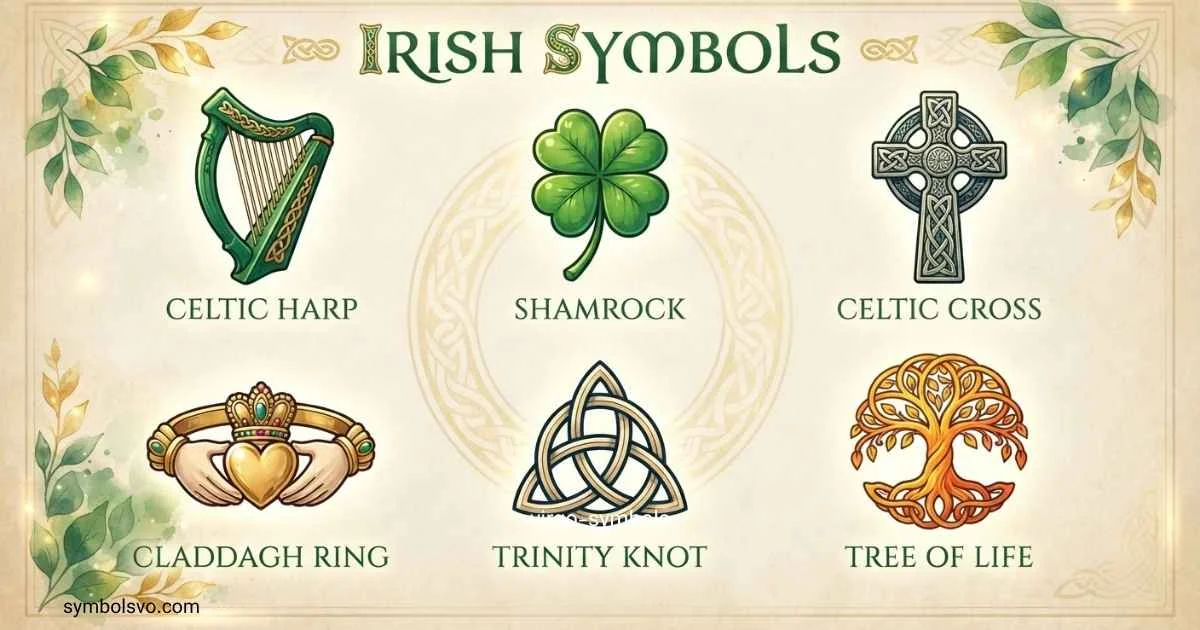
Irish symbols are fascinating because each one can carry a story of history, culture, faith, nature, or identity. From Celtic designs to traditional Irish emblems, these symbols connect Ireland’s past with the present.
If you’re curious about what Irish symbols mean, you’re in the right place. You can discover the stories behind familiar symbols and learn why they remain meaningful today.
I’ll take you through the most important Irish symbols in a simple, easy-to-understand way, so you can explore their meanings, origins, and cultural importance with confidence.
Irish Symbols And Meanings
Irish symbols can represent national identity, Christianity, Celtic heritage, nature, family, love, luck, and Irish history. Their meanings can also change depending on the period and the person using them.
Here are some of the best-known examples:
| Irish symbol | Common association |
| ☘ — Shamrock | Ireland, St. Patrick, Irish identity |
| ♣ — Club suit | Sometimes used visually as a clover-like shape, but it is not specifically an Irish symbol |
| Harp | Irish national identity and the Irish state |
| Claddagh | Love, loyalty, friendship |
| Celtic cross | Irish Christian and Celtic heritage |
| Trinity knot | Celtic-inspired design and interconnectedness |
| Celtic knot | Continuity, interconnection, and decorative heritage |
| Irish wolfhound | Irish heritage and traditional dog breed |
| Green | Strong modern association with Ireland and Irish celebrations |
| St. Patrick’s cross | St. Patrick and Christian tradition |
The harp has a particularly important national history. The National Museum of Ireland notes that it has represented Ireland since the medieval period and was officially adopted as a national symbol with the establishment of the Irish Free State in 1922. The design is associated with the medieval Brian Boru harp now held at Trinity College Dublin.
The shamrock also has a long cultural connection with St. Patrick. The National Museum of Ireland points out, however, that the popular story that St. Patrick used the three leaves to explain the Trinity is a relatively late tradition rather than something securely documented from his lifetime.
That distinction matters when researching Irish symbols. A symbol can be culturally important without every popular story about its origin being historically proven.
Traditional Irish Symbols
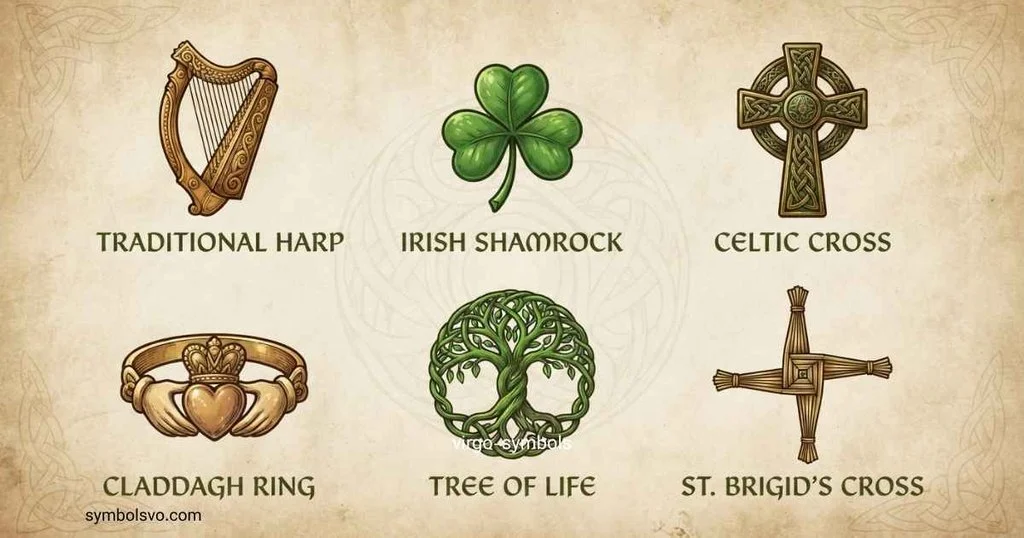
Traditional Irish symbols developed through many different periods, including early Christian Ireland, medieval Ireland, folk traditions, and more recent expressions of national identity.
Some of the most recognizable include:
Irish Harp
The harp is one of the strongest national symbols of Ireland. It appears in official state imagery and has been associated with Ireland for centuries.
Shamrock
The three-leaf shamrock is closely connected with St. Patrick’s Day and Irish identity. It is also represented in Unicode as the shamrock character ☘, U+2618. Unicode lists its keywords as including “Irish” and “shamrock.”
Claddagh
The Claddagh is a traditional Irish ring design featuring a heart, hands, and crown. It is commonly associated with love, friendship, and loyalty.
Celtic Cross
The Celtic cross combines a Christian cross form with a circular ring and is strongly associated with Ireland and Celtic Christian art. Historic examples can be found across Ireland.
Irish Wolfhound
The Irish wolfhound has a long association with Ireland and appears in Irish historical and cultural imagery. It is particularly useful as a symbol of Irish heritage, strength, and connection with traditional Irish life.
These symbols should not all be treated as belonging to one single ancient tradition. Some are national symbols, some are Christian, and others are artistic or folk symbols that became strongly associated with Irish identity over time.
Celtic Irish Symbols
Celtic Irish symbols are often recognized by flowing lines, spirals, interlacing patterns, knots, and geometric designs. They are especially common in manuscripts, stone carvings, metalwork, jewelry, monuments, and modern Irish-inspired artwork.
Popular Celtic designs include:
- Celtic knot — interwoven decorative pattern often associated today with continuity and connection.
- Trinity knot or triquetra — three-lobed interlaced design widely used in Celtic-inspired art.
- Celtic cross — Christian cross associated with Celtic and Irish heritage.
- Spiral motifs — recurring forms found in prehistoric Irish art.
- Interlace — woven-looking decorative patterns characteristic of Insular and Celtic-influenced art.
- Tree of Life designs — popular modern Celtic-inspired imagery, although specific modern versions should not automatically be presented as ancient Irish symbols.
One important distinction is that Celtic does not always mean specifically Irish. Celtic culture covered several regions, and many designs now marketed as “Celtic symbols” have connections beyond Ireland.
Irish manuscripts and archaeological objects provide stronger evidence for particular historical designs than modern tattoo catalogs or social-media graphics.
Ancient Irish Symbols And Meanings
Ancient Irish symbolism includes motifs from prehistoric monuments, Iron Age traditions, early medieval art, and later interpretations of Ireland’s Celtic past.
Some of the most important ancient motifs include spirals, geometric patterns, animals, birds, and interlaced designs.
The triple spiral, often called a triskele or triskelion in modern discussions, is especially associated with prehistoric Irish monuments. One of the best-known examples is found at Newgrange in County Meath.
The spiral is another major feature of Irish prehistoric art. These motifs appear prominently in passage-tomb art and are among the most recognizable visual elements of Ireland’s ancient archaeological heritage.
Animal imagery also appears in Irish decorative traditions. The National Museum of Ireland describes objects featuring stylized animals, interlace, shamrocks, round towers, and wolfhounds as part of later artistic representations of Ireland’s past.
It is best to avoid assigning a single fixed meaning to every ancient motif. Archaeologists can identify the design and its context, but the original symbolic intention is not always known.
Old Irish Symbols
“Old Irish symbols” can refer to several different things, so the phrase needs some care.
It may mean:
- Ancient Irish decorative motifs
- Early Christian Irish symbols
- Medieval Irish manuscript designs
- Gaelic cultural symbols
- Traditional folk objects
- Symbols later revived as representations of Ireland
The round tower, for example, is an unmistakable feature of Ireland’s medieval landscape and has become an important visual representation of Irish heritage. The Celtic cross is another familiar feature of Ireland’s Christian and artistic history.
The harp also belongs in discussions of older Irish identity. The National Museum of Ireland notes its medieval association with Ireland and its later adoption as a national symbol.
The phrase “old Irish symbol” does not automatically mean that a modern graphic or tattoo design dates from ancient Ireland. Many modern designs borrow older motifs and reinterpret them for contemporary use.
Gaelic Irish Symbols
Gaelic Irish symbols are connected with the Irish-language and Gaelic cultural tradition, but there is no single official set of “Gaelic symbols.”
Common examples include:
- The harp, representing Ireland and Irish cultural identity.
- The shamrock, especially in connection with St. Patrick.
- Claddagh designs, associated with Irish cultural heritage.
- Celtic lettering and interlace, often used in modern Gaelic-inspired artwork.
- Traditional Irish motifs appearing in manuscripts, stonework, jewelry, and textiles.
Irish-language phrases are also sometimes treated as symbols of Gaelic identity. For example, Éire is the Irish name for Ireland.
The distinction between language and symbolism is useful. A Gaelic word is not necessarily a symbol, and a Celtic knot is not automatically a specifically Gaelic or ancient Irish religious sign.
Shamrock Irish Symbol
The shamrock is one of the most recognizable Irish symbols.
The three-leaf plant became strongly associated with St. Patrick and St. Patrick’s Day. According to the National Museum of Ireland, the belief that St. Patrick used the shamrock to explain the Holy Trinity is a relatively late tradition.
The shamrock is also an easy symbol to copy:
☘
Its Unicode information is:
- Character: ☘
- Unicode code point: U+2618
- Unicode name: SHAMROCK
Unicode’s emoji data also associates the character with keywords such as Irish and shamrock.
The shamrock is commonly used for:
- St. Patrick’s Day posts
- Irish-themed usernames
- Social media captions
- Greeting cards
- Irish heritage designs
- Decorative text
- Digital invitations
Do not confuse the shamrock ☘ with the four-leaf clover emoji 🍀. Unicode lists them as separate characters, and the four-leaf clover is explicitly associated with luck.
Irish Symbols Of Luck
Several symbols are popularly connected with Irish luck, although these associations come from different cultural traditions.
Shamrock
The shamrock is strongly associated with Ireland and St. Patrick’s Day. In some folk traditions, shamrock has also been associated with good fortune. The National Museum of Ireland records the custom of throwing the shamrock over the shoulder for luck after “drowning the shamrock.”
Four-Leaf Clover
🍀 is commonly associated with luck. It is technically a four-leaf clover emoji rather than a specifically Irish national symbol.
Horseshoe
The horseshoe is widely associated with good luck in European and North American folk traditions. It is sometimes included in Irish-themed collections, but its use is broader than Ireland.
Harp
The harp is better understood as a national and cultural symbol than as a traditional “luck symbol.”
A useful rule is to distinguish Irish identity symbols from symbols that are merely popular in Irish-themed designs.
Irish Symbols Of Protection
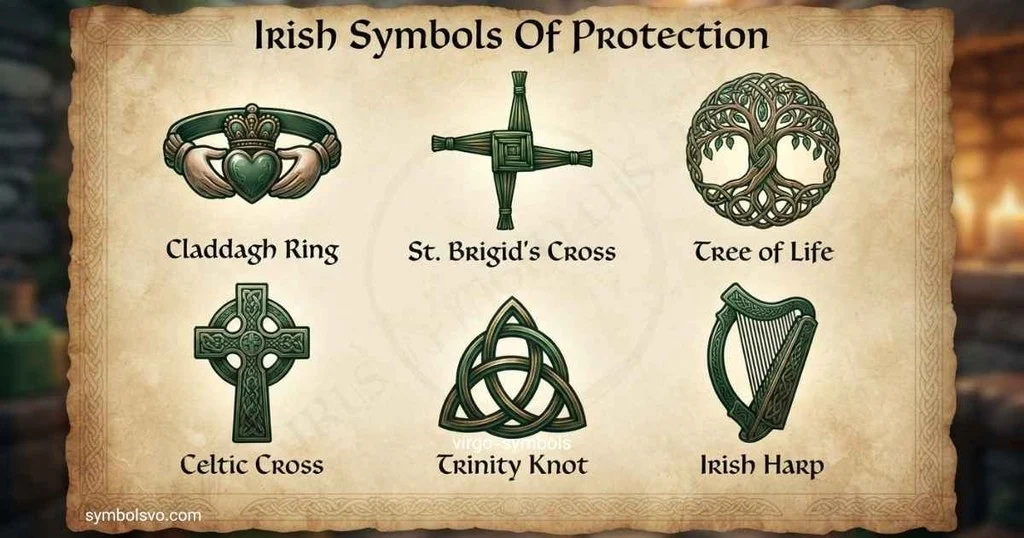
Irish history and folklore contain many protective traditions, but modern websites sometimes give very specific meanings to designs without strong historical evidence.
Some imagery commonly associated with protection includes:
- Celtic crosses — often connected with Christian faith and Irish heritage.
- Interlaced designs — widely used as protective or decorative imagery in modern Celtic-inspired art.
- Animals — animals and mythical creatures appear in Irish folklore and decorative traditions.
- Holy wells and sacred sites — important in Irish religious and folk traditions.
- St. Brigid’s cross — traditionally made from rushes and associated with St. Brigid.
St. Brigid’s cross is especially interesting because it remains part of Irish folk tradition. Traditional examples are made by weaving rushes into a distinctive four-armed form.
Protection meanings should be treated as cultural interpretations rather than universal definitions. An ancient design may have an uncertain original purpose, while a modern person may use the same design as a personal symbol of protection.
Irish Symbols For Love
The most famous Irish symbol associated with love is the Claddagh.
The traditional Claddagh design contains three main elements:
- Heart — love
- Hands — friendship
- Crown — loyalty
The ring is commonly associated with Irish identity and relationships. It is often given as a romantic gift, friendship gift, or family keepsake.
Other Irish-inspired love imagery includes:
- Celtic knots
- Interlaced hearts
- Trinity-inspired designs
- Claddagh hearts
- Irish wedding motifs
The Claddagh is especially popular because its design communicates several relationship values at once. It can therefore work as a meaningful jewelry design without requiring a long explanation.
Irish Symbols For Family
Irish family symbolism often focuses on heritage, ancestry, belonging, and continuity.
Popular choices include:
| Symbol | Common modern association |
| Claddagh | Family love, loyalty, friendship |
| Celtic knot | Connection and continuity |
| Celtic tree designs | Family roots and growth |
| Harp | Irish heritage |
| Shamrock | Irish identity and family heritage |
| Celtic cross | Faith and heritage |
The Celtic knot is particularly common in family jewelry and tattoos because its continuous interwoven appearance can represent an ongoing connection.
A tree of life is also widely used in modern Irish and Celtic-inspired artwork. However, it is safer to describe it as a modern Celtic-inspired family symbol rather than claiming that one standardized “ancient Irish family symbol” existed.
Family symbolism can be made personal by combining an Irish design with a surname, county, date, initials, or family motto.
Scots-Irish Symbols
Scots-Irish symbols relate to the historical communities of Ulster and to people of Scottish and Irish Protestant background who later became an important part of the population of North America.
There is no single universal Scots-Irish symbol.
Instead, Scots-Irish identity may be represented through combinations of:
- Irish and Scottish family heritage
- Ulster imagery
- Family tartans where historically appropriate
- Celtic designs
- Scottish and Irish surnames
- Religious traditions
- Migration and family-history symbols
The term Scots-Irish is especially important in genealogy. In the United States, it commonly refers to descendants of people from Ulster, many of whom were of Scottish origin.
For family-history projects, it is better to research a specific surname, county, migration route, or historical community than to assume that a particular Celtic design represents every Scots-Irish family.
Irish Symbols Tattoos
Irish symbols are popular tattoo choices because many designs can carry personal meanings connected with heritage, family, love, faith, or Irish identity.
Popular Irish-inspired tattoo ideas include:
- ☘ Shamrock
- Claddagh
- Celtic cross
- Trinity knot
- Celtic knot
- Irish harp
- Celtic spiral
- Irish wolfhound
- St. Brigid’s cross
- Irish lettering
- Family-name designs
Before getting a historical symbol tattooed, check its origin carefully. A design described online as “ancient Irish” may actually be a modern interpretation of Celtic artwork.
Choosing An Irish Tattoo
Consider three things:
Meaning: Decide what you want the tattoo to represent.
History: Check whether the claimed historical meaning is supported by reliable sources.
Design: Choose a clear version that will remain recognizable at the tattoo’s intended size.
For a family tattoo, a Claddagh or interlaced knot can work well. For national identity, the harp or shamrock may be more immediately recognizable.
Irish Symbols Images
Irish symbols images are useful for understanding the visual differences between related designs.
When searching for images, look for clear examples of:
- Irish harp
- Shamrock
- Claddagh
- Celtic cross
- Trinity knot
- Celtic knotwork
- Celtic spirals
- St. Brigid’s cross
- Irish wolfhound
- Round towers
- Ancient Irish stone carvings
Museum collections are particularly valuable because they connect images with historical objects and descriptions. The National Museum of Ireland, for example, documents Irish objects featuring harps, shamrocks, wolfhounds, round towers, interlacing, and other Irish motifs.
For modern use, images can be used in:
- Tattoo inspiration
- Jewelry design
- School projects
- Heritage presentations
- Social media graphics
- Digital invitations
- Irish-themed crafts
When using an image commercially, check its copyright or licensing status instead of assuming that an image found through a search engine is free to reuse.
Irish Symbols Copy And Paste
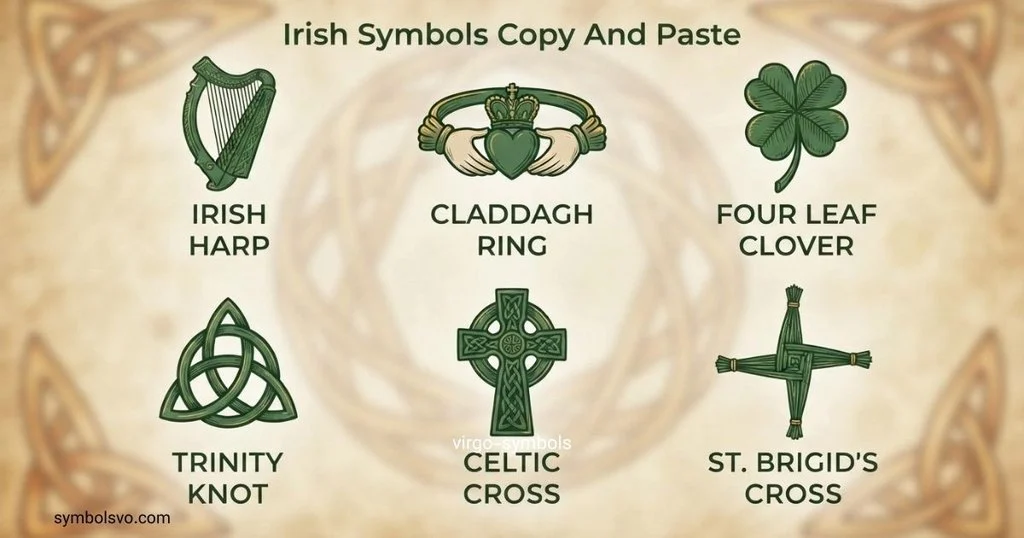
If you need Irish symbols for social media, messages, profiles, or decorative text, the easiest options are Unicode characters that genuinely exist as text characters.
Irish Symbols To Copy
☘ — Shamrock
🍀 — Four-leaf clover
☘️ — Shamrock emoji presentation
🇮🇪 — Flag of Ireland
☘︎ — Text-style shamrock presentation on supported systems
The most useful Irish-related character is:
☘
You can copy it directly from this page.
The four-leaf clover is:
🍀
And the Irish flag emoji is:
🇮🇪
Unicode officially lists the shamrock at U+2618 and the four-leaf clover at U+1F340.
For Celtic knots, Claddagh designs, Celtic crosses, and many other Irish motifs, there is usually no single Unicode character representing the exact traditional design. In those cases, use an image, SVG, font glyph, or decorative graphic rather than inventing a Unicode code point.
For quick copy-and-paste use:
☘
🍀
🇮🇪
☘️
These characters can be useful in usernames, captions, messages, bios, invitations, and St. Patrick’s Day posts. Their exact visual appearance can vary between operating systems, applications, and fonts.
Frequently Asked Questions
What is the most famous Irish symbol?
The shamrock and Irish harp are among the most recognizable Irish symbols. The harp has a particularly important official national role, while the shamrock is strongly associated with St. Patrick and Irish identity.
What symbol represents Irish heritage?
Several symbols can represent Irish heritage, including the harp, shamrock, Claddagh, Celtic cross, and Celtic-inspired knotwork. The best choice depends on whether you want to emphasize national identity, family, religion, or artistic heritage.
What does the Claddagh symbol mean?
The Claddagh traditionally features a heart, hands, and crown, commonly interpreted as love, friendship, and loyalty. It is especially associated with the Irish ring tradition.
Is the Celtic knot an Irish symbol?
Celtic knotwork is strongly associated with Ireland and Celtic art, but it should not be treated as exclusively Irish. Celtic artistic traditions extended across multiple regions, and many modern knot designs are later interpretations.
Is there an Irish symbol I can copy and paste?
Yes. The shamrock ☘, four-leaf clover 🍀, and Irish flag emoji 🇮🇪 are easy Unicode-based options. Traditional designs such as the Claddagh and many Celtic knots generally need an image or graphic rather than a dedicated Unicode character.
Conclusion
Irish symbols bring together many layers of history and identity. The harp and shamrock are strongly associated with Ireland today, while the Claddagh, Celtic cross, spirals, knots, and other designs connect people with Irish art, Christianity, folklore, family traditions, and the wider Celtic heritage.
The meaning of a symbol is not always fixed. Some meanings are well documented, while others come from later folklore, modern jewelry, tattoo culture, or popular interpretations. Checking the historical context helps you choose a symbol that matches the story you want to tell.
For digital use, the shamrock ☘, four-leaf clover 🍀, and Irish flag 🇮🇪 are convenient copy-and-paste choices. For tattoos, jewelry, artwork, and family designs, traditional motifs such as the Claddagh, harp, and Celtic knotwork offer many ways to express Irish heritage while leaving room for personal meaning.

 Mason Ellington
 Daniel Brooks