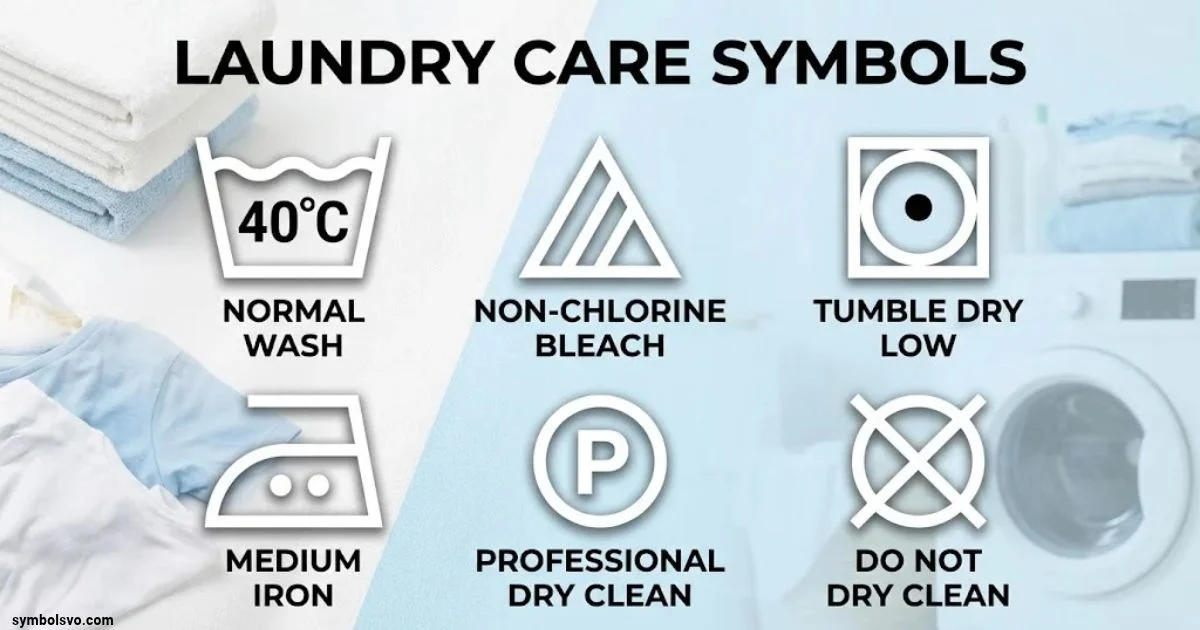
Have you ever looked at a clothing tag and wondered what all those tiny symbols mean? A washing tub, a crossed-out triangle, or an iron with three dots can seem confusing at first. However, each symbol communicates an important instruction about cleaning and caring for your clothes.
Laundry care symbols tell you how to wash, bleach, dry, iron, and professionally clean different garments. Following these instructions helps prevent shrinking, fading, stretching, and heat damage. It also helps your clothes maintain their original appearance for longer.
If you’re washing cotton T-shirts, delicate silk blouses, wool sweaters, or everyday jeans, understanding clothing care labels makes laundry much easier.
This guide explains the major laundry symbols and their meanings, including washing temperatures, drying methods, bleaching restrictions, ironing instructions, and professional cleaning symbols. You’ll also find practical reference charts and fabric-specific advice to help you make better laundry decisions.
Complete Laundry Care Symbols Chart and Their Meanings
Laundry labels use five basic symbol categories. Each category represents a different stage of garment care.
The five main categories are:
- Washing symbols: Explain how to wash clothing and which water temperature to use.
- Bleaching symbols: Show whether chlorine or non-chlorine bleach is permitted.
- Drying symbols: Explain whether to tumble dry, hang, drip dry, or dry flat.
- Ironing symbols: Indicate suitable ironing temperatures and restrictions.
- Dry cleaning symbols: Provide instructions for professional dry or wet cleaning.
The international care-labeling standard, ISO 3758:2023, organizes these treatments into a consistent system. The symbols communicate the maximum treatment that a textile can withstand without irreversible damage.
Here’s a quick reference chart:
| Symbol | Category | Meaning |
| Washing tub | Washing | Wash according to the indicated instructions |
| Hand inside tub | Washing | Hand wash the garment |
| Crossed-out tub | Washing | Do not wash |
| Triangle | Bleaching | Bleaching is permitted |
| Triangle with diagonal lines | Bleaching | Use non-chlorine bleach only |
| Crossed-out triangle | Bleaching | Do not bleach |
| Square with circle | Drying | Tumble drying is permitted |
| Crossed-out square with circle | Drying | Do not tumble dry |
| Square with vertical lines | Drying | Line dry |
| Square with horizontal line | Drying | Dry flat |
| Iron with one dot | Ironing | Use low temperature |
| Iron with two dots | Ironing | Use medium temperature |
| Iron with three dots | Ironing | Use high temperature |
| Crossed-out iron | Ironing | Do not iron |
| Circle | Professional cleaning | Professional cleaning instructions |
| Crossed-out circle | Professional cleaning | Do not dry clean |
Remember: The symbol’s shape identifies the treatment. Additional dots, lines, letters, and crosses provide more specific instructions.
For example, a square represents drying, but a circle inside that square changes the instruction to tumble drying. Similarly, lines underneath a washing tub indicate a gentler washing process.
How to Read Laundry Care Symbols on Clothing Labels
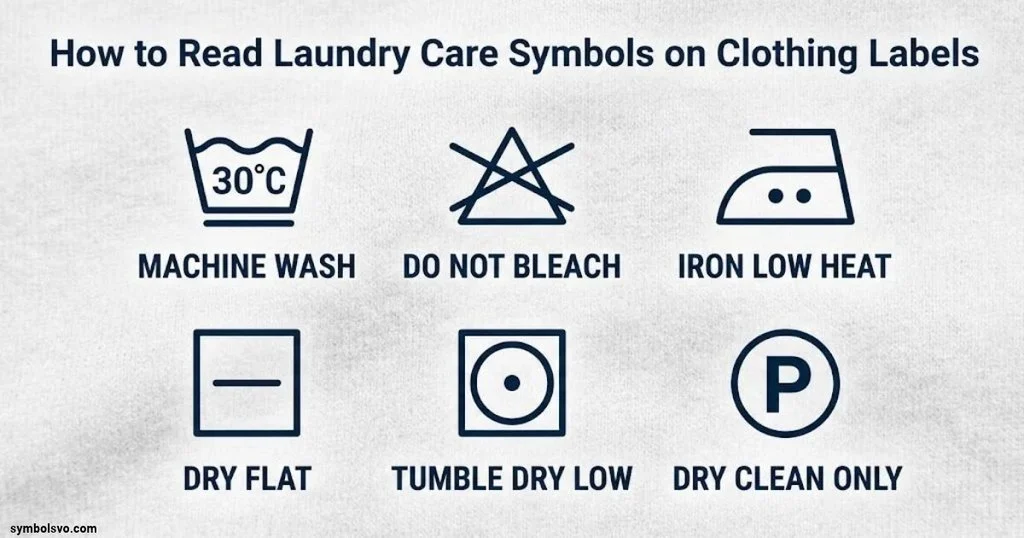
Before starting a laundry load, take a moment to examine the care label. Those small instructions can save you from damaging an expensive garment.
Most clothing manufacturers attach care labels inside garments. You can commonly find them in these locations:
- Inside the side seam of shirts and T-shirts.
- Along the waistband of jeans and trousers.
- Inside the neckline of sweaters.
- Along the inner seam of dresses.
- Inside the lining of jackets and coats.
The symbols usually appear in a standard order:
Washing → Bleaching → Drying → Ironing → Professional cleaning
This sequence helps you understand the complete cleaning process, from washing the garment to its final treatment.
Understanding Dots, Lines, and Crosses
Three small details appear repeatedly across different laundry symbols. Learning them makes clothing labels much easier to understand.
Dots indicate temperature or heat intensity. Their exact meaning depends on the symbol.
- One dot generally indicates a low-temperature treatment.
- Two dots generally indicate a medium-temperature treatment.
- Three dots generally indicate a high-temperature treatment.
Lines indicate a gentler process. For example, one line underneath a washing tub means a mild wash. Two lines indicate a very mild wash with reduced mechanical action.
A cross means the indicated treatment is prohibited. A crossed-out dryer symbol means you shouldn’t tumble dry the garment. A crossed-out iron means ironing may cause damage.
One important distinction: current ISO washing symbols commonly use numbers inside the tub to specify maximum water temperatures. Dot-based washing temperature symbols also appear in some regional and older labeling systems.
Why You Should Follow the Most Restrictive Instruction
A garment may tolerate machine washing but still require air drying. Another item might allow ironing but prohibit steam.
Always consider every symbol rather than focusing on just one.
For example, a polyester blouse might carry these instructions:
- Machine wash at 30°C.
- Do not bleach.
- Tumble dry at low temperature.
- Iron at low temperature.
Using hot water or a high dryer setting could damage the garment even though machine washing is permitted.
Washing Symbols and Their Meanings
The washing tub symbol is one of the most recognizable clothing care symbols. It tells you whether a garment can go into a washing machine or needs special treatment.
However, the details inside and underneath the tub matter just as much as its basic shape.
Machine Wash Symbol
A plain washing tub generally indicates that domestic washing is permitted. The temperature and cycle requirements depend on additional markings.
For example, a tub marked 40°C means the garment can be washed at a maximum water temperature of 40 degrees Celsius.
This doesn’t necessarily mean you must use exactly 40°C. A cooler setting may be suitable when the garment needs less intensive cleaning.
Before loading the washing machine, check the remaining instructions. Some garments require reduced agitation or a lower spin speed.
Hand Wash Symbol
A hand inside a washing tub indicates that you should wash the garment by hand.
Manufacturers commonly use this instruction for delicate clothing that may suffer from regular machine agitation.
Silk blouses, delicate knitwear, and certain wool garments may carry this symbol.
To hand wash clothing correctly:
- Fill a clean basin with water at the recommended temperature.
- Add a small amount of suitable detergent.
- Submerge the garment and gently move it through the water.
- Avoid rubbing, twisting, or stretching the fabric.
- Rinse carefully until the detergent disappears.
- Remove excess water by pressing gently.
- Follow the label’s drying instructions.
Hand washing doesn’t mean scrubbing clothes harder. Gentle handling is the entire point.
Do Not Wash Symbol
A crossed-out washing tub means the garment must not undergo domestic washing.
Water, agitation, or the washing machine’s mechanical action may damage the material or its construction.
This instruction sometimes appears on structured garments, specialty textiles, and delicate items that require professional care.
If you see this symbol, check the professional cleaning instructions printed alongside it.
Washing Temperature Symbols
Water temperature affects cleaning performance and fabric condition. Some garments tolerate hot water, while others require cooler washing.
On ISO-style washing labels, the number inside the tub specifies the maximum washing temperature.
| Washing temperature | Fahrenheit equivalent | Common use |
| 20°C | 68°F | Very delicate or lightly soiled items |
| 30°C | 86°F | Delicate fabrics and many everyday garments |
| 40°C | 104°F | Common washable clothing |
| 50°C | 122°F | Selected colorfast textiles |
| 60°C | 140°F | Suitable durable textiles and certain household linens |
| 70°C | 158°F | Selected heat-resistant textiles |
| 95°C | 203°F | Certain white cotton and linen items |
These are maximum permitted temperatures when shown on the corresponding care symbol. They aren’t universal recommendations for every garment.
For everyday laundry, cooler water often works well with modern detergents. However, heavily soiled items may need a more intensive treatment when their labels allow it.
Washing Cycle Symbols
Lines underneath the washing tub indicate how gently the machine should handle clothing.
| Washing symbol | Meaning | Recommended machine setting |
| Tub without a line | Normal washing | Regular cycle |
| Tub with one line | Mild washing | Permanent press or gentle cycle |
| Tub with two lines | Very mild washing | Delicate or wool cycle |
Normal wash: Suitable for garments that can withstand regular machine agitation.
Permanent press: Uses gentler washing and reduced creasing compared with a normal cycle. It works well for many easy-care garments.
Delicate wash: Uses reduced agitation and usually a gentler spin to protect sensitive fabrics.
Always select a cycle that matches the care label rather than relying only on the garment’s appearance.
Spin Speed and Gentle Washing
The spin cycle removes excess water by rotating clothes inside the washing machine.
However, high spin speeds can stress delicate fibers and change the shape of certain garments.
When a care label requires a very mild wash, choose a suitable low-spin or delicate setting if your machine offers one.
For wool sweaters and delicate knitwear, excessive spinning may cause stretching, creasing, or distortion.
Bleaching Symbols and Their Meanings
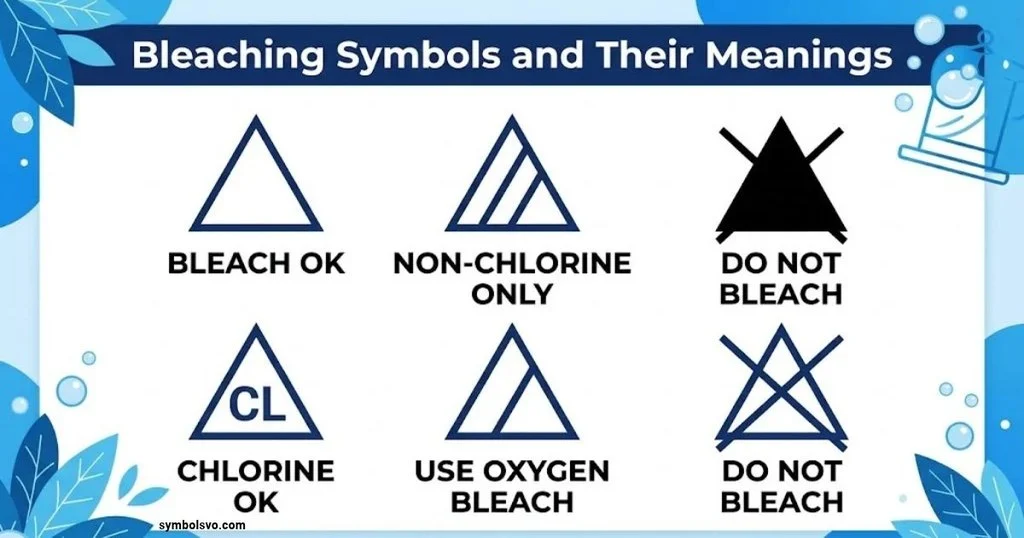
The triangle laundry symbol represents bleaching. It tells you whether bleach is safe for a particular garment.
Bleach can remove stains and brighten suitable fabrics. However, the wrong product can cause permanent discoloration or fiber damage.
There are three main bleaching symbols.
Empty Triangle: Bleaching Allowed
An empty triangle indicates that any permitted bleaching agent may be used.
This includes chlorine bleach and oxygen-based, non-chlorine bleach.
However, permission to bleach doesn’t mean you should add bleach to every wash. Consider the garment’s color, fabric composition, and product instructions.
Crossed-Out Triangle: Do Not Bleach
A triangle with a cross through it means bleaching is prohibited.
Avoid chlorine bleach and oxygen bleach on garments carrying this instruction.
Bleaching may cause:
- Permanent color loss.
- Uneven discoloration.
- Weakened textile fibers.
- Visible patches or spots.
- Damage to fabric finishes.
Use a suitable bleach-free detergent instead.
Triangle With Diagonal Lines: Non-Chlorine Bleach Only
A triangle containing two diagonal lines indicates that only oxygen-based or other non-chlorine bleach is permitted.
This distinction matters because chlorine bleach can damage certain dyes and fibers.
Oxygen bleach generally provides a different bleaching action and is commonly used for suitable colored or washable fabrics.
However, always check the product label before using it.
Bleaching Symbols Quick Reference Chart
| Symbol appearance | Meaning | Permitted treatment |
| Empty triangle | Bleaching allowed | Chlorine or oxygen bleach |
| Triangle with two diagonal lines | Non-chlorine bleach only | Oxygen-based bleach |
| Crossed-out triangle | Do not bleach | No bleaching agents |
Important: Older labels may use additional markings, including the letters CL. Follow the specific instructions on the garment rather than assuming every triangle variation has the same meaning.
Drying Symbols and Their Meanings
Washing removes dirt, but drying determines how well a garment retains its original shape and texture.
The square laundry symbol represents drying. A circle inside the square indicates tumble drying, while lines inside the square describe natural drying methods.
Tumble Dry Symbol
A square containing a circle indicates that tumble drying is permitted.
A tumble dryer removes moisture by rotating clothing in a drum while circulating warm or heated air.
However, the dots inside the circle determine the permitted heat level.
Do Not Tumble Dry Symbol
A crossed-out square containing a circle means you should not use a tumble dryer.
High heat and repeated tumbling can damage sensitive fabrics. Certain garments may shrink, stretch, or lose their original shape.
Wool, silk, and some synthetic garments require particular care.
When tumble drying isn’t permitted, follow the natural drying instructions instead.
Tumble Dryer Heat Settings
| Symbol | Meaning | Drying guidance |
| Square with circle and one dot | Low-temperature tumble dry | Use reduced heat |
| Square with circle and two dots | Normal-temperature tumble dry | Use normal permitted heat |
| Crossed-out square with circle | Do not tumble dry | Use an approved natural drying method |
Some older or regional laundry charts show additional dryer settings, including three-dot high-heat symbols. The current ISO 3758:2023 tumble-drying system uses one dot for low temperature and two dots for normal temperature.
Always check the labeling system used on your garment.
Natural Drying Symbols
Natural drying uses air rather than a heated rotating drum. The lines inside the square indicate how the garment should be positioned.
| Symbol appearance | Meaning | How to dry |
| Square with one vertical line | Line dry | Hang on a clothesline or hanger |
| Square with three vertical lines | Drip dry | Hang without removing excess water through spinning |
| Square with one horizontal line | Dry flat | Place horizontally on a suitable surface |
| Square with three horizontal lines | Drip flat dry | Lay flat while the garment remains wet |
These methods help protect garments that cannot tolerate tumble drying.
Dry in the Shade Symbols
A diagonal line inside a natural-drying symbol indicates that the garment should dry in the shade.
Shade drying can help protect sensitive colors and materials from direct sunlight.
For example, some colored fabrics may fade after prolonged exposure to strong sunlight.
Common shade-drying combinations include:
- Line dry in the shade.
- Drip dry in the shade.
- Dry flat in the shade.
- Drip flat in the shade.
Do Not Wring Symbol
The do-not-wring instruction means you shouldn’t twist the garment to remove water.
Wringing can stretch fibers, distort seams, and damage delicate knitwear.
Instead, press the garment gently between clean towels to remove excess moisture. Then reshape it and follow the recommended drying method.
Ironing Symbols and Their Meanings
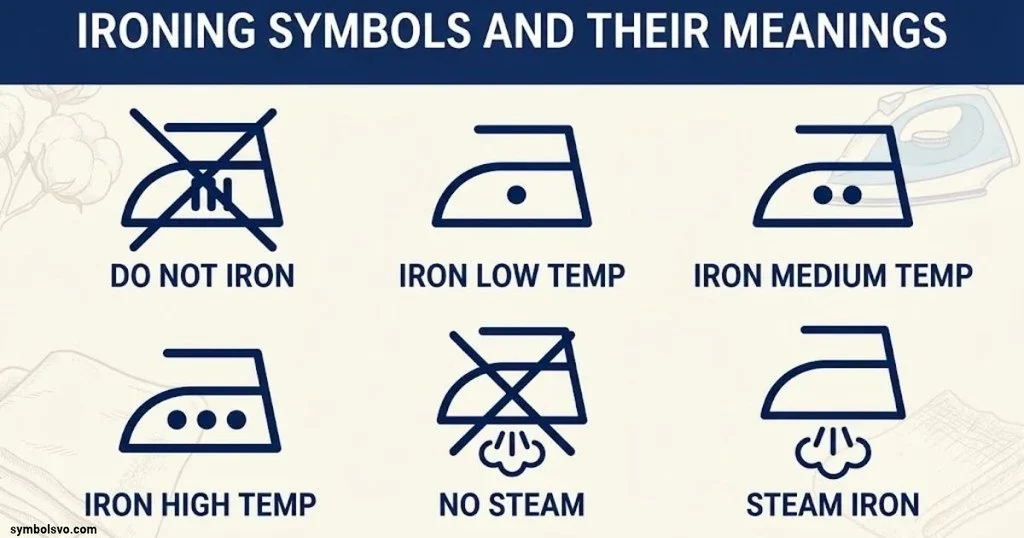
Ironing symbols help you choose a safe temperature for removing wrinkles.
The basic iron symbol represents domestic ironing and pressing. Dots inside the iron indicate the maximum permitted heat.
Ironing Allowed
A plain iron symbol means ironing is permitted.
However, check the dots before choosing a temperature. Some fabrics can withstand high heat, while others need a cooler setting.
Low Temperature Ironing
An iron with one dot indicates low-temperature ironing.
The maximum soleplate temperature under the international system is approximately 110–120°C, depending on the applicable labeling convention.
This setting is suitable for certain heat-sensitive materials, including nylon and acrylic.
Use gentle pressure and avoid prolonged contact with one area.
Medium Temperature Ironing
An iron with two dots indicates a medium-temperature setting.
The ISO guidance specifies a maximum soleplate temperature of approximately 160°C.
This setting is commonly associated with suitable wool, silk, polyester, and viscose garments.
For delicate materials, consider using a pressing cloth to reduce direct heat exposure.
High Temperature Ironing
An iron with three dots indicates high-temperature ironing.
The maximum soleplate temperature is approximately 200–210°C under common international guidance.
This setting may be suitable for certain cotton and linen garments.
However, fabric composition alone doesn’t determine the correct setting. Decorative prints, coatings, and special finishes may have lower heat limits.
Do Not Iron
A crossed-out iron means ironing is prohibited.
Direct heat can cause irreversible damage to some fabrics, coatings, and decorative details.
If the garment becomes wrinkled, follow its care instructions for suitable alternatives.
Do Not Steam
An iron symbol with crossed-out steam indicates that steam ironing isn’t permitted.
Dry ironing may still be allowed if the remaining symbol and temperature instructions permit it.
This distinction is important because steam can affect certain sensitive fabrics and finishes.
Ironing Temperature Reference Chart
| Iron symbol | Maximum temperature | Recommended setting |
| One dot | 110–120°C | Low |
| Two dots | 160°C | Medium |
| Three dots | 200–210°C | High |
| Crossed-out iron | Not permitted | Do not iron |
These are maximum limits, not temperatures you must always reach. Start lower when you’re unsure and follow the garment’s specific instructions.
Dry Cleaning Symbols and Their Meanings
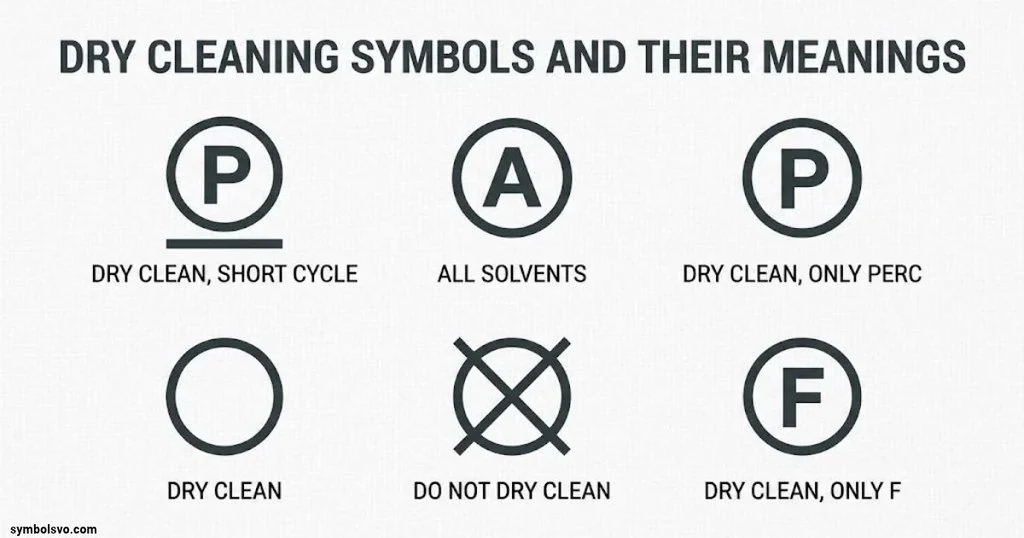
The circle laundry symbol represents professional textile cleaning.
Unlike ordinary domestic washing, professional cleaning uses specialized equipment, controlled processes, and suitable cleaning agents.
A circle may contain letters or additional markings that help professional cleaners select an appropriate treatment.
Basic Dry Cleaning Symbol
A plain circle indicates that professional textile cleaning is permitted.
The precise cleaning method depends on the additional instructions and the professional cleaner’s assessment.
Don’t assume a plain circle means every solvent or cleaning method is suitable.
Dry Clean Only
A dry-clean-only instruction means the garment should receive professional cleaning rather than ordinary home washing.
This instruction often appears on structured garments, formal clothing, and certain delicate textiles.
Examples include:
- Structured suits.
- Certain wool coats.
- Formal dresses.
- Delicate garments with special finishes.
- Clothing containing components that may react badly to water.
Professional cleaning can help preserve the garment’s construction and appearance.
Do Not Dry Clean
A crossed-out circle means professional dry cleaning isn’t permitted.
This restriction applies even if the garment looks suitable for ordinary dry cleaning.
Check the remaining care instructions to identify an approved alternative.
Letters Inside Dry Cleaning Symbols
Letters inside professional cleaning circles communicate technical information to the cleaner.
Some common international symbols use the following letters:
| Letter | Professional cleaning meaning |
| A | Cleaning with specified permitted solvents |
| P | Cleaning under specified professional solvent restrictions |
| F | Cleaning using hydrocarbon solvents |
| W | Professional wet cleaning |
The exact permitted process depends on the applicable standard and symbol combination.
These letters aren’t ordinary consumer instructions. They help professional cleaners choose suitable equipment, solvents, and treatment conditions.
Additional Dry Cleaning Instructions
Lines underneath professional cleaning symbols indicate that a gentler process is required.
A single line generally means a mild process. Two lines indicate a very mild process.
These restrictions can affect:
- Mechanical action.
- Moisture levels.
- Cleaning temperature.
- Solvent treatment.
- Finishing procedures.
Professional wet cleaning also deserves attention. Although it uses water, it differs from ordinary home washing because trained cleaners use specialized equipment and controlled processes.
International Laundry Care Symbols: American vs. European Standards
Laundry symbols appear on clothing sold in different countries. However, their presentation can vary between labeling systems.
The international standard ISO 3758:2023 provides a system for textile care symbols. It covers domestic washing, bleaching, drying, and ironing, along with professional dry and wet cleaning.
European Laundry Symbols
European and other international garments commonly use ISO-style care symbols.
These labels often display:
- Numerical washing temperatures in Celsius.
- Lines underneath washing tubs to indicate gentler cycles.
- Triangles for bleaching instructions.
- Squares for drying methods.
- Dots inside irons for heat levels.
- Circles with letters for professional cleaning.
American Laundry Symbols
In the United States, care labels frequently use written instructions such as:
- The machine was cold.
- Wash warm.
- Tumble dry low.
- Do not bleach.
- Iron on low heat.
- Dry clean only.
The US Federal Trade Commission’s Care Labeling Rule requires covered clothing manufacturers and importers to provide adequate regular-care instructions. These instructions can use words or symbols that meet the applicable requirements.
Key Differences
| Feature | Common international labeling | Common US labeling |
| Washing temperature | Numerical Celsius values | Words such as cold, warm, or hot |
| Washing cycles | Tub and underline combinations | Written cycle instructions may appear |
| Bleaching | Triangle symbols | Written bleach instructions or symbols |
| Drying | Square-based symbols | Written dryer settings or symbols |
| Ironing | Iron with temperature dots | Written heat instructions or symbols |
| Professional cleaning | Circle with letters | Written dry-cleaning instructions or symbols |
The main lesson is simple: don’t assume every clothing label follows exactly the same presentation.
Read the complete instruction and use the temperature or treatment limit printed on the garment.
Laundry Symbols for Different Fabric Types
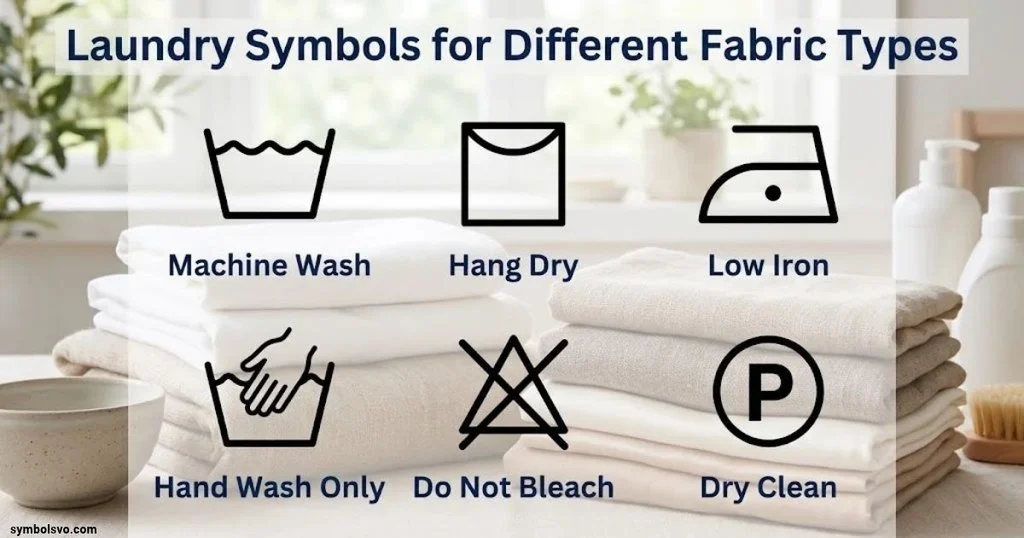
Different textile materials respond differently to water, heat, agitation, and cleaning products.
Understanding fabric composition can help you interpret care labels. However, the garment’s actual instructions should always take priority.
Cotton
Cotton is a natural fiber commonly used in T-shirts, towels, bedsheets, and everyday clothing.
Many cotton garments can withstand machine washing. However, their recommended temperatures vary depending on dyes, construction, and finishes.
Cotton care tips:
- Check the washing temperature before selecting a cycle.
- Separate dark and light-colored clothing.
- Avoid excessive dryer heat when shrinkage is a concern.
- Follow the ironing temperature indicated on the label.
Wool
Wool fibers can shrink or become distorted under unsuitable washing conditions.
Some wool garments allow machine washing on a dedicated wool cycle. Others require hand washing or professional cleaning.
Wool care tips:
- Use a suitable wool detergent.
- Avoid aggressive agitation.
- Follow hand-washing instructions when present.
- Dry flat when the label recommends it.
- Avoid excessive heat.
Silk
Silk is a delicate natural fiber with a smooth surface and fine structure.
Some silk garments tolerate gentle hand washing, while others require professional cleaning.
Silk care tips:
- Follow the washing restrictions carefully.
- Use a suitable gentle detergent.
- Avoid twisting or wringing.
- Keep away from excessive heat.
- Follow shade-drying instructions when provided.
Linen
Linen comes from flax fibers and is commonly used in shirts, trousers, dresses, and household textiles.
It can develop natural wrinkles and may shrink under unsuitable washing conditions.
Linen care tips:
- Check the recommended washing temperature.
- Avoid unnecessary high-heat drying.
- Iron at the permitted temperature.
- Consider ironing while slightly damp if the label allows it.
Polyester
Polyester is a synthetic fiber used in shirts, sportswear, jackets, and blended fabrics.
It generally dries quickly and resists wrinkles better than many natural fibers. However, excessive heat can damage its structure.
Polyester care tips:
- Use the washing temperature shown on the label.
- Avoid excessive dryer heat.
- Choose low-temperature ironing when permitted.
- Check special instructions for blended materials.
Acrylic and Other Synthetic Fabrics
Acrylic, nylon, and other synthetic materials often require careful temperature control.
Excessive heat can cause melting, distortion, or permanent changes in appearance.
Synthetic fabric care tips:
- Choose a suitable washing cycle.
- Avoid high-temperature drying unless explicitly permitted.
- Follow ironing restrictions.
- Use a pressing cloth when appropriate.
Fabric Care Comparison Table
| Fabric | Common washing approach | Drying considerations | Main precaution |
| Cotton | Machine wash when permitted | Line or tumble dry according to label | Shrinkage |
| Wool | Gentle wash or hand wash | Often dry flat | Shrinking and distortion |
| Silk | Delicate wash or professional cleaning | Gentle natural drying | Heat and mechanical damage |
| Linen | Machine wash when permitted | Air dry or suitable dryer setting | Shrinkage and wrinkles |
| Polyester | Machine wash when permitted | Often low-heat drying | Excessive heat |
| Acrylic | Gentle machine wash when permitted | Usually low-heat or natural drying | Heat distortion |
These are general material characteristics. A specific garment may have different requirements because of its dye, lining, finish, or construction.
Common Laundry Symbol Mistakes to Avoid
Even experienced people sometimes misread clothing labels. A small mistake can cause permanent damage.
Here are common errors worth avoiding.
Assuming every washing tub means normal washing: Lines underneath the tub indicate that the garment needs gentler treatment.
Ignoring dryer restrictions: Machine washing permission doesn’t automatically mean tumble drying is safe.
Using the wrong bleach: Non-chlorine bleach instructions don’t permit chlorine bleach.
Ignoring ironing dots: A high-temperature iron can scorch or melt heat-sensitive materials.
Confusing dry cleaning with wet cleaning: These professional processes use different cleaning methods and equipment.
Wringing delicate clothing: Twisting wet garments can stretch fibers and distort their shape.
Ignoring shade-drying instructions: Direct sunlight may fade certain dyes and delicate materials.
Assuming fabric type determines every instruction: Two cotton shirts may have completely different care requirements because of their construction and finishes.
What Happens When You Ignore Laundry Care Symbols?
Incorrect garment care can affect both appearance and durability. Some damage appears immediately, while other problems develop gradually after repeated washing.
Fabric Shrinkage
Excessive heat and unsuitable washing conditions can cause certain fibers to shrink.
Wool is particularly sensitive to unsuitable moisture, heat, and agitation. Cotton can also shrink depending on its construction and previous treatment.
Following the recommended temperature and drying method helps reduce this risk.
Color Fading and Bleeding
Incorrect washing temperatures, unsuitable detergents, and prohibited bleaching agents can affect garment colors.
Dark clothing may lose its original appearance after repeated unsuitable washing.
Separate clothing by color and follow the bleach instructions carefully.
Fabric Stretching and Loss of Shape
Aggressive washing and wringing can distort delicate garments.
Knitwear is especially vulnerable because its looped construction can stretch under weight and mechanical stress.
Drying flat helps certain garments maintain their original shape.
Heat Damage and Scorching
Excessive dryer and ironing temperatures can permanently damage textile fibers.
Synthetic materials may melt or become distorted. Some natural fabrics may scorch or develop shiny patches.
Check the heat restrictions before using an iron or tumble dryer.
Wrinkles and Fabric Deterioration
Incorrect drying methods can leave clothing heavily wrinkled or distorted.
Overloading the washing machine can also prevent garments from moving freely, reducing cleaning performance.
Use the recommended cycle and avoid unnecessarily aggressive treatment.
How to Wash Clothes Correctly Using Laundry Care Symbols
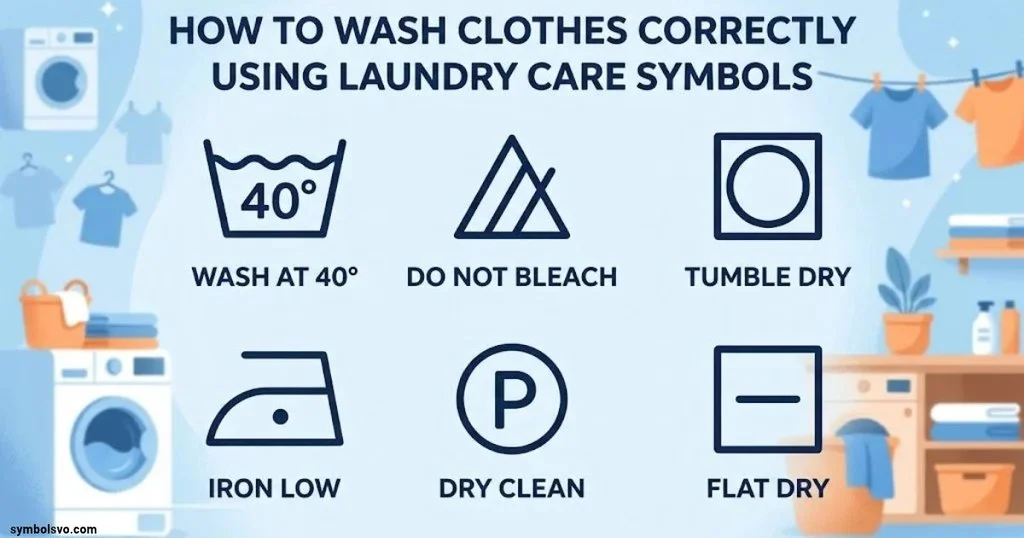
Understanding laundry symbols is useful, but applying them correctly makes the biggest difference.
Follow this simple process before starting your next laundry load.
Check the Garment’s Care Label
Find the label and read every instruction.
Don’t focus only on the washing symbol. Drying, bleaching, and ironing restrictions matter too.
Separate Clothes by Color and Fabric
Separate whites, darks, and colors to reduce color transfer.
Also consider fabric weight and washing requirements. Heavy towels and delicate garments usually need different treatment.
Identify the Correct Washing Method
Check whether the label permits machine washing or requires hand washing.
If the symbol shows a mild or very mild cycle, select the corresponding machine setting.
Select the Correct Water Temperature
Use the maximum temperature printed inside the washing tub.
If the label specifies 30°C, don’t select a 40°C or 60°C cycle simply because the garment looks durable.
Check the Bleaching Instructions
Look for the triangle symbol.
If it shows a crossed-out triangle, avoid bleaching agents. If it contains diagonal lines, use only permitted non-chlorine bleach.
Choose the Recommended Drying Method
Check whether tumble drying is permitted.
If the garment requires line drying or flat drying, use that method instead.
Follow Ironing and Professional Cleaning Restrictions
Before ironing, check the dots inside the iron symbol.
If the garment requires professional cleaning, don’t experiment with ordinary household washing methods.
Practical Example: Reading a Complete Clothing Care Label
Imagine a cotton-blend shirt with these instructions:
| Care instruction | Meaning | What you should do |
| Washing tub marked 30°C | Maximum washing temperature is 30°C | Use a cool machine-wash cycle |
| Crossed-out triangle | Do not bleach | Use bleach-free detergent |
| Square with circle and one dot | Low-temperature tumble drying | Use low dryer heat |
| Iron with two dots | Medium-temperature ironing | Keep the iron at or below 160°C |
| Circle with P | Professional cleaning under specified restrictions | Follow the professional-cleaning instruction |
This example shows why you should read the entire label. Knowing that a shirt is machine washable doesn’t tell you how to dry or iron it safely.
Frequently Asked Questions About Laundry Care Symbols
What Do Laundry Care Symbols Mean?
Laundry care symbols are standardized or regionally used markings that explain how to clean and maintain clothing. They cover washing, bleaching, drying, ironing, and professional textile cleaning.
What Are the Five Main Laundry Symbols?
The five main categories are washing, bleaching, drying, ironing, and professional cleaning. Each category uses a different basic shape to communicate its instructions.
What Does a Washing Tub Symbol Mean?
A washing tub indicates that domestic washing is permitted according to the temperature and cycle instructions inside or underneath it. A crossed-out tub means the garment must not be washed.
What Do the Dots Mean on Laundry Symbols?
Dots generally indicate temperature or heat levels. Their meaning depends on the symbol. Inside an iron, they indicate ironing temperature. Inside a tumble-drying symbol, they indicate dryer heat.
What Does a Crossed-Out Washing Symbol Mean?
A crossed-out washing tub means you shouldn’t wash the garment using the indicated domestic washing process. Check the remaining care instructions for an approved cleaning alternative.
What Does a Triangle Mean on a Clothing Label?
A triangle represents bleaching instructions. An empty triangle permits bleaching, a triangle with diagonal lines allows non-chlorine bleach, and a crossed-out triangle prohibits bleaching.
What Does a Square Mean on Laundry Labels?
A square represents drying. A circle inside the square indicates tumble drying, while vertical and horizontal lines describe natural drying methods.
What Does a Circle Mean on Clothing Labels?
A circle represents professional textile cleaning. Letters inside the circle provide cleaning instructions for professional cleaners, including permitted solvents and processes.
What Does an Iron With One Dot Mean?
An iron with one dot indicates low-temperature ironing. Under common international guidance, the maximum soleplate temperature is approximately 110–120°C.
What Does Do Not Tumble Dry Mean?
A crossed-out square containing a circle means you shouldn’t use a tumble dryer. Instead, follow the garment’s permitted natural drying instructions.
Can I Wash Clothes That Say Dry Clean Only?
You shouldn’t assume that dry-clean-only clothing is safe for home washing. Water and machine agitation may damage its fabric, construction, lining, or finish. Consult a professional cleaner before attempting an alternative method.
Are American and European Laundry Symbols Different?
They can differ in presentation. International labels commonly use numerical washing temperatures in Celsius, while American labels frequently use written instructions such as cold, warm, and hot. Both systems communicate garment-care requirements.
Where Can I Find Laundry Care Symbols on Clothing?
You can usually find them on small labels attached to the inside seams, waistbands, necklines, or garment linings. The location depends on the clothing type and manufacturer.
Can I Use a Laundry Symbols Chart to Understand Any Clothing Label?
A laundry symbols chart can explain most common care-label markings. However, some regional variations and specialized instructions exist. Always check the complete label and follow its specific requirements.
Conclusion
Understanding laundry care symbols makes it easier to wash, dry, and maintain your clothes correctly. Each symbol provides a simple instruction that helps protect fabric quality, prevent damage, and keep garments looking their best.
Before washing any item, take a moment to check its care label. Look at the washing temperature, bleach instructions, drying method, ironing limits, and professional cleaning guidance. Pay attention to symbols with dots, lines, or crosses because small details can change the recommended care method.
Once you learn what these symbols mean, laundry labels become much easier to understand. You can avoid common washing mistakes, choose the right settings, and help your favorite clothes last longer.

I’m Nathan Holloway, a passionate researcher and writer with a deep interest in symbols, signs, and their hidden meanings. I enjoy exploring how symbols have influenced different civilizations, religions, and modern communication. Through my work, I aim to make complex historical and cultural concepts easy to understand for readers of all backgrounds. Every article I write is carefully researched to provide reliable and engaging information.
Books:
- Beyond the Symbol
- The Secret Meanings of Everyday Signs
Author 2: Grace Whitmore
Description:
My name is Grace Whitmore, and I love discovering the stories behind the world’s most fascinating symbols. I spend my time researching ancient civilizations, mythology, spiritual traditions, and modern iconography to uncover the meanings people often overlook. I believe that every symbol has a history worth telling, and I enjoy sharing that knowledge in a simple and reader-friendly way.
Books:
- Echoes of Ancient Symbols
- The Symbolic World
 Mason Ellington
 Daniel Brooks