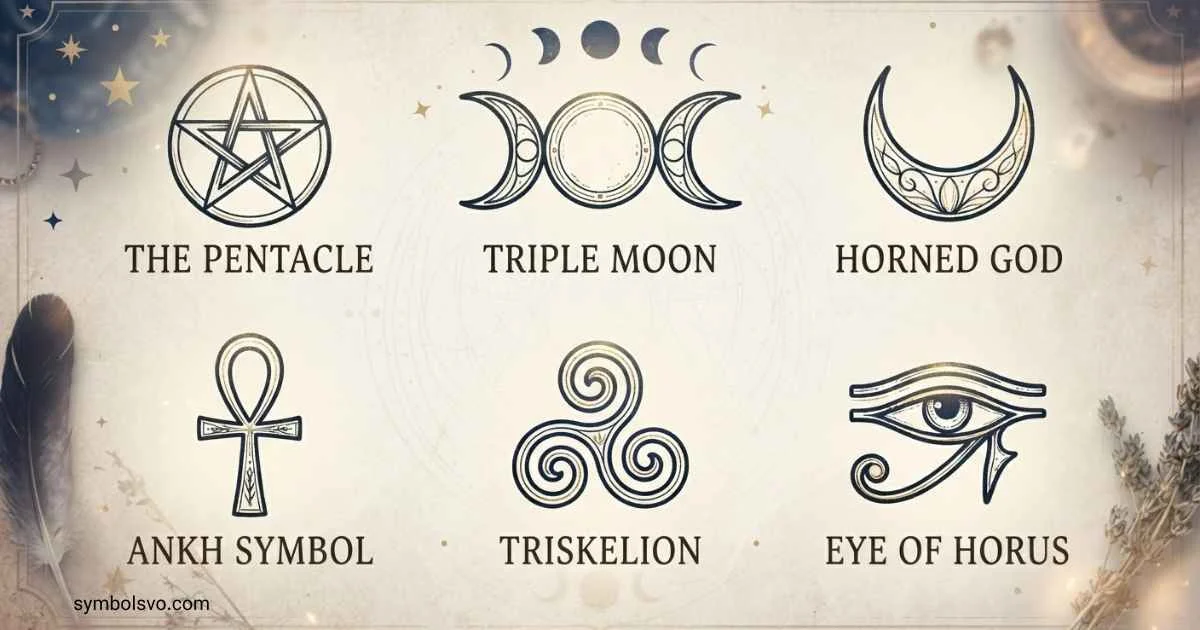
I’ve always found witch symbols fascinating because a simple sign can carry layers of history, belief, and meaning. When you look closely, you may discover that these symbols are more than mysterious designs.
You might recognize a pentagram, crescent moon, or other familiar sign, but do you know what it actually represents? I’ll help you understand these symbols clearly, so you can explore their meanings without confusion.
Whether you’re a curious beginner or already interested in witchcraft symbolism, you’ll find useful context here. Let’s explore the history, meanings, and modern uses of witch symbols together.
What Are Witch Symbols Called
Witch symbols do not have one official name or classification. The term generally refers to signs, objects, shapes, characters, or images associated with witchcraft, magic, folklore, pagan traditions, or modern occult practices.
Some are recognizable as religious or spiritual symbols, while others are ordinary objects that gained symbolic meaning through stories and traditions.
Common examples include:
- ☾ — Crescent moon, often associated with lunar symbolism and feminine spirituality.
- ☽ — Reversed crescent moon, used decoratively and in lunar symbolism.
- ☿ — Mercury symbol, associated with the planet and the Roman god Mercury.
- ♄ — Saturn symbol, traditionally associated with Saturn in astrology.
- ☉ — Sun symbol, commonly used for solar symbolism.
- ✦ — Four-pointed star, often used decoratively in magical or mystical designs.
- ✧ — White four-pointed star, commonly used as a decorative mystical symbol.
- ☥ — Ankh, an ancient Egyptian symbol associated with life.
- ⚚ — Staff-related symbol sometimes encountered in occult and esoteric contexts.
- 🜁 — Alchemical symbol for air.
- 🜂 — Alchemical symbol for fire.
- 🜃 — Alchemical symbol for earth.
- 🜄 — Alchemical symbol for water.
A symbol’s presence in a witchcraft-themed design does not automatically mean it originated in witchcraft. Many symbols have older religious, astronomical, alchemical, or cultural histories.
Witch Symbols And Meanings
The meaning of a witch symbol depends heavily on context. A moon may represent cycles, intuition, or femininity in one setting, while a crescent can simply be decorative in another.
Here are several widely encountered symbols and their common associations:
| Symbol | Common name | Common association |
| ☾ | Crescent moon | Moon, cycles, intuition |
| ☽ | Crescent moon | Lunar symbolism |
| ★ | Star | Guidance, mystery, aspiration |
| ✦ | Four-pointed star | Magic, light, decoration |
| ☥ | Ankh | Life, ancient Egypt |
| 🜁 | Air alchemical symbol | Air, thought, intellect |
| 🜂 | Fire alchemical symbol | Fire, energy, transformation |
| 🜃 | Earth alchemical symbol | Earth, stability, nature |
| 🜄 | Water alchemical symbol | Water, emotion, flow |
| 🜔 | Salt alchemical symbol | Alchemy and transformation |
| ♀ | Venus symbol | Venus, femininity, love |
| ♂ | Mars symbol | Mars, action, strength |
The pentagram is another important symbol often associated with modern witchcraft. It is a five-pointed star, usually drawn with one point upward. In different contexts, it can represent elements, balance, spirituality, or other ideas. Its meaning should not be assumed from appearance alone.
Common Witch Symbols
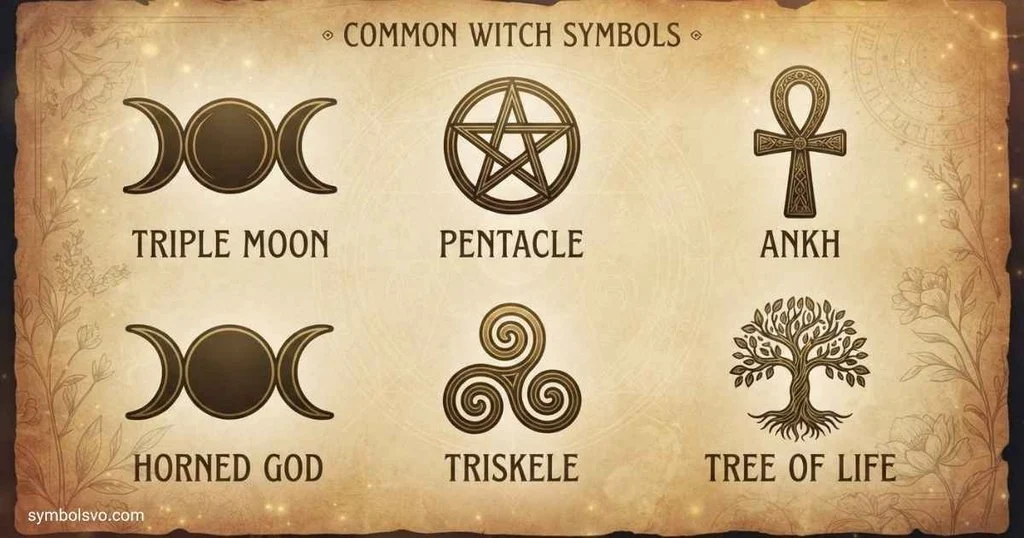
Some symbols appear repeatedly in modern witchcraft-inspired art, jewelry, tattoos, books, and online communities.
Pentagram
The pentagram is a five-pointed star drawn with five straight lines. In modern occult and pagan contexts, an upright pentagram can represent different combinations of the four classical elements and spirit.
An inverted pentagram has also been used in different occult traditions and later became strongly associated with Satanism in popular culture. The historical meanings are more complicated than the common horror-movie image suggests.
Triple Moon
The triple moon symbol commonly shows a waxing crescent, full moon, and waning crescent. In some modern pagan traditions, it represents the stages of the moon and is associated with the Maiden, Mother, and Crone concept.
Cauldron
The cauldron is strongly connected with magical stories, folklore, potion-making, and witchcraft imagery. In symbolic art, it can represent transformation, creation, cooking, or magical work.
Broom
The broom is one of the most recognizable objects in witch folklore. Modern popular culture often portrays witches flying on broomsticks, although the familiar image is largely a product of folklore, literature, and later popular representation.
Crystal Ball
Crystal balls are commonly associated with divination and fortune-telling. Their connection with witches is especially strong in modern fantasy and occult imagery.
Ancient Witch Symbols
Ancient cultures had religious, magical, protective, and divinatory symbols, but calling all of them “witch symbols” can be misleading. Witchcraft is not one ancient religion shared by every civilization.
Some ancient symbols are now used in modern witchcraft because of their historical or symbolic associations.
Examples include:
- ☥ Ankh — Ancient Egyptian symbol associated with life.
- Eye of Horus — Ancient Egyptian protective and royal symbol.
- ☿ Mercury — Planetary and alchemical symbolism.
- ☉ Sun — Solar and divine symbolism in many traditions.
- ☾ Moon — Lunar cycles and celestial symbolism.
- Serpent — Transformation, healing, danger, wisdom, or rebirth depending on culture.
- Spiral — Cycles, movement, growth, and transformation in various ancient artistic traditions.
Ancient symbols should be understood within their original cultures rather than automatically labeling them as witchcraft symbols. Modern spiritual practices may reinterpret older imagery for contemporary purposes.
Pagan Witch Symbols
“Pagan” is a broad modern category covering many different religious and spiritual traditions. Pagan witchcraft is therefore not a single system with one official symbol set.
Symbols frequently encountered in modern pagan or witchcraft communities include:
- Pentagram
- Triple moon
- Horned God imagery
- Goddess symbols
- Solar symbols
- Lunar symbols
- Oak leaves
- Acorns
- Spirals
- Runes
- Elemental symbols
- Seasonal symbols
The pentagram is particularly recognizable. Some practitioners use it to represent the elements of earth, air, fire, water, and spirit.
Nature also plays a major role in many modern pagan practices. Trees, herbs, flowers, animals, the Sun, Moon, and changing seasons can all carry personal or religious symbolism.
Celtic Witch Symbols
Celtic witch symbols are often discussed online alongside Celtic mythology, modern paganism, and contemporary witchcraft. However, not every symbol marketed as “Celtic witchcraft” has a documented connection to historical Celtic witchcraft.
Common Celtic-inspired symbols include:
- ☘ — Shamrock, strongly associated with Ireland.
- Triskelion — Three-part spiral design associated with Celtic and broader ancient European imagery.
- Celtic knot — Interlaced decorative patterns commonly associated with Celtic art.
- Spiral — A recurring form in prehistoric and Celtic-related art.
- Tree imagery — Often used in modern Celtic-inspired spiritual designs.
- Ravens and other animals — Connected with various Celtic myths and stories.
The triskelion is especially popular in modern spiritual artwork. Its three-part structure is sometimes interpreted through themes such as cycles, movement, or interconnectedness, although meanings vary by tradition.
It is better to distinguish documented historical Celtic art from modern “Celtic witch” interpretations.
Irish Witch Symbols
Irish witch symbols can refer to Irish folklore, Celtic-inspired spirituality, magical traditions, or modern witchcraft aesthetics.
Ireland has a rich body of folklore involving fairies, supernatural beings, sacred landscapes, plants, animals, and seasonal customs. However, these traditions should not all be treated as evidence of a single historical Irish witchcraft symbol system.
Popular Irish-inspired symbols include:
- ☘ Shamrock — Strongly associated with Ireland.
- Claddagh — Heart, hands, and crown design traditionally associated with love, loyalty, and friendship.
- Triskelion — Threefold spiral motif found in ancient European contexts and strongly associated with Celtic imagery.
- Celtic knot — Interwoven decorative pattern.
- Spiral motifs — Prominent in prehistoric Irish art.
- Harp — National symbol of Ireland.
- Oak and sacred tree imagery — Common in Celtic-inspired designs.
For a historically accurate design, it is useful to identify whether a symbol comes from ancient Irish archaeology, medieval Celtic art, Irish folklore, or modern Celtic-inspired spirituality.
Green Witch Symbols
Green witchcraft is a modern term commonly used for nature-focused witchcraft. Green witches often emphasize plants, herbs, gardening, natural cycles, forests, and a close relationship with the natural world.
Common green witch symbols and imagery include:
- 🌿 Herb sprig — Herbs, nature, healing traditions.
- 🍃 Leaves — Growth, nature, renewal.
- 🌱 Seedling — New growth and beginnings.
- 🌳 Tree — Nature, roots, strength, and connection.
- 🌙 Moon — Natural cycles and lunar observation.
- 🪴 Potted plant — Gardening and plant-based practice.
- 🍄 Mushroom — Forest imagery, nature, and transformation.
- 🕯 Candle — Intention, ritual, and atmosphere.
There is no official Unicode “green witch symbol.” Emojis such as 🌿 and 🌱 are ordinary Unicode characters that people may use to create a green-witch aesthetic.
Grey Witch Symbols And Meanings
“Grey witchcraft” is a modern label generally used for approaches that are described as sitting between concepts commonly called “white” and “black” magic. Definitions vary considerably between practitioners.
Because grey witchcraft is not a universally standardized religion, there is no official set of grey witch symbols.
Symbols commonly used in grey-witchcraft-inspired designs may include:
- ☯ — Yin-yang, often used to express balance or complementary forces.
- ☾ — Lunar symbolism.
- ⚖ — Balance and fairness.
- ☿ — Mercury and transformation in some occult traditions.
- Pentagram — Spirituality, elements, and balance in some modern practices.
- Black-and-white designs — Visual representation of duality.
The yin-yang symbol deserves special care. It comes from Chinese philosophical and religious traditions and should not be presented as a traditional Western witchcraft symbol. Modern practitioners may use it metaphorically, but its historical background is distinct.
White Witch Symbols
“White witch” is another modern term often associated with benevolent, protective, healing, or nature-focused magical practice. It does not have one universally recognized symbol system.
Common imagery associated with the idea includes:
- ☀ — Sun and light.
- ☾ — Moon.
- ✧ — Light and spiritual symbolism.
- 🌿 — Nature and herbs.
- 🕊 — Peace.
- 🕯 — Ritual light.
- Pentagram — Spiritual or elemental symbolism in some traditions.
These associations are contextual. A crescent moon, candle, or pentagram does not automatically mean “white witchcraft.”
Good Witch Symbols
The phrase “good witch” usually describes a witch character or spiritual archetype associated with helping, healing, protection, nature, wisdom, or kindness.
Symbols commonly used for this theme include:
- 🕊 — Peace
- 🌿 — Nature and herbs
- ✨ — Magic and wonder
- ☀ — Light
- 🌙 — Lunar spirituality
- 🕯 — Light and ritual
- 🌸 — Growth and beauty
- ♡ — Love and compassion
These are largely symbolic and aesthetic associations rather than an official vocabulary.
In stories, the good-witch image often contrasts with the evil-witch archetype. Modern fantasy has made this distinction especially familiar through books, films, television, games, and comics.
Witch Symbols For Good Luck
Good-luck witch symbols often combine magical imagery with symbols traditionally associated with fortune or positive outcomes.
Popular choices include:
- ☘ — Shamrock, commonly associated with luck.
- 🍀 — Four-leaf clover emoji.
- ★ — Star, often used as a wish or good-fortune motif.
- 🌙 — Moon, used in magical and mystical designs.
- 🐇 — Rabbit imagery can symbolize luck in various cultural contexts.
- 🔮 — Crystal ball, associated with divination and magical aesthetics.
- 🧿 — Nazar amulet, widely associated with protection against the evil eye in several cultures.
The last example has an important distinction: the nazar is a cultural protective amulet, not an inherently witchcraft-specific symbol.
For a witchy good-luck aesthetic, combinations can work well:
☾ ✧ 🍀 ✧ ☽
🌿 ★ 🌙 ★ 🌿
These are decorative combinations rather than traditional magical formulas.
Witch Symbols For Protection
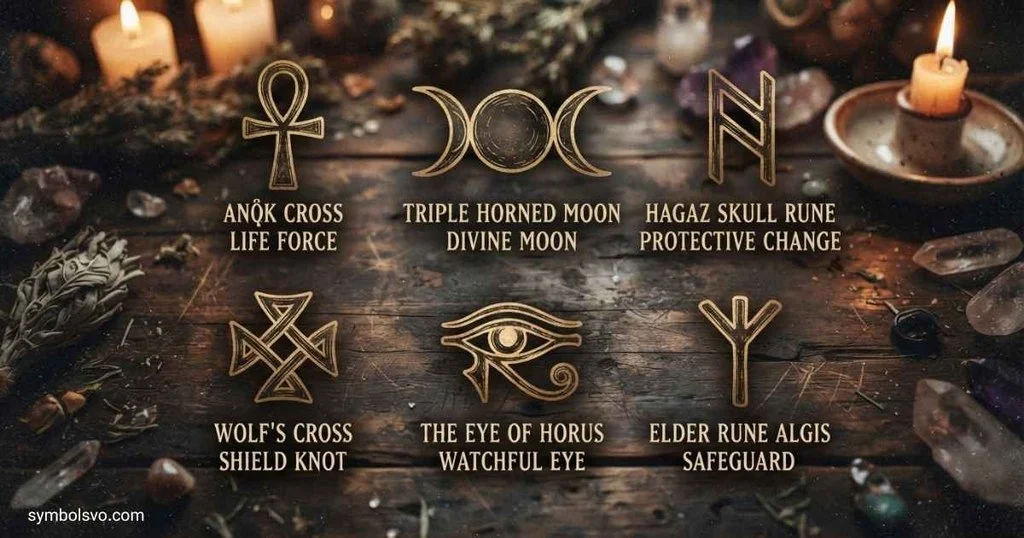
Protection is one of the most common themes in modern witchcraft-inspired symbolism.
The pentagram is frequently used in protective and spiritual contexts by some modern practitioners. Other symbols may be chosen because of their historical associations with protection.
Examples include:
- 🧿 — Nazar, traditionally associated with protection from the evil eye.
- ☥ — Ankh, associated with life in ancient Egyptian symbolism.
- Eye of Horus — Ancient Egyptian protective symbolism.
- Pentagram — Protection and spiritual symbolism in some modern traditions.
- 🌿 — Herbs and nature in contemporary witchcraft imagery.
- ☾ — Lunar imagery in modern magical aesthetics.
Protection symbolism differs greatly across cultures. A symbol’s meaning should be considered in its historical context rather than assuming that every protective-looking symbol comes from witchcraft.
Protective Witch Symbols
Protective witch symbols are often selected for jewelry, tattoos, altar decorations, artwork, journals, and digital designs.
Here is a useful distinction:
| Symbol or motif | Common protective association | Historical context |
| Pentagram | Spiritual protection in some traditions | Modern Western occult and pagan use |
| 🧿 Nazar | Protection from the evil eye | Middle Eastern, Mediterranean, and nearby traditions |
| Eye of Horus | Protection and well-being | Ancient Egyptian |
| Knotwork | Continuity and interconnectedness | Celtic-inspired and broader decorative traditions |
| Herb imagery | Nature and folk practices | Many cultural traditions |
| Moon imagery | Spiritual and cyclical symbolism | Broad cultural use |
If you plan to use one as a tattoo or personal emblem, research its original meaning first. A symbol can have a very different meaning in another culture or religious tradition.
Witch Symbols Copy And Paste
If you want witchy symbols for a username, bio, caption, message, journal, or decorative design, these characters are easy to copy and paste.
Witchy Symbols
- ☾
- ☽
- ☀
- ★
- ☆
- ✦
- ✧
- ✩
- ✪
- ✫
- ✬
- ✭
- ✮
- ✯
- ✰
- ☿
- ♀
- ♂
- ☥
- ☯
- ⚗
- ⚖
- 🜁
- 🜂
- 🜃
- 🜄
- 🕯
- 🔮
- 🧿
- 🌙
- 🌿
- 🍀
- 🕸️
- 🕷️
- 🦉
- 🐈⬛
- 🦇
Decorative Witchy Combinations
You can combine individual characters to create a mystical look:
☾ ✧ ☽
⋆。°✩ 🌙 ✩°。⋆
☽ ✦ ☾
🕯 ✧ 🌙 ✧ 🕯
🌿 ☾ ✦ ☽ 🌿
☾⋆⁺₊✧
Not every character in these combinations is a traditional witchcraft symbol. Some are simply Unicode characters chosen for their visual appearance.
Salem Witch Symbols
“Salem witch symbols” usually refers to symbols associated with the Salem witch trials, modern representations of the trials, or the broader folklore surrounding witches in Salem, Massachusetts.
The Salem witch trials took place in colonial Massachusetts in 1692 and 1693. They involved accusations of witchcraft against many people, resulting in executions and other severe consequences.
There was not a special official “Salem witch symbol” used by accused witches during the trials.
Modern Salem-themed designs often use:
- Witch hats
- Brooms
- Cauldrons
- Black cats
- Pentagrams
- Moons
- Ravens
- Old-fashioned lettering
- Witch silhouettes
- 1692 references
Historical accuracy matters here. Many symbols now associated with Salem witch imagery are later popular-culture representations rather than documented symbols used by the accused people of 1692.
Evil Witch Symbols
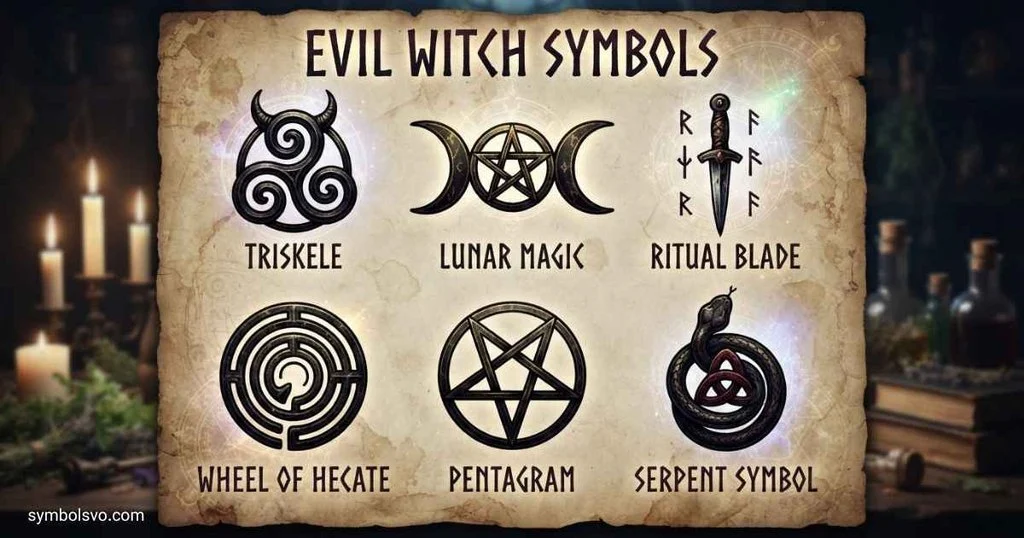
“Evil witch symbols” are mostly associated with fictional villains, horror, folklore, or modern occult imagery. There is no universal symbol that means “evil witch.”
Popular fictional and decorative imagery includes:
- ☠ — Skull and crossbones, commonly associated with death or danger.
- 🕷️ — Spider, often used for dark or gothic aesthetics.
- 🕸️ — Spider web, commonly associated with haunted or gothic imagery.
- ☾ — Dark lunar imagery.
- ⚡ — Power, danger, or dramatic energy.
- 🔥 — Fire and destruction.
- ♠ — Dark decorative imagery in some designs.
- Pentagram — Can carry very different meanings depending on orientation and context.
The pentagram deserves particular care. It is not inherently an “evil witch symbol.” It has been used in different religious, occult, magical, and cultural contexts, with meanings that vary significantly.
For fictional artwork, a combination of moon, thorns, skulls, candles, ravens, and dark typography can create a witchy aesthetic without falsely presenting a modern design as an ancient symbol.
Scarlet Witch Symbols
Scarlet Witch symbols belong primarily to the fictional Marvel character Wanda Maximoff, known as the Scarlet Witch.
Unlike historical witchcraft symbols, Scarlet Witch imagery comes from Marvel’s comic books, films, television, and related media.
The most recognizable Scarlet Witch-inspired visual is the red pointed crown or headpiece associated with Wanda’s character design. Other common imagery includes:
- Red magical energy
- Hexagonal shapes
- Red glowing effects
- Mystical circles
- The letter or concept of a “W”
- Chaos magic imagery
- Wanda’s red costume palette
The hexagon is particularly recognizable in some modern Scarlet Witch imagery because of its connection with Wanda’s powers and the visual language used in Marvel productions.
It is useful to separate Scarlet Witch symbols from traditional witchcraft. Wanda is a fictional superhero and magical character, so her visual symbols belong to Marvel’s fictional universe rather than to a historical witchcraft tradition.
Frequently Asked Questions
What is the most common witch symbol?
The pentagram is one of the most recognizable symbols associated with modern witchcraft and occult imagery. Its meaning varies by tradition and context, so it should not automatically be interpreted as evil or satanic.
What symbol represents protection in witchcraft?
Protection symbolism varies by tradition. The pentagram is used protectively in some modern practices, while other cultures have their own protective symbols, such as the nazar or Eye of Horus.
What are the symbols for a good witch?
There is no official good-witch symbol. Modern designs often use moons, stars, herbs, candles, flowers, sunlight, and peaceful imagery to represent a helpful or benevolent witch.
What are Celtic witch symbols?
Celtic witch symbols are usually modern combinations of Celtic-inspired motifs and contemporary witchcraft imagery. Triskelions, spirals, knotwork, trees, and lunar designs are common, but their historical meanings should be distinguished from modern witchcraft interpretations.
Are witch symbols real symbols?
Some are historically documented religious, cultural, astronomical, or magical symbols. Others are modern inventions, decorative characters, or fictional designs. Their meaning depends on their origin and the context in which they are used.
Conclusion
Witch symbols cover a wide range of imagery, from the pentagram and lunar symbols to herbs, stars, cauldrons, protective amulets, Celtic motifs, and fictional designs. There is no single universal dictionary of witch symbols, so understanding the context behind each symbol is more useful than assigning one fixed meaning to everything.
Historical traditions should also be separated from modern witchcraft, popular culture, and fantasy. Celtic, Irish, Egyptian, pagan, Salem, and Marvel imagery all have different origins. Some symbols have been adopted into modern witchcraft, while others are simply associated with witches through books, films, games, and internet culture.
For copy-and-paste use, Unicode characters such as ☾, ☽, ✧, ★, ☥, 🧿, 🌿, and 🔮 can add a witchy or mystical style to profiles, captions, messages, and artwork. The best symbol depends on the meaning and visual style you want rather than on a single “correct” witch symbol.

I’m Daniel Brooks, a content creator and symbol enthusiast dedicated to researching the fascinating world of signs and symbols. I enjoy discovering the hidden meanings behind famous icons, emojis, historical emblems, and cultural symbols. Through my writing, I aim to provide trustworthy, well-researched, and reader-friendly information that helps people learn something new with every visit.
Books:
- The Complete Guide to World Symbols
- The Power of Universal Signs
 Mason Ellington
 Grace Whitmore