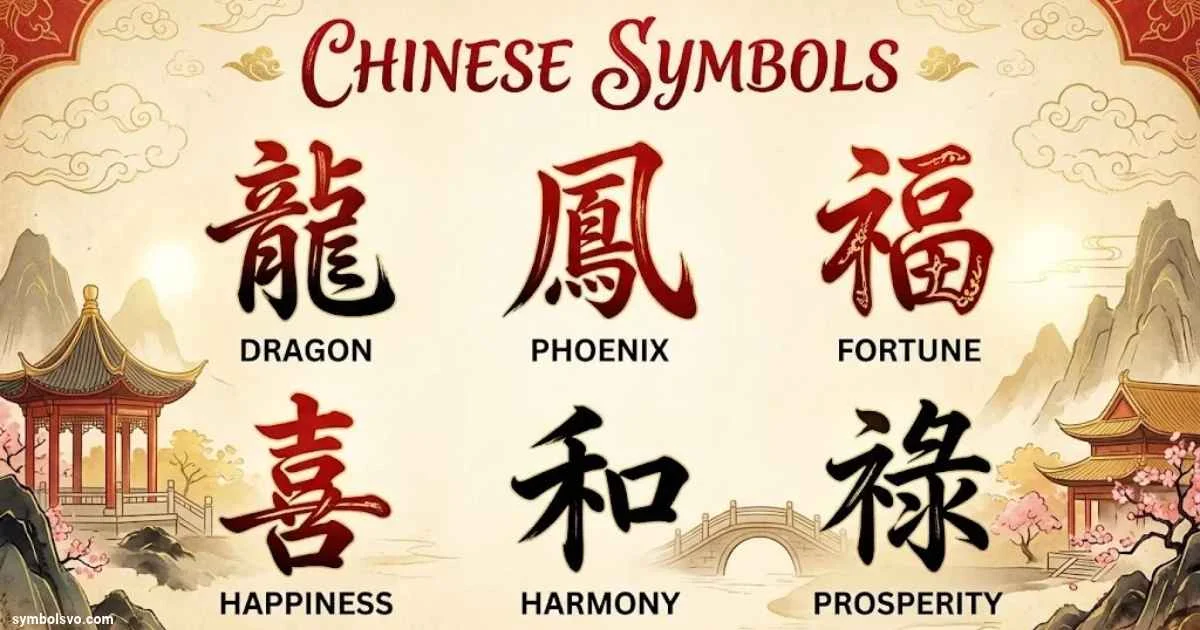
Chinese symbols have fascinated people for centuries because they communicate ideas far beyond their written appearance. A single character can represent love, happiness, strength, wisdom, fortune, or family. Some also carry deep connections to Chinese traditions, philosophy, festivals, and everyday life.
However, Chinese writing involves more than decorative symbols. Each character belongs to a language system with its own pronunciation, structure, and historical development. Its meaning can also change when combined with other characters.
In this guide, you’ll discover Chinese symbols and their meanings, including popular characters for love, luck, wealth, peace, courage, and longevity. You’ll also explore traditional cultural symbols, Chinese calligraphy, tattoo meanings, and the differences between simplified and traditional Chinese characters.
If you’re researching Chinese culture, choosing a meaningful character, or simply curious about the writing system, this guide will help you understand what these symbols actually represent.
What Are Chinese Symbols?
Chinese symbols generally refer to Chinese characters, traditional decorative characters, and cultural images used throughout Chinese history. The most important distinction is that Chinese characters form part of a written language, while cultural symbols communicate ideas through recognizable images and objects.
Chinese characters are called Hànzì (汉字). They represent meaningful linguistic units and often combine with other characters to create complete words and expressions.
For example:
- 愛 (ài) means love in traditional Chinese.
- 爱 (ài) means love in simplified Chinese.
- 福 (fú) represents fortune, blessings, and good luck.
- 家 (jiā) means family or home.
- 和 (hé) represents harmony.
- 龍 (lóng) means dragon in traditional Chinese.
Unlike English letters, Chinese characters don’t simply represent individual consonant or vowel sounds. They generally represent a syllable associated with a meaningful linguistic unit.
A character can also have different meanings depending on its surrounding words. For instance, 生 (shēng) can refer to birth, life, or growth. Its precise interpretation depends on context.
Chinese Characters vs. Chinese Cultural Symbols
People often use the terms Chinese symbols and Chinese characters interchangeably. However, they don’t always describe the same things.
| Type | Meaning | Example |
| Chinese characters | Written units used in the Chinese language | 愛, 福, 家 |
| Chinese words | Two or more characters forming a word | 和平, 健康 |
| Cultural symbols | Images representing traditional beliefs or values | Dragon, phoenix |
| Decorative symbols | Artistic forms used in traditional designs | Chinese knots, decorative 福 |
| Philosophical symbols | Images or concepts representing philosophical ideas | Yin and Yang |
For example, 福 is a written character associated with good fortune. A dragon is a cultural symbol associated with power, authority, and auspiciousness.
Understanding this difference makes it easier to explore Chinese cultural symbols without confusing traditional artwork with actual written language.
Chinese Symbols for Love and Relationships
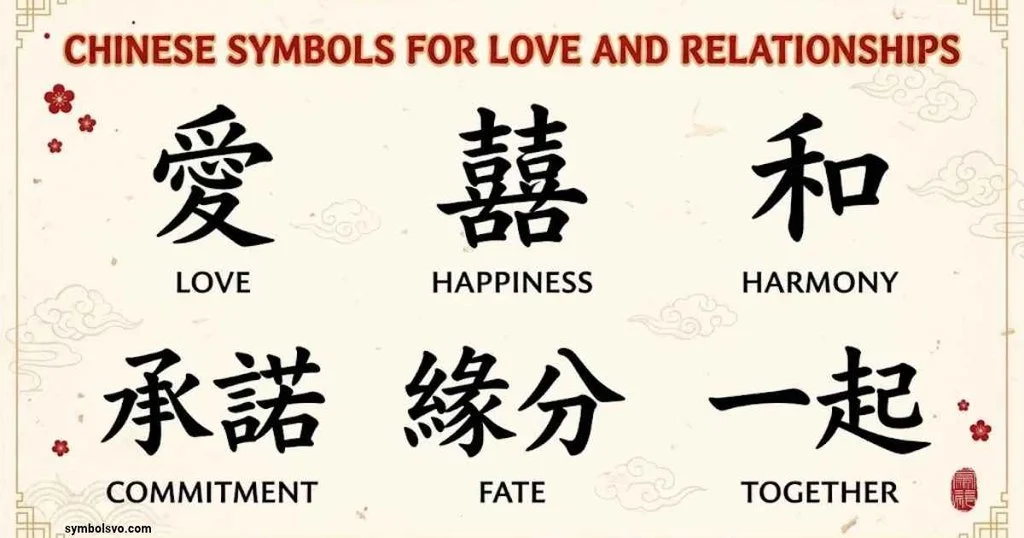
Love and relationships hold an important place in Chinese culture. Several characters express affection, emotional connection, friendship, and family relationships.
Some appear in everyday language, while others are especially popular in wedding decorations, jewelry, and meaningful gifts.
| Chinese symbol | Pinyin | Meaning |
| 愛 / 爱 | ài | Love |
| 情 | qíng | Emotion or affection |
| 友 | yǒu | Friend |
| 友誼 / 友谊 | yǒuyì | Friendship |
| 家 | jiā | Family or home |
| 親 / 亲 | qīn | Close or affectionate |
| 心 | xīn | Heart or mind |
| 緣 / 缘 | yuán | Fate or connection |
愛 / 爱 – Love
The character 愛 (traditional) or 爱 (simplified) means love. It expresses affection, devotion, and emotional attachment.
People use this character in romantic relationships, family expressions, and everyday conversations. It also appears in Chinese artwork, jewelry, and tattoo designs.
For example, 我愛你 (wǒ ài nǐ) means “I love you” in traditional Chinese writing. The simplified version is 我爱你.
The traditional and simplified forms share the same pronunciation and basic meaning.
情 – Emotion and Affection
情 (qíng) represents emotions, feelings, and affection. It appears in many expressions connected to relationships and emotional experiences.
For example, 感情 (gǎnqíng) refers to feelings or emotional relationships. It can describe affection between partners, family members, and friends.
友誼 / 友谊 – Friendship
The word 友誼 (traditional) or 友谊 (simplified) means friendship.
It describes a relationship built on trust, mutual respect, loyalty, and companionship. The individual character 友 means friend.
People may choose this expression to represent meaningful friendships or lasting personal connections.
家 – Family and Home
家 (jiā) means family, home, or household.
This character carries a strong connection to belonging and family relationships. In Chinese culture, family often represents a source of support, responsibility, and shared identity.
For example, 家庭 (jiātíng) means family or household.
心 – Heart and Mind
心 (xīn) means heart or mind. It represents both the physical heart in certain contexts and a person’s thoughts, feelings, or inner nature.
You can find it in expressions such as:
- 愛心 (àixīn) – Love or compassion.
- 開心 / 开心 (kāixīn) – Happy or feeling joyful.
- 信心 (xìnxīn) – Confidence.
- 用心 (yòngxīn) – To be attentive or wholehearted.
Chinese Symbols for Luck, Fortune, and Prosperity
Good fortune plays a visible role in Chinese celebrations and traditional decorations. During Lunar New Year, families commonly display auspicious characters to express hopes for happiness, success, and financial well-being.
The character 福 is especially recognizable because people often place it on doors, windows, and decorative ornaments.
| Chinese symbol | Pinyin | Meaning |
| 福 | fú | Fortune and blessings |
| 吉 | jí | Good luck |
| 財 / 财 | cái | Wealth |
| 富 | fù | Richness |
| 貴 / 贵 | guì | Valuable or prestigious |
| 旺 | wàng | Flourishing |
| 發 / 发 | fā | Developing or prospering |
| 昌 | chāng | Flourishing or prosperous |
福 – Fortune, Luck, and Blessings
福 (fú) is one of the most recognizable Chinese good luck symbols.
It represents good fortune, blessings, happiness, and favorable circumstances. Chinese families frequently display this character during Lunar New Year because it expresses wishes for a prosperous year.
You may see 福 printed on red paper and displayed near entrances. Some households also place it upside down.
The upside-down 福 decoration creates a wordplay involving 倒 (dào), meaning upside down, and 到 (dào), meaning to arrive. Together, the expression suggests that good fortune has arrived.
This tradition makes 福 particularly popular in festive decorations.
吉 – Good Luck and Auspiciousness
吉 (jí) means lucky, favorable, or auspicious.
It appears in traditional greetings and expressions wishing someone success or good fortune. The character is especially relevant during celebrations, weddings, and important occasions.
For example, 吉祥 (jíxiáng) means auspicious or lucky.
財 / 财 – Wealth and Money
財 (traditional) and 财 (simplified) mean wealth, money, or financial resources.
This character appears in expressions connected to financial success and prosperity. People may include it in business decorations, festive artwork, and traditional ornaments.
It is also associated with wishes for financial stability and abundance.
富 – Richness and Prosperity
富 (fù) means rich, wealthy, or abundant.
It often appears in expressions describing financial prosperity and material wealth. For example, 富有 (fùyǒu) means wealthy or rich.
Although 富 and 財 both relate to wealth, they aren’t identical. 財 emphasizes money or financial resources, while 富 describes being wealthy or abundant.
旺 – Flourishing and Growth
旺 (wàng) describes something flourishing, thriving, or prosperous.
People commonly associate it with business growth, success, and favorable circumstances. It appears in expressions such as 興旺 / 兴旺 (xīngwàng), meaning prosperous or flourishing.
Chinese Symbols for Happiness and Joy
Chinese culture uses several characters to express happiness, celebration, and positive experiences. These characters frequently appear in wedding decorations, festive gifts, and traditional artwork.
| Chinese symbol | Pinyin | Meaning |
| 喜 | xǐ | Happiness or joy |
| 囍 | shuāngxǐ | Double Happiness |
| 樂 / 乐 | lè | Happiness or enjoyment |
| 歡 / 欢 | huān | Joy or delight |
| 慶 / 庆 | qìng | Celebration |
| 祥 | xiáng | Auspiciousness |
喜 – Happiness and Joy
喜 (xǐ) means happiness, joy, or delight.
It appears in expressions associated with celebrations and positive experiences. One common example is 喜歡 / 喜欢 (xǐhuān), which means to like or enjoy something.
You can also find this character in traditional wedding decorations.
囍 – Double Happiness
囍 (shuāngxǐ) is known as the Chinese Double Happiness symbol.
It combines two 喜 characters into one decorative form. The symbol represents shared happiness, marital joy, and blessings for a couple.
The Double Happiness character is traditionally associated with weddings and marriage celebrations.
Chinese wedding decorations often feature 囍 on:
- Wedding invitations.
- Red paper decorations.
- Bedroom ornaments.
- Gift packaging.
- Wedding clothing and accessories.
Unlike ordinary characters used in everyday writing, 囍 has a particularly strong decorative and ceremonial association.
樂 / 乐 – Happiness and Enjoyment
樂 (traditional) and 乐 (simplified) can mean happiness, pleasure, or music depending on pronunciation and context.
When pronounced lè, it commonly means happiness or enjoyment. When pronounced yuè, it means music.
This distinction demonstrates why Chinese pronunciation matters. The same written character can have different readings and meanings.
慶 / 庆 – Celebration
慶 (traditional) or 庆 (simplified) means celebration or congratulation.
It appears in expressions related to festivals, anniversaries, achievements, and happy occasions.
For example, 慶祝 / 庆祝 (qìngzhù) means to celebrate.
Chinese Symbols for Peace and Harmony
Peace and harmony represent important ideas in Chinese philosophy, relationships, and social life.
Characters in this category describe calmness, safety, balance, and peaceful coexistence.
| Chinese symbol | Pinyin | Meaning |
| 和 | hé | Harmony |
| 平 | píng | Level, peaceful |
| 和平 | hépíng | Peace |
| 安 | ān | Safety and peace |
| 靜 / 静 | jìng | Quietness |
| 寧 / 宁 | níng | Tranquility |
和 – Harmony
和 (hé) represents harmony, agreement, and peaceful relationships.
It appears in many expressions describing cooperation and balanced relationships. In Chinese philosophical traditions, harmony can refer to the relationship between people, society, and the natural world.
For example, 和諧 / 和谐 (héxié) means harmony or harmonious.
和平 – Peace
和平 (hépíng) is the Chinese word for peace.
It can describe peaceful relationships between countries, communities, and individuals. Unlike 和 alone, 和平 is a complete two-character word.
This distinction matters when choosing a Chinese expression for artwork or tattoos.
安 – Safety and Peace
安 (ān) means safe, peaceful, or settled.
It appears in common expressions such as:
- 平安 (píng’ān) – Peace and safety.
- 安全 (ānquán) – Safety or security.
- 安心 (ānxīn) – Peace of mind.
- 安靜 / 安静 (ānjìng) – Quiet or peaceful.
The character often communicates a wish for someone’s safety and well-being.
靜 / 静 – Quietness and Stillness
靜 (traditional) and 静 (simplified) mean quiet, calm, or still.
The character is useful when discussing peaceful surroundings, meditation, and mental calmness.
It can also describe a quiet environment without necessarily carrying a spiritual meaning.
Chinese Symbols for Strength, Courage, and Power
Strength-related Chinese characters represent physical ability, determination, courage, and resilience.
Some describe physical power, while others focus on mental strength and the ability to overcome difficulties.
| Chinese symbol | Pinyin | Meaning |
| 力 | lì | Strength or force |
| 強 / 强 | qiáng | Strong |
| 勇 | yǒng | Courage |
| 武 | wǔ | Martial or military |
| 堅 / 坚 | jiān | Firm or steadfast |
| 毅 | yì | Resolve or determination |
| 忍 | rěn | Endurance or patience |
力 – Strength and Power
力 (lì) means strength, force, or power.
It can describe physical ability, effort, or influence. The character appears in several common expressions:
- 力量 (lìliàng) – Strength or power.
- 能力 (nénglì) – Ability or capability.
- 努力 (nǔlì) – To work hard or make an effort.
People often associate 力 with determination and personal strength.
強 / 强 – Strength and Power
強 (traditional) and 强 (simplified) mean strong or powerful.
The character can describe physical strength, powerful objects, or someone with a strong personality.
For example, 強大 / 强大 (qiángdà) means powerful or mighty.
勇 – Courage and Bravery
勇 (yǒng) means courage or bravery.
It represents the willingness to face challenges despite fear or uncertainty. The character appears in 勇敢 (yǒnggǎn), meaning brave or courageous.
It can be a meaningful expression for people who value bravery and determination.
忍 – Patience and Endurance
忍 (rěn) means to endure, tolerate, or exercise restraint.
It carries a different meaning from ordinary physical strength. Instead, it emphasizes patience and the ability to withstand difficult situations.
In Chinese expressions, 忍耐 (rěnnài) means patience or endurance.
Chinese Symbols for Wisdom, Knowledge, and Intelligence
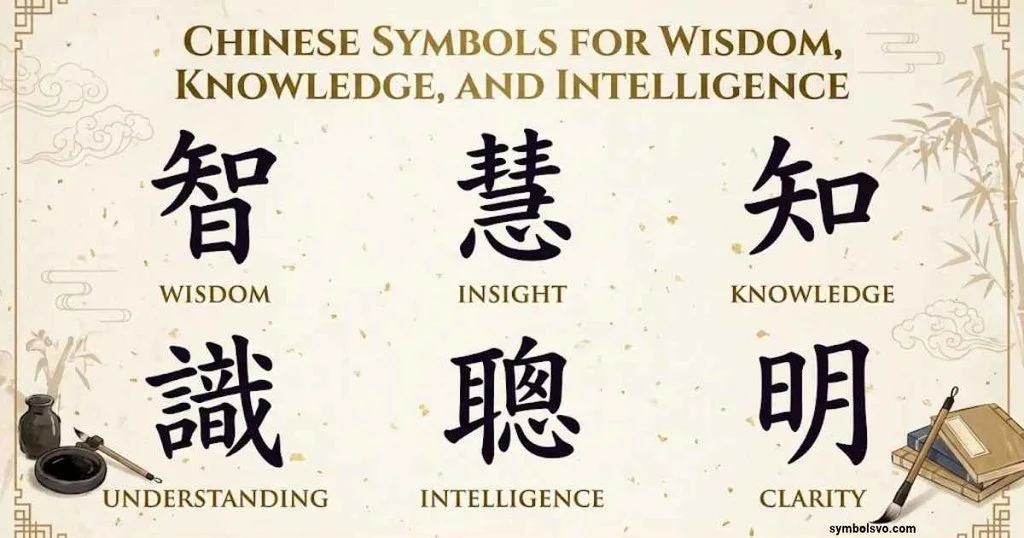
Wisdom-related characters represent learning, understanding, thoughtful decisions, and knowledge.
These characters appear in education, literature, philosophical discussions, and everyday expressions.
| Chinese symbol | Pinyin | Meaning |
| 智 | zhì | Wisdom |
| 慧 | huì | Insight or intelligence |
| 學 / 学 | xué | Learning |
| 知 | zhī | Knowing |
| 明 | míng | Brightness or clarity |
| 思 | sī | Thought or reflection |
智 – Wisdom and Intelligence
智 (zhì) means wisdom or intelligence.
It describes the ability to understand situations, make informed decisions, and apply knowledge effectively.
For example, 智慧 (zhìhuì) means wisdom or intelligence.
慧 – Insight and Understanding
慧 (huì) represents wisdom, insight, and understanding.
It often appears in expressions describing intelligence and thoughtful judgment. The character also appears in personal names.
學 / 学 – Learning and Education
學 (traditional) and 学 (simplified) mean learning or studying.
It appears in common words such as:
- 學生 / 学生 (xuéshēng) – Student.
- 學校 / 学校 (xuéxiào) – School.
- 學習 / 学习 (xuéxí) – Learning or studying.
明 – Brightness and Clarity
明 (míng) means bright, clear, or understandable.
It can describe physical brightness and intellectual clarity. The character consists of the components 日 (sun) and 月 (moon).
This combination is often used to explain the structure of the character, although its modern meaning should be learned through actual language usage rather than assumed from its components.
Chinese Symbols for Longevity, Health, and Life
Longevity and good health have long been important themes in Chinese traditional art and celebrations.
Certain characters appear on gifts, decorative scrolls, birthday ornaments, and traditional ceramics.
| Chinese symbol | Pinyin | Meaning |
| 壽 / 寿 | shòu | Longevity |
| 健 | jiàn | Healthy or strong |
| 康 | kāng | Health and well-being |
| 健康 | jiànkāng | Health |
| 生 | shēng | Life or birth |
| 命 | mìng | Life or destiny |
| 長 / 长 | cháng | Long or lasting |
壽 / 寿 – Longevity and Long Life
壽 (traditional) and 寿 (simplified) mean longevity or long life.
The character is especially popular in traditional birthday celebrations. People use it on decorative objects, paintings, and gifts to express wishes for a long and healthy life.
It is one of the most recognizable Chinese symbols for longevity.
健康 – Health and Well-Being
健康 (jiànkāng) means health.
The first character 健 relates to being healthy or strong, while 康 relates to health and well-being.
Together, they form a common word used in everyday conversations.
For example, 身體健康 / 身体健康 (shēntǐ jiànkāng) means physical health or being healthy.
生 – Life, Birth, and Growth
生 (shēng) has several meanings, including life, birth, and growth.
It appears in expressions such as:
- 生命 (shēngmìng) – Life.
- 生日 (shēngrì) – Birthday.
- 生活 (shēnghuó) – Life or daily living.
- 生長 / 生长 (shēngzhǎng) – Growth.
This character represents the beginning and continuation of life.
命 – Life and Destiny
命 (mìng) can mean life, fate, or destiny.
Its interpretation depends heavily on context. For example, 生命 means life, while 命運 / 命运 (mìngyùn) means fate or destiny.
The character is also used in words relating to commands and orders.
Chinese Symbols for Hope, Dreams, and Ambition
Hope and ambition represent a person’s goals, expectations, and desire for a better future.
Chinese characters in this category appear in personal names, motivational expressions, literature, and everyday language.
| Chinese symbol | Pinyin | Meaning |
| 希 | xī | Hope or expectation |
| 望 | wàng | Expectation or looking toward |
| 希望 | xīwàng | Hope |
| 志 | zhì | Aspiration or ambition |
| 夢 / 梦 | mèng | Dream |
| 目 | mù | Eye or item; used in objectives |
| 成 | chéng | Achievement or completion |
希望 – Hope
希望 (xīwàng) means hope or expectation.
It describes a positive desire for something to happen. People use it in everyday conversations when discussing dreams, goals, and future possibilities.
For example, 我希望你成功 (wǒ xīwàng nǐ chénggōng) means “I hope you succeed.”
志 – Ambition and Determination
志 (zhì) represents ambition, aspiration, or determination.
It often appears in expressions related to personal goals and commitment.
For example, 志向 (zhìxiàng) means ambition or aspiration.
夢 / 梦 – Dreams
夢 (traditional) and 梦 (simplified) mean dreams.
The character can refer to dreams experienced during sleep or figurative dreams involving personal goals and ambitions.
For example, 夢想 / 梦想 (mèngxiǎng) means dream or aspiration.
Chinese Symbols for Protection, Safety, and Family
Chinese characters associated with protection and safety often appear in blessings, traditional decorations, and expressions of goodwill.
They communicate wishes for security, family well-being, and a peaceful home.
| Chinese symbol | Pinyin | Meaning |
| 安 | ān | Safety and peace |
| 守 | shǒu | Guard or protect |
| 保 | bǎo | Preserve or protect |
| 護 / 护 | hù | Protection |
| 家 | jiā | Home or family |
| 宅 | zhái | Residence |
| 平安 | píng’ān | Peace and safety |
守 – Guarding and Protection
守 (shǒu) means to guard, protect, keep, or observe.
It can describe protecting someone, maintaining a promise, or following a rule.
For example, 守護 / 守护 (shǒuhù) means to protect or guard.
護 / 护 – Protection
護 (traditional) and 护 (simplified) mean to protect, guard, or care for.
The character appears in words such as 保護 / 保护 (bǎohù), meaning protection.
It is a more direct choice than 安 when someone specifically wants to express the idea of protecting something or someone.
平安 – Peace and Safety
平安 (píng’ān) means peace, safety, or being safe and well.
People commonly use this expression when wishing someone protection from danger or trouble.
It is particularly suitable for greetings, family blessings, and traditional gifts.
Chinese Symbols for Energy and Spiritual Meaning
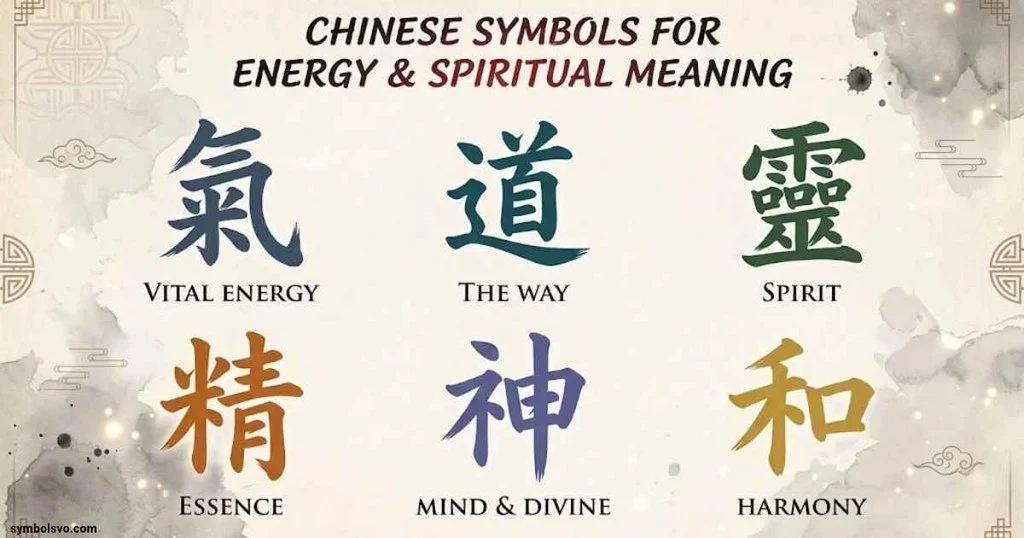
Chinese philosophy includes several concepts connected to nature, life, balance, and the relationship between human beings and the world.
Some characters in this category have philosophical meanings that extend beyond their everyday translations.
| Chinese symbol | Pinyin | Meaning |
| 氣 / 气 | qì | Breath or vital energy |
| 道 | dào | The Way or path |
| 陰 / 阴 | yīn | Yin |
| 陽 / 阳 | yáng | Yang |
| 靈 / 灵 | líng | Spirit or spiritual nature |
| 神 | shén | Spirit or deity |
| 心 | xīn | Heart or mind |
氣 / 气 – Qi or Vital Energy
氣 (traditional) and 气 (simplified) are pronounced qì in Mandarin.
The character can mean air, breath, or energy. In Chinese philosophy, Qi (气) describes a vital force associated with living processes and the natural world.
The concept appears in several traditional practices:
- Traditional Chinese medicine.
- Tai chi.
- Qigong.
- Chinese martial arts.
- Traditional philosophical discussions.
Qi isn’t simply another word for electricity or physical energy. Its meaning depends on the philosophical or traditional medical framework in which people use it.
道 – The Way or Path
道 (dào) means way, path, or method.
It holds particular importance in Daoism, a Chinese philosophical and religious tradition. In Daoist thought, the Dao represents the fundamental way or underlying principle through which the universe operates.
The character also appears in everyday expressions. For example, 道路 (dàolù) means road or route.
陰 / 阴 and 陽 / 阳 – Yin and Yang
Yin and Yang describe complementary aspects of existence in traditional Chinese philosophy.
- Yin (陰 / 阴): Commonly associated with darkness, coolness, rest, and the receptive side of a relationship.
- Yang (陽 / 阳): Commonly associated with brightness, warmth, activity, and the active side of a relationship.
Neither represents absolute good or evil. Instead, the concept describes how contrasting qualities interact and depend on each other.
The familiar Yin-Yang diagram uses a circular design with two interlocking sections. Each section contains a small circle of the opposite color, suggesting that each side contains the potential for the other.
靈 / 灵 – Spirit and Spiritual Nature
靈 (traditional) and 灵 (simplified) can mean spirit, spiritual, or supernatural.
The character appears in religious, cultural, and literary contexts. It can describe spiritual qualities or something considered mysterious and extraordinary.
神 – Spirit or Deity
神 (shén) can mean spirit, deity, or divine being.
It appears in Chinese religious traditions, mythology, and everyday expressions.
For example, 神話 / 神话 (shénhuà) means mythology.
Traditional Chinese Cultural Symbols and Their Meanings
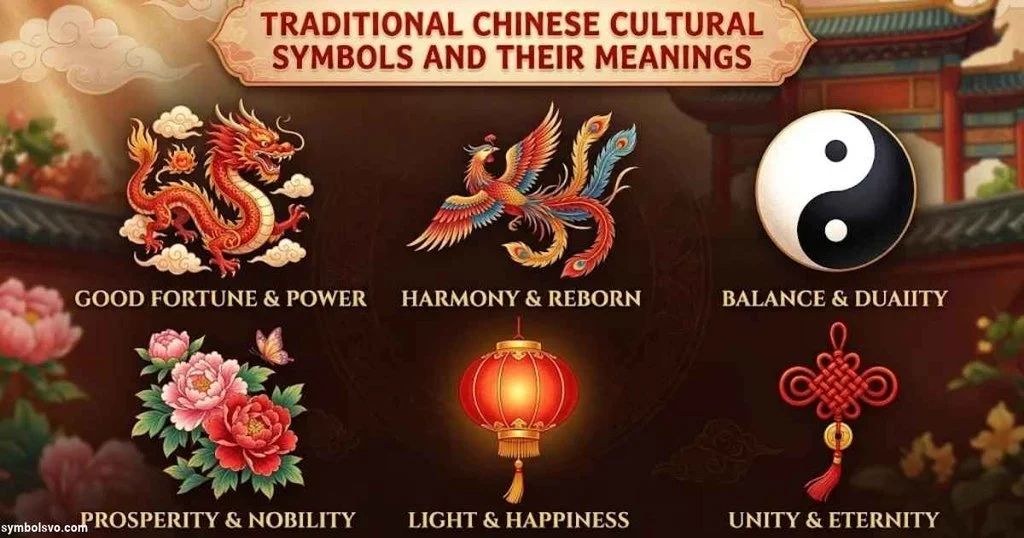
Not all important Chinese symbols are written characters. Chinese culture also uses animals, plants, objects, and decorative patterns to communicate traditional values and auspicious wishes.
These images appear in festivals, paintings, ceramics, textiles, architecture, and traditional celebrations.
Chinese Dragon Symbol (龍 / 龙)
Chinese dragon – Power, authority, strength, and good fortune
The Chinese dragon is among the most recognizable symbols of Chinese cultural heritage.
Unlike many Western dragon stories, traditional Chinese dragons are often associated with positive qualities. They represent authority, prosperity, strength, and auspicious power.
Historically, dragons also had strong imperial associations. Chinese emperors used dragon imagery to express royal authority and legitimacy.
Chinese dragons appear in:
- Lunar New Year celebrations.
- Dragon dance performances.
- Imperial artwork.
- Traditional architecture.
- Ceramics and decorative textiles.
- Chinese zodiac traditions.
The Chinese zodiac assigns the dragon to one of its twelve animal signs. People commonly associate this sign with confidence, ambition, and strength.
Chinese Phoenix Symbol (鳳凰 / 凤凰)
Phoenix – Renewal, grace, harmony, and auspiciousness
The Chinese phoenix is traditionally called Fenghuang (鳳凰 / 凤凰).
It represents grace, virtue, prosperity, and renewal. Its imagery frequently appears alongside the dragon in traditional Chinese artwork.
The dragon and phoenix together can symbolize a harmonious marriage and the joining of complementary qualities.
Historically, phoenix imagery also appeared in imperial and ceremonial art. Its meaning varies according to the artwork and historical period.
Yin and Yang Symbol (陰陽 / 阴阳)
Yin and Yang – Balance and complementary forces
The Yin-Yang symbol is a circular design divided into two curved sections, traditionally black and white.
Each section contains a small circle in the opposite color.
This design represents the relationship between complementary forces. Rather than suggesting that everything must remain identical, it emphasizes balance through interaction and change.
The concept appears in:
- Chinese philosophy.
- Traditional cosmology.
- Traditional Chinese medicine.
- Tai chi.
- Martial arts.
- Contemporary decorative designs.
An important point is that Yin and Yang should not be reduced to a simple good-versus-evil comparison. Both are necessary parts of the traditional philosophical framework.
Chinese Zodiac Symbols and Their Meanings
The Chinese zodiac, known as 生肖 (shēngxiào), uses twelve animals in a repeating cycle.
Each animal represents a year within the traditional zodiac system. The cycle is commonly associated with personality traits, cultural stories, and traditional fortune interpretations.
| Zodiac animal | Chinese name | Common symbolic associations |
| Rat | 鼠 (shǔ) | Resourcefulness and adaptability |
| Ox | 牛 (niú) | Diligence and reliability |
| Tiger | 虎 (hǔ) | Courage and power |
| Rabbit | 兔 (tù) | Gentleness and good fortune |
| Dragon | 龍 / 龙 (lóng) | Authority and strength |
| Snake | 蛇 (shé) | Wisdom and strategy |
| Horse | 馬 / 马 (mǎ) | Energy and freedom |
| Goat | 羊 (yáng) | Kindness and harmony |
| Monkey | 猴 (hóu) | Cleverness and creativity |
| Rooster | 雞 / 鸡 (jī) | Confidence and punctuality |
| Dog | 狗 (gǒu) | Loyalty and protection |
| Pig | 豬 / 猪 (zhū) | Abundance and good fortune |
These associations are traditional interpretations rather than scientific personality descriptions.
The zodiac also follows the Chinese lunisolar calendar. Therefore, zodiac years don’t always begin on January 1. The beginning of the Chinese New Year determines the transition between animal signs.
Other Important Chinese Cultural Symbols
Chinese traditional art includes numerous objects and natural elements with symbolic meanings. Their significance often comes from pronunciation, folklore, religious beliefs, and visual associations.
| Cultural symbol | Chinese name | Common meaning |
| Fish | 魚 / 鱼 | Abundance and prosperity |
| Bat | 蝠 | Good fortune |
| Peony | 牡丹 | Wealth and honor |
| Lotus | 蓮 / 莲 | Purity |
| Bamboo | 竹 | Integrity and resilience |
| Plum blossom | 梅花 | Perseverance |
| Crane | 鶴 / 鹤 | Longevity |
| Peach | 桃 | Long life |
| Pine tree | 松 | Endurance |
| Koi fish | 錦鯉 / 锦鲤 | Success and perseverance |
| Chinese knot | 中國結 / 中国结 | Unity and connection |
| Ruyi | 如意 | Fulfillment of wishes |
Fish – Abundance and Prosperity
Fish imagery frequently appears in Chinese paintings, decorations, and festive artwork.
The Chinese word for fish, 魚 (yú), sounds like 餘 (yú), meaning surplus or abundance. This creates a traditional wordplay associated with having more than enough.
A common expression is 年年有餘 / 年年有余 (niánnián yǒuyú), meaning having abundance year after year.
Fish decorations are especially popular during Lunar New Year celebrations.
Bat – Good Fortune
In Chinese decorative art, the bat represents good fortune because 蝠 (fú), the word for bat, sounds like 福 (fú), meaning fortune.
This connection makes bats a common motif in traditional decorative designs.
Five bats can represent the Five Blessings, traditionally associated with longevity, wealth, health, virtue, and a peaceful death.
Peony – Wealth and Honor
The peony (牡丹, mǔdān) is often called the king of flowers in Chinese cultural traditions.
It represents wealth, honor, beauty, and prosperity.
Traditional paintings frequently combine peonies with other auspicious objects to express wishes for success and abundance.
Lotus – Purity and Spiritual Growth
The lotus (蓮 / 莲, lián) has important associations in Chinese Buddhist art and other East Asian traditions.
It grows in muddy water while producing a clean and beautiful flower. This natural quality makes it a symbol of purity and spiritual development.
Lotus imagery often appears in temples, paintings, sculptures, and decorative objects.
Bamboo – Strength and Integrity
Bamboo (竹, zhú) represents flexibility, resilience, and integrity.
Its ability to bend without easily breaking makes it a powerful image of endurance. Traditional Chinese paintings frequently depict bamboo to communicate moral character and inner strength.
Plum Blossom – Perseverance
The plum blossom (梅花, méihuā) blooms during cold weather, sometimes while winter conditions remain harsh.
Because of this characteristic, it represents perseverance, renewal, and resilience.
It is also one of the Four Gentlemen in traditional Chinese painting, alongside orchid, bamboo, and chrysanthemum.
Crane – Longevity and Elegance
The crane (鶴 / 鹤, hè) is traditionally associated with long life, grace, and longevity.
Crane imagery frequently appears in paintings and decorative objects intended for birthday celebrations or gifts for older family members.
Peach – Long Life and Immortality
Peaches have a special place in Chinese mythology and traditional storytelling.
They are associated with longevity and immortality, particularly through stories about the peaches of the Queen Mother of the West.
Peach imagery therefore appears in traditional birthday gifts and auspicious artwork.
Chinese Knot – Unity and Connection
Chinese knots are decorative arrangements made by tying cords into intricate patterns.
They symbolize unity, connection, good wishes, and continuity.
People commonly display them during Lunar New Year and other celebrations. Red knots are especially popular because red has strong associations with happiness and auspiciousness in Chinese culture.
Ruyi – Fulfillment of Wishes
Ruyi (如意, rúyì) is a traditional ornamental object associated with good fortune and wishes coming true.
Its name can be understood as “as you wish” or “according to your wishes.”
Ruyi objects appear in traditional artwork, ceremonial settings, and decorative collections.
Chinese Good-Luck Decorations and Their Meanings
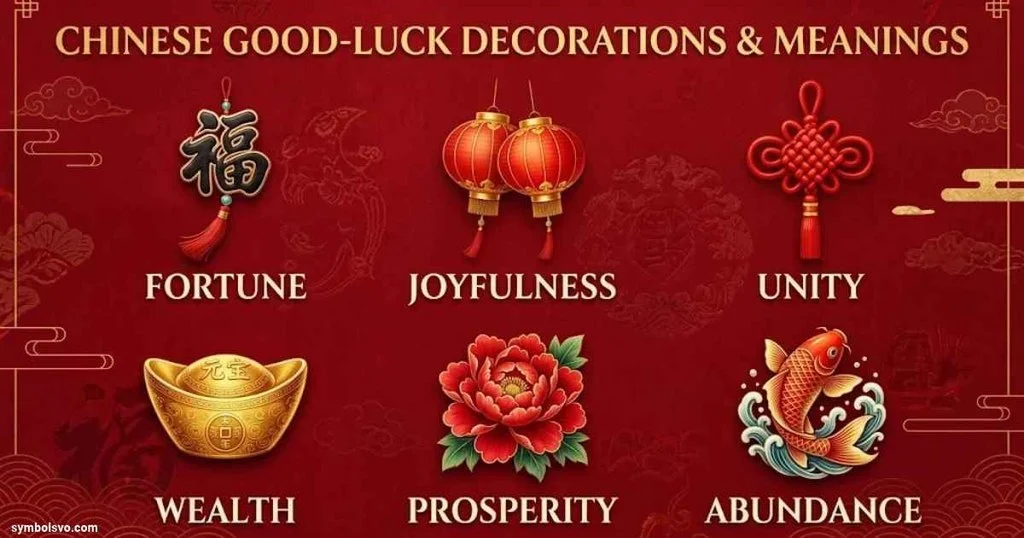
Chinese celebrations use many decorative objects to express blessings and positive wishes.
Some decorations feature written characters, while others rely on colors, shapes, and traditional associations.
| Decoration | Chinese name | Meaning |
| Fortune character | 福 | Blessings and good fortune |
| Red lanterns | 紅燈籠 / 红灯笼 | Celebration and auspiciousness |
| Red envelopes | 紅包 / 红包 | Monetary gifts and good wishes |
| Spring couplets | 春聯 / 春联 | New Year blessings |
| Five Blessings | 五福 | Five traditional blessings |
Why Is the Chinese Fortune Symbol Displayed Upside Down?
The upside-down 福 character is one of the most familiar Lunar New Year decorations.
The tradition relies on a Chinese pronunciation-based wordplay.
The word 倒 (dào) means upside down. Meanwhile, 到 (dào) means to arrive. Both share the same pronunciation in Mandarin.
Therefore, placing 福 upside down creates a playful suggestion that fortune has arrived.
People commonly display the character on doors, walls, and windows during the Lunar New Year season.
What Are the Five Blessings in Chinese Culture?
The Five Blessings are known as 五福 (wǔfú).
A traditional interpretation includes:
- Longevity.
- Wealth.
- Health and peace.
- Love of virtue.
- A peaceful death or a natural end to life.
These blessings represent a broad vision of a fortunate life rather than financial success alone.
The Five Blessings frequently appear together in traditional artwork, sometimes represented through five bats because of the phonetic connection between 蝠 and 福.
Traditional Chinese vs. Simplified Chinese Characters
Chinese writing has two major modern character forms: traditional and simplified.
Both systems represent the Chinese language. However, certain characters have different written structures.
Traditional characters generally preserve older, more complex written forms. Simplified characters reduce strokes in many commonly used characters.
The large-scale simplification program in mainland China took place mainly during the 1950s and 1960s. Simplified Chinese is now standard in mainland China and Singapore, while traditional Chinese remains standard in Taiwan, Hong Kong, and Macau.
The two systems are different written forms, not separate spoken languages.
What Are Traditional Chinese Characters?
Traditional Chinese characters are written forms that preserve many historical character structures.
They are widely used in:
- Taiwan.
- Hong Kong.
- Macau.
- Some overseas Chinese communities.
- Traditional calligraphy and historical publications.
For example, 愛 is the traditional form of the character meaning love.
Traditional characters often contain more strokes than their simplified counterparts. However, not every traditional character has a different simplified form.
What Are Simplified Chinese Characters?
Simplified Chinese characters were developed to make writing and learning certain commonly used characters easier.
They are widely used in mainland China and Singapore.
For example, 爱 is the simplified form of 愛.
Simplification involved different methods, including reducing strokes and adopting existing abbreviated character forms.
Traditional vs. Simplified Chinese Characters Chart
| English meaning | Traditional Chinese | Simplified Chinese | Pinyin |
| Love | 愛 | 爱 | ài |
| Longevity | 壽 | 寿 | shòu |
| Wealth | 財 | 财 | cái |
| Strong | 強 | 强 | qiáng |
| Music or happiness | 樂 | 乐 | lè |
| Dream | 夢 | 梦 | mèng |
| Spirit | 靈 | 灵 | líng |
| Protection | 護 | 护 | hù |
| Horse | 馬 | 马 | mǎ |
| Dragon | 龍 | 龙 | lóng |
| Phoenix | 鳳 | 凤 | fèng |
| Health | 健康 | 健康 | jiànkāng |
| Peace | 和平 | 和平 | hépíng |
| Fortune | 福 | 福 | fú |
| Family | 家 | 家 | jiā |
Notice that characters such as 福, 家, and 和平 look identical in both systems. Simplification does not change every character.
Are Chinese Symbols the Same as Japanese Kanji?
Chinese characters and Japanese Kanji share historical origins, but they aren’t identical writing systems.
Kanji developed from Chinese characters introduced to Japan over many centuries. Japanese later adapted these characters to represent parts of its own language.
Although many characters look similar, their pronunciation, usage, and sometimes meanings differ.
For example:
| Meaning | Chinese | Japanese Kanji |
| Mountain | 山 (shān) | 山 (yama / san) |
| Water | 水 (shuǐ) | 水 (mizu / sui) |
| Fire | 火 (huǒ) | 火 (hi / ka) |
| Person | 人 (rén) | 人 (hito / jin / nin) |
| Love | 愛 (ài) | 愛 (ai) |
The written forms may match, but the spoken readings differ.
Japanese also uses two additional writing systems:
- Hiragana: A phonetic script used for grammatical elements and native Japanese words.
- Katakana: A phonetic script commonly used for foreign loanwords and certain names.
Chinese doesn’t use these two Japanese syllabaries as part of its standard writing system.
Therefore, a Chinese character shouldn’t automatically be treated as a Japanese word with the same pronunciation or meaning.
Chinese Symbols in Calligraphy and Traditional Art
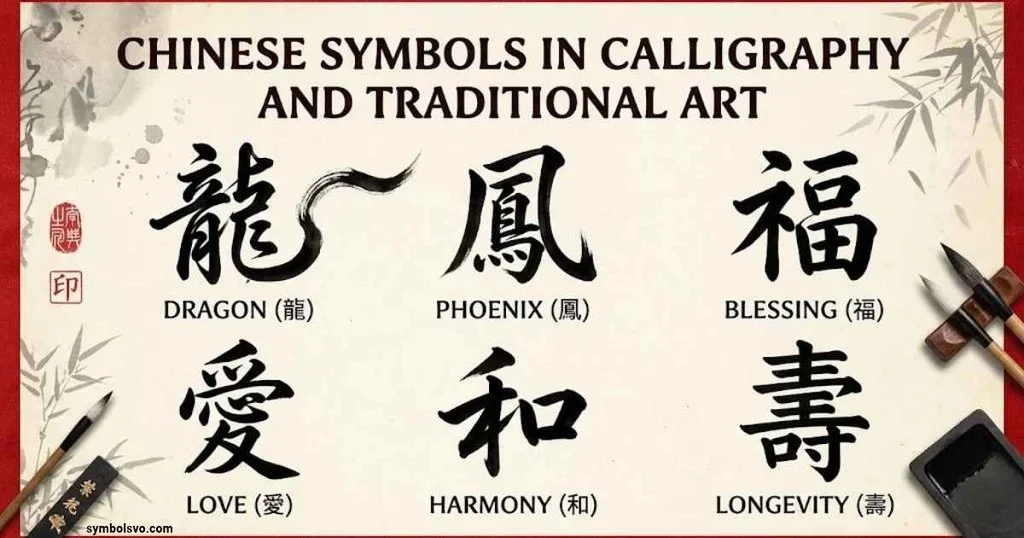
Chinese calligraphy is the artistic practice of writing Chinese characters with attention to brushwork, structure, movement, and visual balance.
It holds an important position in Chinese cultural history. Calligraphy developed alongside painting, literature, education, and philosophical traditions.
A calligrapher doesn’t simply write a character correctly. Brush pressure, stroke direction, spacing, and rhythm also influence its appearance.
Five Main Chinese Calligraphy Styles
Chinese calligraphy includes several historical styles. Each has distinct visual features and practical uses.
| Calligraphy style | Chinese name | Main characteristics |
| Seal Script | 篆書 / 篆书 | Ancient, balanced, and decorative |
| Clerical Script | 隸書 / 隶书 | Broad and distinctive strokes |
| Regular Script | 楷書 / 楷书 | Clear and structured |
| Running Script | 行書 / 行书 | Connected and flowing |
| Cursive Script | 草書 / 草书 | Highly abbreviated and expressive |
Seal Script (篆書 / 篆书)
Seal Script is one of the oldest major Chinese calligraphy styles.
Its characters often have balanced proportions and rounded or elongated forms. Historically, people used seal script for inscriptions and official seals.
Modern artists still use it for decorative calligraphy and traditional artwork.
Clerical Script (隸書 / 隶书)
Clerical Script became important during the Han dynasty.
It features relatively broad strokes and distinctive horizontal shapes. Its structure influenced later developments in Chinese writing.
Regular Script (楷書 / 楷书)
Regular Script is the standard form most learners encounter when studying Chinese characters.
Its strokes are clearly separated, making individual characters easier to recognize and reproduce.
It is widely used in textbooks, printed materials, and handwriting practice.
Running Script (行書 / 行书)
Running Script connects strokes more naturally than Regular Script.
It allows faster writing while keeping most characters recognizable. Calligraphers often use it to balance readability with artistic expression.
Cursive Script (草書 / 草书)
Cursive Script uses highly flowing and abbreviated forms.
Some characters may look dramatically different from their standard printed versions. Reading cursive writing often requires familiarity with traditional stroke patterns and calligraphic conventions.
How Chinese Calligraphy Changes a Character’s Appearance
Calligraphy can make the same character appear in several different styles.
For example, the character 福 may look compact in Regular Script and more fluid in Running Script.
Several factors influence its appearance:
- Brush pressure: Determines how thick or thin a stroke becomes.
- Stroke direction: Influences the movement and balance of the character.
- Spacing: Controls the relationship between individual components.
- Proportion: Affects the overall shape and visual weight.
- Brush speed: Creates different textures and line patterns.
Traditional Chinese artwork often combines calligraphy with paintings, poems, and decorative inscriptions.
Characters also appear on ceramics, scrolls, wooden objects, textiles, and architectural features.
Chinese Symbols and Their Meanings in Tattoos
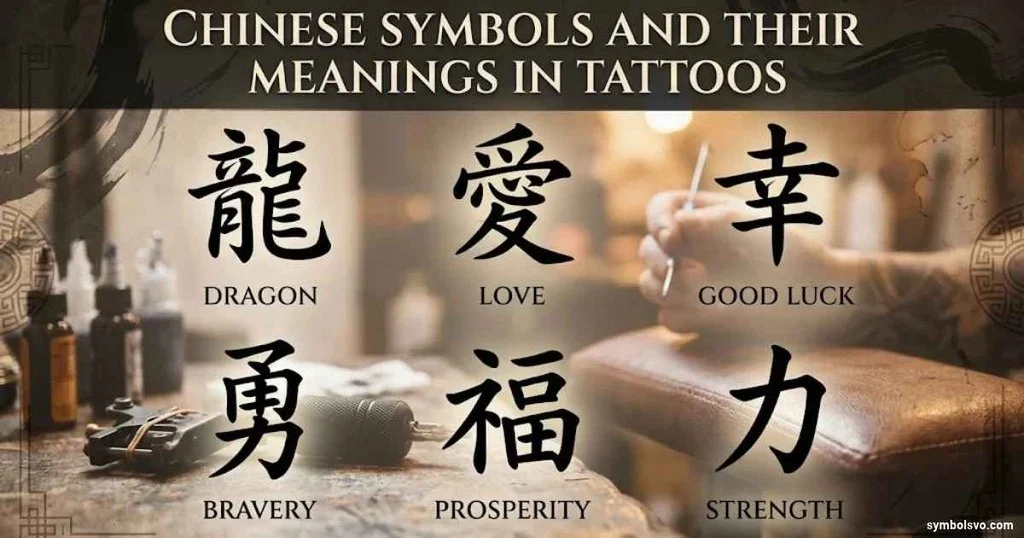
Chinese character tattoos attract people who want a visual representation of personal values, relationships, and life experiences.
Popular choices include characters for love, courage, strength, wisdom, and good fortune.
However, a meaningful tattoo requires more than choosing a character from an online list. Chinese characters have specific pronunciations and linguistic contexts. A design that looks attractive may not communicate the intended message.
Popular Chinese Tattoo Symbols
| Chinese symbol | Pinyin | Tattoo meaning |
| 愛 / 爱 | ài | Love |
| 福 | fú | Fortune and blessings |
| 力 | lì | Strength |
| 勇 | yǒng | Courage |
| 忍 | rěn | Endurance |
| 和 | hé | Harmony |
| 智 | zhì | Wisdom |
| 龍 / 龙 | lóng | Dragon |
| 壽 / 寿 | shòu | Longevity |
| 心 | xīn | Heart and mind |
Chinese Tattoo Symbols for Love
愛 / 爱 is a common choice for people who want to represent love and affection.
Other possibilities include 心, meaning heart or mind, and 情, meaning emotion or affection.
However, a complete expression may communicate an idea more clearly than a single character.
For instance, 永遠的愛 / 永远的爱 (yǒngyuǎn de ài) means everlasting love.
Chinese Tattoo Symbols for Strength and Courage
People interested in strength often choose 力 or 強 / 强.
For courage, 勇 is a direct character choice. 忍 is another option for someone who wants to represent patience and endurance.
Each character communicates a different idea, so choosing one based on its actual meaning is important.
Chinese Tattoo Symbols for Peace and Protection
和平 means peace, while 安 represents safety and calmness.
平安 communicates peace and safety together. It is a common expression of goodwill in everyday Chinese.
These choices are more specific than selecting a character simply because it looks attractive.
Important Things to Check Before Getting a Chinese Tattoo
Before permanently using a Chinese character, take time to verify its meaning.
- Confirm the translation: Ask a fluent Chinese speaker to check the intended meaning.
- Choose the writing system: Decide whether traditional or simplified Chinese is appropriate.
- Check the pronunciation: Learn the correct Pinyin and tones.
- Understand the context: A character may carry different meanings in different expressions.
- Verify the complete phrase: Avoid combining unrelated characters.
- Check the calligraphy: Make sure decorative lettering doesn’t distort the character.
- Review the final design: Have the exact artwork checked before getting it tattooed.
A single incorrect stroke can change a character or make it look unfamiliar. Professional verification is worth the extra effort.
How to Read and Write Chinese Characters Correctly
Learning to recognize Chinese characters becomes easier when you understand their basic structure.
Chinese characters contain individual strokes and components arranged in specific patterns. Some characters stand alone, while others combine several components to create more complex forms.
Understanding Chinese Character Structure
Three important elements help explain how Chinese characters work.
Strokes: Strokes are the individual lines and marks used to write a character. Their direction and order follow established writing conventions.
Radicals: Radicals are components used to classify characters in dictionaries. Many provide clues about a character’s meaning, although not every radical directly explains its modern meaning.
Character components: Components form the internal structure of a character. Some provide meaning clues, while others suggest pronunciation.
For example, 木 (mù) means tree. Combining two 木 components creates 林 (lín), meaning woods. Three components create 森 (sēn), associated with dense or luxuriant trees.
This example shows how character components can contribute to meaning and structure.
Basic Chinese Stroke Order Rules
Chinese characters follow conventional stroke-order patterns. Learning these rules helps improve handwriting and makes character recognition easier.
Common guidelines include:
- Top to bottom: Write upper components before lower components.
- Left to right: Write the left side before the right side.
- Horizontal before vertical: In many standard patterns, horizontal strokes come first.
- Outside before inside: Write enclosing structures before their internal components.
- Close the frame last: When a character has a fully enclosing component, its closing stroke often comes last.
These are general guidelines rather than rules without exceptions. Individual characters may have specific stroke-order conventions.
How to Find the Meaning of a Chinese Character
If you encounter an unfamiliar Chinese character, use a reliable Chinese-English dictionary.
Check the following details:
- The character’s written form.
- Its Mandarin Pinyin pronunciation.
- Its possible English meanings.
- Its traditional or simplified form.
- Common words containing the character.
- Its meaning within the original sentence.
Looking at context is especially important because one character may have several meanings or pronunciations.
How Many Strokes Do Chinese Characters Have?
Chinese characters vary considerably in complexity.
Some contain only one stroke, while others contain many individual marks.
Here are a few examples:
| Chinese character | Pinyin | Meaning | Stroke count |
| 一 | yī | One | 1 |
| 人 | rén | Person | 2 |
| 山 | shān | Mountain | 3 |
| 木 | mù | Tree | 4 |
| 明 | míng | Bright | 8 |
| 愛 | ài | Love | 13 |
| 龍 | lóng | Dragon | 16 |
| 龘 | dá | Dragon-related character | 48 |
Stroke counts refer to the standard written forms shown. Traditional and simplified versions can have different counts.
What Is the Hardest Chinese Character to Write?
龘 (dá) is a particularly complex and uncommon Chinese character.
It consists of three 龍 components, with each component representing a dragon. The character has 48 strokes in its standard form.
It is associated with dragons and has an unusual historical and literary usage. However, it isn’t a common character in everyday Chinese communication.
Importantly, no single character holds a universally accepted title as the hardest Chinese character. Difficulty depends on stroke complexity, familiarity, and writing ability.
Chinese Symbols for Specific Uses and Everyday Applications
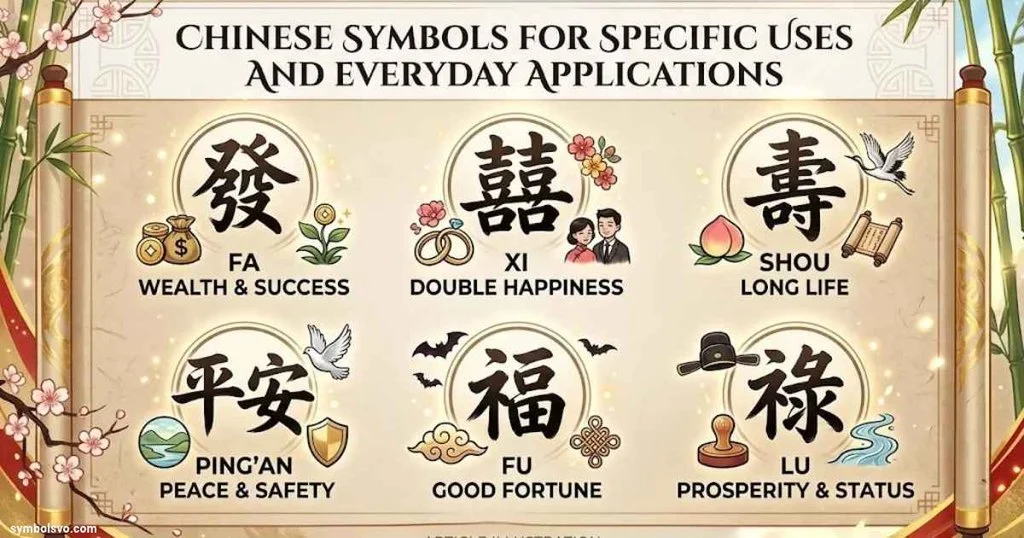
Chinese characters appear in many aspects of everyday life. People use them in names, business decorations, wedding celebrations, gifts, and traditional artwork.
Understanding their meanings helps you choose characters that communicate the right message.
Chinese Symbols for Names
Chinese names commonly combine characters with meaningful qualities, sounds, and family traditions.
Parents may select characters associated with wisdom, beauty, strength, happiness, or good fortune.
Some examples include:
| Chinese character | Pinyin | Meaning |
| 明 | míng | Brightness or clarity |
| 智 | zhì | Wisdom |
| 美 | měi | Beauty |
| 安 | ān | Peace and safety |
| 勇 | yǒng | Courage |
| 俊 | jùn | Handsome or talented |
| 雅 | yǎ | Elegance or refinement |
| 志 | zhì | Aspiration |
Chinese names require careful consideration because pronunciation, character combinations, and cultural associations all matter.
A direct translation of a foreign name doesn’t necessarily create a natural Chinese name. The appropriate characters should be selected with attention to sound and meaning.
Chinese Symbols for Business and Success
Traditional Chinese business decorations often feature characters associated with wealth, prosperity, and good fortune.
Common choices include:
- 福 – Fortune and blessings.
- 財 / 财 – Wealth and money.
- 旺 – Flourishing and thriving.
- 吉 – Good luck.
- 發 / 发 – Growth and development.
- 昌 – Prosperity and flourishing.
Business owners may display these characters during Lunar New Year or incorporate them into traditional decorative designs.
They communicate wishes for a successful business rather than guaranteeing financial results.
Chinese Symbols for Weddings
Chinese weddings traditionally use several auspicious characters and cultural images.
The Double Happiness symbol (囍) is particularly recognizable. It represents shared joy and wishes for a happy marriage.
Other popular wedding symbols include:
- 龍 / 龙 – Dragon.
- 鳳 / 凤 – Phoenix.
- 喜 – Happiness.
- 福 – Fortune and blessings.
- 和 – Harmony.
Dragon and phoenix imagery frequently appears together in traditional wedding decorations. The pairing represents a harmonious union and auspicious wishes for the couple.
Chinese Symbols for Home Decoration
Chinese characters and cultural motifs can add traditional meaning to home decorations.
Some popular choices include:
| Symbol | Meaning | Common decorative use |
| 福 | Fortune | Door decorations |
| 和 | Harmony | Wall artwork |
| 安 | Safety | Decorative calligraphy |
| 壽 / 寿 | Longevity | Birthday ornaments |
| 魚 / 鱼 | Abundance | Paintings |
| 竹 | Resilience | Wall art |
| 牡丹 | Wealth and honor | Traditional paintings |
Some people also incorporate these symbols into Feng Shui arrangements.
However, their traditional associations should not be confused with scientifically established effects on wealth, health, or personal success.
Chinese Symbols in Jewelry and Gifts
Chinese characters frequently appear in traditional jewelry and personalized gifts.
Jade pendants, bracelets, decorative ornaments, and carved accessories may feature characters associated with protection, longevity, and fortune.
Popular examples include:
- 福 for blessings and good fortune.
- 壽 for long life.
- 愛 for love.
- 平安 for peace and safety.
- 如意 for wishes coming true.
Jade also has a long cultural history in China. It has been associated with beauty, virtue, status, and traditional beliefs.
When buying personalized jewelry, make sure the character is written correctly and matches the intended meaning.
Frequently Asked Questions About Chinese Symbols and Their Meanings
What Are the Most Common Chinese Symbols and Their Meanings?
Some commonly recognized Chinese characters include 福 (fortune), 愛 (love), 喜 (happiness), 和 (harmony), 安 (safety), 力 (strength), 智 (wisdom), and 壽 (longevity).
Traditional cultural symbols include dragons, phoenixes, lotus flowers, bamboo, cranes, and Yin and Yang.
What Does the Chinese Symbol 福 Mean?
福 (fú) means fortune, blessings, and good luck. It is widely displayed during Lunar New Year celebrations and appears on traditional decorations, red paper ornaments, and household objects.
What Is the Chinese Symbol for Love?
愛 is the traditional Chinese character for love, while 爱 is its simplified form. Both have the same Mandarin pronunciation, ài, and represent affection or emotional attachment.
What Is the Chinese Character for Happiness?
喜 (xǐ) means happiness or joy. The decorative character 囍 represents Double Happiness and is especially associated with Chinese weddings.
What Does the Double Happiness Symbol Mean?
囍 represents shared happiness, marital joy, and blessings for a couple. It combines two 喜 characters and commonly appears on traditional wedding decorations.
What Is the Chinese Symbol for Good Luck?
福 (fú) is one of the most popular Chinese symbols associated with good fortune. Another character, 吉 (jí), means lucky or auspicious.
What Is the Chinese Symbol for Wealth?
財 (traditional) and 财 (simplified) mean wealth or money. 富 means richness or prosperity, while 旺 describes flourishing or thriving.
What Is the Chinese Symbol for Peace?
和平 (hépíng) is the Chinese word for peace. The individual character 和 represents harmony, while 安 communicates safety and peacefulness.
What Is the Chinese Symbol for Strength?
力 (lì) represents strength or force. 強 (traditional) and 强 (simplified) mean strong or powerful. 勇 (yǒng) represents courage and bravery.
What Is the Chinese Character for Courage?
勇 (yǒng) means courage or bravery. It appears in 勇敢 (yǒnggǎn), which means brave or courageous.
What Is the Chinese Symbol for Family?
家 (jiā) means family, home, or household. It appears in common expressions such as 家庭 (jiātíng), meaning family or household.
What Is the Chinese Character for Friendship?
友誼 (traditional) and 友谊 (simplified) mean friendship. The individual character 友 means friend.
What Is the Chinese Symbol for Longevity?
壽 (traditional) and 寿 (simplified) mean longevity or long life. They commonly appear on birthday decorations and traditional gifts.
What Is the Chinese Symbol for Health?
健康 (jiànkāng) means health or well-being. It combines 健, associated with being healthy or strong, and 康, associated with health.
What Does the Chinese Character 氣 Mean?
氣 (traditional) and 气 (simplified) are pronounced qì. The character can mean air or breath and represents vital energy in traditional Chinese philosophical and medical contexts.
What Is the Chinese Symbol for Hope?
希望 (xīwàng) means hope or expectation. The characters 希 and 望 contribute to this expression of looking forward to something positive.
What Is the Chinese Character for Wisdom?
智 (zhì) means wisdom or intelligence. 慧 (huì) also represents insight and understanding.
What Is the Chinese Symbol for Protection?
護 (traditional) and 护 (simplified) mean to protect or guard. 安 means safety and peace, while 守 means guarding or protecting.
What Does the Chinese Character 生 Mean?
生 (shēng) has several meanings, including life, birth, and growth. It appears in words such as 生命 (life), 生日 (birthday), and 生活 (daily life).
What Is the Chinese Symbol for Ambition?
志 (zhì) represents aspiration, ambition, and determination. It appears in 志向 (zhìxiàng), meaning ambition or aspiration.
What Is the Difference Between Traditional and Simplified Chinese Symbols?
Traditional characters preserve many historical written forms, while simplified characters reduce the strokes in many commonly used characters.
For example, 愛 is traditional and 爱 is simplified. Both mean love and have the same Mandarin pronunciation.
Are Chinese Symbols the Same as Japanese Kanji?
No. Japanese Kanji developed from Chinese characters, so many written forms look similar or identical. However, Japanese and Chinese use different pronunciations, grammar, and writing conventions.
How Do You Write Chinese Symbols Correctly?
Start by identifying the correct character and its meaning. Then learn its Pinyin pronunciation, stroke order, and traditional or simplified form. Use a reliable dictionary or a fluent Chinese speaker to verify unfamiliar characters.
Why Is the Chinese Fortune Symbol Displayed Upside Down?
People display 福 upside down because of a Mandarin wordplay. 倒 means upside down, while 到 means to arrive. Both are pronounced dào, creating the expression that good fortune has arrived.
What Do Chinese Symbols Mean in Tattoos?
Chinese tattoo characters often represent personal values such as love, courage, strength, wisdom, peace, and good fortune. Their meanings depend on the actual character or phrase. Always verify the translation before choosing a permanent design.
Conclusion: Understanding Chinese Symbols and Their Meanings
Chinese symbols offer a fascinating way to explore language, history, philosophy, and cultural traditions. Characters such as 愛, 福, 喜, 和, and 壽 communicate ideas that remain important in everyday Chinese life.
Traditional imagery adds another dimension. Dragons represent power and auspiciousness, phoenixes suggest renewal, and lotus flowers symbolize purity. Meanwhile, Yin and Yang illustrate the relationship between complementary forces.
Understanding these meanings requires more than memorizing translations. You should also consider pronunciation, character structure, historical context, and cultural usage.
If you’re exploring Chinese symbols for love, searching for good-luck characters, studying traditional calligraphy, or considering a meaningful tattoo, choosing accurate characters makes all the difference.

I’m Nathan Holloway, a passionate researcher and writer with a deep interest in symbols, signs, and their hidden meanings. I enjoy exploring how symbols have influenced different civilizations, religions, and modern communication. Through my work, I aim to make complex historical and cultural concepts easy to understand for readers of all backgrounds. Every article I write is carefully researched to provide reliable and engaging information.
Books:
- Beyond the Symbol
- The Secret Meanings of Everyday Signs
Author 2: Grace Whitmore
Description:
My name is Grace Whitmore, and I love discovering the stories behind the world’s most fascinating symbols. I spend my time researching ancient civilizations, mythology, spiritual traditions, and modern iconography to uncover the meanings people often overlook. I believe that every symbol has a history worth telling, and I enjoy sharing that knowledge in a simple and reader-friendly way.
Books:
- Echoes of Ancient Symbols
- The Symbolic World
 Mason Ellington
 Daniel Brooks