The phrase symbols instrument can refer to several things, from musical notation and percussion symbols to cymbal signs, instrument illustrations, and dashboard warning lights. People also search for small instrument symbols, hand signs, Chinese characters, and decorative music icons they can copy and use.
Musical instruments have their own sounds, shapes, names, and visual representations. For example, cymbals create bright crashing sounds, while musical notation uses special characters to represent notes, rhythms, and other instructions. Some symbols are part of standard Unicode, while others are illustrations or signs used in specific settings.
This guide explores cymbal instrument history, sounds, prices, drawings, and different categories of instrument-related symbols. You will also find useful information about musical symbols, percussion signs, Chevrolet Trailblazer dashboard indicators, and instrument names in different languages.
Symbols Instrument History
Musical instruments have a long history, and their symbols have developed alongside music itself. Early musicians used drawings, gestures, and written marks to communicate musical ideas. Over time, these visual representations became more organized.
Cymbals are among the oldest percussion instruments. Historical evidence suggests that cymbals existed in ancient civilizations thousands of years ago. They were used in religious ceremonies, celebrations, traditional performances, and military events.
Ancient cymbals were commonly made from metal, including bronze and other copper-based alloys. Different cultures developed their own shapes, sizes, and playing techniques.
How Instrument Symbols Developed
The development of musical symbols made it easier for musicians to read and perform music.
Some important stages include:
- Ancient music notation: Early systems used marks and signs to represent musical movements and sounds.
- Medieval notation: Written musical systems became more organized, helping musicians perform religious and classical music.
- Modern musical notation: Notes, rests, clefs, and other signs developed into the notation commonly used today.
- Digital symbols: Computers and smartphones introduced Unicode characters and emoji for representing music and instruments.
History of Cymbals
Cymbals became especially important in orchestral and percussion music. Their use expanded as musicians experimented with different sizes, thicknesses, and playing techniques.
During the development of modern drum kits, cymbals became essential components. Drummers began using hi-hats, crashes, rides, and other types to create different rhythms and accents.
Today, cymbals are used in rock, jazz, pop, classical, marching bands, and traditional music.
Cymbals Instrument Sound
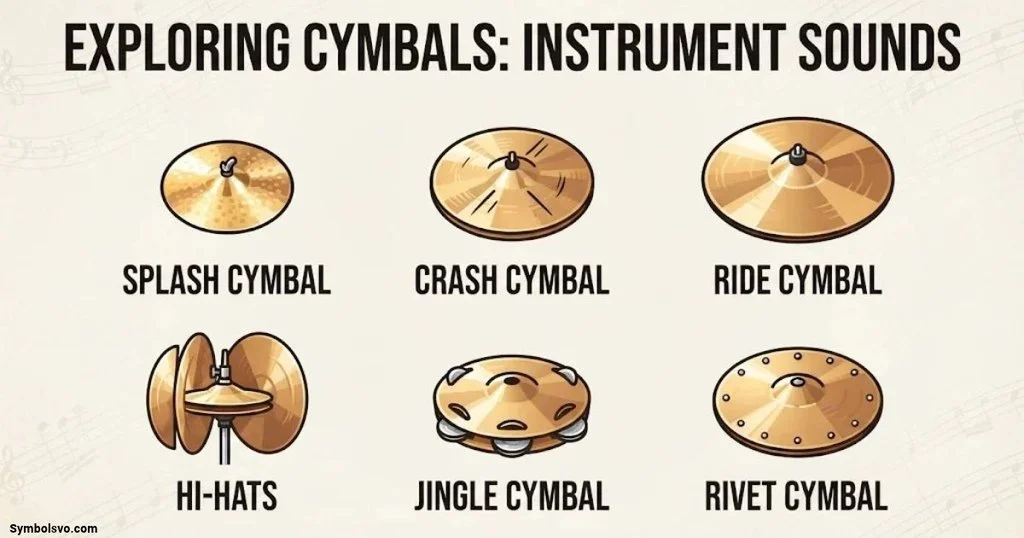
Cymbals produce sound when their metal surfaces vibrate after being struck, clashed, or otherwise played. Their sound can range from a short, sharp accent to a long, shimmering resonance.
Unlike many percussion instruments, cymbals do not usually produce one clearly defined musical pitch. Instead, they create complex combinations of frequencies that give them their distinctive metallic character.
Different Types of Cymbal Sounds
| Cymbal Type | Sound Characteristics |
| Crash cymbal | Loud, bright, explosive sound |
| Ride cymbal | Clear, steady ping with a sustained wash |
| Hi-hat | Sharp, controlled ticking or sizzling sound |
| Splash cymbal | Short, quick, bright accent |
| China cymbal | Aggressive, trashy, distinctive sound |
| Bell cymbal | Clear, focused metallic tone |
How Cymbals Produce Different Sounds
Several factors affect the sound of a cymbal:
- Size: Larger cymbals often produce a longer and fuller sound.
- Thickness: Thicker cymbals generally respond differently from thin cymbals and may produce a stronger attack.
- Material: Bronze and brass alloys create different tonal characteristics.
- Hammering: Hammer marks influence the cymbal’s vibration and tonal complexity.
- Playing technique: Hitting the edge, bow, or bell produces different sounds.
Common Cymbal Sound Descriptions
Here are some simple words used to describe cymbal sounds:
- Crash — A powerful, sudden sound.
- Ping — A clear and focused metallic note.
- Wash — A broad, sustained sound.
- Sizzle — A bright, shimmering sound.
- Choke — A sound quickly stopped by grabbing the cymbal.
These descriptions help drummers choose cymbals that match their musical style.
Cymbals Instrument Price
The price of a cymbal depends on its brand, size, material, construction, and sound quality. Beginner cymbals are generally more affordable, while professional models and complete cymbal sets can cost considerably more.
In Pakistan, cymbal prices vary between local music stores and online retailers.
Cymbal Prices in Pakistan
The following examples provide an idea of prices listed by Pakistani music retailers. These are indicative listing prices, not guaranteed market rates.
| Cymbal or Product | Listed Price (PKR) |
| Maxtone 10-inch Splash | Rs. 6,000 |
| Maxtone 12-inch Splash | Rs. 7,500 |
| Drum Kingdom 20-inch Ride | Rs. 17,500 |
| Zildjian ZBT 16-inch Crash | Rs. 26,000 |
| Zildjian ZBT 18-inch Crash | Rs. 27,500 |
| Sabian B8X 14-inch China | Rs. 28,000 |
| Sabian XSR 10-inch Splash | Rs. 32,000 |
| Sabian XSR Performance Set | Rs. 190,000 |
Prices and availability can change, and some products may be out of stock.
Pakistan Electronics & Music+1
What Affects Cymbal Prices?
Consider these factors before buying:
- Brand: Established manufacturers often charge more for their products.
- Material: Different bronze and brass alloys affect sound and price.
- Size: Larger cymbals may require more material and manufacturing work.
- Manufacturing quality: Hand-hammered and carefully finished cymbals can cost more.
- Product condition: Used cymbals may be cheaper, but cracks and keyholing can reduce their value.
Which Cymbal Should Beginners Buy?
Beginners do not need the most expensive cymbals. A practical starting setup usually includes:
- One pair of hi-hats.
- One crash cymbal.
- One ride cymbal.
Choose cymbals that sound good with your drum kit and fit your budget. Check for cracks, dents, and unusual damage before purchasing a used instrument.
Cymbal Instrument Drawing
A cymbal instrument drawing is a visual representation of a round metal percussion instrument. It is useful for school projects, music lessons, instrument identification, and art activities.
Most cymbal drawings show a circular metal plate with a raised center and a small mounting hole.
Simple Cymbal Drawing Guide
You can draw a basic cymbal by following these steps:
- Draw a large circle to represent the cymbal.
- Add a smaller circle near the center.
- Draw a small hole in the middle.
- Add curved lines around the surface to show its shape.
- Use light and dark shading to create a metallic appearance.
Different Cymbal Drawing Ideas
Some popular drawing styles include:
- Simple cymbal drawing: A basic outline with a raised center.
- Drum set drawing: Cymbals shown as part of a complete drum kit.
- Crash cymbal drawing: A cymbal with a slightly tilted position.
- Hi-hat drawing: Two cymbals arranged together on a stand.
- Cartoon cymbal drawing: A colorful and simplified design for children.
A labeled drawing can also help students understand the different parts of a cymbal, including its bow, bell, edge, and center hole.
Musical Symbols Instrument
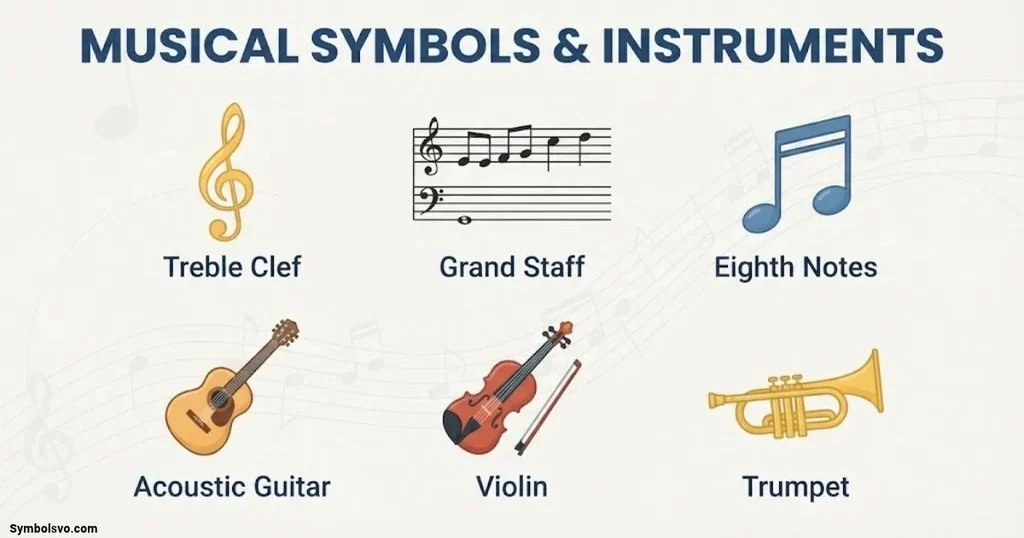
Musical symbols are visual characters used to communicate musical information. They represent notes, rhythms, pauses, pitch changes, and other instructions that help musicians perform compositions.
Some musical symbols are available as Unicode characters, while others are usually displayed through specialist music notation software.
Popular Musical Symbols To Copy
Here are some commonly used musical characters and emoji:
| Symbol | Name | Common Use |
| ♪ | Eighth Note | Musical notation and decoration |
| ♫ | Beamed Eighth Notes | Music-related text |
| ♬ | Beamed Sixteenth Notes | Musical decoration |
| ♩ | Quarter Note | Music notation |
| ♭ | Flat Sign | Lowers a note by a semitone |
| ♯ | Sharp Sign | Raises a note by a semitone |
| ♮ | Natural Sign | Cancels a sharp or flat |
| 𝄞 | G Clef | Indicates a pitch reference |
| 𝄢 | F Clef | Indicates a lower pitch reference |
| 🎵 | Musical Note Emoji | Music and entertainment |
| 🎶 | Multiple Musical Notes Emoji | Melody and musical mood |
| 🎼 | Musical Score Emoji | Written music |
Musical Instrument Emoji
You can also copy these instrument-related emoji:
- 🎹 — Musical keyboard.
- 🎸 — Guitar.
- 🎻 — Violin.
- 🎺 — Trumpet.
- 🎷 — Saxophone.
- 🥁 — Drum.
- 🪘 — Long drum.
- 🪇 — Maracas.
- 🪈 — Flute.
- 🎤 — Microphone.
- 🎧 — Headphones.
These characters are useful in social media posts, music profiles, messages, and decorative text.
One distinction is worth remembering: 🎵 and 🎶 are emoji, while ♪ and ♫ are traditional text musical symbols. Their appearance can vary between devices and applications.
Percussion Symbols Instrument
Percussion symbols represent instruments and playing techniques used to create rhythmic sounds. They are important in drum notation, orchestral scores, marching bands, and modern music production.
Percussion instruments include drums, cymbals, tambourines, bells, and many other sound-producing objects.
Common Percussion Instrument Symbols
Here are some copyable symbols and emoji associated with percussion:
| Symbol | Instrument or Representation |
| 🥁 | Drum |
| 🪘 | Long Drum |
| 🪇 | Maracas |
| ♩ | Quarter Note |
| ♪ | Eighth Note |
| ♫ | Beamed Eighth Notes |
| ♬ | Beamed Sixteenth Notes |
| 𝄽 | Quarter Rest |
| 𝄾 | Eighth Rest |
| 𝄿 | Sixteenth Rest |
Drum Notation Symbols
Drum notation uses different note positions and notehead shapes to represent individual instruments.
For example:
- Bass drum notes are commonly placed in the lower part of a percussion staff.
- Snare drum notes are usually assigned a separate position.
- Hi-hat notes often use an X-shaped notehead.
- Cymbal crashes may also use X-shaped noteheads.
The exact notation depends on the arrangement, notation software, and the conventions used by the composer.
A useful detail is that Unicode includes dedicated percussion-related musical characters, such as the drum clefs 𝄥 and 𝄦. These are notation characters rather than pictures of actual drums.
Cymbal Symbols Instrument
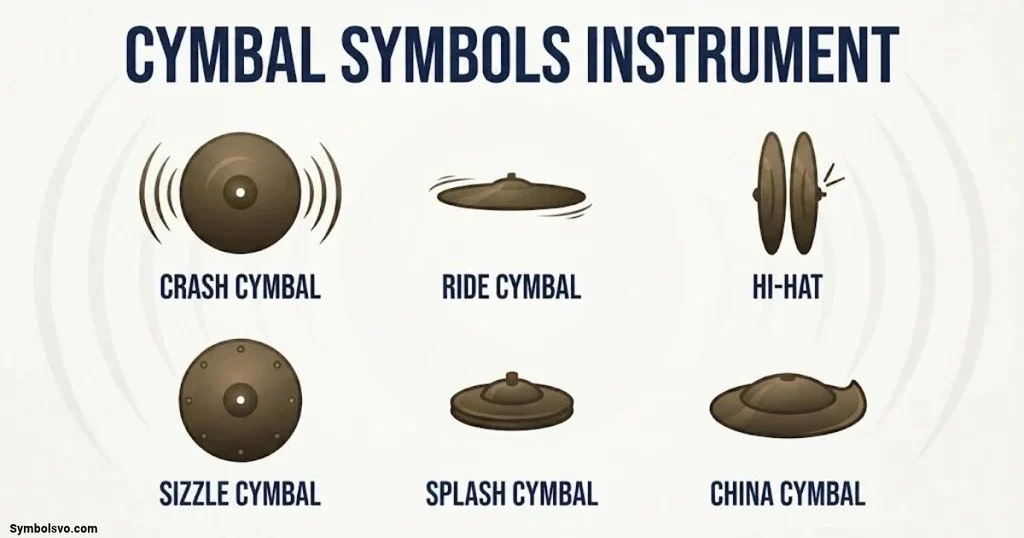
Cymbals are recognizable percussion instruments, but Unicode does not provide a dedicated standard emoji specifically representing a cymbal.
People often use drum, music, and sound-related symbols as alternatives when creating digital content about cymbals.
Cymbal-Related Symbols To Copy
Music and percussion symbols
🥁
🎵
🎶
♫
♪
♬
🎼
🔔
What These Symbols Represent
- 🥁 — A drum, commonly used to represent percussion music.
- 🎵 — A musical note.
- 🎶 — Multiple musical notes.
- ♫ — Beamed eighth notes.
- ♪ — An eighth note.
- ♬ — Beamed sixteenth notes.
- 🎼 — A musical score.
- 🔔 — A bell, useful for representing metallic sounds.
These symbols are suitable for music descriptions, drum lessons, social media captions, and decorative text.
If you are designing a professional cymbal chart or drum lesson, use an actual cymbal illustration or a notation symbol rather than suggesting that a music emoji is an official cymbal character.
Band Symbols Instrument
Band symbols help identify musical groups, instruments, and different sections of a performance. They are commonly used in school band announcements, marching band graphics, music posters, and social media profiles.
Different instruments have their own recognizable emoji and notation characters.
Popular Band Instrument Symbols
| Symbol | Instrument | Typical Band Role |
| 🎺 | Trumpet | Brass melody |
| 🎷 | Saxophone | Melody and harmony |
| 🎸 | Guitar | Rhythm and melody |
| 🎹 | Keyboard | Harmony and accompaniment |
| 🥁 | Drum | Rhythm |
| 🎻 | Violin | Melody and harmony |
| 🪈 | Flute | High-pitched melody |
| 🎼 | Musical Score | Written music |
Band Music Decorative Symbols
You can copy these characters for band names, descriptions, and music-related posts:
- ♫ Music
- ♪ Melody
- ♬ Rhythm
- 🎶 Musical performance
- 🎼 Musical score
- 🎤 Singing
- 🎧 Listening to music
- 🥁 Percussion
For example:
- 🎺 School Music Band
- 🥁 Drumline Performance
- 🎷 Jazz Band
- 🎸 Rock Music Group
- ♫ Live Music Tonight ♫
These combinations are decorative rather than official band notation.
Small Symbols Instrument
Small instrument symbols are useful when you want to add music-related designs without taking up much space. They work well in usernames, short captions, bios, messages, and compact designs.
Small Music Symbols To Copy And Paste
♪
Copy
♫
Copy
♬
Copy
♩
Copy
♭
Copy
♯
Copy
♮
Copy
🎵
Copy
🎶
Copy
🎺
Copy
🎸
Copy
🥁
Copy
🎻
Copy
🎷
Copy
🎹
Copy
🎼
Copy
Examples Of Small Decorative Text
You can combine different characters to create simple music-themed designs:
- ♫ Music Lover ♫
- ♪ My Favorite Song ♪
- 🎵 Music World 🎵
- ♬ Rhythm And Melody ♬
- 🥁 Drummer Life 🥁
- 🎸 Guitar Music 🎸
Small symbols are especially useful when you want a clean design that does not distract from the main text.
Kids Symbols Instrument
Instrument symbols can make music learning more interesting for children. Simple emoji, colorful illustrations, and easy-to-recognize characters help young learners connect instrument names with their appearance and sounds.
Musical Instrument Symbols For Kids
| Symbol | Instrument | Simple Description |
| 🥁 | Drum | Makes rhythmic sounds when struck |
| 🎸 | Guitar | Has strings that produce musical sounds |
| 🎹 | Piano | Uses keys to make different notes |
| 🎺 | Trumpet | A brass instrument played by blowing |
| 🎷 | Saxophone | A wind instrument with a reed |
| 🎻 | Violin | A string instrument played with a bow |
| 🪈 | Flute | Produces sound through moving air |
| 🪇 | Maracas | Makes a shaking sound |
Fun Music Symbols For Children
Children can also learn these basic musical characters:
- ♪ — Music note.
- ♫ — Two connected musical notes.
- ♩ — Quarter note.
- 🎵 — Musical note emoji.
- 🎶 — Multiple musical notes.
- 🎼 — Musical score.
Simple Activities Using Instrument Symbols
Parents and teachers can use these characters in different learning activities:
- Symbol matching: Ask children to match an instrument symbol with its correct name.
- Sound recognition: Play an instrument sound and ask children to identify the instrument.
- Drawing practice: Let children draw a drum, guitar, trumpet, or cymbal.
- Music worksheets: Use symbols to create simple matching exercises.
- Creative writing: Encourage children to make short music-themed sentences using emoji.
These activities make instrument learning more interactive and enjoyable.
Symbols Instrument Clipart
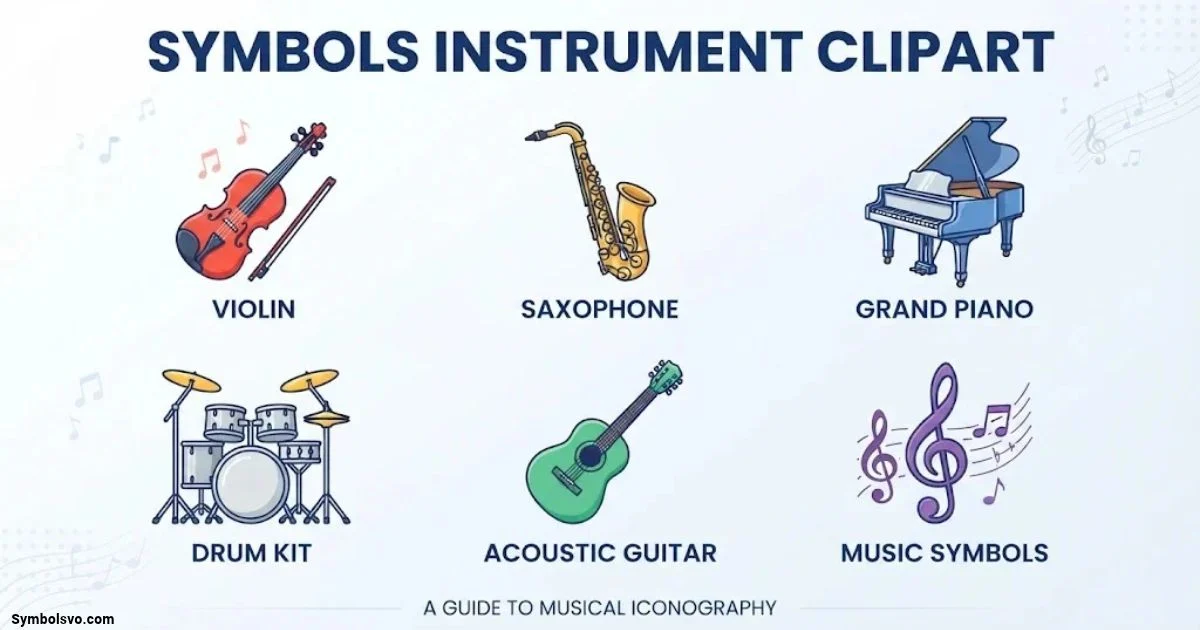
Instrument clipart refers to digital illustrations of musical instruments. These graphics are commonly used in educational worksheets, music posters, presentations, invitations, and creative designs.
Unlike Unicode characters, clipart images are graphic files. They can include detailed colors, shapes, textures, and realistic instrument designs.
Popular Instrument Clipart Categories
1. Percussion Instrument Clipart
- Drum set illustrations.
- Crash cymbal graphics.
- Hi-hat and ride cymbal drawings.
- Tambourine illustrations.
- Maracas and hand drum graphics.
2. String Instrument Clipart
- Guitar illustrations.
- Violin drawings.
- Cello graphics.
- Harp designs.
- Bass guitar illustrations.
3. Wind Instrument Clipart
- Trumpet graphics.
- Flute illustrations.
- Saxophone drawings.
- Clarinet designs.
- Trombone images.
4. Keyboard Instrument Clipart
- Piano illustrations.
- Electric keyboard graphics.
- Organ drawings.
- Digital music keyboard designs.
Where Can You Use Instrument Clipart?
Instrument clipart is useful for:
- School music assignments.
- Music teaching presentations.
- Children’s educational books.
- Music festival posters.
- Band announcements.
- Website designs.
- Printable worksheets.
When using clipart, check its license. Free access does not always mean that an image is free for commercial use.
Symbols Instrument Latest
New music-related designs and Unicode characters make it easier to express musical interests in digital communication. However, there is a difference between newly popular symbols, existing Unicode characters, and newly introduced emoji.
Here are some useful instrument-related characters and emoji for modern digital content.
Popular Instrument Emoji
| Symbol | Official Character Name |
| 🎹 | Musical Keyboard |
| 🎸 | Guitar |
| 🎻 | Violin |
| 🎺 | Trumpet |
| 🎷 | Saxophone |
| 🎤 | Microphone |
| 🎧 | Headphone |
| 🥁 | Drum |
| 🪘 | Long Drum |
| 🪇 | Maracas |
| 🪈 | Flute |
Modern Music Symbols For Social Media
Copy Popular Music Characters
🎵
Copy
🎶
Copy
🎼
Copy
🎤
Copy
🎧
Copy
🎹
Copy
🎸
Copy
🥁
Copy
🪘
Copy
🪇
Copy
🪈
Copy
♫
Copy
Are These Symbols New Unicode Characters?
Not necessarily. Some musical symbols have existed in Unicode for many years, while emoji have been added and expanded through different Unicode releases.
For example, the Unicode Musical Symbols block contains characters for clefs, notes, rests, and other notation elements. Its code point range is U+1D100 to U+1D1FF.
The musical instrument emoji and decorative music characters belong to different Unicode groups. They should not be treated as one single collection.
Symbols Instrument Panel Trailblazer
The instrument panel in a Chevrolet Trailblazer contains several symbols that communicate information about the vehicle. These indicators help drivers understand the status of important systems, identify potential problems, and operate vehicle features.
Some symbols are warning lights, while others simply show that a particular feature is active.
Common Chevrolet Trailblazer Dashboard Symbols
Here are examples of indicators found in Chevrolet Trailblazer documentation. Their availability and appearance can vary by model year and equipment.
| Symbol or Label | Meaning |
| ⛽ | Low Fuel |
| BRAKE | Brake System Warning |
| ABS | Antilock Brake System |
| 🛢️ | Engine Oil Pressure |
| 🔋 | Battery or Charging System |
| Check Engine | Engine or Emissions System Issue |
| PARK | Electric Parking Brake |
| Airbag | Airbag Readiness |
| Traction Control | Traction Control Status |
| Cruise Control | Cruise Control Status |
| Lane Keep Assist | Lane Assistance Status |
These are simplified text representations. The actual dashboard graphics may look different.
Understanding Dashboard Warning Colors
Red warning lights: These usually indicate a serious issue or condition requiring immediate attention. Examples include certain brake system and oil pressure warnings.
Yellow or amber lights: These commonly indicate a system fault, a disabled feature, or a condition that needs checking.
Green or blue lights: These generally show that a feature or vehicle function is active.
Important Trailblazer Dashboard Advice
If a warning light appears:
- Check the exact symbol displayed on the dashboard.
- Read the owner’s manual for your specific model year.
- Pay attention to any accompanying warning message.
- Stop safely if the warning indicates an urgent problem.
- Arrange professional inspection when required.
The Chevrolet Trailblazer owner’s manuals provide model-specific explanations of dashboard symbols and warning messages.
Car Symbols Instrument
Car instrument symbols are visual indicators displayed on a vehicle’s dashboard. They communicate information about the engine, brakes, battery, fuel, lighting, safety systems, and other vehicle functions.
Drivers should understand these symbols because some indicate normal operation, while others may signal a problem.
Common Car Dashboard Symbols
| Symbol | Meaning |
| ⛽ | Fuel Level |
| 🛢️ | Engine Oil Pressure |
| 🌡️ | Engine Temperature |
| 🔋 | Battery or Charging System |
| ABS | Antilock Braking System |
| (!) | Brake System Warning |
| 🚗 | Vehicle or Driving System Indicator |
| 🔑 | Key or Security System |
| 🚪 | Door Open |
| 🛞 | Tire Pressure Monitoring |
| 💡 | Lighting System |
| Seat Belt | Seat Belt Reminder |
These emoji and text labels are simplified representations, not exact universal dashboard graphics.
Important Types Of Car Symbols
Engine symbols: These indicate engine-related problems or maintenance requirements.
Brake symbols: These relate to the braking system, parking brake, and ABS.
Battery symbols: These can indicate a charging system problem.
Tire symbols: These commonly warn about low tire pressure or a tire monitoring system issue.
Safety symbols: These may relate to airbags, seat belts, traction control, or driver assistance features.
Lighting symbols: These indicate headlights, fog lights, high beams, and other lighting functions.
Why Do Dashboard Symbols Matter?
Dashboard indicators help drivers identify problems before they become more serious. Ignoring an important warning can lead to vehicle damage or unsafe driving conditions.
Always check the owner’s manual because the same-looking indicator can have different meanings across vehicle manufacturers and models.
Hand Symbols Instrument
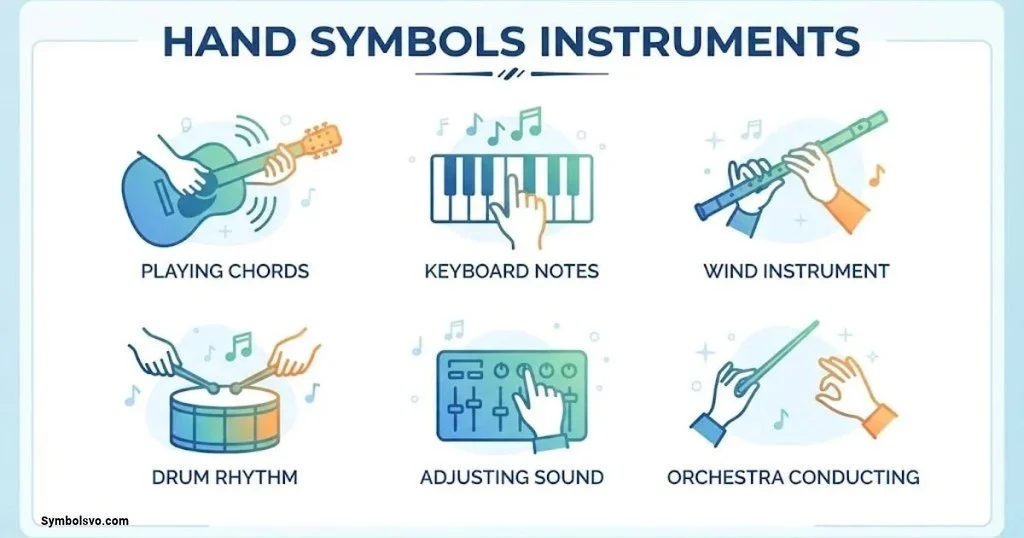
Hand symbols can represent musical gestures, rhythm instructions, and communication between musicians. They are especially useful in music education, conducting, and group performances.
Some hand gestures have specific musical meanings, while others are general visual signs used to communicate instructions.
Common Hand Symbols For Music
Here are some hand-related Unicode characters:
| Symbol | Unicode Name | Common Use |
| ☝ | Index Pointing Up | Pointing or indicating |
| 👆 | Backhand Index Pointing Up | Direction or emphasis |
| 👋 | Waving Hand | Greeting |
| 👏 | Clapping Hands | Applause |
| 🤘 | Sign of the Horns | Rock music association |
| ✌ | Victory Hand | Peace or victory |
| 🖐 | Hand with Fingers Splayed | General hand gesture |
| 🤚 | Raised Back of Hand | Hand gesture |
Musical Hand Gestures
Musicians also use hand movements to communicate without speaking.
Examples include:
- Conducting gestures: A conductor moves their hands to guide tempo, rhythm, and musical expression.
- Solfege hand signs: These gestures represent different scale degrees during music education.
- Count-in gestures: Musicians use fingers or hand movements to show when a performance should begin.
- Stop gestures: A conductor may use a clear hand movement to signal the end of a musical passage.
Rock Music Hand Symbol
The 🤘 emoji is commonly associated with rock and heavy metal culture. It is often used in concert captions, music profiles, and messages.
However, it should not be confused with 🤟, which represents the I Love You hand sign in American Sign Language.
These two symbols look similar but have different meanings.
Chinese Symbols Instrument
Chinese musical instruments have a rich history and are recognized by their unique shapes, sounds, and traditional designs. People searching for Chinese instrument symbols may want Chinese characters, instrument names, or decorative signs related to traditional music.
Chinese writing uses characters rather than an alphabet like English. Instrument names are therefore written using Chinese characters.
Chinese Musical Instrument Names
| Chinese Characters | Pinyin | English Name |
| 琵琶 | Pípá | Pipa |
| 古筝 | Gǔzhēng | Guzheng |
| 二胡 | Èrhú | Erhu |
| 笛子 | Dízi | Dizi Flute |
| 扬琴 | Yángqín | Yangqin |
| 锣 | Luó | Gong |
| 鼓 | Gǔ | Drum |
| 编钟 | Biānzhōng | Chinese Bell Chimes |
Traditional Chinese Musical Instruments
1. Pipa (琵琶)
The pipa is a traditional Chinese plucked string instrument. It has a pear-shaped body and is played using the fingers or picks.
2. Guzheng (古筝)
The guzheng is a traditional Chinese zither with multiple strings. It produces a rich sound and is commonly used in traditional Chinese music.
3. Erhu (二胡)
The erhu is a two-stringed bowed instrument. It is known for its expressive sound.
4. Dizi (笛子)
The dizi is a traditional Chinese bamboo flute. It is used in many forms of Chinese music.
5. Gong (锣)
The gong is a metal percussion instrument that produces a strong, resonant sound when struck.
Chinese Music Characters For Copying
- 音乐 — Music.
- 乐器 — Musical instrument.
- 鼓 — Drum.
- 锣 — Gong.
- 琵琶 — Pipa.
- 古筝 — Guzheng.
- 二胡 — Erhu.
These are Chinese words and instrument names, not Unicode emoji specifically designed for musical instruments.
Symbols Instrument In Spanish

If you are looking for the Spanish translation of musical instrument names and symbols, several useful words can help you understand music-related content.
The English word instrument translates to instrumento in Spanish. The word cymbal is commonly translated as platillo.
Musical Instrument Names In Spanish
| English | Spanish |
| Musical Instrument | Instrumento musical |
| Cymbal | Platillo |
| Drum | Tambor |
| Guitar | Guitarra |
| Piano | Piano |
| Violin | Violín |
| Trumpet | Trompeta |
| Saxophone | Saxofón |
| Flute | Flauta |
| Keyboard | Teclado |
| Bell | Campana |
| Music | Música |
Spanish Words For Cymbal Types
| English | Spanish |
| Crash Cymbal | Platillo crash |
| Ride Cymbal | Platillo ride |
| Splash Cymbal | Platillo splash |
| Hi-Hat | Charles |
| China Cymbal | Platillo china |
Some instrument names are commonly retained in English in music shops and among musicians, so terminology can vary by country and context.
Spanish Music Symbols
You can also use these characters in Spanish music-related messages:
- ♪ Música
- ♫ Canción
- 🎵 Nota musical
- 🎶 Notas musicales
- 🥁 Tambor
- 🎸 Guitarra
- 🎹 Piano
- 🎺 Trompeta
For example:
Me encanta la música. 🎵
Meaning: I love music.
Toco la batería. 🥁
Meaning: I play the drums.
Frequently Asked Questions
What Is The Symbol For A Cymbal Instrument?
There is no dedicated standard Unicode emoji specifically for a cymbal. The drum emoji 🥁 and musical symbols such as ♪ and ♫ are common alternatives for representing percussion and music.
What Are The Most Common Musical Symbols?
Some commonly used musical symbols include ♪ (eighth note), ♫ (beamed eighth notes), ♩ (quarter note), ♭ (flat), ♯ (sharp), and ♮ (natural). Each has a different purpose in musical notation.
How Much Does A Cymbal Cost In Pakistan?
Cymbal prices in Pakistan depend on the brand, size, material, and quality. Entry-level examples can cost several thousand rupees, while professional cymbals and complete sets can cost considerably more.
What Does The Cymbal Sound Like?
A cymbal usually produces a bright, metallic, shimmering sound. Depending on its type and playing technique, it can create a short accent, a sharp crash, or a long-lasting musical wash.
What Is The Difference Between A Musical Symbol And An Instrument Emoji?
A musical symbol represents notation, such as a note, rest, or clef. An instrument emoji represents an instrument or music-related object, such as a guitar 🎸, drum 🥁, or piano 🎹.
Conclusion
Instrument symbols can represent different aspects of music, from traditional musical notation and percussion signs to instrument emoji and decorative characters. Cymbals are an important part of percussion music, producing distinctive sounds in many musical styles. Understanding their history, types, and prices can also help musicians choose the right equipment.
Digital symbols make it easier to discuss instruments and music online. Characters such as ♪, ♫, 🎵, 🥁, and 🎸 can be used in messages, social media profiles, educational activities, and creative designs. Chinese instrument names and Spanish translations also make music-related information accessible to a wider audience.
Remember that not every instrument has its own dedicated Unicode symbol. Some characters represent musical notation, while others are emoji or decorative alternatives. Choose the correct symbol for your purpose, and check your vehicle’s owner’s manual when searching for dashboard indicators.

Mason Ellington is a creative and dedicated Content Writer and Symbols Expert with a passion for words, communication, and symbolic meanings. He specializes in crafting engaging, informative, and well-structured content while exploring the deeper meanings and interpretations behind symbols. With a creative mindset and attention to detail, Mason transforms ideas into meaningful content that informs, inspires, and connects with readers. His expertise combines powerful storytelling, clear communication, and a deep understanding of symbolism.
 Daniel Brooks
 Nathan Holloway