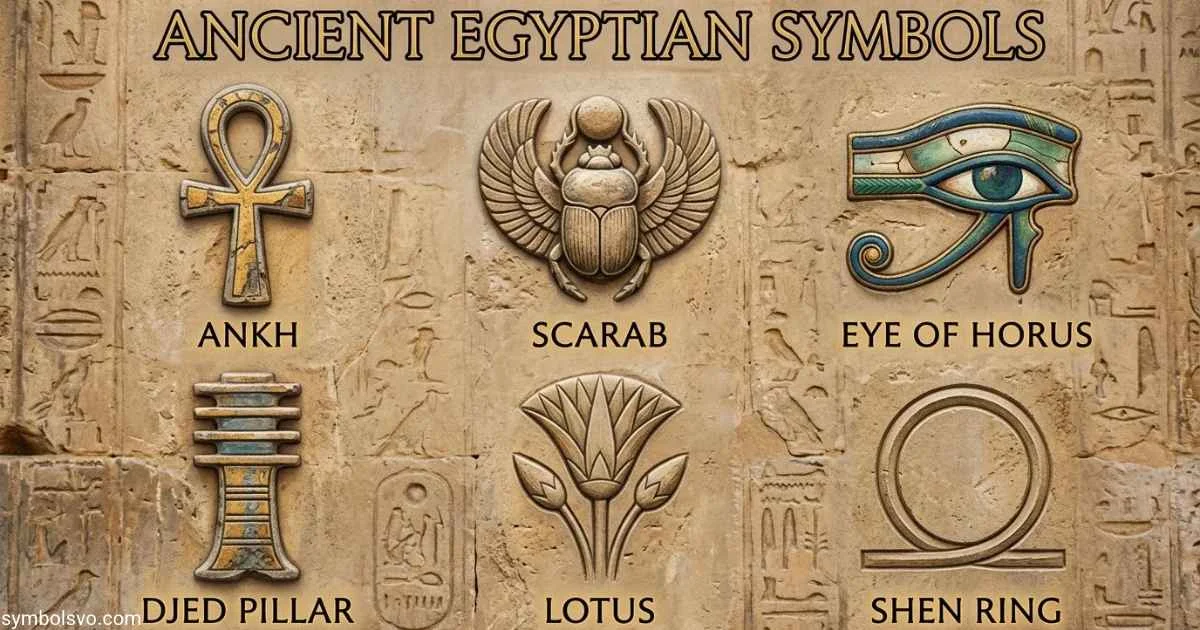
Ancient Egyptian symbols reveal how one of history’s most fascinating civilizations understood life, death, nature, and divine power. From the famous ankh to the mysterious Eye of Horus, these signs appeared on temple walls, royal crowns, jewelry, tombs, and sacred objects. Each carried meanings shaped by religion, mythology, politics, and daily life.
Some ancient Egyptian symbols represented life and protection. Others expressed royal authority, stability, rebirth, or the hope of continued existence after death. Many also connected people with particular gods and goddesses, including Ra, Horus, Osiris, Isis, and Anubis.
However, Egyptian symbolism wasn’t a simple code in which every image had one fixed meaning. A symbol’s significance could change with its setting, historical period, and relationship to other images.
This guide explores more than 50 Egyptian symbols and their meanings, explains their historical background, and shows how ancient Egyptians used them in writing, religious ceremonies, royal art, and funerary traditions.
What Are Ancient Egyptian Symbols?
Ancient Egyptian symbols were signs, images, objects, and artistic motifs that communicated ideas about religion, nature, kingship, and human existence. Egyptians used them for thousands of years, adapting familiar images to express complex beliefs.
You can find these symbols carved into stone temples, painted on coffins, engraved on jewelry, and written in hieroglyphic inscriptions. Some appeared as small protective amulets, while others decorated enormous monuments.
The meaning depended on the symbol itself and the context in which artists or scribes used it.
For example, the ankh represented life and frequently appeared in the hands of Egyptian gods. The djed pillar expressed stability and became closely associated with Osiris. Meanwhile, the Eye of Horus represented a restored eye and carried associations with protection, healing, and wholeness. Museums preserve examples of these symbols on objects dating back thousands of years.
Egyptian Symbols vs. Hieroglyphs
Although people often use the terms interchangeably, Egyptian symbols and Egyptian hieroglyphs aren’t exactly the same thing.
Hieroglyphs formed a writing system. Their signs could represent individual consonants, combinations of consonants, complete words, or semantic categories that helped clarify meaning. Egyptian artists also used images symbolically without necessarily employing them as written words.
Consider these differences:
| Feature | Egyptian symbols | Egyptian hieroglyphs |
| Main purpose | Communicate ideas, beliefs, or associations | Record language through a writing system |
| Examples | Royal crowns, ritual objects, sacred imagery | Phonetic signs, word signs, determinatives |
| Common locations | Jewelry, temples, statues, tombs | Inscriptions, monuments, coffins, papyri |
| Possible meanings | Life, authority, protection, renewal | Sounds, words, and categories of meaning |
A single image could serve more than one purpose. The ankh, for instance, was both a hieroglyphic sign meaning life and a recognizable symbol used in religious art.
This overlap makes Egyptian iconography especially interesting. To understand an image correctly, you need to consider whether it functions as writing, religious imagery, a royal emblem, or a combination of these.
Ankh — The Egyptian Symbol of Life

The Ankh is one of the most recognizable Egyptian symbols of life. It resembles a cross with a loop at the top and represents life, living, and continued existence.
Egyptian gods frequently hold an ankh in temple reliefs and tomb paintings. In some scenes, a deity extends it toward a pharaoh as a sign of divine life. Egyptians also included the sign in jewelry, amulets, and funerary objects.
Main meaning: Life, vitality, and continued existence.
The ankh’s exact original shape remains debated, but its written meaning is clear. It wasn’t simply a decorative cross. Its connection to life made it an important part of Egyptian religious imagery. The British Museum’s guide to pharaonic symbols explains its role in royal and divine scenes.
Eye of Horus (Wedjat) — Protection and Healing
The Eye of Horus, also called the Wedjat, represents the restored eye of Horus, a falcon-associated god. Egyptian mythology tells how Horus’s eye suffered injury during a conflict involving Seth and was subsequently restored.
This story connected the eye with healing, wholeness, protection, and renewal. Egyptians wore Wedjat amulets during life and placed them among funerary objects.
Main meaning: Protection, healing, restoration, and well-being.
The Wedjat was more than a popular decorative design. Archaeological objects show that Egyptians used eye-shaped amulets in real burial contexts. The Metropolitan Museum of Art documents a New Kingdom amulet and explains its connection to the restored eye and protection. Read its Wedjat Eye Amulet entry.
Eye of Ra — Solar Power and Divine Authority
The Eye of Ra represents the power of the sun god Ra. Egyptian mythology sometimes presents this divine eye as a force that protects the gods and king or punishes threats to cosmic order.
The eye could appear through different goddesses, including Sekhmet and other solar deities, depending on the myth and period.
Main meaning: Solar power, divine authority, and protection.
Although the Eye of Ra and Eye of Horus look similar in some artistic traditions, they aren’t interchangeable. Their mythological associations differ, and context matters when identifying either symbol.
Djed Pillar — Stability and Endurance
The Djed Pillar resembles a sturdy column with several horizontal bars near its top. It represents stability, endurance, and lasting strength.
The symbol became closely associated with Osiris, the god linked to resurrection and the afterlife. Egyptians used djed-shaped amulets and depicted the sign in funerary art.
Main meaning: Stability, endurance, and lasting existence.
The djed also appeared in a ritual known as the raising of the djed, which expressed the restoration of stability. The British Museum records a djed amulet from Egypt’s 26th Dynasty, dating to around 600 BCE or later. Its museum entry explains its connection to endurance and stability.
Scarab Beetle — Rebirth and Renewal
The scarab beetle became an important symbol of renewal because Egyptians associated the beetle’s behavior with the sun’s daily journey across the sky.
The god Khepri, often depicted as a scarab or a human with a scarab head, represented becoming and solar renewal. Scarab amulets appeared in jewelry, seals, and funerary objects.
Main meaning: Rebirth, transformation, and renewal.
Some scarabs carried hieroglyphs or protective designs on their undersides. Others served as seals. Heart scarabs had a specific funerary role, connecting the beetle’s symbolism with beliefs about judgment and continued existence after death.
Tyet — The Knot of Isis
The Tyet, commonly called the Knot of Isis, resembles a tied knot with loops and hanging ends. It is associated with Isis and appears in protective and funerary contexts.
The symbol’s association with Isis connects it to divine care and protection. Tyet amulets were sometimes made from red materials, reflecting particular ritual associations.
Main meaning: Protection and association with Isis.
The Tyet resembles the ankh in some ways, but the two signs have different forms and meanings. The ankh is the well-established sign for life, while the Tyet is particularly connected with Isis and protective practices.
Was Scepter — Power and Dominion
The Was Scepter is a long staff with a distinctive animal-shaped top and a forked base. It represents power, dominion, and authority in Egyptian religious and royal imagery.
Gods frequently carry Was scepters in temple reliefs. The staff also appears alongside the ankh and djed in combinations expressing life, stability, and authority.
Main meaning: Power, dominion, and authority.
These combinations show how Egyptians could join several ideas in one composition. The Metropolitan Museum documents an object combining ankh, djed, and was signs, linking them with life, stability, and dominion. See its combined-symbol artifact.
Shen Ring — Eternity and Protection
The Shen Ring is a loop of rope shaped into a circle, often with a short extension. Its circular form conveyed completeness and the idea of encircling or safeguarding something.
Shen rings appeared in royal and divine imagery. The elongated form surrounding a royal name developed into the cartouche.
Main meaning: Protection, completeness, and enduring existence.
The British Museum explains that the cartouche developed from the shen ring and served as an enclosure around a king or queen’s name. Its cartouche guide provides a helpful introduction.
Sa Sign — Protection and Well-Being
The Sa sign is a protective emblem associated with safety and well-being. Its shape appears in Egyptian art and in objects linked to protection.
Protective signs often worked alongside images of gods, sacred animals, and other amulets. Their meanings depended on the object and its setting.
Main meaning: Protection and safety.
Nefer — Beauty and Goodness
The Nefer sign is associated with goodness, beauty, and perfection. Its recognizable form combines elements that resemble a heart and windpipe, although its precise historical origin is debated.
Egyptians used nefer in words, personal names, and inscriptions. The name Nefertiti, for example, is commonly translated as “the beautiful one has come.”
Main meaning: Beauty, goodness, and excellence.
Nefer is also a useful reminder that hieroglyphic signs could function as writing, not just as independent symbols. Its role depends on the word or inscription in which it appears.
Feather of Ma’at — Truth and Cosmic Order
The Feather of Ma’at represents truth, justice, balance, and proper order. Ma’at was both a goddess and a central principle of Egyptian life.
In funerary scenes, the deceased person’s heart is weighed against the feather. The scene expresses the belief that a person’s conduct mattered in the judgment after death.
Main meaning: Truth, justice, balance, and cosmic order.
Ma’at’s significance extended beyond the afterlife. Egyptian kings were expected to uphold proper order, while ordinary people encountered the concept through ideas about fairness, responsibility, and social harmony.
Akhet — The Horizon
The Akhet sign depicts the sun between two forms representing the horizon. It connects the landscape with the sun’s appearance and disappearance.
Solar imagery played a major role in Egyptian creation traditions and ideas about daily renewal. The horizon sign could appear in inscriptions and architectural or religious contexts.
Main meaning: Horizon, solar movement, and renewal.
Akhet also appears in ancient Egyptian place names, including Akhetaten, the city established by Akhenaten during the Amarna period. Its meaning therefore depends on whether it appears as a hieroglyph, part of a name, or a broader solar image.
Benben Stone — Creation and the Primordial Mound
The Benben Stone belongs to Egyptian creation traditions associated with Heliopolis. It was connected with the primordial mound that emerged from the original waters.
This image of land rising from water offered a powerful way to express the beginning of creation. Benben traditions also relate to solar worship and later interpretations of pyramid-shaped sacred forms.
Main meaning: Creation, emergence, and solar associations.
The Benben shouldn’t be treated as a universal name for every Egyptian pyramid or pyramid capstone. Its historical significance comes from particular religious traditions.
Lotus or Water Lily — Renewal and Creation
The lotus or water lily appears throughout Egyptian art. Its opening and closing cycle connected it with renewal, while its appearance in creation imagery linked it with emerging life.
Egyptian artists placed aquatic flowers in tomb paintings, decorative scenes, offerings, and representations of feasting.
Main meaning: Renewal, creation, and flourishing life.
The plant is also associated with Upper Egypt in symbolic representations. The British Museum’s pharaonic symbols guide discusses the relationship between the lotus, renewal, and regional identity.
Wadj Sign and Papyrus Column — Freshness and Flourishing Life
The Wadj sign is connected with the papyrus plant and ideas of freshness and flourishing vegetation. Papyrus grew in the Nile region and became an important material for writing.
Papyrus motifs also appeared in temple columns and decorative art. Together with lotus imagery, they could represent the plants of Egypt’s contrasting regions.
Main meaning: Freshness, vegetation, and flourishing life.
Sun Disk — Solar Divinity
The Sun Disk represents the visible sun and its divine associations. It appears in images of Ra and other solar deities, often as a circular disk above a deity’s head.
Solar imagery connected daily sunrise and sunset with creation, renewal, royal authority, and divine power.
Main meaning: Solar divinity, creation, and renewal.
The Aten, a solar disk emphasized during Akhenaten’s reign, is a more specific religious form. Its rays ending in hands appear in Amarna-period art, sometimes extending the ankh toward the royal family.
Winged Sun Disk — Divine Protection and Kingship
The Winged Sun Disk combines a sun disk with extended wings, sometimes accompanied by cobras. It frequently appears above temple entrances, royal names, and sacred scenes.
The image conveys solar power and protection. Its placement over doorways or inscriptions could reinforce the protective character of the setting.
Main meaning: Solar power, protection, and royal authority.
Cartouche — Royal Names and Protection
A Cartouche is an elongated oval enclosing a royal name in hieroglyphic inscriptions. It helped distinguish the ruler’s name from surrounding text.
Cartouches are especially useful to Egyptologists because they can help identify pharaohs and establish the context of monuments and artifacts.
Main meaning: Royal identity and protection.
The cartouche grew from the shen ring, whose circular form represented encirclement. By enclosing a royal name, it expressed the ruler’s special status and symbolic relationship to the world.
Serekh — The Pharaoh’s Royal Name
The Serekh is a rectangular frame decorated like a palace facade, often with a falcon of Horus above it. It enclosed the king’s Horus name.
The serekh belongs to an early tradition of royal representation and differs from the later, more familiar cartouche.
Main meaning: Royal identity and kingship.
Uraeus — The Royal Cobra
The Uraeus is the upright cobra that appears on many royal crowns and headdresses. It is associated with Wadjet and the protection of the pharaoh.
In royal imagery, the cobra could express the ruler’s divine protection and readiness to confront threats. Its raised posture made it a striking emblem of kingship.
Main meaning: Royal protection and authority.
White Crown (Hedjet) — Upper Egypt
The White Crown, or Hedjet, is the tall, narrow crown associated with Upper Egypt. It appears in royal reliefs, statues, and ceremonial imagery.
Egyptian royal crowns communicated political identity as well as status. The White Crown represented one of the two major regions traditionally united under the pharaoh.
Main meaning: Upper Egypt and royal authority.
Red Crown (Deshret) — Lower Egypt
The Red Crown, or Deshret, is associated with Lower Egypt. Its distinctive form includes a raised rear section and a projecting coil.
Like the White Crown, it identified a major region of the ancient Egyptian kingdom. The two crowns appear together in representations of unified kingship.
Main meaning: Lower Egypt and regional royal authority.
Double Crown (Pschent) — Unified Egypt
The Double Crown, traditionally called the Pschent, combines the Red Crown and White Crown.
It expresses the pharaoh’s rule over Upper and Lower Egypt. Its imagery connects kingship with the political unity of the Two Lands.
Main meaning: Unified Egypt and royal sovereignty.
Atef Crown — Osiris and Divine Kingship
The Atef Crown combines a central crown with tall feathers on either side. It is closely associated with Osiris and appears in divine and royal imagery.
Its distinctive form helps identify certain representations of Osiris and related religious scenes.
Main meaning: Osiris, divine authority, and funerary associations.
Khepresh (Blue Crown) — Royal Regalia
The Khepresh, often called the Blue Crown, is a royal headdress frequently shown with patterned decoration.
It appears in scenes of kingship, ceremonies, and military activity. Its exact use varied across depictions, so it shouldn’t be described simply as a battle helmet.
Main meaning: Royal status and ceremonial authority.
Nemes Headcloth — The Pharaoh’s Headdress
The Nemes Headcloth is a striped, pleated cloth that frames the pharaoh’s face and hangs down on either side of the chest.
It is familiar from royal statues and the Great Sphinx of Giza. Unlike a crown, the nemes is a royal headdress.
Main meaning: Pharaoh’s identity and royal status.
Crook and Flail — Kingship and Authority
The Crook and Flail are two ceremonial objects frequently held across a pharaoh’s chest. The crook resembles a shepherd’s staff, while the flail has a handle with hanging elements.
They appear in royal imagery and in representations of Osiris. Their combination communicates authority and the responsibilities associated with rulership.
Main meaning: Kingship, authority, and ceremonial power.
Sedge and Bee — The Two Lands
The Sedge and Bee appear in royal titulary. The sedge represents Upper Egypt, while the bee represents Lower Egypt in the royal title associated with rule over both regions.
Together, they express the pharaoh’s authority over the Two Lands.
Main meaning: Political unity and royal sovereignty.
A limestone stela in the British Museum illustrates this arrangement alongside royal cartouches and protective imagery. See the stela of Amenhotep.
Sema-Tawy — Unification of Upper and Lower Egypt
The Sema-Tawy motif depicts plants representing Upper and Lower Egypt tied together around a central form.
Artists used this image to express the union of the Two Lands. It appears in royal and architectural settings where national unity mattered.
Main meaning: Unity and the joining of Egypt’s two regions.
Ka Sign — Vital Essence
The Ka is a vital aspect of a person’s existence in ancient Egyptian religious thought. Its hieroglyph resembles two raised arms.
The ka was closely connected with life and offerings. Funerary rituals helped sustain the deceased’s existence, including through food and drink offerings.
Main meaning: Vital essence and continued existence.
Ba Bird — Individual Identity and Mobility
The Ba is often depicted as a bird with a human head. It represented an important aspect of a person’s identity and was associated with movement between different states of existence.
Egyptian funerary texts and images show the ba in connection with the deceased and the afterlife.
Main meaning: Individual identity and spiritual mobility.
The ba wasn’t exactly the same as the modern Western idea of a soul. Egyptian beliefs described different aspects of existence, and each had its own role.
Akh — The Transformed Spirit
The Akh describes a transformed and effective spiritual state associated with Egyptian afterlife beliefs.
It is often discussed alongside the ka and ba, although these terms refer to different concepts rather than interchangeable versions of a single soul.
Main meaning: Transformed existence and spiritual effectiveness.
Heart (Ib) — Thought and Moral Judgment
The Ib, or heart, held a central place in Egyptian ideas about thought, character, memory, and moral judgment.
In funerary scenes, the heart is weighed against the Feather of Ma’at. The result determines whether the deceased can proceed toward a blessed afterlife.
Main meaning: Character, thought, and moral judgment.
Heh — Vastness and Eternity
Heh is associated with vastness and enormous spans of time. The deity often appears holding palm-rib signs linked to years.
Egyptian art used this imagery to express long duration and enduring existence, especially in royal and divine contexts.
Main meaning: Vastness, long duration, and eternity.
Canopic Jars — Protection of the Deceased
Canopic jars held organs removed during mummification. Egyptians associated them with funerary protection and the preservation of the deceased.
The Four Sons of Horus were linked with the jars and the protection of particular organs. Their images and functions developed across Egyptian history.
Main meaning: Funerary preservation and protection.
The four sons are Imsety, Hapy, Duamutef, and Qebehsenuef. They are commonly associated with the liver, lungs, stomach, and intestines, respectively.
Sistrum — Music and Hathor
The Sistrum is a ritual rattle used in Egyptian religious ceremonies. It is strongly associated with Hathor and appears in scenes involving temple music and worship.
Its sound formed part of religious performance, so its significance came from its practical ceremonial use as well as its artistic appearance.
Main meaning: Ritual music and devotion to deities, especially Hathor.
Menat — Ritual Necklace and Counterpoise
The Menat was a necklace with a distinctive counterpoise at the back. It appears in religious imagery associated with Hathor and ceremonial music.
Menat objects could serve as ritual equipment and offerings, linking jewelry with religious practice.
Main meaning: Hathor worship and ritual use.
The British Museum’s menat-counterpoise amulet illustrates the close relationship between Hathor imagery, ritual objects, and royal inscriptions.
Falcon — Horus and Kingship
The Falcon is closely associated with Horus, a god connected with the sky and kingship. Falcon imagery appears in temple reliefs, royal inscriptions, and statues.
The bird’s elevated position in Egyptian art made it a powerful image of divine and royal authority.
Main meaning: Horus, kingship, and sky-related divinity.
Vulture and Cobra — Royal Protection
The Vulture and Cobra represent two important protective goddesses: Nekhbet and Wadjet. Nekhbet was associated with Upper Egypt, while Wadjet was associated with Lower Egypt.
Their images could appear together on royal crowns and in scenes of divine protection.
Main meaning: Royal protection and the Two Lands.
Jackal and Anubis — Funerary Protection
Anubis is commonly depicted with a jackal’s head. He was associated with embalming, mummification, and the protection of the dead.
Jackal imagery is especially familiar from tomb art and funerary objects. It reflects the importance of proper burial and the safeguarding of the deceased.
Main meaning: Embalming and funerary protection.
Ibis — Thoth and Wisdom
The Ibis is associated with Thoth, a god connected with writing, knowledge, calculation, and wisdom.
Thoth appears in myths, temple scenes, and funerary imagery. The ibis also became the subject of animal mummification and religious offerings.
Main meaning: Writing, knowledge, and wisdom.
Cat — Bastet and Household Protection
The Cat is strongly associated with Bastet, a goddess connected with domestic life and protection. Cats also appear in everyday scenes and religious objects.
Egyptian attitudes toward cats changed and varied with context. Not every cat image represented Bastet, and not every depiction carried the same religious meaning.
Main meaning: Household associations and protection through Bastet.
Lioness — Sekhmet and Solar Power
The Lioness is closely associated with Sekhmet, a powerful goddess connected with solar force, warfare, and healing.
Her image shows that Egyptian deities could represent both danger and protection. The same divine power that threatened enemies could also restore order.
Main meaning: Solar power, strength, and protection.
Cow Horns and Sun Disk — Hathor
The Cow Horns and Sun Disk are familiar features of Hathor’s imagery. Hathor was associated with motherhood, music, joy, and divine nourishment.
The motif also appears in the imagery of other goddesses in certain contexts. Its meaning should therefore be interpreted alongside the deity and scene.
Main meaning: Hathor, nourishment, and divine power.
Frog — Heqet and Birth
The Frog is associated with Heqet, a goddess connected with childbirth and birth-related protection.
Frog imagery also appears in Egyptian creation traditions. Its association with fertility and renewal made it meaningful in religious and amuletic contexts.
Main meaning: Birth, fertility, and renewal.
Taweret — Pregnancy and Household Safety
Taweret is a protective goddess commonly shown with a hippopotamus-like body and features of other animals.
Her imagery is closely connected with pregnancy, childbirth, and household safety. Small figures and amulets helped bring this protective deity into domestic life.
Main meaning: Pregnancy, childbirth, and family protection.
Bes — Protection of Children and Families
Bes is a protective deity often shown with a broad face and a front-facing body. His imagery appears on household objects and items connected with personal care.
Bes was associated with children, family life, and protection from harmful forces. Unlike many Egyptian figures shown in profile, he frequently faces the viewer.
Main meaning: Household protection and family well-being.
Benu Bird — Creation and Renewal
The Benu Bird appears in Egyptian creation and solar traditions. It is commonly depicted as a long-legged bird and is associated with cycles of renewal.
The Benu has connections to later Greek traditions about the phoenix, but the two shouldn’t be treated as identical in every detail.
Main meaning: Creation, solar renewal, and cyclical existence.
Ouroboros — Cycles and Renewal
The Ouroboros depicts a serpent forming a circle by biting its own tail. In some later Egyptian religious contexts, it expressed cyclical time, enclosure, and renewal.
Its use should be understood within its historical setting rather than assumed to have been equally common throughout all Egyptian periods.
Main meaning: Cycles, enclosure, and renewal.
Tree of Life — Sacred Trees and Continued Existence
Trees held important places in Egyptian religious imagery. Certain sacred trees were associated with nourishment, divine care, and the continued well-being of the deceased.
The phrase Tree of Life is a broad modern label, not the name of one universal Egyptian hieroglyph with a single fixed meaning.
Main meaning: Nourishment, divine care, and continued existence in specific contexts.
Egyptian Symbols by Meaning
Some readers recognize a symbol but don’t know its name. Others know what they want to express, such as life, protection, strength, or renewal, and need to identify the right symbol.
The following table brings the main Egyptian symbols and their meanings together for quick reference.
| Meaning or theme | Egyptian symbols | Historical association |
| Life | Ankh | Life and continued existence |
| Protection | Eye of Horus, Tyet, Sa sign | Protective and religious practices |
| Healing | Eye of Horus | Restoration and wholeness |
| Stability | Djed pillar | Endurance and Osiris |
| Rebirth | Scarab, Benu bird | Renewal and creation traditions |
| Solar power | Eye of Ra, Sun Disk | Ra and other solar deities |
| Royal authority | Was scepter, Uraeus | Kingship and divine power |
| Unity | Double Crown, Sema-Tawy | Upper and Lower Egypt |
| Truth and justice | Feather of Ma’at | Cosmic order and moral judgment |
| Fertility and birth | Frog, Heqet, Taweret | Birth and family protection |
| Writing and wisdom | Ibis, Thoth | Knowledge and written language |
| Funerary protection | Heart scarab, canopic jars | Burial and afterlife beliefs |
| Eternal existence | Shen ring, Heh | Enclosure and long duration |
These categories are useful starting points, not strict rules. For example, the scarab can relate to renewal and protection, while the djed can appear in both royal and funerary contexts.
Egyptian Symbols of Life and Eternal Existence
The ankh is the clearest starting point when exploring Egyptian symbols of life. It appears in divine imagery and inscriptions where gods offer life to rulers.
The ka, ba, and akh add more depth to this theme. They represent different aspects of existence in Egyptian religious thought. Rather than treating them as three words for the soul, it’s more accurate to understand them as distinct concepts that worked together within Egyptian beliefs about life and death.
The djed pillar also belongs in this group because of its connection with stability and enduring existence.
Egyptian Symbols of Protection and Healing
The Eye of Horus is particularly important because it represents a restored eye. Its association with healing and wholeness made it suitable for protective amulets.
The Tyet, Sa sign, Shen ring, and Uraeus provide other examples of protective imagery. These signs didn’t all serve the same purpose. Some appeared in personal amulets, while others belonged to royal or divine representations.
Ancient Egyptians also used materials, inscriptions, and ritual practices alongside protective imagery. An amulet’s significance could depend on its shape, material, location, and associated text.
Egyptian Symbols of Rebirth and Renewal
The scarab beetle offers one of the best examples of Egyptian ideas about renewal. Its association with Khepri connected the beetle with the sun’s daily cycle.
The Benu bird, lotus or water lily, and Akhet sign also relate to creation or solar renewal in particular contexts. These symbols reflect a worldview in which recurring natural events could express larger religious ideas.
The symbolism wasn’t limited to a single idea of rebirth. It could concern daily solar renewal, the emergence of life, or the deceased person’s hoped-for transformation after death.
Egyptian Symbols of Power and Royal Authority
Royal imagery communicated the pharaoh’s status and responsibilities. The Was scepter represented dominion, while the Uraeus signaled royal protection.
Crowns were especially important because they connected the ruler with the regions of Egypt. The White Crown represented Upper Egypt, the Red Crown represented Lower Egypt, and the Double Crown combined the two.
The crook and flail, cartouche, and serekh added further layers of royal identity. Together, these images helped communicate kingship in temples, monuments, and royal objects.
Egyptian Symbols of Truth and Justice
The Feather of Ma’at is closely associated with truth, justice, and proper order. Ma’at was more than a goddess in Egyptian religion; the concept also expressed the order that sustained the world.
The weighing-of-the-heart scene brings these ideas together. In funerary art, the deceased’s heart is weighed against Ma’at’s feather, representing judgment based on the person’s moral standing.
This imagery shows that Egyptian religious symbolism could express ethical ideas as well as divine power.
Egyptian Symbols of Fertility and Birth
The frog and Heqet, Taweret, and Bes are useful examples of imagery associated with birth and household protection.
Heqet was connected with childbirth, Taweret protected such as pregnant people and families, and Bes guarded domestic life. Their imagery appeared in religious objects and settings connected with everyday concerns.
These symbols help reveal a side of ancient Egyptian religion beyond monumental temples and royal tombs. People also sought divine care in their homes and family lives.
Egyptian Hieroglyphs vs. Egyptian Symbols: How the Writing System Worked

Understanding Egyptian hieroglyphics helps explain why not every Egyptian image should be read as a standalone symbol.
Hieroglyphs formed a writing system capable of recording names, prayers, royal titles, historical events, and religious texts. Scribes combined different types of signs to communicate language.
The British Museum’s guide to decipherment explains how Egyptian writing used sound signs alongside signs representing words. See its resource on hieroglyphs and the decipherment of ancient Egyptian writing.
Phonograms, Logograms, and Determinatives
Egyptian writing included several important sign types.
- Phonograms: Signs representing one or more consonant sounds.
- Logograms: Signs representing complete words or concepts.
- Determinatives: Signs that helped clarify a word’s meaning without necessarily being pronounced.
Egyptologists also classify phonograms as uniliteral, biliteral, or triliteral signs, depending on whether they represent one, two, or three consonants.
Egyptian writing wasn’t simply an alphabet like the modern English alphabet. It combined phonetic signs with word signs and meaning-related markers.
Did Ancient Egyptian Hieroglyphs Have Vowels?
Egyptian hieroglyphic writing generally recorded consonants rather than spelling vowels in the way English does. Egyptologists therefore use scholarly transliteration conventions to represent Egyptian words.
When modern readers encounter familiar spellings such as Anubis or Osiris, they’re seeing conventional forms used to identify ancient names. Those spellings don’t always reproduce the original Egyptian pronunciation exactly.
How Do You Read Egyptian Hieroglyphs?
Reading hieroglyphs requires attention to the direction of the signs and their arrangement.
Figures of people and animals often face toward the beginning of the text. Readers use these orientations to determine whether an inscription runs from left to right or right to left. Signs can also be arranged in balanced groups rather than in a simple straight line.
A cartouche can make a royal name easier to identify, but translating a complete inscription requires more than recognizing individual pictures.
Hieroglyphs, Hieratic, and Demotic
Egyptians used related writing systems for different purposes.
| Writing system | Main characteristics |
| Hieroglyphic | Formal signs used in monumental and religious inscriptions |
| Hieratic | A cursive script used for many documents and religious texts |
| Demotic | A later cursive script used for a wide range of practical and literary purposes |
These scripts belong to the history of Egyptian writing. They’re not separate collections of religious symbols.
It’s also inaccurate to call ancient Egyptian hieroglyphs Egyptian runes. Runes belong to different writing traditions and aren’t the historical name for Egyptian signs.
Eye of Horus vs. Eye of Ra: What’s the Difference?
The Eye of Horus and Eye of Ra are often confused because both connect an eye with divine power. Their mythological roles, however, differ.
| Feature | Eye of Horus | Eye of Ra |
| Main association | Horus | Ra |
| Common themes | Healing, wholeness, protection | Solar power, authority, protection |
| Mythological context | The injured and restored eye of Horus | The active power of the sun god |
| Common imagery | Wedjat eye amulets | Solar eye imagery and associated goddesses |
The Eye of Horus became particularly associated with restoration after the mythological injury and healing of the god’s eye. The Eye of Ra, by contrast, could represent the sun god’s active force, including protective or destructive power.
Neither symbol has to mean exactly the same thing in every image. Look at the surrounding deities, inscriptions, and objects before assigning a specific interpretation.
Ankh vs. Djed Pillar: Life vs. Stability
The ankh and djed pillar often appear together, but they express different ideas.
The ankh represents life, while the djed pillar represents stability and endurance. The djed is closely associated with Osiris, whereas the ankh frequently appears as a sign carried or offered by deities.
| Feature | Ankh | Djed pillar |
| Shape | Cross-like form with a loop | Pillar with horizontal bars |
| Main meaning | Life | Stability and endurance |
| Religious association | Life-giving divine power | Osiris and lasting stability |
| Typical contexts | Temple art, jewelry, inscriptions | Amulets, funerary imagery, ritual scenes |
Their combination shows how Egyptian artists could place related concepts together without making them identical. Life and stability supported a broader idea of continued existence.
Ka vs. Ba vs. Akh: Three Egyptian Concepts
The ka, ba, and akh are important when exploring Egyptian beliefs about human existence and the afterlife.
| Concept | General explanation | Common representation or context |
| Ka | A vital aspect of a person’s existence | Offerings and funerary practices |
| Ba | An aspect of individual identity associated with mobility | Often shown as a human-headed bird |
| Akh | A transformed and effective spiritual state | Afterlife beliefs and funerary texts |
These descriptions provide a starting point, but they don’t capture every detail of a religious system that changed over many centuries.
The important distinction is that Egyptians didn’t necessarily view a person as having one simple, indivisible spiritual identity. Their beliefs included several related aspects of existence, each with its own significance.
How Ancient Egyptians Used Symbols in Daily and Religious Life

Egyptian symbols weren’t limited to temple walls. They appeared in personal objects, royal regalia, funerary equipment, and written documents.
Their use helps explain how religion, government, and everyday concerns overlapped in ancient Egyptian society.
Symbols on Amulets and Jewelry
Egyptian amulets were small objects that people wore or placed with the dead. Egyptians believed these objects could provide protection or transfer particular qualities to their owners.
Common examples included:
- The ankh, associated with life.
- The Eye of Horus, associated with healing and protection.
- The scarab, associated with renewal.
- The djed pillar, associated with stability.
- The Tyet, associated with Isis and protection.
Archaeological finds show that some amulets were grouped together and worn on the body. The Metropolitan Museum documents Wedjat amulets found among burial objects, demonstrating their use in actual funerary contexts.
Materials mattered, too. Egyptian amulets could be made from stone, faience, metal, and other substances. Their shape, color, inscription, and placement could contribute to their intended purpose.
Symbols in Temples and Religious Ceremonies
Egyptian temples featured deities, sacred animals, protective signs, and royal inscriptions. These images helped communicate relationships between the gods, the pharaoh, and the order of the world.
The sistrum, for example, was a real musical instrument used in religious ceremonies. The winged sun disk could appear above sacred entrances, while the ankh and Was scepter frequently appeared in divine imagery.
Temple decoration wasn’t merely ornamental. Its placement and subject matter formed part of a larger religious environment.
Symbols in Tombs and Funerary Art
Funerary symbolism helped express Egyptian beliefs about death and continued existence. Tombs and coffins could feature protective deities, hieroglyphic texts, and images connected with resurrection.
The heart scarab is a particularly useful example. It was associated with the heart’s role in judgment after death. Canopic jars, meanwhile, formed part of the equipment used to preserve the deceased’s organs during mummification.
The Book of the Dead contained spells and instructions intended to assist the deceased in the afterlife. It wasn’t one identical book owned by every Egyptian. Its contents varied across manuscripts and periods.
Symbols on Pharaohs and Royal Monuments
Royal art used a recognizable visual language to establish a ruler’s identity and authority.
The Uraeus, royal crowns, Nemes headcloth, crook and flail, cartouche, and serekh all played different roles in this system. Some identified a king’s name, others communicated regional authority, and still others expressed divine protection.
The combination of symbols could convey more than any single emblem alone.
Symbols in Egyptian Writing
Hieroglyphs recorded royal names, religious texts, administrative information, and many other forms of language. Some signs also had symbolic importance beyond their function in a sentence.
A cartouche, for example, both encloses a royal name and carries associations with kingship. The ankh can represent the word for life while also appearing in religious art as a sign of life-giving power.
This is why historians examine both the linguistic and visual context of an Egyptian inscription.
Egyptian Symbols in Modern Culture

Today, Egyptian symbols appear in jewelry, artwork, fashion, books, museums, and popular media. Their distinctive shapes make them recognizable, but their modern meanings don’t always match their ancient uses.
The ankh, Eye of Horus, scarab, and cartouche remain especially popular. Some people appreciate their historical significance, while others choose them for personal reasons.
Understanding the original context helps you distinguish documented ancient meanings from modern interpretations.
Ancient Egyptian Symbols for Tattoos
If you’re researching Egyptian symbols for tattoos, start by understanding the historical meaning of each design rather than choosing an image based only on its appearance.
| Symbol | Historical association | What to understand before choosing it |
| Ankh | Life and continued existence | It was a hieroglyph and a religious symbol |
| Eye of Horus | Healing, restoration, protection | It relates to a specific mythological tradition |
| Scarab | Becoming and renewal | It connects with Khepri and solar imagery |
| Djed pillar | Stability and endurance | It has strong associations with Osiris |
| Cartouche | Royal names and protection | It traditionally encloses a royal name |
| Feather of Ma’at | Truth, justice, and order | It relates to a major Egyptian religious principle |
| Tyet | Isis and protective practices | It isn’t simply another version of the ankh |
One important distinction: Modern tattoo meanings often simplify ancient Egyptian beliefs. For instance, describing the Eye of Horus as a universal sign of good luck leaves out its mythological connection with a restored eye.
If you want to use hieroglyphs to represent a personal name, don’t rely on a decorative alphabet chart alone. Accurate writing requires understanding Egyptian sounds, transliteration, and the conventions used to represent names.
Egyptian Symbols Copy and Paste
Some readers search for Egyptian symbols copy and paste options to use in messages, documents, usernames, or designs.
Unicode includes characters for many Egyptian hieroglyphs. However, displaying them correctly depends on the font, operating system, and application. A character may appear differently across devices or show as an empty box when the required font isn’t available.
Keep these points in mind:
- A hieroglyph character represents a particular sign, not necessarily an entire word or sentence.
- A sequence of copied hieroglyphs isn’t automatically a correct translation.
- Decorative combinations may look authentic without forming meaningful Egyptian writing.
- Names require careful transliteration rather than a simple one-letter-for-one-symbol substitution.
For reliable research, the Unicode Standard provides information about character encoding, while museum collections offer historical examples of how hieroglyphs appeared on real objects.
Frequently Asked Questions About Egyptian Symbols
What Is the Most Famous Ancient Egyptian Symbol?
The ankh is one of the most widely recognized ancient Egyptian symbols. Its looped cross shape and association with life make it particularly familiar in jewelry, art, and popular culture.
The Eye of Horus is another widely recognized symbol, especially in discussions of protection and healing.
What Is the Egyptian Symbol for Life?
The ankh is the best-known Egyptian symbol for life. It also functioned as a hieroglyphic sign meaning life or to live.
Egyptian gods frequently carry the ankh in temple reliefs and other religious imagery. The sign can express both earthly life and continued existence.
What Is the Egyptian Symbol for Protection?
The Eye of Horus, Tyet, Sa sign, Shen ring, and Uraeus all have protective associations.
Their uses differed. The Eye of Horus appeared on personal amulets, while the Uraeus frequently appeared on royal crowns. The best interpretation depends on the object and its historical context.
What Is the Egyptian Symbol for Rebirth?
The scarab beetle is strongly associated with renewal and rebirth. Its connection with Khepri linked it to the sun’s daily movement and the idea of becoming.
The lotus or water lily and Benu bird also have associations with renewal and creation in particular Egyptian traditions.
What Is the Egyptian Symbol for Healing?
The Eye of Horus, also called the Wedjat, is one of the clearest examples of an Egyptian symbol associated with healing.
Its meaning comes from the myth of Horus’s injured and restored eye. Egyptians used Wedjat amulets for protection and well-being.
What Is the Egyptian Symbol for Strength?
There isn’t one universal Egyptian symbol that means strength in every context. The Was scepter represents power and dominion, while the djed pillar is associated with stability and endurance.
The appropriate symbol depends on whether you mean physical power, royal authority, or lasting stability.
What Is the Egyptian Symbol for Immortality?
Ancient Egyptian beliefs about continued existence involved several symbols and religious concepts rather than one universal sign of immortality.
The ankh represents life, the djed pillar relates to stability and endurance, and the scarab connects with renewal. These associations overlap with afterlife beliefs, but they aren’t identical.
What Is the Difference Between the Eye of Horus and the Eye of Ra?
The Eye of Horus is closely associated with restoration, healing, and protection following the mythological injury of Horus’s eye.
The Eye of Ra represents the solar god’s power and can express protection, authority, or destructive force. Although their images can resemble one another, their mythological associations differ.
Were Egyptian Hieroglyphs an Alphabet?
No. Egyptian hieroglyphic writing wasn’t simply an alphabet. It used signs representing individual consonants, combinations of consonants, complete words, and semantic categories.
Some hieroglyphs functioned phonetically, while others helped convey meaning. Scribes combined these signs to write the ancient Egyptian language.
How Many Ancient Egyptian Hieroglyphs Were There?
The number depends on the historical period and the sign list being counted. Hundreds of signs were used in the writing system, and the available repertoire expanded over time.
Formal monumental inscriptions and more specialized texts could use different ranges of signs. There isn’t one fixed number that accurately describes every period of Egyptian writing.
Are Egyptian Symbols and Hieroglyphs the Same Thing?
Not exactly. Hieroglyphs are signs within an Egyptian writing system, while Egyptian symbols include a broader range of religious images, royal emblems, objects, and visual motifs.
Some hieroglyphs also functioned as symbols. The ankh is a good example because it represented the word for life and appeared as a religious emblem.
Is There an Ancient Egyptian Symbol for Love?
Ancient Egyptians expressed love and affection through poetry, personal objects, religious imagery, and other cultural practices. However, there’s no single universally accepted ancient Egyptian symbol that represents love in every context.
Modern sources sometimes assign fixed romantic meanings to Egyptian signs without sufficient historical evidence. Check the original context before accepting such claims.
What Do Egyptian Gods and Goddesses Symbolize?
Egyptian deities were associated with different forces, roles, and aspects of existence.
| Deity | Common associations |
| Ra | Sun and solar power |
| Horus | Sky and kingship |
| Osiris | Afterlife and resurrection |
| Isis | Magic, protection, and motherhood |
| Anubis | Embalming and funerary practices |
| Thoth | Writing and knowledge |
| Ma’at | Truth, justice, and cosmic order |
| Hathor | Music, motherhood, and joy |
| Sekhmet | Solar power, warfare, and healing |
| Taweret | Pregnancy and household protection |
These are broad associations, not complete definitions of each deity. Egyptian gods could take on different roles across myths, regions, and historical periods.
Conclusion: Understanding Ancient Egyptian Symbols
Ancient Egyptian symbols offer a window into a civilization that connected religion, government, nature, and human existence through a rich visual language.
The ankh represented life. The Eye of Horus expressed restoration and protection. The djed pillar conveyed stability, while the scarab connected with renewal. Royal crowns, cartouches, and scepters communicated authority, and the Feather of Ma’at expressed truth and cosmic order.
Yet the meaning of any Egyptian symbol depends on more than its shape. Its historical period, associated deity, placement, inscription, and intended use can all change how historians interpret it.
When exploring ancient Egyptian symbols and their meanings, look beyond simple definitions. The objects preserved in museums, the inscriptions carved into temples, and the images painted in tombs reveal how these symbols worked within real religious and social practices.
That’s what makes them so fascinating: they aren’t just striking designs from the ancient world. They’re clues to how ancient Egyptians understood their lives, their rulers, their gods, and the world beyond death.

Mason Ellington is a creative and dedicated Content Writer and Symbols Expert with a passion for words, communication, and symbolic meanings. He specializes in crafting engaging, informative, and well-structured content while exploring the deeper meanings and interpretations behind symbols. With a creative mindset and attention to detail, Mason transforms ideas into meaningful content that informs, inspires, and connects with readers. His expertise combines powerful storytelling, clear communication, and a deep understanding of symbolism.
 Nathan Holloway
 Daniel Brooks