
Family symbols express something words sometimes struggle to capture: love, belonging, loyalty, protection, and the connections that carry through generations. A simple heart can represent affection, while a tree with spreading branches can tell a deeper story about family roots and shared history.
Whether you’re looking for a meaningful family symbol, researching cultural traditions, or exploring ideas for jewelry, artwork, or a personalized design, understanding each symbol’s meaning helps you make a thoughtful choice.
Some symbols have well-documented historical or religious significance. Others, such as infinity signs and linked circles, have become popular ways to express family relationships in modern designs. Their meanings can also change depending on personal experiences and cultural context.
This guide explores 35 symbols for family, explains what they represent, and shows how you can choose one that reflects your family’s story.
What Are Family Symbols?
Family symbols are images, objects, patterns, or emblems that represent relationships between family members. They can express affection, shared identity, ancestry, protection, spiritual beliefs, or memories that connect generations.
Some symbols have a long cultural history. Others gain meaning through personal experiences. For example, a family tree can represent documented ancestry, while a simple circle might symbolize togetherness because its continuous shape has no obvious beginning or end.
People use family symbols in many ways, including:
- Jewelry: Pendants, rings, bracelets, and engraved keepsakes.
- Artwork: Family portraits, wall decorations, and personalized emblems.
- Tattoos: Designs representing relatives, shared experiences, or family values.
- Heritage projects: Family trees, historical records, and ancestral displays.
- Religious items: Symbols that express shared faith and spiritual traditions.
- Memorials: Designs that honor loved ones and preserve their memory.
The important distinction is that not every meaningful family symbol originated as a symbol of family. A heart is widely associated with love, for instance, but a particular knot or animal may have different meanings in different traditions. Understanding that difference makes it easier to choose a symbol that genuinely fits your intentions.
Symbols for Family and Their Meanings
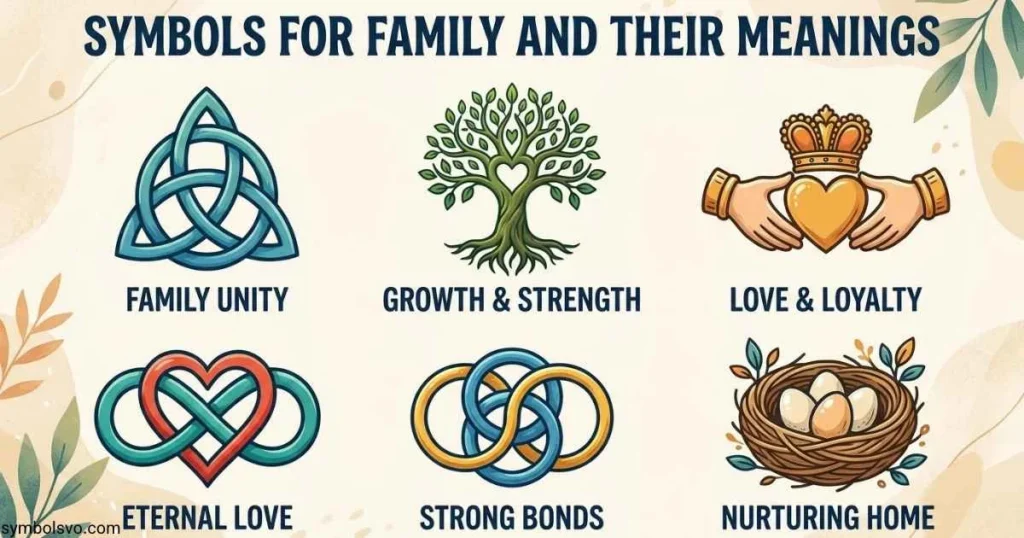
The following symbols represent different aspects of family life, from affection and unity to ancestry and cultural heritage. Some have established historical associations, while others are modern interpretations that people use to express personal connections.
Tree of Life — Family Growth and Generational Connection
The Tree of Life is one of the most recognizable symbols used to represent family, growth, and connection across generations. Its roots reach into the ground while its branches spread outward, creating a natural picture of how individual lives grow from shared beginnings.
In a family design, the roots can represent ancestors and heritage. The trunk may symbolize the present generation, while the branches represent children, grandchildren, and future descendants.
The Tree of Life also appears in several cultural and religious traditions, although its meanings differ between them. The familiar Celtic-inspired version is especially popular in modern jewelry and artwork. Its exact circular design shouldn’t automatically be described as an unchanged ancient Celtic emblem.
Best for: Family heritage artwork, meaningful gifts, pendants, and designs celebrating several generations.
Family Tree — Ancestry and Family Roots
A family tree represents biological or recorded relationships between relatives across generations. Unlike the broader spiritual symbolism of the Tree of Life, a genealogical family tree often includes actual names, dates, marriages, and relationships.
Its branching structure makes complicated family histories easier to understand. Grandparents appear in earlier generations, parents connect to their children, and the branches continue as descendants grow.
Families also use family trees to preserve photographs, stories, migration histories, and important traditions. The result becomes more than a decorative symbol; it can serve as a record of where a family came from and how its members are connected.
Best for: Genealogy projects, family reunion displays, ancestry books, and personalized wall art.
Heart — Family Love and Affection
The heart is a familiar symbol of love, affection, compassion, and emotional connection. Although its associations extend beyond family relationships, its simple shape makes it a natural choice for expressing care between parents, children, siblings, and other loved ones.
A single heart can represent the family as a whole. Several hearts can stand for individual relatives, especially when each one includes a name, initial, or meaningful date.
Heart designs also work well when you want something recognizable without relying on a specific cultural or religious tradition. Their meaning comes partly from their widespread association with affection and partly from the memories attached to the design.
Best for: Family gifts, greeting cards, necklaces, and simple personal artwork.
Infinity Symbol — Lasting Family Bonds
The infinity symbol looks like a sideways figure eight. In mathematics, it represents the idea of something without a finite limit. In personal designs, people often interpret its continuous loop as a sign of lasting love and enduring connection.
For families, the infinity symbol can represent relationships that remain meaningful through distance, change, and the passing of time. Combined with a heart, it emphasizes affection. Combined with initials, it creates a more personal design.
Its family meaning is primarily a modern symbolic interpretation rather than a traditional emblem belonging to one particular culture.
Best for: Personalized necklaces, matching family artwork, and designs celebrating lifelong relationships.
Celtic Knot — Interconnection and Continuity
Celtic knotwork features interlaced lines that weave over and under one another. It appears in historical Insular art, including medieval manuscripts, stone carvings, and metalwork.
The interwoven structure has made Celtic knots popular modern symbols of connection, continuity, and enduring relationships. For a family, the pattern can suggest that individual lives remain linked through shared history and experience.
However, there isn’t one universal Celtic knot that historically meant family. Modern designs often assign personal meanings to particular patterns, so it’s worth distinguishing those interpretations from documented historical uses.
Best for: Celtic-inspired jewelry, heritage artwork, and designs representing interconnected relationships.
Circle — Unity and Wholeness
A circle has no obvious beginning or end. This simple feature makes it a common visual metaphor for unity, wholeness, and continuity.
In family artwork, a circle can represent a group of people connected by shared values and affection. Some designs place several names inside a ring, while others arrange small symbols around a central point.
Its meaning depends on how the circle is used. A circle can represent many things beyond family, but it offers a clean and flexible way to communicate togetherness.
Best for: Family logos, wall art, minimalist illustrations, and personalized emblems.
Linked Circles — Relationships and Family Connection
Linked circles represent relationships through a simple visual arrangement. Each circle can stand for an individual, while the overlapping or connected areas suggest the relationships that bring those individuals together.
A design with three circles might represent three family members. Four circles could represent four relatives, and a larger arrangement could include grandparents, parents, children, or an extended family.
There is no universal historical meaning attached to every linked-circle design. Their strength lies in their adaptability: you can create a symbol around the actual people and relationships that matter to you.
Best for: Personalized family emblems, modern artwork, and simple visual representations of family groups.
Intertwined Hearts — Shared Love and Emotional Bonds
Intertwined hearts combine the familiar meaning of the heart with the idea of two lives closely connected. Depending on the design, they can represent the bond between a parent and child, two siblings, or several loved ones.
Unlike a single heart, which can express love broadly, multiple connected hearts make the relationship itself more visible. Different colors or initials can distinguish each person without breaking the overall design.
These designs are particularly useful when you want to represent affection between specific family members rather than the entire family.
Best for: Personalized keepsakes, family cards, and relationship-focused artwork.
Linked Hands — Care and Mutual Support
Hands often communicate care through recognizable actions: holding, helping, protecting, and reaching toward another person. When two hands connect, the image can represent mutual support and a willingness to stand beside someone during difficult times.
For families, linked hands can express the practical side of love. Family members don’t simply care about one another; they also help with everyday responsibilities, offer encouragement, and share burdens.
The image can be particularly meaningful when family unity is defined by the support people provide rather than by their names or ancestry alone.
Best for: Family artwork, illustrations, greeting cards, and keepsake designs.
Home — Security and Belonging
A home represents more than a building. For many people, it brings to mind familiar routines, shared meals, family celebrations, and a place where they feel accepted.
A house symbol can therefore express security, comfort, and belonging. Some designs combine a home outline with a heart, family name, or tree to show the connection between a physical place and the people who make it meaningful.
Home can also represent an emotional bond that survives a move. Families may leave a house behind while keeping the traditions and memories they created there.
Best for: Family name signs, home décor, housewarming gifts, and personalized illustrations.
Oak Tree — Strength and Stability
Oak trees are known for their sturdy trunks and long lives. These qualities have made the oak a common metaphor for strength, endurance, and stability.
In family symbolism, an oak can represent a dependable foundation. Its deep roots suggest the support provided by earlier generations, while its broad branches offer a visual metaphor for a family that grows over time.
The oak also carries particular cultural associations in parts of Europe, including Celtic and other historical traditions. Its precise meaning depends on the tradition, so it’s better to explain the symbolism in context rather than assign one universal interpretation.
Best for: Heritage artwork, family emblems, and designs celebrating resilience.
Wolf — Loyalty and Group Bonds
Wolves are social animals that cooperate in raising young, finding food, and protecting members of their group. Their social behavior helps explain why modern artwork often uses wolves to represent loyalty, teamwork, and strong bonds.
A wolf image may appeal to families who value cooperation and standing together through challenges. A design featuring several wolves can also represent different generations or individuals sharing a common identity.
However, wolf behavior is more complex than the popular idea of a rigid pack hierarchy. Their social structure varies, and their symbolism in folklore differs across cultures.
Best for: Nature-inspired artwork, family emblems, and designs emphasizing loyalty.
Elephant — Care and Family Relationships
Elephants form close social groups, and females often live with their young and other related females. These relationships make elephants a compelling image of care, cooperation, and family connection.
A mother elephant walking beside her calf can represent nurturing and protection. A group of elephants may suggest the importance of social bonds and shared experience across generations.
Elephants also carry different religious and cultural meanings in various parts of the world. For example, the elephant-headed Hindu deity Ganesha has a distinct religious significance that should not be reduced to a generic symbol of family.
Best for: Parent-child artwork, meaningful gifts, and designs emphasizing care and loyalty.
Lion — Courage and Protection
Lions are widely associated in art and heraldry with courage, power, and authority. A lion image can therefore represent the desire to protect loved ones and face challenges with confidence.
Lionesses caring for cubs also provide a natural visual connection to nurturing and parental care. In family artwork, a lion with cubs can express a parent’s protective role, while a lion emblem can communicate strength and family pride.
These are symbolic interpretations, not a claim that every lion group follows a particular social pattern or that all cultures assign lions the same meaning.
Best for: Family emblems, illustrations representing parental protection, and designs focused on courage.
Bear — Strength and Guardianship
Bears are powerful animals that feature in the stories, art, and traditions of many societies. Their size and strength have made them symbols of power, endurance, and protection in some contexts.
A bear with its cub can represent parental care and the instinct to keep young animals safe. As a family symbol, it may appeal to people who associate love with dependable support and a willingness to face difficult situations together.
Bear symbolism varies considerably between cultures, so the intended meaning should guide the choice of design.
Best for: Nature-themed family artwork and designs representing strength and care.
Dove — Peace and Harmony
The dove is widely recognized as a symbol of peace. In Christianity, it also carries important biblical associations, including imagery connected with the Holy Spirit.
For a family, a dove can express the hope for harmony, understanding, and peaceful relationships. It may also appear in memorial artwork or religious keepsakes, depending on the family’s beliefs.
The symbol works particularly well when the desired message is gentleness and reconciliation rather than physical protection.
Best for: Religious family artwork, memorial keepsakes, and designs centered on peace.
Olive Branch — Peace and Reconciliation
The olive branch has a long history as a symbol of peace and goodwill. In ancient Greek contexts, olive branches were associated with victory and honor, while the branch became a familiar emblem of peace in later traditions.
Within a family, an olive branch can represent forgiveness, reconciliation, and the choice to restore a relationship after a disagreement.
Its meaning differs from the shield or lion. Rather than emphasizing defense, the olive branch focuses on reducing conflict and building understanding.
Best for: Family keepsakes, reconciliation gifts, and artwork expressing harmony.
Flower — Love, Growth, and Remembrance
Flowers carry a wide range of meanings, and those meanings often depend on the species, color, and cultural setting. A bouquet can represent affection, while a particular flower may hold a personal connection to a relative, wedding, birthday, or family memory.
Flowers also provide a natural way to combine individual identities within one design. Each relative might be represented by a different flower, creating a bouquet that expresses the family as a whole.
Because floral symbolism varies, identify the specific flower before assigning it a precise meaning. A rose, lotus, and chrysanthemum do not carry identical cultural associations.
Best for: Personalized gifts, family artwork, memorial designs, and birth-flower arrangements.
Lotus Flower — Renewal and Spiritual Growth
The lotus holds important meanings in several Asian religious and philosophical traditions, including Hinduism and Buddhism. Its ability to grow from muddy water and produce a striking flower has made it a powerful image of spiritual development in many contexts.
For families, the lotus can become a personal symbol of renewal, patience, or growth through challenging circumstances. However, these family meanings are interpretations rather than the sole or original meaning of the flower in every tradition.
Because the lotus is sacred in some contexts, it’s worth understanding its religious significance before using it solely as decoration.
Best for: Spiritual artwork, meaningful gifts, and designs representing personal growth.
Bamboo — Flexibility and Resilience
Bamboo bends in the wind and can continue growing under changing conditions. In several East Asian cultural traditions, it has associations with integrity, resilience, and flexibility.
As a family symbol, bamboo can represent the ability to adapt without losing shared values. Families face changes in location, work, relationships, and responsibilities. Flexibility can help them navigate those changes while maintaining meaningful connections.
Bamboo is a particularly useful choice for someone who values quiet perseverance rather than a bold image of strength.
Best for: Botanical artwork, nature-inspired emblems, and designs representing adaptability.
Mountain — Endurance and Shared Challenges
Mountains often appear in art as symbols of endurance, stability, and the challenge of reaching a difficult goal. Their size and permanence make them a natural metaphor for the obstacles families work through together.
A mountain design can represent a shared journey, especially when relatives have supported one another through major changes. A sunrise above the peaks may add a sense of hope or a fresh beginning.
These meanings are common modern interpretations rather than a single universal cultural definition.
Best for: Minimalist family designs, landscape artwork, and symbols representing perseverance.
Anchor — Stability and Dependability
An anchor helps hold a vessel in place, giving it a practical connection to stability and security. That function explains why the anchor is often used metaphorically to represent something dependable during uncertain times.
In family symbolism, an anchor can represent a trusted relative, a stable home, or the values that help people remain grounded through change.
The design is particularly meaningful when you want to express reliability rather than ancestry or romance.
Best for: Personalized keepsakes, nautical artwork, and designs honoring dependable family support.
Shield — Defense and Protection
A shield has a direct historical connection to defense. In heraldry, shield-shaped designs also became central to coats of arms used to identify people, families, and institutions.
For modern family artwork, the shield can represent protection, courage, and a commitment to supporting loved ones. A personalized version might include initials, a family name, a tree, or another meaningful motif.
A decorative family shield should not automatically be presented as an authentic historical coat of arms. Its meaning may be personal even when its shape draws on heraldic traditions.
Best for: Family emblems, heritage displays, and personalized artwork.
Compass — Guidance and Direction
A compass helps people navigate and choose a direction. As a symbol, it can represent guidance, purpose, and the values that help someone find their way through life.
For families, a compass may stand for the guidance parents provide or the lessons relatives pass down. It can also represent the idea that family remains an important point of reference, even when people live far apart.
Unlike a family tree, the compass focuses less on origins and more on the direction a person takes.
Best for: Travel-themed family artwork, gifts for growing children, and symbols representing guidance.
Constellation — Family Members Connected Across Distance
A constellation connects stars into a recognizable pattern. In modern personal artwork, this offers a useful metaphor for people who remain connected despite living in different places.
Each star can represent a family member, while the lines show the relationships between them. A personalized constellation might include the number of stars corresponding to relatives or draw inspiration from a meaningful date or place.
This is a contemporary symbolic interpretation rather than an ancient, universally established family emblem.
Best for: Personalized wall art, family keepsakes, and designs celebrating long-distance relationships.
Matching Stars — Shared Identity and Connection
Stars are often associated with hope, guidance, and aspiration. When several stars appear together, they can represent people who share a bond while following their own paths.
A family might use different star sizes to distinguish generations or arrange the stars in a pattern meaningful to its members. Alternatively, each relative could have a matching star design.
The beauty of this approach is its simplicity. The design can communicate connection without spelling out every detail of the relationship.
Best for: Small keepsakes, personalized artwork, and simple family designs.
Birth Flowers — Individuality Within a Family
Birth flowers connect particular flowers with months of the year. The associations vary between sources and traditions, but the idea provides a practical way to represent family members through individual floral designs.
A bouquet containing each relative’s birth flower can represent the family as a whole. Alternatively, a single flower can honor one person while remaining part of a larger family design.
Birth flowers work especially well when you want something personal without using names or dates. Just verify the flower associated with each month before finalizing a custom design.
Best for: Personalized jewelry, family illustrations, gifts, and keepsakes.
Fingerprints — Individual Identity and Personal Connection
Every person’s fingerprints have distinctive ridge patterns. That individuality makes fingerprints a compelling choice for personalized family artwork.
A fingerprint design can represent one person or combine several prints to show the unique identities within a family. Some artwork arranges prints into a heart or another recognizable shape.
Unlike the Tree of Life or cross, fingerprint artwork is primarily a contemporary personalized design. Its significance comes from the real individuals represented rather than an established ancient symbolic tradition.
Best for: Custom keepsakes, personalized gifts, and family artwork.
Family Initials — Names and Shared Identity
Initials provide a direct way to connect a design with particular names. A monogram might combine the initials of parents and children, while a family emblem could incorporate the first letter of a shared surname.
This option is especially flexible because it can be adapted to different visual styles. Traditional lettering can create a formal appearance, while simple typography suits a contemporary design.
Initials don’t have a universal symbolic meaning beyond their association with names and identity. Their personal significance depends on the people represented.
Best for: Jewelry, stationery, family logos, and personalized keepsakes.
Family Crest or Coat of Arms — Lineage and Heraldic Identity
A coat of arms is a system of heraldic identification with specific historical rules and traditions. Depending on the country and period, coats of arms could identify individuals, lineages, institutions, or other recognized bodies.
Modern family crests often use shields, animals, plants, and initials to communicate values such as courage, loyalty, or heritage. However, a decorative crest created for a family today is not automatically a historically documented coat of arms.
If you’re researching an ancestral emblem, look for reliable heraldic records rather than assuming that everyone with the same surname shares one official crest.
Best for: Genealogy projects, heritage displays, and custom family emblems.
Adinkra Symbols — Cultural Values and Heritage
Adinkra is a visual symbol tradition associated particularly with Akan cultures of Ghana and neighboring areas. Adinkra symbols appear in textiles and other cultural contexts, where individual designs can communicate ideas, values, and messages.
Some Adinkra symbols may suit a family design because they express values relevant to relationships, community, or responsibility. However, Adinkra is not one symbol with one meaning, and not every design represents family.
If you choose an Adinkra symbol, research its name, meaning, and cultural background. This approach respects the tradition and helps ensure that your design communicates the idea you intend.
Best for: Culturally informed artwork, heritage projects, and designs expressing specific values.
Double Happiness Symbol — Marital Joy and Harmony
The Chinese Double Happiness symbol, written as 囍, is associated especially with weddings and marital joy. Its form combines the character for happiness in a repeated arrangement.
The symbol is particularly relevant to the formation of a family through marriage. It can express the hope for happiness and harmony in a couple’s shared life.
However, Double Happiness is not a universal symbol for every type of family relationship. Its specific association with weddings gives it a different role from symbols such as the family tree or heart.
Best for: Wedding decorations, marriage keepsakes, and gifts celebrating a couple.
Trinity Knot — Interconnection and Spiritual Interpretations
The Trinity Knot, also called the triquetra, consists of three connected loops or points. The design appears in historical contexts, including early medieval Christian art, and has accumulated different interpretations over time.
In Christianity, the three-part form is often associated with the Holy Trinity: the Father, Son, and Holy Spirit. In modern family artwork, some people interpret its three connected parts as parents and a child or as three generations.
Those family interpretations can be meaningful, but they shouldn’t be presented as the one proven original meaning of the symbol. Its historical, religious, and personal meanings need to be kept distinct.
Best for: Celtic-inspired artwork, spiritual keepsakes, and designs representing interconnected relationships.
Cross — Christian Faith and Family Values
The cross is the central symbol of Christianity, associated with the crucifixion of Jesus and the Christian understanding of salvation. For Christian families, it can express shared faith, devotion, hope, and spiritual identity.
A cross may appear in a family home, on a keepsake, or in artwork marking a religious milestone. Its meaning is rooted in Christian belief rather than in a universal definition of family.
For a family whose faith is central to its identity, the cross can connect personal relationships with shared religious values and traditions.
Best for: Christian family keepsakes, religious artwork, and gifts marking faith milestones.
Om Symbol — Spiritual Identity and Shared Beliefs
Om, also written as Aum, is a sacred sound and symbol with an important place in Hindu traditions. It also holds significance in other Indian religious traditions, although its meaning and use vary.
A family may choose Om to express shared spiritual beliefs or a connection with a religious tradition. In that context, it represents spiritual identity rather than a universal symbol of family relationships.
Because Om has sacred significance, it’s worth learning about its religious context before using it purely as a decorative element.
Best for: Spiritually meaningful artwork and keepsakes for families with a connection to the relevant traditions.
Which Symbols Represent Family Love, Strength, Unity, and Protection?
Choosing a family symbol becomes easier when you start with the quality you want it to express. Some designs focus on affection, while others emphasize resilience, safety, or shared history.
| What you want to represent | Symbols to consider | Why they fit |
| Family love | Heart, intertwined hearts, infinity symbol | Express affection and lasting connection |
| Family strength | Oak tree, Tree of Life, mountain | Suggest stability, endurance, and growth |
| Family unity | Circle, linked circles, Celtic knot | Emphasize connection and togetherness |
| Family protection | Shield, home, lion | Represent defense, security, or guardianship |
| Family heritage | Family tree, coat of arms, Tree of Life | Connect identity with ancestry and generations |
| Family support | Linked hands, elephant, anchor | Suggest care, dependability, and mutual support |
| Family remembrance | Flowers, stars, personalized keepsakes | Preserve personal memories and relationships |
| Spiritual identity | Cross, Om, lotus | Express particular religious or spiritual beliefs |
These categories overlap. The Tree of Life, for example, can represent strength and ancestry at the same time. Your own family experiences can give a symbol additional meaning.
Symbols for Family Love
If love is your main priority, the heart is an obvious starting point. Its meaning is familiar, and you can personalize it with initials, dates, or several connected hearts.
The infinity symbol offers a slightly different message. It emphasizes continuity and lasting connection, making it a popular choice for designs celebrating relationships that endure through change.
Intertwined hearts can represent particular relationships, while birth flowers allow each family member to have an individual place within a shared design.
Symbols for Family Strength and Resilience
The oak tree and Tree of Life are strong options when you want to represent a dependable foundation. Their roots and branches create a visual connection between stability and growth.
Mountains offer another interpretation of strength. Rather than emphasizing ancestry, they can represent challenges a family has faced together.
Bamboo is worth considering if you associate resilience with adaptability. Its cultural associations in some East Asian traditions emphasize qualities that differ from the oak’s familiar image of sturdiness.
Symbols for Family Unity and Togetherness
Circles, linked circles, and interwoven knots are useful when the central idea is connection.
A circle creates a simple image of wholeness. Linked circles show relationships between individuals, while knotwork suggests a more intricate connection between different parts.
Linked hands can express unity through action. They suggest people who help one another rather than simply sharing a name or family history.
Symbols for Family Protection and Security
A shield is a direct choice for protection because of its established function in defense and its use in heraldry.
A home can represent emotional safety and belonging, while an anchor suggests dependability during uncertain times.
Lion and elephant imagery can also work, depending on the meaning you want to convey. Lions often symbolize courage and strength in art, while elephant groups provide a real-world example of close social bonds and care.
Symbols for Family Heritage and Ancestry
A family tree is particularly useful when you want to document actual relationships. Its branches can represent generations, and names or dates can turn it into a historical record.
The Tree of Life offers a broader interpretation of ancestry and continued growth. A coat of arms may be appropriate when you have verified a genuine heraldic connection or want to create a new family emblem.
Culturally specific symbols can also be meaningful, but their origins and established meanings deserve careful research.
Family Symbols in Different Cultures and Religions
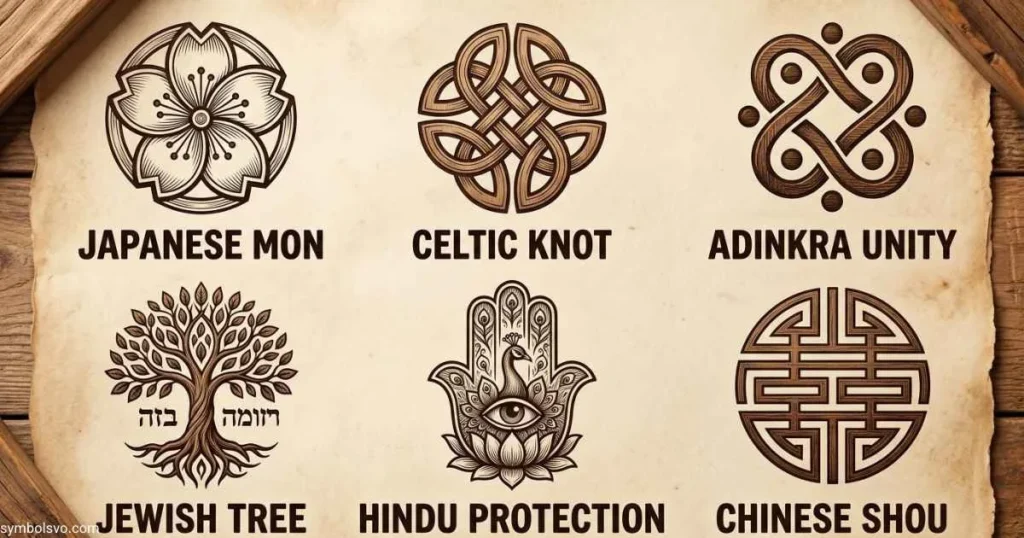
Family symbolism doesn’t follow one universal system. A design that represents marriage in one cultural context may carry a spiritual meaning in another.
Understanding these differences helps you select symbols respectfully and avoid repeating inaccurate claims.
Celtic and Irish Family Symbolism
Celtic-inspired family designs often use interlaced knots, trees, and circular patterns. These designs are popular because they visually express continuity and connectedness.
Historical Celtic and early medieval Insular art includes elaborate interlace. However, there isn’t one universally established ancient Celtic emblem specifically meaning family. Modern interpretations often build on the appearance of historical designs rather than reproduce a fixed ancient definition.
If you want a Celtic-inspired family symbol, consider what matters most: ancestry, the connection between generations, or the visual beauty of knotwork. If documented heritage is important, research the specific design rather than relying on a generic label such as “ancient family knot.”
Chinese Symbols Associated With Marriage and Family Life
The Double Happiness symbol, 囍, is especially associated with weddings and marital joy in Chinese cultural contexts.
It can represent the happiness a couple hopes to build together and therefore has a natural connection to the formation of a family. However, it isn’t a general symbol for every family relationship.
Chinese culture also includes many other symbols whose meanings depend on the object, occasion, and tradition. Research the particular character or design before attributing a meaning to it.
West African Adinkra Symbolism
Adinkra symbols are associated particularly with Akan cultures of Ghana and nearby regions. They appear in textiles and other artistic forms and communicate a range of ideas and values.
Some Adinkra designs may be relevant to family themes, depending on the value expressed by the specific symbol. Yet it would be inaccurate to describe all Adinkra symbols as family symbols.
A respectful approach starts with the symbol’s name, documented meaning, and cultural background. That information helps you distinguish a genuine traditional association from a modern interpretation.
Christian Symbols Used by Families
The cross is central to Christianity and carries meanings related to Jesus, salvation, and Christian faith. Families may use it to express shared beliefs, religious identity, and spiritual commitment.
The dove also has an important place in Christian symbolism, including associations with the Holy Spirit. Outside that specific context, it is widely recognized as an emblem of peace.
These symbols can be meaningful for Christian families, but their religious meanings should not be reduced to generic ideas about togetherness.
Hindu and Other Indian Religious Traditions
Om has a central role in Hindu religious and philosophical traditions. The lotus also appears in several Indian religious traditions, with meanings that depend on the particular context.
A family may choose one of these symbols because its spiritual beliefs are part of their shared identity. However, neither should be presented simply as an ancient symbol of family unity.
Understanding the original religious meaning is an important part of choosing sacred imagery.
Indigenous and Other Cultural Traditions
Indigenous cultures around the world have distinct histories, beliefs, and artistic traditions. There is no single set of symbols that represents all Indigenous peoples.
If you’re considering a symbol associated with a specific Native American nation or another Indigenous community, identify the community and research the meaning through reliable sources connected to that tradition.
The same principle applies to Viking imagery, African cultural traditions, and other historical symbols. A design’s popularity online doesn’t prove its origin or meaning.
How to Choose the Right Symbol for Your Family
The best family symbol is one that expresses something meaningful to the people it represents. You don’t need to select the most elaborate design or the one that appears most frequently online.
Start with these practical steps.
- Decide what matters most. Choose a central idea, such as love, protection, ancestry, resilience, or remembrance.
- Think about your family story. Consider shared traditions, important places, meaningful experiences, and relationships.
- Research your heritage. If you want a culturally specific design, verify its origin and meaning before adopting it.
- Choose a visual style. Botanical illustrations, simple geometric forms, interlaced patterns, and traditional emblems create different effects.
- Consider personalization. Initials, birth flowers, names, or meaningful dates can make a design specific to your family.
- Keep the design clear. Too many details can make a small symbol difficult to recognize.
- Think about long-term meaning. Choose a design that reflects values you expect to remain important over time.
You can also write a short explanation of why you chose the symbol. That gives future generations a way to understand its personal significance.
Popular Ways to Use Family Symbols
Family symbols can appear in everyday objects, meaningful gifts, artwork, and keepsakes. The best format depends on the purpose of the design and how you want people to experience it.
Family Symbol Tattoos
Family tattoos often use recognizable designs that communicate a connection without needing a lengthy explanation.
Popular approaches include:
- Tree of Life designs representing ancestry and growth.
- Hearts expressing affection between loved ones.
- Infinity symbols suggesting lasting connection.
- Birth flowers representing individual family members.
- Initials or dates that preserve a personal memory.
- Celtic-inspired knots expressing a modern interpretation of connectedness.
If you choose a culturally specific design, research its meaning before using it. A symbol can look attractive while carrying a historical or religious significance you didn’t intend.
Family Symbol Jewelry
Jewelry makes a family symbol portable and personal. Pendants, rings, bracelets, and engraved keepsakes can incorporate a design that reminds the wearer of particular people or shared experiences.
A Tree of Life pendant suits someone who values heritage and growth. An infinity pendant emphasizes lasting connection, while a birth-flower necklace can represent several relatives through individual botanical details.
The metal or price doesn’t determine a symbol’s emotional significance. A simple keepsake can mean just as much as an elaborate piece when its design reflects a meaningful relationship.
Family Art and Home Decor
Family symbols can turn a wall, entryway, or shared living space into a place that reflects the people who live there.
Consider a family tree with names and dates, a custom emblem featuring family initials, or a constellation representing relatives who live in different places.
A house illustration can celebrate a meaningful home, while a circle-based design can represent togetherness. For a family reunion, a custom emblem can also be used on invitations, signs, or printed keepsakes.
Memorial and Remembrance Keepsakes
Some symbols help families preserve memories of someone important to them.
Flowers may represent remembrance, while a personalized star or fingerprint design can make a keepsake more specific to an individual. A name, date, or short phrase can provide additional context.
There is no single correct symbol for remembrance. Choose one that reflects the person’s life, the family’s beliefs, or a memory that continues to matter.
Can You Create Your Own Family Symbol?
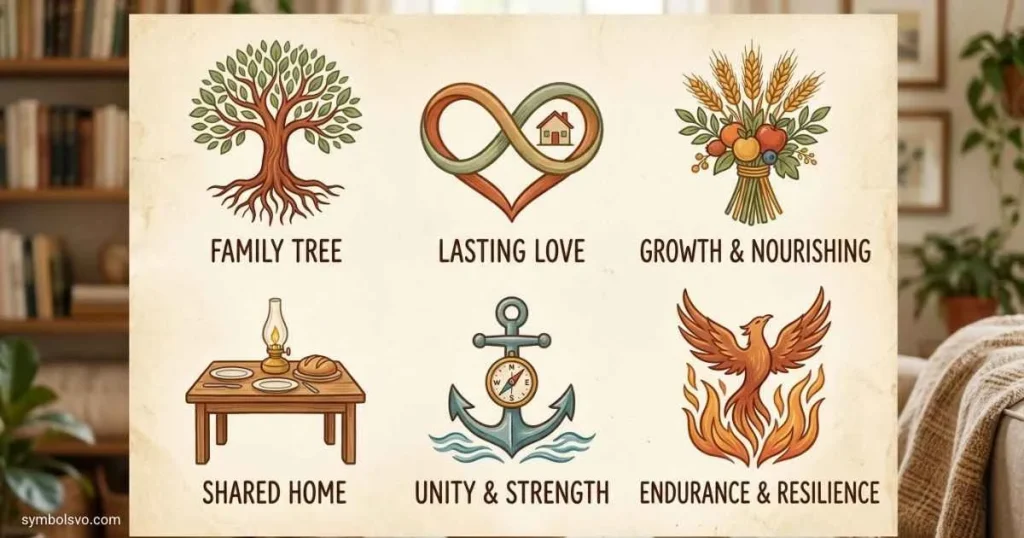
Yes. A family can create a personal emblem by combining a few visual elements with a clear meaning.
You don’t need to imitate an ancient symbol. In fact, a design based on your own family history may be more meaningful than a generic emblem whose origin is uncertain.
Follow these steps:
- Choose two or three core values. For example, love, resilience, and belonging.
- Select a main image. A tree, heart, circle, or flower can provide the design’s foundation.
- Add personal details. Consider initials, meaningful dates, or flowers associated with family members.
- Keep the layout simple. Make sure the main shape remains recognizable when reduced in size.
- Record the meaning. Write down why you chose each element so its significance doesn’t get lost.
- Check any borrowed symbols. If you include cultural or religious imagery, verify its meaning and use it respectfully.
For example, a family might combine a tree with three small stars. The tree could represent shared roots, while the stars represent three children. That meaning would belong to the family’s own design rather than an established historical definition.
The result can be used for artwork, gifts, stationery, or other personal projects. What matters most is that the symbol tells a story the family recognizes as its own.
Frequently Asked Questions About Symbols for Family
What Is the Most Common Symbol for Family?
The family tree is one of the most recognizable symbols of family because it represents ancestry, relationships, and generations. The Tree of Life is another popular choice, especially for designs celebrating growth, heritage, and continuity. However, no single symbol is universally recognized as the official symbol for every family.
What Symbol Represents Family Love?
The heart is a widely recognized symbol of love and affection. The infinity symbol can express lasting connection, while intertwined hearts emphasize the bond between specific people. Your choice depends on whether you want to represent affection, lifelong connection, or a particular family relationship.
What Symbol Represents Family Strength?
The oak tree and Tree of Life are popular choices for representing family strength. Their roots and sturdy structures suggest stability, while their branches represent growth. Mountains can also symbolize endurance and the ability to face challenges together.
What Animal Symbolizes Family?
Elephants and wolves are common choices in modern family artwork. Elephant groups offer examples of close social bonds and care, while wolves are associated with cooperation and group relationships. Lions and bears can also represent strength and protection. Each animal’s symbolism varies across cultures.
What Symbol Represents Family Protection?
The shield is a direct symbol of defense, while the home often represents security and belonging. A lion can communicate courage and strength, and an anchor can symbolize dependable support. The most suitable choice depends on the type of protection you want to express.
What Is an Ancient Symbol for Family?
Trees, hearts, and heraldic emblems have different histories and cultural associations, but their uses should be distinguished carefully. The Tree of Life appears in several traditions, while the familiar Celtic-inspired version has a more complicated history than some modern descriptions suggest. Always check whether a design’s family meaning is historically documented or a later interpretation.
What Does the Tree of Life Mean for Family?
The Tree of Life commonly represents family roots, ancestry, strength, growth, and generations. Its roots can symbolize those who came before, while its branches suggest children and descendants. It can also express the idea that family members remain connected even as their lives develop in different directions.
What Does a Celtic Knot Mean for Family?
A Celtic knot can represent connection and continuity in modern family designs. Its interwoven lines make it a natural visual metaphor for relationships that remain linked over time. However, not every Celtic knot has a documented historical meaning specifically related to family.
What Are Good Symbols for Family Tattoos?
Popular choices include the Tree of Life, heart, infinity symbol, family initials, birth flowers, and Celtic-inspired knotwork. A constellation or linked-circle design can also represent individual relatives within one group. Choose a design based on its meaning and verify any cultural associations before using it.
Can a Family Have Its Own Unique Symbol?
Absolutely. A family can create a custom symbol using initials, flowers, meaningful objects, or images representing shared experiences. For example, a tree might represent ancestry while several stars represent individual family members. Recording the meaning behind the design helps preserve its story for future generations.
Final Thoughts on Choosing a Meaningful Family Symbol
Family symbols offer a way to express relationships, preserve memories, and celebrate the values that matter most to the people who share them. A heart can represent affection, a family tree can document ancestry, and a Tree of Life can symbolize growth across generations.
Cultural and religious symbols offer another layer of meaning, but their origins deserve careful attention. Understanding the difference between historical symbolism and modern personal interpretation helps you make a more informed choice.
Ultimately, the best symbol for family is one that reflects your family’s story. It might be a traditional emblem, a simple circle, a meaningful flower, or a design you create yourself. What gives it lasting significance is the connection it represents

I’m Daniel Brooks, a content creator and symbol enthusiast dedicated to researching the fascinating world of signs and symbols. I enjoy discovering the hidden meanings behind famous icons, emojis, historical emblems, and cultural symbols. Through my writing, I aim to provide trustworthy, well-researched, and reader-friendly information that helps people learn something new with every visit.
Books:
- The Complete Guide to World Symbols
- The Power of Universal Signs
 Nathan Holloway
 Mason Ellington