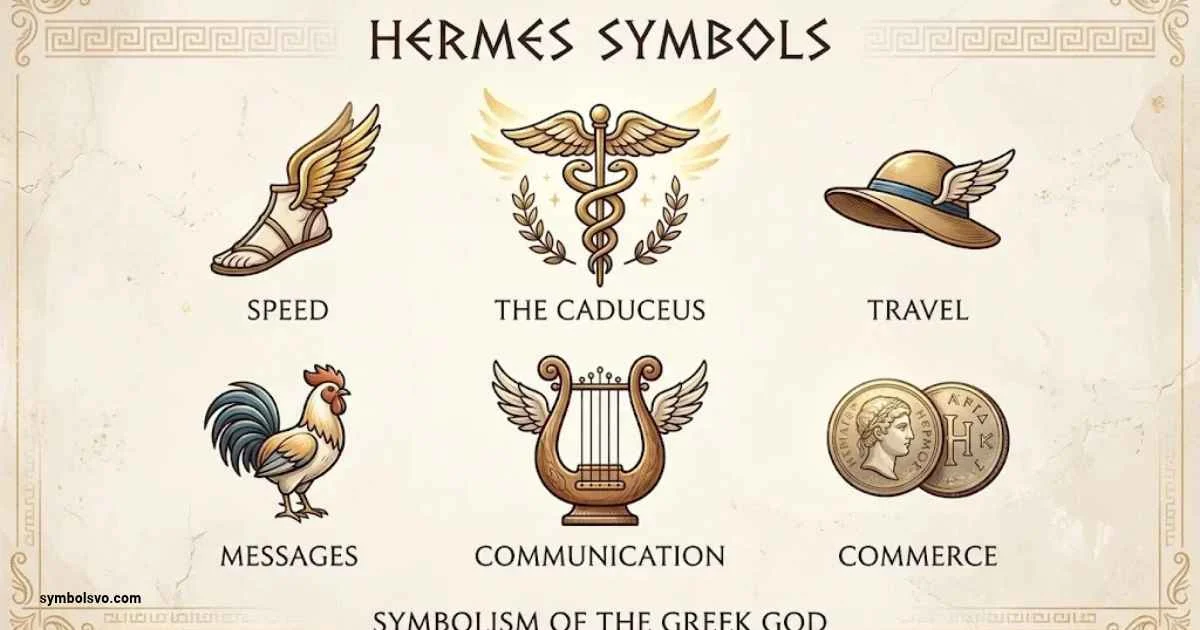
Hermes is one of the most recognizable figures in Greek mythology. Known as the messenger of the gods, he connected the divine world with human life. His responsibilities extended far beyond delivering messages. He also protected travelers, guided souls, supported merchants, watched over roads, and represented cleverness and quick thinking.
The symbols of Hermes reflect these different responsibilities. His famous caduceus features two intertwined snakes, while his winged sandals represent speed and movement. Other recognizable attributes include the petasos, tortoise, lyre, ram, rooster, and stone pillars known as herms.
Each symbol has a different mythological background. Some come from famous stories about Hermes, while others developed through ancient religious practices and artistic representations. Understanding these distinctions makes his symbolism much more interesting.
This guide explores important Hermes symbols and their meanings, including their origins, roles in ancient Greek culture, and influence on modern society. It also explains the difference between the caduceus and the Rod of Asclepius, two symbols that people often mistake for one another.
Who Is Hermes in Greek Mythology?
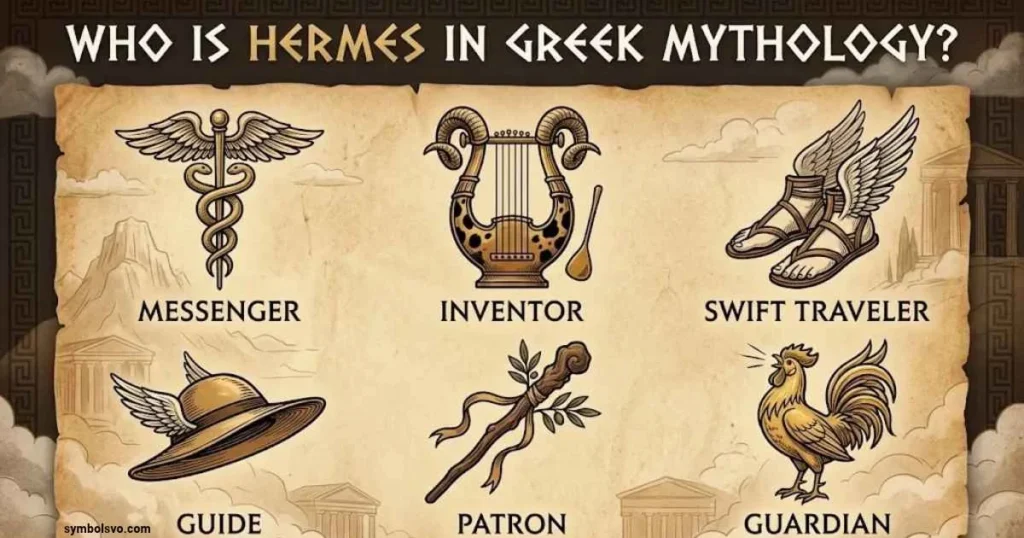
Hermes was an ancient Greek god associated with communication, travel, trade, boundaries, and the movement of souls. He was the son of Zeus, king of the gods, and Maia, a daughter of the Titan Atlas.
Greek mythology describes Hermes as intelligent, quick, persuasive, and mischievous. Unlike gods who controlled one major aspect of nature, Hermes served several important roles across the divine and human worlds.
He belonged to the twelve Olympian gods and often carried messages for Zeus. His ability to move between different places made him a natural protector of travelers, merchants, and messengers.
Hermes also had a close relationship with Apollo. Their famous story involves stolen cattle, an ingenious musical instrument, and an agreement that strengthened their relationship.
Hermes as the Messenger of the Gods
Hermes’s most famous responsibility was delivering messages between the gods and humans. He could travel quickly between Mount Olympus and the mortal world.
His duties included carrying divine instructions, delivering warnings, and helping gods communicate with one another. This role explains why artists frequently portrayed him with a staff, winged sandals, and distinctive headwear.
As a divine messenger, Hermes represented:
- Communication: Delivering messages between different worlds.
- Speed: Traveling quickly to complete divine tasks.
- Intelligence: Understanding situations and finding solutions.
- Diplomacy: Carrying messages during important discussions.
- Connection: Bringing together gods, humans, and other beings.
Hermes as the God of Travel and Roads
Hermes also protected travelers and people who depended on roads for their daily activities. Ancient Greek communities associated him with journeys, crossroads, entrances, and boundaries.
Travelers sometimes encountered stone markers dedicated to Hermes along roads. These monuments helped identify places and reflected his protective role.
His association with travel also extended beyond ordinary journeys. Mythology describes him moving between Olympus, the human world, and the underworld.
Hermes as the God of Trade and Commerce
Hermes had a strong connection with merchants, markets, and commercial exchanges. He represented the movement of goods and the interactions that made trade possible.
His Roman counterpart, Mercury, developed an especially strong association with commerce and financial activity.
Hermes’s commercial responsibilities included:
- Protecting merchants and trading activities.
- Supporting communication between buyers and sellers.
- Representing exchange and commercial movement.
- Connecting different communities through trade.
- Protecting travelers transporting valuable goods.
Hermes also had a trickster side. Ancient stories associated him with thieves, deception, and clever schemes. His personality reflected both the useful and unpredictable sides of human exchange.
Hermes as the Guide of Souls
Another important title associated with Hermes is Psychopompos, meaning guide or conductor of souls.
In Greek mythology, Hermes helped guide deceased souls toward the underworld. He did not serve as the ruler of the dead. That responsibility belonged to Hades.
Instead, Hermes acted as an intermediary who escorted souls on their journey after death.
This role connected him with:
- Life and death transitions.
- Spiritual journeys in Greek mythology.
- Communication between different worlds.
- Guidance and safe passage.
Hermes as a Trickster and Protector of Thieves
Hermes was also famous for his cleverness and mischievous behavior. One of the best-known stories describes how he stole Apollo’s cattle shortly after his birth.
Rather than relying on physical strength, Hermes used intelligence and deception to avoid being discovered.
The story established his reputation as a trickster god. It also introduced the mythological origin of his famous lyre.
His trickster identity explains why Hermes became associated with:
- Thieves and cunning behavior.
- Quick thinking and clever solutions.
- Persuasion and negotiation.
- Luck and unexpected opportunities.
- Intelligence and adaptability.
These qualities make Hermes a particularly interesting figure in Greek mythology. He represented both the helpful messenger and the clever rule-breaker.
What Are the Main Symbols of Hermes?
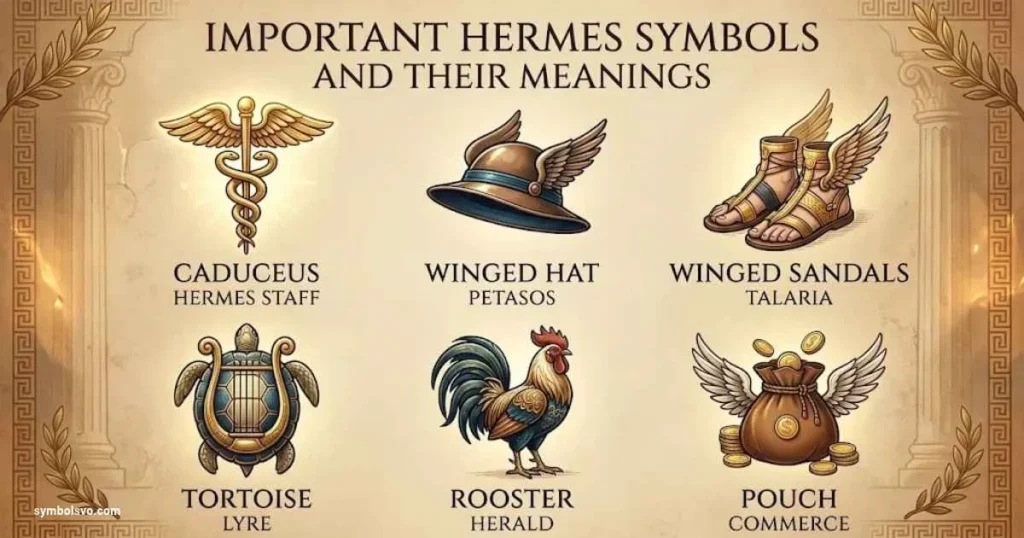
The main symbols of Hermes include his caduceus, winged sandals, petasos, tortoise, lyre, and herms. These objects identify his different responsibilities and provide clues about his mythology.
Some symbols are closely connected to specific ancient stories. Others developed through religious traditions, sculptures, coins, and pottery.
The following table summarizes their main associations.
| Symbol | Meaning or association |
| Caduceus | Heraldship, communication, and negotiation |
| Winged sandals | Speed and divine travel |
| Petasos | Travel and messenger identity |
| Herald’s staff | Official messages and heraldship |
| Rooster | An animal associated with Hermes |
| Ram | Pastoral protection and shepherding |
| Tortoise | The mythological invention of the lyre |
| Lyre | Music and Hermes’s clever invention |
| Money bag | Commerce and wealth |
| Herms | Boundaries, roads, and protection |
| Wings | Speed and movement in divine imagery |
These associations explain why Hermes appears in so many different forms throughout ancient Greek art.
Important Hermes Symbols and Their Meanings
The Caduceus: Hermes’s Most Recognizable Symbol
The caduceus is the most recognizable attribute of Hermes. It consists of a central staff with two snakes winding around it. Many traditional representations also include a pair of wings near the top.
The ancient Greek name for this object is kerykeion, meaning a herald’s staff or wand. Hermes carried it as part of his responsibilities as the messenger of the gods.
The caduceus helped identify Hermes in ancient sculptures, pottery, and other artistic representations. It also reflected his position as a divine herald who carried messages between different groups.
What does the caduceus symbolize?
Its historical associations include:
- Heraldship: Hermes’s official role as a divine messenger.
- Communication: Carrying information between gods and humans.
- Negotiation: Its connection to heralds and diplomatic activity.
- Commerce: Its later association with trade and Mercury.
- Movement: Its connection to Hermes’s traveling responsibilities.
The two intertwined snakes make the caduceus visually distinctive. However, their presence should not automatically be interpreted as representing balance, healing, or spiritual energy. Those meanings often come from later interpretations.
Why does Hermes carry two snakes?
The caduceus developed as a recognized heraldic staff in Greek tradition. Its snake imagery became part of the familiar design associated with Hermes.
Ancient and later representations sometimes vary in their details. Some show wings, while others emphasize the staff and intertwined serpents.
The important point is that the caduceus identifies Hermes’s role as a herald rather than serving as a general symbol for every kind of spiritual or medical activity.
Winged Sandals (Talaria): Symbol of Speed and Travel
The Talaria, commonly called Hermes’s winged sandals, represent one of his most recognizable mythological attributes.
Ancient artists often portrayed Hermes wearing sandals with small wings attached near the ankles or feet. These magical sandals allowed him to travel quickly while carrying messages and completing divine assignments.
Unlike ordinary footwear, the Talaria reflected Hermes’s supernatural mobility. They helped distinguish him from other Greek gods in paintings, sculptures, and vase illustrations.
What do Hermes’s winged sandals mean?
Their main associations include:
- Speed: Moving quickly between different destinations.
- Travel: Protecting and representing journeys.
- Mobility: Moving freely between divine and mortal worlds.
- Messenger identity: Supporting Hermes’s responsibilities as a divine courier.
- Freedom of movement: Representing his ability to travel beyond ordinary human limitations.
The sandals also appear in stories involving other mythological figures. In some traditions, Perseus receives magical footwear from Hermes during his quest to defeat Medusa.
The Talaria became a lasting part of Greek mythological imagery. Even today, winged footwear often represents speed, delivery, and rapid movement.
Winged Hat (Petasos): Symbol of the Traveling Messenger
The petasos was a broad-brimmed hat worn in ancient Greece. Travelers commonly used this type of headwear because it provided protection from sunlight and weather.
Hermes frequently appears wearing a petasos in ancient artistic representations. Artists sometimes added wings to the hat to emphasize his supernatural speed and identity as the messenger of the gods.
Although people often call it a winged helmet, the traditional petasos was a hat rather than protective military headgear.
What does Hermes’s winged hat represent?
Its main associations include:
- Travel and outdoor journeys.
- Hermes’s role as a divine messenger.
- Movement between different places.
- His recognizable identity in Greek art.
- His connection with travelers and communication.
The petasos is especially useful when identifying Hermes in ancient artwork. When artists combine it with winged sandals and the caduceus, his identity becomes much easier to recognize.
The Herald’s Staff (Kerykeion): Symbol of Messenger Authority
The herald’s staff, known in Greek as the kerykeion, was an important attribute of Hermes. It represented his authority as a messenger and his connection to official communication.
In ancient Greek society, heralds delivered messages and performed important duties during public events, negotiations, and conflicts. Their position required people to recognize their role and understand the importance of their announcements.
Hermes’s staff connected him with this tradition on a divine level.
The staff is closely related to the caduceus rather than being a completely separate mythological object.
What did the herald’s staff represent?
- Official communication and announcements.
- The authority of a recognized messenger.
- Diplomatic exchanges.
- Hermes’s responsibility for delivering messages.
- The connection between different communities.
In mythology, Hermes’s staff also possessed supernatural abilities. Some literary traditions describe it as having the power to influence sleep and wakefulness.
This magical quality further strengthened its connection with Hermes’s role as a god who moved between different states and worlds.
The Rooster: An Animal Associated With Hermes
The rooster appears among animals associated with Hermes in ancient Greek traditions and artistic representations.
Its connection to Hermes is less central than the caduceus, sandals, or petasos. However, it forms part of the wider collection of animal imagery linked with the god.
Roosters had an important place in ancient Greek life. Their crowing marked the arrival of daylight, making them familiar animals in households and agricultural communities.
Some older mythological interpretations connect the rooster with alertness and vigilance. However, these are broader associations rather than firmly established meanings unique to Hermes.
Why is the rooster associated with Hermes?
The animal appears within the wider tradition of Hermes’s attributes and associations.
Its possible symbolic connections include:
- Awareness and alertness.
- The arrival of daylight.
- Animal imagery in ancient Greek religious life.
- Hermes’s broader association with everyday activities and communities.
When discussing the rooster, it is best to distinguish its wider cultural symbolism from Hermes’s more firmly established mythological attributes.
The Ram: Symbol of Pastoral Protection
The ram has a particularly meaningful connection with Hermes because of his responsibilities as a protector of shepherds and livestock.
Ancient Greek communities depended heavily on sheep and other domesticated animals. Livestock provided food, wool, and other resources that supported everyday life.
Hermes became associated with pastoral communities and the protection of their animals.
One of his recognizable artistic forms was Hermes Kriophoros, meaning Hermes the ram-bearer. In this representation, he carries a ram across his shoulders.
This image reflects his protective relationship with flocks and shepherds.
What does the ram symbolize in Hermes’s mythology?
- Protection of livestock.
- Shepherding and pastoral life.
- The relationship between Hermes and rural communities.
- Animal welfare within ancient religious traditions.
- The god’s responsibilities beyond cities and marketplaces.
The ram is more than a decorative animal in Hermes’s iconography. It reflects the practical importance of livestock in ancient Greek society.
The Tortoise: The Origin of Hermes’s Lyre
The tortoise has one of the most interesting connections to Hermes because of its role in the mythological invention of the lyre.
According to the Homeric Hymn to Hermes, the young god discovered a tortoise outside his mother’s cave on Mount Cyllene.
Rather than ignoring the animal, Hermes recognized that its shell could become something useful. He removed the interior of the shell and transformed it into the body of a musical instrument.
He added other materials, stretched strings across the structure, and created the first lyre in the famous myth.
The story presents Hermes as an inventive god who could turn an ordinary natural object into something extraordinary.
The Acropolis Museum also identifies the tortoise as an attribute in its collection’s classical statue of Hermes. Its description connects the animal’s shell directly to the lyre Hermes invented.
What does the tortoise represent in Hermes symbolism?
- Creativity and invention.
- Cleverness and resourcefulness.
- The relationship between nature and human craftsmanship.
- The mythological origin of the lyre.
- Hermes’s ability to recognize useful opportunities.
The tortoise is particularly important because it connects two major Hermes attributes: the animal itself and the musical instrument created from its shell.
The Lyre: Symbol of Music and Invention
The lyre was an important stringed instrument in ancient Greek culture. It appeared in music, education, poetry, religious celebrations, and artistic performances.
Greek mythology credits Hermes with creating the first lyre using a tortoise shell.
The story begins with Hermes discovering the tortoise. After making the instrument, he used it to produce beautiful music.
However, another important event took place during this story. Hermes had also stolen cattle belonging to Apollo.
When Apollo discovered what happened, he confronted Hermes. The dispute eventually led to an exchange involving the newly invented lyre.
Apollo admired the instrument’s sound and accepted it as part of their agreement. The lyre later became one of Apollo’s most recognizable attributes.
The Homeric Hymn to Hermes provides the main literary account of this famous story.
What does the lyre symbolize?
- Musical invention and craftsmanship.
- The relationship between Hermes and Apollo.
- Creativity and artistic expression.
- Music in ancient Greek society.
- The transformation of natural materials into cultural objects.
Although the lyre became especially associated with Apollo, its mythological origin remains closely connected to Hermes.
The Money Bag: Symbol of Trade and Commerce
The money bag, sometimes shown as a small purse or coin pouch, became associated with Hermes through his connection with commerce and his Roman counterpart, Mercury.
Hermes already had strong connections to merchants and commercial activity in Greek mythology. Roman culture further developed Mercury’s identity as a god of trade, business, and financial exchange.
Artists sometimes represented Mercury carrying a purse to emphasize these responsibilities.
The money bag became a recognizable visual attribute in later Greco-Roman representations.
What does the money bag represent?
- Commercial activity.
- Money and financial exchange.
- Merchants and marketplaces.
- Wealth and material transactions.
- Hermes’s connection with trade.
It is important to understand that the money bag does not hold the same position as the caduceus in Hermes’s earliest and most recognizable Greek iconography.
Its association developed more strongly through later representations of Mercury and commercial activity.
Herms: Ancient Greek Boundary Markers
Herms were distinctive stone monuments associated with Hermes. They typically consisted of rectangular pillars featuring a carved head of the god near the top.
Many traditional examples also included a carved phallic representation. This feature connected the monuments with fertility, protection, and the ancient religious practices surrounding Hermes.
Herms appeared in different public and private locations, including roads, entrances, boundaries, and other important places.
Their presence reflected Hermes’s responsibility as a protector of travelers and boundaries.
The earliest forms were simpler piles of stones associated with roads and locations. Over time, these developed into more recognizable sculpted pillars.
What did herms represent in ancient Greece?
- Property and territorial boundaries.
- Roadside identification.
- Protection of entrances and public spaces.
- Hermes’s religious presence in everyday life.
- The connection between travel and sacred spaces.
Herms were not simply statues placed for decoration. They served practical, religious, and cultural purposes.
Their importance became especially visible in ancient Greek cities. They helped mark spaces while reminding people of Hermes’s protective role.
The historical development of herms is discussed in Encyclopaedia Iranica’s Hermes reference and the Science Museum’s discussion of the Antikythera Hermes.
Wings: A Recurring Feature of Hermes’s Iconography
Wings appear repeatedly in Hermes’s artistic representations. Artists placed them on his sandals, hat, and sometimes the caduceus.
These features helped communicate his ability to travel quickly between different destinations.
Unlike the tortoise or lyre, wings are not one independent object with a separate mythological invention story. Instead, they form a recurring part of Hermes’s visual identity.
What do wings represent in Hermes’s iconography?
- Speed and rapid movement.
- Divine travel.
- The messenger’s ability to move between worlds.
- Hermes’s supernatural identity.
- Freedom of movement within mythological imagery.
The wing motif also influenced later artistic representations of Mercury. Today, winged designs continue to appear in commercial and transportation imagery because people readily associate them with speed and movement.
Hermes’s Sacred Animals and Their Mythological Associations
Animals played an important role in ancient Greek mythology. Gods were frequently connected with particular creatures through stories, religious practices, and artistic representations.
Hermes had several animal associations, although not every creature held the same religious importance.
Three animals deserve particular attention.
| Animal | Connection to Hermes | Mythological importance |
| Ram | Shepherds and livestock | Protection of flocks |
| Tortoise | Invention of the lyre | Creativity and craftsmanship |
| Rooster | Ancient animal associations | Part of Hermes’s wider iconography |
Why Were Animals Important to Hermes?
Hermes had responsibilities that extended into rural communities. His connection with shepherds and livestock made animals a natural part of his mythology.
The ram reflected his protective role, while the tortoise appeared in a famous story about invention.
These associations also show how ancient Greek religion connected divine figures with ordinary experiences.
For example, a shepherd might recognize Hermes through a ram-bearing statue. A musician familiar with Greek mythology might recognize his connection to the tortoise and lyre.
What Does Hermes Symbolize in Greek Mythology?
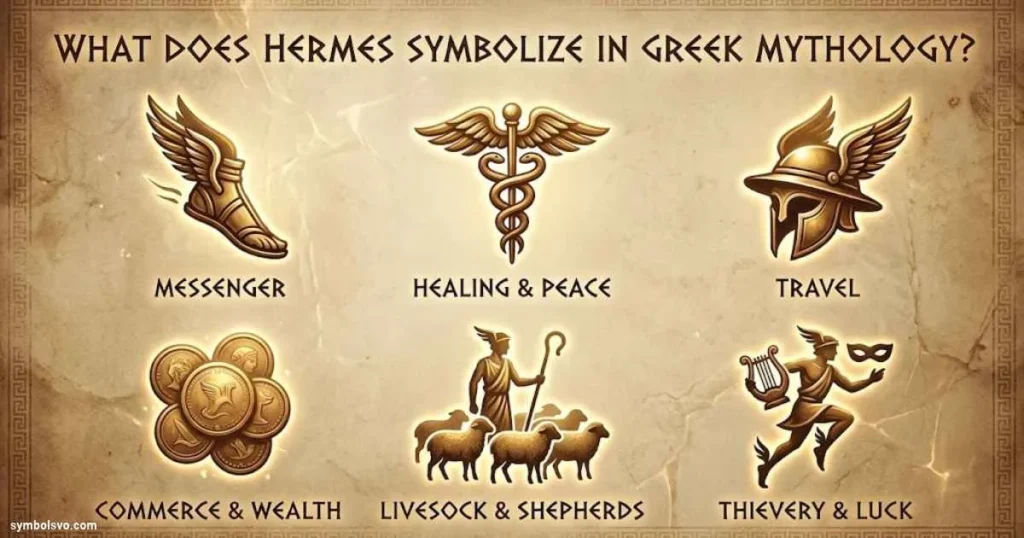
The symbolism of Hermes extends beyond individual objects. His different attributes collectively represent the responsibilities and qualities associated with his divine identity.
He connected different worlds, protected travelers, supported commerce, and guided souls. His mythology also highlighted intelligence and the ability to solve problems through cleverness.
Here are the major themes associated with Hermes symbolism.
Communication and Divine Messages
Communication is one of the strongest themes connected with Hermes.
As the messenger of the gods, he delivered information and carried instructions between divine and mortal worlds.
His caduceus reinforces this responsibility because it identifies him as a herald.
This association also explains why Hermes is sometimes connected with eloquence, interpretation, and persuasion.
Speed, Movement, and Travel
Hermes could travel between different locations with remarkable speed.
His winged sandals and petasos visually communicated this ability. These attributes distinguished him from gods whose responsibilities centered on specific places or natural forces.
His movement also had a mythological dimension because he could travel between Olympus, earth, and the underworld.
Trade, Commerce, and Wealth
Hermes represented the movement of goods and commercial exchanges.
His connection with merchants made him an important figure for people involved in business and trade.
The later Roman association with Mercury strengthened this commercial identity.
The caduceus and money bag became familiar images connected with these activities.
Protection and Safe Passage
Hermes protected travelers, shepherds, and people moving through unfamiliar spaces.
His association with roads and boundaries explains why ancient communities placed herms at entrances and along important routes.
His role as a guide of souls also reflects this broader responsibility for passage between different places.
Intelligence, Cunning, and Resourcefulness
Hermes was not simply fast. He was also exceptionally clever.
His theft of Apollo’s cattle demonstrates his ability to develop unexpected solutions and avoid direct confrontation.
The invention of the lyre provides another example of his resourcefulness.
These stories explain his association with intelligence, cleverness, and adaptability.
Guidance and Transition
Hermes occupied an unusual position between different worlds.
He delivered messages for the gods and guided deceased souls toward the underworld.
This made him an important intermediary figure in Greek mythology.
His symbolism therefore includes guidance, transition, and movement between different states of existence.
Hermes Symbols in Ancient Greek Art and Religion
Ancient Greek artists used recognizable attributes to identify gods in sculptures, pottery, coins, and other objects.
Hermes was particularly easy to identify because he had several distinctive features.
A figure holding a caduceus and wearing a petasos was likely intended to represent Hermes. Adding winged sandals made the identification even clearer.
Hermes in Classical Greek Sculpture
Greek sculptors portrayed Hermes in different forms throughout antiquity.
Some representations showed him as a youthful athletic figure. Others depicted him as a bearded man carrying a ram or holding his characteristic staff.
His artistic appearance changed across historical periods.
The Acropolis Museum preserves a classical statue of Hermes dated approximately 450–400 BC. The museum notes that the figure likely held a tortoise in one hand and a caduceus in the other.
Hermes in Ancient Greek Pottery
Pottery provided another important way to represent Hermes.
Artists included him in mythological scenes involving Apollo, Zeus, and other figures.
His recognizable attributes helped viewers identify him within complex compositions.
Common visual details included:
- Winged sandals.
- A traveling hat or petasos.
- The caduceus.
- A short traveling cloak.
- A lyre in scenes connected with Apollo.
Hermes in Public Spaces and Religious Sites
Herms appeared throughout ancient Greek communities.
They stood near roads, entrances, and boundaries. These monuments combined practical identification with religious significance.
Hermes also had connections with gymnasiums and athletic spaces. His association with movement and physical activity made him relevant to these environments.
His presence in public places shows how closely ancient Greek religion connected mythology with everyday life.
Hermes and Mercury: Greek and Roman Symbols Compared
Hermes and Mercury are closely related mythological figures. Hermes belongs to Greek mythology, while Mercury is his Roman counterpart.
When Roman culture adopted Greek religious traditions, it connected many of Hermes’s responsibilities and attributes with Mercury.
Both gods became associated with messages, travel, and commerce. Their artistic representations also shared recognizable features.
| Feature | Hermes | Mercury |
| Mythological tradition | Greek | Roman |
| Divine parentage | Zeus and Maia | Jupiter and Maia |
| Main role | Messenger of the gods | Messenger of the Roman gods |
| Travel attribute | Winged sandals | Winged sandals |
| Staff | Caduceus | Caduceus |
| Headwear | Petasos | Winged hat |
| Commercial association | Merchants and trade | Strong association with commerce |
| Guide of souls | Psychopompos | Guide of departed souls |
How Roman Culture Adopted Hermes
Roman religion often identified Greek gods with Roman deities who had similar responsibilities.
Mercury became closely associated with Hermes and inherited many of his attributes.
His commercial role became especially important in Roman religious life.
The money bag became a familiar visual feature in representations of Mercury, reinforcing his relationship with wealth and business.
The similarities between the two figures explain why their names and symbols sometimes appear together in historical discussions.
Hermes Symbols in Modern Culture
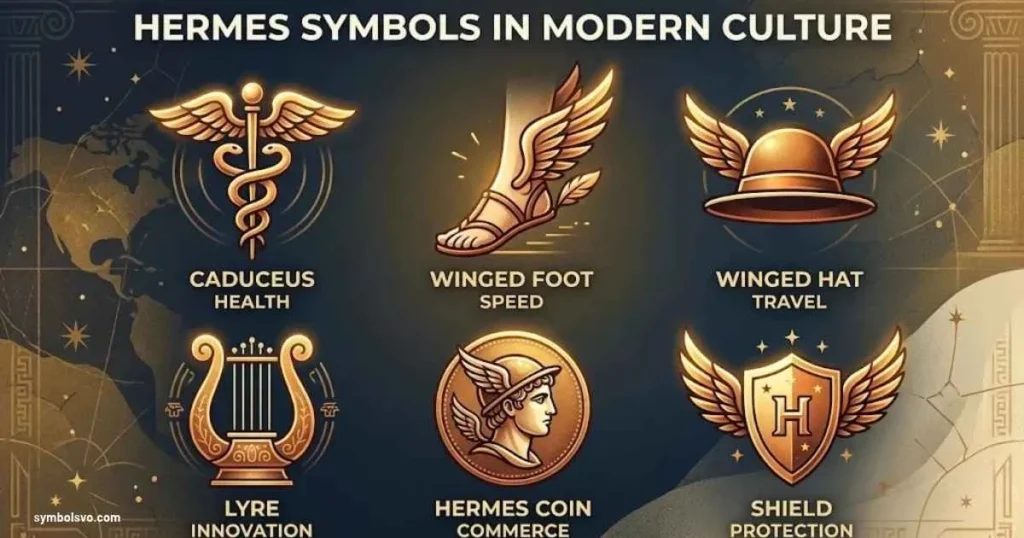
The influence of Hermes extends beyond ancient Greek religion. His attributes have appeared in commercial imagery, medical emblems, literature, entertainment, and modern visual design.
However, modern uses do not always preserve their original mythological meanings.
Understanding the historical background helps explain why these symbols remain recognizable.
The Caduceus in Business and Commerce
The caduceus has a strong historical association with Hermes and Mercury.
Because both gods were connected with merchants and trade, the staff became an appropriate visual reference for commercial activity.
Today, caduceus-inspired designs sometimes appear in:
- Business and trading imagery.
- Commercial organizations.
- Financial and professional branding.
- Transportation-related designs.
- Communication and delivery imagery.
Its connection with trade makes it particularly relevant to Hermes’s commercial identity.
The Caduceus in Modern Medicine
One of the most interesting modern uses of Hermes’s symbol is its appearance in healthcare.
Some hospitals, medical organizations, and professional groups use the caduceus as a medical emblem.
However, this usage creates a historical misunderstanding because the caduceus originally belonged to Hermes rather than the Greek god of medicine.
The distinction becomes clear when comparing it with the Rod of Asclepius.
The Science Museum Group’s history of medical symbols explains how the two symbols developed different associations and how the caduceus entered modern medical imagery.
Winged Symbols in Transportation and Delivery
Wings have a natural connection with movement and rapid travel.
Since Hermes’s winged sandals and hat helped identify him as a fast-moving messenger, later designers found winged imagery useful for communicating speed.
You may encounter similar visual ideas in:
- Delivery and logistics branding.
- Transportation-related designs.
- Aviation imagery.
- Courier services.
- Commercial illustrations.
These modern designs do not necessarily represent direct religious references to Hermes. They often borrow the familiar visual language of speed and movement.
Hermes in Literature, Film, and Video Games
Hermes continues to appear in modern storytelling.
Writers and game designers often use his familiar characteristics when creating characters who deliver messages, travel quickly, or move between different worlds.
His personality also offers plenty of storytelling opportunities.
He can serve as a clever guide, a mischievous trickster, a divine messenger, or an unpredictable ally.
Modern adaptations may change parts of his mythology. However, the caduceus, winged sandals, and petasos remain recognizable visual references.
Caduceus vs. Rod of Asclepius: What’s the Difference?
The caduceus and Rod of Asclepius are two different symbols from Greek mythology. People often confuse them because both feature a staff with a snake.
However, their mythological origins and traditional meanings are different.
The caduceus belongs to Hermes, the messenger god. The Rod of Asclepius belongs to Asclepius, the Greek god associated with medicine and healing.
| Feature | Caduceus | Rod of Asclepius |
| Associated god | Hermes | Asclepius |
| Snakes | Two | One |
| Wings | Often present | Absent |
| Main historical association | Heraldship and commerce | Medicine and healing |
| Mythological role | Messenger’s staff | Attribute of the healing god |
| Modern use | Business and some medical organizations | Healthcare and medicine |
Why Are the Two Symbols Confused?
Their similar designs make them easy to mistake for one another.
Both feature serpents wrapped around a central staff. Over time, some organizations adopted the caduceus as a medical emblem.
Its modern medical use became especially visible in the United States after the U.S. Army Medical Corps adopted it in 1902.
However, the single-serpent Rod of Asclepius has the stronger historical connection with medicine and healing.
Which Symbol Actually Represents Hermes?
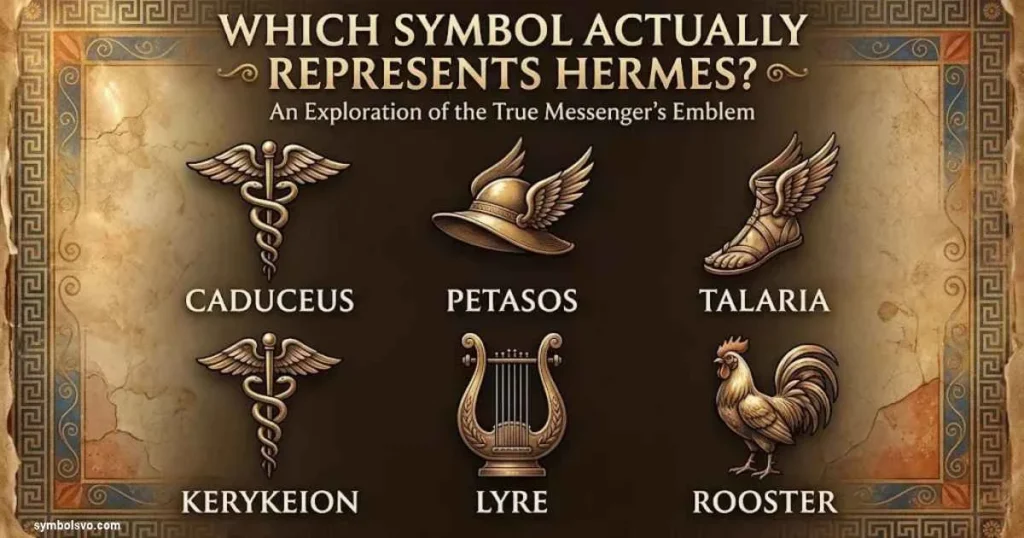
The caduceus is the symbol associated with Hermes.
Its traditional design features:
- A central staff.
- Two intertwined serpents.
- A pair of wings in many familiar representations.
The Rod of Asclepius belongs to Asclepius and usually features one serpent without wings.
Remembering this distinction helps you identify the correct figure when studying Greek mythology, ancient sculpture, or modern symbolic designs.
Frequently Asked Questions About Hermes Symbols
What Is the Most Famous Symbol of Hermes?
The caduceus is the most famous symbol of Hermes. It features a staff surrounded by two intertwined snakes and often includes a pair of wings. The symbol represents Hermes’s role as the divine messenger and herald in Greek mythology.
What Are the Main Symbols of Hermes?
The main symbols of Hermes include the caduceus, winged sandals, petasos, tortoise, lyre, ram, rooster, money bag, and herms. Wings also appear repeatedly in his artistic representations. Each attribute reflects a different part of his mythology.
What Does the Caduceus Symbolize in Greek Mythology?
The caduceus represents Hermes’s role as a herald and messenger of the gods. Its traditional associations include official communication, negotiation, and commerce. Although some modern organizations use it in medicine, its original mythological connection is with Hermes.
Why Is Hermes Associated With Two Snakes?
The two intertwined snakes form the recognizable design of Hermes’s caduceus. The staff developed as his heraldic attribute and became a familiar way to identify him in ancient Greek and Roman artwork.
What Do Hermes’s Winged Sandals Symbolize?
Hermes’s winged sandals, called Talaria, represent supernatural speed and movement. They reflect his ability to travel quickly between Olympus, the mortal world, and other destinations. They also identify him as the messenger of the gods.
Why Does Hermes Wear a Winged Helmet?
Hermes is traditionally associated with the petasos, a broad-brimmed traveling hat. Artists sometimes added wings to emphasize his speed and messenger identity. Although people often call it a winged helmet, the traditional petasos was a hat.
What Is the Meaning of the Petasos?
The petasos was a practical broad-brimmed hat worn by ancient Greeks, particularly travelers. Its association with Hermes developed through his familiar artistic representations. The addition of wings helped distinguish the god from ordinary travelers.
What Animals Are Associated With Hermes?
The ram, tortoise, and rooster are among the animals associated with Hermes. The ram reflects his connection with shepherds and livestock. The tortoise appears in the myth of his lyre’s invention, while the rooster belongs to his wider animal associations.
Why Is the Tortoise Important to Hermes?
The tortoise is important because Hermes used its shell to create the first lyre in Greek mythology. According to the Homeric Hymn to Hermes, he transformed the shell into the instrument’s body and added strings to produce music.
What Is the Connection Between Hermes and Apollo?
Hermes and Apollo are connected through the famous story of the stolen cattle and the invention of the lyre. Hermes stole Apollo’s cattle but later gave him the musical instrument he had created. Their disagreement eventually developed into an agreement and friendship.
What Do Herms Represent in Ancient Greece?
Herms were stone pillars associated with Hermes. Ancient Greeks placed them near roads, entrances, and boundaries. They represented protection, territorial identification, and the god’s presence in everyday public and private spaces.
Is the Caduceus a Medical Symbol?
The caduceus is originally the staff of Hermes, not the traditional symbol of the Greek god of medicine. The Rod of Asclepius, which features one serpent, has the stronger historical connection with healing and healthcare.
What Does Hermes Represent in Greek Mythology?
Hermes represents communication, travel, commerce, protection, intelligence, and guidance. His responsibilities as a messenger and guide connect him with movement between different worlds. His stories also highlight cleverness, invention, and resourcefulness.
Are Hermes and Mercury the Same God?
Hermes and Mercury are closely related figures from Greek and Roman mythology. Hermes is the Greek god, while Mercury is his Roman counterpart. They share many attributes, including the caduceus, winged sandals, and associations with travel and trade.
Conclusion: Understanding the Meaning of Hermes Symbols
The symbols of Hermes reveal the many responsibilities and characteristics of one of ancient Greece’s most versatile gods. His caduceus identifies him as a divine messenger, while his winged sandals and petasos reflect his extraordinary ability to travel.
Other attributes tell equally interesting stories. The ram connects him with shepherds and livestock, while the tortoise recalls the invention of the lyre. Herms demonstrate his importance in protecting roads, boundaries, and public spaces.
Together, these objects and animals explain why Hermes held such an important place in ancient Greek religion and mythology.
His influence also extends into modern culture. The caduceus remains recognizable in commercial imagery, winged designs continue to suggest speed, and his mythological stories inspire modern literature and entertainment.
Understanding Hermes symbols and their meanings provides more than a list of ancient objects. It offers a closer look at Greek beliefs about communication, movement, trade, creativity, and the connection between different worlds.

I’m Daniel Brooks, a content creator and symbol enthusiast dedicated to researching the fascinating world of signs and symbols. I enjoy discovering the hidden meanings behind famous icons, emojis, historical emblems, and cultural symbols. Through my writing, I aim to provide trustworthy, well-researched, and reader-friendly information that helps people learn something new with every visit.
Books:
- The Complete Guide to World Symbols
- The Power of Universal Signs
 Mason Ellington