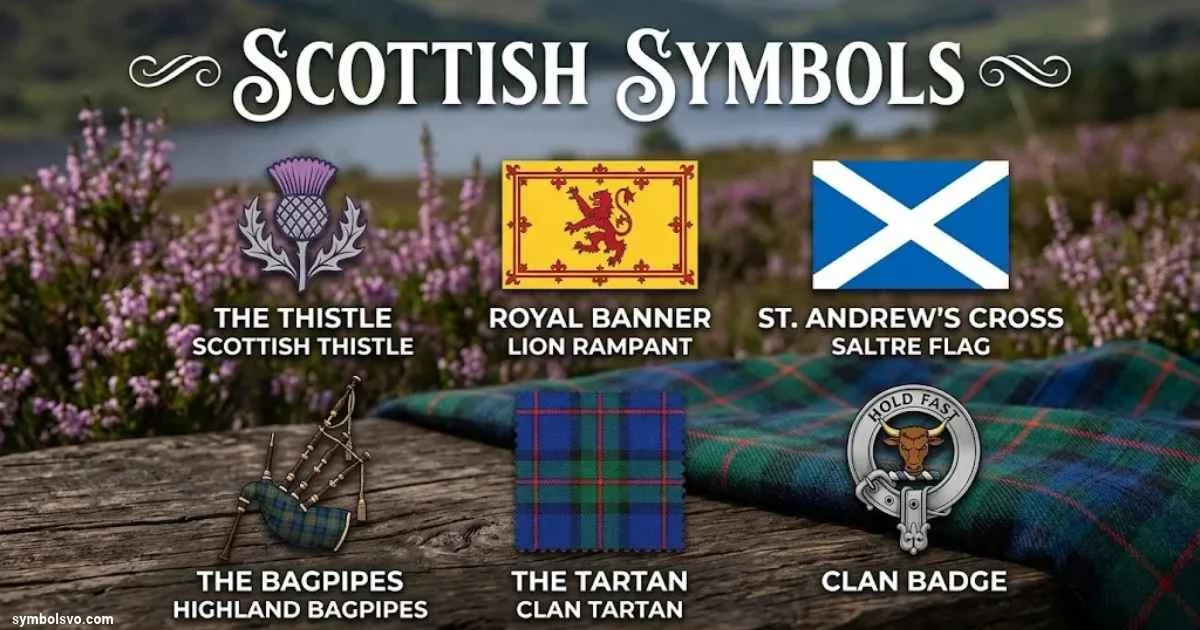
Scotland has a rich cultural identity shaped by centuries of history, royal traditions, folklore, music, and Highland heritage. Its symbols tell stories about the country’s people, beliefs, struggles, and traditions. From the blue-and-white Scottish Saltire to the proud Scottish unicorn and the famous Scottish thistle, each emblem carries a meaning that connects modern Scotland with its past.
Some Scottish symbols have official national status, while others became important through royal history, local customs, and cultural traditions. The Saltire is Scotland’s national flag, the thistle is its national flower, and the unicorn is its national animal. Other familiar symbols include the Lion Rampant, Scottish tartan, Highland kilt, and bagpipes.
Understanding these Scottish symbols and their meanings offers a closer look at Scotland’s national identity. Whether you are researching Scottish history, exploring your family heritage, or simply curious about the country’s traditions, these 15 iconic symbols provide a useful starting point.
What Are the National Symbols of Scotland?
National symbols of Scotland are objects, designs, animals, flowers, flags, and traditions that represent the country’s history and cultural identity. They help people recognize Scotland and understand the stories behind its heritage.
Some symbols are connected to the Scottish monarchy and royal heraldry. Others come from religious traditions, Highland culture, folklore, or everyday life. Together, they represent different parts of Scotland’s national character.
It is useful to understand that not every famous Scottish emblem has the same official status. The Saltire is the national flag, while the unicorn is recognized as Scotland’s national animal. Tartan and bagpipes are powerful cultural symbols, but they are not official national emblems in the same sense.
Here is a quick overview of some of the best-known symbols of Scotland.
| Scottish Symbol | What It Represents |
| Scottish Saltire | National identity and Saint Andrew |
| Scottish Thistle | Resilience, protection, and national heritage |
| Unicorn | Strength, purity, and royal authority |
| Lion Rampant | Scottish monarchy and royal heraldry |
| Scottish Tartan | Clan heritage and cultural identity |
| Honours of Scotland | Royal history and sovereignty |
| Highland Kilt | Traditional clothing and Highland culture |
| Scottish Bagpipes | Music and national heritage |
| Saint Andrew | Religious history and national identity |
| Royal Coat of Arms | Scottish monarchy and heraldic tradition |
| Scottish Harp | Gaelic music and cultural history |
| Scottish Wildcat | Native wildlife and natural heritage |
| Red Deer | Highland landscapes and wildlife |
| Celtic Knotwork | Interconnection and traditional art |
| St Andrew’s Day | Scottish traditions and national celebration |
These symbols are often seen on flags, clothing, buildings, monuments, souvenirs, and at cultural celebrations. Each has a different background and meaning.
The Saltire: Scotland’s National Flag
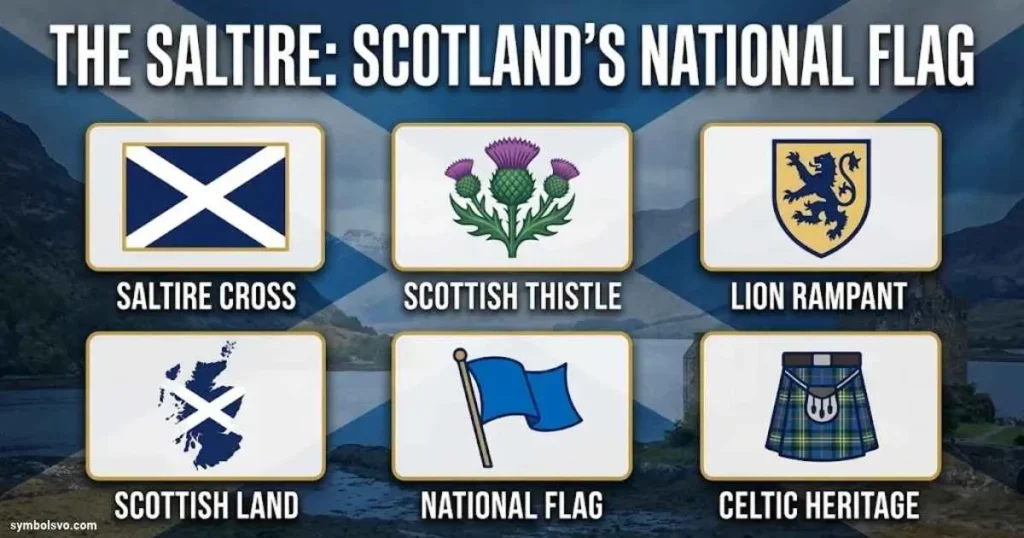
The Scottish Saltire is one of the most recognizable national symbols of Scotland. It features a white diagonal cross on a blue background. The cross is also called St Andrew’s Cross because it represents Saint Andrew, the patron saint of Scotland.
Unlike a traditional flag with a horizontal or vertical cross, the Saltire has two diagonal white bands that extend from one corner to the opposite corner. Its simple design makes it easy to recognize around the world.
What Does the Scottish Saltire Represent?
The Saltire represents Scottish national identity, history, and the country’s connection to Saint Andrew. It is more than a national flag. For many people, it is a symbol of belonging and pride.
The white diagonal cross represents the cross associated with Saint Andrew in Christian tradition. The blue background is commonly connected with Scotland’s national colors.
The flag appears in many places, including:
- Scottish government and public buildings.
- Sporting events and international competitions.
- National celebrations and festivals.
- Scottish community gatherings around the world.
- Homes and businesses displaying Scottish identity.
The Legend Behind St Andrew’s Cross
A popular Scottish tradition connects the Saltire with a battle involving King Óengus II in the ninth century.
According to the legend, Óengus and his army faced a powerful enemy. Before the battle, Saint Andrew appeared in a vision or sign, showing a white cross against a blue sky. The king took this as a promise of victory and encouraged his soldiers.
After the battle, the diagonal cross became associated with Scotland and Saint Andrew.
However, this story is a traditional legend rather than a proven historical account of how the flag originated. Its exact early development is uncertain.
Why Is the Saltire Important Today?
The Saltire remains a central part of Scottish identity. It is flown during national celebrations and used by Scottish teams in international sports.
It also appears in the Union Flag, where the Scottish diagonal cross is combined with the crosses associated with England and Ireland.
For many Scots, the Saltire represents a shared history that connects people across different regions, backgrounds, and generations.
Scottish Thistle: The National Flower of Scotland
The Scottish thistle is one of the country’s oldest and most recognizable national emblems. This prickly flowering plant represents resilience, strength, protection, and pride.
Although its appearance may seem simple, the thistle carries a powerful message. Its sharp spines make it difficult to touch, while its flower gives it a distinctive appearance. This combination has helped it become a symbol of strength and defense.
The thistle is widely used in Scottish art, jewelry, clothing, architecture, and national celebrations.
Why Is the Thistle Scotland’s National Flower?
The exact reason the thistle became Scotland’s national flower is not known with certainty. However, a popular legend connects it with a battle between Scottish defenders and invading Norsemen.
According to the story, enemy soldiers tried to approach a Scottish camp silently at night. One of them stepped on a thorny thistle and cried out in pain. The noise alerted the sleeping Scottish warriors, allowing them to prepare for the attack.
The Scots eventually defeated the invaders. The plant became associated with protection and courage.
This story is commonly linked with the Battle of Largs in 1263, although historians treat it as folklore rather than verified history. The thistle’s national significance developed over time, and it was already an established Scottish emblem by the medieval period.
Scotland’s national flower
What Does the Scottish Thistle Symbolize?
The thistle has several important symbolic meanings:
- Resilience: Its ability to grow in challenging conditions represents strength.
- Protection: Its sharp spines suggest defense against danger.
- Courage: It reflects the determination to stand firm during difficult times.
- National pride: It represents Scotland’s cultural identity.
- Heritage: Its long association with Scotland connects it to historical traditions.
The plant is also connected with the Order of the Thistle, one of Scotland’s highest orders of chivalry. The order recognizes people for their service and is closely associated with the Scottish monarchy.
The Motto Associated With the Thistle
The thistle is often connected with the Latin motto:
Nemo me impune lacessit
This phrase is commonly translated as “No one provokes me with impunity.”
The motto reflects the protective character of the thistle. It suggests that Scotland should not be challenged without consequences.
Today, the thistle remains an important part of Scottish national imagery. It appears on official designs, medals, decorative objects, and souvenirs.
Unicorn: Scotland’s National Animal
The Scottish unicorn is one of the most unusual national symbols in the world. While many countries choose real animals to represent their identity, Scotland has a mythical creature as its national animal.
The unicorn has a horse-like body, a single horn, and a long history in European mythology. It became closely connected with Scottish royalty and heraldry during the medieval period.
In Scotland, the unicorn represents strength, purity, independence, and royal authority.
Why Is the Unicorn Scotland’s National Animal?
The unicorn became popular in Scottish royal symbolism because medieval traditions associated it with extraordinary power and nobility.
In European folklore, the unicorn was often described as a powerful creature that could not easily be captured or controlled. Its legendary nature made it an appealing symbol for kings and royal families.
Scottish monarchs adopted the unicorn as a royal emblem. It later became an important part of Scotland’s coat of arms.
The Royal Collection explains that the unicorn has long been associated with Scottish royalty and continues to appear in royal imagery today.
Royal Collection Trust
What Does the Chained Unicorn Mean?
One of the most interesting details of the Scottish unicorn is the chain around its body.
In Scottish royal heraldry, the unicorn is commonly shown with a chain and a crown. This design reflects the traditional belief that only a king could overpower and command such a powerful creature.
The chain can therefore be understood as a symbol of royal authority. It represents the monarch’s ability to control a creature associated with strength and independence.
The Unicorn in Scotland’s Royal Coat of Arms
The unicorn is one of the supporters in the Royal Coat of Arms of Scotland. It stands opposite a lion and helps represent the historic kingdoms associated with the British monarchy.
Unicorn designs can also be seen on historic buildings, monuments, and decorative features in Scotland.
The Palace of Holyroodhouse in Edinburgh contains several examples of unicorn imagery. These designs show how the mythical animal became part of Scotland’s architectural and royal heritage.
Lion Rampant: Scotland’s Royal Banner
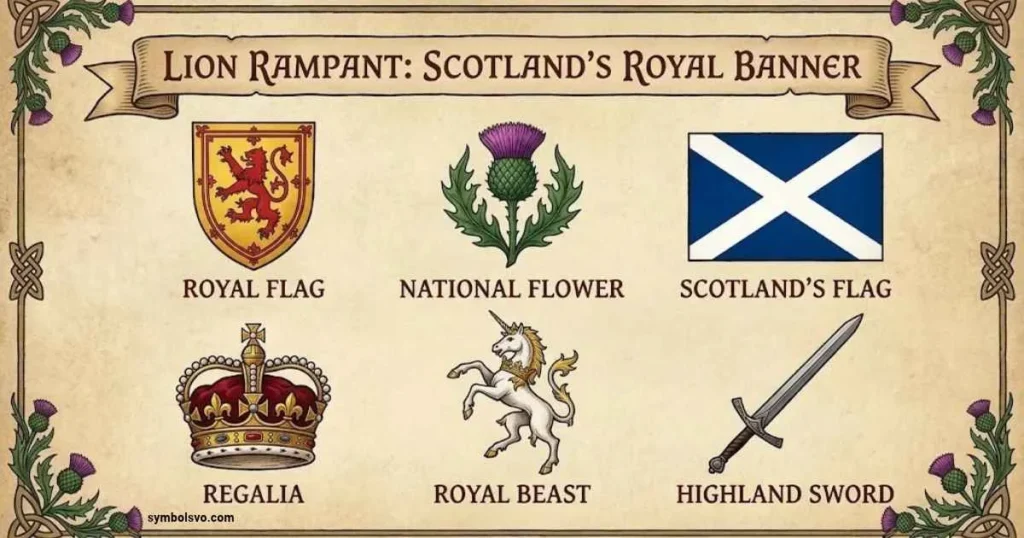
The Lion Rampant is another famous Scottish symbol. It features a red lion standing upright with its front paws raised against a golden background. The design is usually surrounded by a decorative border known as a royal tressure.
The Lion Rampant represents Scottish royalty, power, courage, and monarchy. It is strongly connected with the country’s royal history.
Many people recognize it as a Scottish flag. However, it is important to understand the difference between the Lion Rampant and the Saltire.
What Does the Lion Rampant Represent?
The lion has been a popular symbol of strength and courage in European heraldry for centuries. In Scotland, it became associated with the royal family and the authority of the Scottish monarch.
The design is traditionally linked with William I, also known as William the Lion. However, the Royal Family notes that clear evidence of its use appears during the reign of his successor, Alexander II, by 1222.
The Royal Family
The Lion Rampant is used in Scottish royal arms and official royal imagery.
Difference Between the Saltire and the Lion Rampant
The Saltire and Lion Rampant are both important Scottish symbols, but they serve different purposes.
| Feature | Scottish Saltire | Lion Rampant |
| Design | White diagonal cross on blue | Red upright lion on gold |
| Main meaning | National identity | Royal authority |
| Connection | Saint Andrew | Scottish monarchy |
| Status | National flag of Scotland | Royal banner |
| General use | Can be flown by the public | Official use is restricted |
The Saltire is Scotland’s national flag, while the Lion Rampant is the Royal Banner of the Royal Arms of Scotland.
The Royal Banner is associated with the monarch and certain official representatives. It should not be treated as an alternative national flag.
Honours of Scotland: The Scottish Crown Jewels
The Honours of Scotland are the historic crown jewels of Scotland. They are among the country’s most important royal treasures and represent monarchy, tradition, and national history.
The Honours consist of three main objects:
- The Crown of Scotland.
- The Sceptre.
- The Sword of State.
Together, these objects are known as the Scottish Crown Jewels. They were used in royal ceremonies and represent the historic authority of the Scottish monarchy.
The Crown of Scotland
The Crown of Scotland is the most recognizable object among the Honours. It was made in its present form during the reign of James V in the sixteenth century.
The crown is made from Scottish gold and decorated with precious stones and pearls. Its design reflects the importance of monarchy and royal authority.
It was worn during important royal ceremonies and remains a powerful symbol of Scotland’s royal past.
The Sceptre
The sceptre represents the monarch’s authority to rule. It was presented to James IV in 1494 and is believed to have been a gift from Pope Alexander VI.
Its design includes decorative details that reflect religious and royal traditions.
The Sword of State
The Sword of State represents the monarch’s responsibility to protect the kingdom and uphold justice.
It was presented to James IV in 1507. Its decorated handle and blade make it one of the most distinctive objects in the collection.
Where Are the Honours of Scotland Kept?
The Honours of Scotland are kept at Edinburgh Castle. Visitors can see them in the Crown Room and learn about their history.
The objects survived periods of political upheaval, including the seventeenth century. They were hidden for safekeeping during the English Civil War and later rediscovered in Edinburgh Castle in 1818.
Their survival makes them an important part of Scotland’s royal and national heritage.
Scottish Tartan: A Symbol of Clan Heritage
Scottish tartan is one of the most recognizable patterns associated with Scotland. It consists of intersecting horizontal and vertical stripes that create a repeated checked design.
Tartan is closely connected with Highland clothing, clan heritage, and Scottish cultural identity. It is especially famous because of its association with the traditional kilt.
Different tartan patterns use different colors and stripe arrangements. Some are connected with clans, families, geographical areas, organizations, and individuals.
What Does Scottish Tartan Represent?
Tartan represents heritage, tradition, belonging, and cultural identity. For many people, a particular pattern creates a connection with their family history or ancestral region.
Historically, tartan was an important part of Highland clothing. Over time, different patterns became associated with particular clans and communities.
However, it is not accurate to assume that every Scottish family has a unique tartan. Some patterns are associated with clans, while others represent districts, organizations, or general designs.
How Is Tartan Made?
A tartan pattern is created by weaving colored threads in a repeated arrangement. The vertical and horizontal stripes combine to form a checked design.
The Scottish Register of Tartans defines tartan through a pattern of alternating colored stripes that create a repeated check when woven.
Common features of tartan include:
- Repeating stripes of different colors.
- A balanced arrangement of vertical and horizontal lines.
- Different stripe widths and color combinations.
- A woven structure that creates the familiar checked appearance.
Is There One Official National Tartan of Scotland?
Scotland does not have one universally recognized tartan pattern that represents every Scottish person.
Instead, there are thousands of registered tartan designs. Some are connected with clans and districts, while others represent organizations, individuals, or communities.
The Scottish Register of Tartans was established under the Scottish Register of Tartans Act 2008. It preserves information about historic and modern tartan designs. The register is administered by National Records of Scotland.
Tartan in Modern Scottish Culture
Today, tartan appears in traditional clothing and modern fashion. It is used in kilts, scarves, jackets, skirts, accessories, home decorations, and ceremonial clothing.
It is also popular at Scottish weddings, Highland Games, cultural festivals, and national celebrations.
For many people, wearing tartan is a way to celebrate Scottish ancestry and maintain a connection with family traditions.
Scottish Kilt: Traditional Clothing and Cultural Identity
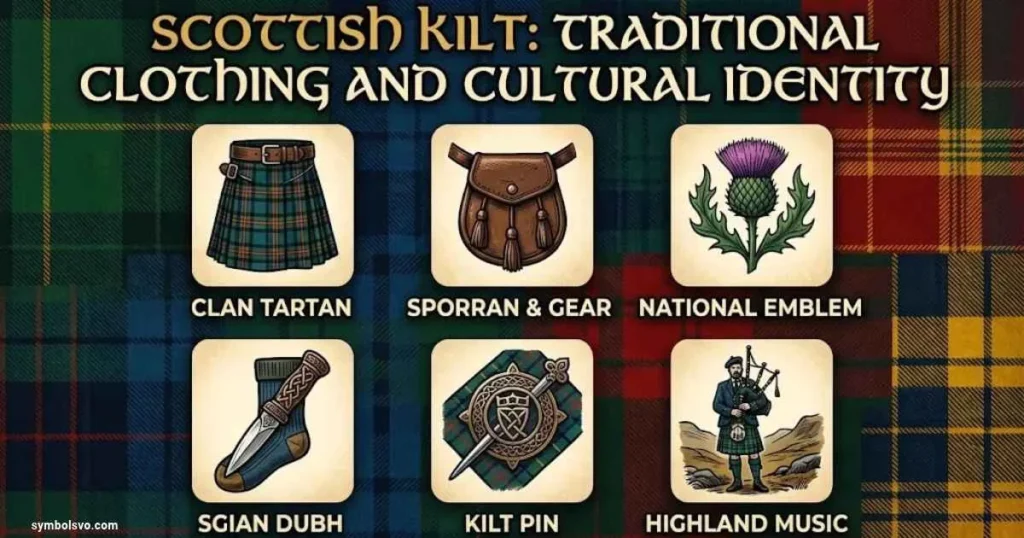
The Scottish kilt is a traditional garment strongly associated with Highland culture. It is usually made from tartan fabric and worn around the waist with pleats at the back.
Although the kilt is often seen as a symbol of Scotland as a whole, its historical roots are closely connected with the Scottish Highlands.
The garment has changed over time. Earlier forms of Highland dress were different from the tailored kilts commonly worn today.
What Does the Scottish Kilt Symbolize?
The kilt represents Scottish heritage, tradition, and cultural pride. It is also associated with clan identity because many people choose tartan patterns connected with their family or ancestral region.
Kilts are worn during:
- Scottish weddings.
- Highland Games.
- Cultural festivals.
- Formal ceremonies.
- Military and pipe band performances.
- St Andrew’s Day celebrations.
Traditional Parts of Highland Dress
A traditional Highland outfit may include several accessories.
| Item | Purpose |
| Kilt | Main garment made from tartan fabric |
| Sporran | Small pouch worn at the front |
| Kilt pin | Decorative pin attached to the kilt |
| Belt and buckle | Traditional waist accessory |
| Ghillie brogues | Traditional style of Scottish footwear |
| Plaid brooch | Decorative accessory used with a plaid |
These accessories help complete the traditional Highland outfit.
The kilt remains one of the most recognizable examples of Scottish cultural clothing. It connects historic Highland traditions with modern celebrations and formal occasions.
Scottish Bagpipes: The Sound of Scottish Heritage
The Scottish bagpipes are among the most famous musical symbols of Scotland. Their distinctive sound is closely associated with Highland culture, military history, traditional ceremonies, and national celebrations.
The best-known type is the Great Highland Bagpipe. It produces a continuous sound through a system of pipes supplied with air from a bag.
Bagpipes are commonly heard at Scottish weddings, funerals, festivals, parades, and Highland Games.
Why Are Bagpipes Associated With Scotland?
Bagpipes have a long history across different regions of the world. They are not unique to Scotland, but the Great Highland Bagpipe became especially important in Scottish cultural life.
The instrument developed a strong connection with Highland communities and military traditions. Pipe music was used during gatherings, ceremonies, and military events.
Over time, bagpipes became a recognizable part of Scotland’s public identity.
The Role of Bagpipes in Scottish Traditions
Bagpipes are used for several cultural and ceremonial purposes.
- Weddings: Pipers often welcome guests or accompany important moments.
- Funerals: Traditional melodies can express respect and remembrance.
- Highland Games: Pipe bands perform during competitions and celebrations.
- Parades: Bagpipes are often used in public processions.
- National events: Pipers help create a strong sense of Scottish identity.
Bagpipe music is also part of a wider musical tradition that includes folk songs, dance tunes, and formal piping competitions.
Saint Andrew: The Patron Saint of Scotland
Saint Andrew is the patron saint of Scotland. His connection with the country is reflected in the national flag, which is known as St Andrew’s Cross or the Scottish Saltire.
In Christian tradition, Andrew was one of the twelve apostles of Jesus Christ. He is believed to have been a fisherman before becoming a follower of Jesus.
His importance in Scotland developed through religious traditions and historical associations.
Why Is Saint Andrew Important to Scotland?
Saint Andrew represents Scotland’s Christian heritage and national identity. His cross became the design associated with the Scottish national flag.
According to Christian tradition, Andrew was crucified on a diagonal cross. This cross became known as the St Andrew’s Cross.
The Saltire uses this diagonal shape to represent the saint.
St Andrew’s Day
Scotland celebrates St Andrew’s Day on November 30 each year.
It is a national day that recognizes the country’s patron saint and celebrates Scottish culture.
Common activities include:
- Traditional Scottish music and dancing.
- Community gatherings and cultural events.
- Scottish food and local celebrations.
- Performances by bagpipe players.
- Displays of the Saltire.
- Events organized by Scottish communities abroad.
St Andrew’s Day is also an opportunity for people to celebrate Scotland’s history and traditions.
Royal Coat of Arms of Scotland
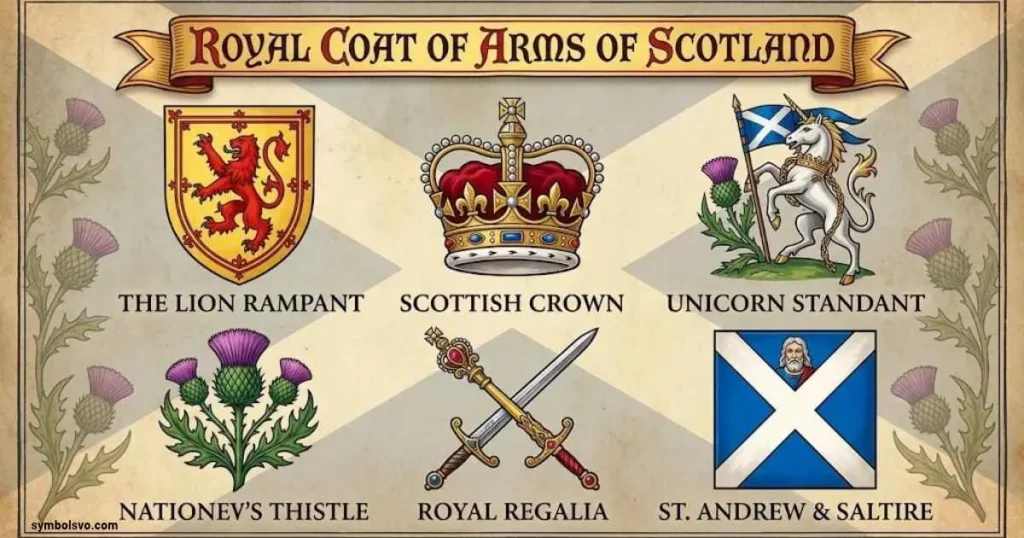
The Royal Coat of Arms of Scotland is an important part of the country’s heraldic history. It contains several symbols associated with the Scottish monarchy, including the red Lion Rampant and unicorn supporters.
Heraldry is the traditional system of identifying individuals, families, institutions, and royal authorities through distinctive designs.
The Scottish royal arms developed over centuries and reflect the history of the country’s monarchy.
Main Features of the Scottish Royal Arms
The design includes several recognizable elements.
The Lion Rampant: The red lion represents the Scottish royal family and monarchy.
The Unicorn: The unicorn represents strength and royal authority. It is traditionally shown with a chain.
The Crown: The crown represents the monarch’s position and authority.
The Royal Tressure: The decorative border around the lion is an important feature of Scottish heraldry.
The Motto: The phrase “Nemo me impune lacessit” is closely associated with Scottish royal and national traditions.
How Is It Different From the UK Royal Coat of Arms?
The Royal Coat of Arms of Scotland reflects the historic Scottish monarchy. The Royal Arms used in other parts of the United Kingdom have a different arrangement of heraldic symbols.
The Scottish version gives special prominence to the Lion Rampant and uses the unicorn as a supporter.
These designs reflect the separate histories of Scotland and England, as well as their later union under one monarch.
St Andrew’s Day Traditions and Scottish Celebrations
St Andrew’s Day is one of the most important annual celebrations connected with Scottish identity.
Held on November 30, it honors Scotland’s patron saint while providing an opportunity to celebrate the country’s culture, music, food, and traditions.
The day is observed in Scotland and by Scottish communities in other parts of the world.
How Do People Celebrate St Andrew’s Day?
Celebrations vary from place to place. Some communities organize formal events, while others prefer family gatherings and local activities.
Popular traditions include:
- Listening to traditional Scottish music.
- Watching Highland dancing performances.
- Enjoying Scottish food.
- Attending cultural festivals.
- Flying the Scottish Saltire.
- Learning about Scottish history and heritage.
The celebration also highlights the importance of community and cultural identity.
For people living outside Scotland, St Andrew’s Day can be a meaningful way to maintain a connection with Scottish ancestry.
Other Traditional Scottish Symbols and Cultural Emblems
Scotland’s cultural identity is not represented by flags and royal emblems alone. Its wildlife, musical instruments, artwork, and natural landscape also contribute to its heritage.
Some of these symbols are closely connected with Scottish history, while others reflect broader Celtic and Highland traditions.
Scottish Wildcat
The Scottish wildcat is a native wild animal associated with Scotland’s natural heritage. It is sometimes called the Highland tiger because of its striped appearance and elusive nature.
Wildcats are important to Scotland’s biodiversity. They are also a reminder of the country’s distinctive wildlife and natural landscapes.
The animal faces serious conservation challenges, particularly because of habitat pressures and crossbreeding with domestic cats.
Although the Scottish wildcat is not an official national animal, it is an important symbol of native wildlife and conservation.
Red Deer
The red deer is one of Scotland’s most recognizable wild animals. It is strongly associated with the Highlands, where deer can be seen across mountains, forests, and open moorland.
Red deer represent the natural beauty of Scotland’s countryside. They are also connected with traditional hunting history and rural life.
Their presence in the Scottish landscape makes them an important part of the country’s natural heritage.
Scottish Harp (Clàrsach)
The Scottish harp, known in Gaelic as the clàrsach, is a traditional musical instrument connected with Scotland’s Gaelic culture.
The harp has a long history in the musical traditions of Scotland and other Celtic regions. It was played in royal courts and gatherings and was associated with poets and musicians.
The instrument represents artistic expression, storytelling, and Gaelic heritage.
Today, the Scottish harp continues to appear in traditional music performances and cultural events.
Celtic Knotwork
Celtic knotwork is a decorative art style made from interwoven lines and repeating patterns. It appears in historic stone carvings, manuscripts, jewelry, and modern designs.
The patterns often have no clear beginning or end. Because of this, people commonly associate them with eternity, connection, continuity, and interconnectedness.
Celtic knotwork is found across several Celtic cultural traditions. It is not exclusively Scottish, but it forms an important part of Scotland’s wider Celtic artistic heritage.
The Highland Landscape
Scotland’s natural landscape is also an important part of its identity. Mountains, lochs, islands, forests, and open moorlands appear in traditional stories, paintings, songs, and national imagery.
The Highlands are especially important in Scottish cultural history. They are associated with Gaelic traditions, clan heritage, traditional clothing, and distinctive music.
Although landscapes are not official national emblems, they are powerful cultural symbols that help people recognize Scotland.
Scottish Symbols in Modern Culture
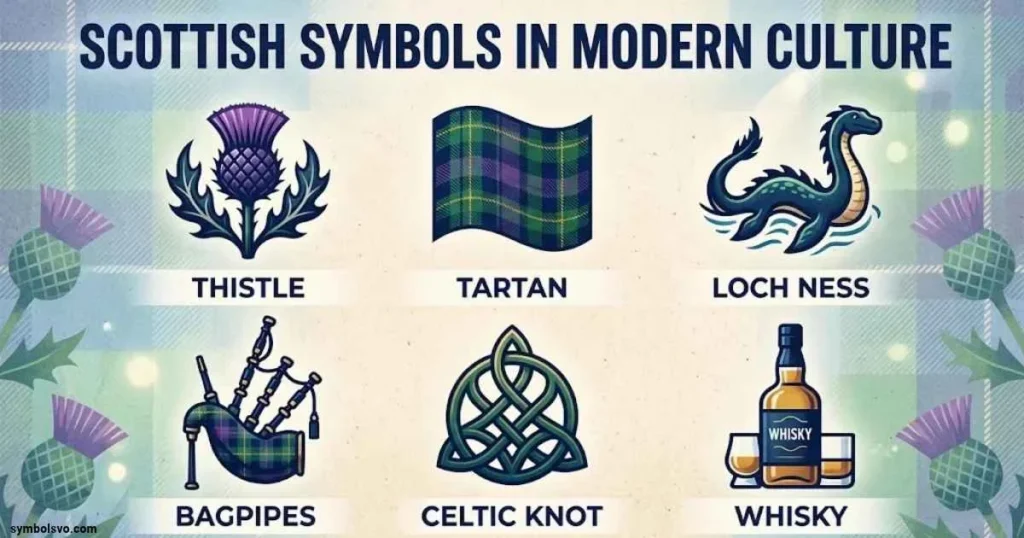
Traditional Scottish symbols remain important in modern life. They are used in public events, education, tourism, fashion, sports, art, and national celebrations.
Their meanings may have changed over time, but they continue to connect people with Scotland’s history and cultural identity.
Scottish Symbols in Sports
The Saltire is commonly displayed at international sporting events. Scottish supporters wave the flag to show national pride and support their teams.
The Lion Rampant also appears in some sporting and cultural settings, although its official status as a royal banner should not be confused with the Saltire’s role as the national flag.
Scottish Symbols in Fashion
Tartan is widely used in modern fashion. Designers incorporate traditional patterns into jackets, scarves, dresses, skirts, and accessories.
The kilt remains popular for weddings, formal ceremonies, and cultural celebrations.
The thistle and Celtic knotwork are also common decorative designs in jewelry, clothing, and accessories.
Scottish Symbols in Tourism
Scottish symbols play an important role in the country’s tourism industry. Visitors often encounter them at historic castles, museums, monuments, gift shops, and cultural festivals.
Edinburgh Castle is especially important because it houses the Honours of Scotland. Historic royal buildings also display unicorns, lions, and other examples of Scottish heraldry.
Scottish Symbols and the Global Scottish Community
Scottish heritage extends far beyond Scotland’s borders. People with Scottish ancestry live in many countries and continue to celebrate their family connections.
Tartan clothing, bagpipe music, Highland dancing, and St Andrew’s Day events help communities maintain links with Scottish traditions.
For many people, these symbols offer a way to celebrate their roots and share Scottish culture with younger generations.
Scottish Symbols and Their Meanings: Quick Comparison
The following table summarizes the most recognizable Scottish symbols and the meanings commonly associated with them.
| Symbol | Category | Main Meaning |
| Saltire | National flag | Scottish identity and Saint Andrew |
| Thistle | National flower | Resilience and protection |
| Unicorn | National animal | Strength and royal authority |
| Lion Rampant | Royal banner | Scottish monarchy |
| Honours of Scotland | Royal regalia | Sovereignty and royal history |
| Tartan | Textile pattern | Clan and cultural heritage |
| Kilt | Traditional clothing | Highland identity |
| Bagpipes | Musical instrument | Scottish music and tradition |
| Saint Andrew | Patron saint | Christian and national heritage |
| Royal Coat of Arms | Heraldic emblem | Scottish royal authority |
| Scottish Harp | Musical instrument | Gaelic culture |
| Scottish Wildcat | Native wildlife | Natural heritage |
| Red Deer | Native wildlife | Highland landscape |
| Celtic Knotwork | Traditional art | Connection and continuity |
| St Andrew’s Day | National celebration | Scottish culture and identity |
These symbols represent different parts of Scotland’s history. Some are connected with the monarchy, while others reflect everyday traditions, religious beliefs, and the natural environment.
FAQs About Scottish Symbols
What Are Scotland’s National Symbols?
Scotland’s best-known national symbols include the Saltire, thistle, and unicorn. The Saltire is the national flag, the thistle is the national flower, and the unicorn is the national animal. Other important cultural symbols include tartan, the kilt, and bagpipes.
What Is the Most Famous Symbol of Scotland?
The Scottish Saltire is arguably the most recognizable national symbol. Its white diagonal cross on a blue background represents Saint Andrew and Scottish national identity. It is widely displayed at sporting events, national celebrations, and public buildings.
What Does the Scottish Saltire Represent?
The Saltire represents Saint Andrew, the patron saint of Scotland. Its white diagonal cross reflects the cross associated with the saint in Christian tradition. Today, it is widely recognized as a symbol of Scottish identity and national pride.
Why Is the Thistle Scotland’s National Flower?
The thistle became Scotland’s national flower through a long historical association with the country. A popular legend says its sharp spines helped alert Scottish warriors to an enemy attack. The story is folklore, but the flower has become a lasting emblem of protection and resilience.
Why Is the Unicorn Scotland’s National Animal?
The unicorn became a Scottish royal symbol during the medieval period. It was associated with strength, purity, and power. Scottish royal heraldry adopted the mythical creature, and it continues to appear in the Royal Coat of Arms of Scotland.
What Does the Lion Rampant Represent?
The Lion Rampant represents the Scottish monarchy and royal authority. Its design features a red lion standing upright on a golden background. It is used in the Royal Banner of the Royal Arms of Scotland and should not be confused with the national Saltire.
What Is the Difference Between the Saltire and the Lion Rampant?
The Saltire is Scotland’s national flag and features a white diagonal cross on blue. The Lion Rampant is the Scottish royal banner and shows a red lion on gold. Their designs and official purposes are different.
Can Anyone Fly the Lion Rampant Flag?
The Lion Rampant is the Royal Banner of the Royal Arms of Scotland. Its official use is connected with the monarch and authorized royal representatives. It is not a general national flag like the Saltire, so people should understand its distinct heraldic status.
What Are the Honours of Scotland?
The Honours of Scotland are the country’s historic crown jewels. They consist of the Crown of Scotland, the Sceptre, and the Sword of State. These objects represent the Scottish monarchy and were used in important royal ceremonies.
Where Are the Scottish Crown Jewels Kept?
The Honours of Scotland are kept at Edinburgh Castle. Visitors can view them in the Crown Room and learn about their history. They are among Scotland’s most important surviving royal treasures.
Does Scotland Have an Official National Tartan?
There is no single universally recognized tartan pattern that represents every Scottish person. Scotland has thousands of tartan designs connected with clans, districts, organizations, and individuals. The Scottish Register of Tartans preserves information about these patterns.
What Do Scottish Clan Tartans Represent?
Clan tartans are patterns associated with particular Scottish clans and family traditions. They can represent heritage, belonging, and connections with ancestors. However, not every Scottish surname has its own tartan, and some patterns are designed for wider use.
Why Is Saint Andrew Important to Scotland?
Saint Andrew is the patron saint of Scotland. His connection with the country is reflected in the Saltire, which is also known as St Andrew’s Cross. Scotland celebrates St Andrew’s Day every year on November 30.
What Does the Scottish Thistle Motto Mean?
The Latin phrase “Nemo me impune lacessit” is commonly translated as “No one provokes me with impunity.” It reflects the thistle’s protective character and is associated with Scottish national and royal traditions.
What Are Some of the Oldest Scottish Symbols?
The Saltire, thistle, and Lion Rampant have long histories in Scotland’s national and royal traditions. Their exact origins and development differ. The unicorn also became an important emblem of Scottish royalty during the medieval period.
Which Scottish Symbols Represent National Pride?
The Saltire, thistle, tartan, kilt, and bagpipes are widely associated with Scottish national pride. They represent the country’s history, cultural traditions, and shared identity. Their use in celebrations and sporting events helps keep these traditions visible.
What Does the Chain Around the Scottish Unicorn Mean?
The chain around the unicorn in Scottish royal heraldry represents the idea that only a king could command such a powerful creature. It reflects royal authority and the unicorn’s legendary strength.
Why Are Bagpipes Associated With Scotland?
The Great Highland Bagpipe became closely connected with Scottish Highland culture, military traditions, and public ceremonies. Although bagpipes are found in other parts of the world, the Scottish style has become one of the country’s most recognizable cultural symbols.
Conclusion: The Meaning Behind Scotland’s Symbols
Scottish symbols tell the story of a country shaped by history, tradition, royal heritage, music, and cultural pride. The Saltire represents national identity, the thistle reflects resilience, and the unicorn symbolizes strength and royal authority. Meanwhile, the Lion Rampant, Honours of Scotland, and Royal Coat of Arms preserve important parts of Scotland’s monarchy and heraldic history.
Other traditions, including tartan, the Highland kilt, bagpipes, and Celtic knotwork, show how Scottish culture has developed and continued across generations. Native wildlife such as the Scottish wildcat and red deer also connects the country’s identity with its natural landscape.
These symbols are more than decorative designs or historical objects. They help preserve stories, express belonging, and connect modern communities with Scotland’s past. Together, they offer a meaningful picture of Scotland’s national identity and cultural heritage.
Meta Description

I’m Nathan Holloway, a passionate researcher and writer with a deep interest in symbols, signs, and their hidden meanings. I enjoy exploring how symbols have influenced different civilizations, religions, and modern communication. Through my work, I aim to make complex historical and cultural concepts easy to understand for readers of all backgrounds. Every article I write is carefully researched to provide reliable and engaging information.
Books:
- Beyond the Symbol
- The Secret Meanings of Everyday Signs
Author 2: Grace Whitmore
Description:
My name is Grace Whitmore, and I love discovering the stories behind the world’s most fascinating symbols. I spend my time researching ancient civilizations, mythology, spiritual traditions, and modern iconography to uncover the meanings people often overlook. I believe that every symbol has a history worth telling, and I enjoy sharing that knowledge in a simple and reader-friendly way.
Books:
- Echoes of Ancient Symbols
- The Symbolic World
 Mason Ellington
 Daniel Brooks