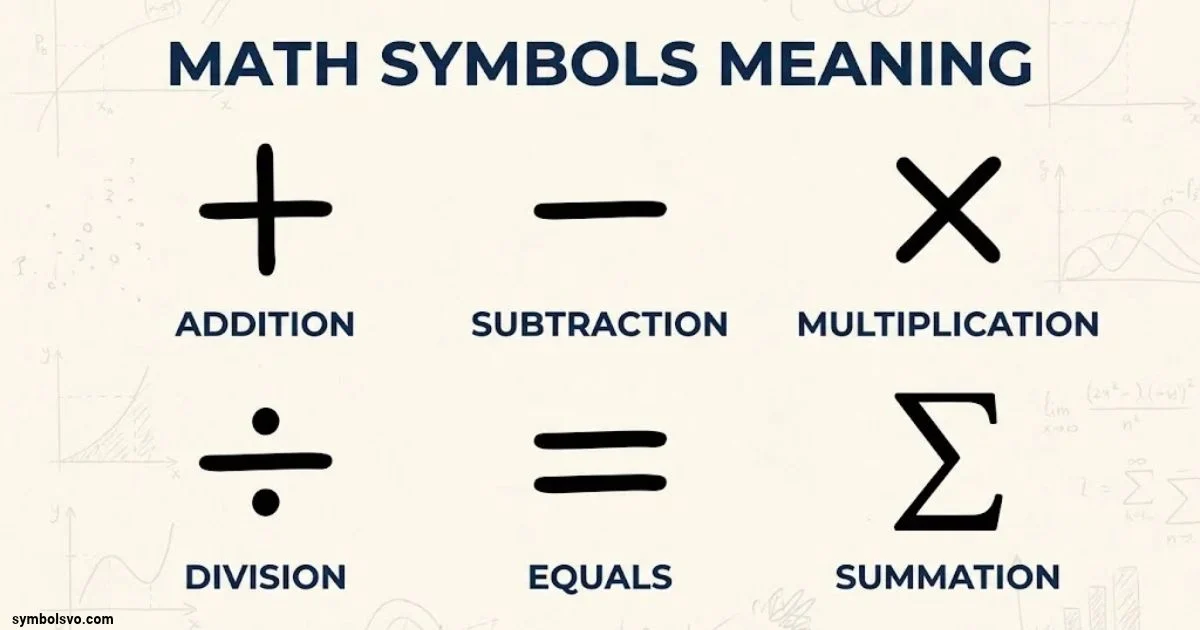
Mathematical symbols make numbers, calculations, equations, and complex ideas easier to understand. From simple addition and subtraction signs to advanced calculus and statistics notation, each symbol has a specific purpose. Learning their meanings can help you solve problems, understand formulas, and read mathematical expressions correctly.
If you are looking for math symbols meaning, this guide brings together a wide collection of mathematical symbols with their names, explanations, and examples. You can also find commonly used symbols, Greek letters, algebra notation, geometry signs, and symbols used in different branches of mathematics.
Whether you are a student, teacher, parent, or someone who wants a quick mathematical reference, you can use this article to identify symbols and understand how they work. Copy the symbols directly and use the examples to see how they appear in real mathematical expressions.
All Mathematical Symbols
Mathematical symbols are special characters used to represent numbers, operations, relationships, measurements, and mathematical concepts. Some symbols are familiar from elementary school, while others are used in advanced subjects such as calculus, discrete mathematics, and statistics.
Here is a quick collection of mathematical symbols organized by their general purpose.
| Category | Mathematical symbols |
| Basic arithmetic | +, −, ×, ÷, = |
| Comparison | <, >, ≤, ≥, ≠ |
| Advanced operations | √, ∛, !, % |
| Algebra | x, y, a, b, ∝, ≡ |
| Fractions | ½, ⅓, ¼, ¾ |
| Set theory | ∈, ∉, ∪, ∩, ∅ |
| Logic | ∧, ∨, ¬, ⇒, ⇔ |
| Geometry | ∠, °, ⊥, ∥, △ |
| Calculus | ∫, ∬, ∂, ∇, ∞ |
| Statistics | μ, σ, Σ, x̄, ρ |
| Greek letters | α, β, γ, θ, π, Ω |
Mathematical notation can change depending on the subject. For example, the Greek letter π represents the ratio of a circle’s circumference to its diameter, while Σ is commonly used to represent summation.
Some symbols also have more than one meaning. The letter x can represent an unknown number, a variable, or a coordinate, depending on the expression.
Mathematical Symbols With Names And Meanings
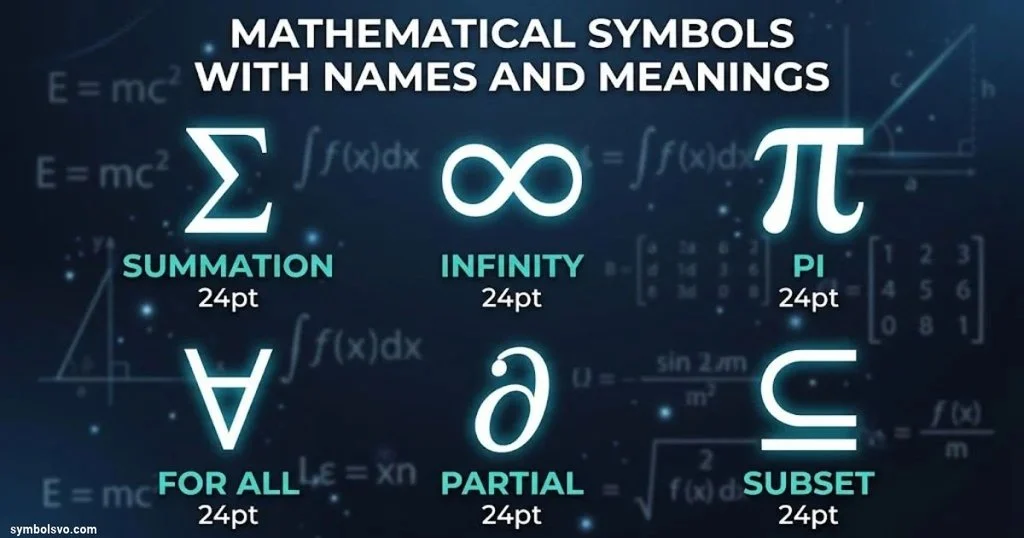
This section provides a useful reference to mathematical symbols, their names, and their common meanings. You can copy the characters directly and use them in notes, assignments, documents, or mathematical expressions.
Basic Arithmetic Symbols
| Symbol | Name | Meaning |
| + | Plus sign | Addition |
| − | Minus sign | Subtraction or negative value |
| × | Multiplication sign | Multiplication |
| ÷ | Division sign | Division |
| / | Slash | Division or fraction |
| = | Equal sign | Two values are equal |
| ≠ | Not equal to | Two values are different |
| ± | Plus-minus sign | Positive or negative alternatives |
| ∓ | Minus-plus sign | Opposite of plus-minus |
| % | Percent sign | Per hundred |
| ‰ | Per mille sign | Per thousand |
| ! | Factorial | Product of consecutive positive integers |
| √ | Square root | Number that produces a given value when squared |
| ∛ | Cube root | Number that produces a given value when cubed |
| ∜ | Fourth root | Number raised to the fourth power |
| ∞ | Infinity | Unlimited or unbounded quantity |
Comparison Symbols
| Symbol | Name | Meaning |
| < | Less than | Smaller than |
| > | Greater than | Larger than |
| ≤ | Less than or equal to | Smaller than or equal to |
| ≥ | Greater than or equal to | Larger than or equal to |
| ≈ | Approximately equal to | Nearly the same value |
| ≃ | Asymptotically equal to / approximately equal to | Meaning depends on context |
| ≡ | Identically equal to | Identical values or equivalence |
| ≅ | Approximately equal or congruent | Depends on mathematical context |
| ∝ | Proportional to | Changes in proportion |
| ≪ | Much less than | Significantly smaller |
| ≫ | Much greater than | Significantly larger |
Fraction And Decimal Symbols
| Symbol | Name | Meaning |
| ½ | One-half | One divided by two |
| ⅓ | One-third | One divided by three |
| ¼ | One-quarter | One divided by four |
| ⅔ | Two-thirds | Two divided by three |
| ¾ | Three-quarters | Three divided by four |
| ⅛ | One-eighth | One divided by eight |
| ⅜ | Three-eighths | Three divided by eight |
| ⅝ | Five-eighths | Five divided by eight |
| ⅞ | Seven-eighths | Seven divided by eight |
| . | Decimal point | Separates whole and fractional parts |
Other Useful Mathematical Symbols
| Symbol | Name | Meaning |
| ∴ | Therefore | Shows a conclusion |
| ∵ | Because | Gives a reason |
| ∠ | Angle | Represents an angle |
| ° | Degree | Measures angles or temperature |
| ⊥ | Perpendicular | Forms a right angle |
| ∥ | Parallel | Lines that do not intersect in a plane |
| ∅ | Empty set | Set containing no elements |
| ∈ | Element of | Belongs to a set |
| ∉ | Not an element of | Does not belong to a set |
| ∀ | For all | Applies to every element |
| ∃ | There exists | At least one element exists |
| ∑ | Summation | Adds a sequence of values |
| ∫ | Integral | Represents integration |
| ∂ | Partial derivative | Derivative with respect to one variable |
| ∇ | Nabla | Used for gradient and other vector operations |
Remember that a symbol’s meaning depends on the mathematical expression in which it appears. For example, the vertical bar | can mean divides, absolute value, or such that in different mathematical contexts.
Common Mathematical Symbols And Their Meanings
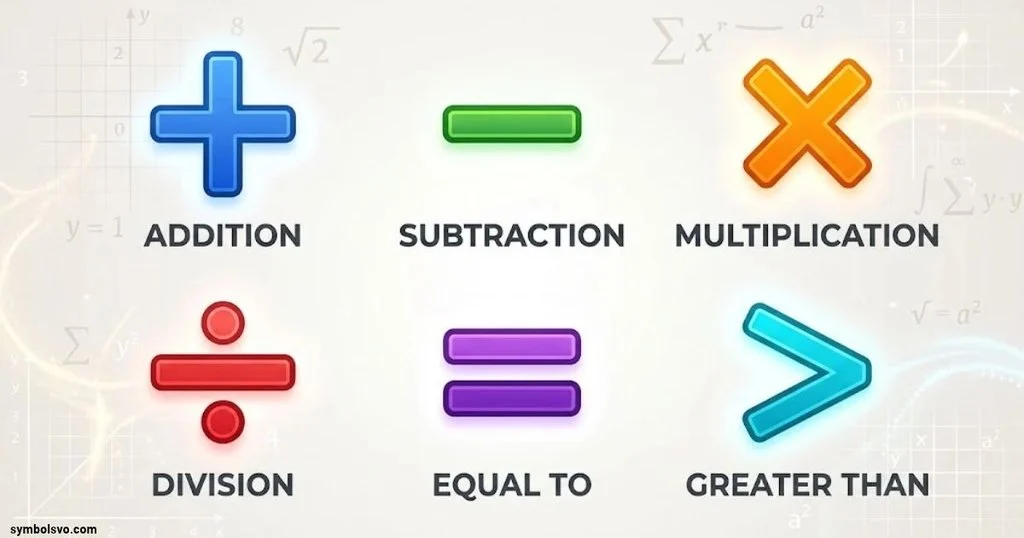
Some mathematical symbols appear in almost every area of mathematics. Students learn them early because they are necessary for basic calculations and understanding equations.
Here are the most frequently used math symbols and their everyday applications.
| Symbol | Name | Meaning | Example |
| + | Addition | Adds two numbers | 5 + 3 = 8 |
| − | Subtraction | Finds the difference | 9 − 4 = 5 |
| × | Multiplication | Multiplies numbers | 4 × 3 = 12 |
| ÷ | Division | Divides one number by another | 12 ÷ 4 = 3 |
| = | Equal to | Shows equal values | 5 + 2 = 7 |
| ≠ | Not equal to | Shows different values | 5 ≠ 8 |
| < | Less than | Shows a smaller value | 3 < 7 |
| > | Greater than | Shows a larger value | 9 > 4 |
| ≤ | Less than or equal to | Shows a smaller or equal value | x ≤ 10 |
| ≥ | Greater than or equal to | Shows a larger or equal value | x ≥ 5 |
| % | Percent | Represents a fraction out of 100 | 50% = 0.5 |
| √ | Square root | Finds the square root | √25 = 5 |
| π | Pi | Circle constant | π ≈ 3.14159 |
| ∞ | Infinity | Represents an unbounded quantity | x → ∞ |
| ± | Plus or minus | Represents two possible signs | x = ±5 |
Why Are These Symbols Important?
Mathematical symbols make calculations shorter and easier to read. Instead of writing long explanations, you can use a single character to communicate a mathematical operation or relationship.
For example:
- 8 + 4 = 12 shows an addition problem.
- 15 > 10 shows that fifteen is greater than ten.
- x ≠ 0 means that x cannot equal zero.
- √64 = 8 shows the square root of sixty-four.
- 50% represents fifty out of every hundred.
Understanding these common signs gives you a foundation for learning more advanced mathematical concepts.
Mathematical Symbols With Examples
Knowing a symbol’s name is useful, but seeing it in an actual expression makes its meaning easier to understand. The following examples show how different mathematical symbols work in calculations and equations.
Addition, Subtraction, Multiplication, And Division
| Symbol | Example | Explanation |
| + | 7 + 5 = 12 | Adds seven and five |
| − | 10 − 6 = 4 | Subtracts six from ten |
| × | 8 × 3 = 24 | Multiplies eight by three |
| ÷ | 20 ÷ 4 = 5 | Divides twenty by four |
| / | 12/3 = 4 | Represents division |
Comparison Examples
| Symbol | Example | Explanation |
| = | 4 + 3 = 7 | Both sides have the same value |
| ≠ | 5 ≠ 9 | Five is different from nine |
| < | 2 < 6 | Two is less than six |
| > | 10 > 7 | Ten is greater than seven |
| ≤ | x ≤ 8 | x can be eight or any smaller value |
| ≥ | x ≥ 3 | x can be three or any larger value |
| ≈ | π ≈ 3.14 | Pi is approximately 3.14 |
Powers And Roots
| Symbol | Example | Explanation |
| ² | 5² = 25 | Five squared |
| ³ | 2³ = 8 | Two cubed |
| √ | √36 = 6 | Square root of 36 |
| ∛ | ∛27 = 3 | Cube root of 27 |
| ! | 4! = 24 | Four factorial |
Advanced Mathematical Examples
| Symbol | Example | Explanation |
| ∑ | ∑(1 to 4) = 10 | Adds 1 + 2 + 3 + 4 |
| ∫ | ∫2x dx = x² + C | Finds an indefinite integral |
| ∂ | ∂f/∂x | Partial derivative with respect to x |
| ∈ | 3 ∈ {1, 2, 3} | Three belongs to the set |
| ∪ | A ∪ B | Union of two sets |
| ∩ | A ∩ B | Intersection of two sets |
| ∀ | ∀x, x² ≥ 0 | For every real number x |
| ∃ | ∃x such that x = 5 | At least one such value exists |
These examples cover different mathematical situations. Some symbols represent operations, while others describe relationships between numbers, sets, or functions.
Mathematical Symbols Chart
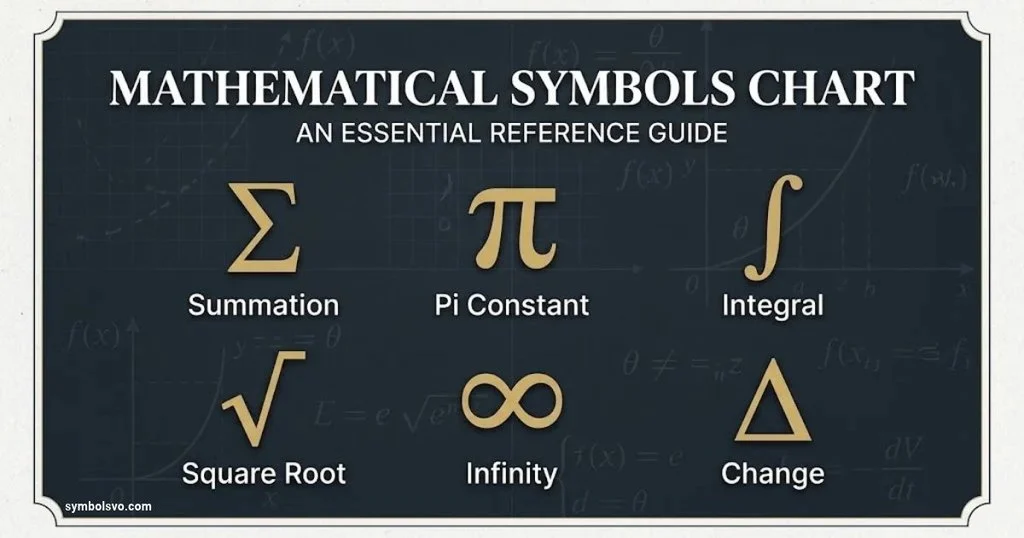
A mathematical symbols chart provides a quick way to identify characters without reading long explanations. You can use this collection as a reference when completing homework, preparing lessons, or writing mathematical expressions.
Basic Math Symbols Chart
| Symbol | Symbol name | Meaning |
| + | Plus | Addition |
| − | Minus | Subtraction |
| × | Times | Multiplication |
| ÷ | Division | Division |
| = | Equals | Equality |
| ≠ | Not equal | Inequality |
| < | Less than | Smaller value |
| > | Greater than | Larger value |
| ≤ | Less than or equal | Smaller or equal |
| ≥ | Greater than or equal | Larger or equal |
| ± | Plus-minus | Two possible signs |
| % | Percent | Per hundred |
| √ | Square root | Root operation |
| ∛ | Cube root | Third root |
| ! | Factorial | Product of consecutive integers |
Advanced Math Symbols Chart
| Symbol | Symbol name | Meaning |
| ∞ | Infinity | Unbounded quantity |
| ∑ | Summation | Sum of values |
| ∏ | Product | Product of values |
| ∫ | Integral | Integration |
| ∬ | Double integral | Integration over a two-dimensional region |
| ∮ | Contour integral | Integral along a closed curve |
| ∂ | Partial derivative | Derivative of a multivariable function |
| ∇ | Nabla | Vector differential operator |
| Δ | Delta | Change or difference |
| ∴ | Therefore | Conclusion |
| ∵ | Because | Reason |
| ∝ | Proportional to | Proportional relationship |
| ≡ | Equivalent or identical | Context-dependent equivalence |
| ∀ | For all | Universal statement |
| ∃ | There exists | Existence statement |
Mathematical Set And Logic Symbols Chart
| Symbol | Name | Meaning |
| ∈ | Element of | Belongs to a set |
| ∉ | Not an element of | Does not belong to a set |
| ⊂ | Subset | Proper subset in common conventions |
| ⊆ | Subset or equal | Subset that may be equal |
| ⊃ | Superset | Proper superset in common conventions |
| ⊇ | Superset or equal | Superset that may be equal |
| ∪ | Union | Combines sets |
| ∩ | Intersection | Common elements |
| ∅ | Empty set | Set with no elements |
| ∧ | Logical AND | Both conditions are true |
| ∨ | Logical OR | At least one condition is true |
| ¬ | Logical NOT | Negation |
| ⇒ | Implies | Logical implication |
| ⇔ | If and only if | Logical equivalence |
You can use this chart to identify mathematical notation quickly. Keep in mind that some specialized symbols have different interpretations depending on the textbook, subject, or mathematical convention.
Mathematical Symbols In Algebra
Algebra uses letters, numbers, and mathematical symbols to represent unknown values and describe relationships. Unlike basic arithmetic, algebra allows you to work with variables and solve equations without knowing every number in advance.
Common Algebra Symbols
| Symbol | Name | Meaning |
| x, y, z | Variables | Represent unknown or changing values |
| a, b, c | Constants or coefficients | Represent fixed values or multipliers |
| + | Plus | Addition |
| − | Minus | Subtraction |
| = | Equal sign | Shows equality |
| ≠ | Not equal | Shows unequal values |
| ± | Plus-minus | Represents positive and negative solutions |
| √ | Square root | Finds a square root |
| ² | Squared | Raises a value to power two |
| ³ | Cubed | Raises a value to power three |
| ∝ | Proportional to | Shows proportional relationships |
| ≡ | Identically equal | Shows identity or equivalence |
Algebra Symbols With Examples
1. Variable (x)
A variable represents an unknown or changing number.
Example:
x + 5 = 12
To find x, subtract five from both sides.
x = 7
2. Exponent (²)
An exponent tells you how many times a number is multiplied by itself.
Example:
4² = 4 × 4 = 16
3. Square Root (√)
The square root finds a number that produces the original value when multiplied by itself.
Example:
√49 = 7
4. Plus-Minus (±)
The plus-minus symbol can represent two possible values.
Example:
x = ±4
This means x can be 4 or −4.
Common Algebraic Expressions
| Expression | Meaning |
| x + y | Sum of two variables |
| x − y | Difference between two variables |
| xy | Product of x and y |
| x/y | Division of x by y |
| x² | x multiplied by itself |
| 2x + 3 | Twice x plus three |
| x² − 4 = 0 | A quadratic equation |
| y = mx + b | Slope-intercept form of a linear equation |
Algebraic notation helps you describe patterns, solve equations, and understand how one quantity changes in relation to another.
Discrete Mathematics Symbols
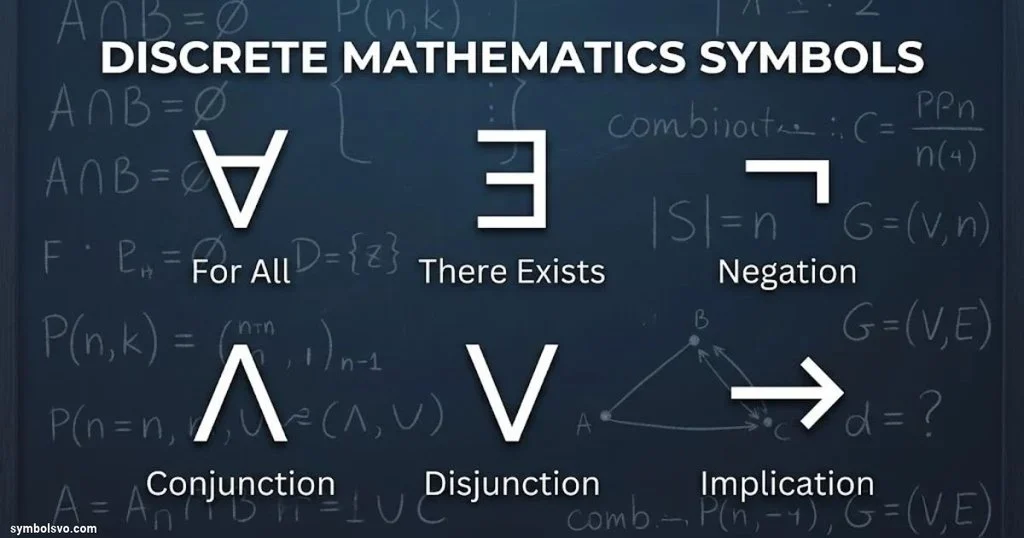
Discrete mathematics studies separate and countable objects rather than continuously changing quantities. It is widely used in computer science, logic, algorithms, graph theory, and information technology.
Its symbols help describe sets, logical statements, relationships, and mathematical structures.
Logic Symbols
| Symbol | Name | Meaning |
| ∧ | Logical AND | Both statements must be true |
| ∨ | Logical OR | At least one statement must be true |
| ¬ | Logical NOT | Reverses a truth value |
| ⇒ | Implies | One statement leads to another |
| ⇔ | If and only if | Both statements imply each other |
| ⊕ | Exclusive OR | Exactly one condition is true |
| ∀ | Universal quantifier | For every element |
| ∃ | Existential quantifier | There exists an element |
| ∄ | There does not exist | No such element exists |
| ∴ | Therefore | Shows a conclusion |
Relations And Set Symbols
| Symbol | Name | Meaning |
| ∈ | Element of | Membership in a set |
| ∉ | Not an element of | Non-membership |
| ∪ | Union | Combination of sets |
| ∩ | Intersection | Shared elements |
| ⊆ | Subset or equal | Every element belongs to another set |
| ⊂ | Proper subset | Subset that is not equal |
| ∅ | Empty set | Contains no elements |
| Aᶜ | Complement | Elements outside A within a universal set |
| A × B | Cartesian product | Ordered pairs from two sets |
Other Discrete Mathematics Notation
| Symbol | Name | Meaning |
| ℕ | Natural numbers | Set of natural numbers |
| ℤ | Integers | Positive and negative whole numbers, including zero |
| ℚ | Rational numbers | Numbers expressible as fractions of integers |
| ℝ | Real numbers | All real-valued numbers |
| ℂ | Complex numbers | Numbers involving real and imaginary parts |
| |A| | Cardinality | Number of elements in a finite set |
| n! | Factorial | Product of positive integers up to n |
| ⌊x⌋ | Floor function | Greatest integer less than or equal to x |
| ⌈x⌉ | Ceiling function | Smallest integer greater than or equal to x |
| mod | Modulo | Remainder after division |
Examples In Discrete Mathematics
- P ∧ Q means both P and Q are true.
- P ∨ Q means at least one of P or Q is true.
- ¬P means P is false.
- ∀x ∈ ℕ means for every natural number x.
- ∃x ∈ ℤ means there exists an integer x.
- A ∩ B represents the elements shared by sets A and B.
These symbols are particularly useful when studying programming logic, mathematical proofs, algorithms, and computer science.
Set Theory Symbols
Set theory is the branch of mathematics that studies collections of objects called sets. A set can contain numbers, letters, names, or other mathematical objects.
For example:
A = {1, 2, 3, 4}
This means set A contains four elements.
Set theory symbols help describe membership, subsets, unions, intersections, and relationships between different collections.
Common Set Theory Symbols And Meanings
| Symbol | Name | Meaning |
| { } | Braces | Enclose elements of a set |
| ∈ | Element of | Belongs to a set |
| ∉ | Not an element of | Does not belong to a set |
| ∅ | Empty set | Set with no elements |
| ∪ | Union | Combines elements of two sets |
| ∩ | Intersection | Contains common elements |
| ⊂ | Proper subset | A subset that is not equal to the larger set |
| ⊆ | Subset or equal | Every element belongs to the other set |
| ⊃ | Proper superset | Contains another set as a proper subset |
| ⊇ | Superset or equal | Contains another set or is equal to it |
| Set difference | Elements in one set but not another | |
| Aᶜ | Complement | Elements outside A in the universal set |
| × | Cartesian product | Creates ordered pairs |
| |A| | Cardinality | Number of elements in A |
Set Theory Symbols With Examples
Suppose:
A = {1, 2, 3}
B = {3, 4, 5}
Here is how different set operations work.
1. Union (∪)
A ∪ B = {1, 2, 3, 4, 5}
The union combines all distinct elements from both sets.
2. Intersection (∩)
A ∩ B = {3}
The intersection contains only elements that appear in both sets.
3. Set Difference (\)
A \ B = {1, 2}
This operation contains elements found in A but not in B.
4. Membership (∈)
2 ∈ A
This means two belongs to set A.
5. Non-membership (∉)
5 ∉ A
This means five does not belong to set A.
6. Subset (⊆)
{1, 2} ⊆ A
This means every element in the smaller set is also present in A.
Set theory is used in probability, computer science, logic, statistics, and many other mathematical subjects.
Geometry Symbols
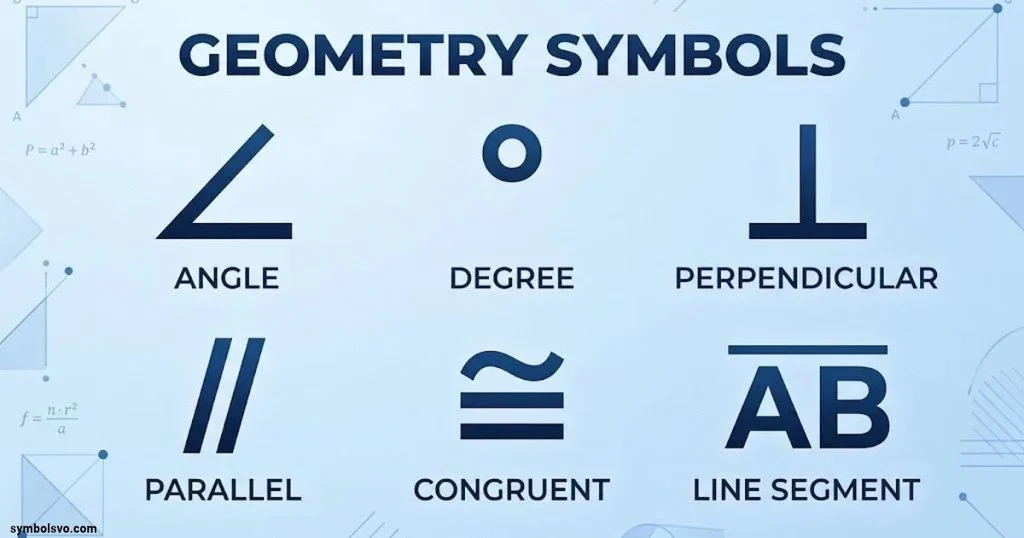
Geometry is the branch of mathematics that studies shapes, sizes, angles, lines, distances, and spatial relationships. Its symbols make it easier to describe geometric figures and solve problems involving measurements.
Common Geometry Symbols
| Symbol | Name | Meaning |
| ∠ | Angle | Represents an angle |
| ° | Degree | Measures an angle |
| △ | Triangle | Represents a triangular shape |
| ∥ | Parallel | Lines that do not meet in a plane |
| ⊥ | Perpendicular | Lines that meet at 90 degrees |
| ≅ | Congruent | Same shape and size |
| ∼ | Similar | Same shape but not necessarily the same size |
| π | Pi | Circle constant |
| r | Radius | Distance from center to circle |
| d | Diameter | Distance across a circle through its center |
| ⌀ | Diameter sign | Indicates diameter in technical drawings |
| AB | Line segment notation | Represents a segment between A and B when appropriately marked |
| ∴ | Therefore | Indicates a conclusion |
Angle Symbols
| Symbol or notation | Name | Meaning |
| ∠ | Angle | General angle notation |
| ∠ABC | Angle ABC | Angle with vertex at B |
| ∠90° | Right angle | Angle measuring 90 degrees |
| ∠45° | Acute angle | Angle smaller than 90 degrees |
| ∠120° | Obtuse angle | Angle greater than 90° but less than 180° |
| 180° | Straight angle | Forms a straight line |
| 360° | Full angle | One complete turn |
Common Geometry Formulas And Examples
| Shape | Formula | Meaning |
| Square | A = s² | Area equals side squared |
| Rectangle | A = l × w | Length multiplied by width |
| Triangle | A = ½ × b × h | Half the base multiplied by height |
| Circle | A = πr² | Area of a circle |
| Circle | C = 2πr | Circumference |
| Cube | V = s³ | Volume of a cube |
| Rectangular prism | V = l × w × h | Length multiplied by width and height |
Examples Of Geometry Notation
- ∠ABC = 90° means angle ABC is a right angle.
- AB ∥ CD means line AB is parallel to line CD.
- AB ⊥ CD means line AB is perpendicular to line CD.
- △ABC ≅ △DEF means the two triangles are congruent.
- △ABC ∼ △DEF means the triangles are similar.
Geometry symbols are useful in school assignments, engineering drawings, construction plans, architecture, and technical diagrams.
Calculus Symbols
Calculus studies how quantities change and how small values accumulate. It is commonly divided into differential calculus and integral calculus.
Its symbols are used to represent derivatives, integrals, limits, rates of change, and mathematical functions.
Common Calculus Symbols And Meanings
| Symbol | Name | Meaning |
| ∫ | Integral | Represents integration |
| ∬ | Double integral | Integration over a two-dimensional region |
| ∭ | Triple integral | Integration over a three-dimensional region |
| ∮ | Contour integral | Integration along a closed curve |
| d/dx | Derivative operator | Differentiation with respect to x |
| dy/dx | Derivative | Rate of change of y with respect to x |
| ∂ | Partial derivative | Differentiation with respect to one variable |
| ∇ | Nabla | Vector differential operator |
| lim | Limit | Value approached by a function |
| Δ | Delta | Change in a quantity |
| ∞ | Infinity | Unbounded quantity |
| dx | Differential | Infinitesimal change in x in calculus notation |
| f′(x) | First derivative | Derivative of a function |
| f″(x) | Second derivative | Derivative of the first derivative |
Calculus Symbols With Examples
1. Derivative (dy/dx)
The derivative describes how quickly one quantity changes in relation to another.
Example:
y = x²
dy/dx = 2x
The derivative of x squared is 2x.
2. Integral (∫)
An integral is used to find accumulated quantities and areas under curves.
Example:
∫2x dx = x² + C
Here, C represents the constant of integration.
3. Limit (lim)
A limit describes the value a function approaches as its input gets closer to a particular number.
Example:
lim (x → 2) (x + 3) = 5
4. Partial Derivative (∂)
Partial derivatives are used when a function contains multiple variables.
Example:
f(x, y) = x² + 3y
∂f/∂x = 2x
The derivative is calculated with respect to x while treating y as constant.
Important Calculus Notation
- f′(x) — First derivative of a function.
- f″(x) — Second derivative of a function.
- ∫f(x) dx — Indefinite integral.
- ∫ₐᵇ f(x) dx — Definite integral from a to b.
- lim x→a f(x) — Limit of a function as x approaches a.
- ∇f — Gradient of a scalar function.
These symbols are commonly used in physics, engineering, economics, computer science, and advanced mathematics.
Statistics Symbols
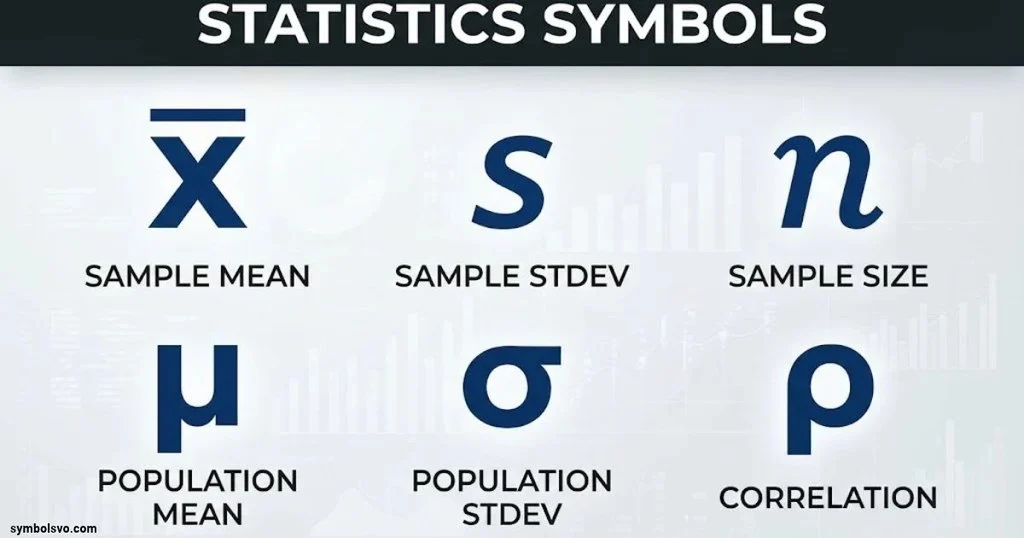
Statistics is the branch of mathematics concerned with collecting, organizing, analyzing, and interpreting data. Statistical symbols represent averages, probabilities, variation, sample sizes, and relationships between variables.
Learning these symbols makes statistical formulas and research results easier to understand.
Common Statistics Symbols And Meanings
| Symbol | Name | Meaning |
| μ | Mu | Population mean |
| x̄ | X-bar | Sample mean |
| σ | Sigma | Population standard deviation |
| σ² | Sigma squared | Population variance |
| s | Sample standard deviation | Measures sample data spread |
| s² | Sample variance | Variance of a sample |
| n | Sample size | Number of observations in a sample |
| N | Population size | Number of individuals in a population |
| Σ | Summation | Adds values |
| P(A) | Probability | Probability of event A |
| ρ | Rho | Population correlation coefficient |
| r | Correlation coefficient | Commonly represents sample correlation |
| H₀ | Null hypothesis | Hypothesis tested in statistical analysis |
| H₁ | Alternative hypothesis | Competing hypothesis |
| α | Alpha | Commonly represents significance level |
| β | Beta | May represent Type II error probability or a model parameter |
| p | P-value or probability | Meaning depends on context |
Statistics Symbols With Examples
1. Mean (μ or x̄)
The mean is the average of a collection of values.
Example:
2, 4, 6, 8
Mean = (2 + 4 + 6 + 8) / 4 = 5
The symbol x̄ commonly represents the sample mean, while μ represents the population mean.
2. Standard Deviation (σ or s)
Standard deviation measures how spread out values are around the mean.
- σ represents population standard deviation.
- s commonly represents sample standard deviation.
A smaller standard deviation generally means the values are closer to the mean.
3. Variance (σ² or s²)
Variance measures the average squared deviation from the mean, with the exact calculation depending on whether you are working with a population or a sample.
4. Probability (P)
Probability describes how likely an event is to happen.
Example:
P(A) = 0.5
This means event A has a probability of 50%.
5. Summation (Σ)
The summation symbol represents the addition of a sequence of values.
Example:
Σx = 2 + 4 + 6 + 8 = 20
Other Useful Statistical Notation
| Notation | Meaning |
| Q₁ | First quartile |
| Q₂ | Second quartile or median |
| Q₃ | Third quartile |
| IQR | Interquartile range |
| SE | Standard error |
| CI | Confidence interval |
| z | Z-score or standard normal variable, depending on context |
| χ² | Chi-square statistic |
| t | T-statistic or t-distributed variable |
| F | F-statistic |
Statistical notation is especially useful in research papers, data analysis, surveys, scientific studies, and academic reports.
Greek Letters Used In Mathematics
Greek letters are widely used in mathematics to represent constants, variables, angles, functions, and other mathematical quantities. They are especially common in algebra, geometry, calculus, statistics, and physics.
Both uppercase and lowercase Greek letters appear in mathematical formulas. Some have different meanings depending on the subject.
Lowercase Greek Letters
| Symbol | Name | Common mathematical use |
| α | Alpha | Angles, coefficients, significance levels |
| β | Beta | Coefficients, angles, parameters |
| γ | Gamma | Angles and special functions |
| δ | Delta | Small changes or quantities |
| ε | Epsilon | Small positive quantities |
| ζ | Zeta | Zeta functions |
| η | Eta | Efficiency or parameters |
| θ | Theta | Angles and variables |
| ι | Iota | Index or mathematical notation |
| κ | Kappa | Constants and curvature |
| λ | Lambda | Eigenvalues and parameters |
| μ | Mu | Mean and micro-prefix |
| ν | Nu | Frequency and other variables |
| ξ | Xi | Random variables and parameters |
| ο | Omicron | Rarely used as a mathematical variable |
| π | Pi | Circle constant |
| ρ | Rho | Density and correlation |
| σ | Sigma | Standard deviation |
| τ | Tau | Time constants and other quantities |
| υ | Upsilon | Specialized variables |
| φ | Phi | Angles, functions, and golden ratio notation |
| χ | Chi | Chi-square notation |
| ψ | Psi | Functions and wave-related notation |
| ω | Omega | Angular frequency and other quantities |
Uppercase Greek Letters
| Symbol | Name | Common mathematical use |
| Γ | Gamma | Gamma function |
| Δ | Delta | Change or difference |
| Θ | Theta | Asymptotic notation |
| Λ | Lambda | Eigenvalues and parameters |
| Ξ | Xi | Specialized variables |
| Π | Pi | Product notation |
| Σ | Sigma | Summation |
| Φ | Phi | Functions and mathematical constants |
| Ψ | Psi | Functions and specialized notation |
| Ω | Omega | Sample spaces, sets, and other mathematical concepts |
Greek Letters For Copy And Paste
If you need Greek letters for homework, mathematical documents, or digital notes, you can copy them from this collection.
Lowercase:
α β γ δ ε ζ η θ ι κ λ μ ν ξ ο π ρ σ τ υ φ χ ψ ω
Uppercase:
Α Β Γ Δ Ε Ζ Η Θ Ι Κ Λ Μ Ν Ξ Ο Π Ρ Σ Τ Υ Φ Χ Ψ Ω
A few Greek letters look similar to Latin characters. For example, uppercase Alpha (Α) looks like A, while lowercase omicron (ο) looks like the English letter o. They are different Unicode characters.
Mathematical Symbols For Kids
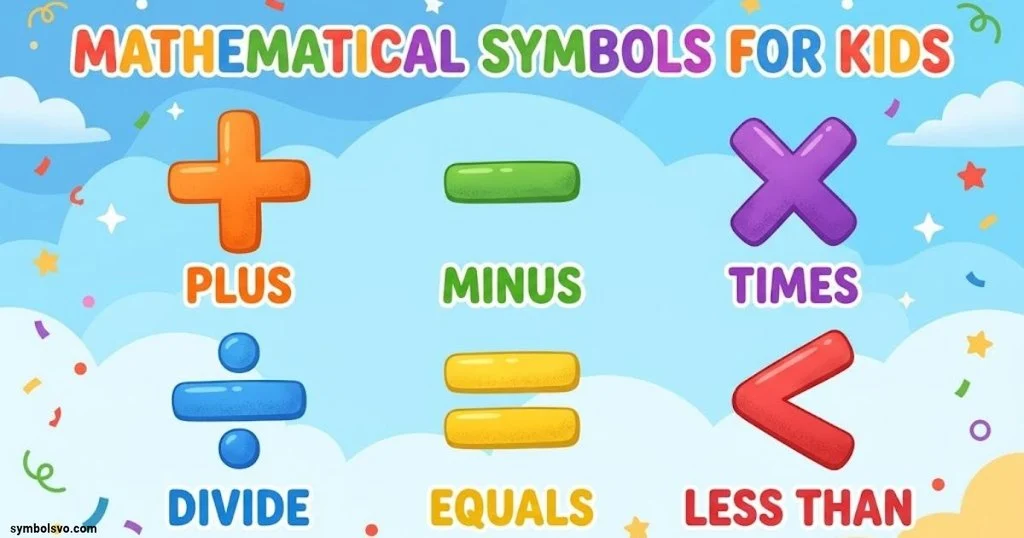
Mathematical symbols help children learn basic calculations, compare numbers, understand shapes, and solve simple problems. Introducing these signs with easy examples can make mathematics more enjoyable and less confusing.
Start with the symbols children see most often in elementary school.
Basic Math Symbols For Kids
| Symbol | Name | Simple meaning |
| + | Plus | Put numbers together |
| − | Minus | Take away |
| × | Multiply | Add equal groups |
| ÷ | Divide | Share equally |
| = | Equal | Has the same value |
| > | Greater than | Bigger number |
| < | Less than | Smaller number |
| √ | Square root | Find a number that makes a square |
| % | Percent | Out of 100 |
| ½ | Half | One of two equal parts |
| ¼ | Quarter | One of four equal parts |
| ° | Degree | Measures an angle |
Easy Math Examples
Addition (+)
2 + 3 = 5
If you have two apples and get three more, you have five apples.
Subtraction (−)
7 − 2 = 5
If you have seven candies and give away two, five remain.
Multiplication (×)
3 × 4 = 12
Three groups of four objects make twelve objects.
Division (÷)
12 ÷ 3 = 4
Sharing twelve objects equally among three people gives each person four.
Greater Than (>)
9 > 4
Nine is bigger than four.
Less Than (<)
3 < 8
Three is smaller than eight.
Equal To (=)
5 + 2 = 7
Both sides have the same value.
Tips For Teaching Math Symbols To Children
- Use everyday objects such as toys, fruits, and pencils to explain addition and subtraction.
- Practice multiplication with groups of similar objects.
- Use pictures and number cards to explain greater-than and less-than signs.
- Introduce fractions with pizza slices or other familiar shapes.
- Encourage children to solve simple problems using symbols instead of only memorizing their names.
- Practice a few symbols at a time before introducing more advanced notation.
Children understand mathematical concepts more easily when they can connect symbols with real examples. Regular practice helps them recognize signs and use them correctly.
Frequently Asked Questions About Mathematical Symbols
What Are The Most Common Mathematical Symbols?
The most common mathematical symbols include plus (+), minus (−), multiplication (×), division (÷), equal (=), not equal (≠), greater than (>), less than (<), and square root (√). These symbols are used in basic arithmetic, algebra, and many other mathematical subjects.
What Does ∑ Mean In Mathematics?
The symbol ∑ is called Sigma or the summation symbol. It represents the addition of a sequence of values. For example, ∑ from 1 to 4 of n means 1 + 2 + 3 + 4, which equals 10.
What Is The Difference Between ≈ And =?
The equal sign (=) indicates that two values are exactly equal. The approximately equal sign (≈) indicates that two values are close but may not be exactly the same. For example, π ≈ 3.14, while 2 + 3 = 5.
What Are The Main Mathematical Symbols Used In Algebra?
Common algebra symbols include x and y for variables, + for addition, − for subtraction, = for equality, √ for square roots, and exponents such as ² and ³. These symbols help represent unknown values and solve equations.
How Can I Type Mathematical Symbols On My Keyboard?
You can copy mathematical characters directly from a symbols chart and paste them into documents, messages, or notes. You can also use your device’s character picker, Unicode input methods, equation editor, or mathematical keyboard. For complex formulas, an equation editor or LaTeX is often more convenient.
Conclusion
Mathematical symbols provide a simple way to represent calculations, numbers, relationships, and advanced mathematical ideas. From basic arithmetic signs to specialized calculus and statistics notation, each character helps communicate information clearly and accurately.
Learning the names and meanings of these symbols makes it easier to understand equations, complete assignments, read formulas, and explore different branches of mathematics. Keeping a mathematical symbols chart nearby can also save time when you need to identify an unfamiliar character.
Use the tables and examples in this guide as a reference whenever you need to understand or copy a mathematical symbol. Start with the basic signs, practice using them in simple expressions, and gradually become familiar with more advanced notation.

I’m Daniel Brooks, a content creator and symbol enthusiast dedicated to researching the fascinating world of signs and symbols. I enjoy discovering the hidden meanings behind famous icons, emojis, historical emblems, and cultural symbols. Through my writing, I aim to provide trustworthy, well-researched, and reader-friendly information that helps people learn something new with every visit.
Books:
- The Complete Guide to World Symbols
- The Power of Universal Signs
 Nathan Holloway
 Mason Ellington