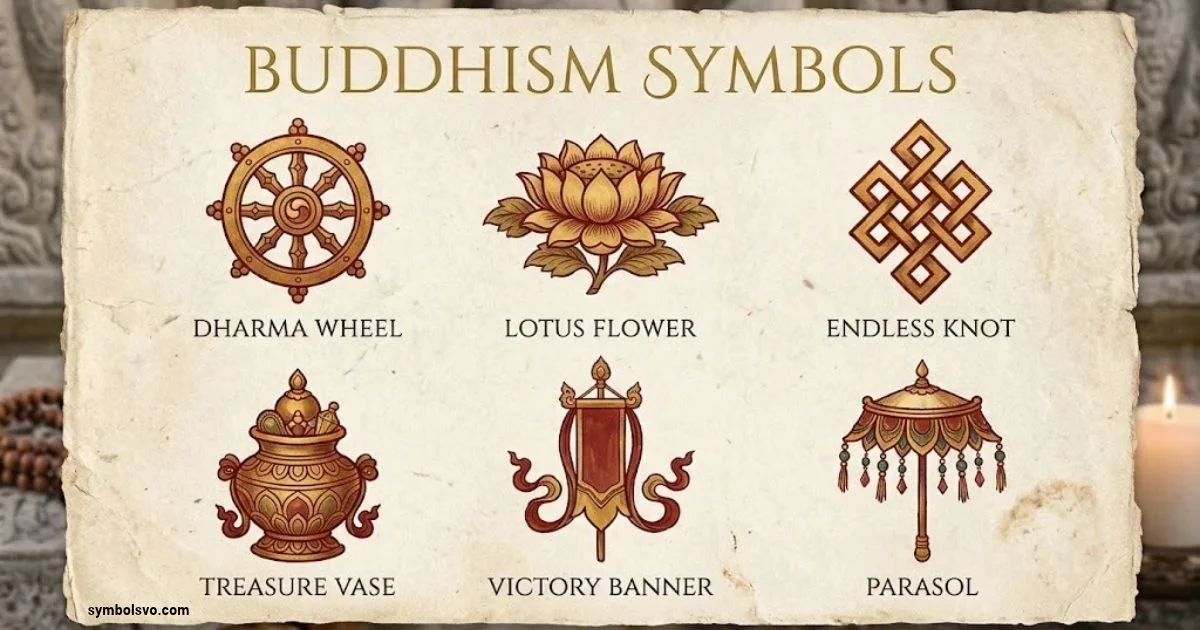
Buddhist symbols carry meanings that go far beyond their beautiful designs. You can find them in ancient temples, meditation spaces, religious paintings, jewelry, statues, and modern tattoos. Each one communicates an idea connected to the Buddha’s teachings, spiritual practice, or the path toward enlightenment.
Some Buddhist symbols represent wisdom and compassion. Others remind people to practice mindfulness, overcome suffering, develop inner peace, and let go of attachment. Their meanings can also differ across Buddhist traditions and cultures.
Understanding these symbols helps you appreciate Buddhist art and philosophy more deeply. It also makes it easier to recognize the messages behind familiar images, such as the lotus flower, Dharma Wheel, Bodhi Tree, and Buddha statue.
This guide explores important symbols of Buddhism, their historical backgrounds, spiritual meanings, and uses in Buddhist traditions. It also explains sacred figures, hand gestures, animals, and numbers associated with Buddhist teachings.
What Are Buddhist Symbols?
Buddhist symbols are visual signs, objects, patterns, and gestures that communicate ideas from Buddhism. They help represent teachings that can be difficult to explain through words alone.
For example, the lotus flower grows in muddy water but rises above the surface with clean petals. In Buddhist symbolism, this natural process represents purity, spiritual development, and the possibility of awakening despite difficult circumstances.
Similarly, the Dharma Wheel represents the Buddha’s teachings and the path that leads away from suffering. A stupa represents sacred Buddhist presence and remembrance, while a mandala can provide a visual focus for meditation.
These symbols appear in different forms, including:
- Religious objects: Stupas, prayer wheels, bells, and ritual vessels.
- Natural imagery: Lotus flowers, Bodhi leaves, elephants, and deer.
- Geometric designs: Mandalas, wheels, and sacred patterns.
- Sacred gestures: Buddhist mudras made with the hands.
- Religious figures: Buddhas and bodhisattvas shown in paintings and statues.
Buddhist symbolism developed over many centuries. Its visual language varies across regions, including India, Sri Lanka, Tibet, China, Japan, Thailand, and other Buddhist communities.
The Most Important Buddhism Symbols and Their Meanings
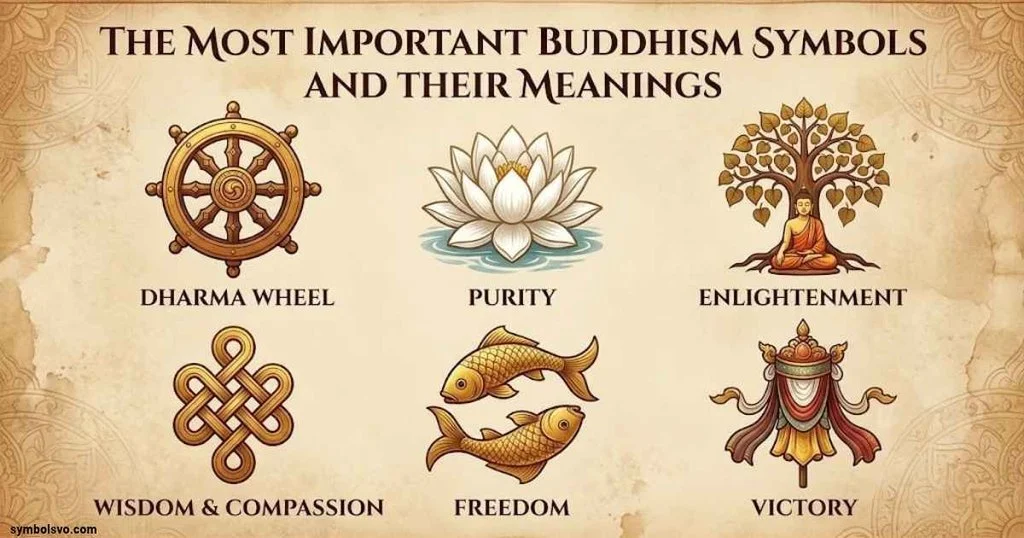
Buddhism includes many sacred images and objects. Some are recognized across several Buddhist traditions, while others have stronger connections to particular regions or schools.
The following symbols offer a useful introduction to Buddhist religious symbols, their meanings, and their place in Buddhist art.
Dharma Wheel (Dharmachakra)
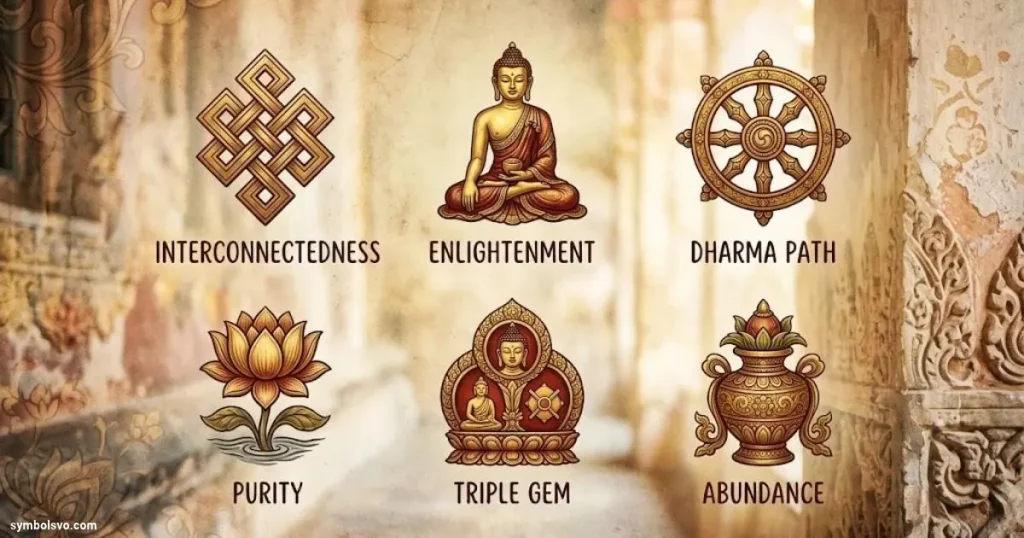
The Dharma Wheel, also called the Dharmachakra, is one of the best-known symbols of Buddhism. It represents the Buddha’s teachings and the path that helps people understand and overcome suffering.
The wheel is commonly shown with eight spokes. These spokes represent the Noble Eightfold Path, a practical guide to ethical conduct, mental discipline, and wisdom.
The eight parts are:
- Right View
- Right Intention
- Right Speech
- Right Action
- Right Livelihood
- Right Effort
- Right Mindfulness
- Right Concentration
The wheel’s center represents discipline and stability. Its circular shape can suggest the continuity of the Buddha’s teaching and the movement of the Dharma.
The symbol also connects with the Buddha’s first sermon at Deer Park in Sarnath, where he taught the Four Noble Truths and explained the path to liberation. Buddhist art often shows a Dharma Wheel between two deer to recall this event.
The Metropolitan Museum of Art+1
Meaning: The Dharma Wheel symbolizes the Buddha’s teachings, wisdom, ethical living, and the path to enlightenment.
Lotus Flower (Padma)
The Lotus Flower is among the most recognizable Buddhist spiritual symbols. It represents purity, spiritual awakening, resilience, and the ability to rise above difficult conditions.
A lotus grows in muddy water, yet its flower can emerge clean and beautiful above the surface. Buddhist teachings use this natural image to explain how wisdom and compassion can develop in a world filled with confusion, desire, and suffering.
The lotus also appears beneath many Buddha and bodhisattva figures. It represents a foundation of spiritual purity and awakened understanding.
Different lotus colors carry different associations in Buddhist art. Interpretations vary by tradition, but common meanings include:
| Lotus color | Common symbolic association |
| White lotus | Purity, spiritual clarity, and peace |
| Pink lotus | The historical Buddha and supreme awakening |
| Blue lotus | Wisdom, knowledge, and victory over ignorance |
| Red lotus | Love, compassion, and the heart |
| Purple lotus | Spiritual mystery and sacred teachings |
The lotus is also a popular image in Buddhist jewelry, meditation artwork, tattoos, and home décor. However, its meaning is deeper than beauty or decoration.
Meaning: The lotus flower symbolizes purity, resilience, personal growth, and the journey toward enlightenment.
Endless Knot (Shrivatsa)
The Endless Knot is one of the Eight Auspicious Symbols in Tibetan and other Himalayan Buddhist traditions. Its design consists of interwoven lines that form a continuous pattern without a clear beginning or end.
The pattern represents the interconnected nature of life. Actions, experiences, relationships, and consequences influence one another.
It also expresses the relationship between wisdom and compassion. Buddhist practice develops both qualities together rather than treating them as separate goals.
The endless design can remind practitioners of:
- The connection between cause and effect.
- The relationship between wisdom and compassion.
- The interdependence of all things.
- The continuing cycle of existence.
- The importance of thoughtful actions.
The knot is sometimes used in Buddhist gifts, textiles, wall art, and jewelry. Its meaning is especially relevant to the Buddhist idea of dependent origination, which explains how phenomena arise through conditions and relationships.
Meaning: The Endless Knot represents interdependence, continuity, wisdom, compassion, and the connection between actions and their results.
Bodhi Tree and Bodhi Leaf
The Bodhi Tree holds a special place in Buddhist history. According to Buddhist tradition, Siddhartha Gautama attained enlightenment while meditating beneath a sacred fig tree at Bodh Gaya in present-day India.
After this awakening, he became known as the Buddha, meaning the Awakened One.
The tree therefore represents the moment of enlightenment and the possibility of awakening through meditation, wisdom, and disciplined practice.
The Bodhi leaf is also a popular Buddhist symbol of spiritual awakening. Its heart-shaped form makes it recognizable in religious artwork and decorative objects.
Buddhist communities have preserved and planted Bodhi trees as living reminders of the Buddha’s enlightenment. The original tree has a long history of religious significance, and a descendant at the Mahabodhi Temple remains an important pilgrimage focus.
Early Buddhist artists also used the Bodhi Tree to represent the Buddha before human-shaped Buddha statues became common.
Buddhism+1
Meaning: The Bodhi Tree symbolizes enlightenment, wisdom, meditation, spiritual growth, and the potential to overcome ignorance.
Vajra (Dorje)
The Vajra, known as Dorje in Tibetan, is a powerful ritual symbol in Vajrayana Buddhism. It often looks like a short metal scepter with symmetrical prongs extending from both ends.
The Sanskrit word vajra can refer to a thunderbolt or diamond. Both images communicate strength and indestructibility.
In Buddhist symbolism, the Vajra represents the unshakable nature of awakened wisdom. It can also express the realization of emptiness, a central concept in many Mahayana and Vajrayana teachings.
Vajras are often used alongside a ritual bell. In common Tibetan Buddhist interpretations, the Vajra represents skillful means or compassionate action, while the bell represents wisdom. Their pairing expresses the importance of developing both.
The Vajra should not be understood simply as a weapon or a symbol of physical power. Its deeper meaning concerns spiritual realization and the clarity that cuts through ignorance.
Meaning: The Vajra symbolizes indestructible wisdom, spiritual strength, clarity, and the union of wisdom and compassionate action.
Buddhist Stupa
A Buddhist Stupa is a sacred architectural structure associated with the Buddha, his teachings, and Buddhist remembrance. Some stupas were built to contain relics, while others commemorate important events or sacred places.
The stupa’s rounded dome, central structure, and rising spire create a distinctive form. Its design differs across Buddhist regions, including India, Nepal, Tibet, Sri Lanka, China, and Southeast Asia.
For practitioners, a stupa is more than a monument. It can represent the Buddha’s enlightened mind and serve as a focus for devotion, reflection, and pilgrimage.
Many Buddhist communities walk around stupas in a clockwise direction as a devotional practice. This movement is called circumambulation.
Historically, stupas also played an important role in early Buddhist art. Before artists regularly depicted the Buddha in human form, the stupa could symbolize his presence and his passage into nirvana.
The Metropolitan Museum of Art+1
Meaning: The stupa represents the Buddha’s presence, enlightenment, sacred remembrance, and the preservation of Buddhist teachings.
Buddha’s Footprints (Buddhapada)
The Buddha’s Footprints, known as Buddhapada, are sacred images of the Buddha’s feet. They often include a Dharma Wheel or other auspicious marks on the soles.
These footprints represent the historical Buddha’s presence and the path he left for others to follow.
They have particular importance in early Buddhist art. For centuries, artists in India often represented the Buddha through symbols instead of showing him as a human figure. Footprints, empty thrones, trees, and wheels helped communicate his presence and important events from his life.
The Metropolitan Museum of Art+1
The footprints also carry a spiritual message. They remind practitioners that the Buddha showed a path, but each person must follow it through their own understanding and practice.
Meaning: Buddha’s footprints symbolize the Buddha’s presence, his teachings, reverence, and the spiritual path toward awakening.
Buddhist Mandala
A Buddhist Mandala is a geometric design used in several Buddhist traditions, especially Tibetan Vajrayana Buddhism. It often contains circles, squares, gates, deities, and carefully arranged patterns.
Mandalas can represent the universe, an enlightened realm, or a symbolic structure used during meditation and visualization practices.
Their detailed designs encourage concentration. Practitioners may use them to focus attention, understand Buddhist teachings, and visualize a sacred environment.
Tibetan Buddhist sand mandalas are especially well known. Monks create intricate patterns using colored sand, sometimes spending days or weeks completing the design. Afterward, they traditionally dismantle the mandala as part of a ritual.
This practice highlights impermanence, the Buddhist teaching that all conditioned things change and do not remain permanent.
Mandalas are also used in Buddhist paintings, textiles, temple decorations, and meditation spaces.
Meaning: Buddhist mandalas represent the universe, spiritual order, meditation, sacred space, and impermanence.
Conch Shell (Shankha)
The Conch Shell is one of the Eight Auspicious Symbols in Tibetan Buddhism. It is commonly shown as a white shell with a spiraling shape.
Its sound carries an important symbolic message. Traditionally, the conch’s powerful voice represents the spread of the Buddha’s teachings across the world.
The sound can also symbolize a call to awaken from ignorance and pay attention to the Dharma.
In Buddhist ceremonies, conch shells may be used as ritual instruments. Their sound marks important moments and creates a sacred atmosphere.
The conch is often depicted with its opening facing to the right, although artistic forms can vary.
Meaning: The conch shell symbolizes the powerful voice of the Dharma, awakening, and the spread of Buddhist wisdom.
Golden Fish
The Golden Fish usually appear as a pair of fish swimming freely. They are another important part of the Eight Auspicious Symbols.
Their movement through water represents freedom and fearlessness. In Buddhist interpretations, they can suggest liberation from the ocean of suffering and the ability to move through existence without being controlled by fear.
Fish also live in water without drowning in it. This image can serve as a reminder to live in the world while developing wisdom and detachment.
The pair is often shown facing different directions or arranged symmetrically. Their design appears in Tibetan Buddhist paintings, ritual objects, textiles, and temple decorations.
Meaning: Golden Fish symbolize freedom, fearlessness, happiness, and liberation from suffering.
Parasol (Chatra)
The Parasol, or Chatra, is a traditional umbrella-like symbol associated with protection and spiritual authority.
In Buddhist symbolism, it represents protection from harmful influences, obstacles, and the suffering caused by ignorance. It can also express the protective power of the Buddha’s teachings.
Historically, parasols were signs of royalty and high status in South Asian cultures. Their inclusion in Buddhist art connects spiritual protection with the idea of enlightened leadership.
A parasol often appears above sacred figures, stupas, or other religious objects.
Meaning: The parasol symbolizes protection, dignity, spiritual authority, and freedom from harmful influences.
Treasure Vase (Bumpa)
The Treasure Vase is an ornate vessel associated with abundance, prosperity, and spiritual wealth. It is one of the Eight Auspicious Symbols in Tibetan Buddhism.
Unlike an ordinary container, the symbolic vase is often imagined as holding inexhaustible treasures. These treasures can represent material well-being, but their deeper meaning includes wisdom, compassion, long life, and positive qualities.
The vase reminds practitioners that genuine spiritual richness comes from developing the mind and living ethically.
It may appear in Buddhist ritual settings, paintings, decorative designs, and ceremonial objects.
Meaning: The Treasure Vase symbolizes abundance, good fortune, spiritual wealth, and the accumulation of positive qualities.
Victory Banner (Dhvaja)
The Victory Banner represents the triumph of wisdom over ignorance and the victory of spiritual understanding over destructive mental states.
Its imagery is connected with overcoming obstacles on the path to enlightenment. In Buddhist teachings, the most important victory is not defeating another person. It is overcoming greed, hatred, delusion, and other causes of suffering.
The banner is sometimes shown as a tall ceremonial structure with decorative layers. It appears in Tibetan Buddhist art and religious settings.
Meaning: The Victory Banner symbolizes spiritual victory, perseverance, wisdom, and the overcoming of inner obstacles.
Buddhist Prayer Wheel (Mani Wheel)
The Buddhist Prayer Wheel is especially associated with Tibetan Buddhist practice. It usually consists of a rotating cylinder containing written mantras, prayers, or sacred texts.
Many prayer wheels contain the mantra Om Mani Padme Hum, which is closely associated with Avalokiteshvara, the bodhisattva of compassion.
Practitioners rotate the wheel while reciting prayers or mantras. The practice is understood as a way to cultivate compassion, mindfulness, and positive intentions.
Prayer wheels come in different sizes. Some are small enough to hold in one hand, while others are installed in rows around temples and pilgrimage paths.
The practice is not simply about spinning an object. Its spiritual value depends on the intention, understanding, and devotion behind the action.
Meaning: The prayer wheel represents devotional practice, compassion, mantra recitation, and the cultivation of positive intentions.
Buddhist Bell (Ghanta)
The Buddhist Bell is a ritual object used in several Buddhist traditions. It produces a clear sound that can mark ceremonies, meditation practices, and other religious activities.
In Vajrayana Buddhism, the bell is frequently paired with the Vajra. The bell commonly represents wisdom, while the Vajra represents skillful means or compassionate action.
Together, they express the idea that wisdom and compassionate action should work together.
The sound of a bell can also serve as a reminder to return attention to the present moment. Its fading resonance may encourage reflection on impermanence.
Meaning: The Buddhist bell symbolizes wisdom, awareness, impermanence, and the importance of mindful practice.
Buddhist Swastika (Manji)
The Buddhist Swastika, known as Manji in Japan, is an ancient religious symbol used in several Asian traditions. In Buddhist contexts, it can represent auspiciousness, eternity, harmony, or the Buddha’s virtues.
It appears in Buddhist temples, religious texts, maps, statues, and traditional artwork. In Japan, the left-facing manji is commonly used to mark Buddhist temples on maps.
Its historical meaning is distinct from the meaning attached to the Nazi symbol in modern European history. The Nazi regime appropriated and transformed an ancient symbol, giving it a violent political association.
When discussing Buddhist symbolism, it is important to explain the cultural and historical context rather than treating every use of the shape as identical.
Meaning: In Buddhist contexts, the manji can symbolize auspiciousness, eternity, well-being, and the virtues of the Buddha.
Three Jewels (Triratna)
The Three Jewels of Buddhism, also called the Triple Gem or Triratna, are central to Buddhist belief and practice.
They are not simply decorative symbols. They express the three foundations of taking refuge in Buddhism:
- Buddha: The awakened teacher who discovered and taught the path.
- Dharma: The Buddha’s teachings and the truth they explain.
- Sangha: The Buddhist community, especially the community of practitioners who preserve and follow the teachings.
Taking refuge in the Three Jewels is an important step for many Buddhists. It means placing confidence in the Buddha as a teacher, the Dharma as a path, and the Sangha as a source of support.
The Three Jewels are sometimes represented by a three-part emblem in Buddhist art.
Meaning: The Three Jewels symbolize the Buddha, his teachings, and the community that follows and preserves the Dharma.
Om and Om Mani Padme Hum
The sound Om appears in several Indian religious traditions, including Hinduism and some forms of Buddhism. It is not exclusively Buddhist.
In Tibetan Buddhism, Om is part of the famous six-syllable mantra Om Mani Padme Hum, which is associated with Avalokiteshvara, the bodhisattva of compassion.
The mantra is widely recited in Tibetan Buddhist communities. It appears on prayer wheels, carved stones, prayer flags, and religious artwork.
Its interpretation is complex, and different teachers explain its syllables in different ways. Broadly, it is associated with compassion, purification, and the path toward awakening.
It is useful to distinguish the general sacred syllable Om from the complete Buddhist mantra. They are related in some practices, but they are not interchangeable.
Meaning: Om Mani Padme Hum is strongly associated with compassion, spiritual practice, and the aspiration to awaken for the benefit of all beings.
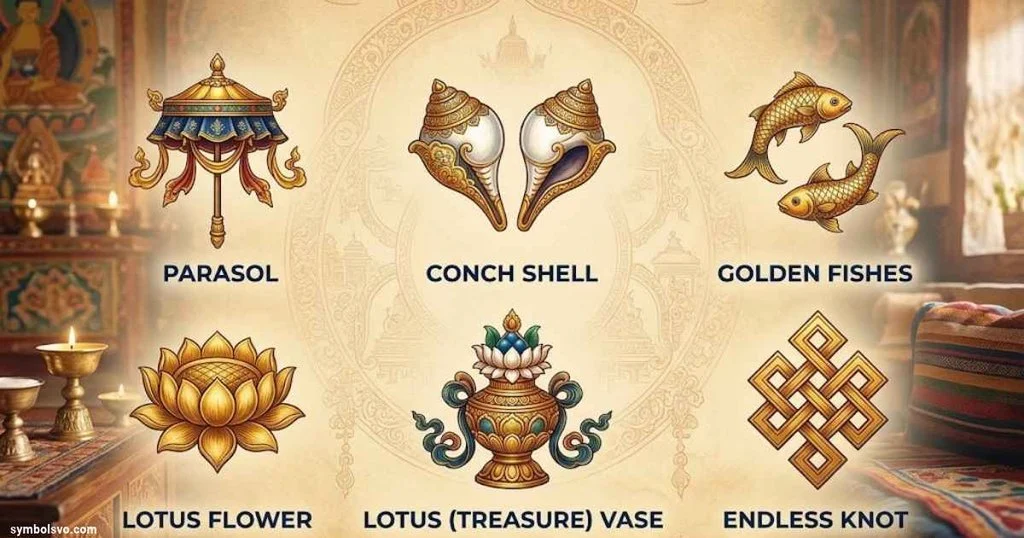
The Eight Auspicious Symbols in Buddhism
The Eight Auspicious Symbols, known as Ashtamangala, form an important group of Buddhist sacred symbols. They are especially prominent in Tibetan and Himalayan Buddhist art.
Together, they represent qualities and blessings connected with the Buddha’s teachings. Their exact interpretations can vary across traditions.
| Symbol | Common meaning |
| Dharma Wheel | Buddha’s teachings and the Noble Eightfold Path |
| Lotus Flower | Purity and enlightenment |
| Endless Knot | Interdependence and wisdom |
| Conch Shell | The sound and spread of the Dharma |
| Golden Fish | Freedom and fearlessness |
| Parasol | Protection from suffering and harmful influences |
| Treasure Vase | Abundance and spiritual wealth |
| Victory Banner | Victory over ignorance and inner obstacles |
These eight symbols often appear together in Buddhist temples, ceremonial objects, wall paintings, and religious textiles. Museums such as the Smithsonian’s National Museum of Asian Art preserve historical examples of the complete set.
Smithsonian’s National Museum of Asian Art+1
The group is particularly useful when studying Buddhist iconography because it shows how individual objects can communicate related spiritual ideas.
Important Buddha Figures and Their Symbolic Meanings
Buddhist art includes many enlightened figures and bodhisattvas. Each figure communicates particular qualities through posture, clothing, objects, colors, and hand gestures.
It is important to remember that these figures are not all the same Buddha. Some represent the historical Buddha, while others belong to different Buddhist traditions and devotional practices.
Gautama Buddha
Gautama Buddha, also known as Siddhartha Gautama or Shakyamuni Buddha, was the historical teacher whose teachings became the foundation of Buddhism.
His statues often show him seated in meditation, standing, or reclining. These postures communicate different moments or qualities associated with his life and teachings.
The Buddha’s image commonly represents enlightenment, wisdom, mindfulness, compassion, and freedom from ignorance.
Avalokiteshvara and Guanyin
Avalokiteshvara is a bodhisattva associated with compassion. A bodhisattva is a being who works toward awakening while remaining dedicated to helping others.
In East Asian traditions, Avalokiteshvara is known as Guanyin in Chinese Buddhism. Guanyin is widely revered as a compassionate figure who responds to the suffering of living beings.
Some depictions show Avalokiteshvara with many arms and hands. This imagery expresses the ability to reach out and help countless beings.
Symbolic meaning: Compassion, mercy, kindness, and care for all living beings.
Amitabha Buddha
Amitabha Buddha is an important figure in Pure Land Buddhism. His name is associated with infinite light, and he is connected with Sukhavati, commonly called the Pure Land.
Devotion to Amitabha is especially important in several East Asian Buddhist traditions. Practitioners may recite his name as part of their religious practice.
Symbolic meaning: Infinite light, compassion, hope, and the aspiration for rebirth in the Pure Land.
Medicine Buddha (Bhaisajyaguru)
The Medicine Buddha, known as Bhaisajyaguru, is associated with healing and the alleviation of suffering.
He is often depicted with a blue body and a medicine bowl or healing fruit. These features connect him with the Buddhist aspiration to relieve physical and spiritual suffering.
His symbolism is not limited to bodily health. It can also refer to freedom from mental afflictions and the wisdom needed to understand suffering.
Symbolic meaning: Healing, well-being, compassion, and relief from suffering.
Maitreya Buddha
Maitreya is known as the Buddha of the future. Buddhist traditions describe him as the next Buddha who will appear when the teachings of the present Buddha have faded from the world.
His image represents hope and the continuation of the Dharma.
Symbolic meaning: Future enlightenment, hope, kindness, and renewal of Buddhist teachings.
Laughing Buddha (Budai)
The Laughing Buddha is commonly shown as a cheerful, round-bellied figure with a broad smile. This figure is generally identified with Budai, a Chinese monk associated with popular religious traditions.
Budai is not the historical Gautama Buddha. The two figures have different identities and cultural backgrounds.
In popular East Asian culture, Budai is associated with happiness, generosity, contentment, and good fortune. His image is often found in homes, shops, and decorative objects.
Symbolic meaning: Joy, generosity, contentment, and prosperity in popular tradition.
Manjushri
Manjushri is a bodhisattva associated with wisdom and insight. He is often shown holding a flaming sword that cuts through ignorance.
Some images also show him holding a book representing the perfection of wisdom teachings.
His symbolism highlights the importance of understanding reality clearly rather than relying on confusion or blind belief.
Symbolic meaning: Wisdom, insight, learning, and the removal of ignorance.
Buddhist Mudras and Their Meanings
Buddhist mudras are symbolic hand gestures used in Buddhist statues, paintings, rituals, and meditation traditions. They help identify the meaning of a Buddha image and communicate a particular spiritual quality or event.
A small change in hand position can completely change the meaning of a statue.
| Mudra | Hand position | Common meaning |
| Dhyana Mudra | Hands resting together in the lap | Meditation and concentration |
| Abhaya Mudra | One hand raised with palm facing outward | Fearlessness and reassurance |
| Bhumisparsha Mudra | One hand reaches down to touch the earth | Enlightenment and the earth as witness |
| Dharmachakra Mudra | Hands positioned near the chest | Teaching the Dharma |
| Varada Mudra | Hand lowered with open palm | Generosity, giving, and compassion |
| Vitarka Mudra | Thumb and index finger form a circle | Discussion, explanation, and teaching |
Dhyana Mudra
The Dhyana Mudra represents meditation and mental concentration. Both hands rest in the lap, usually with the palms facing upward.
It is commonly seen in seated Buddha statues. The gesture encourages a sense of stillness, balance, and inward attention.
Abhaya Mudra
The Abhaya Mudra is a gesture of fearlessness. The hand is raised with the palm facing outward.
It communicates reassurance, protection, and the absence of fear. In Buddhist art, it can represent the Buddha’s ability to calm and guide others.
Bhumisparsha Mudra
The Bhumisparsha Mudra is known as the earth-touching gesture. The Buddha’s right hand reaches toward the ground while he sits in meditation.
It recalls the moment of enlightenment, when the earth is called to witness Siddhartha’s awakening.
Dharmachakra Mudra
The Dharmachakra Mudra represents the teaching of the Dharma. The hands are positioned near the chest, often with the fingers forming symbolic circles.
It is closely associated with the Buddha’s first sermon at Sarnath.
Varada Mudra
The Varada Mudra is a gesture of generosity and giving. One hand is lowered with the palm facing outward.
It can represent compassion, kindness, and the willingness to help others.
Vitarka Mudra
The Vitarka Mudra is associated with explanation, discussion, and the transmission of teachings. The thumb and index finger usually touch to form a circle.
It often appears in images of the Buddha or bodhisattvas teaching the Dharma.
Sacred Animals in Buddhism and Their Meanings
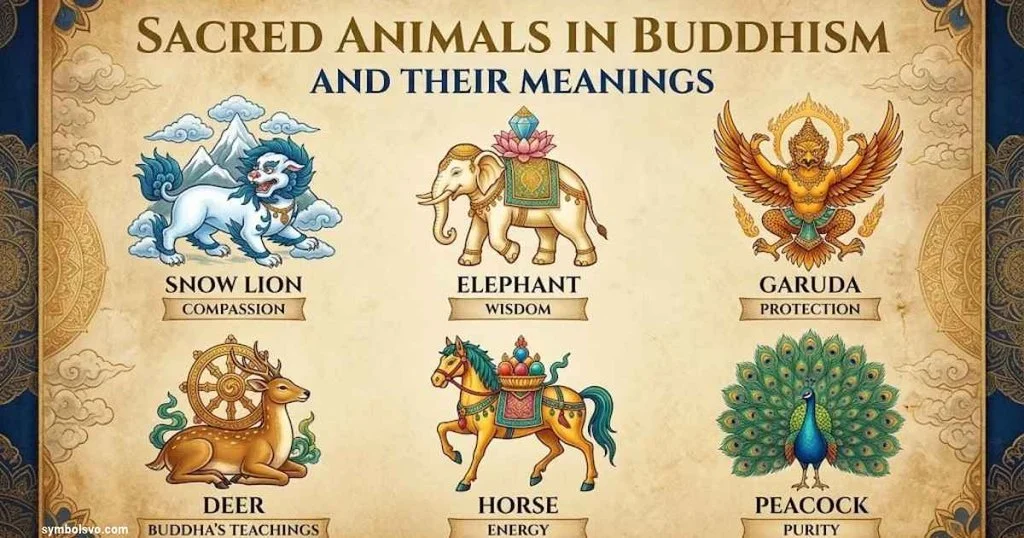
Animals appear throughout Buddhist stories, paintings, sculptures, and temple decorations. They can represent qualities such as wisdom, strength, gentleness, freedom, and protection.
Some animals also connect with important events in the Buddha’s life or stories about his previous lives. Their meanings vary across Buddhist cultures, so not every animal has one universal interpretation.
Elephant
The Buddhist Elephant is associated with strength, patience, mental discipline, and wisdom.
Elephants also appear in traditional accounts of the Buddha’s life. In one well-known story, Queen Maya dreams of a white elephant before Siddhartha’s birth.
In Buddhist teachings, the elephant can represent a trained and disciplined mind. Just as a powerful elephant needs guidance, the mind benefits from mindfulness and careful practice.
Meaning: Wisdom, patience, strength, mental discipline, and dignity.
Lion
The Buddhist Lion represents strength, courage, and the power of the Buddha’s teachings.
The Buddha is sometimes called the Lion of the Shakyas. His teachings are also described through the image of a lion’s roar, suggesting a confident declaration of truth.
Lion figures may appear as guardians near temple entrances, protecting sacred spaces.
Meaning: Courage, authority, fearlessness, and the strength of the Dharma.
Deer
Deer are closely connected with the Buddha’s first sermon at Deer Park in Sarnath.
Buddhist art often shows two deer beside a Dharma Wheel. The image recalls the place where the Buddha first taught the Four Noble Truths and the path to the end of suffering.
Deer can also suggest gentleness, peacefulness, and harmony.
Meaning: Gentleness, peace, harmony, and the beginning of the Buddha’s public teaching.
Garuda
The Garuda Bird is a powerful mythical creature found in Buddhist, Hindu, and other Asian traditions. It is often depicted with a bird-like body, wings, and human features.
In Buddhist traditions, Garuda can represent strength, freedom, and protection. In some Vajrayana contexts, it is also associated with overcoming harmful forces and powerful obstacles.
Meaning: Freedom, strength, protection, and the ability to overcome obstacles.
Naga
Nagas are serpent-like beings found in Buddhist stories and wider South Asian religious traditions. They are sometimes depicted as snakes, multi-headed serpents, or human figures with serpent features.
In Buddhist narratives, nagas can protect sacred teachings and important places. One famous story describes the serpent king Mucalinda sheltering the meditating Buddha from a storm.
Meaning: Protection, guardianship, transformation, and connection with sacred natural forces.
Buddhist Symbols and Their Spiritual Meanings
People often search for a particular Buddhist symbol of peace, love, happiness, protection, or strength. Buddhism does not assign one exclusive symbol to every emotion. However, several images are commonly connected with these qualities.
The table below brings together some useful associations.
| Spiritual quality | Related Buddhist symbol | Common interpretation |
| Peace | Lotus, Buddha image, meditation mudra | Calmness, clarity, and inner balance |
| Happiness | Golden Fish, Treasure Vase | Joy, freedom, and auspiciousness |
| Love | Red Lotus, Avalokiteshvara | Compassion and care for others |
| Compassion | Avalokiteshvara, Guanyin | Responding to the suffering of living beings |
| Protection | Parasol, Vajra, protective deities | Spiritual protection and overcoming obstacles |
| Strength | Vajra, Lion, Elephant | Courage, resilience, and mental discipline |
| Beauty | Lotus Flower | Purity and spiritual development |
| Wisdom | Dharma Wheel, Manjushri | Understanding and freedom from ignorance |
| Healing | Medicine Buddha | Relief from suffering and well-being |
| Prosperity | Treasure Vase, Golden Fish | Abundance and positive qualities |
| Mindfulness | Buddha image, prayer wheel | Awareness and intentional practice |
| Harmony | Endless Knot | Interconnection and balance |
Buddhist Symbols of Peace and Inner Calm
The lotus flower, meditation Buddha, and Dhyana Mudra are often associated with peace.
They represent qualities that support inner calm, including mindfulness, patience, concentration, and freedom from unnecessary attachment.
However, Buddhist peace is not simply the absence of noise or conflict. It also involves understanding the causes of suffering and developing a mind that responds with awareness rather than anger or confusion.
Buddhist Symbol of Love and Compassion
Avalokiteshvara is one of the strongest symbols of compassion in Mahayana Buddhism. His or her imagery represents a commitment to helping beings who experience suffering.
Guanyin, the East Asian form of Avalokiteshvara, is especially associated with mercy and compassionate care.
The red lotus can also represent love and compassion in some Buddhist symbolic systems. Its meaning should be understood within the tradition where it appears.
Buddhist Symbols of Protection and Strength
The Vajra represents spiritual strength and indestructible wisdom. The parasol symbolizes protection, while the lion can communicate courage and fearlessness.
These images do not necessarily promise physical safety or guarantee good fortune. Their deeper purpose is to remind practitioners of the qualities that help them face challenges with wisdom and courage.
Buddhist Symbols of Happiness and Good Fortune
The Golden Fish and Treasure Vase are among the Eight Auspicious Symbols. They are commonly connected with freedom, abundance, and positive conditions.
The Laughing Buddha, or Budai, is also widely associated with happiness and prosperity in popular East Asian culture. Remember, however, that Budai is not the historical Gautama Buddha.
Buddhist Numbers and Their Symbolic Meanings
Numbers appear throughout Buddhist teachings, texts, rituals, and symbolic traditions. Some numbers are especially important because they organize key teachings or religious practices.
Their meanings are not always identical across Buddhist schools.
| Number | Buddhist association | Meaning |
| 3 | Three Jewels | Buddha, Dharma, and Sangha |
| 4 | Four Noble Truths | The Buddha’s explanation of suffering and its end |
| 5 | Five Precepts and other groups of five | Ethical conduct and training |
| 8 | Noble Eightfold Path | The practical path toward liberation |
| 108 | Prayer beads in many Buddhist traditions | A traditional number used in mantra recitation |
Number Three
The number three is especially important because of the Three Jewels. Taking refuge in the Buddha, Dharma, and Sangha expresses a commitment to the foundations of Buddhist practice.
Number Four
The Four Noble Truths explain suffering, its origin, its cessation, and the path leading to its cessation.
They form a central framework for understanding Buddhist philosophy and practice.
Number Five
Five appears in several important Buddhist teachings. The Five Precepts, for example, guide ethical conduct by encouraging practitioners to avoid killing, stealing, sexual misconduct, false speech, and intoxicants that lead to heedlessness.
Number Eight
The number eight is closely connected with the Noble Eightfold Path and the eight spokes of the Dharma Wheel.
It represents a practical framework for developing wisdom, ethical conduct, and mental discipline.
Number 108
Many Buddhist prayer beads, or malas, contain 108 beads. Practitioners use them to count mantra recitations or other forms of devotional practice.
The number has several traditional explanations, and its interpretation can vary. It should not be treated as a universal rule followed identically by every Buddhist community.
Buddhist Symbols Across Different Traditions
Buddhism developed across many countries and cultures. As it spread, its art, rituals, and symbolic language adapted to local traditions.
The three broad traditions most often discussed are Theravada, Mahayana, and Vajrayana. They share important teachings but may emphasize different practices and forms of religious expression.
Theravada Buddhism
Theravada Buddhism is practiced widely in countries such as Sri Lanka, Thailand, Myanmar, Cambodia, and Laos.
Its religious art often features the historical Buddha, the Bodhi Tree, stupas, and scenes from the Buddha’s life.
Monastic communities and the teachings preserved in the Pali Canon play important roles in Theravada traditions.
Mahayana Buddhism
Mahayana Buddhism is practiced in several East Asian regions, including China, Japan, Korea, and Vietnam.
Its visual traditions include many Buddhas and bodhisattvas. Avalokiteshvara, Amitabha, and Manjushri are especially important figures.
The bodhisattva ideal emphasizes the aspiration to attain enlightenment for the benefit of all beings.
Vajrayana Buddhism
Vajrayana Buddhism is especially associated with Tibet, Bhutan, Mongolia, and Himalayan regions.
Its symbolic language includes mandalas, Vajras, ritual bells, prayer wheels, mantras, and elaborate depictions of Buddhas and bodhisattvas.
These symbols often function as part of specific rituals, meditation practices, and visualization methods. Their meanings can be highly detailed, so a single image may communicate several connected teachings.
Buddha Statues and Their Postures
A Buddha statue is one of the most familiar forms of Buddhist imagery. However, its posture can communicate different meanings.
The figure’s hand gestures, seating position, and surrounding objects help identify the image.
| Buddha posture | Common meaning |
| Sitting Buddha | Meditation, teaching, or enlightenment |
| Standing Buddha | Teaching, blessing, reassurance, or protection |
| Reclining Buddha | The Buddha’s final passing into Parinirvana |
Sitting Buddha
A Sitting Buddha often represents meditation and spiritual concentration. The hands may rest in the Dhyana Mudra or show the Bhumisparsha Mudra.
The exact meaning depends on the gesture and the context of the statue.
Standing Buddha
A Standing Buddha may represent teaching, blessing, or fearlessness. Some statues show the Abhaya Mudra, with one hand raised to communicate reassurance.
Other standing images use different gestures and symbolic objects.
Reclining Buddha
A Reclining Buddha commonly represents the Buddha’s final passing into Parinirvana. This is not simply an image of sleeping.
The posture reminds viewers of impermanence and the Buddha’s final release from the cycle of rebirth.
Buddhist Symbols in Daily Life
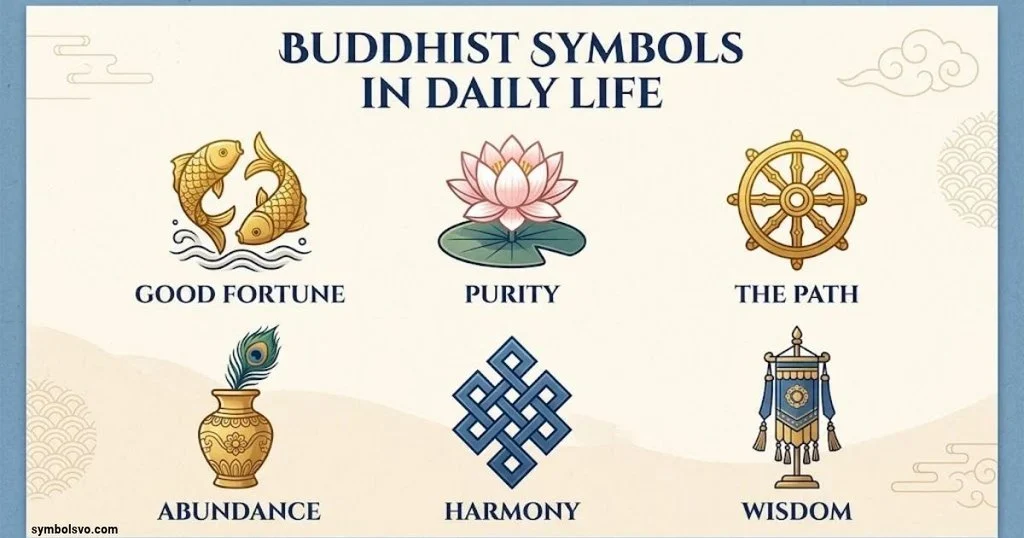
Buddhist symbols are no longer limited to monasteries and temples. People encounter them in homes, meditation studios, jewelry shops, art galleries, and online spaces.
Their popularity has made it especially important to understand their cultural and religious context.
Buddhist Tattoos
Common Buddhist tattoo symbols include the lotus flower, Dharma Wheel, Endless Knot, and mandala.
People may choose these designs to represent personal growth, mindfulness, compassion, or a connection with Buddhist teachings.
However, some images are sacred objects used in specific religious practices. A mantra, deity image, or ritual symbol may carry meanings that go beyond its appearance.
Before choosing a Buddhist tattoo, learn what the design represents and consider whether its use is respectful in the relevant culture.
Buddhist Jewelry
Buddhist-inspired jewelry often includes lotus pendants, prayer beads, small Dharma Wheels, and Endless Knot designs.
Some people wear these objects as reminders of mindfulness or spiritual values. Others appreciate their traditional artwork.
A piece of jewelry does not automatically make someone a Buddhist. Its significance depends on the wearer’s beliefs, intentions, and understanding.
Buddhist Home Décor
Buddhist-inspired home décor can include Buddha statues, lotus artwork, mandalas, prayer flags, and small altar objects.
People often use these items to create a quiet space for reflection or meditation.
If you display a Buddha image, it is worth learning about respectful placement and the customs associated with that image in its cultural setting.
Buddhist Meditation Spaces
A Buddhist meditation space may include a Buddha image, candles, flowers, incense, a meditation cushion, or a small altar.
The objects are not all essential. Their purpose is to support a calm environment and encourage focused practice.
A simple space with few distractions can be just as useful as an elaborate shrine.
Buddhist Symbols Compared With Other Religious Symbols
Some symbols appear in more than one religious or cultural tradition. Their appearance may be similar, but their meanings and histories can differ.
This is especially important when discussing Buddhist cultural symbols and broader Asian spiritual imagery.
| Symbol | Traditions or contexts | Important distinction |
| Om | Hinduism and some Buddhist practices | Not exclusively Buddhist |
| Lotus | Buddhism, Hinduism, and other Asian traditions | Meanings differ by religious context |
| Swastika | Ancient South Asian and other cultures | Buddhist uses have distinct historical meanings from Nazi appropriation |
| Hamsa Hand | Jewish, Islamic, and wider Mediterranean and Middle Eastern traditions | Not a specifically Buddhist symbol |
| Mandala | Hindu and Buddhist traditions | Designs and ritual meanings vary |
Is the Hamsa Hand a Buddhist Symbol?
The Hamsa Hand, also called the Hand of Fatima in some contexts, is a protective symbol associated with several cultural and religious traditions, particularly in parts of the Middle East and North Africa.
It is commonly shown as an open hand, sometimes with an eye in the center. Its meanings can include protection, blessing, and good fortune.
Although it may appear in collections of spiritual symbols, it is not one of the traditional Eight Auspicious Symbols of Buddhism. It should not be described as an exclusively Buddhist religious symbol.
Is Om a Buddhist or Hindu Symbol?
Om has a long history in Indian religious traditions, especially Hinduism. It also appears in some Buddhist mantras and practices.
The syllable is included at the beginning of Om Mani Padme Hum, a mantra strongly associated with Tibetan Buddhism and Avalokiteshvara.
Therefore, Om has connections with Buddhism, but it is not unique to Buddhism.
Are Buddhist and Hindu Symbols the Same?
Some symbols and visual forms are shared across Buddhist and Hindu traditions. This is partly because Buddhism developed in the Indian religious and cultural environment.
However, shared imagery does not mean that the symbols always have identical meanings. The same image may be interpreted differently depending on the tradition, text, ritual, and historical period.
Frequently Asked Questions About Buddhism Symbols
What is the main symbol of Buddhism?
The Dharma Wheel is widely recognized as the main symbol of Buddhism. Its eight spokes represent the Noble Eightfold Path, while the wheel itself represents the Buddha’s teachings.
What are the eight main Buddhist symbols?
The Eight Auspicious Symbols are the Dharma Wheel, Lotus Flower, Endless Knot, Conch Shell, Golden Fish, Parasol, Treasure Vase, and Victory Banner.
What is the most powerful symbol in Buddhism?
There is no single symbol officially recognized as the most powerful across all Buddhist traditions. The Dharma Wheel, Vajra, Lotus Flower, and Three Jewels are among the most significant because of their connections with Buddhist teachings.
What does the lotus flower mean in Buddhism?
The lotus flower represents purity, resilience, and spiritual awakening. It grows in muddy water but rises above the surface, making it a powerful image of overcoming difficulties and developing wisdom.
What does a Buddha statue symbolize?
A Buddha statue commonly represents enlightenment, wisdom, compassion, and the possibility of spiritual awakening. Its posture and hand gestures can communicate more specific meanings.
What is the Buddhist symbol for inner peace?
The lotus flower and Dhyana Mudra are commonly associated with inner peace. Both represent qualities such as calmness, concentration, mindfulness, and spiritual balance.
What does the Vajra symbol mean?
The Vajra represents indestructible wisdom, spiritual strength, and clarity. In Vajrayana Buddhism, it is often paired with a ritual bell to express the relationship between wisdom and skillful means.
What does Avalokiteshvara represent?
Avalokiteshvara represents compassion and the commitment to help all living beings overcome suffering. In Chinese Buddhism, this bodhisattva is widely known as Guanyin.
What are the Three Jewels of Buddhism?
The Three Jewels are the Buddha, Dharma, and Sangha. They represent the awakened teacher, his teachings, and the Buddhist community that follows and preserves those teachings.
What does Om mean in Buddhism?
Om is a sacred syllable used in several Indian religious traditions. In Tibetan Buddhism, it appears in the mantra Om Mani Padme Hum, which is associated with Avalokiteshvara and compassion.
What is the meaning of Buddhist mandalas?
Buddhist mandalas can represent the universe, an enlightened realm, or a sacred structure used in meditation and visualization. Their detailed geometric designs also support concentration and reflection.
What does a Buddhist stupa represent?
A Buddhist stupa is a sacred structure associated with the Buddha, his teachings, and remembrance. Some stupas contain relics, while others commemorate important events or sacred places.
What is the meaning of Buddha’s footprints?
Buddha’s footprints represent his presence, teachings, and the path he showed to others. They were especially important in early Buddhist art, when artists often represented the Buddha through symbols rather than human figures.
What is the lucky number in Buddhism?
There is no single universal lucky number in Buddhism. However, numbers such as 3, 4, 5, 8, and 108 have important religious associations. The number eight connects with the Noble Eightfold Path, while 108 is commonly used for prayer beads.
What is the Buddhist symbol for happiness?
The Golden Fish and Treasure Vase are associated with auspiciousness and positive qualities. The Laughing Buddha, or Budai, is also popularly connected with happiness and prosperity, although he is not the historical Gautama Buddha.
What animals are sacred in Buddhism?
Elephants, lions, deer, Garudas, and nagas appear in Buddhist stories and artwork. They can represent qualities such as wisdom, strength, gentleness, protection, and freedom.
What does the Garuda symbolize?
Garuda commonly represents strength, freedom, and protection. In some Buddhist traditions, it is associated with overcoming obstacles and harmful forces.
What does the Laughing Buddha represent?
The Laughing Buddha represents happiness, generosity, contentment, and prosperity in popular East Asian traditions. He is generally identified with Budai, a Chinese monk, rather than Gautama Buddha.
Is the Hamsa Hand a Buddhist symbol?
No. The Hamsa Hand is associated with several cultural and religious traditions, particularly in the Middle East and North Africa. It is not one of the traditional Eight Auspicious Symbols of Buddhism.
What symbolizes love in Buddhism?
Avalokiteshvara and Guanyin are important symbols of compassion and loving-kindness. The red lotus is also associated with love and compassion in some Buddhist symbolic traditions.
Final Thoughts on Buddhist Symbols and Their Meanings
Buddhist symbols offer a visual way to understand the religion’s teachings, history, and spiritual practices. The Dharma Wheel represents the path taught by the Buddha, while the lotus flower illustrates purity and awakening. The Vajra communicates indestructible wisdom, and the Endless Knot reminds people that everything is connected.
Other symbols carry meanings through their use in rituals, meditation, architecture, and Buddhist art. Buddha figures, mudras, sacred animals, and the Eight Auspicious Symbols each contribute to this rich visual tradition.
Their interpretations can change across countries and Buddhist schools. Understanding those differences helps prevent confusion between traditional Buddhist symbols and images borrowed from other religious or cultural settings.
If you encounter a Dharma Wheel in a temple, a lotus in a painting, or a mandala in a meditation space, learning its meaning can reveal a deeper connection to Buddhist philosophy. These symbols are not just decorative designs. They are reminders of wisdom, compassion, mindfulness, and the ongoing journey toward enlightenment.

Mason Ellington is a creative and dedicated Content Writer and Symbols Expert with a passion for words, communication, and symbolic meanings. He specializes in crafting engaging, informative, and well-structured content while exploring the deeper meanings and interpretations behind symbols. With a creative mindset and attention to detail, Mason transforms ideas into meaningful content that informs, inspires, and connects with readers. His expertise combines powerful storytelling, clear communication, and a deep understanding of symbolism.
 Nathan Holloway
 Daniel Brooks