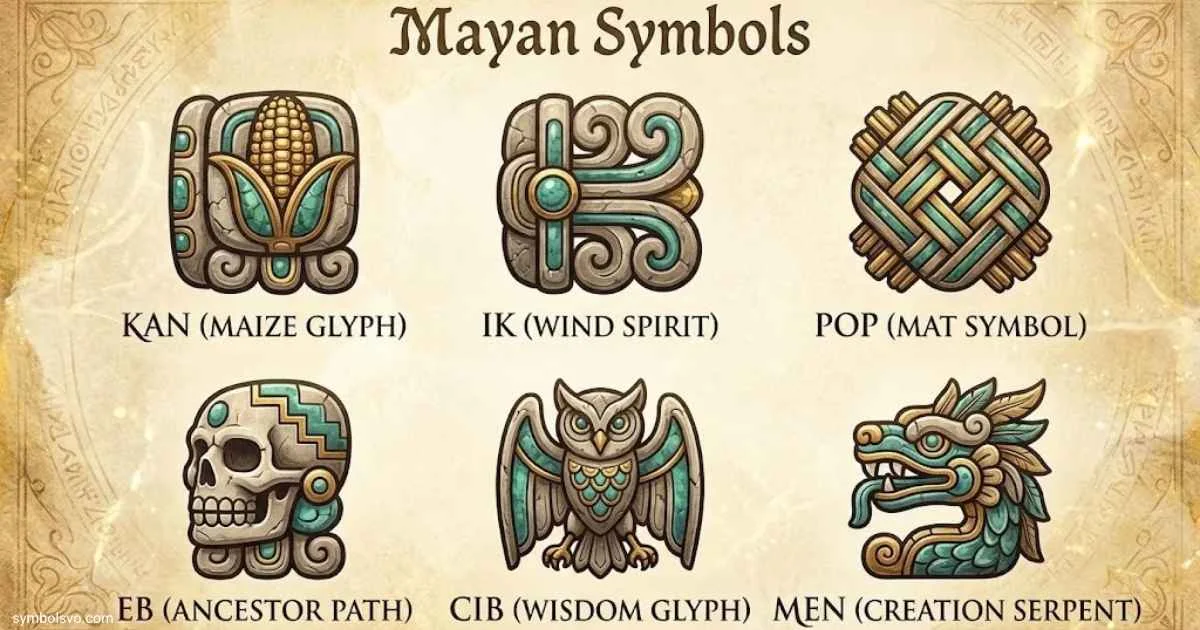
Mayan symbols offer a fascinating window into one of the most accomplished civilizations of the ancient Americas. From intricate stone carvings to mathematical notation and sacred calendar signs, these symbols helped the Maya record history, track time, honor deities, and express ideas about the world around them.
However, not every ancient Maya image was a written symbol. Some signs represented complete words, others recorded syllables, and still others belonged to mathematics, calendars, or religious art. Understanding these differences makes their meanings far more interesting.
The Maya civilization flourished across parts of present-day southern Mexico, Guatemala, Belize, Honduras, and El Salvador. Its achievements included a sophisticated Maya writing system, advanced mathematical knowledge, detailed astronomical observations, and impressive cities filled with temples, palaces, and carved monuments. Today, Maya peoples continue to preserve their languages, traditions, and cultural heritage.
In this guide, you’ll discover famous Mayan symbols and their meanings, learn how ancient Maya glyphs worked, explore their number system and calendars, and understand how these traditions remain relevant today.
What Are Mayan Symbols?
Mayan symbols are visual signs and designs associated with the ancient Maya and their cultural traditions. The term covers several different things, including written glyphs, numerical notation, calendar signs, images of gods, and artistic motifs.
The ancient Maya developed a sophisticated writing system that could record spoken language. Their scribes used combinations of word signs and phonetic signs to write names, historical events, religious texts, dates, and other information. Researchers have found Maya writing on stone monuments, pottery, murals, and manuscripts known as codices.
The word symbol is broader than glyph. A glyph usually refers to a written sign or a recognizable unit within a hieroglyphic inscription. A jaguar depicted in a royal scene, for example, may carry cultural meaning without functioning as a written word in that particular image.
This distinction matters because popular discussions often assign a fixed meaning to every Maya design. In reality, the meaning depends on its context, location, date, and use.
Maya Symbols vs. Maya Glyphs
| Feature | Maya glyphs | Other Maya symbols and imagery |
| Main purpose | Record language and information | Communicate religious, political, or artistic ideas |
| Examples | Word signs, syllabic signs, written names | Jaguar imagery, deity portraits, ornamental motifs |
| Common locations | Inscriptions, pottery, codices, monuments | Temples, sculptures, ceramics, textiles, ritual objects |
| How to interpret them | Study the writing, language, and reading order | Examine the imagery and its cultural and historical setting |
Some objects combine both forms. A carved monument might portray a ruler while its accompanying inscription identifies the ruler and records an important event.
That combination of image and writing makes Maya art especially valuable to historians and archaeologists.
History and Origins of Mayan Symbols
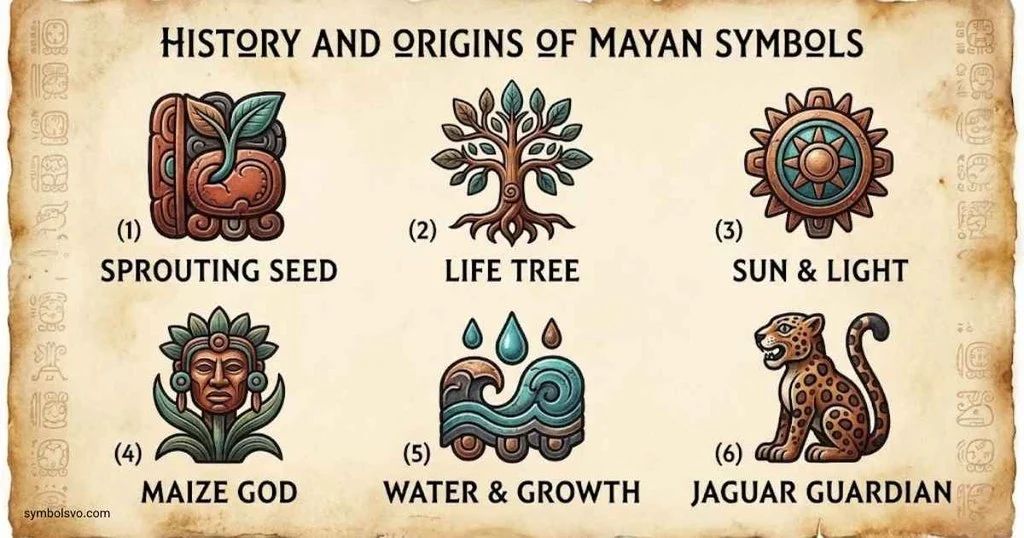
The history of Maya symbols stretches across centuries of cultural development. Their writing system evolved within the wider world of Mesoamerican civilizations, where different societies developed distinctive artistic traditions, calendars, and forms of record-keeping.
The Origins of Maya Writing
Maya hieroglyphic writing emerged during the first millennium BCE, although the precise dating and interpretation of some early examples remain subjects of scholarly discussion. By the Late Preclassic period, the Maya were developing the traditions that later flourished on monumental inscriptions.
Early writing helped establish a way to preserve information beyond spoken communication. Over time, scribes developed complex combinations of word signs and phonetic signs, allowing them to record names, dates, titles, and complete statements.
The script was not simply a collection of pictures. It represented language through an organized system of signs, making it one of the most important writing traditions of the ancient Americas.
Maya Symbols During the Classic Period
The Classic Maya period, conventionally dated from approximately 250 to 900 CE, produced many of the most famous Maya inscriptions.
During this era, powerful kingdoms built monumental cities and recorded their histories on carved stone monuments called stelae, building panels, stairways, and other objects. Inscriptions often documented royal accessions, military victories, political alliances, marriages, and ceremonial events.
These records provide details that archaeologists could not recover from architecture alone. A temple tells researchers about construction and artistic choices. Its inscription may reveal who commissioned it, which ruler governed the city, and what event the monument commemorated.
Maya scribes were skilled specialists. Their work required knowledge of writing conventions, historical traditions, and the visual design of glyphs.
The Decline of Ancient Maya Cities and the Survival of Maya Culture
Many major southern lowland Maya cities experienced political and demographic changes between the eighth and tenth centuries. Monumental construction and royal inscriptions declined in numerous places, but the Maya people did not disappear.
Maya communities continued living across the region, and their languages and cultural traditions survived through profound historical changes. In some areas, Maya writing and book traditions continued into the period of Spanish colonization.
The arrival of Spanish forces and missionaries brought devastating changes. Many Indigenous books were destroyed, and the use of traditional writing declined under colonial rule. Nevertheless, surviving manuscripts, inscriptions, oral traditions, and archaeological discoveries preserve important evidence of Maya history.
How Researchers Deciphered Maya Glyphs
For centuries, many scholars struggled to understand Maya hieroglyphs. Their pictorial appearance made them seem mysterious, and early researchers lacked sufficient knowledge of the languages encoded in the script.
Decipherment advanced through a combination of linguistic analysis, comparisons between inscriptions, archaeological evidence, and the study of calendars. The work of scholars such as Yuri Knorozov helped establish the importance of phonetic readings, while Tatiana Proskouriakoff’s research showed how inscriptions could record dynastic histories and the lives of rulers.
Today, researchers can read a substantial portion of Maya hieroglyphic writing. Some signs and passages remain uncertain, but the script is no longer an undecipherable collection of pictures. It is a functioning writing system whose texts reveal political, religious, and historical information.
Types of Mayan Symbols and Glyphs
The Maya hieroglyphic writing system combined several kinds of signs. Learning the difference between them helps explain how scribes created detailed written records without relying on a conventional alphabet.
Logograms: Signs That Represent Words
Logograms represent complete words or meaningful lexical units. Instead of spelling a word with separate letters, a scribe could use a sign associated with that word.
For example, Maya inscriptions can represent the word for jaguar, commonly reconstructed as bahlam, using a logographic sign depicting a jaguar head. The same word could also be written with syllabic signs.
Logograms made the script visually rich. Some resemble animals, faces, body parts, or objects, while others are more abstract.
Syllabic and Phonetic Signs
Syllabic signs represent sounds, commonly consonant-vowel combinations such as ba, ma, or ki. Scribes combined these signs to spell words phonetically.
A word could sometimes be written using syllabic signs alone or through a combination of a logogram and phonetic signs. These combinations could clarify pronunciation and distinguish between words with similar appearances.
This flexibility is one reason Maya writing looks so different from English. The script does not use a simple alphabet in which each letter represents a single sound.
Glyph Blocks and Hieroglyphic Inscriptions
Maya writing typically appears in glyph blocks, which contain one or more signs arranged within a compact visual unit. Larger signs may occupy the center while smaller signs attach to their sides or fit within them.
Many monumental texts use paired columns of glyph blocks. Readers generally follow the text from left to right across paired columns and then continue down the inscription.
The arrangement varies with the object and layout, so reading a damaged monument requires careful analysis. Researchers examine the signs, their placement, the language, and related inscriptions before proposing a translation.
Numerical and Calendar Signs
Not all Maya signs record words. Numerical notation uses dots, bars, and a shell-shaped sign for zero. Calendar signs identify days, months, and positions within longer cycles.
These systems often appear together in inscriptions. A monument might record a date using numerical signs and calendar names before describing a ruler’s actions in written language.
The same carved surface can therefore contain several kinds of information at once.
Famous Mayan Symbols and Their Meanings
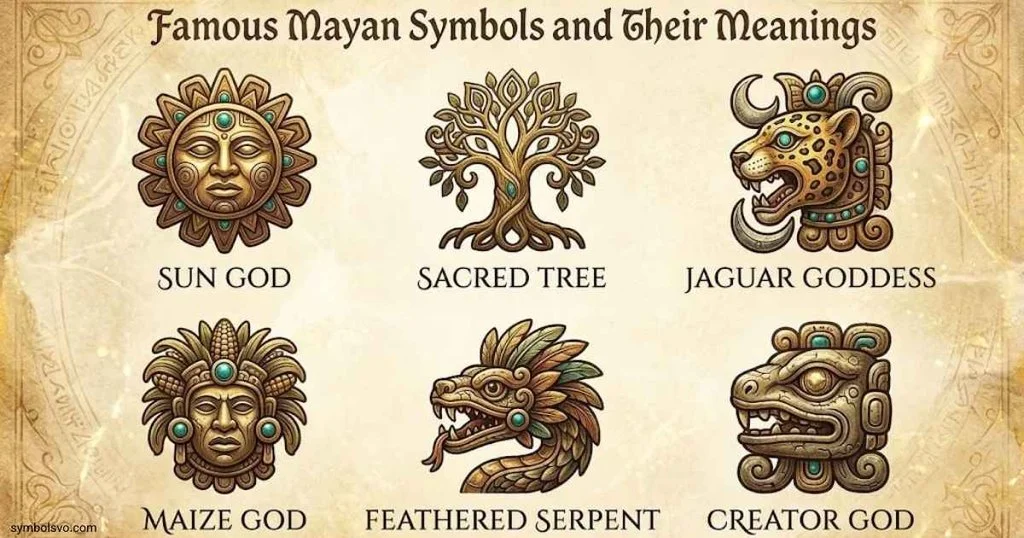
Some of the most recognizable ancient Maya symbols feature animals, celestial bodies, plants, and supernatural beings. These images help researchers understand Maya religion, political authority, and ideas about life and the natural world.
Still, a symbol’s meaning isn’t always simple. The same animal might appear in a royal portrait, a mythological scene, or a religious object, with a different significance in each setting.
The Mayan Sun Symbol
The sun played an important role in Maya timekeeping, agriculture, and religious traditions. Its daily movement across the sky helped people understand the passage of time and the changing seasons.
Maya art and inscriptions include solar imagery and references to k’in, a term associated with the sun and the day. Solar deities also appear in Maya religious art, although their names and visual features vary across different traditions.
Sun-related imagery may therefore connect with time, celestial cycles, and divine power. However, not every circular design represents the sun, and there is no single solar symbol that explains every Maya tradition.
The most reliable way to interpret a sun image is to examine its accompanying glyphs, artistic details, and archaeological setting.
The Mayan Jaguar Symbol
The jaguar symbol is one of the most recognizable motifs in ancient Maya art. As a powerful predator active at night, the jaguar held a special place in Maya imagery and supernatural traditions.
Artists portrayed jaguars on ceramics, monuments, royal objects, and images of deities. Jaguar features also appear in depictions of rulers and supernatural beings.
The animal’s associations with strength and danger made it a powerful image of authority. In some contexts, jaguars also connect with darkness, nighttime, and the supernatural. The Metropolitan Museum of Art discusses these themes in its examination of Maya divine imagery.
Commonly discussed associations include:
- Power and rulership: Jaguar imagery appeared in elite and royal settings.
- Night and darkness: The animal’s nocturnal habits influenced its supernatural associations.
- Strength and danger: Its status as a formidable predator made it a compelling artistic motif.
- Supernatural forces: Jaguar features appear in representations of certain gods and otherworldly beings.
These associations are useful for understanding the imagery, but they shouldn’t be treated as a fixed dictionary. A jaguar figure may communicate several ideas at once.
The Mayan Serpent and Feathered Serpent
Serpents appear throughout Mesoamerican religious art. Their forms can connect with supernatural beings, deities, and ideas about the relationship between the human world and the divine.
One famous example is Kukulkan, the feathered serpent associated with Chichén Itzá. Feathered-serpent imagery appears in the site’s monumental architecture and other works of art. The Metropolitan Museum of Art identifies the feathered serpent as one of Chichén Itzá’s principal deities.
The feathered serpent also belongs to wider Mesoamerican traditions. The Nahuatl name Quetzalcoatl is widely recognized, while Kukulkan is the corresponding name used in Yucatec Maya tradition. Their histories overlap, but their identities and significance shouldn’t automatically be treated as identical in every period.
Serpent imagery can be associated with:
- Divine power: Serpents appear as supernatural beings and deities.
- Religious authority: Their images feature in ceremonial and monumental settings.
- Connections between worlds: Some supernatural serpent imagery appears in scenes involving gods and rulers.
- Cultural exchange: Feathered-serpent traditions reveal connections among different Mesoamerican societies.
It’s important to distinguish a general serpent motif from a specific deity. The details of the image and its location help researchers determine which interpretation makes sense.
The Mayan Corn Symbol and Maize God
Maize, commonly called corn in American English, was central to Maya agriculture and food traditions. It also occupied an important place in religious thought.
The Maize God appears in Maya art as a youthful figure often associated with a distinctive elongated head resembling an ear of maize. Artists portrayed episodes from his mythology on ceramic vessels and other objects.
In the Popol Vuh, the K’iche’ Maya creation narrative, human beings are successfully created from yellow and white corn after earlier attempts fail. This story expresses a profound connection between maize, human identity, and the sacred world.
Maize-related imagery can therefore connect with:
- Life and nourishment: Maize sustained communities across the Maya region.
- Agricultural cycles: Planting, growth, and harvest shaped everyday life.
- Renewal: The Maize God’s mythology includes death and regeneration.
- Creation traditions: Corn plays a direct role in the K’iche’ creation story.
These meanings come from specific artistic and mythological traditions. A modern design featuring an ear of corn may draw inspiration from Maya culture, but it doesn’t automatically reproduce a documented ancient glyph.
Mayan Death Symbols and the Underworld
Death and the afterlife appear in Maya mythology, religious imagery, and written traditions. Artists depicted skeletal figures, supernatural beings, and scenes involving the underworld.
The Popol Vuh describes Xibalba, the underworld in K’iche’ Maya mythology. Its stories include the trials of the Hero Twins, who confront the lords of this realm through a series of challenges.
Maya imagery also connects death with the natural processes of growth and renewal. The Metropolitan Museum of Art notes that Maya conceptions of nighttime and death could overlap with ideas about fertility and regeneration.
However, there is no single universal Mayan death symbol. Skeletal imagery, underworld beings, and other motifs must be interpreted according to their specific context.
The Maya Hero Twins
The Hero Twins, known as Hunahpu and Xbalanque in the K’iche’ Popol Vuh, are among the most famous characters in Maya mythology.
Their story describes their confrontation with the lords of Xibalba and their participation in a dramatic cycle of trials and transformation. The narrative explores themes of intelligence, resilience, divine power, and the relationship between death and renewal.
The twins appear in Maya-related art and later interpretations of ancient traditions. Their story also helps explain why researchers study images alongside written texts rather than interpreting each figure in isolation.
One important distinction: the Hero Twins are mythological characters, not a single pair of written glyphs. Their names can be written in the Maya script, while their visual representations may appear in narrative scenes.
Other Important Mayan Symbols and Motifs
Beyond jaguars, serpents, and maize, Maya art features many other meaningful images.
| Symbol or motif | Historical context and associations |
| Rain and water imagery | Connected with rainfall, agriculture, and deities such as Chaahk |
| Sacred mountains | Associated in some traditions with supernatural places and sacred landscapes |
| Royal headdresses | Could communicate rank, rulership, or a ruler’s relationship with divine authority |
| Flowers and plants | Appeared in artistic and religious contexts, with meanings depending on the image |
| Celestial imagery | Connected with observations of the sun, moon, planets, and calendar cycles |
| Calendar day signs | Identified named days within Maya calendrical systems |
These examples show why Maya symbolism cannot be reduced to a list of simple translations. A careful interpretation considers the image, the object, the inscription, and the cultural tradition behind it.
Mayan Symbols in Mathematics and Numbers
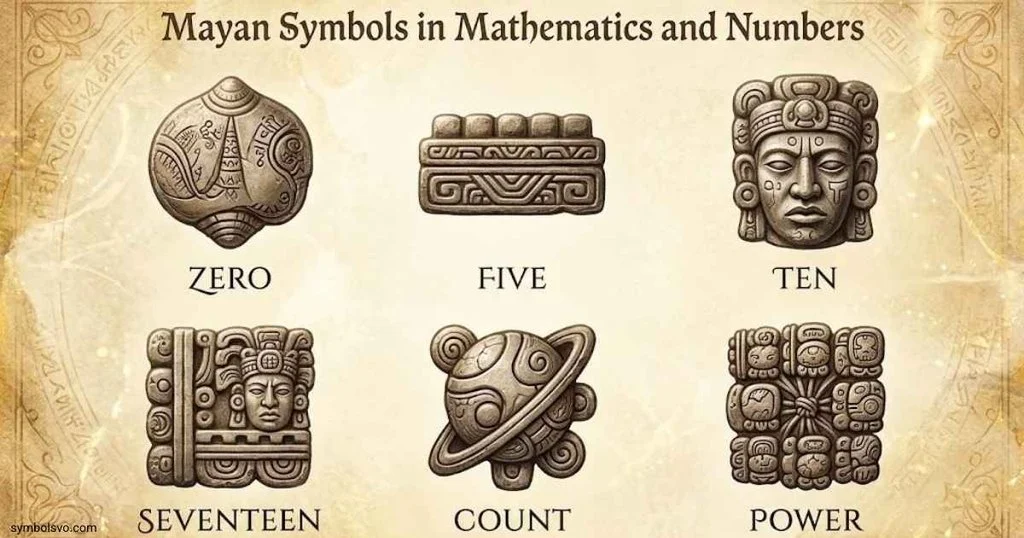
The Maya developed an impressive mathematical system that supported calendrical calculations and the recording of dates. Their numerical notation used just a few basic signs to express a wide range of values.
The Maya number system is particularly notable for its use of dots, bars, and a symbol for zero.
How the Maya Number System Worked
Maya numerals generally used a base-20, or vigesimal, system. The basic signs were combined to represent numbers from zero upward.
- A dot represents one.
- A bar represents five.
- A shell-shaped sign represents zero.
By combining dots and bars, scribes could represent the numbers from one through nineteen. Larger numbers were written using positions stacked vertically.
The basic pattern is easy to understand once you learn the three signs.
What Do the Dot, Bar, and Shell Symbols Mean?
| Maya numerical sign | Value | Explanation |
| Dot | 1 | Each dot adds one |
| Bar | 5 | Each bar adds five |
| Shell-shaped sign | 0 | Represents zero in numerical notation |
For example:
| Number | How it is represented |
| 1 | One dot |
| 4 | Four dots |
| 5 | One bar |
| 6 | One bar and one dot |
| 10 | Two bars |
| 13 | Two bars and three dots |
| 19 | Three bars and four dots |
| 20 | One dot in the second position and zero in the first |
These signs provided a compact way to write numbers and perform calculations. They also played an important role in the Maya calendar.
How the Maya Used Zero
The Maya zero symbol is one of the most significant features of their mathematical tradition. In positional notation, zero allows a number to occupy an empty place without changing the values of the positions around it.
Think about the difference between 6 and 60 in modern decimal notation. The zero helps distinguish the tens position from the ones position.
The Maya used a shell-shaped sign to represent zero in their numerical system. Their use of zero helped them record dates and express large numerical values.
For calendrical purposes, Maya positional notation also included a special adjustment: the third position represented 360 days rather than 400. This modification made the system useful for recording calendar periods.
The achievement wasn’t simply the invention of an interesting sign. It was the integration of zero into a working system of numerical notation.
Maya Calendar Symbols and Their Meanings
The Maya calendar was not one single calendar. It consisted of interconnected systems that served different purposes, from naming individual days to recording long stretches of history.
The Maya observed celestial cycles and developed sophisticated methods for tracking time. Their calendars supported religious ceremonies, historical records, and the organization of important dates.
The Tzolk’in Sacred Calendar
The Tzolk’in calendar consists of 260 days. It combines 13 numbers with a sequence of 20 named days.
Each day has a number and a name. As the number cycle and day-name cycle advance together, the same combination returns after 260 days.
This system played an important role in ceremonial life and divinatory traditions. Day signs were not merely decorative pictures; they formed part of an organized system for identifying and interpreting days.
The Tzolk’in remains important in some contemporary Maya traditions, although practices and interpretations vary among communities.
The Haab’ Calendar
The Haab’ calendar consists of 365 days and approximates the solar year.
It contains 18 months of 20 days each, followed by a final period of five days. That gives the calendar 360 days plus five additional days.
| Feature | Haab’ calendar |
| Total length | 365 days |
| Regular months | 18 |
| Days in each regular month | 20 |
| Final period | 5 days |
| Main purpose | Solar-year timekeeping and calendrical organization |
Unlike the modern Gregorian calendar, the Haab’ does not add a leap day every four years. This means its 365-day cycle does not perfectly match the tropical year over long periods.
The Long Count Calendar
The Long Count calendar served a different purpose: it recorded elapsed time from a traditional creation-era starting point.
Its main units are:
| Unit | Equivalent |
| K’in | 1 day |
| Winal | 20 days |
| Tun | 360 days |
| K’atun | 7,200 days |
| Bak’tun | 144,000 days |
The system uses a modified positional structure suited to recording long spans of time. Maya inscriptions often combine Long Count dates with other calendar information, helping researchers place historical events within a broader chronology.
One widely discussed Long Count date corresponds to December 21, 2012, in the Gregorian calendar. This date marked the completion of a major cycle, not a prediction that the world would end.
How Maya Calendar Cycles Worked Together
The Tzolk’in and Haab’ calendars operated together in a cycle known as the Calendar Round.
Because the two cycles have different lengths, the same combination of a Tzolk’in day and Haab’ date repeats every 18,980 days, or approximately 52 Haab’ years.
The Long Count provided a way to distinguish dates across longer historical periods.
Together, these systems helped Maya scribes record dates with remarkable precision. They also show how mathematics, astronomy, religion, and historical record-keeping overlapped in Maya society.
What Do Maya Day Signs Represent?
The 20 day signs have individual names and distinctive forms. Some are recognizable as animals or natural features, while others have more abstract designs.
Names such as Imix, Ik’, K’an, and Ajaw appear in discussions of Maya calendrical traditions. Their spellings and interpretations can vary with language, region, and transcription conventions.
To understand a day sign properly, consider three questions:
- Which calendar system does it belong to?
- What number or date accompanies it?
- What historical or contemporary tradition provides the interpretation?
Be cautious with websites that assign each day sign a fixed personality type without explaining the source. Historical calendar signs and modern spiritual interpretations are related subjects, but they are not interchangeable.
Mayan Symbols in Religion and Mythology
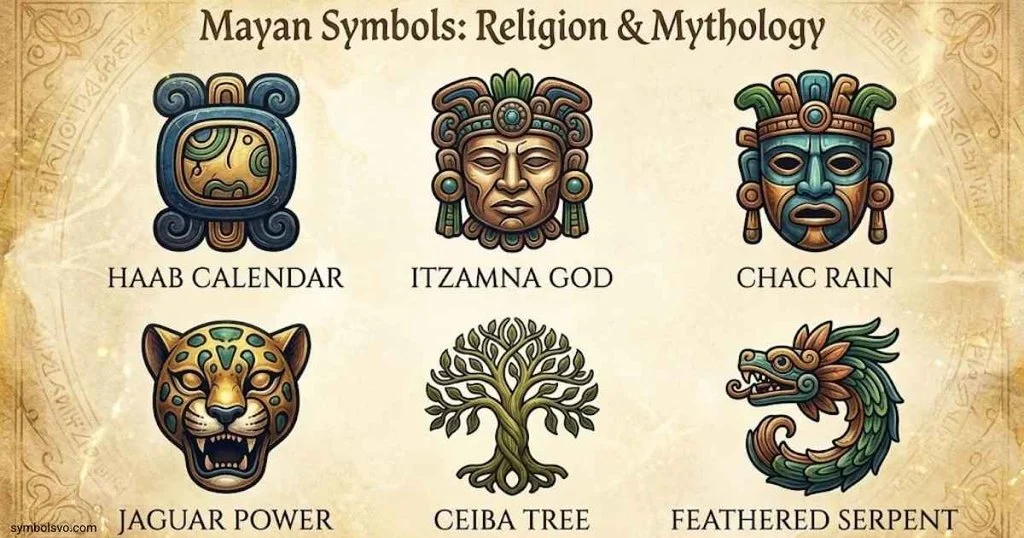
Religion shaped many aspects of ancient Maya life, including architecture, ceremonies, rulership, and artistic expression. Maya religious symbols often appeared alongside written inscriptions, making them important evidence for understanding ancient beliefs.
However, Maya religious traditions differed across communities and changed over time. No single interpretation explains every deity, sacred image, or ceremonial object.
Maya Gods and Their Symbols
Maya artists represented deities through distinctive combinations of facial features, clothing, headdresses, and supernatural attributes.
Some figures can be connected with particular gods through inscriptions or recognizable artistic conventions. Others remain difficult to identify confidently.
Three important examples include:
- Chaahk: A major rain deity associated with rainfall, storms, and agricultural fertility.
- The Maize God: A youthful deity connected with maize, creation traditions, and regeneration.
- Solar deities: Figures associated with the sun and its movement through the sky.
These deities did not necessarily have identical forms or meanings across every Maya region. Artistic details and written names can help researchers identify specific figures.
The Popol Vuh and Maya Creation Mythology
The Popol Vuh, also known as the Popol Wuj, preserves important K’iche’ Maya creation traditions and stories about the Hero Twins.
The text describes the creators’ attempts to make human beings. After earlier attempts fail, the creators form humans from yellow and white corn.
This story highlights the importance of maize in Maya cultural identity. Corn was not simply a crop; it was also part of a broader understanding of human origins and the relationship between people and the sacred world.
The Popol Vuh also recounts the Hero Twins’ encounters with the lords of Xibalba. Their story explores trials, transformation, and the relationship between life and death.
One important historical detail deserves attention: the surviving written version of the Popol Vuh was recorded during the Spanish colonial period. It preserves K’iche’ traditions, but it should not be treated as a complete record of every Maya community’s beliefs.
Religious Rituals and Sacred Places
Maya temples, caves, monuments, and ceremonial spaces often contained images associated with deities and sacred events.
Rulers used public ceremonies and monuments to connect political authority with religious traditions. Inscriptions could record a ceremony’s date and describe the ruler’s role, while carvings portrayed the people and supernatural beings associated with the event.
Archaeologists examine these objects together rather than interpreting them separately. A carved figure becomes easier to understand when researchers know where it was found, what surrounds it, and whether an accompanying inscription identifies the subject.
Nature, Agriculture, and the Sacred World
Maya religious imagery frequently reflects people’s relationships with the natural environment.
Rain affected crop growth. Maize supported communities. Mountains and caves held significance in some religious traditions, while observations of the sun and other celestial bodies shaped calendars.
These relationships appear in mythology, ceremonial objects, and artistic motifs. They also remind us that ancient Maya religious life wasn’t separate from practical concerns. Agriculture, timekeeping, political authority, and religious beliefs often reinforced one another.
How the Ancient Maya Used Symbols in Everyday Life
Although many surviving inscriptions commemorate rulers and ceremonies, Maya symbols served several connected purposes.
Recording Royal Histories and Political Events
Maya inscriptions preserved information about kings, dynasties, and major events. Carved monuments frequently recorded dates and described royal accessions, military campaigns, alliances, and ritual activities.
These records were valuable to rulers because they established dynastic legitimacy and preserved accounts of political achievements.
For modern historians, they provide evidence that can be compared with archaeological discoveries. Inscriptions from different cities sometimes refer to the same rulers or events, helping researchers reconstruct relationships between Maya kingdoms.
Astronomy and Timekeeping
The Maya carefully observed celestial cycles and recorded astronomical information in manuscripts and inscriptions.
Their calendar systems allowed scribes to track recurring dates, while surviving codices contain astronomical tables and calculations involving the planet Venus and eclipses.
The Dresden Codex, for example, preserves calendrical material and astronomical calculations. Its contents show that Maya astronomy combined careful observation with religious and ceremonial interpretations.
Agriculture, Trade, and Administration
Maya communities relied on agriculture, particularly maize, beans, and squash. Seasonal knowledge helped farmers organize planting and harvesting around local environmental conditions.
Written records and numerical systems supported calendar calculations and the recording of important events. Symbols also appeared on pottery and other objects that moved through social, political, and economic networks.
However, not every object bearing a Maya motif served an administrative purpose. Its function must be established from archaeological evidence rather than assumed from its appearance.
Where Can You Find Ancient Maya Symbols Today?
Ancient Maya symbols survive on monuments, buildings, ceramics, and manuscripts. Several archaeological sites provide especially valuable examples.
Tikal, Guatemala
Tikal was a major Maya city with monumental temples, palaces, plazas, and carved monuments. Its inscriptions provide evidence about rulers, dynastic histories, and political relationships.
The city’s architecture also shows how public spaces and royal buildings formed part of a wider political and ceremonial landscape.
Palenque, Mexico
Palenque is famous for its carved panels, inscriptions, and royal monuments. Its written records have helped researchers reconstruct dynastic history and study the relationship between rulers and religious traditions.
The site’s inscriptions demonstrate how Maya writing preserved detailed accounts of political events.
Chichén Itzá, Mexico
Chichén Itzá is known for its monumental architecture and feathered-serpent imagery. Its artistic traditions reflect important religious and cultural developments in the northern Maya region.
The site provides a useful example of how recognizable motifs can appear across architecture, sculpture, and ceremonial objects.
Copán, Honduras
Copán contains significant Maya monuments, including its famous Hieroglyphic Stairway. The inscriptions preserve historical information about rulers and dynastic events.
The site is particularly important for understanding Maya epigraphy, the study of inscriptions and their historical meaning.
The Four Surviving Maya Codices
The Maya produced folding books called codices, which preserved information through combinations of painted images, numbers, calendar signs, and hieroglyphic writing.
Four pre-Columbian Maya codices are widely recognized today:
| Codex | Current location | Important contents |
| Dresden Codex | Dresden, Germany | Calendar calculations, astronomical tables, and ritual material |
| Madrid Codex | Madrid, Spain | Almanacs, divinatory material, and agricultural and ritual subjects |
| Paris Codex | Paris, France | Calendar cycles and ceremonial information |
| Maya Codex of Mexico, formerly called the Grolier Codex | Mexico City, Mexico | A manuscript associated with Venus-calendar material |
These books are extraordinarily valuable because so few survived the colonial destruction of Indigenous manuscripts. The Dresden Codex, in particular, has played an important role in research on Maya calendrical and astronomical knowledge.
How to Read and Interpret Mayan Symbols
Learning to read Maya glyphs takes time, but you can begin by recognizing the different kinds of signs and understanding how they work together.
The most important rule is simple: don’t interpret a symbol based on its appearance alone. A picture that looks familiar might represent a word, a deity, or an artistic motif, depending on its context.
Identify the Type of Symbol
Start by determining what kind of sign you’re examining.
- Written glyph: A sign within a text that represents a word or syllable.
- Numerical sign: A dot, bar, or zero symbol used to express a number.
- Calendar sign: A day name, month sign, or component of a date.
- Religious image: A depiction of a deity, supernatural being, or sacred scene.
- Decorative motif: An artistic pattern whose meaning may be uncertain or depend on its setting.
This first step prevents a common mistake: assuming every ancient Maya design has a direct translation into English.
Examine the Inscription’s Layout
Maya inscriptions often contain groups of signs arranged in glyph blocks. Their position and relationship to neighboring signs can help researchers understand the text.
Look for repeated patterns, numerical signs, recognizable day names, and images that may accompany the writing.
However, recognizing one sign doesn’t necessarily reveal the whole inscription’s meaning. Maya writing combines linguistic information with complex visual conventions.
Use Reliable Historical Sources
If you want to investigate a particular design, compare it with museum records, archaeological publications, and established research on Maya writing.
The Smithsonian’s Living Maya Time resource explains Maya calendars and cultural traditions. The British Museum’s introduction to Maya glyphs also provides a useful starting point for understanding the writing system.
For a deeper study, the ClassicMayan Portal provides scholarly resources on Maya hieroglyphs and sign classifications.
These sources can help you separate historically supported interpretations from modern claims that lack clear evidence.
Mayan Symbols in Modern Maya Culture
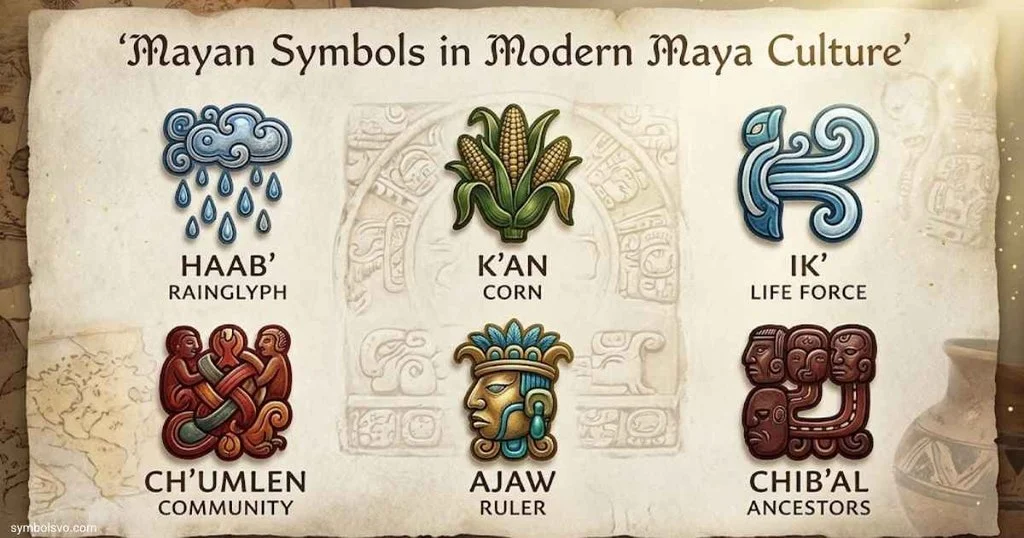
Ancient Maya symbols remain important because Maya culture is a living tradition, not merely a subject of archaeology.
Today, Maya communities continue to maintain their languages, artistic practices, and cultural knowledge across Mesoamerica and beyond. The Smithsonian’s National Museum of the such as Native American(s) reports that more than seven million Maya live in their ancestral homelands and other parts of the world.
Maya Cultural Identity and Heritage
Maya cultural heritage includes much more than ancient monuments. It encompasses living languages, oral traditions, community histories, agricultural knowledge, textiles, ceremonies, and contemporary art.
Some communities preserve or revive aspects of ancestral calendrical and writing traditions. Researchers and Maya scholars also continue to study inscriptions and manuscripts, expanding our understanding of the past.
These efforts demonstrate the connection between archaeological research and contemporary cultural identity.
Symbols in Contemporary Art and Craft
Maya-inspired imagery appears in ceramics, jewelry, textiles, sculptures, and other forms of creative expression.
Some contemporary artists draw directly on local cultural traditions. Others reinterpret ancient motifs in new ways, blending historical references with modern materials and styles.
The key is to recognize that a modern artwork may represent a contemporary interpretation rather than a direct copy of an ancient symbol.
Mayan Symbols in Tattoos, Jewelry, and Digital Design
People also encounter Maya-inspired imagery in tattoos, clothing, decorative objects, and digital artwork.
Before using a design, consider the following:
- Check its historical source. Find out whether it represents a documented glyph, a deity, or a modern artistic motif.
- Understand its context. A religious image or royal emblem may carry associations that aren’t obvious from its appearance.
- Avoid invented translations. Many websites assign meanings such as “eternal protection” or “unbreakable strength” without credible historical evidence.
- Respect living communities. Maya cultural heritage belongs to diverse communities whose traditions continue to evolve.
A design can be visually striking without having one universally accepted ancient meaning. Understanding that distinction makes its use more informed and respectful.
Important Facts About Mayan Symbols
The following facts summarize some of the most important features of Maya writing, mathematics, and cultural history.
| Fact | Explanation |
| Maya writing used hundreds of signs | The script includes logograms, syllabic signs, and numerous variations. |
| The script was not an alphabet | It combined word signs and phonetic signs in a logosyllabic system. |
| Maya numerals used dots and bars | Dots represented ones, while bars represented fives. |
| Maya scribes used a zero sign | A shell-shaped sign commonly represented zero in numerical notation. |
| The Tzolk’in had 260 days | It combined 13 numbers with 20 named days. |
| The Haab’ had 365 days | It contained 18 periods of 20 days and one final period of five days. |
| The Long Count recorded elapsed time | Its units helped identify dates across long historical periods. |
| Four pre-Columbian Maya codices are widely recognized | The Dresden, Madrid, Paris, and Maya Codex of Mexico survive. |
| Maya inscriptions recorded political history | Many texts preserve royal names, dates, ceremonies, and dynastic events. |
| Maya culture continues today | Maya peoples maintain living languages, traditions, and cultural identities. |
These facts show that Maya symbols were not limited to religious art. They formed part of a broader intellectual and cultural system that connected writing, mathematics, history, and timekeeping.
Frequently Asked Questions About Mayan Symbols
What do Mayan symbols mean?
Mayan symbols have different meanings depending on their type and context. Written glyphs can represent words or syllables, while numerical signs record quantities and calendar signs identify days or dates. Religious images may represent deities, supernatural beings, or cultural ideas.
What are the most famous Mayan symbols?
Some widely recognized examples include jaguar imagery, feathered-serpent imagery, maize-related depictions, Maya numeral signs, and calendar day signs. Their meanings vary across different historical and cultural contexts.
How many Mayan glyphs are there?
The Maya writing system contains hundreds of distinct signs and many variations. The Smithsonian’s Living Maya Time resource describes approximately 800 signs, although counts vary depending on whether researchers include graphic variants and related forms.
What is the difference between Maya glyphs and Mayan symbols?
A glyph usually refers to a sign within the Maya writing system. The broader term symbol can include glyphs, numerical notation, calendar signs, religious imagery, and artistic motifs.
For example, a written jaguar sign may represent a word, while a sculpted jaguar in a ceremonial setting may communicate political or religious ideas.
How did the Maya represent numbers?
The Maya used a system based on dots, bars, and a shell-shaped zero sign. A dot represented one, a bar represented five, and combinations of these signs expressed numbers up to nineteen. Larger values used positional notation.
How did the Maya use zero?
The Maya used a shell-shaped sign for zero within their numerical notation. Zero helped distinguish positional values and supported the recording of dates and large numbers.
What are the three main Maya calendars?
The three commonly discussed systems are the Tzolk’in, Haab’, and Long Count.
The Tzolk’in contains 260 days, the Haab’ contains 365 days, and the Long Count records elapsed time over longer periods. The Tzolk’in and Haab’ also combine to form the Calendar Round.
What does the Mayan jaguar symbol represent?
Jaguar imagery can be associated with power, rulership, nighttime, and supernatural forces. Its meaning depends on the specific artwork, inscription, and historical setting rather than a single universal definition.
Are Mayan symbols still used today?
Yes. Maya communities continue to preserve cultural traditions, languages, and artistic practices. Some contemporary artists and communities also draw on ancestral motifs and calendrical traditions, although modern uses vary widely.
Where can you see ancient Maya symbols?
Important examples appear at archaeological sites such as Tikal in Guatemala, Palenque and Chichén Itzá in Mexico, and Copán in Honduras. Maya manuscripts and artifacts are also preserved in museum and library collections around the world.
Can anyone learn to read Maya glyphs?
Yes. Beginners can learn the basic sign types, numeral system, calendar notation, and reading conventions. Reading complete inscriptions accurately requires more advanced knowledge of Maya languages, grammar, historical context, and epigraphic methods.
Conclusion: Understanding the Meaning Behind Mayan Symbols
Mayan symbols reveal how the ancient Maya recorded language, measured time, represented numbers, honored deities, and preserved political histories. Their writing system combined logograms and syllabic signs, while their mathematical and calendrical systems supported remarkably sophisticated record-keeping.
Recognizable images such as jaguars, serpents, and maize-related figures offer valuable insights into Maya art and religious traditions. Yet their meanings depend on historical context rather than a universal list of symbolic definitions.
The surviving inscriptions, codices, and monuments provide evidence of these achievements. Meanwhile, contemporary Maya communities continue to preserve and develop their cultural heritage.
Understanding Maya symbols therefore means looking beyond their appearance. Each sign or image becomes more meaningful when you understand the language, history, and living traditions behind it.

Mason Ellington is a creative and dedicated Content Writer and Symbols Expert with a passion for words, communication, and symbolic meanings. He specializes in crafting engaging, informative, and well-structured content while exploring the deeper meanings and interpretations behind symbols. With a creative mindset and attention to detail, Mason transforms ideas into meaningful content that informs, inspires, and connects with readers. His expertise combines powerful storytelling, clear communication, and a deep understanding of symbolism.
 Daniel Brooks
 Nathan Holloway