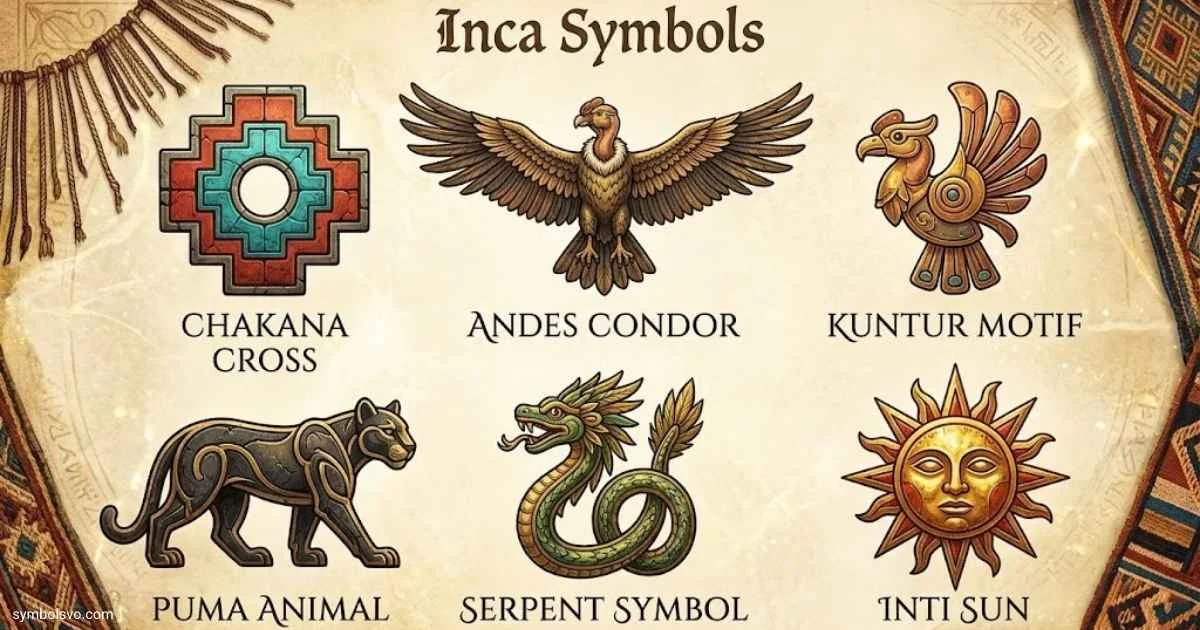
The Inca symbols found in ancient textiles, religious objects, architecture, and artwork offer a fascinating glimpse into one of South America’s most influential civilizations. From solar imagery associated with Inti to intricate geometric patterns woven into ceremonial clothing, these designs reveal connections between religion, political authority, social identity, and the natural world.
However, understanding their meanings takes more than matching a picture with a simple definition. Some symbols have strong historical associations, while others remain open to scholarly debate. Modern interpretations also differ from the beliefs and practices of people who lived during the Inca Empire.
The Inca civilization flourished in the Andes of South America, with Cusco serving as its political and religious center. At its height during the 15th and early 16th centuries, the empire connected diverse communities across a vast region through administration, roads, religious practices, and artistic traditions.
In this guide, you’ll explore the most recognizable ancient Inca symbols, learn about their cultural significance, discover the importance of animal imagery and textile designs, and understand how these traditions continue to influence modern Andean art.
What Are Inca Symbols?
Inca symbols are images, patterns, and other meaningful visual forms associated with the Inca Empire and its cultural traditions. They appeared on woven garments, pottery, ceremonial objects, buildings, and other materials that people used in everyday life and religious activities.
Unlike modern logos, these designs didn’t always have one simple meaning. Their significance could depend on the object, the person using it, the setting, and the historical period.
For example, a geometric pattern on a finely woven tunic could communicate social status or political identity. A representation of the sun could relate to religious beliefs and the authority of the Inca ruler. A knotted cord, meanwhile, could preserve information rather than represent a single spiritual idea.
How the Inca Used Symbols and Visual Communication
Visual designs played several important roles in Inca society.
- Religion: Images and sacred objects connected people with deities, ancestors, and important places.
- Political authority: Clothing, ceremonial objects, and artistic styles could express rank and imperial power.
- Social identity: Textile designs and other visual features helped distinguish communities and individuals.
- Administration: The Inca used khipu, also spelled quipu, to record information through knotted cords.
- Artistic expression: Weaving, metalworking, ceramics, and stone carving reflected technical skill and cultural traditions.
The Inca also inherited ideas and artistic practices from earlier Andean societies. Consequently, not every ancient Peruvian design originated with the Inca.
An important distinction: The Inca did not use a conventional alphabetic writing system like English. Their methods of recording information included khipu, while their visual art communicated meaning in ways that researchers are still investigating.
Important Inca Symbols and Their Meanings
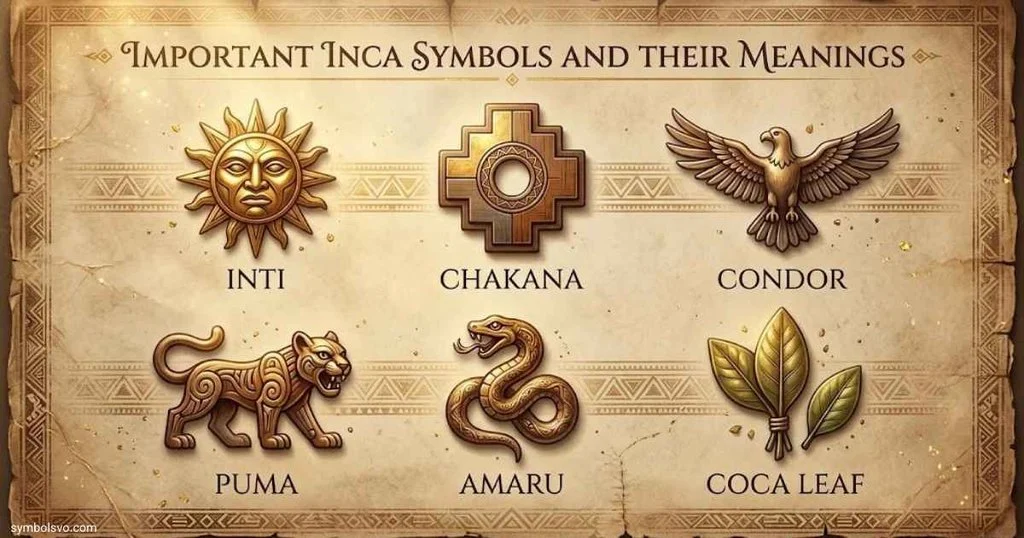
The most recognizable Inca symbols and meanings come from several different sources, including religious traditions, animal imagery, woven designs, and archaeological objects. Some have well-documented historical connections, while others carry meanings that scholars continue to debate.
The following examples explain what each symbol represents in its historical context and how people commonly interpret it today.
Inti: The Inca Sun Symbol
The sun held a central place in Inca religion. Inti, the sun deity, was closely connected to the ruling dynasty, agriculture, and the authority of the empire. Inca rulers presented themselves as descendants of the sun, giving solar worship an important political role as well as a religious one.
The sun also mattered to communities whose lives depended on planting seasons, crop growth, and changes in daylight. Religious ceremonies helped maintain relationships between people and the powers they believed influenced their world.
Common interpretations of the Inca sun symbol include:
- Life and renewal: Sunlight supports plants, animals, and human communities.
- Royal authority: Inti’s connection with the ruling dynasty helped legitimize imperial power.
- Agricultural abundance: Solar cycles mattered to farming and seasonal activities.
- Divine presence: Solar worship formed part of the empire’s religious traditions.
Today, sun designs appear in jewelry, artwork, and tattoos inspired by ancient Peru. However, a modern circular sun with rays isn’t automatically an authentic Inca artifact. Historical examples must be identified through their materials, design, and archaeological context.
The Andean Condor
The Andean condor is one of the most recognizable animals associated with the Andes. Its enormous wingspan and ability to soar above mountain landscapes have made it an enduring feature of regional art and cultural imagination.
In many contemporary explanations of Inca animal symbols, the condor represents the upper world or celestial realm. It is also commonly associated with freedom, spiritual connection, and communication between earthly and divine forces. These interpretations reflect broader Andean traditions, although the precise meaning depends on the historical source and context.
Condor imagery can be meaningful to people today for several reasons:
- Freedom: Its flight suggests independence and movement.
- Elevation: Its mountain habitat connects it with the high Andes.
- Spiritual connection: Modern interpretations often associate the bird with the celestial world.
- Cultural identity: The condor remains an important emblem of Andean heritage.
It’s worth remembering that a living animal’s cultural significance can extend beyond one ancient civilization. Condors have meaning in multiple Andean communities, so calling every condor design exclusively Inca would overlook that wider heritage.
The Puma
The puma appears in discussions of ancient Andean art because of its strength, hunting ability, and place in the region’s natural environment. Inca artists incorporated feline forms into objects and architectural designs, although individual examples require careful interpretation.
Cusco, the former Inca capital, is famously said to have been laid out in the shape of a puma. This interpretation is widely repeated, but the exact relationship between the city’s layout and the animal remains a matter of historical discussion rather than a simple fact that explains every part of the city.
In popular Inca symbolism, the puma is associated with:
- Strength and physical power.
- The earthly world and human life.
- Protection or guardianship in some modern interpretations.
- The relationship between people and the Andean environment.
These associations make the puma a popular subject in contemporary designs. Still, not every puma image served as a protective emblem in ancient times. The meaning of a particular carving or textile motif depends on its original use.
The Serpent
Serpents had a long history in ancient Andean culture, appearing in artistic traditions that existed before the Inca Empire. Their importance therefore cannot be explained through Inca beliefs alone.
A particularly interesting example is a serpent ornament in the collection of the Metropolitan Museum of Art. The museum identifies it as possibly Inca and dates it to approximately 1450–1532 CE. Its description discusses the serpent’s role in Andean religious traditions and the possibility that the object served a ceremonial or ritual function.
Serpents are commonly linked with several ideas:
- Fertility and rain: Some Andean traditions associated serpents with natural forces and agricultural renewal.
- Transformation: Their movement and changing appearance inspire modern symbolic interpretations.
- The lower world: Some popular accounts place serpents in the realm beneath the human world.
- Power: Historical depictions could carry religious or ritual significance.
These meanings shouldn’t be treated as interchangeable. A documented serpent ornament provides evidence about a particular object, not proof that every serpent design carried the same message.
The Chakana or Andean Cross
The Chakana, often called the Andean cross or Inca cross, is a stepped geometric design found in Andean art. It may appear as a stepped diamond or cross-like figure, sometimes with a central opening or circle.
Although modern explanations often describe it as a universal map of the Inca universe, the historical picture is more complicated. Related designs appear across different periods of Andean history, and scholars have cautioned against assuming that every example carries the same meaning. The Los Angeles County Museum of Art describes the motif as widespread but not fully understood.
Common contemporary interpretations connect the Chakana with:
- The relationship between the earth and the sky.
- The organization of the cosmos.
- Four directions and a central point.
- The interconnectedness of different forms of life.
Some modern interpretations also associate the design with three worlds and the condor, puma, and serpent. These ideas are influential today, but they should be identified as interpretations rather than presented as a fully established universal code used by every Inca community.
Tocapu: Geometric Symbols on Inca Textiles
Tocapu, also written tocapu or tokapu, refers to distinctive geometric motifs often arranged in square or rectangular units. Researchers have studied these designs on Inca tunics and other objects because they may have communicated information about rank, identity, or political relationships.
The Metropolitan Museum of Art and other collections document the importance of textiles in the visual culture of the Inca Empire. The Getty Art & Architecture Thesaurus also describes tocapu as geometric designs associated especially with high-status garments.
Researchers have proposed several explanations for their significance:
- They may have marked social position or elite status.
- Some could have related to particular lineages or rulers.
- Their arrangement may have communicated political identity.
- Certain motifs might have carried meanings that are no longer fully understood.
However, scholars have not decoded every motif into a definite word or phrase. It’s misleading to present a modern chart of geometric shapes as a complete translation of an ancient Inca writing system.
The Checkerboard Pattern
Checkerboard patterns offer a useful example of how a design could communicate more than decoration. Historical descriptions and surviving tunics connect certain checkerboard garments with Inca soldiers and imperial administration.
The Los Angeles County Museum of Art explains that Spanish chroniclers described Inca soldiers wearing checkerboard-like tunics. It also discusses how clothing designs could reflect the empire’s organization and the wearer’s position.
A checkerboard pattern may therefore be associated with:
- Military identity in specific historical contexts.
- The standardization of imperial clothing.
- Social distinctions expressed through garments.
- The broader visual identity of the Inca state.
The important detail is context. A checkerboard design on a modern shirt doesn’t automatically carry the same significance as one found on a historically documented tunic.
Stepped Patterns, Diamonds, and Other Geometric Designs
Inca geometric symbols often appear as repeated squares, diamonds, zigzags, and stepped forms. Weavers arranged these shapes in bands, grids, and larger compositions that required careful planning and considerable skill.
Geometric designs served practical artistic purposes, but they could also carry social or political associations. Research on Inca tunics has identified several recurring design families, including diamond waistbands, zigzag bands, checkerboards, and tocapu motifs.
These patterns are important because they show how Inca artists created visual order through repetition and symmetry. A textile’s complete arrangement may be more informative than any single shape taken out of context.
When studying these designs, look at three features:
- Shape: Does the pattern use squares, diamonds, steps, or zigzags?
- Arrangement: Are the motifs repeated in rows, enclosed in bands, or combined with other designs?
- Material and context: Was the pattern woven into an elite tunic, a ceremonial garment, or another object?
Those details offer a stronger starting point for interpretation than assigning a spiritual meaning based on appearance alone.
Khipu or Quipu: The Inca Knotted-Cord System
A khipu, also called a quipu, is a system of cords and knots that the Inca used to record information. Depending on the example, its features could include cord colors, knot types, positions, and relationships between primary and subsidiary cords.
Khipu were important tools for managing a large empire. They helped preserve numerical information used in administration, including records related to people, labor, and resources. Researchers are also investigating whether some khipu recorded narrative or other non-numerical information. The precise extent of their capabilities remains an active research topic.
Khipu are sometimes described as Inca symbols, but that label needs a little care. They aren’t single images representing ideas. Instead, they’re structured information systems that used physical arrangements of cords and knots.
Their main features include:
- Cords: The basic structure holding the recorded information.
- Knots: Their type and position could encode numerical values.
- Colors: Color patterns may have helped distinguish categories or information.
- Cord relationships: The arrangement of cords could organize information into meaningful groups.
Khipu are a reminder that communication doesn’t always require letters or pictures. People can preserve complex information through other carefully organized systems.
Gold and Precious-Metal Imagery
Gold and other valuable materials played important roles in Inca ceremonial life. Spanish accounts and surviving objects reveal that precious metals appeared in religious settings, elite objects, and displays of authority.
Gold is often associated with the sun in modern descriptions of Inca culture. This connection makes sense in light of Inti’s religious importance, but it doesn’t mean every gold object represents the sun. The object’s form, location, and intended use all matter.
Precious materials could signal wealth, status, ritual importance, or political relationships. Their value also depended on cultural beliefs that differed from modern assumptions about money and jewelry.
For an accurate interpretation, examine the actual artifact and its collection record rather than assuming that its material alone reveals its purpose.
Llamas, Alpacas, and Vicuñas
Camelids were essential to life in the Andes. Llamas carried goods across mountainous terrain, while alpacas and other camelids supplied valuable fibers. Their importance extended into textile production, food systems, trade, and ritual practices.
Because these animals supported so many aspects of life, they appear in discussions of ancient Inca symbols and Andean art. However, their practical importance shouldn’t be confused with one fixed symbolic meaning.
Consider the differences:
| Animal | Historical importance | Interpretation to approach carefully |
| Llama | Transport, wool, meat, and ritual use | Strength or endurance |
| Alpaca | Fine fiber and textile production | Wealth or abundance |
| Vicuña | Particularly valued fine fiber | Prestige or elite status |
The interpretations in the final column are useful modern associations, not universal translations of every historical animal image. A camelid depicted on a vessel, garment, or ceremonial object must be understood in its specific setting.
Four-Part Designs and the Inca Empire
The Inca Empire was known as Tawantinsuyu, a Quechua name commonly translated as “land of the four parts.” Its administration organized a vast territory into four major regions connected to Cusco.
This four-part organization is important when studying Inca political history and some geometric designs. Researchers have considered whether certain patterns reflect the empire’s divisions or its broader social organization.
However, not every square, diamond, or four-part motif represents Tawantinsuyu. Similar shapes can serve different artistic purposes, and their meaning depends on evidence from the particular object.
The safest conclusion is that the empire’s political organization and visual culture sometimes intersected. Establishing a direct connection requires more than noticing that a pattern has four sides.
Inca Religious Symbols and Sacred Beliefs
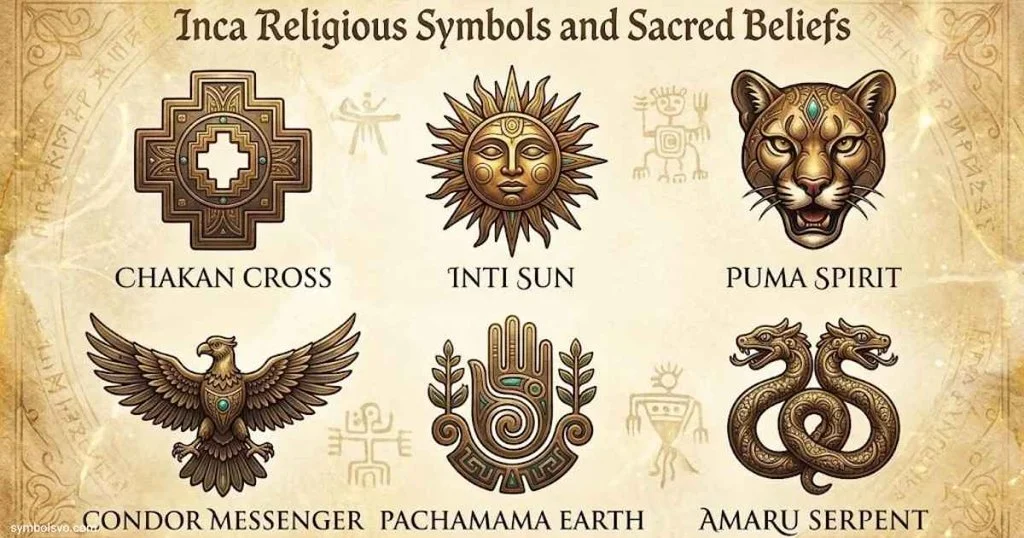
Religion influenced many aspects of Inca life, including ceremonies, agriculture, political authority, and relationships with the natural environment. Inca religious symbols should therefore be understood within a wider system of beliefs rather than as an isolated collection of decorative icons.
The Inca recognized powerful deities and sacred places, including mountains, springs, rocks, and other natural features. Many such places were known as huacas, or wak’as. These weren’t simply graphic symbols; they could be places, objects, or beings considered sacred.
Viracocha: The Creator Deity
Viracocha, also written Wiraqocha, appears in historical accounts of Andean religious traditions as a creator deity. Stories about Viracocha vary, partly because accounts were recorded by outsiders after the Spanish arrived.
Modern artwork sometimes represents Viracocha with a fixed visual appearance. Yet there isn’t one universally established graphic symbol that identifies the deity in every historical context.
When discussing Viracocha, focus on the religious traditions and historical sources rather than claiming that a particular geometric mark was the deity’s official symbol.
Pachamama: Earth and Fertility
Pachamama is associated with the earth and agricultural life in Andean traditions. The relationship between communities and the land mattered deeply in a region where farming depended on local climate, altitude, water, and careful management of mountain environments.
Pachamama’s cultural significance extends beyond the historical Inca Empire. Contemporary Andean communities continue to maintain diverse traditions connected with the land, though practices and beliefs differ by community.
Modern designs sometimes label a spiral, leaf, or geometric figure as the universal Pachamama symbol. Such claims need evidence. The cultural concept itself is important, but that doesn’t establish a single ancient icon used by everyone.
Mama Quilla and the Moon
Mama Quilla, also known as Mama Killa, was associated with the moon in Inca religious traditions. The moon had practical importance for observing time and organizing activities connected with agricultural and ceremonial cycles.
Modern moon designs can express femininity, cycles, or renewal. These are contemporary interpretations unless supported by a specific historical source.
Illapa and Weather-Related Beliefs
Illapa was associated with thunder, lightning, and weather-related forces. In an agricultural society, rain and storms could affect crops and community welfare, making weather-related beliefs particularly significant.
A lightning bolt may be used today as a symbol of power or energy. However, it shouldn’t automatically be described as a specific ancient Inca emblem of Illapa without evidence connecting the design to that deity.
Inca Animal Symbols and Their Cultural Significance
Animals provided food, materials, transportation, and subjects for artistic expression. They also appeared in Andean religious traditions, where their physical characteristics could influence how people understood the natural and spiritual worlds.
The condor, puma, and serpent are often grouped together in modern accounts of Inca animal symbols. Popular explanations associate them with the upper world, earthly life, and the lower world. This framework is useful for understanding some contemporary interpretations, but it can oversimplify the diverse beliefs of ancient Andean societies.
Animal imagery also changed across regions and historical periods. Earlier Andean cultures developed artistic traditions that the Inca later adapted, incorporated, or transformed. That’s why identifying an animal design requires attention to its date, location, and medium.
For readers researching animal motifs, the best approach is to separate three questions:
- What animal does the artwork depict?
- What do historical sources or archaeological evidence say about this particular object?
- Which meanings come from later interpretations or modern personal associations?
This method helps prevent common mistakes, especially when using Inca symbols for tattoos or other contemporary designs.
Inca Textile Symbols and Geometric Patterns
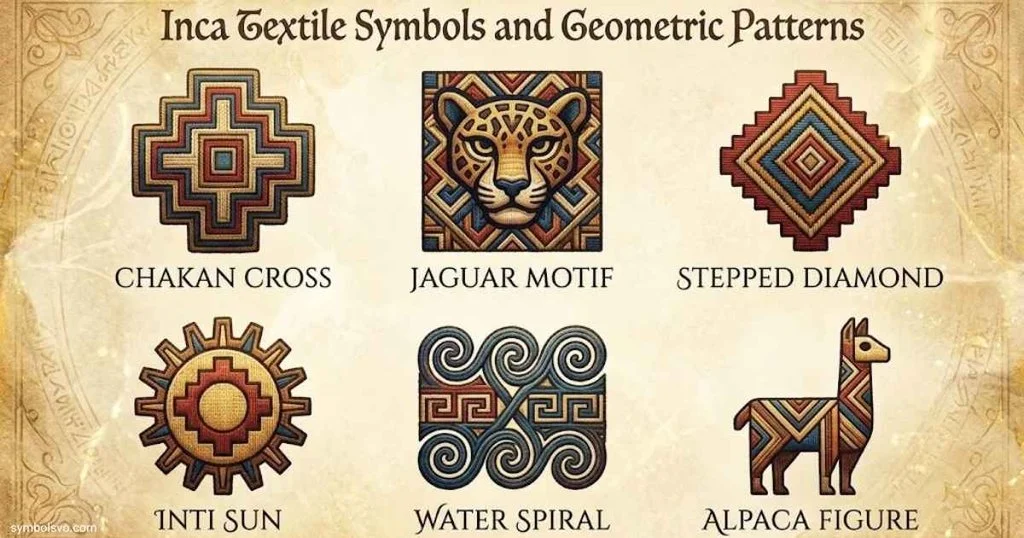
Textiles were among the most important forms of material culture in the Inca Empire. Skilled weavers produced garments using cotton and fibers from camelids such as alpacas and llamas. The finest cloth, known as cumbi in historical sources, was associated with rulers, elite individuals, and ceremonial use.
Inca textile symbols weren’t merely decorative additions. The materials, quality, colors, and arrangement of motifs could communicate social position and cultural identity.
What Did Tocapu Patterns Mean?
Tocapu motifs are usually square or rectangular geometric designs arranged in rows, bands, or grids. Their repeated structure makes them especially recognizable on certain Inca tunics.
Researchers have proposed some motifs related to elite lineages, political authority, or social rank. However, they haven’t established a definitive translation for every design. Even scholars who recognize their importance disagree about how consistently the motifs conveyed specific meanings.
A useful example comes from the Museo de América in Madrid. Its collection includes an Inca-style textile sash dated to 1532–1600, featuring 224 tocapu motifs. The museum notes that the piece likely dates to the colonial period, demonstrating that Inca artistic traditions continued after Spanish conquest.
How Color, Weaving, and Design Communicated Status
A textile’s meaning could come from its complete appearance rather than one isolated motif.
- Materials: Fine camelid fibers and cotton served different practical and artistic purposes.
- Weaving quality: Producing intricate cloth required skill and time.
- Pattern arrangement: Grids, bands, and repeated motifs created recognizable visual styles.
- Historical context: Certain garments were associated with military use, ceremonial activities, or elite identity.
These features help explain why researchers study whole garments instead of treating every square or diamond as a standalone symbol.
Can Every Inca Textile Pattern Be Translated?
No. Some patterns have useful historical associations, but many remain uncertain.
A geometric design might have communicated identity, referred to a particular relationship, or contributed to a larger visual composition. Without supporting evidence, assigning a precise meaning to it would be speculation.
For a closer look at documented examples, explore the Metropolitan Museum of Art’s guide to Andean textiles and the Los Angeles County Museum of Art’s collection information on the Andean uncu.
What Was the Khipu, and Was It an Inca Symbol?
A khipu, or quipu, was a structured recording system made from cords and knots. It helped administrators manage information across a large empire, including numerical records relevant to labor, resources, and other responsibilities.
Its construction was more sophisticated than a bundle of tied strings. The number and type of knots, their placement, cord colors, and relationships among cords could carry information. Researchers have also investigated whether some examples recorded narrative information beyond numerical accounting.
The distinction between khipu and other Inca symbols matters because a khipu was an information system rather than a single emblem.
| Feature | Purpose or significance |
| Main cords | Organized the recording structure |
| Knots | Encoded numerical information in recognized patterns |
| Cord colors | Could distinguish categories or carry additional information |
| Cord arrangement | Helped organize relationships among recorded values |
| Specialized keepers | Maintained and interpreted records |
Khipu demonstrate that the Inca developed sophisticated ways to manage information without relying on an alphabetic writing system. Their full range of uses remains an important subject of research.
What Does the Chakana or Inca Cross Mean?
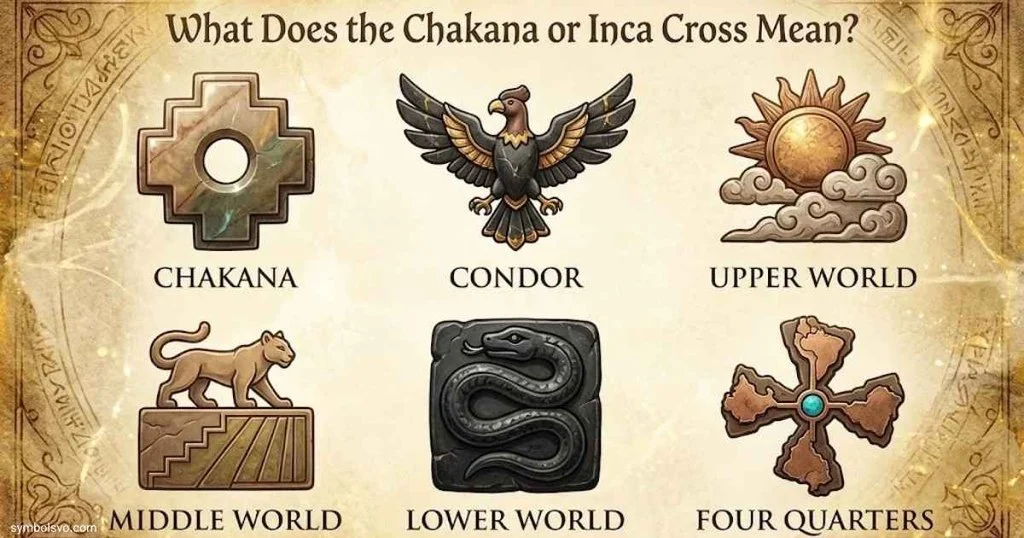
The Chakana, commonly called the Andean cross, is a stepped geometric motif with a long history in Andean visual culture. Similar designs appear on objects from different periods, including some made before the Inca Empire.
Contemporary explanations frequently connect the Chakana with the four directions, three levels of existence, and the relationship between humanity and the cosmos. These interpretations are influential, but they shouldn’t be treated as a universally proven ancient formula.
The Los Angeles County Museum of Art’s collection record for an Andean textile fragment discusses the motif’s broad historical distribution and notes that many of its meanings remain uncertain.
When interpreting a Chakana design, consider:
- Its shape: Does it feature stepped sides, a diamond form, or a central opening?
- Its age: Does the object belong to the Inca period, an earlier Andean culture, or a later period?
- Its context: Was it used on a textile, carved into stone, or created for modern decorative purposes?
- Its interpretation: Is the proposed meaning supported by historical evidence or based on a contemporary spiritual tradition?
This approach allows readers to appreciate the Chakana without presenting every modern explanation as established archaeological fact.
Inca Symbols for Strength, Protection, and Good Fortune
Many people search for Inca symbols for strength, protection, balance, and good fortune because they want a design with personal meaning. These interests are understandable, but historical accuracy matters when choosing a symbol from another culture.
A design can inspire someone today without having carried exactly the same meaning in ancient times.
Symbols Commonly Associated With Strength
The puma is often associated with strength because of its physical power and its place in Andean animal imagery. Modern artists may use it to express courage, confidence, or resilience.
However, these personal associations shouldn’t be confused with a fixed historical translation. The meaning of an ancient puma image depends on the artifact and its original context.
Symbols Associated With Protection
Some historical religious objects had ritual significance, and particular animals could carry protective associations in Andean traditions. The Metropolitan Museum of Art’s discussion of a serpent ornament, for example, describes historical evidence connecting serpent imagery with ritual practices and protective powers.
That evidence doesn’t mean every serpent drawing or serpent tattoo served as a protective charm.
Symbols Associated With Nature and Abundance
Solar imagery, agricultural traditions, and camelid animals offer useful starting points for exploring themes of nature and abundance. These subjects were important in Inca society because communities depended on farming, animal husbandry, and relationships with the environment.
If you choose a design for personal reasons, you can explain what it means to you while being honest about the historical evidence.
Inca Symbols in Tattoos, Jewelry, and Modern Culture
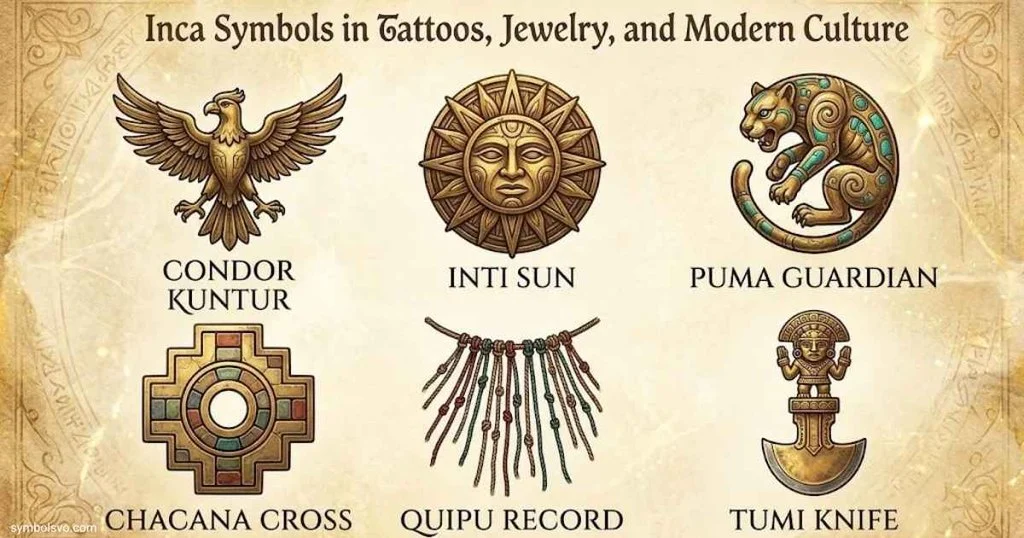
Ancient Andean motifs appear in contemporary jewelry, clothing, artwork, and tattoos. Their strong geometric forms and recognizable animal imagery make them appealing to people interested in history, nature, or cultural heritage.
However, Inca symbols for tattoos are often marketed with simple meanings that don’t reflect the complexity of historical evidence.
Popular Inca-Inspired Tattoo Motifs
A contemporary sun design may express energy, life, or renewal. Inti’s historical significance adds context, but the exact design should be checked before calling it an authentic Inca representation.
The condor can represent freedom or a connection with the mountains in modern art. Its cultural significance extends across Andean traditions.
Modern designs often use the puma to express strength and courage. Historical representations should be distinguished from newly created illustrations.
The stepped cross is popular in modern jewelry and tattoos. Its historical roots are broader than the Inca Empire alone.
Tocapu-inspired motifs draw attention to the precision of Andean weaving. Their original meanings shouldn’t be invented or presented as fully decoded.
How to Choose a Historically Informed Design
If you’re interested in an ancient design, start with a documented example rather than a generic image labeled “Inca.”
Check whether the design appears in a museum collection or archaeological publication. Look at its date, material, geographic origin, and known purpose.
It’s also worth distinguishing personal meaning from cultural history. You can appreciate a design’s appearance while acknowledging that its historical meaning may be uncertain or different from the interpretation you give it today.
Cultural Respect and Authenticity
Inca heritage isn’t limited to the distant past. Indigenous Andean communities continue to maintain and develop cultural traditions, including weaving, artistic expression, and relationships with the land. The Smithsonian’s National Museum of the such as Native American(s) highlights this continuity in its Great Inka Road historical timeline.
Respectful use means avoiding claims that every design belongs to one ancient culture or that all Andean communities share the same beliefs. It also means recognizing the difference between a documented historical artifact and a modern design inspired by it.
How to Identify Authentic Inca Symbols
Not every design sold as an ancient Inca symbol has a documented connection to the Inca Empire. Some designs are modern inventions, while others come from earlier Andean cultures or from the colonial period.
To assess a design’s authenticity, examine the evidence behind it.
Check the Historical Origin
Look for a museum record or archaeological publication that identifies the object’s age, geographic origin, and cultural context. A museum catalog may also explain whether an object is genuinely from the Inca period or combines Inca and European features.
For example, the Museo de América’s tocapu textile is dated to 1532–1600 and identified as an Inca object made in a colonial style. This distinction matters because it shows how artistic traditions continued to evolve after the conquest.
Compare the Design With Documented Artifacts
Use reliable collections to check whether a motif appears on an actual historical object.
Useful starting points include:
- The Metropolitan Museum of Art for Andean textiles, religious objects, and archaeological art.
- The Smithsonian Institution for information about Inca history, material culture, and khipu.
- The Los Angeles County Museum of Art for examples of Andean tunics and geometric designs.
- Museo de América for historical Peruvian and Andean collections.
Watch for Unsupported Claims
Be cautious when a website claims that a particular symbol guarantees protection, attracts wealth, or has one precise spiritual meaning without citing historical evidence.
The same caution applies to claims that every Chakana design represents the same cosmic system or that every tocapu motif has been translated into a word.
Authenticity depends on evidence, not just appearance. A modern design can be inspired by Inca art without being an authentic ancient artifact.
Inca Symbols vs. Aztec Symbols: What’s the Difference?
The Inca and Aztec civilizations developed in different parts of the Americas. Although both had sophisticated artistic traditions and religious systems, their symbols reflect distinct histories and environments.
| Feature | Inca civilization | Aztec (Mexica) civilization |
| Main region | Andes of western South America | Central Mexico |
| Political center | Cusco | Tenochtitlan |
| Major historical period | Imperial expansion from the 15th century to the Spanish conquest | Imperial expansion during the 15th and early 16th centuries |
| Notable artistic forms | Geometric textiles, metalwork, stonework, khipu | Painted manuscripts, stone sculpture, ceremonial objects |
| Important religious imagery | Solar imagery associated with Inti, animal forms, sacred landscapes | Deities, calendrical imagery, and religious figures in distinctive Mesoamerican traditions |
| Information systems | Khipu and other administrative methods | Pictorial manuscripts and other recording traditions |
The two civilizations shouldn’t be treated as interchangeable. Their religious beliefs, political systems, and visual traditions developed in different cultural settings.
It’s also important to remember that neither civilization represented every culture in its wider region. The Andes and Mesoamerica contained many societies before, during, and after their periods of imperial power.
For historical background, the Metropolitan Museum of Art’s overview of the Central and Southern Andes explains the geographic reach of the Inca Empire and the coexistence of imperial and local traditions.
Are Inca Symbols Still Used Today?
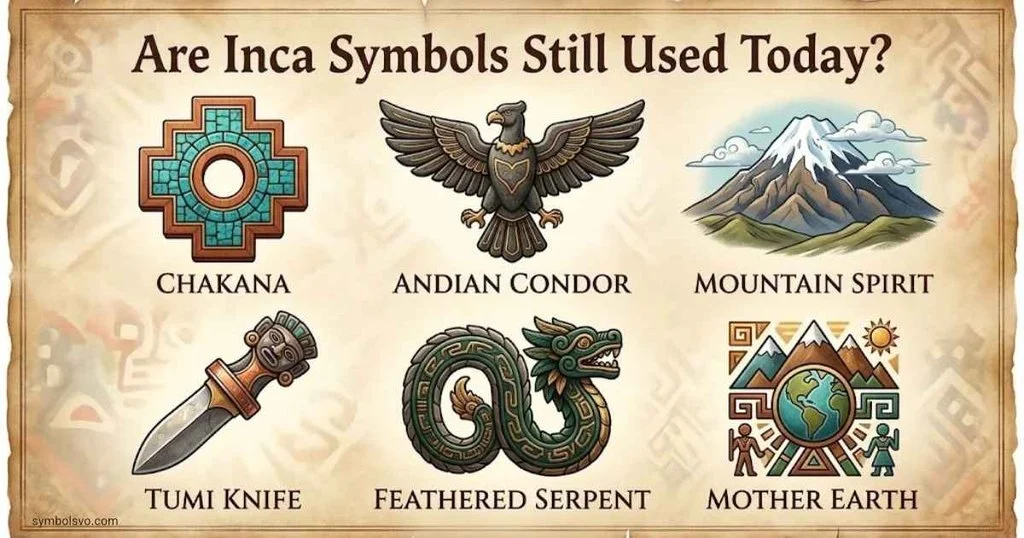
Yes. Inca-inspired designs and broader Andean artistic traditions continue to appear in textiles, jewelry, contemporary art, cultural events, and decorative objects.
However, modern use doesn’t always mean an unchanged survival from ancient times. Some motifs have been adapted, reinterpreted, or combined with other traditions over centuries.
Three examples help explain this continuity:
- Textile weaving: Contemporary Andean weavers maintain and develop regional techniques and patterns, although traditions vary between communities.
- Geometric motifs: Designs inspired by historical tocapu and Chakana patterns appear in modern clothing, jewelry, and art.
- Cultural identity: Historical imagery can express connections to Andean heritage, but its meaning depends on the community and the person using it.
The Inca Empire was conquered by Spanish forces in the 16th century, yet Indigenous Andean communities continued to preserve and reshape their traditions. The Smithsonian’s Inka Road historical timeline documents the long history of Andean societies and the continuing presence of Inka descendants.
Understanding this living heritage makes the study of Inca symbols more meaningful. These designs aren’t simply relics of a vanished civilization; many belong to a broader cultural history that continues today.
Frequently Asked Questions About Inca Symbols
What are the most famous Inca symbols?
The best-known examples include solar imagery associated with Inti, the condor, puma, serpent, tocapu textile motifs, and the Chakana or Andean cross. Khipu are also important to understanding Inca communication, although they functioned as information-recording devices rather than single symbols.
What do Inca symbols mean?
Their meanings depend on the design and its historical context. Some relate to religious beliefs, political authority, social identity, or relationships with nature. Others remain uncertain. Modern interpretations can be meaningful, but they shouldn’t automatically be presented as proven ancient beliefs.
What is the Inca sun symbol?
The Inca sun symbol usually refers to imagery associated with Inti, the sun deity. Inti held an important place in Inca religion and was closely connected to the ruling dynasty. Modern sun designs often express life and renewal, but not every sun illustration is a historically authentic Inca motif.
What does the condor symbolize in Inca culture?
In many modern explanations of Andean symbolism, the condor represents the upper or celestial world. It is also associated with flight, spiritual connection, and the mountains. These meanings should be understood within their broader Andean context rather than assigned to every historical condor image.
What does the puma represent in Inca symbolism?
The puma is commonly associated with strength and earthly life in modern interpretations of Andean symbolism. It also appears in discussions of Cusco’s architecture and historical art. However, the precise meaning of an individual puma depiction depends on its original setting and use.
What is the meaning of the Chakana?
The Chakana is a stepped geometric motif also known as the Andean cross. Modern interpretations associate it with cosmic order, the four directions, and different levels of existence. Its historical meanings remain debated, and related designs existed in Andean cultures beyond the Inca.
What are tocapu symbols?
Tocapu are geometric motifs, often enclosed in squares or rectangles, that appear on certain Inca textiles and other objects. Researchers have proposed connections with rank, lineage, and political identity, but there is no universally accepted translation for every motif.
Did the Inca use symbols as a writing system?
The Inca didn’t use a conventional alphabetic writing system like English. They used khipu to record numerical information and possibly other forms of information in some cases. The full range of khipu’s capabilities remains a subject of scholarly investigation.
What is the difference between a khipu and a symbol?
A symbol is a sign or image that represents something, while a khipu is a structured recording system made from knotted cords. Khipu used features such as knots, cord colors, and arrangement to preserve information.
Are all ancient Peruvian symbols Inca?
No. Peru was home to many civilizations before the Inca, including the Chavín, Moche, Nazca, Wari, and Chimú. These societies developed their own artistic and religious traditions. A design found in Peru isn’t necessarily Inca simply because it is ancient or geometric.
Are Inca symbols still used today?
Yes. Inca-inspired imagery and wider Andean traditions appear in contemporary textiles, artwork, jewelry, and cultural expression. Some designs preserve historical forms, while others reinterpret them for modern audiences.
How can you tell whether an Inca symbol is authentic?
Look for a documented origin, a reliable museum record, and information about the object’s date, material, and archaeological context. If a seller provides only a spiritual meaning without evidence of the design’s historical origin, treat the claim cautiously.
Conclusion: Understanding the Meaning of Inca Symbols
Inca symbols offer a window into the religious beliefs, political organization, artistic skill, and daily life of the Inca Empire. Solar imagery associated with Inti, animal representations, intricate textile patterns, and khipu each reveal a different aspect of how people communicated and organized their world.
The most important lesson is that these designs don’t all belong to one simple symbolic code. Some have well-documented historical associations, while others remain open to debate or have acquired new meanings in contemporary culture.
If you’re researching ancient Andean art, choosing a design, or exploring Inca symbols and their meanings, start with reliable historical evidence. Museum collections and archaeological research can help you distinguish documented motifs from modern interpretations.
Above all, remember that the history of Andean symbolism extends beyond the Inca Empire. Its artistic traditions reflect many generations of creativity and continue to influence living communities today.

I’m Daniel Brooks, a content creator and symbol enthusiast dedicated to researching the fascinating world of signs and symbols. I enjoy discovering the hidden meanings behind famous icons, emojis, historical emblems, and cultural symbols. Through my writing, I aim to provide trustworthy, well-researched, and reader-friendly information that helps people learn something new with every visit.
Books:
- The Complete Guide to World Symbols
- The Power of Universal Signs
 Nathan Holloway
 Mason Ellington