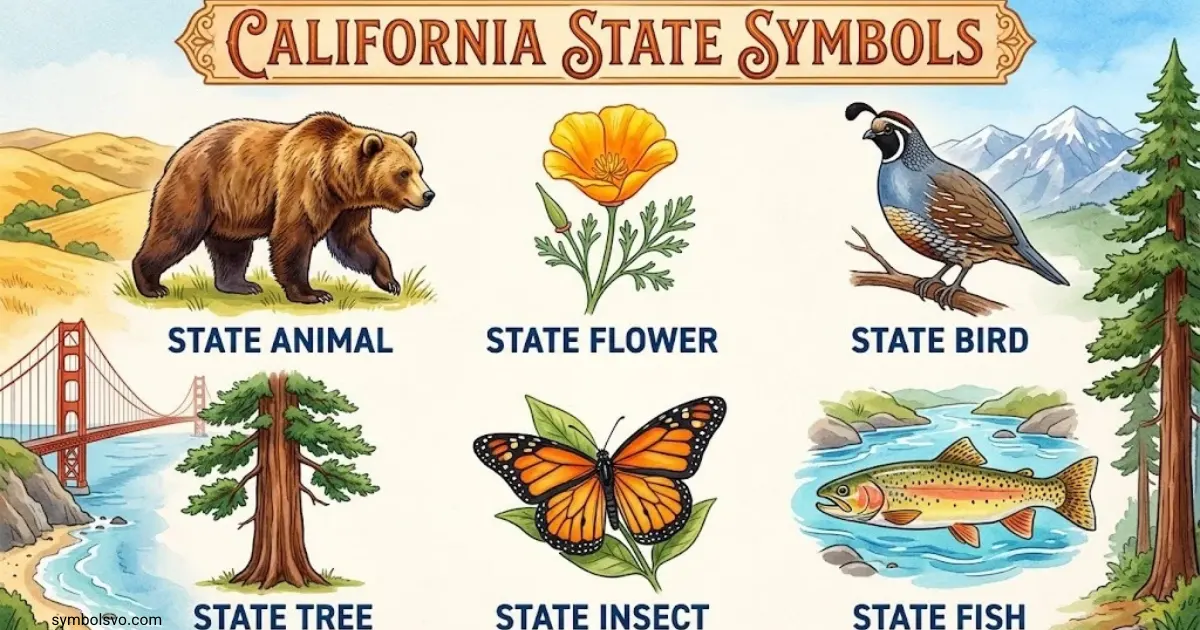
California’s identity goes far beyond Hollywood, sunny beaches, and Silicon Valley. The state also has a remarkable collection of official symbols that reflect its history, wildlife, landscapes, industries, and cultural traditions. From the grizzly bear on the state flag to the golden poppy blooming across open fields, each emblem tells a different part of California’s story.
California state symbols include familiar emblems such as the state flower, state bird, state animal, and state tree. They also include less familiar designations, including a state gemstone, state soil, state fabric, state sport, and state dinosaur. California has adopted these symbols over many decades, often recognizing something that residents consider important to their heritage.
Whether you’re researching a school project, exploring California history, or looking for a complete reference, this guide covers the official California state symbols, their meanings, important facts, and historical backgrounds.
California State Symbols List at a Glance
California has an extensive collection of official symbols established through state law. The list includes natural features, historical emblems, cultural traditions, and designated places. The following table covers many of the best-known symbols and several lesser-known designations.
| Symbol category | California’s official symbol |
| State flag | Bear Flag |
| State seal | Great Seal of California |
| State motto | Eureka |
| State nickname | Golden State |
| State colors | Blue and gold |
| State animal | California grizzly bear |
| State bird | California valley quail |
| State flower | California golden poppy |
| State tree | Coast redwood and giant sequoia |
| State amphibian | California red-legged frog |
| State reptile | Desert tortoise |
| State freshwater fish | California golden trout |
| State marine fish | Garibaldi |
| State marine mammal | California gray whale |
| State insect | California dogface butterfly |
| State mineral | Gold |
| State rock | Serpentine |
| State gemstone | Benitoite |
| State fossil | Saber-toothed cat |
| State dinosaur | Augustynolophus morrisi |
| State grass | Purple needlegrass |
| State lichen | Lace lichen |
| State soil | San Joaquin soil |
| State mushroom | California golden chanterelle |
| State song | “I Love You, California” |
| State dance | West Coast Swing |
| State folk dance | Square dance |
| State sport | Surfing |
| State fabric | Denim |
| State nuts | Almond, walnut, pistachio, and pecan |
| State tall ship | Californian |
| State gold rush ghost town | Bodie |
| State silver rush ghost town | Calico |
Source: California State Capitol Museum’s official state symbols guide and the California State Library’s state symbols publication. This is a reference list of selected designations, not an exhaustive inventory of every official state symbol.
One important detail: California distinguishes between several similar categories. Gold is the state mineral, for example, while serpentine is the state rock. Likewise, the garibaldi represents marine fish, while the California golden trout represents freshwater fish.
These distinctions make the California state symbols list more useful for research and educational projects.
California’s Flag, Seal, Motto, and Colors
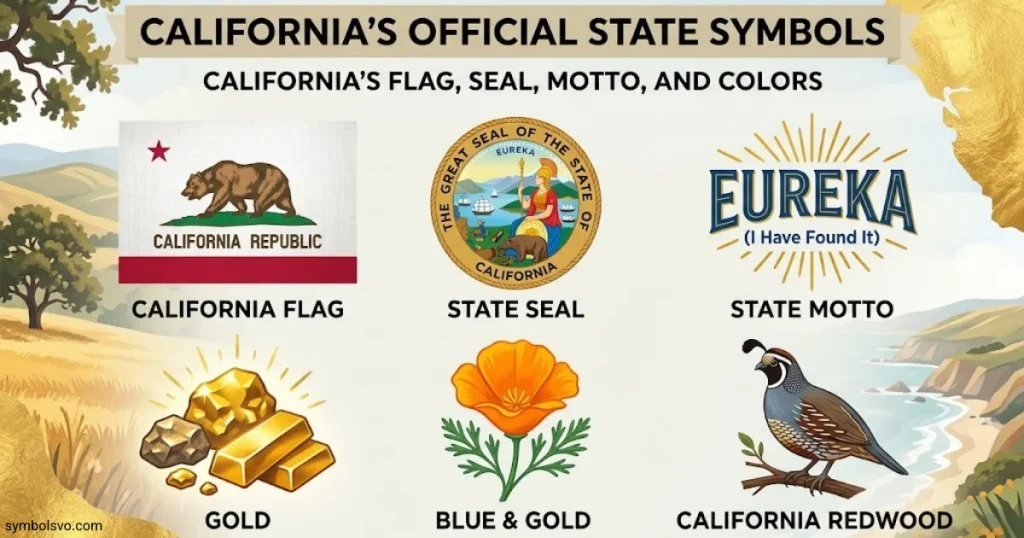
California’s official emblems tell the story of its transition from Mexican territory to an American state. They also reflect the Gold Rush, early government, and the state’s growing identity.
California State Flag: The Bear Flag
Official designation: State flag | Adopted in 1911
The California state flag, commonly called the Bear Flag, features a grizzly bear, a red star, a red stripe, and the words “California Republic.” Its design connects modern California with a short but important episode in the state’s history.
The original Bear Flag appeared during the Bear Flag Revolt of 1846 in Sonoma. During this uprising, American settlers challenged Mexican authority and proclaimed an independent California republic. The republic lasted only a short time before American control replaced it.
The original flag was handmade from simple materials, including cloth and natural coloring. It was later lost in the 1906 San Francisco earthquake and fire. A surviving photograph and a replica helped preserve its design.
California officially adopted the state flag in 1911. The Legislature established its final design and color specifications in 1953.
The grizzly bear became a lasting emblem of strength and independence. However, California’s native grizzly population disappeared during the early twentieth century because of hunting, trapping, and habitat pressures.
Interesting fact: California is widely recognized for displaying an extinct animal on its state flag. The bear remains a powerful historical emblem even though wild California grizzlies no longer roam the state.
For the official history, see the California State Capitol Museum’s flag guide.
Great Seal of California
The Great Seal of California is one of the state’s oldest official emblems. Delegates approved its original design during the 1849 Constitutional Convention in Monterey, before California joined the United States.
The seal contains several details that represent the young state’s political and economic life.
- Minerva: The Roman goddess of wisdom represents California’s admission to the Union as a state rather than as a territory.
- The grizzly bear: This animal symbolizes California’s wildlife and strength.
- The gold miner: Mining reflects the importance of the Gold Rush and mineral wealth.
- Ships: These represent maritime trade and the state’s connection to the Pacific Ocean.
- Agricultural imagery: Farming represents the importance of fertile land and food production.
- Mountains and waterways: These features reflect California’s varied landscape.
- Thirty-one stars: They represent California’s admission as the 31st state in 1850.
The seal’s design offers a historical snapshot of what early Californians considered important. Mining, agriculture, transportation, and statehood all appear within a single emblem.
Today, the Great Seal appears on official government documents and other state materials. Its imagery also connects it with two other important emblems: the California grizzly bear and the motto Eureka.
California State Motto: Eureka
The California state motto is “Eureka,” a Greek expression meaning “I have found it.”
The phrase is traditionally associated with the ancient Greek mathematician Archimedes. According to a famous story, he exclaimed the expression after making a discovery about water displacement. The story is widely repeated, although its historical details are not fully established.
California’s connection to the word is more direct. Gold discoveries transformed the region during the nineteenth century, drawing prospectors and settlers from around the world. The phrase became a fitting expression for a place associated with finding gold and discovering new opportunities.
The word appears on the Great Seal alongside a gold miner. California formally designated Eureka as its state motto in 1963.
Although the motto is short, it captures an important chapter in California’s history. It also reflects a broader association with discovery, exploration, and innovation.
California State Colors: Blue and Gold
California’s official state colors are blue and gold. Their use reflects both historical traditions and familiar features of the state’s landscape.
Blue represents the sky, while gold recalls the precious metal associated with California’s Gold Rush. The colors also have a long connection with the University of California, Berkeley, whose early publications used the blue-and-gold combination.
California formally adopted the colors in 1951.
Today, blue and gold appear in official documents, government materials, and various state-related designs. Although many organizations use these colors, their official designation distinguishes them from the separate color schemes of schools or sports teams.
California State Nickname: The Golden State
California is widely known as the Golden State. The nickname has several historical associations, especially the Gold Rush that began in 1848.
Gold discoveries brought thousands of prospectors to California. The resulting migration helped expand settlements, trade, transportation, and agriculture. Gold also influenced the state’s reputation as a place of opportunity.
The nickname has another meaning, too. California’s golden poppies brighten hillsides during spring, while golden sunlight and dry grasslands characterize many parts of the landscape.
The Legislature formally recognized the Golden State as California’s official nickname in 1968. The name therefore connects natural beauty with economic history and the state’s wider identity.
California State Animal, Bird, and Other Wildlife Symbols
California’s wildlife symbols represent the state’s diverse habitats, from mountain forests and grasslands to deserts and coastal waters. Several of these designations also draw attention to species that need protection.
California State Animal: California Grizzly Bear
The California grizzly bear became California’s official state animal in 1953. Although the animal no longer lives in the wild in California, its image remains one of the state’s most recognizable emblems.
Historically, grizzlies lived across much of California. They occupied varied habitats and played an important role in the state’s natural environment. However, extensive hunting, trapping, and conflicts with expanding human settlements led to their disappearance.
The grizzly’s appearance on the Bear Flag predates its official designation as the state animal. That connection helped preserve its place in California’s identity long after the last wild California grizzlies vanished.
The animal symbolizes strength and independence, but its history also highlights the consequences of unchecked wildlife exploitation.
Key fact: The California grizzly is extinct in the state. Its official symbolism doesn’t mean that wild California grizzlies still live there.
California State Bird: California Valley Quail
The California valley quail became the state bird in 1931. Its rounded body, patterned feathers, and distinctive curved plume make it easy to recognize.
Valley quail inhabit brushy areas, grasslands, oak woodlands, and other landscapes that offer food and shelter. They eat seeds, grains, leaves, and insects, adapting their diet to seasonal conditions.
These birds often gather in groups called coveys. Living together helps them locate food and detect potential predators. During breeding season, however, their behavior changes as pairs establish nesting areas and raise their young.
The quail’s strong connection with California’s grasslands and woodlands makes it a fitting symbol of the state’s native wildlife.
California State Flower: Golden Poppy
The California golden poppy, scientifically known as Eschscholzia californica, became California’s official state flower in 1903.
Its bright orange petals often cover hillsides, valleys, and open fields during the spring. In favorable conditions, large groups of poppies create the colorful displays that many people associate with California.
The plant thrives in sunny locations and tolerates dry conditions once established. Its leaves have a finely divided appearance, and its flowers respond to sunlight, often opening during bright weather and closing under unfavorable conditions.
The poppy represents the state’s natural beauty and its characteristic seasonal landscapes. It also appears in gardens, public artwork, and educational materials.
The California poppy is sometimes called the golden poppy because of its vivid color. It grows naturally across much of the state and can also thrive in suitable gardens.
A common misconception is that every poppy growing in California has special legal protection. Rules vary by location and circumstances, so anyone considering picking wildflowers should check applicable land-management rules first.
Why was the poppy chosen? Its widespread presence, striking appearance, and association with California’s spring landscapes made it a natural choice for the state flower.
California State Tree: Coast Redwood and Giant Sequoia
California’s state tree designation includes two related but distinct species: the coast redwood (Sequoia sempervirens) and the giant sequoia (Sequoiadendron giganteum).
Although people sometimes confuse them, these trees differ in their preferred habitats and physical characteristics.
The coast redwood grows along the Pacific Coast, where winter rain and summer fog help support its enormous height. It includes the tallest living tree species in the world. Some coast redwoods exceed 350 feet in height.
Giant sequoias grow naturally in the western Sierra Nevada. They are famous for their enormous trunk volume and thick bark. Rather than reaching the same heights as the tallest coast redwoods, giant sequoias typically develop massive trunks.
| Feature | Coast redwood | Giant sequoia |
| Scientific name | Sequoia sempervirens | Sequoiadendron giganteum |
| Natural habitat | Pacific Coast | Western Sierra Nevada |
| Best-known feature | Exceptional height | Enormous trunk volume |
| Common conditions | Moist air, winter rain, coastal fog | Mountain forests and seasonal conditions |
| Ecological importance | Forest habitat and carbon storage | Long-lived forest habitat and carbon storage |
Both species can live for centuries or even thousands of years under suitable conditions. Their longevity makes them remarkable examples of California’s natural heritage.
California State Amphibian: California Red-Legged Frog
The California red-legged frog became the state’s official amphibian in 2014. It is one of the largest native frogs in the western United States and is associated with wetlands, ponds, streams, and other freshwater habitats.
Its reddish hind legs help distinguish it from several other frog species. Adults may have brown, gray, or reddish coloring, often with dark markings across the back.
The frog’s history connects California wildlife with literature. Mark Twain’s famous short story “The Celebrated Jumping Frog of Calaveras County” helped make jumping frogs part of the state’s popular cultural history.
However, the real species faces challenges that go beyond its literary reputation. Habitat loss, invasive predators, and changes to wetland environments have reduced its range. The federal government listed it as threatened in 1996.
Its official designation helps draw attention to California’s native amphibians and the freshwater habitats they depend on.
California State Reptile: Desert Tortoise
The desert tortoise became California’s official state reptile in 1972. It inhabits arid landscapes, including parts of the Mojave Desert, where it has adapted to limited water and extreme temperatures.
Desert tortoises spend much of their time in burrows. These shelters protect them from intense summer heat and cold winter conditions. They also help the animals conserve moisture in a dry environment.
Their diet consists mainly of grasses, wildflowers, and other plants. During favorable seasons, tortoises may feed on vegetation that grows after rainfall.
Despite their adaptations, desert tortoises face serious threats from habitat disturbance, road development, disease, and human activity. Their slow growth and long life cycles make population recovery difficult.
California’s designation recognizes the tortoise as a distinctive part of the state’s desert wildlife. It also offers an opportunity to explain why desert ecosystems deserve protection.
California State Freshwater Fish: Golden Trout
The California golden trout is the state’s official freshwater fish. It is native to the southern Sierra Nevada and is especially associated with clear, high-elevation streams.
Its golden sides, reddish lateral stripe, and dark spots create a distinctive appearance. These colors make it one of California’s best-known native trout.
The golden trout thrives in cold freshwater environments. However, changes to waterways, habitat degradation, and competition or interbreeding with introduced trout have affected some populations.
The species is important to anglers, naturalists, and conservation programs. Its official designation also highlights the ecological value of California’s mountain streams.
When discussing the state fish, remember to distinguish the golden trout from the garibaldi. The trout represents freshwater habitats, while the garibaldi represents the Pacific marine environment.
California State Marine Fish: Garibaldi
The garibaldi became California’s official state marine fish in 1995. Its brilliant orange body makes it one of the easiest Pacific coastal fish to recognize.
Garibaldi live among rocky reefs and kelp forests along the southern California coast and into Baja California. Adults defend nesting territories, particularly during the breeding season.
Unlike the golden trout, which inhabits freshwater streams, the garibaldi depends on marine ecosystems. Its bright coloring makes it a familiar sight for divers and underwater photographers.
California also protects garibaldi through restrictions on their collection and possession. These protections help preserve the species in its natural habitat.
California State Marine Mammal: Gray Whale
The California gray whale became the state’s official marine mammal in 1975. Gray whales travel along the Pacific Coast during one of the most remarkable seasonal migrations among large marine mammals.
Many eastern North Pacific gray whales migrate between feeding areas in northern waters and breeding or calving lagoons farther south in Baja California. Their round-trip journeys can cover thousands of miles.
Gray whales feed mainly on small marine organisms, including bottom-dwelling invertebrates. They use baleen plates to filter food from water and sediment.
Their migration has made them a familiar part of California’s coastal wildlife and whale-watching culture. However, ship strikes, entanglement in fishing gear, and changing ocean conditions can threaten whales.
The gray whale represents the close relationship between California and the Pacific Ocean. It also demonstrates why marine habitats matter to wildlife that travels across international boundaries.
California State Insect: California Dogface Butterfly
The California dogface butterfly became the official state insect in 1972. Its name comes from a distinctive dark marking on the male’s yellow forewings that resembles the profile of a dog’s head.
The species is native to California and is associated with particular host plants. Like other butterflies, it passes through four life stages: egg, caterpillar, pupa, and adult.
Its development illustrates the importance of plants in the life cycles of insects. Caterpillars need suitable host plants for food, while adult butterflies rely on nectar sources.
The dogface butterfly has appeared on California-related public materials, helping make it one of the state’s most distinctive insect symbols.
Other California Wildlife Symbols
California’s official wildlife designations extend beyond its best-known animals. Additional symbols represent the state’s varied habitats and native species.
- Pallid bat: Represents California’s bat wildlife and the role bats play in controlling insect populations.
- Dungeness crab: Connects the state’s coastal fisheries with its marine ecosystems.
- Pacific leatherback sea turtle: Highlights the importance of protecting marine reptiles and their migration routes.
- Giant garter snake: Represents California’s wetland and agricultural-water habitats.
- Banana slug: A familiar forest invertebrate associated with moist environments.
These species illustrate how California’s official state emblems encompass far more than large mammals and colorful birds.
For current designations and official descriptions, consult the California State Capitol Museum.
California’s Official Plants, Grass, Lichen, and Mushroom
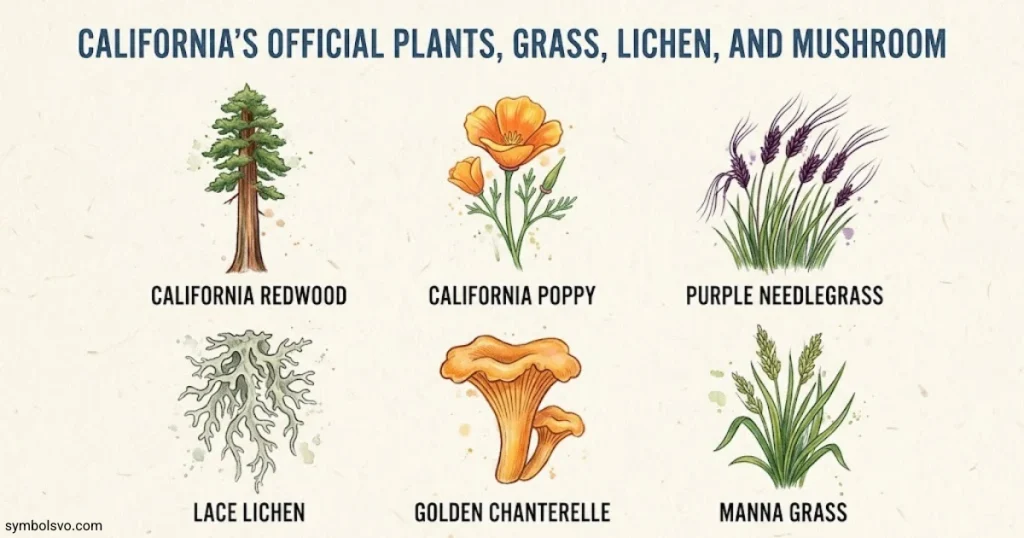
California’s plant symbols reflect the state’s unusual range of climates. Coastal forests, mountain slopes, grasslands, and dry valleys support different plant communities, each with its own ecological value.
State Grass: Purple Needlegrass
Purple needlegrass became California’s state grass in 2004. This native bunchgrass grows across much of the state and is particularly associated with California’s native grasslands.
Its long root system helps stabilize soil and makes the plant relatively tolerant of dry conditions. Established plants can support soil structure and provide food or shelter for wildlife.
Purple needlegrass also has cultural significance. Indigenous peoples of California used native grasses for purposes including basketry and food gathering. Later, grasslands supported livestock and other agricultural activities.
Today, purple needlegrass is useful in habitat restoration, erosion control, and efforts to restore native vegetation. It represents the importance of plants that may look modest but perform valuable ecological functions.
State Lichen: Lace Lichen
Lace lichen is California’s official state lichen. Its delicate, branching growth can hang from tree branches like strands of pale green lace.
Lichens form through a partnership between fungi and photosynthetic organisms, usually algae or certain bacteria. The partners exchange resources that help the lichen survive in its environment.
Lace lichen provides habitat and nesting material for some wildlife. It can also be sensitive to environmental changes, making lichens useful subjects for scientific studies of air quality and ecosystem health.
California’s designation recognizes an organism that many people overlook. Although it may appear decorative, lace lichen is part of a complex relationship among plants, trees, fungi, and animals.
State Mushroom: California Golden Chanterelle
The California golden chanterelle represents the state’s diverse forest ecosystems. This golden mushroom is associated with California woodlands, particularly areas where it grows in connection with tree roots.
Many chanterelles form mycorrhizal relationships with trees. The fungal network helps exchange nutrients and supports the wider forest ecosystem.
The mushroom also has culinary value, but its official status is about more than food. It represents the biological richness of California’s forests and the organisms that live beneath the forest floor.
Wild mushroom identification can be difficult, so photographs or superficial similarities aren’t enough to establish whether a mushroom is safe to eat.
California’s State Nuts
California recognizes four official state nuts: almond, walnut, pistachio, and pecan. Their designations reflect the importance of nut production to California agriculture.
The state produces a large share of the United States’ almonds and pistachios. Its climate, irrigation systems, agricultural expertise, and extensive farming regions support these crops.
Although people commonly call all four foods nuts, botanists classify them differently. Almonds and pistachios are seeds enclosed in fleshy fruit structures, walnuts have their own botanical classification, and pecans are true nuts.
These distinctions show how official symbols can connect everyday foods with agriculture, botany, and the state’s economy.
California’s Geological and Prehistoric Symbols
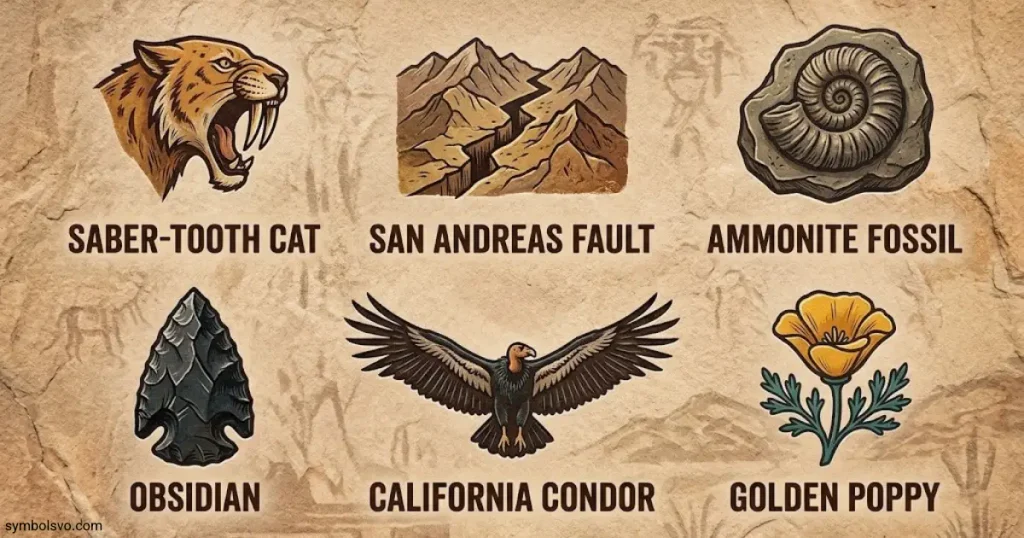
California’s geology has shaped its mountains, valleys, mineral deposits, and natural resources. Several official symbols recognize this geological history, including gold, serpentine, benitoite, and prehistoric animals.
State Mineral: Gold
Gold became California’s official state mineral in 1965. Few substances have influenced the state’s development as strongly as this precious metal.
The discovery of gold at Sutter’s Mill in January 1848 helped trigger the California Gold Rush. News of the discovery spread quickly, attracting people from across the United States and other parts of the world.
The resulting population growth transformed California. Mining settlements expanded, transportation networks developed, and San Francisco grew into a major commercial center. The rush also accelerated California’s path to statehood in 1850.
Gold mining came with serious costs, including environmental damage and the displacement of Indigenous communities. Hydraulic mining, in particular, altered rivers and deposited large amounts of sediment downstream.
Gold remains an important historical symbol. It explains the nickname Golden State and helps connect California’s modern identity with its nineteenth-century past.
State Rock: Serpentine
Serpentine became California’s official state rock in 1965. It commonly appears in green shades, sometimes with darker patterns and a smooth or waxy surface.
Serpentine refers to a group of minerals and rocks associated with particular geological processes. Serpentine-rich rocks often occur in areas influenced by the movement of tectonic plates.
California contains extensive serpentine formations because of its complex geological history. These rocks also support unusual plant communities, since their soils can contain high concentrations of certain metals and limited amounts of nutrients.
Historically, serpentine was used in construction and other industries. Some serpentine rocks contain naturally occurring asbestos minerals, which can pose serious health risks when fibers become airborne.
That distinction matters: not every specimen of serpentine contains asbestos, but asbestos-containing material requires careful handling.
State Gemstone: Benitoite
Benitoite became California’s official state gemstone in 1985. This rare blue gemstone was discovered in California’s San Benito County region in 1907 and later received its name from the nearby San Benito River area.
Its brilliant blue color and strong optical properties make it especially interesting to mineral collectors. Under suitable ultraviolet light, benitoite can also show striking fluorescence.
The gemstone is chemically distinct from ordinary quartz or sapphire. It belongs to a rare mineral group containing barium, titanium, and silicate.
Benitoite’s limited natural distribution makes it an important part of California’s geological heritage. Its official designation also highlights a lesser-known side of the state’s natural resources.
State Fossil: Saber-Toothed Cat
California’s state fossil is the saber-toothed cat, commonly associated with Smilodon fatalis. This prehistoric predator lived during the Ice Age and is famous for its long upper canine teeth.
One of the best places to learn about this animal is the La Brea Tar Pits in Los Angeles. The site preserves fossils of numerous Ice Age animals that became trapped in natural asphalt deposits.
Researchers have recovered remains of saber-toothed cats, dire wolves, mammoths, and other extinct species. These fossils help scientists reconstruct ancient ecosystems and understand how animals lived during periods of major environmental change.
The saber-toothed cat represents California’s deep natural history, long before modern cities, agriculture, or the Gold Rush existed.
State Dinosaur: Augustynolophus morrisi
California’s official state dinosaur is Augustynolophus morrisi, a plant-eating dinosaur that lived during the Late Cretaceous Period.
Its fossils were discovered in California’s marine-influenced geological deposits. Although the dinosaur lived on land, its remains became part of the fossil record preserved in ancient sediments.
Augustynolophus belonged to the hadrosaur group, often called duck-billed dinosaurs because of the shape of their broad snouts. These animals used specialized teeth to process plant material.
The state dinosaur and state fossil are different designations. The saber-toothed cat was a mammal that lived during the Ice Age, while Augustynolophus lived millions of years earlier during the age of dinosaurs.
State Soil: San Joaquin Soil
San Joaquin soil is California’s official state soil. It occurs in the southern part of the Central Valley, one of the state’s most important agricultural regions.
The soil developed through geological processes involving material transported from surrounding landscapes, including the Sierra Nevada. Its characteristics can support productive agriculture when farmers manage water, nutrients, and soil conditions appropriately.
The designation highlights an often-overlooked resource. Soil supports food production, stores water, cycles nutrients, and provides habitat for countless organisms.
California’s agricultural success depends on many factors, but fertile soil is an essential part of the picture.
California’s Official Songs, Dance, Sport, and Cultural Symbols
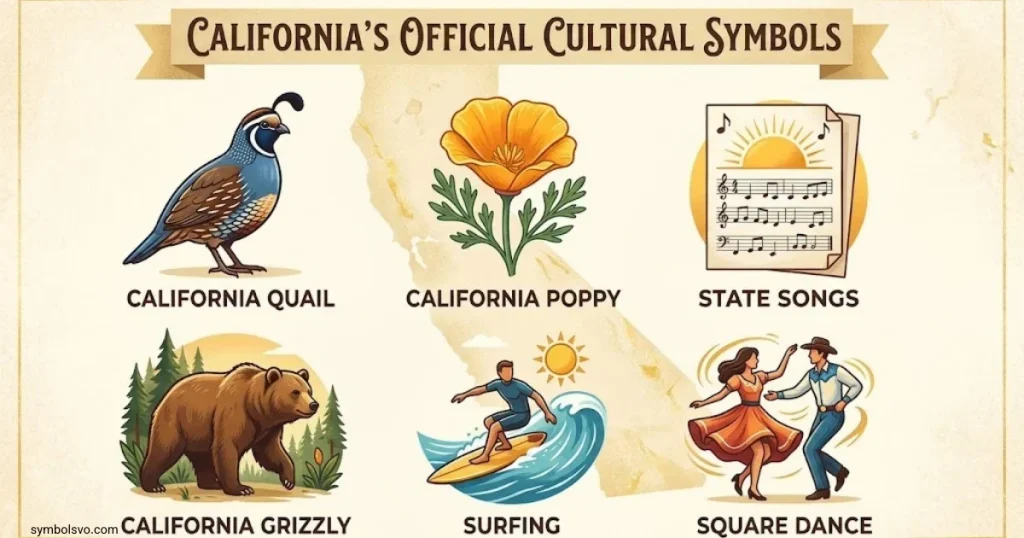
Not all California state symbols come from nature. Some recognize music, recreation, clothing, and traditions that have become closely associated with life in the state.
State Song: “I Love You, California”
California’s official state song is “I Love You, California.” F. B. Silverwood wrote the lyrics, and Alfred F. Frankenstein composed the music in 1913.
The song celebrates California’s landscapes, including its mountains, valleys, forests, flowers, and coastline. Its lyrics reflect the affection that residents and visitors have long expressed for the state.
The song gained public attention through performances and events during the early twentieth century. California officially designated it as the state song in 1951.
Unlike the Bear Flag, which recalls a political uprising, the song emphasizes California’s scenery and emotional connection with its residents.
Readers can explore its history through the California State Capitol Museum.
State Dance: West Coast Swing
West Coast Swing is California’s official state dance. This partner dance developed from swing dance traditions and became associated with California’s social dance culture.
It is known for its smooth movements, elastic connection between partners, and ability to adapt to different musical styles. Dancers commonly perform it to blues, pop, R&B, and other music.
West Coast Swing differs from square dance, which California recognizes separately as its state folk dance.
The two designations illustrate how state symbols can represent different parts of cultural life rather than one single tradition.
State Folk Dance: Square Dance
Square dance is California’s official state folk dance. It typically involves four couples arranged in a square, following a caller’s instructions.
The dance has roots in several European and American social dance traditions. Over time, communities adapted its steps and patterns to local customs.
Square dancing represents the social side of cultural heritage: people gathering, learning coordinated movements, and participating in community events.
State Sport: Surfing
Surfing became California’s official state sport in 2018. The sport is deeply associated with the state’s Pacific coastline, beach communities, and outdoor recreation.
Surfing developed in the Pacific Islands long before it became popular in California. During the twentieth century, surfers helped establish California as a major center of surf culture.
The state’s long coastline offers a range of conditions, from gentle beach breaks to powerful reef and point breaks. Surfing has also influenced music, clothing, photography, and film.
Its designation recognizes a recreational activity that has become part of California’s international image.
State Fabric: Denim
California’s official state fabric is denim, a durable cotton-based textile commonly used to make jeans.
Denim itself originated long before California’s Gold Rush. However, California played a major role in the development and popularization of modern blue jeans.
In 1873, San Francisco-based merchant Levi Strauss and tailor Jacob Davis received a patent for reinforcing work pants with metal rivets. Their design helped create durable clothing for miners and other workers.
Over time, jeans became popular far beyond work sites. They evolved into everyday clothing associated with American fashion and California’s cultural influence.
California designated denim as its state fabric in 2016.
State Tall Ship: Californian
The Californian is California’s official state tall ship. This sailing vessel is a replica of a nineteenth-century revenue cutter that patrolled the Pacific Coast.
The modern ship was launched in 1984 and later became part of the Maritime Museum of San Diego’s collection. Its design and operation help preserve maritime history and provide educational sailing experiences.
The ship represents California’s long relationship with ocean travel, coastal trade, navigation, and maritime services.
State Gold Rush Ghost Town: Bodie
Bodie is California’s official gold rush ghost town. Located in Mono County, it grew rapidly after gold discoveries and later mining activity during the nineteenth century.
At its peak, Bodie supported thousands of residents, along with businesses, homes, and mining operations. When mining declined, the population gradually left.
Today, Bodie is preserved as a historic site. Its remaining buildings help visitors understand how people lived in a remote mining community.
California’s official designation recognizes the town’s connection to the Gold Rush and the broader history of mining settlements.
State Silver Rush Ghost Town: Calico
Calico, in San Bernardino County, developed during the silver mining boom that began in the late nineteenth century.
The settlement grew around local mineral discoveries. When silver mining became less profitable, the town declined.
Calico is now a restored historic attraction that helps visitors explore the region’s mining past. Its official designation as the state silver rush ghost town complements Bodie’s gold rush designation.
Together, the two places show that California’s mining history involved more than gold alone.
Why Are California State Symbols Important?
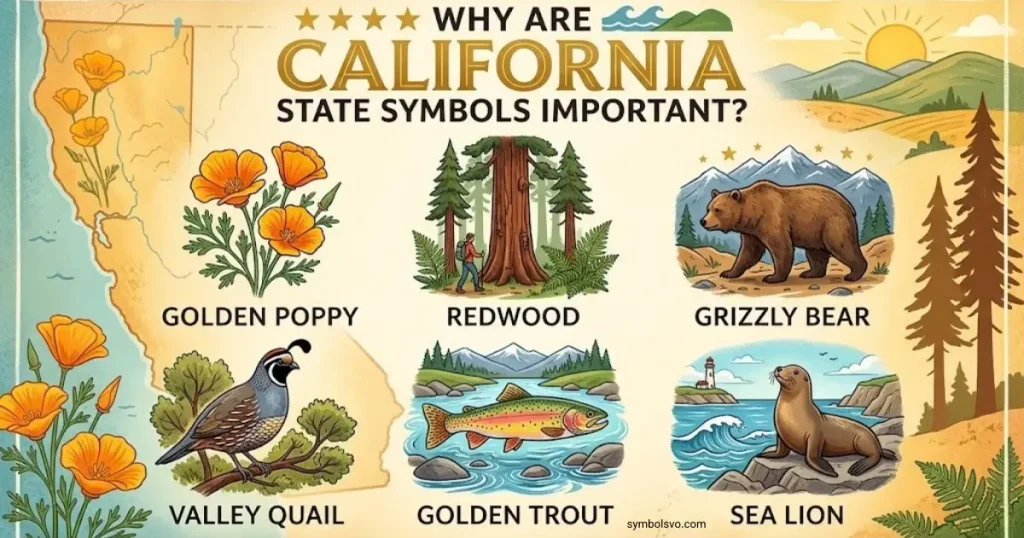
California’s official symbols do more than identify the state. They preserve important parts of its history and help people understand the natural and cultural features that make it distinctive.
Several symbols connect directly with major historical events. Gold recalls the Gold Rush, while the Bear Flag represents the political upheaval of 1846. The Great Seal records ideas that mattered to California’s early leaders.
Other symbols highlight the state’s natural heritage. The coast redwood and giant sequoia represent ancient forests, while the California red-legged frog and desert tortoise draw attention to native wildlife and its habitats.
Cultural designations tell another part of the story. Surfing reflects California’s coastal recreation, denim connects with its clothing history, and the state song celebrates its landscapes.
Together, these official California emblems help students, residents, and visitors explore the state’s development. They also provide useful starting points for learning about history, science, geography, agriculture, and conservation.
Frequently Asked Questions About California State Symbols
What are California’s official state symbols?
California’s official state symbols include the Bear Flag, Great Seal, state motto, state animal, state bird, state flower, state tree, state mineral, state gemstone, state song, and many other designations. The complete collection also includes cultural symbols, geological features, wildlife, and historic places.
The California State Capitol Museum provides a detailed reference.
How many official state symbols does California have?
California has dozens of official symbols and related designations. The exact total depends on which categories are counted and whether multiple entries within one category are counted separately.
For example, California recognizes two tree species under its state tree designation and four official state nuts. Some official designations recognize places, artifacts, and cultural traditions rather than individual species.
For a school project, consult the current state symbols guide and explain the counting method rather than relying on an unsupported total.
What is California’s state animal?
The California grizzly bear is the official state animal. California adopted the designation in 1953.
Although the bear appears on the state flag and seal, the California grizzly is extinct in the wild. Its image remains an important symbol of the state’s history.
What is California’s state flower?
California’s state flower is the golden poppy, also known as the California poppy. The state adopted it in 1903.
Its bright orange flowers bloom during spring and often cover open hillsides and fields. The plant represents California’s natural beauty and seasonal landscapes.
What is California’s state bird?
California’s state bird is the California valley quail. It received the official designation in 1931.
The bird is recognizable by its curved head plume and patterned feathers. It commonly inhabits grasslands, brush, and oak woodlands.
What is California’s state tree?
California’s state tree designation includes the coast redwood and giant sequoia.
The coast redwood is famous for its exceptional height, while the giant sequoia is known for its enormous trunk volume. Both species are native to California and represent its remarkable forest heritage.
What does Eureka mean in California’s state motto?
Eureka means “I have found it” in Greek. California adopted it as its official state motto in 1963.
The expression is closely associated with the Gold Rush and the discovery of valuable resources. It also appears on the Great Seal of California.
Why does California’s flag feature a grizzly bear?
The grizzly bear comes from the original Bear Flag associated with the 1846 Bear Flag Revolt. The animal represented strength and independence during a period of political change.
California officially adopted the flag in 1911. The grizzly remains a prominent emblem despite the extinction of California’s native grizzly population.
What is California’s state gemstone?
Benitoite is California’s official state gemstone. The state adopted it in 1985.
This rare blue mineral was discovered in the San Benito County region in 1907. Its striking color and distinctive optical properties make it prized by mineral collectors.
What is California’s state mineral?
Gold is California’s official state mineral. The designation recognizes gold’s major role in the state’s history, especially during the Gold Rush that began in 1848.
Gold helped attract migrants, expand settlements, and transform California’s economy.
What is California’s state rock?
Serpentine is California’s official state rock. It often appears in shades of green and forms in distinctive geological settings.
California has extensive serpentine formations, which also support unusual plant communities. Some serpentine rocks contain asbestos minerals, so specimens should be handled with appropriate care.
What is California’s state fossil?
California’s state fossil is the saber-toothed cat, commonly identified with Smilodon fatalis. Fossils from the La Brea Tar Pits help researchers understand this Ice Age predator and other prehistoric animals.
California separately recognizes Augustynolophus morrisi as its state dinosaur.
What is California’s state marine fish?
The garibaldi is California’s official state marine fish. Its bright orange body makes it easy to recognize around rocky reefs and kelp forests along the Pacific Coast.
California’s freshwater fish symbol is the golden trout, a different species that inhabits mountain streams.
Where can students find a California state symbols list?
Students can use the California State Capitol Museum’s state symbols guide and the California State Library’s state symbols publication.
These resources provide descriptions and historical information that help students prepare reports, worksheets, and presentations. For exact legal designations and adoption dates, check the relevant government records.
Conclusion: Exploring California State Symbols
The California state symbols tell a story that stretches from prehistoric animals and ancient forests to the Gold Rush and modern coastal culture. The Bear Flag, golden poppy, grizzly bear, coast redwood, gold, and benitoite each represent a different part of the state’s identity.
Less familiar designations, including denim, purple needlegrass, surfing, and Bodie, add further depth to the picture. They show how California recognizes its natural resources, industries, history, and traditions.
For students and curious readers, exploring these symbols offers a practical way to learn about California’s geography, wildlife, geology, and past. For accurate details, use official state references and verify historical dates before including them in educational work.

I’m Nathan Holloway, a passionate researcher and writer with a deep interest in symbols, signs, and their hidden meanings. I enjoy exploring how symbols have influenced different civilizations, religions, and modern communication. Through my work, I aim to make complex historical and cultural concepts easy to understand for readers of all backgrounds. Every article I write is carefully researched to provide reliable and engaging information.
Books:
- Beyond the Symbol
- The Secret Meanings of Everyday Signs
Author 2: Grace Whitmore
Description:
My name is Grace Whitmore, and I love discovering the stories behind the world’s most fascinating symbols. I spend my time researching ancient civilizations, mythology, spiritual traditions, and modern iconography to uncover the meanings people often overlook. I believe that every symbol has a history worth telling, and I enjoy sharing that knowledge in a simple and reader-friendly way.
Books:
- Echoes of Ancient Symbols
- The Symbolic World
 Mason Ellington
 Daniel Brooks