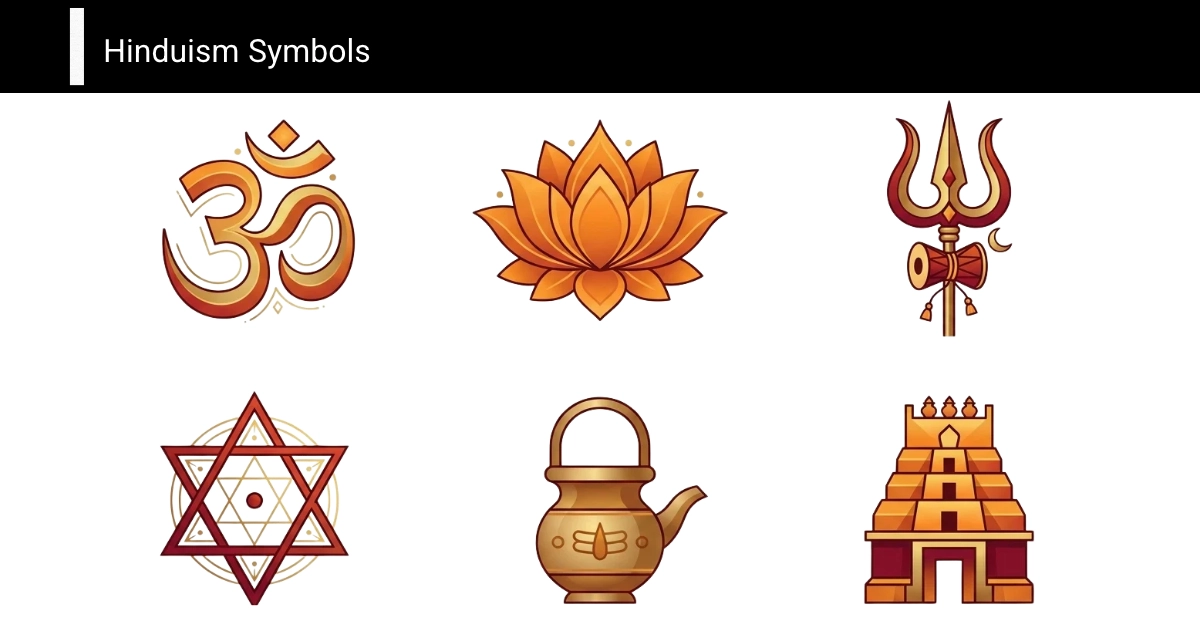
Hinduism has a rich tradition of sacred symbols that express spiritual ideas, religious beliefs, devotion, and cultural identity. From the familiar Om (Aum) symbol to the lotus flower and Lord Shiva’s Trishula, each symbol carries meanings shaped by Hindu scriptures, temple traditions, and everyday worship.
Some Hindu symbols represent divine qualities such as wisdom, purity, and protection. Others serve a direct role in religious ceremonies. A conch shell may announce a sacred ritual, a diya brings light to a prayer space, and a tilaka can express devotion to a particular deity.
However, Hindu symbolism isn’t one fixed system with a single interpretation for every sign. Meanings can vary across regions, religious traditions, and individual practices. Understanding that diversity makes these symbols much more meaningful.
In this guide, you’ll discover 15 important Hindu symbols and their meanings, learn which Hindu deities they’re associated with, and explore how people use them in worship, meditation, festivals, and daily life.
What Are Hindu Symbols?
Hindu symbols are sacred signs, objects, sounds, geometric patterns, and images that communicate religious or philosophical ideas. They help people express beliefs that can be difficult to explain through words alone.
Some symbols, such as Om, represent broad spiritual concepts. Others have a close connection with a particular deity. The Trishula, for example, is associated with Lord Shiva, while the Shankha, or conch shell, is an important attribute of Lord Vishnu.
Hindu traditions also use everyday objects in sacred settings. A pot filled with water, a flower offered at a shrine, or a small oil lamp can carry religious significance beyond its physical purpose.
These symbols appear in several places:
- Hindu temples: Sculptures, carvings, deity attributes, and sacred geometric designs.
- Religious ceremonies: Conch shells, lamps, ritual pots, and forehead marks.
- Homes: Prayer rooms, entrance decorations, sacred images, and auspicious signs.
- Festivals: Decorative patterns, lamps, and symbols associated with celebrations.
- Spiritual practices: Mantras, meditation, prayer beads, and devotional imagery.
One important distinction is that Hinduism doesn’t have a single official list of symbols that every community must follow. Their significance depends on the religious tradition and the context in which people use them.
Hindu Symbols and Their Meanings at a Glance
If you’re looking for a quick explanation, this table summarizes the most recognizable Hindu religious symbols and their traditional associations.
| Hindu symbol | Meaning or association | Related deity or tradition |
| Om (Aum) | Sacred sound and ultimate reality | Upanishadic traditions |
| Lotus flower | Purity, beauty, and spiritual unfolding | Lakshmi, Saraswati, Vishnu |
| Trishula | Divine power and transformation | Shiva |
| Sri Yantra | Sacred geometry and contemplative worship | Sri Vidya, Shakti |
| Swastika | Auspiciousness and well-being | Hindu religious traditions |
| Tilaka | Devotion and religious identity | Various Hindu traditions |
| Bindi | Cultural identity and, in some contexts, spiritual significance | Regional and devotional traditions |
| Shankha | Sacred sound and divine association | Vishnu |
| Nandi | Devotion and service | Shiva |
| Kalasha | Auspiciousness, welcome, and abundance | Hindu ritual traditions |
| Garuda | Divine service and protection | Vishnu |
| Rudraksha beads | Devotion and mantra practice | Shiva traditions |
| Damru | Rhythm and cosmic creation | Shiva |
| Diya | Light, knowledge, and worship | Hindu devotional practice |
| Radha-Krishna imagery | Divine love and devotion | Vaishnava and Bhakti traditions |
These meanings offer a useful starting point rather than a universal dictionary. For example, the lotus appears with several Hindu deities, while the Sri Yantra has a more specific role in Shakti-centered worship. The educational resource RE:ONLINE’s guide to Hindu symbols explores several of these distinctions.
The Most Important Hindu Symbols and Their Meanings
Om (Aum): The Sacred Symbol of Hinduism
Sanskrit: ॐ | Also written as Aum
Om is one of the best-known Hindu symbols because it connects sacred sound with profound questions about existence and consciousness. In Hindu practice, people chant Om during prayer, meditation, and the recitation of certain mantras.
The syllable has a particularly important place in the Upanishads, philosophical texts that explore the nature of the self and ultimate reality. The Mandukya Upanishad focuses on Om and relates it to the full range of conscious experience.
A traditional interpretation examines its three sounds: A, U, and M. These correspond to waking, dreaming, and deep sleep. The silence associated with the syllable points toward turiya, a fourth state understood in this teaching as transcending the other three.
| Element | Traditional interpretation |
| A | Waking consciousness |
| U | Dreaming consciousness |
| M | Deep sleep |
| Silence beyond the sounds | Turiya, the transcendent fourth state |
This interpretation comes from a philosophical tradition; it isn’t a scientific description of brain activity. Likewise, popular explanations assigning a fixed meaning to every curve in the written Om character aren’t all identical across teachers.
Om also appears at the beginning or end of many prayers and mantras. You may see it on temple entrances, prayer books, home altars, and devotional objects.
Why it matters: Om brings sound, contemplation, and religious philosophy together in one sacred syllable. Its significance extends well beyond its familiar written shape.
For further reading, see this overview of Om meditation and its scriptural background.
Lotus Flower: A Symbol of Purity and Spiritual Growth
The lotus flower is an important image in Hindu religious art. Its ability to grow from muddy water and open above the surface makes it a fitting symbol for purity, spiritual development, and beauty.
Hindu deities often appear standing or seated on lotus flowers. Lakshmi, the goddess associated with prosperity and auspiciousness, is commonly depicted with lotuses. Saraswati and Vishnu also appear with lotus imagery in various artistic traditions.
The flower’s symbolism isn’t limited to physical beauty. It can suggest the possibility of developing wisdom and spiritual understanding while living in an imperfect world.
Think of a lotus rising through muddy water. Its surroundings don’t prevent it from opening into a flower. In a similar way, the image can represent the pursuit of spiritual growth amid life’s difficulties.
The lotus also appears in temple carvings, paintings, decorative designs, and ritual offerings.
Common associations include:
- Purity: Remaining spiritually focused amid worldly distractions.
- Spiritual awakening: Opening toward greater understanding.
- Beauty and grace: Expressing divine qualities through nature.
- Detachment: Acting in the world without becoming entirely consumed by it.
- Prosperity: Its close association with Lakshmi in Hindu iconography.
The exact interpretation depends on the deity and context. A lotus associated with Lakshmi, for instance, may emphasize prosperity and auspiciousness, while another image may highlight purity or spiritual development.
Trishula: Lord Shiva’s Sacred Trident
The Trishula, commonly called Shiva’s trident, is a three-pronged implement strongly associated with Lord Shiva. Artists often show Shiva carrying it as an expression of his divine power.
In Hindu traditions, Shiva is associated with destruction and transformation. Here, destruction doesn’t simply mean an ending. It can also suggest the removal of what prevents renewal or the continuation of cosmic processes.
The Trishula therefore represents much more than a distinctive attribute in a religious image. It connects Shiva with divine authority and the changing nature of existence.
Some interpretations assign meanings to the trident’s three prongs, such as creation, preservation, and destruction. Others connect them with different groups of three or with aspects of human experience. These interpretations vary, so no single explanation should be presented as the only accepted meaning.
You can encounter the Trishula in:
- Shiva temple sculptures and shrines.
- Images of Shiva in his various forms.
- Religious flags and devotional artwork.
- Ritual settings connected with Shiva worship.
What does the Trishula symbolize? Its clearest association is with Lord Shiva and his divine power. Additional meanings involving transformation, cosmic balance, and groups of three depend on the particular tradition.
Sri Yantra: Sacred Geometry and Divine Energy
The Sri Yantra, also called the Shri Chakra, is a sacred geometric diagram associated with Sri Vidya and traditions devoted to the Divine Mother.
Its design features nine interlocking triangles arranged around a central point called the bindu. The diagram also includes lotus forms and an outer boundary in many traditional representations.
The intersecting triangles are often interpreted through the relationship between Shiva and Shakti, representing complementary divine principles. The central point provides a focus for contemplating the relationship between unity and the complexity of existence.
Unlike a general decorative pattern, the Sri Yantra has a defined place in particular forms of Hindu ritual and contemplative practice. Its construction and use can follow specific traditional rules.
| Feature | Significance |
| Nine interlocking triangles | A central feature of the Sri Yantra’s sacred geometry |
| Bindu | The central point of the diagram |
| Lotus forms | Part of the diagram’s layered structure |
| Outer boundary | Frames the geometric design |
| Meditative focus | A use within relevant devotional traditions |
The Sri Yantra is especially important in Sri Vidya worship, where it connects geometric form, mantra, ritual, and devotion to the goddess.
You’ll sometimes see claims that its geometry guarantees wealth or produces measurable supernatural effects. Those claims should be distinguished from its documented religious significance. Its importance within a tradition doesn’t establish that every claimed effect has been scientifically demonstrated.
Why it matters: The Sri Yantra shows how geometry can function as a sacred language within Hindu worship rather than as decoration alone.
For additional context, RE:ONLINE’s explanation of Hindu symbolism discusses yantras and their use in ritual and meditation.
Swastika: An Ancient Hindu Symbol of Auspiciousness
The Swastika is an ancient symbol associated with good fortune, well-being, and auspicious beginnings in Hindu religious traditions. The Sanskrit word svastika is connected with the idea of well-being.
In India, people may draw this symbol on doorways, ritual objects, business account books, and other items associated with important occasions. Its appearance during weddings, festivals, and housewarming ceremonies reflects its traditional auspicious meaning.
Some interpretations connect its four arms with the four directions or other groups of four. However, these explanations aren’t universal, and the symbol’s meaning depends on its religious and cultural setting.
The swastika also has a difficult modern history that deserves clear explanation. Adolf Hitler’s Nazi Party adopted a version of the symbol in 1920, turning it into an emblem of racist ideology, persecution, and genocide. The United States Holocaust Memorial Museum’s history of the swastika explains both its much older history and its appropriation by Nazi Germany.
These histories must not be confused. The swastika remains sacred in Hinduism, Buddhism, and Jainism, while the Nazi version is associated with hatred and extremist ideology in many modern contexts.
Key points about the Hindu swastika:
- Traditional meaning: Auspiciousness, good fortune, and well-being.
- Common settings: Homes, temples, weddings, festivals, and religious ceremonies.
- Cultural context: Its significance predates its adoption by the Nazi Party by thousands of years.
- Important distinction: Interpret the symbol within its actual historical and religious context rather than assuming every use has the same meaning.
The swastika is a strong example of why understanding a symbol’s context matters as much as recognizing its shape.
Tilaka: A Forehead Mark of Devotion
The Tilaka, also spelled tilak, is a mark applied to the forehead during religious observances and other occasions. Its appearance can communicate devotion, religious affiliation, or participation in a ceremony.
People use different materials to create tilaka marks, including sandalwood paste, sacred ash, and kumkum. The style often reflects the deity or religious tradition with which the wearer identifies.
For example, Shaiva traditions commonly use horizontal lines of sacred ash associated with Shiva. Many Vaishnava traditions use vertical markings connected with Vishnu and his devotional traditions. The exact designs differ among communities.
Tilaka can also be applied by a priest or family member during a blessing or religious gathering. In those settings, it may mark a person’s participation in worship or express a wish for auspiciousness.
Common materials include:
- Sandalwood paste: Used in various devotional and ritual settings.
- Sacred ash (vibhuti): Strongly associated with Shiva traditions.
- Kumkum: A colored powder commonly used in Hindu worship.
- Turmeric: Used in a range of regional and ceremonial practices.
The tilaka is sometimes associated with the third eye, a concept linked with spiritual vision or insight in certain Hindu traditions. However, not every tilaka has that specific meaning.
The most useful way to understand a tilaka is to look at its form, the tradition of the person wearing it, and the occasion on which it appears.
Bindi: Cultural Identity and Spiritual Significance
The Bindi is a mark traditionally worn on the forehead, often between the eyebrows. It is recognizable across many South Asian communities, including Hindu communities, although its meaning and use vary considerably.
Traditional bindis may be made with kumkum or other materials. Today, decorative bindis also come in many colors, shapes, and designs. Some people wear them as part of cultural dress, while others connect them with religious or spiritual practices.
The forehead’s central area is sometimes associated with the third eye or inner awareness. This connection appears in particular spiritual interpretations, but it doesn’t mean that every bindi wearer intends to express a specific religious belief.
The bindi can also carry social and cultural meanings. Its use has changed over time, and modern wearers may choose it for tradition, personal expression, or appearance.
What Is the Difference Between Tilaka and Bindi?
Although the two marks can look similar, they aren’t interchangeable in every context.
| Feature | Tilaka | Bindi |
| Common purpose | Religious devotion, identity, or ritual blessing | Cultural expression and, in some settings, spiritual significance |
| Appearance | Lines, shapes, or marks made with different materials | Often a dot, though modern designs vary |
| Religious association | Frequently connected with a deity or tradition | Varies by person and cultural context |
| Materials | Sandalwood paste, sacred ash, kumkum, and others | Traditional powders or modern decorative materials |
| Typical use | Worship, ceremonies, and devotional occasions | Daily wear, cultural occasions, and religious settings |
The distinction is helpful, but it isn’t absolute. Both marks have diverse histories, and people use them in different ways.
Shankha: The Sacred Conch Shell
The Shankha, or conch shell, is an important symbol in Hindu worship and is closely associated with Lord Vishnu.
In traditional images, Vishnu often carries a conch alongside other divine attributes. One well-known example is Panchajanya, the conch associated with him in Hindu tradition.
The shell also has a practical role in religious ceremonies. Its sound may announce the beginning of worship or mark an important moment in a ritual. The sound creates a clear transition from ordinary activity to a sacred occasion.
The Shankha’s associations include:
- Auspiciousness: Its presence can mark a sacred beginning.
- Devotion: It appears in worship connected with Vishnu and other Hindu practices.
- Sacred sound: Blowing the conch announces or accompanies religious observances.
- Righteousness: Some interpretations connect its sound with the call to follow a righteous path.
Conch shells appear in temple rituals, household worship, and religious art. Their significance can vary according to the ceremony and the tradition using them.
The Shankha illustrates how a Hindu symbol can combine a physical object, a recognizable sound, and a religious meaning.
Nandi: The Sacred Bull of Lord Shiva
Nandi is the sacred bull associated with Lord Shiva. He serves as Shiva’s vahana, or mount, and is also understood as a devoted attendant.
Nandi has a prominent place in many Shiva temples. A sculpture of the bull often sits facing the shrine where Shiva is worshiped. This arrangement makes Nandi part of the temple’s visual and devotional structure.
His image conveys devotion, loyalty, and attentive service. Nandi is not simply an animal included in religious artwork; his position connects him directly with Shiva worship.
Nandi is commonly associated with:
- Devotion: His relationship with Shiva represents dedicated service.
- Patience: His still, attentive posture suggests calmness and steadiness.
- Strength: The bull’s physical power contributes to his symbolism.
- Temple worship: His position facing Shiva’s shrine is an important feature of many temples.
Visitors to some Shiva temples pause near Nandi before approaching the main shrine. The exact customs vary by temple and local tradition.
Nandi’s significance also demonstrates how Hindu religious symbols can include animals and divine attendants rather than only abstract signs or geometric patterns.
Kalasha: A Sacred Symbol of Abundance
The Kalasha is a ritual pot used in many Hindu ceremonies. A traditional arrangement may include a vessel filled with water, mango leaves, and a coconut placed at the opening.
Its use and exact construction vary across regions and rituals. The pot can represent auspiciousness, abundance, welcome, or the presence of sacred blessings.
A kalasha may appear during weddings, housewarming ceremonies, festival worship, and other important religious occasions. In some rituals, it serves as a focal point for invoking or honoring a deity.
| Element | Common association |
| Pot or vessel | A container for something precious or sacred |
| Water | Life, purity, and ritual significance |
| Mango leaves | Auspiciousness in many regional traditions |
| Coconut | An offering and an important ceremonial element |
These associations should be understood within their ritual context rather than treated as fixed meanings for every kalasha.
The kalasha also appears in religious art and temple settings. Its presence can signal that a space or occasion has been prepared for worship.
Why it matters: The kalasha shows how an ordinary household vessel can become a meaningful sacred object through its arrangement and use in religious practice.
Garuda: The Divine Vehicle of Vishnu
Garuda is a powerful bird-like divine being in Hindu mythology. He is closely associated with Lord Vishnu and serves as Vishnu’s vahana.
Garuda appears in religious sculptures, temple imagery, and traditional stories. Artists often depict him with human and bird-like features, distinguishing him from an ordinary eagle or other bird.
His symbolism is connected with courage, strength, protection, and devoted service. His relationship with Vishnu emphasizes his role in supporting and accompanying the deity.
Garuda is associated with several themes:
- Divine service: His role as Vishnu’s vehicle expresses his close relationship with the deity.
- Courage: Traditional depictions emphasize his formidable character.
- Protection: His presence can represent divine guardianship.
- Freedom: His bird-like form lends itself to associations with flight and power.
Garuda also appears in Hindu stories involving the nagas, a class of serpent beings. These narratives contribute to his distinctive place in Hindu mythology.
His image is especially relevant in Vaishnava traditions, which focus devotion on Vishnu and his forms. As with other divine figures, details of his portrayal vary across texts, artistic styles, and regional traditions.
Rudraksha Beads: Devotion and Spiritual Practice
Rudraksha beads come from the seeds of trees in the Elaeocarpus genus, especially Elaeocarpus ganitrus. They hold an important place in devotional practices associated with Lord Shiva.
People often string the beads into a mala, a strand used to count repetitions of a mantra. This makes rudraksha a practical aid to prayer as well as a religiously meaningful object.
A practitioner may use a mala while repeating a Shiva mantra or another prayer appropriate to their tradition. Counting the repetitions helps maintain a steady practice without requiring constant attention to numbers.
Rudraksha beads are associated with:
- Devotion to Shiva: Their religious significance is especially strong in Shaiva traditions.
- Mantra recitation: A mala can help count repetitions.
- Meditation: Handling the beads can provide a consistent focus during practice.
- Religious identity: Some practitioners wear rudraksha as an expression of their spiritual commitments.
Different traditions attach significance to the number of beads, their arrangement, and their natural features. Those interpretations shouldn’t be reduced to one universal set of rules.
It’s also important to separate religious beliefs from scientific claims. Rudraksha has a well-established place in Hindu devotional practice, but claims that wearing it guarantees healing, wealth, or supernatural protection shouldn’t be presented as proven facts.
Damru: Lord Shiva’s Sacred Drum
The Damru is a small, hourglass-shaped drum closely associated with Lord Shiva. It often appears in depictions of Shiva as Nataraja, the Lord of Dance, where it represents rhythm and the creative aspect of the cosmic dance.
The drum produces sound when a person shakes it, causing small attached beaters or cords to strike its surfaces. In religious imagery, this sound is often connected with creation and the emergence of order from an unmanifest state.
Shiva’s dance brings together several aspects of existence, including creation, preservation, transformation, and liberation. The damru contributes to this imagery by representing rhythm and the dynamic movement of the cosmos.
Its common symbolic associations include:
- Creation: The emergence of sound and the beginning of manifestation in traditional interpretations.
- Rhythm: The recurring patterns and cycles associated with existence.
- Transformation: Change as a continuing feature of the universe.
- Divine power: Its connection with Shiva’s cosmic role.
The damru frequently appears alongside Shiva’s Trishula in devotional art. Although these objects are sometimes displayed together, they have distinct meanings: the Trishula is a trident associated with divine power, while the damru is a drum connected with sound and rhythm.
Diya: The Sacred Lamp of Light and Knowledge
The Diya is a small lamp used in Hindu worship. Traditional diyas often consist of a clay vessel filled with oil or ghee and a cotton wick that produces a steady flame.
Lighting a diya is a familiar part of household prayer, temple worship, aarti, and many Hindu festivals. During Diwali, lamps illuminate homes and public spaces, creating a strong association between light, celebration, and auspiciousness.
The diya’s symbolism reaches beyond its practical purpose. Light can represent knowledge, clarity, hope, and the movement away from ignorance.
Common associations include:
- Knowledge: Light serves as a metaphor for understanding.
- Hope: A flame can represent optimism and renewal.
- Worship: Lighting a lamp marks an act of devotion.
- Auspiciousness: Diyas are used during ceremonies and important celebrations.
- Spiritual clarity: The flame can serve as a reminder to cultivate awareness.
In many Hindu homes, people light a lamp at a household shrine as part of their daily prayers. During aarti, a lit lamp may be moved before a deity as an offering.
The exact procedure depends on the tradition and occasion. Still, the diya remains one of the most recognizable sacred objects in Hinduism because it combines a simple physical action with a widely understood religious image.
Radha-Krishna: Symbols of Divine Love and Devotion
Images of Radha-Krishna occupy an important place in Hindu devotional traditions, particularly those centered on Krishna. Their relationship is commonly understood as an expression of divine love, devotion, and the soul’s longing for a relationship with the divine.
Artists often portray Radha and Krishna together in paintings, sculptures, devotional calendars, and temple decorations. Their images may include recognizable attributes such as Krishna’s flute, a peacock feather, and lotus flowers.
Each element contributes to the wider devotional scene. Krishna’s flute, for instance, is closely connected with his identity and the stories of his life. The peacock feather is another familiar feature of his iconography.
Radha-Krishna imagery is associated with several themes:
- Divine love: Love understood as a profound spiritual relationship.
- Devotion: The importance of loving dedication to the divine.
- Longing and union: Themes explored in devotional poetry and religious storytelling.
- Grace and beauty: Qualities often expressed through their artistic portrayals.
- Bhakti: The path of loving devotion emphasized in many Hindu traditions.
The meanings of Radha and Krishna’s relationship vary across theological schools and devotional communities. Some traditions interpret their love through the relationship between the individual soul and the divine, while others emphasize different aspects of divine play and devotion.
Radha-Krishna imagery isn’t one standardized symbol in the same way as Om or the Swastika. Instead, it is a devotional representation whose meaning emerges through religious stories, poetry, music, and worship.
Hindu Symbols Associated With Different Meanings
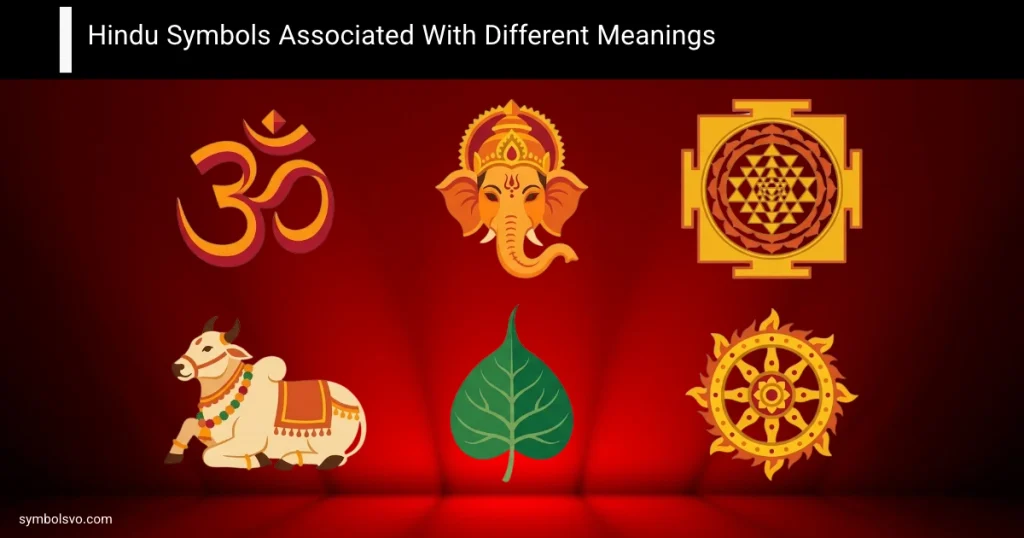
People often search for Hindu symbols for peace, love, protection, prosperity, and wisdom. These categories can help you understand how several symbols relate to similar ideas.
However, Hindu traditions don’t always assign one exclusive symbol to each quality. The same symbol may express several ideas depending on its context.
Hindu Symbols for Peace
Om is commonly used in chanting and meditation, making it an important symbol in contemplative practice. The lotus can represent spiritual growth and detachment, while the diya represents light and knowledge.
These symbols don’t guarantee peace or a particular emotional outcome. Their significance comes from their religious meanings and the practices in which people use them.
Hindu Symbols for Love and Devotion
Radha-Krishna imagery is strongly associated with divine love and Bhakti, or loving devotion. Rudraksha beads can also express devotion through their connection with Shiva and mantra recitation.
The lotus sometimes appears in images of divine beauty and grace. Its association with love depends on the particular deity, story, or devotional context.
Hindu Symbols for Protection and Strength
The Trishula represents Shiva’s divine power, while Garuda is associated with Vishnu and divine service. Some sacred marks and objects also have protective significance within particular religious traditions.
It’s important to distinguish these traditional beliefs from claims that possessing a symbol guarantees physical safety or prevents misfortune.
Hindu Symbols for Prosperity and Good Fortune
The Swastika and Kalasha are commonly associated with auspiciousness and well-being. Lotus imagery is also connected with Lakshmi, a goddess associated with prosperity.
People may use these symbols during weddings, housewarming ceremonies, business openings, and festivals. Their use expresses hopes for a fortunate beginning rather than a guaranteed material result.
Hindu Symbols for Wisdom and Spiritual Growth
Om provides a focus for contemplation on consciousness and ultimate reality. The Sri Yantra has a role in particular traditions of goddess worship and meditation.
The lotus also represents spiritual unfolding in many Hindu artistic and devotional contexts. Tilaka, meanwhile, may express religious identity or devotion rather than having one universal meaning related to wisdom.
How Hindu Symbols Are Used in Daily Life and Religious Ceremonies
Hindu symbols aren’t confined to scripture books or temple walls. They remain part of living religious traditions, appearing in household worship, festivals, and important life events.
Hindu Symbols in Puja and Worship
Puja is a form of worship that may involve offerings, prayers, flowers, lamps, incense, and other ritual objects.
The symbols used depend on the deity being worshiped and the specific tradition. A household shrine dedicated to Shiva may include his image or a Trishula, while Vishnu worship may feature a Shankha or other attributes associated with him.
Common examples include:
- Applying tilaka or kumkum during worship.
- Lighting a diya before a deity.
- Using a conch shell during certain rituals.
- Arranging a Kalasha for an auspicious ceremony.
- Offering lotus flowers or other flowers where appropriate.
- Using rudraksha beads to count mantra repetitions.
These objects serve practical ritual purposes while expressing religious ideas. Their meaning becomes clearer when you understand how and why people use them.
Hindu Symbols in Temples
Temples combine architecture, sculpture, and ritual practice to create a sacred environment. Hindu symbols often help visitors recognize which deity a shrine honors.
For example, Nandi commonly appears facing a Shiva shrine. Vishnu may be depicted holding a conch shell, while Shiva may appear with a Trishula or damru.
Lotus motifs also appear in temple architecture and sculpture. Their presence can carry symbolic significance while contributing to the visual design.
The use of symbols varies by temple, region, and religious tradition. A single feature shouldn’t be assumed to appear in every Hindu temple.
Hindu Symbols in Weddings and Festivals
Important ceremonies often use symbols that express hopes for an auspicious beginning.
A Swastika may appear in a traditional decorative design, while a Kalasha may form part of a ritual arrangement. Forehead marks can indicate participation in worship, and lamps are common during festivals such as Diwali.
The symbolism is closely connected with the occasion. A lamp used in a festival may emphasize light and celebration, while a Kalasha used in a wedding may express auspiciousness and welcome.
Hindu Symbols in Meditation and Personal Devotion
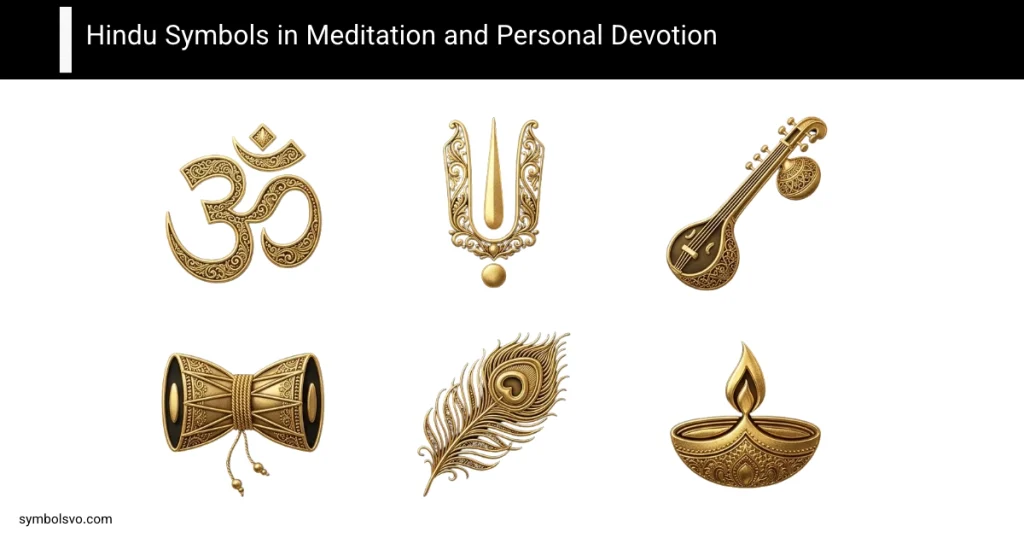
Some symbols support a more personal form of religious practice.
A practitioner may chant Om, use a rudraksha mala, or contemplate a Sri Yantra within a tradition that prescribes its use. Others may keep an image of a deity in a home shrine as a reminder of their devotional commitments.
These practices differ in their methods and purposes. A symbol can be a focus for prayer, a ritual object, a visual representation of a religious idea, or all three.
Hindu Symbols vs. Hindu Gods: What’s the Difference?
It’s easy to confuse a Hindu symbol with a deity or an object associated with a deity. The categories overlap, but they aren’t identical.
| Category | What it means | Example |
| Sacred syllable | A sound used in religious recitation and contemplation | Om |
| Deity attribute | An object closely associated with a god or goddess | Shiva’s Trishula |
| Divine attendant or mount | A being connected with a deity | Nandi or Garuda |
| Sacred geometric diagram | A structured design used in particular devotional traditions | Sri Yantra |
| Ritual object | An object used during worship or ceremonies | Kalasha or diya |
| Devotional representation | An image expressing a religious relationship or theme | Radha-Krishna imagery |
A deity is a divine figure worshiped or honored within a religious tradition. A symbol or attribute can represent that deity, communicate a religious idea, or help practitioners focus their worship.
For example, the Shankha is a conch shell associated with Vishnu, but it isn’t Vishnu himself. Likewise, the Trishula is an attribute of Shiva, while Nandi is a divine attendant and mount associated with him.
Understanding these distinctions makes it easier to interpret Hindu art, temple imagery, and religious practices accurately.
Frequently Asked Questions About Hindu Symbols
What are the major symbols of Hinduism?
Some widely recognized symbols of Hinduism include Om, the lotus flower, the Swastika, the Trishula, the Shankha, the tilaka, and the Sri Yantra. Other important examples include Nandi, Garuda, the Kalasha, rudraksha beads, and the diya. Their significance varies across Hindu traditions.
What are the 11 symbols of Hinduism?
There is no universally established set of exactly 11 Hindu symbols. Different educational guides select different examples. A list of 11 might include Om, the lotus, Trishula, Sri Yantra, Swastika, tilaka, bindi, Shankha, Nandi, Kalasha, and Garuda.
What does Om symbolize in Hinduism?
Om is a sacred syllable associated with ultimate reality and consciousness. The Mandukya Upanishad connects its sounds with waking, dreaming, and deep sleep, while the silence beyond them represents turiya, a transcendent fourth state.
What is the most powerful Hindu symbol?
Hinduism doesn’t establish one universally agreed ranking of symbolic power. Om has a particularly important place in many traditions, while the Trishula, Sri Yantra, and other symbols have significant roles within their respective devotional settings.
What does the lotus flower symbolize in Hinduism?
The lotus commonly represents purity, beauty, and spiritual unfolding. Its association with Lakshmi connects it with prosperity and auspiciousness, while its appearance in other religious images may emphasize spiritual growth or detachment.
What does the Trishula represent?
The Trishula is the trident associated with Lord Shiva. It represents his divine power, and some traditions interpret its three prongs through concepts such as creation, preservation, and destruction. Those additional interpretations vary.
What is the meaning of the Sri Yantra?
The Sri Yantra is a sacred geometric diagram associated with Sri Vidya and Shakti worship. Its nine interlocking triangles surround a central point called the bindu. Practitioners use it in specific ritual and contemplative traditions.
What does the Swastika symbolize in Hinduism?
The Swastika traditionally represents auspiciousness and well-being in Hinduism. It appears in religious ceremonies, festivals, and household settings. Its Hindu history is distinct from its later appropriation by Nazi Germany as an emblem of racist ideology.
What is the difference between Tilaka and Bindi?
A tilaka commonly expresses religious devotion, affiliation, or participation in a ritual. A bindi has cultural and, in some contexts, spiritual significance. Their appearance and uses can overlap, so context matters.
What symbolizes love in Hinduism?
Radha-Krishna imagery is strongly associated with divine love and devotion in many Bhakti traditions. The lotus may also express beauty and grace in religious art. The meaning depends on the particular story and devotional context.
What Hindu symbol brings good luck?
The Swastika and Kalasha are both associated with auspiciousness and good fortune in Hindu traditions. People may use them during weddings, housewarming ceremonies, and other important occasions. Their presence expresses traditional hopes for well-being rather than guaranteeing a particular outcome.
Which Hindu symbols represent peace and protection?
Om is widely used in contemplative practice, while the Trishula and Garuda have associations with divine power and protection. These meanings are rooted in religious traditions and shouldn’t be treated as guarantees of safety or specific results.
Why are Hindu symbols important?
Hindu symbols communicate religious ideas, connect devotees with deities, and support practices such as prayer, meditation, and ritual worship. They also appear in architecture, art, festivals, and family traditions, helping preserve cultural and religious meaning across generations.
Conclusion: Understanding the Meaning of Hindu Symbols
Hindu symbols express a rich range of religious, philosophical, and cultural ideas. Om connects sacred sound with contemplation, the lotus represents spiritual unfolding, and the Trishula expresses Shiva’s divine power. Other symbols, including the Shankha, Kalasha, and diya, have important roles in worship and ceremonies.
Their meanings become clearer when you look beyond their appearance and explore their connections with deities, scriptures, and living traditions. Some symbols carry broad philosophical meanings, while others belong to particular forms of worship.
It’s also important to remember that Hinduism includes many communities and schools of thought. Not every symbol has one fixed interpretation, and not every Hindu uses the same symbols in daily life.
Whether you’re studying Hindu symbols and their meanings for cultural understanding, religious education, or personal interest, approaching them with curiosity and respect helps reveal the depth behind their familiar forms.

Mason Ellington is a creative and dedicated Content Writer and Symbols Expert with a passion for words, communication, and symbolic meanings. He specializes in crafting engaging, informative, and well-structured content while exploring the deeper meanings and interpretations behind symbols. With a creative mindset and attention to detail, Mason transforms ideas into meaningful content that informs, inspires, and connects with readers. His expertise combines powerful storytelling, clear communication, and a deep understanding of symbolism.
 Nathan Holloway
 Daniel Brooks